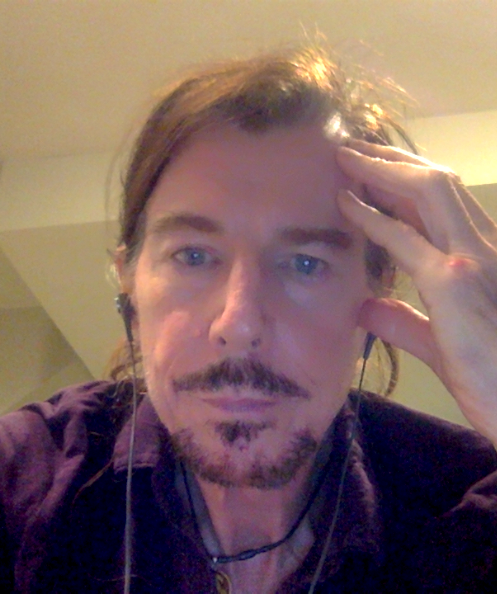
| Blogless Steve Raker is a frequent contributor to Virtual Occoquan. He’s a wizard with a camera, and he’s given me permission to post a couple of his photos. The accompanying text is his.
WHAT HAPPENS WHEN WE DIE?
We are here to help each other enjoy this journey. Can’t you just feel it when you touch another, ..this must be the main part. Life would be valueless if we didn’t have access to the lives of others. And each of us is necessary for the rest of the people of the world to enjoy their lives. We need them, they need us. Each of us is necessary. And then it ends.
When we die we go back to the same state of being as before we were born. Our eternity is our legacy. The subtle shift towards good or evil that we have made in the world is like a reverse wave, gaining size and energy as it moves from the shores of our tiny but important lives. Tiny but important lives.
TRIVIALIZING PRAYER Last night after he and his team won the game, Andy Pettite of the Yankees said he had members of his church and people all over the country praying for him. The interviewer thought that sounded reasonable; at least he didn’t slap his forehead with astonishment. These folks apparently were able to shorten up their prayers for Sally who is dying in unspeakable pain and Billy who has never seen his father sober. They were able to squeeze one in for Andy’s curve ball. Wildly successful Andy thought that was a good use of their time and prayers. Next they’re gonna work one up so Andy gets a perfect grilled cheese sandwich. …Cupla weeks ago this is what Coach Tony Dungy had to say about beating the Tampa Bay Bucs in a football game that got the Lord’s attention: “These guys just never gave up. That’s what I like about us,” Dungy said. “We’ve got great chemistry and I just had a feeling the Lord was going to do something, and he certainly did.” I guess the Lord don’t like the Bucs any more than I do. |
October 23, 2003
STEVE RAKER – WORDS AND PICTURES
October 22, 2003
WHISTLE-BLOWERS: HEROES OR FOOLS?
There’s a story hidden behind each revelation of corporate corruption and greed, each unearthing of a political scandal, each discrediting of a sports star or professional impersonator. It’s the story of a whistle-blower, the individuals who, for a variety of reasons, altruistic or vindicting or simply mischievous, bring to the attention of media and regulatory authorities the wrong-doing of people in power. In many cases they bite the hand that feeds them.
To understand the motivation for whistle-blowers, we first need to understand the motivation of the people who commit the crimes in the first place. In some cases, like Enron, the motive is greed, coupled with a feeling of invincibility. In other cases, like Watergate, the motive is psychopathy. In still others, it’s the thirst for power, fame or wealth that is unattainable by legitimate means. These are not simple crimes, and the perpetrators are careful not to, and convinced they won’t, be caught. Every such crime has victims — those that are defrauded or whose investments are rendered worthless, those whose lives are ruined by unlawful persecution or by charlatans, those whose rightful claim to success or stardom is stolen by cheaters. What’s interesting is that the whistle-blowers are often neither the victims of the crime, nor the people whose job it is to prevent or detect such crimes. Often they are altruists who become aware of what appears to be criminal activity, and who can’t be discouraged, fooled, intimidated or bought off. Often they are low in the corporate, political or sports hierarchy, but unlike computer hackers, disinterested in being heroes or fifteen minutes of fame or notoriety. Often they are just doing what they think is the right thing, with no personal axe to grind with the perpetrators. Are they heroes or are they fools? A recent story in Salon by Eric Boehlert, The Betrayal of the Whistle-Blowers suggests the legal system is stacked against them, and that their lives are more likely to be ruined than advanced by their actions. Here are quotes from two of them: “What I have learned is, don’t do the right thing — don’t try to protect the American people when you see that they are in danger, because the law won’t protect you,” says Bogdan Dzakovic, a whistle-blower within the FAA who tried to air warnings about lax airline security years before the 9/11 attacks. He considers himself lucky: He’s still got a job with the FAA and collects a government paycheck. But he spends his time doing menial tasks. “My career is over,” he says. Looking back on his decision to blow the whistle, [Richard] Levernier, [a tester of safety and security at nuclear facilities with 33 years of federal service before he demanded the DOE stop ignoring the huge exposure of these facilities to sabotage], has nothing but regrets: “Given my experience, I would not do it again, even though I truly believe it was the right thing to do. DOE’s inappropriate removal of my security clearance has ruined my career and life.” Over the past few weeks, I’ve asked several of the business leaders I know how they think their firm would deal with a whistle-blower exposing major scandal or fraud or negligence in their companies. Their answers were ambivalent: One the one hand they would want a major crime exposed, no matter the consequences, but on the other hand they believe controls in their organizations are strong enough to prevent or detect such crimes, and would therefore be highly skeptical of, even antagonistic to, a whistle-blower who made major allegations that challenged or shattered those beliefs. So what should a smart whistle-blower do? I’ve done a bit of work in forensics during my career, and it seems to me that as long as you have no desire for personal glory or financial reward for blowing the whistle, you can be successful if you follow these four rules of thumb (and self-preservation):
If you want to learn more, the Government Accountability Project has a great site on whistle-blowing. Read their ‘How to Blow the Whistle’ page especially. The National Whistleblower Center also has excellent news and resources on the subject, including up to date reviews of current legislation and the protection it does (and doesn’t) offer. I’d suggest you also Google ‘whistle-blower’ and read some personal stories of what some individuals have been through, and their first-hand advice. Perhaps because of the potential stigma of subversiveness that whistle-blowing carries with it, and the loneliness and isolation it can bring, the Internet has a lot of ‘self-help’ type groups and sites to offer a life-line for whistle-blowers when the struggle against power seems hopeless. There’s an old expression ‘No guts, no glory’. The correct expression for whistle-blowers should be ‘Lots of guts, calculated risk, no glory’. If that appeals to you, your Tarot card is The Hanged Man, and you might just have what it takes to be a whistle-blower. Now, more than ever before, we need you. |
MOST POPULAR CANADIAN BLOGS — AND A TIP OF THE HAT TO TWO CANADIAN CONSERVATIVE BLOGGERS
Unlike most of their US counterparts, Canadian conservative weblogs are often well-researched, reasonable, bile-free, and informative to read.
Colby Cosh, one of the two leading conservative Canadian bloggers, has just re-compiled his list of the Most Popular Canadian blogs, which reads as follows (primary focus of each blog in parentheses):
Colby’s methodologyfor measuring popularity is so complex and sophisticated that it makes my head spin, but it’s thorough, and the fact that my blog, at the other end of the political spectrum, made his list suggests it’s fair (though there’s no way my blog is as popular as Caterina’s or Wood’s Lot). Colby’s blog provides an excellent analysis of Canada’s fractured conservative politics. Winds of Change, another conservative blog, is moderated by a friend of mine, Joe Katzman. Take a look at the fascinating and informative comments thread on this post from Winds of Change, and learn about conservatives’ anguish and ambivalence about West Bank settlements and the building of the wall between Israel and Palestine. Even though I generally disagree with them, I think it’s important to keep an open mind and understand others’ viewpoints, so I’m adding Colby’s and Joe’s blogs to my blogroll. Not my favourites, mind you — but still worth a read. |
October 21, 2003
ENEMY ALIENS: (ATTORNEY-)GENERAL ASHCROFT’S WAR AT HOME
John Ashcroft’s war on those he deems ‘enemies’ in the US — that is, everyone that doesn’t share his fiercely reactionary views — is brilliantly documented in a new book Enemy Aliens: Double Standards and Constitutional Freedoms in the ‘War on Terrorism’, by David Cole, professor at Georgetown University Law Center and a renowned expert on constitutional law. Cole makes it clear that the current outrageous and arbitrary treatment of at least 5,000 aliens by Ashcroft and his Patriot Act stormtroopers — including arbitrary arrest, deprivation of access to a telephone, to legal counsel, food and water, long periods of solitary confinement, arbitrary deportation, confiscation and destruction of property, and indefinite confinement at hell-holes like Guantanamo without charges and in violation of the Geneva convention — is just a dress rehearsal for similar draconian treatment for citizens who dare question the wisdom of the US Administration. This will be enabled by new legislation, the Domestic Security Enhancement Act, to be pushed through under the guise of ‘fighting terrorism’, that will further strip away the basic rights and freedoms of Americans to expose anyone who isn’t a Bush Patriot, and then deprive them of their citizenship so they can be treated as — guess what — aliens.
Cole shows Ashcroft as a man without moral scruples, engaged in an all-out pathological war on imagined and trumped-up ‘enemies’ — anyone who doesn’t support the Government without question, without condition, without reservation. He cites case after case where aliens, and now some American citizens who are either Islamic or have the misfortune to have MidEastern names, have been treated as ‘enemy combatants’, with no rights, no recourse, no appeal, by the one-man McCarthyite wrecking-crew named Ashcroft. And all hidden under a blanket of secrecy under the guise of ‘national security’. America has had psychotic extremists like this in power before — McCarthy, Nixon and others — but these were people who were bent on changing the law for their own deranged purposes, not ignoring and circumventing the law as Ashcroft is doing. What is particularly disconcerting is the lack of demands — by Democrats and the media — to have this man, who shows contempt for everything most Americans hold dear, immediately removed from office. In a review of Enemy Aliens in The New York Review of Books (from which the above cartoon by the amazing David Levine is taken), writer Anthony Lewis says: “What was not inevitable [after 9/11]ónot necessaryówas that officials should act in an arbitrary, even lawless way. Commitment to law has been the great secret of America’s rise to wealth and power, and a main reason for the world’s admiration of our system. Law binds us all, great and small: so we believed. The Bush administration’s abandonment of legal normsóthe disregard of the Geneva Convention in Guant·namo, the order for trial by military commissionsóhas cost us dearly not only in our own values but in the world’s estimate of us. At a moment when we need allies around the world to join us in resisting terrorism, we have made too many think we are not really committed to law.” This ‘ends justifies the means’ contempt for US law is new. But US government contempt for international standards of law is a hallmark of the Bush Administration — the refusal to support or honour the decisions of the International Court of Justice, the refusal to sign the Land Mine Convention, and to ratify dozens of other international agreements endorsed by nearly every other democracy in the world. It is ironic that this administration, the most obsessed with law and order since Nixon, so openly disdains the law. For Bush, Ashcroft and the whole extremist gang, it’s all about power, and law is just in the way. It’s almost as if the first half of the Attorney-General’s title is in parentheses. (thanks to Subdude for the link) You know, it is something very strange: You learn to live with things. For example, something is taken away, like let’s say, the freedom of the press or . . . yeah, let’s say that your telephones are tapped, so you say “Okay, I can live with that,” and then the next day something else, and then you say, “Okay, I will have to live with that, too,” and so forth. And then after a few months, you realize that you have lost everything. ó Isabel Allende, interview with Buzzflash |
HELLO SCRIPTING NEWS READERS
Greetings if you came here from Dave Winer’s Scripting News. I appreciate the mention of my blog on Dave’s enormously popular one, and hope that you’ll tell me what you think of How to Save the World, and that you’ll come back and visit again |
October 20, 2003
CHARLES HANDY’S RADICAL BUSINESS PHILOSOPHY
For a few months now I have been espousing a concept called “New Collaborative Enterprises“, as the basis for a radical, post-capitalist society. The idea is to create a new economy based on small self-selecting partnerships of people with unique and complementary skills, who would work for their mutual benefit as absolute peers. Now I discover that one of the very first ‘management gurus’, Charles Handy, has been calling for something like this for fifteen years.
Strategy+Business magazine has just published a comprehensive bio of Handy (requires free registration to view — well worth the effort) written by Lawrence Fisher, a technology writer for the New York Times. Handy calls for the creation of “villages of like-minded individuals, bound by a common purpose and managed by reciprocal trust.” For many years, Handy, who had spent most of his life in business management (with Shell) in the UK, and teaching it at the London Business School, delivered his thoughts on BBC’s three-minute morning show Thought for the Day. These thoughts were published in 1992 as Waiting for the Mountain to Move and Other Reflections on Life. By that time Handy had rebelled against the increasing pervasiveness of the cult of efficiency in business, and began to espouse a new humanistic vision of business in The Age of Unreason (1989) ó its title taken from a George Bernard Shaw observation that all progress depends on unreasonable people, for they are the ones who try to change the world, while reasonable people simply adapt to it. The sequel, The Age of Paradox (1994), according to Fisher, “has a more wary tone. Chapter One is titled ‘We Are Not Where We Hoped to Be,’ and subtitled ‘It Doesnít Make Sense.’ In essence, this book concedes that socioeconomic change has proceeded at an even faster and more deranging pace than the author had anticipated, creating a world full of paradox. Technology has increased wealth and consumption among a few while reducing employment and incomes for many. Opportunities for personal fulfillment are complicated by demands for ever-greater efficiency, and the new freedom to pursue more flexible lifestyles that account for our personal and professional lives only increases the inequities between the skilled or talented haves and the less fortunate have-nots. Mr. Handy returns in The Age of Paradox to the notion of the village, here called the Existential Enterprise, which he suggests should better serve a host of constituencies ó employees, neighbors, customers ó as well as shareholders.” Handy explores these concepts further in The Hungry Spirit: Beyond Capitalism — A Quest for Purpose in the Modern World (1997). Critics, says Fisher, “were not kind to the book, with some suggesting that it was disingenuous for a person of Handyís affluence to say that money is a means, not an end, and others accusing him of being anticapitalist. Handy says he felt stung and misunderstood.” In his recent works, Handy has called for employees to shake off their shackles and use their skills to their own advantage, rather than for the advantage of increasingly indifferent employers. “Figure out what you like to do and who will pay for it, and be a vendor to the elephants, rather than their employee”, he says in The Elephant and the Flea: Looking Backwards to the Future (2001). ìIt is a much more satisfying, adult-to-adult, relationship, versus being an employee, which is always child-to-never-satisfied-parent.î Handy says the existing hierarchical, paternalistic business model makes most employees feel that could not negotiate such a relationship, and hence feel dependent (like children) on corporations to employ them. He says those people underestimate their value and their worth in today’s economy, as a result of their own diminished self-worth. They need to look more closely at their own abilities, he says, and need more training in entrepreneurship. In a conversation with Fisher, Handy said “The whole notion of shareholders as owners of the company is an outdated fiction. Most shareholders never put any money into the company; they simply trade shares with other traders. They deserve a return on investment, but not a say in how the company is managed or the power to sell it to would-be acquirers. That power should reside with the founders and the staff members: the community.” I almost did cartwheels when I read this. This is precisely what I was saying in my prescription for New Collaborative Enterprises. To hear such a venerated business expert say this is wonderful news. Handy told Fisher he knows this model may be a long time coming, but he says he is just as certain that the current model is no longer sustainable. ìMy solutions are far too radical for the short term,î he says. ìThe idea that the ownership models of companies have got to be abandoned in favor of community models sounds mad. But I sincerely believe that it will come to that within 20 years.” I think that’s a perfect time horizon — one generation to render the old order obsolete by building a new and better one in its midst. I’ll be rushing out tomorrow to buy as many of Handy’s books as I can find, but I fully expect my next career, starting in 5-10 years, will be helping as many people as possible to realize Handy’s vision — and mine — to create a new economy based on small mutually-caring enterprises instead of huge mindless and uncaring corporations, on self-sufficient ‘villages’ of people making a living together producing something valuable, useful, meaningful, of high-quality and customized to the individual user’s needs, instead of rapacious, polluting enterprises trying to maximize profit and minimize what they give back. Stay tuned to the ‘business’ category of How to Save the World. I’ll be blogging more on Handy’s prescription as I read, and might even produce a ‘handbook’ on how to be a New Collaborative / Existential Enterprise pioneer. Important ideas coming together. |
October 19, 2003
MORE ON THE SPORTS DOPING SCANDAL
The inimitable Malcolm Gladwell, he of The Tipping Point, wrote an expose last year of the epidemic of illegal drug use in sport, and how athletes, coaches and laboratories are able to stay one step ahead of the testers, and reap gold medals and competitive advantage over clean athletes as a result. Gladwell’s work, and several other exposes, make it clear that the IOC and the USOC are not only incapable of policing drug use in sport, but are quietly involved in covering it up. Clearly, if amateur sport were suddenly cleaned up, there would be very few new world records for a long while, the integrity of all the existing records and recent medals would be suspect, and the Olympic movement might never recover.
Now there’s a new report that suggests that, just maybe, anti-drug forces might be able to get sport cleaned up even without Olympic authority support. The US Anti-Doping Agency (USADA), acting on an anonymous tip from an American coach, has just released an announcement (requires Acrobat reader — click on ‘USADA Statement’ from this press release page to launch the file) that they have developed a test for a steroid that is closely related chemically and in effect to banned steroids, but was previously unknown and undetected. The new steroid, called THG, was developed by a California laboratory. It has now been chemically identified, and in a first set of tests 350 American athletes tested positive for the drug. This was just from samples taken from athletes participating in June’s US Championships. If confirmed, all of these athletes would be banned from participating in IAAF events for two years, including the 2004 Athens Olympics. They would probably have to forfeit any medals they won in the World Championships in Paris that were held shortly after the June event. What’s even worse for this apparently huge ring of cheaters, THG is an inert substance whose presence stays in urine samples for years, and testers could now go back and re-test samples of past Olympic winners, and possibly strip hundreds of them of their medals and world records. And it doesn’t stop at American athletes or even amateur sport. The laboratory that developed THG, Bay Area Laboratories (BALCO), also represents such global sports luminaries as Ivan Lendl, Barry Bonds & John Elway, supplying them with performance-enhancing “nutritional products”. This is a huge scandal, and could lead to the decimation of teams for next year’s Olympics, or even a cancellation of the event. Stay tuned — this is gonna be big. Update 11pm Oct.19: The above number (350 positive tests), cited in the link above, now seems in doubt. Other ‘unnamed sources’ are saying the number of positives was only ‘up to 20′ of 450 or 550 tests. The USADA is refusing to provide any numbers whatsoever, and say that they won’t discuss numbers until the grand jury investigating the scandal has finished its work. More updates as/if additional information becomes available. |
October 18, 2003
HOW TO STOP URBAN SPRAWL IN YOUR NEIGHBOURHOOD
The David Suzuki Foundation has produced a complete toolkit on how to stop urban sprawl in your neighbourhood. The toolkit includes background information on Smart Growth policies, programs and benefits, information on who and how to lobby for changes to urban plans, how to convert proposed ‘sprawl’ developments into ‘smart’ development projects, how to protect land from development, how to use ‘compact development’ and ‘brownfield‘ programs to reduce sprawl, how to work with the media, and how to improve local public transit infrastructure. The kit is upbeat, helpful, and full of scripts, templates and checklists. It’s designed for Canadian municipalities, but Smart Growth is an international movement and the Smart Growth Online site gives information particular to the US that you can substitute as applicable. |
October 17, 2003
THE BANKRUPTING OF THE AMERICAN MIDDLE CLASS
Another great article from Salon’s Katherine Mieszkowski reviews The Two-Income Trap: Why Middle-Class Mothers and Fathers are Going Broke, a new book by Harvard Law Professor Elizabeth Warren and her daughter.
Highlights:
This is another consequence of the ‘privatize and deregulate everything’ mentality that is destroying the American middle class, and millions of families in the process. Public education, transportation, and health infrasructure has crumbled in many areas to the point where it is not only unreliable and poor quality, but even dangerous. As a result, families with incomes that would have once allowed them to live comfortably are now pushed to the limit trying to afford vastly more expensive private alternatives. And the outrageously high interest rates they have to pay to mainstream financial institutions are illegal in most first-world nations, where sensible regulation of such excess still prevails. |
October 16, 2003
ANOTHER ANIMAL CRUELTY HORROR — WHILE CANADA’S SENATE WAFFLES OVER ANIMAL WELFARE REFORM
The waffling of the Canadian Senate over Bill C10(b) — the act to reform Canada’s animal cruelty law for the first time since 1892 — must be held at least partly responsible for the horrific and despicable tragedy at Wood Lynn Farms’ six Ontario ‘facilities’, where 10,000 sick and diseased pigs were found in conditions that are nearly indescribable. This operation was until recently Canada’s largest pig breeder and exporter, and it was a customer complaint — not any action from the Ontario Federation of Agriculture, which self-regulates its members’ behaviour — that led to the discovery that has so traumatized inspectors and veterinarians treating the dead and suffering animals that some will need psychological counseling. Just the facts:
Charged are the following individuals (the company is bankrupt and hence will face no charges):
Because Bill C10(b) has been blocked by the Senate, none of these people will face jail time or major fines. In fact, under the prevailing 1892 law that defines all animals as ‘property’, these scum will be allowed to own a commercial farm operation again in as little as a year. Long continues to run a pig ‘genetics’ operation whose online newsletter is allegedly read by 70,000 pig farmers. I can’t tell you how upset and angry this makes me. This is the type of incident that turns reasonable people into animal rights extremists. As I reported earlier, a powerful lobby of factory farmers, hunters, and animal laboratory owners has worked hard for years to ensure the unelected Canadian Senate blocks the very modest Bill C10(b) despite the fact it has been passed three times by the elected House of Commons. Incidents like this are the result. They show how effective ‘self-regulation’, which the lobby says is preferable to the ‘dangerous’ regulation of C10(b), really is. This lobby, and the Senate, have blood on their hands, and should hang their heads in shame for allowing this to occur, with virtual impunity for the perpetrators of this horrendous crime.
|


There’s a story hidden behind each revelation of corporate corruption and greed, each unearthing of a political scandal, each discrediting of a sports star or professional impersonator. It’s the story of a whistle-blower, the individuals who, for a variety of reasons, altruistic or vindicting or simply mischievous, bring to the attention of media and regulatory authorities the wrong-doing of people in power. In many cases they bite the hand that feeds them.
Unlike most of their US counterparts, Canadian conservative weblogs are often well-researched, reasonable, bile-free, and informative to read.
John Ashcroft’s war on those he deems ‘enemies’ in the US — that is, everyone that doesn’t share his fiercely reactionary views — is brilliantly documented in a new book
Greetings if you came here from Dave Winer’s
For a few months now I have been espousing a concept called “
The inimitable Malcolm Gladwell, he of
The David Suzuki Foundation has produced a complete
Another
The waffling of the Canadian Senate over Bill C10(b) — the act to reform Canada’s animal cruelty law for the first time since 1892 — must be held at least partly responsible for the horrific and despicable tragedy at Wood Lynn Farms’ six Ontario ‘facilities’, where 10,000 sick and diseased pigs were found in conditions that are nearly indescribable. This operation was until recently Canada’s largest pig breeder and exporter, and it was a customer complaint — not any action from the Ontario Federation of Agriculture, which self-regulates its members’ behaviour — that led to the discovery that has so traumatized inspectors and veterinarians treating the dead and suffering animals that some will need psychological counseling. Just the