Dave Pollard's environmental philosophy, creative works, business papers and essays.
In search of a better way to live and make a living, and a better understanding of how the world really works.


November 23, 2003

SAVE A LIFE

Filed under: Our Culture / Ourselves — Dave Pollard @ 09:51
donorMaureen Dowd writes in the NYT this week about the importance of being an organ donor. You can literally save the life of one of 100,000 people waiting for vital organs in North America alone. It costs you nothing except the time to fill out an organ donor card. If you’re American, click on this link, download the card, complete it following the instructions, and talk it over with your family (they can overrule your donation if you don’t). If you’re Canadian, get the applicable provincial organ donor card here.

And if you’ve already filled out a card, take the next opportunity to make a blood donation. Another great need you can fill, for free.

THE WORDS & PICTURES OF HUGH MACLEOD

Filed under: Our Culture / Ourselves — Dave Pollard @ 09:49
scared
gv2
gv3

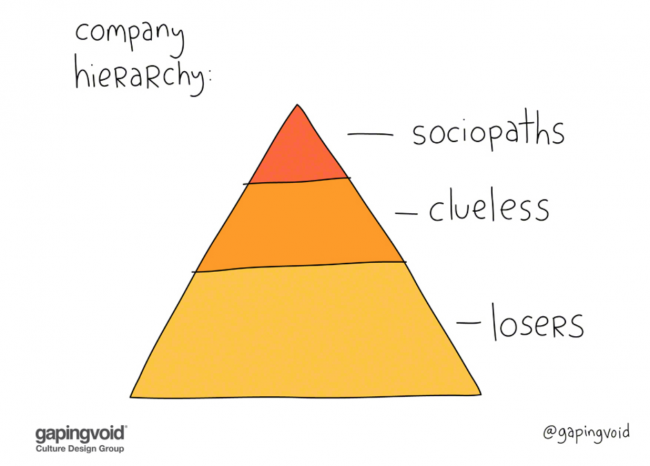
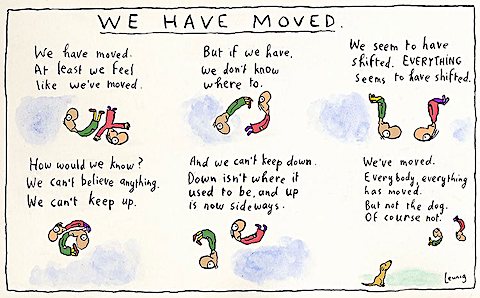
I‘ve always admired artists who can sketch something clever in a few moments over a beer. It’s rare to find such an artist who also has a way with words. The combo is called a cartoonist, and one cartoonist that I admire greatly is Hugh MacLeod of Gaping Void, who creates by doodling on the back of business cards. His work, samples of which are shown above and below, is gritty, smart, and blazingly cynical, but it always brings a smile. And we need more of those these days.

gv4
gv6
gv5

November 22, 2003

‘AND I’M LEFT TO CONCLUDE THERE’S NO HUMAN ANSWER NEAR’

Filed under: Our Culture / Ourselves — Dave Pollard @ 09:39
horse and trainAs I get older I find I get essential solace and renewal from music, especially music of the remarkable years from the late 1960s to the early 1970s, when we all thought we could save the world. One of my favourite musician-songwriters from that period is Ottawa’s Bruce Cockburn. A pilgrimmage to Le Hibou coffeehouse to see Bruce or one of the many other great folk artists and poets of the day was the Canadian equivalent of a trip to the Village to see Bob Dylan. In the early 1970s, Bruce was at the top of his form, turning out lyrics at once angry and poetic, underlined by rich, unique and challenging guitar riffs. He turned out two really exceptional albums, Joy Will Find a Way and In the Falling Dark that I think are among the best albums of their genre. If you’ve never heard his music, you can buy it here, and listen to some samples here. His poetry is exemplary in its own right, and I found his words and music immensely cathartic last week, a week of disheartening news, watching our society’s seemingly hopeless decline into endless violence, terror, retribution and rage. Here are the lyrics from three of his songs from the above two albums.

line

Gavin’s Woodpile

Working out on Gavin’s woodpile
Safe within the harmony of kin
Visions begin to crowd my eyes
Like a meteor shower in the autumn skies
And the soil beneath me seems to moan
With a sound like the wind through a hollow bone
And my mind fills with figures like Lappish runes of power

And log slams on rough-hewn log
And a voice from somewhere scolds a barking dog.

I remember a bleak-eyed prisoner
In the Stoney Mountain life-suspension home
You drink and fight and damage someone
And they throw you away for some years of boredom
One year done and five more to go –
No job waiting so no parole
And over and over they tell you that you’re nothing…

and I toss another log on Gavin’s woodpile
and wonder at the lamp-warm window’s welcome smile.

I remember crackling embers
Coloured windows shining through the rain
Like the coloured slicks on The English River
Death in the marrow and death in the liver
And some government gambler with his mouth full of steak
Saying, “If you can’t eat the fish, fish in some other lake.
To watch a people die — it is no new thing.”

And the stack of wood grows higher and higher
And a helpless rage seems to set my brain on fire.

And everywhere the free space fills
Like a punctured diving suit and i’m
Paralyzed in the face of it all
Cursed with the curse of these modern times

Distant mountains, blue and liquid,
Luminous like a thickening of sky
Flash in my mind like a stairway to life –
A train whistle cuts through the scene like a knife
Three hawks wheel in a dazzling sky –
A slow motion jet makes them look like a lie
And I’m left to conclude there’s no human answer near…

line

In the Falling Dark

And the lights lie tumbled out like gems
The moon is nothing but a toothless grin
Floating out on the evening wind
The smell of sweat and lube oil pervades the night
And the rush of life in flight at the speed of light

A million footsteps whispering
A guitar sounds — some voices sing
Smoke on the breeze — eyes that sting
Far in the east a yellow cloud bank climbs
Stretching away to be part of tomorrow’s time

Earthbound while everything expands
So many grains of sand
Slipping from hand to hand
Catching the light and falling into dark
The world fades out like an overheard remark
In the falling dark

Light pours from a million radiant lives
Off of kids and dogs and the hard-shelled husbands and wives
All that glory shining around and we’re all caught taking a dive
And all the beasts of the hills around shout, “such a waste!
Don’t you know that from the first to the last we’re all one in the gift of grace!”

line

A Long-Time Love Song

Can’t trace this conversation –
Words fragment and fall
Into blue shadows by a white-baked wall.
Through shimmering spaces a single thrush calls –
A song when it’s over is no song at all

And you know I long to feel that sail
Leaping in the wind
And i long to see what lies beyond that rim
Oh, ever-new lover and friend
Sing me that love song again.

Time measured in summersaults
And flickering kids’ play –
Cross-world and southward it’s a fine summer day
Translucent life-span evaporates away
To bead on the cool grass in a cyclic ballet

line

Oh, damn it, I’m crying again. Gotta get some sleep.

Postscript: The image above is of a painting by Canadian artist Alex Colville entitled “Horse & Train”. Bruce used it as cover art for one of his albums and wrote “The horse seems to contain such energy, as if it were a charged particle of pure spirit. This sense of spirit, in confrontation with material power, is something any artist can relate to. A sense of impending doom, too, I think”. The painting hangs in the National Gallery of Canada.

November 21, 2003

INTELLIGENCE FAILURE: ‘WHAT WASHINGTON DOESN’T SEE IN IRAQ’

Filed under: How the World Really Works — Dave Pollard @ 12:14
coverIn this week’s (Nov.24) New Yorker, author George Packer attempts valiantly to portray post-war Iraq accurately and moderately, so that both sides can realize what must urgently be done and hopefully draw together to stave off what he sees as impending disaster. But what emerges is not a moderate picture. What Packer reveals is the absolutely staggering ignorance of the decision-makers in Washington: about Iraqi culture, about geography, about history, about global politics, about what is really going on in Iraq. Because ‘the war after the war’ is being run with an iron hand by a handful of ideologues in Washington who do not know or seemingly care about the facts, not only is the world’s only superpower acting in a grossly incompetent manner in ‘reconstructing’ Iraq, but those in Iraq now perceive their ‘liberators’, through no fault of the brave troops and volunteers on the ground, as complete idiots, horrendously under-resourced, unwilling to spend any money on even basic infrastructure, extravagant in rewarding their own higher-up stalwarts, insensitive and indifferent to the suffering of the people, and utterly disorganized. To the troops and volunteers, the perception is only marginally better: the internal dissension between the ideologues and the more competent military and humanitarian leaders is palpable, disruptive, confusing, counter-productive and demoralizing. It is now clear that, with mind-boggling naÔvetÈ, Bush went to war in Iraq with absolutely no plan for post-war reconstruction, expecting not only that Iraq would somehow be able to manage this enormous task themselves, but would be able to do it with their own money. It is clear that there still is no plan for reconstruction, and the inadequate and uncoordinated team on the ground in Iraq has no idea what to do first, does not have the skills or resources to do the things that most urgently need to be done, and is essentially making it up as they go along. The war in Iraq is clearly going to go down in history as one of the most colossal political and military blunders of all time.

occupationThe consequence of all this is a country largely in limbo, ungoverned, chaotic, with people living in constant and abject fear. Without authority, without resources for reconstruction, the country is degenerating quickly into anarchy, despair, lawlessness, and civil war. With a monstrous live grenade about to go off in its face, there is no wonder that Bush has suddenly decided the US has to make a hasty retreat before next year’s elections, to hell with the consequences. As so many of us said before the war was launched, the US has neither the stomach nor the bankroll to lead Iraq through at least a generation of necessary rebuilding that will cost at least a trillion dollars in US taxpayers’ money, and involve inevitable setbacks, violence and loss of American lives. It’s still hard to conceive that Bush’s cloister of advisors were too stupid to realize this.

The article itself is very long, and although you can get an interesting Flash presentation of some of Packer’s comments and the accompanying photos by Gilles Peress (in ironic black and white) on the New Yorker site, the full text is not online, so you owe it to yourself to buy this issue and read the article in its entirety. The cover to look for, reproduced above, features a stark illustration entitled The Occupation by Anthony Russo. Although I’d never attempt to summarize the whole article, here are some noteworthy excerpts:

One of [acting Iraq Education Minister Andrew] Erdmann’s fundamental conclusions was that long term success depended on international support. In the short run, he explained to me one evening, “the foundation of everything is security”, which partly depends on having sufficient numbers of troops. “You don’t have to look too far to see that isn’t the case here…The question is, why weren’t more people put in? That was the concern of [the long research memo that led to my appointment] – were we prepared to do what it took in the postwar phase?” … Powell circulated Erdmann’s memo to [Cheney, Rumsfeld & Rice]. “Maybe it wasn’t read”, Erdmann said.

“There was a desire by some in [Cheney's] office and the Pentagon to cut and run from Iraq and leave it up to Chalabi to run it”, a senior Administration official told me…”The planning was so wishful that it bordered on self-deception. It isn’t pragmatism, it isn’t Realpolitik, it isn’t conservatism, it isn’t liberalism…It’s theology.”

Two days [after the Army chief of staff said several hundred thousand troops would be needed for reconstruction and the President's chief economic advisor said it would cost $200B], Wolfowitz appeared before the House Budget Committee and said that so high an estimate was “wildly off the mark”. He explained “It’s hard to conceive that it would take more forces to provide stability in post-Saddam Iraq than it would take to conduct the war itself and to secure the surrender of Saddam’s security forces and his Army. Hard to imagine.”

Erdmann said “I had a particular historical perspective. I felt this [the Iraq War] was a defining event which, good or bad, would have an impact for the next decade. If it went badly, the consequences would be worse than Vietnam. And second, the postwar phase was going to be the most important.”

“We were incompetent as far as they [the Iraqi people] were concerned”, [NYU law professor and constitutional advisor Noah] Feldman said. “The key to it all was the looting. That was when it was clear that there was no order. There’s an Arab proverb: Better 40 years of oppression than one day of anarchy.” He added, “That also told them they could fight against us — that we were not a serious force.”

One of the most hierarchical, top-down state systems on earth had been wiped out almost overnight, and no new system had taken its place…[As a result] confused, frustrated Iraqis turn to the Americans, who seem to have all the power and money; the Americans, who don’t see themselves as occupiers, try to force the Iraqis to work within their own institutions, but those institutions have been largely dismantled.

At that moment [following a series of bungled nighttime raids in search of Baathists], Iraq did feel like Vietnam. The Americans were moving half blind in the alien landscape, missing their quarry and leaving behind frightened women and boys with memories.

[Twenty-nine year old Captain John] Prior wants to make a career in the Army, but many other junior officers plan to quit after their current tour. Alcohol use, which is illegal for soldiers stationed in Iraq, has become widespread, and there have been three suicides in other battalions at the base…All the soldiers suffer from the stress of heat, long days, lack of sleep, homesickness, the constant threat of attack, and the simple fact that there are nowhere near enough of them to do the tasks they’ve been given.

“The ayatollah is hooking the international community by using prisoners’ tales,” [warned Elahe Sharifpour-Hicks, a human rights officer working at the UN offices in Baghdad]. “No one should underestimate these ayatollahs, and I’m afraid the Americans are doing this”. [The ayatollahs tell stories repeatedly about their brutal imprisonment at the hands of Saddam as a means of whipping up frenzy in support, sometimes, of their own political aspirations in Iraq, for an Iran-style extreme Islamist state].

As with so many other aspects of the occupation, the origins of the problem [the Iraq Media Network runs music videos most of the day, instead of real news or educational programming] lie in Washington. The insipid programming reflects the Pentagon’s desire to proclaim freedom in Iraq without doing the harder, riskier work of helping Iraqis create the necessary institutions. The intellectual failures of planning continue to haunt the occupation.

[Paul Bremer:] “Your mentality, if you’re an Iraqi, still is: It’s the government that fixes things. The government fixed everything before, for better and for worse — they did everything. And now here comes a government that can throw out our much-vaunted army in three weeks, so why can’t they fix the electricity in three weeks?”

[Describing a good-will visit by Bremer to a hospital, where infant mortality is soaring due to lack of supplies and non-existent distribution infrastructure] In one room, a skeletal baby lay in its mother’s arms. On a nearby bed, a toddler lolled against its mother’s body, mouth open. This was sickness, maybe even the approach of death, not childbirth. The smile died on Bremer’s face. “I don’t like seeing this at all”, he said, and asked the photographer to stop taking pictures.

[Dr. Jean-Bernard Bouvier, medical charity worker, whose WHO-supported emergency distribution plan for drugs was rejected by the Coalition:] “They don’t see the fragility of the system. It’s not that children are starving yet, but it’s a structure that’s slowly crumbling. You can degrade a society bit by bit, but then you reach a point where you just crash.”

Bremer’s decision to abolish the Iraqi Army and purge high-level Baathists from the civil administration only added to the tumult in Iraq. As Jay Garner put it, the immediate result of the May 16th order was the creation of “four hundred thousand new enemies”. Even some of Bremer’s advisors now acknowledge that cutting loose an army without guns and without pay was a serious mistake.

[Ghassan Salame, political advisor to Sergio Vieira de Mello, UN special representative in Iraq]: “When I listen to Mr. Wolfowitz, I feel that he mistakes Baghdad for Berlin in 1945. He doesn’t know the place…This country does not need at all the kind of sweeping privatization that these guys back in Washington are looking for.” [de Mello died in the August 19th UN building bomb blast]

November 20, 2003

CORPORATISM — THE NEW ‘ENEMY WITHIN’

Filed under: How the World Really Works — Dave Pollard @ 12:18
rfkjrYesterday, Salon carried an interview by David Tabot with Robert Kennedy Jr., a long-time environmental campaigner. It’s worth a complete read, but here are some key excerpts, emphasis mine:
  • The NRDC Web site lists over 200 environmental rollbacks by the White House in the last two years. If even a fraction of those are actually implemented, we will effectively have no significant federal environmental law left in our country by this time next year. That’s not exaggeration, it’s not hyperbole, it is a fact.
  • [Bush attaches] stealthy, anti-environmental riders to must-pass budget bills. In that way they can alter statutes without debate or public scrutiny. Furthermore, a lot of the environmental regulations are arcane and highly technical and require strict enforcement by the various agencies. The Bush administration is suspending enforcement or changing agency policies without altering the regulations. A lot of the changes are illegal, and groups like the NRDC will sue them and we will win the lawsuits — but that litigation process takes 10 or 12 years, and by that time the damage will be done.
  • The National Academy of Sciences predicts that 30,000 Americans a year will die because of the Bush decision [two weeks ago to abandon the 'source performance standards' that regulate air pollution].
  • [My father's] book on organized crime was titled “The Enemy Within” — and I think the enemy within is still the greatest threat to our country, but it’s no longer the Mafia, it’s corporate control of our country and our communities, it’s the erosion of democracy. As Teddy Roosevelt said, American democracy will never be destroyed by outside enemies — but it can be destroyed by the malefactors of great wealth who subtly rob and undermine it from within. And I see that process happening today. And just as there were a lot of people who denied that the Mafia existed at that time, today there’s a huge lobby that is denying the fact that our democracy is really threatened by corporate control.
  • I helped Arnold [Schwarzenegger] put together an environmental policy, which Arnold read and then adopted. And it’s probably stronger than [Al] Gore’s policy.

NON-TECHIE RANT AND APOLOGY

Filed under: Using Weblogs and Technology — Dave Pollard @ 01:28
eyebrowsYesterday I got a new PC with a larger screen, and the first thing I did was check out how this blog looks on it using various browsers. What a shock. It looks awful. At the risk of scaring off other non-techie bloggers from doing anything fancy with their blogs, here’s what I learned:

  • You need to check how your theme, layout, graphics, tables and sidebars look with different browsers, and also different versions of each browser and different screen sizes of each version. If it looks fine with IE 5, it may still look dreadful with IE 6, and if it looks fine on a 1200 x 1600 pixel screen, it may look dreadful on a 600 x 800 screen. Many of my JPGs and GIFs are charts with words on them, and when I create them with PowerPoint and export them to Microsoft Image Composer to save them as JPG or GIF files, never wider than 450 pixels to that those with small screens won’t have trouble with them, they look perfect. And with Netscape 7 and IE 5.5 on a medium sized screen the text was crystal clear. But now I discover that on IE 6 much of the text in these JPG and GIF files looks ragged and blurry, and some of the colours of boxes look mottled, making the text hard to read.
  • Every one of my posts is embedded in a table, set so that people who want to print them out (older readers who find reading on-screen hard, for example) can do so without having to tinker with print settings, and except for the right sidebar it will fit on an 8.5×11 page legibly. Within those tables I use text-wrap to conserve space and make the graphics look a bit more professional. But now I find that on a screen larger or smaller than my usual mid-size, the graphics frequently look wonky (the wrap-around doesn’t work properly because of different paragraph lengths on different sized screens), and information shown in table format sometimes gets truncated. And many readers also use text magnification settings on their browsers, which can produce the same unintended effects.

The bottom line is that I now understand why some readers thought my post on ‘good weblog design and layout’ was ironic: to many, perhaps most readers, my blog must look more like a kidnapper’s ransom note (with words glued every which way) than the snappy, semi-professionally laid out journal I had always imagined it to be. To these readers I apologize — I’m embarrassed to admit I had no idea, other than the occasional e-mail from a reader whose problem with my layout I was unable to reproduce.

But I’m also annoyed. Most of us are not techies, and when we get a tool that allows us to use indents, graphics, lists and tables, we expect that those tools will produce layouts that will work regardless of browser, version, screen size or text magnification. I’m not a big fan of MS Office but when I use these features in a Word document, they look fine on all screens and print fine on all printers. It is absurd and unreasonable that before we can safely use these basic functions in a blog post, we need to test out their appearance on different versions of different browsers with different screen sizes. Damn it, we’re here to write, not fiddle with HTML.

Looking at my lovely blog on a large screen on IE 6, I’m almost in tears. You can’t even read the right sidebar — beyond 1400 pixels width, a vertical navy blue bar suddenly appears at the right end of my blog (a heretofore invisible part of my Radio theme) rendering the black text atop it illegible. It’s almost enough to make you give up blogging. But I’m hooked, and chagrined but unrepentant. So if you find the look of How to Save the World amateurish and difficult to read, please persevere and understand that I’m just a crazy non-techie doing my best to write something interesting and perhaps informative. I’m just trying to save the world. Someone else will have to save the blogosphere.

November 19, 2003

HAIKULOGISMS & HAIKUTHYMEMES– A CONTEST

Filed under: Using Weblogs and Technology — Dave Pollard @ 11:07
moon maidenIt’s been awhile since I’ve had a contest. So I’m going to award two prizes, each of $25, redeemable at the online vendor of your choice, to those who submit the best Haikulogism and the best Hiakuthymeme to me (by e-mail or in the comments area below this post) by November 30th. I will pick three finalists in each category, and the final winner in each category will be chosen by someone else (to be announced shortly), since I don’t like making hard decisions.

A Haikulogism is a syllogism in haiku form. A syllogism must have a primary premise that is universal, stated as either a positive or a negative (e.g. everything that lives, moves), a secondary premise that can be either a universal or a particular statement (e.g. no mountain moves), and a conclusion that follows logically from the two premises (e.g. no mountain lives). I’m not stuffy about whether the premises are demonstrable or unarguable — controversial, debatable premises could actually be more interesting. And you’re free to state the secondary premise before the primary one if that suits the metre of the haiku form better.

The haiku form has many rules, some of which preclude entirely the possibility of a Haikulogism. So for purposes of this contest the only rules that must be followed are (a) it must be a three line 17 syllable composition, the middle line having 7 syllables and the remaining lines 5 each, and (b) it must have a ‘break’ or ‘turn’, a shift in perspective between the second and third lines. Natural imagery in the first two lines, traditionally found in haiku, would be wonderful but is not critical.

A Haikuthymeme is an enthymeme in haiku form. An enthymeme must have either a primary or secondary premise (e.g. Bush lied), and a conclusion (e.g. he cannot be trusted). It is left up to the reader to supply the missing premise (e.g. you can’t trust liars), from their own knowledge, so that the conclusion still follows logically.

So here is a terrible example of a Haikulogism:

world is a prison
our instinct is to be free
we want to get off

And here is a terrible example of a Haikuthymeme:

bush lied, people died
how much more can this world take?
turf him out next year

You will not find Haikulogism or Haikuthymeme in the dictionary or Google — I just made them up. But the idea of combining them is not actually new.

I’m sure you can do much better than my examples. Maximum of three entries per person, please. Brain hurt, yet?

Artwork above — ‘Moon Maiden’ by Sioux artist Ioyan Mani — you can buy her work here.

November 18, 2003

THE WAL-MART DILEMMA

Filed under: How the World Really Works — Dave Pollard @ 04:15
Please read this thorough and extraordinary article from Fast Company entitled The Wal-Mart You Don’t Know. If its length discourages you, read the following excerpt (emphasis mine), and you’ll want to go back and read the rest:

If Levi [Strauss] clothing is a runaway hit at Wal-Mart, that may indeed rescue Levi as a business. But what will have been rescued? The Signature line–it includes clothing for girls, boys, men, and women–is an odd departure for a company whose brand has long been an American icon. Some of the jeans have the look, the fingertip feel, of pricier Levis. But much of the clothing has the look and feel it must have, given its price (around $23 for adult pants): cheap. Cheap and disappointing to find labeled with Levi Strauss’s name. And just five days before the cheery profit news, Levi had another announcement: It is closing its last two U.S. factories, both in San Antonio, and laying off more than 2,500 workers, or 21% of its workforce. A company that 22 years ago had 60 clothing plants in the United States–and that was known as one of the most socially reponsible corporations on the planet–will, by 2004, not make any clothes at all. It will just import them.

wal-mart dilemmaThe article brilliantly describes what I call the ‘Wal-Mart Dilemma’, which is represented by the cycle diagrammed at right in red.

The intervention in blue that can stop this ‘race to the bottom’ is anathema to ‘free’ traders. It says simply that if a product can reasonably be produced domestically, then duties and other regulations should be imposed to protect domestic producers. In other words, the alternative to ‘free’ trade is not no trade, but rather regulated trade, regulated to protect the economy and social fabric of the regulating country. That switches the cycle shown in red to the cycle shown in green.

Of course, it’s not all black and white, or we would have resisted the globalization extremists and wouldn’t be facing this dilemma today at all. In the red vicious cycle, the seduction is:

  • lower prices ‘every day’
  • low inflation

and the downside is:

  • low wages
  • low product quality
  • high unemployment
  • high poverty levels

The green cycle also is not perfect. Its seduction is:

  • high wages
  • high product quality
  • lower unemployment
  • lower poverty levels

and its downside is:

  • higher prices
  • higher inflation

You pays your money and you takes your choice. In my biased opinion, the vast majority of people are ahead with the green cycle, and the very rich few are ahead with the red cycle. Guess who’s lobbying and bribing governments for untrammeled globalization and ‘free’ trade? Contrary to what most of us are taught in school, modest inflation is the single most effective way to painlessly redistribute wealth from the rich to the poor, because it allows debts to be repaid in ‘cheaper’ future dollars. There are environmental and social advantages to the green cycle as well. The use of slave labour is discouraged. Lax environmental laws in third world countries are not exploited as much. And if the red cycle gets out of control (some would argue it already has), a possible consequence is deflation, a terrible threat to the whole economy that we need to avoid like the plague.

The answer is not to blame the Wal-Mart shopper for buying imported goods there, because in the vicious red cycle it’s all they can afford — they’re paradoxically forced to perpetuate the cycle and sustain their own and others’ poverty. And the answer is not to blame Wal-Mart either: They’re doing what their corporate charter dictates, using their immense buying power (they sell a quarter trillion dollars worth of goods each year) to increase earnings per share, and in the process they have introduced some unarguably beneficial innovations into their, and their suppliers’, business processes.

The answer is to recognize that ‘free’ trade laws need to be limited to goods and services that cannot be reasonably produced domestically, and pressure politicians to reimpose duties and other regulations on those goods and services that can. That alone would move us from the red cycle to the green, and halt the race to the bottom that threatens our nations’ very social fabric, and benefits only a handful who are rich enough already.

November 17, 2003

CONTRIVANCE

Filed under: Creative Works — Dave Pollard @ 09:41
prisonI had just been writing a weblog entry entitled THE WORLD AS A PRISON, explaining how we had all become so inured to being browbeaten, indoctrinated, humiliated, deceived, cowed, and intimidated by our fellow man that we had given up hope of ever making a better world, and had started deluding ourselves that we were actually free, that things were actually getting better, that somehow, ludicrously, less regulation of the power elite and more growth would solve the world’s problems.

macawsAnd then I woke up. I was soaked in sweat from heat to foot, screaming and writhing, when I felt the caring hands, the caresses and calming embraces of my loved ones sleeping nearby. “Just a nightmare…”, said Mireille, the new visitor to our community. 

“Just a nightmare”, said Mimic, the macaw, swooping down from the giant cedar tree, and perching beside his friend Oswald.

“It was so real…”, I said. “It almost made sense in some ghastly, terrifying way. A whole world of overcrowded, frightened, beaten-down people spreading like a cancer, killing and inflicting massive global suffering. But the real information — the pictures of dead children, the stories of the tortured, the anguish of animals bred strictly for food, the details of cynical genocidal war plans — all of this was carefully suppressed and hidden for fear that the bare truth would cause massive revolt, suicide, revolution, madness. Just endless unimaginable horror behind a thin facade of calm and normalcy…”

“Shhh..”, said Mireille. “You’re frightening the children. You’ll give them nightmares.”

I looked around and my heartbeat and respiration slowly returned to normal. Our community, the Astarte community of artists, about 100 people in a stunning expanse of untouched tropical splendour, the community I had adopted and that had adopted me, in my youth after three years as a Traveler, was intact, peaceful, safe. I was home.

I put on my Second Skin, the programmable attire that had replaced clothing a century ago, and had obviated the need for residential buildings. I instructed it to play some soothing music from my personal collection, and, as a distraction, to display an educational program, on the language of whales, in my Mind’s Eye. As the last one up this morning, I quickly disassembled the SmartWalls of the community Sleeping Area and stowed them under Oswald’s cedar tree. Jorge had set up a temporary Learning Area for today’s three events: A story-telling session for the children this morning, featuring legends of the wolves; An afternoon seminar on computer animation; and the evening rehearsal for Mireille’s new play Mirages, which our community would soon be presenting to some of the neighbouring communities. I decided to go for a walk in the forest, with Mireille, and Catherine, one of the community’s children, tagging along. Just ahead of us, a parachute with a package attached dropped to earth from a helicopter overhead, guided as it landed by Vittorio and Vanessa, our community’s culinary experts. It was their self-chosen job to convert the week’s nutritious BasicFoods that had just been airdropped by the Eos community of fabricators, using flavour chemistry and the herbs and spices the children grew to learn about ecology, into the amazing gastronomic delights consumed twice daily by the members of the community.

As we walked in the forest, Catherine skipped ahead, pointing out the names (species and personal) of the abundant birds, animals and flora we passed, with Mimic repeating them, and correcting her when she got them wrong. The smells of earth and rain and wildflowers filled my senses, and my heart.

roverBut suddenly the warm sun flickering through the forest canopy went grey, and as I turned over a terrible reality suddenly dawned on me…

November 16, 2003

SECOND LOOKS

Filed under: Our Culture / Ourselves — Dave Pollard @ 13:08
you are hereDisposable e-mail addresses: I recently proposed a way to permanently foil spam by giving each subscriber a whole domain of e-mail addresses and letting them set up an unlimited number of transient subdomains. Ron Bell points out that Yahoo Mail Plus ($30/yr) offers just such a service. Called AddressGuard, it works this way:

AddressGuard lets you easily create a large number of disposable addresses using a simple template: Basename-keyword@yahoo.com. You choose one base name, and you can create up to 500 disposable addresses by choosing different keywords. Once you have secured your base name, you have full control of the keywords you want to use. For example, if you chose dairyman88 as your base name, you can create dairyman88-shoeforsale@yahoo.com or dairyman88-myfoodstore@yahoo.com, etc.

Messages sent to any of your disposable email addresses will be automatically forwarded to your Yahoo! Mail account, and you can decide to direct these messages to a specific folder. If any of your disposable email addresses start getting spam, you can simply delete it and messages sent to this address will start bouncing instead of filling up your account.

Small Press, Big Ideas: The Princeton Architectural Press has kindly sent me a few of its newest releases. If you have an interest in design, photography, or landscape, check out their site. I especially like You are Here: Personal Geographies and Other Maps of the Imagination — for lovers of maps, real and metaphorical.

More Wild Women:
In my list of Wild New Women of Salon Blogs, I conspicuously missed Patia Stephens’ Montana Musings, another budding Blog of Place. And since she asked so nicely, I should also point out Katy’s er…unusual I Am Eating My Husbands’ Soul.

Creating Shitty Jobs: Palmerhaas, responding to the jobless recovery, points out that the Onion hilariously predicted this eighteen months ago. Unfortunately, it’s not as funny now that it’s come true.

More Dirty Business: The Massey Energy Inez Kentucky coal slurry spill in October 2000 was a much worse environmental disaster than the Exxon Valdez oil spill, but has received almost no media coverage. Massey Energy is a big contributor to Republican coffers, and is pushing to get the anti-environment Bush gang to fire the investigator so it can all be hushed up. Salon picks up on the story.

Another Multimedia Goldmine: Albino Blacksheep archives Flash and other multimedia shorts from a variety of sources, with topics and treatments both poignant and whimsical. The Miniature Earth is a powerful profile of our planet as a village of 100 people. And for pure unadulterated silliness, try Colin Mochrie vs. Jesus H. Christ.

« Newer PostsOlder Posts »

Powered by WordPress