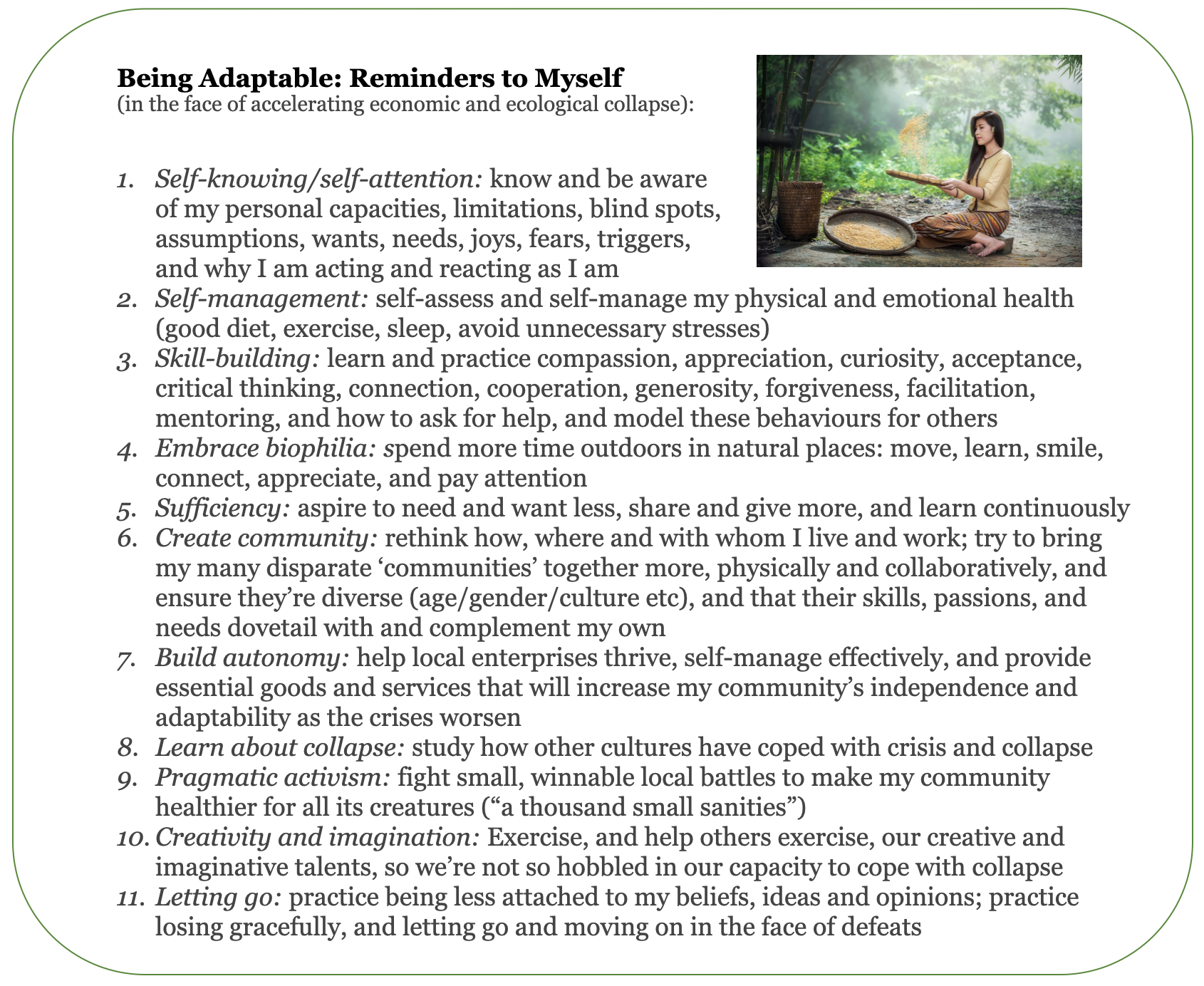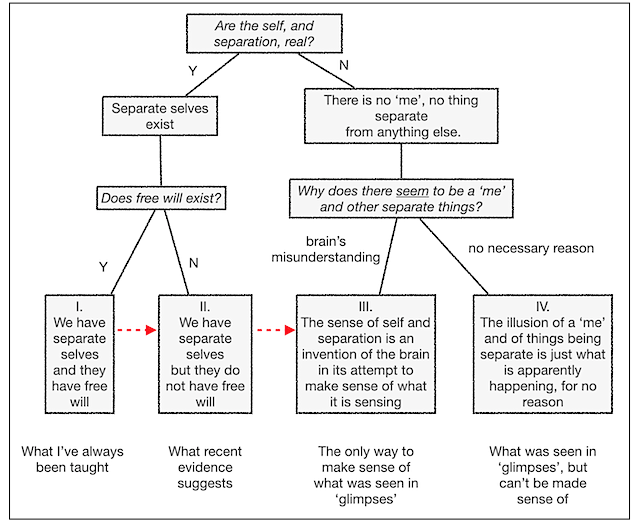
![]() After reading Glenn Parton’s wonderful essay The Machine in Our Heads, which I would urge everyone to read, I was inspired to try again to articulate, in simple terms, the environmental philosophy that underlies much of what I have come to believe in the last five years, and which has driven much of my recent lifestyle and behaviour change, and the writing of this blog. Here’s the latest attempt, talking to myself out loud:
Please let me know what you think of Glenn Parton’s essay. If you’re a regular reader, you’ll know I have little use for psychologists, but I found Parton’s paper very compelling. If you enjoy The Machine in Our Heads, you might also like his Humans in the Wilderness paper, published in the remarkable Canadian eco-philosophy magazine, Trumpeter.
|
March 22, 2004
A SACRED EARTH CULTURE
March 21, 2004
THE TEN KEYS TO EFFECTIVE NETWORKING
There is a lot of nonsensical ‘conventional wisdom’ out there about networking. About the need to be aggressive. About the importance of exchanging business cards. About only networking with ‘key decision makers’. About the art of small talk. About exaggerated politeness. About being everything but yourself. In my experience, none of this advice works. Here are ten things that do:
|
March 20, 2004
A MUSICIAN’S PRAYER
Donato Poveda, the wonderful Grammy-nominated Cuban expatriate musician-songwriter, has the following prayer in the liner notes of his new CD. He’s a Buddhist. I found the words quite moving and thought I’d share them, in both languages:
For those like me that aspire to write music, Donato recommends two books: The Songwriter’s Idea Book by Sheila Davis, and Writing Music for Hit Songs by Jai Josefs, to bring structure to your creativity. They’re on my list of next books to buy. Ironically, Donato, who fled Cuba in his youth to seek a freer life, was one of the few Cuban-born musicians able to attend the Grammy ceremonies. Those still living in Cuba were prohibited by the Bush Administration from attending, as “security risks”. Such is the power of music. |
FRIDAY FIVE: IF YOU…
Every once in awhile I’m inspired to answer the Friday Five questions. Here are this week’s intriguing questions (courtesy of ‘Rayne’, but not Our Rayne) and my extremely unorthodox (you’re surprised?) answers, on the theme of “If you…”:
If you… 1. …owned a restaurant, what kind of food would you serve? Vegan, with pizzazz. Bold flavours, international influences, fusion, appealing to all the senses. Really casual, with big, stuffed chairs and sofas instead of ramrod hard chairs. Even cushions on the floor. Warm, eclectic decor, with no animal products used in any materials. Everything in shareable containers and portions. Live, spontaneous music and dinner theatre. No uniforms. People with no money could sing or work for their supper, no questions asked. Unhurried service. Sliding wall open to the outside, weather permitting. Big windows, bird feeders all around. Socialized pets welcome.
2. …owned a small store, what kind of merchandise would you sell?
If I owned a store, it wouldn’t sell anything. It would be an exchange where people could trade, lend and borrow things — books and music, power tools, stuff from their garden. arts and crafts, recipes. It would be run on a volunteer basis by and for the community in which I live. No signage, so no embarrassment for non-community members, and community members could bring guests. Might even be attached to the restaurant.
3. …wrote a book, what genre would it be?
Fiction. I’m writing a novel, genre is what I think is called ‘speculative’ fiction. Next up is a book of quirky short stories.
4. …ran a school, what would you teach? How to make a living through New Collaborative Enterprise. Critical thinking and creative skills. Self-sufficiency. Once people know these things they can teach themselves, and each other, anything else. The school would have no classrooms and no designated teachers or classes. Whole-class get-togethers would be infrequent and occur at a business location (tour included), or someone’s home, or a restaurant. Otherwise, beyond the outline curriculum and resource list, all activities and discussions would be self-organized by the students. There would be no grades. 5. …recorded an album, what kind of music would be on it?
World music. Fusion of different styles and influences. African, Latin, Classical, Folk. The genre doesn’t really matter. The writing is 90%, the performance 10%. It would be political, but, as Hendrix said, “Everything’s political, isn’t it…”
|
March 19, 2004
REMAINDERS
Remainders is the blog term for links and bookmarks that have come to the blogger’s attention, that s/he thinks are worth a read, but lacks the time or inclination to write a full article about them. Here are mine for this week:
|
March 18, 2004
THE COST OF NOT KNOWING
Once a month I get together for breakfast with the Knowledge Directors from several organizations in the Toronto area. We have wonderful, far-ranging discussions about knowledge management, social networking and business innovation. One of the topics that came up last month was the various risks of having knowledge (theft, destruction, misuse, violation of customer confidentiality, violation of intellectual property laws etc.). That got me thinking about the opposite risk, the risk that “you don’t know what you don’t know”: The risk, and cost, of not knowing.
What are the consequences of operating a business with incomplete and imperfect information?
If it were possible to quantify precisely this ‘cost of not knowing’ (it isn’t), there would be some break-even point (see chart above) at which the cost of not knowing equals the cost (and risk) of having knowledge, and that would determine exacly how much knowledge your company should acquire, make available, and deploy. Although it’s impossible to be this precise, many organizations would benefit from being a little more disciplined in assessing the costs, and risks, of having vs. not having knowledge, so they at least get it approximately right. Once the right quantum of knowledge has been decided on, and processes are in place to acquire and deploy it, knowledge managers need to monitor its quality, value, timeliness and use. This task of content management goes on at two levels: at the organizational level, for centrally managed content, and at the individual ‘desktop’ level, for personally managed content. Content management entails the following measurements, assessments and interventions:
Under the guidance of Colin McFarlane, Ernst & Young recently pioneered a Content Rationalization program to solve the problems of stale, obsolete, and hard to find information. By looking at each database and Intranet website, and talking to users, his team categorized all content into four quadrants of this 2×2 chart: E&Y has also developed two documents, which every employee must sign, that help ensure the security, effective use and confidentiality of the firm’s content. The Appropriate Use Policy document outlines what is considered proper use of the firm’s knowledge and technology tools, with a focus on security and integrity. The Knowledge Sharing Agreement categorizes all firm knowledge into five types, ranging from strictly confidential (no sharing allowed) to open-use (unlimited sharing inside and outside the firm), with specific examples of each. It also carefully explains the trade-off between protecting client-confidential information and the obligation to share knowledge as broadly as possible. But back to the issue of not knowing. In the breakfasts of our Toronto Knowledge Directors group, we’ve concluded that the break-even point in the top chart above, the point at which the cost and risk of not knowing drops below the cost and risk of acquiring and managing a lot of content, falls at different points in different organizations, and that this break-even point is a function of both the organization’s industry and its knowledge culture. As an example, half of our members had decided not to deploy instant messaging technologies in their organizations, because the perceived risk of misuse, hacking or leaks of sensitive information was too high. But for the other half of our members, the critical need for constant consultation within the organization, the need to get objective second opinions on critical judgements made in every assignment, resulted in the decision to deploy IM, because the risks of misuse, hacking and leaks were deemed lower than the risks of insufficient consultation. In these companies, the risk of not knowing was recognized as being high, moving the break-even point to the right and justifying both the cost of deploying IM and the cost of ensuring its security. As with everything else in KM, there’s no one right answer, no ‘best practice’ that applies to everyone. Our group would be interested in knowing how other organizations assess the costs and risks of not knowing, how they rationalize content, and how they assess and address the content problems in the table above. If you’re aware of how your organization handles these issues, we’d love to have a conversation with you. And I wonder whether governments have formal processes for assessing the costs and risks of not knowing. I’m sure some weapons inspectors would be curious about that, too. |
March 17, 2004
GREENSPAN’S FOLLY, AND OUR DUAL ADDICTION TO CONSUMPTION AND DEBT
![]() Alan Greenspan, long-time apologist for corporatist interests and recently reborn Bush neocon lackey, has had an epiphany: He’s now decided that staggering deficits and debts are a good thing in times of low interest rates. As long as ‘consumers’ can be ‘persuaded’ to keep buying the low-quality, over-priced crap that corporatists foist upon them, and as long as the currently wildly overpriced housing and stock markets can be kept at their artificially inflated levels, “balance sheets will remain in good shape”, he says, and hence interest rates can be kept low. And as the Chairman of the US Fed, Greenspan is the guy who single-handedly determines what interest rates will be. It’s a house of cards, of course, a total fraud and extremely dangerous. It’s Enron accounting at its most deceptive, the kind of self-delusion that led to the absurd run-up of stocks in 1929 and the subsequent collapse that produced the Great Depression. Here’s the shaky foundation upon which the entire distorted economy now rests:
I’m sure, gentle reader, you can see the folly here, and all the things that can, and ultimately will, go wrong. Just as Enron’s profits and stock value were based on fraudulent overvaluation of assets, the ‘balance’ of everyone’s balance sheet — individuals’, corporations’, and governments’ — is fraudulently overvalued because the stock prices and real estate prices that constitute most of the assets are absurdly inflated. If any of the following things occurs, the whole house of cards collapses — stock markets will plunge, housing values will plunge, the US dollar will collapse, and interest rates will soar — we’re talking the worst global economic collapse since the Great Depression:
So what do we do to prevent it? We’re so over-leveraged now that the best we can hope for is a ‘soft landing’. Individual citizens can reduce their exposure to the collapse by paying down high-interest and variable-rate debts and short-term mortgages, selling US stocks and bonds (and getting your pension money out of these investments, too), and preparing for the likelihood that housing prices will plummet. We also need to get rid of Bush and Greenspan, and ensure that Kerry has a program for dealing with the astronomical US debt and foreign payments deficit. And we need laws to reduce the power and influence of corporations, electoral campaign finance reform, cancellation of ‘free’ trade agreements and vastly strengthened anti-combines law and oligopoly regulation. But I want to get back to my ‘pusher’ analogy. It’s really insidious. Just as rats in the laboratory have been ‘trained’ to push a button to get a ‘shot’ of addictive pain-killing drugs, and start pushing the button more and more often, we’re being trained — by our education system, by advertising, by the media, and by the entire oil-fueled corporatist economic machine — to want and ‘need’ to buy more and more stuff, to throw things out instead of fixing them, to get stuff done for us instead of doing it ourselves, to buy an endless stream of flimsy $5 doodads made in China instead of one $20 doodad made domestically that will last a lifetime, to undervalue our time and overvalue possessions, to buy overpriced ‘brand names’ for status, and to be terrified of not having enough. And to pay for our addiction to all this overpriced crap, we’re encouraged to borrow more and more money now (“no interest!”, “don’t pay a cent until 2005!”, “zero down!”) so we get as addicted to debt and as dependent on low interest rates as the big corporations and the Bush government. By encouraging this reckless excess, Alan Greenspan really is the ultimate drug pusher, and he damn well knows that this, like all addiction, must ultimately end in tragedy. The corporatists, like all drug pushers, depend on reducing the people, the citizens, to mere consumers, mindless zombies. It’s irresponsible. It’s destroying our social fabric, wrecking families and causing irreparable damage to the environment. It’s shameful. It has to stop. You know I smoked a lot of grass. Oh lord I pumped a lot of pills.
But I never touched nothing that my spirit it could kill. You know I’ve seen a lot of people walking around with tombstones in their eyes. But the pusher don’t care if you live or if you die. God damn the pusher. I say god damn god damn the pusherman. You know the dealer, the dealer is a man with a lot of grass in his hand. Well lord if I were the president of this land you know I’d declare total war
- Hoyt Axton
|
March 16, 2004
JOHN KERRY NEEDS AN ANTHEM
In the months and years leading up to the ouster of Nixon in ’74, the airwaves were filled with the music of protest and change. Now, thirty years later, with a comparable ultra-conservative, repressive, war-mongering corporatist in the White House, the airwaves are filled with pap. The movement to dump Bush needs music, because music is positive, hopeful, energizing, powerful.
John Kerry needs an anthem. Or ten. We need to get the most popular and competent songwriters of our time to stop with the introspective, materialistic, narrow navel-gazing blather and start writing political songs. Songs that can galvanize opposition to Bush’s war on personal freedoms, on women, on children (his No Child Left program), on the environment, on the poor, on labour, and on countries that aren’t friendly to American corporate interests. These are important issues and music is the language of awareness and change. We need songs like Ohio, like Imagine, like The Times They Are a’Changin’, like Alice’s Restaurant, like For What It’s Worth, like What’s Goin’ On, like Mercy Mercy Me, like Edwin Starr’s War. By contrast, these modern protest songs just don’t seem to do it — and none of them is a hit on the level of any of the above ’60s and ’70s songs. We need songs that tell stories. Stories of the returning dead and injured American soldiers that this callous president doesn’t even have the decency to honour with his presence. Stories of innocent Americans terrorized by Ashcroft’s Patriot Act stormtroopers. Stories of struggling workers discarded by greedy corporations flush with Bush’s kickback tax refunds. Stories of poor women and children and homeless people neglected and abandoned by an administration that has bankrupted the economy with war and handouts to the rich but offers nothing to those in real need. Stories of staggering environmental degradation and the poisoning of our air, water and soil, abetted by an administration that neglects to enforce meagre environmental laws and instead doles out public lands to friendly private interests at a rate unprecedented in US history, at a price that’s a fraction of their irreplaceable value. Stories of Halliburton’s corporate rapacity, of theft of a nation’s property as ‘war reparations’ and of cynical deals with despots in countries Bush is supposedly ‘liberating’. Rolling Stone tried to get the ball rolling on this before Christmas, but so far it’s all talk and no music. I can’t believe this is a Clear Channel conspiracy. Look at the Top 100 songs and read their lyrics. It’s pathetic. The one political song is a pro-war song. Why is it, with half a blogosphere of excellent writing about Bush’s excesses, almost none of this writing, none of this anger and energy and indignation has been set to music? Where’s the fire? Where’s the fury? Where is the anthem that will end the reign of The Worst President in the History of the United States? What will we sing in the streets of the land, in hopeful defiance now, and on the night of November 2 in celebration of the end of the four year nightmare that this lying, scheming, cruel, cynical, incompetent president has foisted on the American people and on the world? Cause if you want to end the war and stuff you got to sing loud.
|
March 15, 2004
EVERYTHING YOU NEED TO KNOW ABOUT CANADA IN 10 MINUTES
![]() I‘ve been asked why, as a Canadian, I don’t talk more about Canadian issues on this blog. My answer is that, in the global scheme of things, what happens in Canada has relatively little impact, and if we’re going to save the world and stuff, we need to bring about change in the areas that do have the greatest impact. Also, other than the weather, Canada is a land of moderation, not extremes — we change gradually and there isn’t a great deal of internal conflict. Even the separatist sentiment in Western Canada and in QuÈbec is quite easy to understand and sympathize with, although so far even the separatists have been willing to compromise, so our strange and wonderful country continues to hang together. We’re just not very newsworthy. These days perhaps that’s a good thing. What might be useful, though, would be to give non-Canadians a quick birds’-eye view of the current state of Canada, insofar as it impacts our relationship with other countries, and our contribution to solving the global crises we all face today. So herewith, a biased and over-simplified crash course in Canadian politics and economics, with a smattering of history and geography to the extent it explains who we are. Canada has about 32 million people, about 10% of that of the US, living in a country that has about 10% of the inhabitable and arable land of the US, although our total area is larger. Canadian population, like US population, is growing at third world rates (doubling every 60 years), due entirely to its open immigration policy. Over 95% of Canadians live on 5% of its land (see coloured strips on map above), mostly adjacent to the US. Canada is one of the most urbanized countries in the world, with 40% of the population living in the Big 3 census metropolitan areas (Toronto, MontrÈal, Vancouver), 60% living in the 15 metropolitan areas, and 80% living in ‘urban’ areas (over 500 people per square mile). All Canada’s growth is urban, and 90% of it is in the Big 3 census metropolitan areas. If you extrapolate, the combined population of Canada’s Big 3 cities will grow from 12 million people today to 40 million people by 2060. Population pressure on the precious agricultural land around the Big 3 cities is massive. While Canadians are more urbanized than Americans, almost every Canadian lives within an hour’s drive of vast stretches of wilderness (to the North) and within an hour of the US border (to the South). I believe that’s a defining characteristic of the Canadian psyche. I reported earlier on the drastic differences between Canadian and American values this produces. Just yesterday a survey confirmed that 75% of Canadians believe “George Bush knowingly lied to Americans about his reasons for invading Iraq” and that Canada was right not to support the invasion. Last week another survey suggested that if Canadians could vote in this year’s US election only 16% would vote for Bush. For over half a century, the unique political cultures of Canada’s five regions have remained almost unchanged. The political party that most closely aligns itself to those diverse cultures generally wins elections. In Western Canada, other than in Alberta, the population is closely split between Western reformers, who are generally socially and economically conservative and libertarian, and labour supporters, who are generally socially and economically liberal. Western elections are therefore often more acrimonious than elsewhere in Canada, and centrist parties are generally unelectable. Western reform sentiment has elected Social Credit, Reform, and Alliance governments provincially. Westerners flip-flop from these governments to NDP (New Democratic Party) governments, which have strong labour and nationalization tendencies. Westerners are notorious for not re-electing provincial governments, which tends to prevent excesses in either direction from prevailing for more than a few years. Natural resource industries — mining, forestry, and agriculture — still drive much of the Western economy, and since these commodities are often exported raw, at ever-decreasing prices, the economies of BC, Saskatchewan and Manitoba have floundered for years. This is despite massive infusions of foreign and Eastern Canadian money, brought by retirees attracted by Vancouver’s moderate Seattle-like climate. For some reason, the tourism potential of the West has never been effectively exploited. The Western political schizophrenia is not present in Alberta, which is essentially a one-party Western reform province. Alberta’s economy has thrived on its natural wealth (oil & gas), and many Albertans don’t see why that wealth should be shared with ‘Easterners’. There is a strong Western separatist sentiment in Alberta, driven by economic parochialism and the sense of isolation from power. Southern Ontario and Southern QuÈbec have 40% and 25% of Canada’s population respectively, and almost all of Canada’s manufacturing and financial industry, so the feelings of powerlessness of the rest of Canada (federally, their votes don’t really count) is understandable. Paradoxically, the 25% in Southern QuÈbec feel a similar powerlessness relative to the majority in ‘English Canada’ (a purely abstract concept, but one that’s effective for whipping up QuÈbec nationalist sentiment). Southern Ontario is politically centrist, although both federally and provincially it has supported three different parties as each party has established itself closest to the centre. Two thirds of Ontario’s voters live in four metropolitan areas, so there is also some alienation in the rest of the province. For 125 years following Canada’s Confederation in 1867, the Liberal and Progressive Conservative (PC) parties alternated in power. The winning party was usually the one that occupied the political centre, and hence won Ontario’s huge bloc of seats. This led to the two parties being sometimes indistinguishable, and in some cases actually led to minority governments, with the left-leaning NDP holding the balance of power. These minority governments, and the work of the NDP and its predecessor the CCF, are largely responsible for introducing the European-style social safety net that so starkly differentiates Canada’s broad, single-tier health, education and welfare support system from the US systems. In 1992, that Liberal/PC balance of power was shattered when PC Prime Minister Mulroney attempted to coerce Canadians into accepting a ‘constitutional reform’ package that was in fact a thinly-disguised massive, permanent transfer of political power from the federal to the provincial governments. Mulroney attempted to appeal to both Western and QuÈbec separatists with this measure, and to appeal to parochial interests across the country. Provincial governments, the beneficiaries of the power shift, signed on and encouraged voters to support the accord in a national referendum, and Mulroney warned opponents that if it was defeated, QuÈbecois would see this as a rejection of their need for ‘sovereignty’ and vote to separate from Canada. Voters were enraged by this attempt to blackmail them, weaken the federal government, and plunge the country into an unnecessary constitutional crisis, and soundly defeated the accord in the referendum (ironically, QuÈbec and the West were most strongly opposed). Mulroney was forced out in disgrace, the PC party lost almost every seat in the next election, and the party has never recovered. QuÈbec is a world unto itself, a completely different culture and a separate ‘nation’ in the real sense of the word. Since it recovered from a horrific period of economic underdevelopment and self-imposed isolation in the early 20th century, QuÈbec has shown itself to be Canada’s most progressive province, socially and economically. Like the West, QuÈbec is also split into two equal factions. The centrists prevail in much of MontrÈal, a wonderfully cosmopolitan city but one which has struggled economically because of the hesitation of American and Ontario-based businesses to invest in a province that constantly threatens to separate. The city really doesn’t get a fair shake. QuÈbec nationalists prevail in much of the rest of QuÈbec — socially and economically left-of-centre like the NDP, but determined to take QuÈbec out of Canada or at least renegotiate confederation as an ‘economic union’ of two ‘distinct societies’. My personal belief is that QuÈbec separation (although currently at a low ebb in popularity) is inevitable. Equally inevitable is that QuÈbecois will find separation doesn’t make things any better, and that the rest of Canada will find it doesn’t really change anything. The ‘border crossings’ and separate currency will then disappear, and the only remnants will be the wasted cost and residual disgruntlement. You don’t change (or protect) a language or culture by flag-waving, regulation and issuing your own stamps. The biggest danger with QuÈbec separation is that Canada’s First Nations people, many of whom live in the sparsely-populated and resource-rich Northern 80% of QuÈbec, also feel outnumbered and disadvantaged relative to the rest of QuÈbecois, and have a strong constitutional argument that they could secede from a separate QuÈbec if QuÈbec secedes from the rest of Canada. Things could get very messy. Balkan States of Canada messy. Last but not least, Canada’s Atlantic provinces are qualified ‘Progressive Conservatives’ — socially conservative but economically liberal. With the fishing industry in shambles, unemployment and poverty in the Atlantic Provinces are high, and they appreciate the Canadian ‘social safety net’ — universal, egalitarian health care, unemployment insurance, welfare and affordable one-class education. And unlike the West-coasters, Atlantic Canadians Roll up this politics to the federal level and you get a perpetual advantage for the centrist Liberal Party. Here’s how it works (population in millions):
(NB: The chart above shows how regional political sentiment translates proportionally into seats in Parliament. Many people in each region support the other parties, of course, but not in sufficient numbers to win many seats. Canada, like the US, does not have proportional representation in elections). You may have heard (if you live near the Canadian border) that the PC and Alliance/Reform parties recently merged into a new Conservative party. The merged parties are racked by internal dissension, because they have very different political philosophies. The Progressive Conservative party, which was traditionally centrist (hence the name ‘progressive’ in the title), and socially liberal, is based in the East. The Alliance/Reform party, which is libertarian and socially conservative, is based in the West. When they agreed to merge, many of the leading PCs bolted, since they knew they would be outnumbered by the Western Reform members. Next week the merged party will select its new leader, who opinion polls say will be — surprise — the old Western Reform/Alliance leader. Shackled to the socially-conservative policies of Reform, the new Conservative Party is doomed in the East, and hence federally unelectable. The Liberals must be rejoicing. The Liberals are having problems of their own. With a dynasty that has prevailed for most of the past half-century, the Liberals have gotten sloppy in managing the civil service, and a group of insider criminals has been siphoning off federal funds, using, to the government’s embarrassment, advertising agencies connected to the Liberal Party, and some Crown Corporations, to carry out the fraud. By global, or even large corporation standards, it’s a small fraud, barely material, but the fact that it went on undetected for a decade has shocked the Liberals themselves, and got many voters wondering if one party in power for too many years isn’t a bad idea. But as the above table shows, the disenchanted Liberal voters haven’t anyone else near the centre to vote for. So despite the media feeding frenzy surrounding this scandal (the Canadian media haven’t had much domestic politics to talk about for over a decade), the Liberals continue to outpoll the merged Conservative party 46-31%. Illogically, the media are suggesting that this could produce a minority government, with the separatist Bloc QuÈbecois holding the balance of power. Although the numbers don’t add up, last night the BQ leader said he would be prepared to support the Conservatives rather than the Liberals in such a situation. The proud old Progressive Conservatives, who a generation ago occupied the political centre and won a majority government by doing so, must be groaning — nothing could be more suicidal for this new and unacceptably (in the East anyway) right-of-centre Conservative Party, than to associate themselves with a party dedicated to the break-up of the country. The new Liberal Party leader and Prime Minister Paul Martin is even more popular than his three-term predecessor, Jean ChrÈtien (One thing we now have in common with our American neighbours is that both our national leaders were appointed, not elected, to their posts). Canada’s economy is structurally weak, and one consequence has been, up until Bush’s staggering US deficits changed everything, a weak Canadian dollar, which dropped steadily from above parity in the mid-20th century to US$0.61, but has rebounded in the last year to US$0.75. A number of factors contribute to Canada’s pervasive economic weakness:
Despite these structural weaknesses, Canada has some unique advantages relative to the US, and in fact relative to most countries in the world:
It’s been said that the cold climate ‘defines’ Canada. And in fact, a popular Canadian folk song is called Mon Pays, C’est l’Hiver (my country is winter). But while geography and place are important determinants of culture, I think this is overblown. The climate where 95% of Canadians live is indistinguishable from that of neighbouring American states. What does impact our culture is the isolation of our five population clusters from each other. That means trade and travel tend to be North-South rather than East-West, keeping the five clusters politically and culturally distinct and blurring cultural definition between Canada and the US. Because Canadians basically fear the US, there is a remarkably strong belief in Canadian federalism and the need for a strong federal government, driven more by insecurity than by patriotism. Canadian ‘cultural industries’ are carefully protected and have flourished as a result. And the sense of regional isolation makes Canadians on the whole more interested in being part of the world community and more curious about other cultures. Historically, Canadian immigration and relocation have always been East-West. Surprisingly few Canadians move here from the US and surprisingly few Canadians opt to move to the US. Until a century ago, migration was relentlessly from East to West (UK/Europe to Canada, and Eastern to Western Canada). Now the flow is West to East (Asia to Canada, both East and West). Our global focus is the result, and historically Canada has been quick and generous in its participation in disaster relief and peacekeeping efforts, and in the two World Wars when they embroiled the families of many Canadians. Since WW2, Canadians, like Western Europeans, have been pacifists, believing that providing humanitarian aid and education is a more reliable way to establish global peace and democracy than outside political intervention. And Canada’s borders are indefensible — we know that if Americans really want our water, timber and oil they can seize them militarily, and our borders are so vast we cannot hope to keep terrorists, or even determined refugees, out. Our defence strategy is therefore one of compromise and placation. We work very hard to make sure no one is very angry at us. As the weakest kid in the schoolyard, we use our wit, humour, compassion and generosity to keep the bullies at bay. Although anything could change in an instant, so far it has worked well. |
March 14, 2004
THE GREAT CANADIAN SONG CONTEST
A few years ago, the late, great Peter Gzowski of the CBC asked his listeners to nominate the best Canadian songs of all time. He played many of the nominations on his show, and had a small panel that whittled down the nominations to a top ten list. I don’t recall all ten, but believe #1 was a Nova Scotian song called “Rise Again”.
I thought it might be interesting to try a blog version of the contest, so I’m inviting all Canadian bloggers, and all Canadian readers, to help me come up with a list of nominees. I’ll then circulate the list to any Canadian who wants to be a judge, and winnow it down, first to a list of 12 finalists, and then in a second ballot to a ranked list. If there’s sufficient interest I may try to get the CBC (possibly the program Sounds Like Canada) to air the final twelve, or even make a compilation CD. Whatever we come up will surely beat the hell out of the ghastly (Enter Your Nationality Here) Idol. Here’s how to participate:
Obvious nominees:
My more obscure nominations:
I’m especially looking for more songs written by women, French-Canadian and Native Canadian songs. |


There is a lot of nonsensical ‘conventional wisdom’ out there about networking. About the need to be aggressive. About the importance of exchanging business cards. About only networking with ‘key decision makers’. About the art of small talk. About exaggerated politeness. About being everything but yourself. In my experience, none of this advice works. Here are ten things that do:
Donato Poveda, the wonderful Grammy-nominated Cuban expatriate
Every once in awhile I’m inspired to answer the 
Once a month I get together for breakfast with the Knowledge Directors from several organizations in the Toronto area. We have wonderful, far-ranging discussions about knowledge management, social networking and business innovation. One of the topics that came up last month was the various 

In the months and years leading up to the ouster of Nixon in ’74, the airwaves were filled with the music of protest and change. Now, thirty years later, with a comparable ultra-conservative, repressive, war-mongering corporatist in the White House, the airwaves are filled with pap. The movement to dump Bush needs music, because music is positive, hopeful, energizing, powerful.

A few years ago, the late, great Peter Gzowski of the CBC asked his listeners to nominate the best Canadian songs of all time. He played many of the nominations on his show, and had a small panel that whittled down the nominations to a top ten list. I don’t recall all ten, but believe #1 was a Nova Scotian song called “Rise Again”.