Dave Pollard's environmental philosophy, creative works, business papers and essays.
In search of a better way to live and make a living, and a better understanding of how the world really works.


August 22, 2004

TEN REASONS TO BE OPTIMISTIC

Filed under: Our Culture / Ourselves — Dave Pollard @ 22:57
cassini saturn
My writing of late has been pretty intense, sometimes angry, and, in the words of one reader, ‘exhausting’. I keep making the point that if we’re going to save the world, we’re going to have to pace ourselves, be good to ourselves, avoid pointless guilt and discouragement, eat well, stay fit, indulge ourselves from time to time, give and receive compliments generously, love without restraint, and infect others with our spirit and passion.

Despite the fact that the more I learn, the more reason I see for concern, even alarm, and the more I’m convinced that radical action is needed soon to save us from catastrophe, I remain a hopeless idealist and optimist. There is much to be done, and urgently, but we can do it. Some reasons to be optimistic:

  1. There are more people writing, articulately and eloquently and with the weight of excellent information and argument behind them, about the need for radical change to our culture than ever before. This is a groundswell of awareness and deep caring, possibly unprecedented in the history of man. Something important is happening here.
  2. The Internet has given us two powerful weapons for change: knowledge exchange and organizing capacity. We’re learning to use them well.
  3. Women are slowly gaining power and influence in our society. Young women are better educated and better informed than any generation in our history.
  4. Not having children is no longer, for the first time in our culture, considered selfish or anti-social.
  5. The Wisdom of Crowds.
  6. In the next decade much of the baby boom generation will be retiring. That means a huge number of people, a generation with a penchant for change, will suddenly have an enormous amount of time to think, to learn, to do things for reasons other than financial gain.
  7. Stories have immense power to change minds. We are learning the process of crafting astonishing stories.
  8. The Power of Community.
  9. In our search for models and leaders and inspirations, we are becoming skeptical of arrogance and glibness and the cult of personality, and looking instead for humility, honesty, flexibility, collaboration.
  10. A World of Ends. There is a large and growing appreciation that small and decentralized just works better. And is smarter and more agile.

So there is great reason to be hopeful. But not complacent.

August 21, 2004

WHEN COMMONS CAN’T BE SELF-MANAGED

Filed under: How the World Really Works — Dave Pollard @ 08:48
area mapIn my rambling post last year about community (ours) I described how once a year we set up a ‘goofy golf’ course in our neighbourhood. The 100-acre fence-free community has nine ‘holes’, with a one-foot diameter pail sunk in the lawn for each hole and a numbered flag in each. We trim the grass around the hole and the tee-off area, print up a bunch of maps and scorecards, and invite everyone in the neighbourhood to try out the course, using a sand wedge and a tennis ball. Some people put out coolers of beer, wine and soft drinks by the tee on their property. We have a big barbecue at the end of the day and offer prizes for the best and worst scores. It’s a great exercise in community building and is now a neighbourhood tradition, with a phenomenal turnout.

Contrast this to what happens all too often in ‘community’ and ‘recreation’ centres: People don’t take care of the facilities, which are often starved for funds. User fees are needed to make up the difference, which are often unaffordable for many in the community. So the ‘community’ centre becomes and underused private sports facility for the wealthy, and the not-so-wealthy hang around instead in malls and parking lots outside convenience stores.

There are exceptions of course — some community centres are absolute godsends that help cohere an otherwise disconnected community. But in my experience most are not. Why is this? Is it just another manifestation of the Tragedy of the Commons, whereby the minute something is owned by more than one family its facilities are neglected and desecrated? Is this something inherent in community ownership, or is it an issue of scale and size: The greater the number of people that share something, the more likely each person is to expect others to look after it, and lose the ‘pride of ownership’ that causes them to take proper care of it?

Raymond de Young suggests the answer is more complex than mere size of the community. He says that commons (i.e. shared resources) only avert the tragedy when they are managed by an inclusive, durable, self-initiated and self-managed group. Our makeshift ‘goofy golf’ course meets those criteria. But how scalable are they? The number 150 has been frequently proposed as the upper limit for most functional social networks (our neighbourhood has about 100 people). What do you do when the commons is too large, complex or expensive to be sustained and managed by a community of only 150 people — a large municipal park, or a community stadium or theatre, or recreation centre? Break these up into smaller, more easily manageable units and you significantly lower their utility.

The alternatives when self-management isn’t viable, as Don Dwiggins has pointed out, are (a) abolish commons and privatize everything (the neocon solution), or (b) impose strong government control (the liberal solution). But neither has a good track record. Is there another answer?

August 20, 2004

Awfully Personal Question for August 21, 2004

Filed under: _ Uncategorized — Dave Pollard @ 13:40
christinaWelcome to That’s Awfully Personal, an opportunity for blog writers and readers to reveal a little more about themselves than might normally happen during the daily blogging process, and hence get to know each other a bit better. It’s a little like the late, great Friday Five, but more challenging. Each week our Awfully Personal Panel will post one or more new questions for you to answer on your blog, or in the comment space below if you don’t have a blog.

 For more on how That’s Awfully Personal works, please see the How to Play section below. Here is this week’s Awfully Personal Question:

You and your immediate family have been invited by a rich futurist foundation to participate in a grand experiment in community-building. Eight hundred people, a mix of singles, couples and small families, will be brought together for one week, all expenses paid, and invited to self-organize into twenty groups of 35-45 people each. Each group will be given a very comfortable, 20,000 square-foot communal home with all modern conveniences and communications on a 160 acre piece of wilderness land with its own solar/wind energy generator and its own greenhouse. The conditions are: (a) you can only bring one suitcase of possessions with you, (b) if you stay with the group for one year, and if the group meets its mandate, each member of your group will receive $100,000, (c) the group’s mandate is to meet (virtually or in person) with the other 19 groups (they’re on adjacent acreage) and develop a local economy by the end of the year that could produce all the essential needs of the 800 people, (d) you can’t physically leave the 800-person community during the one year, but you can buy and sell things over the Internet and you can have all the visitors you want provided the others in your group are OK with it, (e) you receive a tax-free weekly living allowance of $1000, less your share of your group’s Internet profits for the week, and (f) at the end of the year, and continuing for as long as at least 25 of the original group members remain, your group can continue to use the home as your own.

Questions: Would you at least show up to meet the 800 people and hear the plan? How likely would you be to find others and form a group by the end of the week? What would you be looking for in group-mates? Do you think you’d stick it out for the whole year to earn your $100,000 prize? Would you stay after that?

How to Play “That’s Awfully Personal”:

  1. Subscribe to (i.e. join) this Yahoo group to get the weekly question(s) sent to you automatically by e-mail each Friday.
  2. On Saturday, or whenever you get around to it, post one of the questions and your answer to it on your weblog or web site.
  3. Then come back here (you may want to bookmark this site) and click the ‘comment’ button under the question(s) of the week. If it’s your first time, you’ll be asked to enter your e-mail and the URL of your blog or website. Then just note that your answer is up. Other readers will then be able to read it on your site by simply clicking on your name in the comments thread. You can check out other people’s answers at the same time. Or, if you don’t have a blog or website, you can post your answer right in the comment box.
  4. If you have questions or observations about “That’s Awfully Personal”, or would like to become part of our Awfully Personal Panel that selects the weekly questions, e-mail us.
  5. If you have a suggestion for Question of the Week, e-mail us and our Panel will review it and, if selected, they will acknowledge you as the author with a link to your blog. Questions should ideally be challenging, so that the answers will be revealing (when answered honestly). But this isn’t Truth or Dare — we want people to want to answer honestly and to have to think a bit before they do.
  6. “That’s Awfully Personal” was developed when The Friday Five closed down. The questions are more thought-provoking and, well, more personal than most Friday Five questions. If they’re too serious for you, here’s a group that is resurrecting The Friday Five, which you might enjoy instead.

WORST CASE SCENARIO

Filed under: How the World Really Works — Dave Pollard @ 10:43
police state
I
‘ve been browsing, with great unease, some of the neocon sites discussing what they should do after the upcoming US election.

One of the most frightening thing about Bush’s first term has been his massive deregulation by deliberate neglect — simply ignoring and not enforcing social and environmental laws and regulations put in place by previous administrations, giving carte blanche to corporations and security forces to simply ignore existing laws with impunity. This is easily accomplished by starving the authorities and agencies responsible for enforcing these laws of budget and information, and by putting zealous hands-off neocons in charge of them.

All this is likely to change, one way or another, after the November US elections. If Kerry wins, which is looking increasingly unlikely, the corporations will have to deploy their armies of lawyers to entrench the de facto deregulations and discourage the ‘re-enforcement’ of social and environmental laws. The strategy for this would appear to be to argue that what Bush giveth away, rightly or wrongly, Kerry has no right to take back.

But if Bush wins, the strategy will be to permanently entrench the gains made by non-enforcement of the laws by either eliminating the laws entirely or, even better, eliminating the social and environmental regulatory authorities or agencies. The new mantra of the neocon corporatists is self-policing. In Bush newspeak that means, of course, no policing. We all saw how effective this approach was with the spectacular corporate frauds of the last decade, led by Bush buddy Ken Lay’s Enron. Nevertheless, we should not be surprised to see a flurry of eliminations of laws, regulations and regulatory authorities, positioned as cost-cutting, streamlining and ‘self-policing’ initiatives, in the early days of a second Bush presidency.

The second thrust of the new neocon agenda is indemnification of corporations against consumer litigation. Bush will be encouraged to use a few big-headline egregious abuses of contingent-fee and class-action litigation to ban these recourses outright, to put strict caps on individual settlements, to provide corporations with more power to intimidate consumers with devastating countersuits, and to put certain privileged industries and groups out of the reach of the courts entirely. The test case for this is the California ballot initiative entitled Limitations on Enforcement of Unfair Business Competition Laws. This initiative, if successful, will prohibit consumer groups from suing corporations to prevent fraud, false advertising or other deceptions. Business groups have poured millions into this, led by Nike, which failed in its earlier attempt to establish a legal right to lie to consumers about its sweatshop operations.

Next on the agenda is expansion of the war in the Mideast with a ‘pre-emptive’ attack on Iran to curtail its nuclear weapons capability. Financing such a war will require severe cuts to government services. Services of a regulatory nature will be replaced by self-policing. Other services will be privatized to corporations that will have free rein to make them profitable. Services that can’t be offered privately at a profit will be simply eliminated. More important than paying for the war, however, will be manning it. There are no countries willing and able to provide significant numbers of troops for a long war against Iran and then Syria and, inevitably, Saudi Arabia. And US voluntary recruits are maxed out, so a reinstatement of the draft is clearly in the cards. Of course, those with money, power and connections will be able to avoid active duty, as Bush did in Vietnam.

Patriot Act II will certainly be back on the agenda if Bush is re-elected. Kerry is so terrified of alienating moderate ‘swing’ voters that he is not making a big issue of this draconian, terrifying legislation, which would effectively suspend many civil liberties that Americans take for granted, and, worse, would give Homeland Security vast new powers and immunity from disclosure or justification of their actions. Those powers would be applied arbitrarily at the absolute and unrestricted discretion of individual officers, with no recourse to the victims. This is a flagrant abrogation of the US Constitution and of the fundamental rule of law. Just as in Latin American and Asian countries under juntas with similar unrestricted powers, American citizens who dare oppose or protest the actions of the government of the day will simply ‘disappear’.

And finally, the neocons are furious at the suggestion that the UN should have suprarnational authority over acts of misconduct carried out by Americans, including war crimes (under the International Court of Justice) and execution of foreign nationals for crimes committed in the US. The US has exercised its executive veto in the UN so often in the last four years that it has become a laughing stock, and these vetos completely undermine the credibility of the UN as well. The simple solution, in the eyes of the neocons, is to withdraw from the UN, to make it clear once and for all that the US does not recognize its authority and considers itself above international law. Expect a re-elected Bush to conveniently present this as an ultimatum to the UN when it invades Iran — join us or we quit.

Repeal of social and environmental protections, prohibition of consumer litigation against corporations, massive elimination and privatization of essential government services, more hugely expensive and dangerous wars in the Mideast, reinstatement of the draft for the poor and middle classes, abrogation of civil liberties, and withdrawal from the UN. This is the worst case scenario if Americans are foolish enough to re-elect Bush. If it comes true, America will have alienated itself from the rest of the West, and evolved into a corporatist state, a rogue nation. If we ever needed proof that the political and economic systems of society are incapable of solving the problems that threaten the survival of our planet, we will have it.

August 19, 2004

THE TRUTH ABOUT NATURE – PART THREE

Filed under: Preparing for Civilization's End — Dave Pollard @ 15:06
Third and final part of a three-part essay. Part One is here. Part Two is here. Bibliography of all sources cited is here.

fig 2
In Part Two I explained what we lost when, thirty thousand years ago, in response to a sudden shortage of big game, we gave up our hunter-gatherer cultures, started the tedious and back-breaking work of agriculture, invented civilization and tried to convince everyone that this strange and unintuitive new society was a good and necessary way to live. Although the ‘history’ we are taught in school starts with the birth of civilization, and treats everything before that as a non-event, books like Daniel’s Quinn’s Ishmael and Story of B, Richard Manning’s Against the Grain, Derrick Jensen’s A Truth Older Than Words and the essays of Jared Diamond have started to develop a credible, broader picture of human history, explaining that the transition of three-million-year-old homo sapiens from hunter-gatherer to farmer-settler was a traumatic one, and led inadvertently to consequences of great suffering and misery and ecological stresses that today imperil the survival of all life on the planet.

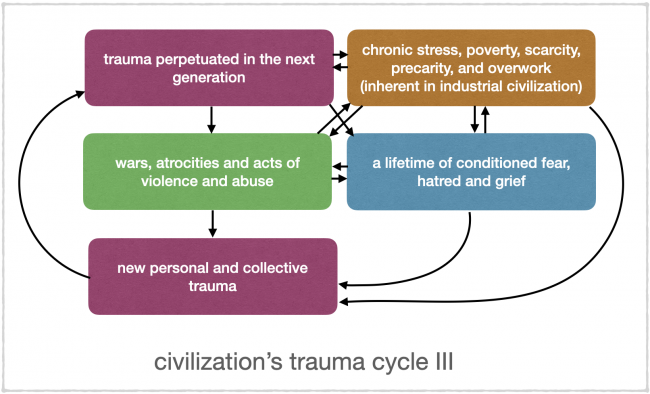
This picture looks something like this: We learned that for civilization to work, we had to live closer together, and to work in a coordinated way in new and difficult jobs. To do so we needed to evolve new, abstract, technical languages and create hierarchies of command and control. The crowding, the coercion, and the development of very successful agricultural technologies had three immediate consequences: High levels of physical and emotional stress (nature’s way of signalling and dealing with overcrowding), excess food (which in turn led to exploding population, and even more crowding), and, paradoxically, recurring and catastrophic shortages, as the new monoculture crops occasionally and spectacularly failed. Thus the vicious cycle shown in the chart above began.

With more and more people crammed into civilization’s new ‘cities’, opportunistic diseases that required proximity quickly evolved and blossomed into epidemics. The human forms of poxviruses, nature’s ubiquitous species-specific population regulator, became endemic and killed over a billion of the first few billion humans born into civilization. The crowding and the loss of community and purpose and place led to mental illness, to new physical ailments (like tooth decay and heart disease) connected to the loss of variety in our diet, and to addictions, which are now so common and widespread that we have come to think of them as normal, and only notice them in the descendants of tribal cultures most recently conquered and forced to adapt to civilization’s ways, where their symptoms are most tragic and most obvious. The crowding also produced continuous violence and war, as fighting broke out over increasingly scarce land and resources, and the ethic that had held for three million years that land was sacred, and belonged to the community that was already there, was replaced by an ethic of acquisition, of justifiable genocide of uncivilized cultures, and of manifest destiny to conquer and seize every acre of land to meet civilization’s insatiable needs. Catastrophic crop failures led to famines, previously unknown on the planet, and the ‘fear of not having enough’ caused everyone to try to hoard surpluses, and prompted those higher in the new hierarchies to demand more than their share, and to use their power to establish and preserve a staggering new inequality of health and wealth.

Social order, which for three million years had been egalitarian and instinctive and built around the tribal community, started to break down as the new larger social structures did not work on the same principles. New social principles therefore had to be developed: New religions taught that suffering was normal and divine will; New laws and punishments and prisons were introduced to enforce obedience to the rules set by those at the top of the hierarchy; New educational and moral codes taught that war is honourable and inevitable, that some people deserve more wealth and security than others, and that conformity and other qualities that keep order and discipline are ‘virtues’; The nuclear family unit was conceived to promote patriarchy and hierarchy as the natural human order, and to replace the loss of the tribal community. And all of these new systems portrayed nature as dangerous, brutal, something that had to be conquered and subdued in the interest of man, and portrayed man as divine, above and apart from all other life, so that man was absolved from the guilt, the responsibility and the intuitive distress over destroying nature and enslaving the tribal peoples and animals that got in the way of global dominion by ‘civilized’ man, in his insatiable need for more land, more resources and more slave labour to feed the ever-increasing masses. And man, social, adaptable, gullible creature that he is, bought it all. He learned to forget his true nature, to distrust his instinct, and to believe that civilization, despite its vicious cycle, was the only way to live.

It’s only in the last century that the wisdom of this new civilization ethos has been seriously questioned by more than a few eccentric individuals. This century has seen the worst wars, the worst famines, the worst epidemics, the greatest suffering of any century in civilization’s brief 300-century history, and the lack of progress has started to lead many to a sense that something is terribly wrong. In The Axemaker’s Gift, Burke & Ornstein reveal that human innovativeness, which originally helped man adapt and live better, is now used as a tool to entrench authority and concentrate power. In The Unconscious Civilization John Ralston Saul explains that the political and economic and corporate systems we built to make our lives better have now enslaved us, and are out of our control. In Ockham’s Razor, Wade Rowland argues that civilization has dehumanized humans, and that science and technology have accelerated rather than slowed this process in the last millennium.

In People Before Profit, Charles Derber recounts the cautionary tale of the 18th century robber barons and warns that corporatism is once again driving much human activity, in ways that benefit only a tiny elite and impoverish all other life on Earth. In When Corporations Rule the World, David Korten shows how corporations, which we invented to try to improve the production and distribution of resources, have lost sight of their purpose and now control us, while producing ever-greater inequality of wealth. The Worldwatch Institute, in its annual State of the World reports, dispassionately identify the measures of growing ecological collapse. And in The New Rulers of the World, Jon Pilger shows how much control now resides in a tiny number of people — fewer than a million — with a vested interest in perpetuating the vicious cycle above.

Richard Manning’s Against the Grain explains how grain surpluses were the first human currency, used to bribe some people into beating down others to establish the first human hierarchies, and describes the incredible vulnerability of monoculture agriculture to catastrophic failures that has led to soul-destroying famines, wars, unimaginable suffering, and even cannibalism — and ultimately to the political systems that perpetrate these disasters and lead to overpopulation, modern concentration-camp style factory farms, and staggering inequality of power and wealth.

As these and other authors paint a disturbing picture of civilization’s well-intentioned social, political and economic folly, other writers describe civilization’s devastating impact on our psyches. Edward Hall, in The Hidden Dimension, explains the psychological impact of overcrowding as a natural stress reaction common to all animal species. The purpose of this reaction is to induce in creatures that have overpopulated a series of hormonal changes that reduce fertility, increase aggressiveness (to spread them out), and increase susceptibility to disease, and hence quickly bring the population back into ecological balance, as illustrated in the diagram in Part Two. In rare situations when that fails, the hormonal changes kick up another notch, and a social ‘blow-up’ is produced — aggressiveness to the point of murder, eating of the young, and adrenal shock leading to premature death ensue. Hall argues that this is precisely what we are witnessing in violent, stressful civilized society. Psychologist Glenn Parton goes further, arguing in The Machine in Our Heads that because we have forgotten how we lived for three million years, lost touch with our instincts, we recognize that something is terribly wrong with the world and feel responsible for it, but no longer see the solution, so the stress ultimately drives us insane.

Meanwhile, the vicious cycle continues to spin out of control. The Census Bureau now predicts that there could well be one billion Americans and fourteen billion humans on the planet by the end of this century, but the corporatist-owned major media continue to pander to the modern myths that population is levelling off quickly, that technology and ingenuity will solve all our problems in plenty of time, and that in fact the West needs more babies to support its ageing population.

Agencies like NOAA and NASA, and scientists like Bill McKibbon (The Overheating World), David Stipp (Climate Collapse) and Kenny Ausubel (The Empire Strikes Out) provide growing evidence that human overpopulation, overdevelopment and overconsumption are not only wiping out most species of life on the planet, but precipitating potentially catastrophic climate change as well. And the creatures that are left, argues JM Coetzee in Elizabeth Costello, are being subjected to cruelty of holocaust proportions.

It is not surprising, in the face of the enormous stresses of civilized life, the incredible unease and guilt we feel about the extinction of all other creatures on the planet, the staggering violence, cruelty and suffering endemic in the culture we created and which is now seemingly out of our control, that we should seek refuge in denial — denial that Earth is in crisis, denial that the atrocities and suffering are actually occurring, denial that it going to get worse rather than miraculously better thanks to human ingenuity or divine intervention, denial that it is our human responsibility to do anything about it, denial that we can do anything about it, and denial that we have any personal responsibility beyond just doing our best not to contribute to the crisis. And if we’re smart enough and informed enough and sensitive enough to be unable to deny this grim reality, we take refuge from the hopelessness and from our helplessness instead by turning it off, by busying ourselves with simpler, more personal, more manageable things. And if we can’t do that either we end our own lives. Human kind cannot bear very much reality.

So what are we to do? Some of the writers cited above offer no solutions — they are merely diagnosticians, they say, it is not their place to tell us what to do. Some writers do proffer answers, that range from the modest to the radical to the resigned. Here are some of them:

The late Freeman Dyson, in his famous Wired interview, suggests we need to rediscover community and focus our attention on it, since that’s the political level at which we can have a personal impact. Along with that, he says, we need to quickly advance new technologies that (like solar energy co-ops) increase community self-sufficiency and (like biotech innovations) improve quality of life. Economist Herman Daly, in Developing Ideas, proposes an economic and tax program that would help communities flourish and encourage conservation and the protection of the commons, and proposes a global contract in which developed nations would agree to reduce their levels of consumption while in return the developing nations would agree to reduce their levels of population.

Just in the last year, Jon Schell in The Unconquerable World has proposed a new political system built around non-violence and consensus-building, while Shoshana Zuboff in The Support Economy has proposed a new post-capitalist economic system based on small enterprises collaborating to meet human needs holistically. Thom Hartmann in Unequal Protection, David Korten in When Corporations Rule the World and Joel Bakan in The Corporation present prescriptions for stripping corporations of their power and perhaps returning that power to local communities. Jim Merkel in Radical Simplicity prescribes a way that each of us can strive to reduce our personal footprint to sustainable levels.

Thomas King in The Truth About Stories and Thomas Berry in Dream of the Earth both say we need to write a new story about a new human culture, that the rest of us can embrace, and which will show us the way forward. Meanwhile, Malcolm Gladwell’s The Tipping Point teaches us how change occurs and can be brought about quickly, and Peter Singer in Ten Ways to Make a Difference and the late Dana Meadows in Places to Intervene in a System offer pragmatic advice about how to bring change about. Stuart Koffman in At Home in the Universe explains how we can exploit the attributes of self-managing systems to help humans evolve at the community level.

While Margaret Mead tells us that most of the major changes in human society and culture have been wrought by a few, caring people, James Surowiecki in The Wisdom of Crowds persuades us of the importance and value of tapping into the collective wisdom of large numbers of people who, together, probably have the answer to every problem, even one as intractable as the crisis that faces us today. And Bill McDonough in Cradle to Cradle and Avery Lovins in Natural Capitalism show proven ways that could be used to redesign the world by learning from nature.

Bucky Fuller reminds us that it is much easier to create a new system that renders the old one obsolete than to try to reform an existing system. There is even a school of thought that proposes a human cultural metamorphosis, explained by Elisabet Sahtouris in EarthDance and Gary Alexander in eGaia, by which transformation to a new human culture might be achieved quickly. Glenn Parton in Humans in the Wilderness suggests a grand experiment of spaced-out Intentional Communities, to reintroduce humans to community and wilderness, and provide a model for building a new natural culture.

So there are many suggested solutions, none of which has achieved any great groundswell of support. They are of four main types:

  • innovative (brought about through invention of new technologies),
  • social/educational (brought about by virally changing a lot of people’s minds),
  • commercial/entrepreneurial (brought about by changing the rules by which the economy operates) and
  • political (brought about by changing laws and regulations).

If there is any consensus of these writers, it is that innovation is the easiest way to bring about change ( because it requires no widespread public agreement to occur) and political reform is the hardest (because the political system was set up to institute the changes needed to make civilization ‘work’ and its very purpose is to defend the status quo).

My answer continues to evolve the more I read, and I’m much less convinced that it’s the right answer than I am of the Truth about Nature and the Truth about Civilization. But for those that are interested, here is my answer, as of today:

  1. There are a lot of things that everyone can do, and should do, to make the world better. Here’s my latest list of 15 things: Trust your instincts; Listen, learn and teach others; Learn and practice critical thinking; Re-learn how to imagine; Use less stuff; Stop at one child; Become less dependent; Become an activist; Volunteer; Be a role model; Be a pioneer; Find or create a meaningful job; Share your expertise; Be good to yourself; and Infect others with your courage and spirit and passion. It’s the least we can do. It’s necessary that we do these things to be clearer about what else we need to do, because these things by themselves won’t be enough.
  2. There is a second group of things that we need to work on that will require specialized expertise and talent:
    • Innovators and scientists need to work on simpler, cheaper, more reliable birth control, abortion and assisted-suicide technologies, breakthroughs in clean energy technology, and technologies that: reduce pollution and waste; prevent rather than just treat diseases; reduce the need for transportation; enable community self-sufficiency (e.g. solar/wind energy co-ops, indoor gardening); do more with less; replace molecules with bits; conserve energy and resources; create nutritious and delicious animal-product-free food; reduce the need for agricultural chemicals; enhance the ability of activists and problem-solvers to organize, collaborate virtually and share information; help identify socially and environmentally irresponsible people and corporations; prevent and treat mental illness; and enable us to better communicate with and learn from other animals.
    • Social activists and teachers need to develop a new non-corporatist, autonomous community-based education system that teaches responsible citizenship, how to learn, how to think creatively and critically, how to get along with others, and how to start and run your own responsible business; they need to persuade people to stop at one child, adopt a vegan diet, buy local and live simpler lives; and they need to teach appreciation of and skills in: community-building, achieving consensus, using citizen-power, effective listening, peaceful conflict resolution; and they need to teach us all how to cope with terrible knowledge, responsibility and change.
    • Entrepreneurs need to demonstrate and teach community-based Natural Enterprise, and pledge to buy local.
    • Politicians and lawyers (I’m not holding my breath on this) need to revamp corporate charters to refocus corporations on responsibility to community, end business subsidies, reform election and campaign finance laws, shift taxes from goods (employment) to bads (pollution, waste, non-renewable resource use), replace GDP with a genuine progress indicator, restrict property ownership, protect and expand the commons and wilderness, make health and education universal rights, shift spending from defense to humanitarian activities, forgive third-world debts, reduce extraterritoriality (power of companies and nations over the affairs of other sovereign nations), reinstate usury laws, introduce currency reform and LETS systems, and extend anti-cruelty laws.
  3. We need to quickly reduce human population on Earth to a sustainable level of no more than one billion. Attempting to make any solution work in a world so horrendously overpopulated is futile and insane. If technology improvements, education and peer pressure can achieve this quickly and voluntarily, that would be the best answer. Political pressure to do so has repeatedly failed, and won’t work. If the voluntary methods won’t work quickly, we need to find another way, painless and non-discriminatory and non-political.
  4. The next culture, everyone seems to agree, needs to be built around communities. We need to create some Model Intentional Communities, a lot of them, to re-learn how communities work, and how to create them, and to show our young people a better way to live (preaching to them won’t work). Quinn’s idea of just ‘walking away’ from our civilization culture is a good one, but we need something to walk away to, and MICs might be the answer, the building block of the next, sustainable culture.
  5. Saving the world is going to require some self-sacrifice and some risk-taking. We need to bring together a lot of bright minds in a lot of different ways to start focusing on this one big problem, instead of the immediate little problems civilization keeps throwing in front of us. We need to diagnose and cure the disease, and that means some of us need to stop being preoccupied with treating the symptoms. I believe that process needs to be voluntary, and the problem-solving groups need to be self-selecting and self-managed. And we need to solve the problem holistically — a vicious cycle can’t be changed merely by tinkering with its isolated parts. That means we need a combination of big-picture thinkers and innovators, and specialists who can expose the big-thinkers’ ideas to real-world reality tests. Think-tanks, conferences, ad hoc organizations — we need them all, and lots of them. If we’re going to fix this, many people will have to decide to make this their calling, their purpose for living, at considerable personal sacrifice, and they’ll have to find, and work with, like minds.
  6. My sense is that the answers, if there are any, are innovations and technologies that can change our culture as broadly and abruptly as the invention of the arrowheads, agriculture, science and automation did. They won’t be the result of linear thinking, and will probably be far more revolutionary than any of the technologies I call for in point 2 above. As Einstein said, We can’t solve problems by using the same kind of thinking we used when we created them.
  7. We don’t have much time. We are already starting to see the early signs of total ecological and social collapse, and although this collapse is unlikely to reach a head in our lifetimes (it could take as long as another century), we may already be too late to begin to prevent it. I believe the signal for the beginning of the end will be more conventional than natural disasters caused by global warming — it is more likely to be a nuclear or biological holocaust caused by two warring, suffering, nothing-left-to-lose nations, or by a stateless group of desperate malcontents who have the motive, and probably the method, and are only now waiting for the opportunity to say fuck you all. There is no time to lose, or to debate whether anything needs to be done. Something needs to be done, now.
  8. We can’t go back. Returning to a hunter-gatherer lifestyle is neither possible nor desirable. We need to go forward to build a new culture that understands and learns from the truth about nature, and is sustainable, but which also uses the best innovations and technologies that human ingenuity has and will come up with, so that a billion of us can live lightly on the Earth, comfortably, easily, connected, in balance with and as part of nature. Innovation can allow us to do more with less, to eat well without farming animals or catastrophic agriculture, to specialize in what we do best and love doing most, with people we love to live and work with. But that innovation and those technologies must also respect the truth about nature, which means we’ll need to reinvent them to work without non-renewable resources, and so that they can be produced with no pollution and no waste. Just because many current technologies use non-sustainable processes and non-renewable materials, exploit slave labour, are produced by a demeaning hierarchical and irresponsible corporatist economy and produce mountains of toxic garbage doesn’t mean all technologies must do so. Just as civilization isn’t the only viable human culture, today’s wasteful and destructive economy isn’t the only viable economy. They’re the only life we know, but not the only life possible. We need only imagine something better, and strive to make it so.

My novel, The Only Life We Know, will attempt to take up Thomas King and Thomas Berry’s challenge to write a new story for homo sapiens. It is set two centuries in the future, after eco-catastrophe has occurred or been averted, in an idyllic world where man lives in harmony and balance with nature, in a life of comfort, community, respect, responsibility and astonishing diversity. I’m not a scientist, or a powerful teacher, or a politician, or a great debater, or an entrepreneur, or an organizer. My skills are innovation and writing, so what I can best offer to save the world is an imaginative story of what could be, and hope that it might serve as an inspiration for those with other talents to figure out how to get us there, from the terrible and precarious world in which we live today.

Once the book is done, I’d like to start a think-tank, to make respectable the idea of Saving the World as a full-time job, and help those that are informed enough, and committed enough, and courageous enough, and self-sacrificing enough, to start working together on some bold, revolutionary answers. And I’d like to start a Model Intentional Community, and use it as an opportunity to teach young people about nature and Natural Enterprise and critical thinking and creative thinking and a better way to live. And of course I’ll continue to do the 15 things listed in point 1 above, which have so transformed me in the three short years since I began this belated journey to try to understand my purpose and my sense of dread about the world we live in.

The truth about nature is that she is inside us, all around us, just waiting for us to ask her what to do. The truth about civilization is that it was an honest mistake, an invention that was necessary at the time, a mere 30,000 years ago, when nature appeared to be letting us down and we thought we could do better. But now it has outlived its usefulness, and is out of control, and threatens the survival of all life on our planet, so it’s time to let it go. It’s time to move forward and imagine and invent a new culture, a sustainable one that works for all creatures on Earth, drawing on the best learnings from nature and the best innovations from civilization.

It’s time to go home.

August 18, 2004

USING TECHNOLOGY IN ENTREPRENEURIAL BUSINESS

Filed under: Working Smarter — Dave Pollard @ 13:41
Nat Enterprise(Eleventh instalment of the upcoming book Natural Enterprise. List of previous instalments here.)

A lot of readers of How to Save the World will probably be disappointed with this chapter in my upcoming book Natural Enterprise for two reasons: I’m not going to plug any specific vendors of technology for small business (although I’ve identified quite a few, including some regular readers), because by the time the book comes out this information could well be obsolete. (When the book comes out there will be a companion website with a list of recommended vendors of technology, though, so don’t despair). And although buying technology is one of the most fun parts of new enterprise formation, my advice is to buy as little as you can get by on. Most entrepreneurs, in my experience, go overboard.

There is no blueprint ‘best answer’ for what technology a new entrepreneurial business needs. It depends on the industry in which you operate, the number and location of your customers and products, whether your product or service can or should be effectively offered online, and a host of other factors.

So the first thing to do is develop a Technology Plan. Although you can hire a consultant to do this with you (don’t let them do it for you), you can also develop the draft plan yourself and then run it by tech-savvy people you know, and (more importantly) other, established entrepreneurs you know with businesses of a similar type and style to yours. The entrepreneurs who’ve already gone through this process can tell you what you really need, and how to avoid the missteps they made, and this can really save you money and grief. You also need to talk to some prospective customers about your Technology Plan, because if it’s inadequate to meet their expectations you’ll need to re-think it. And if they shrug and say it doesn’t matter much to them, that probably means your technologies are mostly internal, back-office tools: Avoid spending too much on toys your customers (who ultimately pay for them) don’t see or benefit from.

The Technology Plan need not be long, but it does need to be carefully thought through. Here’s a checklist of the types of technology it should address. For each type, you’ll need to assess whether you need it at all (some manual alternatives work just fine, and will do so even when your business scales up), identify and evaluate the alternative tools available (including an increasing number of free alternatives), and budget when to buy and how and how much to pay for each.

Telephony: Most telephone companies offer packages designed for entrepreneurial businesses. It’s essential that your telephone system, often the first point of contact with new customers, be reliable and professional. Consider voice messaging, call waiting and call routing needs. Look at them from the customer’s viewpoint. Consider VoIP alternatives including free (but not yet ubiquitous) solutions like Skype.

Fax: I keep thinking fax is dead. It isn’t, yet. Avoid the hokey systems that require customers to call twice to send you a fax.

E-mail: If you want to be taken seriously, you need your own e-mail/web domain, even if you don’t have a website. Make sure it’s short and easy to spell. Shop carefully — prices are all over the map. Cardinal rule of e-mail: If you give your e-mail address to customers, check your e-mail very frequently (route it to someone else in the business if you can’t) and respond to customers immediately.

Public Website: Depending on your business, this may be the most critical technology you buy, or you may not need one at all. Talk to as many others as you can before deciding what you need and who to buy from. You will probably need someone to host your website, and the package the host provides will probably include software to build and maintain your web pages, and limit the size of the site and the volume of traffic (beyond which you pay extra). Most hosts also offer scalable additions for e-commerce at an additional price: Product catalogue, shopping cart, order management and credit-card handling etc. Beyond that, the sky’s the limit: You can add functionality to do online surveys, offer multimedia presentations, provide help-desk support for your products, and many other business applications. As with telephony, think this through from the customer viewpoint: What do they want, what do they need, what might they actually not want to see on your site. Keep it as simple as possible, easy to use, clean-looking, and professional in appearance. If you’re not taking orders for your products over the Internet, it’s unlikely that putting marketing information on your website will produce much benefit: Focus your site content instead on educating your site’s readers. If you give people useful information ‘free’, they’re more likely to want to buy from you. Exception: Put a few, enthusiastic, signed customer testimonials at the top of your site (but get the customers’ permission first). And make sure your contact information is up there with it, and that you’re there to take the calls when they come in. And give your customers a simple way to give you feedback, good and bad, on your site. The good feedback can be the basis for testimonials and viral marketing. If you don’t give them a simple way to vent bad feedback to you directly, they’ll vent to others (including potential customers) instead.

Financial Information System: Depending on the nature of your business, you will have certain statutory reporting and filing requirements for your business. Technology can automate these somewhat, but unless you have a lot of small transactions (purchases, payments, sales and cash receipts), or a lot of different products and services that you need to track and inventory separately, technology isn’t going to reduce your paperwork burden that much or tell you anything you don’t already know. Find a financial system that meets your needs, not the government’s. That probably means a system that will allow you to budget, forecast and monitor cash flow day-to-day, easily. Don’t buy a huge, complex accounting package with thousands of General Ledger accounts and reports you don’t use to manage your business. Again, thinking of the customer first, you want invoices and other financial paperwork that is visible to the customer to look professional. If you have a lot of employees, consider outsourcing payroll and HR records management — it’s usually the most cost-effective application for small enterprises to farm out.

Customer Information System: If you have (or hope to have) a lot of customers your first database application will probably be a customer information system, listing contact information, sales calls (held and scheduled) and successes. A simple spreadsheet application (free over the Internet) will probably suffice until you get more than, say, 100 customers.

Order and Inventory Management System: Depending on volume and nature of your business, you may need Point-of-Sale (POS) and Inventory Management software to keep track of what and how much you’ve sold. Most entrepreneurs don’t have enough distinct products or enough individual transactions to require this, and some accounting packages include rudimentary invoicing and inventory management capability.

Intranet: Once you reach a certain size, or if your organization is virtual (i.e. your people are physically scattered), you’ll probably need some kind of internal website, a space behind a firewall where your people can communicate and collaborate. Don’t design it in a laboratory — get the people who will use it to design it with you. Possible applications are: Scheduling and calendaring, Document- and file-sharing, Internal e-mail and instant messaging, Internal newsletters, Housing databases purchased from outsiders used by all employees, Hosting collaboration and project ‘spaces’ and tools. Your work colleagues will tell you what they need, what makes sense to share, and to what extent (e.g. setting up meetings automatically for other colleagues) they’re willing to allow technology to impose on and make some decisions for them.

Desktop Publishing and Marketing tools: Unless others have told you that you have a real flair for this, or it’s your business, this is best left to professionals. If you’re relying on viral marketing you need very, very little marketing material. A business card, a brochure, a simple website — that’s probably it. Get some one-time professional input on these, and then leave them alone. I know, designing these things yourself is fun. But it’s not the best use of your time. And the results can be truly ugly.

Computers, Mobile Devices and Local Area Networks for the Front Line: Let the users specify what they need, hardware, network and software. Consider free alternatives to the major business software packages. Stress connectivity applications over processing power, memory and multimedia applications — they’re the ones with payback. For applications essential to your business, make sure you have backups for everything — the data, the hardware, the customer connectivity. Even the smallest business needs some redundancy and security systems. Customers just won’t tolerate ‘down time’ anymore. But the more sophisticated your systems, the more costly the redundancy and security systems become — think about this before you go for wireless networking.

Weblogs & Social Networking Applications: I am of course biased about these technologies, but I’m the first to admit that they aren’t the easiest to use, they aren’t for everyone, and they aren’t yet ready for prime time business application. If your colleagues are weblog-savvy, consider them for specific business purposes: Capturing valuable business lessons, Archiving subject matter expertise, and as a Substitute for internal newsletters. And consider running a weblog as an adjunct to your public website — they can be informative and engaging for customers and prospective customers, at minimal cost. And keep a close eye on the burgeoning world of social software: There is a burning need for better tools and databases that can help entrepreneurs find partners, colleagues, advice, information in context, and even customers. Someone’s going to figure out how to meet this need.

Once you have your Technology Plan completed and vetted by users, customers and other entrepreneurs, you have one more critical decision to make: Lease vs. Buy. This decision is getting more difficult as the number of creative financing alternatives increases. There is a new phenomenon called “pay as you go computing” that looks at most or all of the above technologies as a single computing ‘utility’. There are companies that now offer ‘utility’ computing packages, where you outsource all of the purchasing and maintenance of the technology of your business to a third party, in return for a single monthly payment that varies with your usage. The big computer companies are likely to offer ‘utility’ computing by the end of this year, though probably on a less extensive and less flexible basis. Unless you’re a whiz with numbers it may be hard to figure out whether to go for such a plan or not. My advice: Gather up all the costs and the leasing, financing and ‘utility’ computing quotes, buy your friendly accountant lunch and have him compute what’s the best deal. That goes as well for any lease vs. buy decision in your business: Cars, premises, and machinery. The calculations are complicated but straightforward — if you’re an expert in Present Value computations and discounting variable cash flow streams.

Not only is the array of technology choices dizzying, it’s changing daily. That’s why the key is to leverage the Wisdom of Crowds: Talk to a lot of people, especially other entrepreneurs, who are usually all too willing to tell you their technology success stories and horror stories. It’s all part of the homework for building a Natural Enterprise.

OK, dear readers, this is the chapter of Natural Enterprise that I feel least confident, and competent, writing. So please tell me: What’s missing, and what have I got wrong? Remember that this book is for the novice, so I’ve tried to keep it simple and jargon-free. This chapter will get the last re-write just before the book goes to press, but I’m still worried it will be obsolete by the time the book hits the stores. What do you think?

August 17, 2004

A PAEAN TO SOVEREIGNTY

Filed under: How the World Really Works — Dave Pollard @ 04:53
anti-american crowd
Almost three years after the 9/11 attacks, there is every indication that our world is now more insecure than it has ever been. Anti-Western extremists willing to use violence are more numerous and more committed than ever. They have been given justification in their belief that at least some Western leaders harbour overt and hostile ethnic and religious bias, put ideology above reason in their decision-making, and have imperialistic and economic motivations, rather than humanitarian and peacemaking ones, for their constant, trigger-happy war-mongering.

If these extremists wanted to create massive fear, huge economic loss and large numbers of civilian casualties, there are lots of ways to do it, and the bumbling, anti-democratic Homeland Security forces would be helpless to prevent them. These extremists could release bioweapons up smokestacks in North Korea, which, like today’s Chinese pollution, would carry across the Pacific to North America, and its source would be untraceable. Such weapons would be quite easy, according to the experts, for anyone with an appropriate university education to cook up, and tons of them have been missing and unaccounted for since the fall of the Soviet Union. Or the extremists could recruit American radical groups to use conventional weapons to bomb dams, pipelines, refineries, convention and transportation centres and key points in the power grid, or poison the water supply or the food supply (at any of a dozen points in the supply chain). Or they could recruit Americans to become pilots and have them crash planes into nuclear power plants, some of which are directly beneath flightpaths and wouldn’t require any telltale diversion.

So a large number of people (say, a billion or so, and thanks to Bush their numbers swell every day) have motive. method and opportunity to attack the West, but they don’t. Why not?

The neocons can’t fathom the answer to this question, and would like us to believe it’s new Western security measures and vigilance that have prevented more and larger-scale attacks outside the Mideast. But the evidence of the continuing and stunning incompetence of Western intelligence, which has yet to solve conclusively any of the previous attacks, and which is obviously unprepared for new ones, suggests that isn’t the answer. The real answer is a lot simpler, and if you read the articles by reporters in the third world that quote what the locals have to say about us, and use a little bit of imagination, you understand that the answer to this question is the same as the answer to the other two questions we keep asking: Why do they hate us? and What do they want? The answer to all three questions is: We just want the West to go away and leave us alone.


Imagine the Earth was in a tenuous war with an alien race of vastly superior military might, which had put settlements of its own strange and frightening peoples on Earth as a show of strength. And imagine that through an act of astonishing stealth we had been able to blow up one of the aliens’ invading spaceships, and that they retaliated by blowing up an entire arbitrarily selected country on Earth, because they couldn’t figure out where our strike came from. And that they threatened to blow up more countries if we didn’t turn over the perpetrators of our strike on them.

Now suppose we had the opportunity to blow up another of their spaceships, or maybe two or three, but not enough to make a significant dint in their armada. Would we do it? Of course not. We know that the retaliation would be devastating. We would sit tight, hassle the local settlers and hope they got discouraged and went home. We would just want these brutal aliens to go away and leave us alone.

OK, now suppose further that the alien leader broadcasts speeches to his settlers and armies on Earth that glorify an endless war of shock and awe against all those on Earth that oppose the alien invasion, and that claim that the people of Earth who resist the invasion ‘hate freedom’ and are ‘evil’. And that everywhere you go on Earth you see more and more signs of alien expansion — signs in the alien language, alien occupation forces, mines and factories owned by the aliens. How would you feel? Even if they killed the one Earth politician you hated more than any other, would you welcome them as liberators, or fear them to the very bottom of your soul?

Now imagine you’re one of the aliens, and you’re trying to decide what to do next. You’ve invested a fortune in new, unpopular, aggravating security measures to try to prevent the next stealth attack on your armada out in Space, and that’s hampering your ability to conduct operations on Earth to protect your settlements there. A lot of your fellow aliens are suggesting the Earth invasion was a mistake, but you have a lot at stake — thousands of your fellow aliens have already died, the military action is bankrupting the alien empire, and your armada can’t even make it home unless they mine all the rocket fuel on Earth, and that will take time. So what do you do? You dig in for the long haul and secure the mines and your settlements, and invent a fiction for home consumption that you’re doing it for the Earth peoples’ own good.


What the vast majority of third world people want from the West is simply our absence — politically, militarily, economically and culturally — from their countries’ affairs. They want us to go away and leave them alone. They aren’t even particularly interested in selling their oil wealth to the West — the oil nations are currently selling it at a tiny fraction of what they could get for it if they wanted to be greedy, but they know the consequences of doing so would be war, and besides oil wealth has been at best a mixed blessing for the countries that have it, and at worst a curse that perverts the rest of their economies and breeds dependence and lack of diversification. Even in third world countries suffering under despots, people see us as a mixed blessing — chances are it’s weaponry we’ve sold their government that’s killing them, and that it’s profits from joint ventures between our corporations and their government that have financed the genocide, so we shouldn’t be surprised when they doubt our motivations as ‘liberators’. And if they’ve read about Rwanda, they also doubt our capability to help them.

Obviously, the multinational corporations that own a lot of property or employ a lot of slave labour in the third world, and which are making large profits from these operations, would be the big losers if we all just packed up and left — sold off all our interests, as Canada successfully pressured our corporations to do in Sudan a year ago, and simply withdrew. Should we — politically, militarily, economically and culturally — withdraw from the entire third world, and leave them alone to solve their own problems?

Whatever your political stripe, your answer to this question is probably ‘no’, or at least a qualified ‘no’. If you’re a conservative you might see such withdrawal as an act of cowardice, isolationism and economic madness, damaging to all countries concerned. If you’re a liberal you might see it as an abrogation of responsibility to clean up the mess we created, or of our humanitarian duty as citizens of Earth. In either case you might see it as politically reckless.

But no matter your reason for answering ‘no’, you must understand that your answer is not what the majority in the third world wants. If you don’t believe this, reread the four shaded paragraphs above and appreciate that our culture is so foreign, so alien, so threatening to the third world that if they had a choice, they’d forego all the benefits of cultural and economic exchange with the West to avoid what, to them, are its overwhelming costs. We should have the courage, and the imagination, to respect that. Tribal cultures, and communities in nature, respect cultural diversity and don’t interfere with neighbouring communities’ property or practices (to do so invites war, which is almost always won by the defenders). We have copied this concept, which we now call sovereignty, from these natural cultures. But in our modern Crusade for cultural homogeneity, we have lost our respect for it, because we can no longer imagine how the loss of sovereignty feels to a people suddenly invaded by an alien people.

We pay lip service to sovereignty in the UN and other international bodies and international agreements. But we only talk about it when it is abused by dictators and despots who hide behind it to perpetrate atrocities. When another nation’s culture broadly supports something we abhor, like subjugation of women (Afghanistan, still) or laws we consider barbaric (Nigeria) or child labour (Thailand) or slavery (the US until the 1860s), or capital punishment (the US today), it is hard for those of us in more ‘enlightened’ countries to resist the temptation to charge in and tell the majority their culture is wrong and must change. But if we respect sovereignty we must resist that temptation. Just as Americans finally learned the error of their ways about slavery, and will one day learn the error of their ways about capital punishment, the Afghanis and the Nigerians and the Thais will eventually come to realize the social unacceptability of their practices, in their own time and on their own terms. It is not our place to change their culture coercively, and if we try to impose change on them it will just provoke resistance and set back the process further.

So this is a paean to sovereignty — for the right of cultures to seek their own path forward, clumsily and slowly, to own and manage their own resources, make their own strange laws — and to tell alien invaders to go away and leave them alone.

August 16, 2004

CREATING MODEL INTENTIONAL COMMUNITIES: SETTING THE EXAMPLE

Filed under: Preparing for Civilization's End — Dave Pollard @ 19:26
MIC ProcessMy article last month proposing Model Intentional Communities (MICs) as a means of showing young people a better, more natural way to live provoked a strong and positive response. Many readers commented on how important it is to teach by showing (or better yet, by letting young people experiment themselves with some intelligent, structured but light-handed facilitation) rather than by telling. So I’m encouraged to go on to the next step to try to assess how we can (and should) create some MICs.

First, some definitions: An Intentional Community (IC) is an autonomous, self-managed, democratic association of people with shared social, cultural and economic intentions and aspirations. A Model Intentional Community is an Intentional Community that is:

  • exemplary — it works well, and represents the best of what ICs with similar focus and talents have to offer
  • egalitarian — it is non-hierarchical, has no dominant leader, and is free of the coercive characteristics that can cause healthy communities to decline into cults
  • replicable — other successful ICs could be created by following its example
  • educational — by spending time in it, you can learn a great deal, including how and why it is successful
  • responsible and respectful — there is no reason why ICs can’t be selfish or arrogant, but I think we’d want the models we show our young people to be communities where members took responsible for, and were respectful of, the welfare of other members and their neighbourhoods
  • sustainable — it’s not dependent on the largesse of outsiders, or on subsidies or low commodity prices
  • diverse — substantially different in focus, style, and/or structure from the other MICs

There is no cookie-cutter mechanism for creating ICs, but in reviewing the various websites of successful ICs and the umbrella organizations like the FIC, the FEC, and the CCS and CCA here in Canada (cooperatives are somewhat different from ICs, but they share some important principles of formation), you can identify at least a skeleton formation process, which I’ve diagrammed above. I wouldn’t presume to say exactly how to accomplish each of these steps (ask me again when I’ve set one or two up), but the steps are:

  1. Find Members: Select the people who you would love to have in your community, and live and/or work with. Just as in any other activity that involves social networking, this is by far the hardest step. We desperately need better social networking tools and processes.
  2. Set Intentions & Principles: Collectively, the members decide what the objectives of the community will be, and what principles it will live by. These may include principles that define its responsibilities and values, how new members are admitted, a size limit for the community, how resources will be owned and ‘profits’ distributed, the decision-making process, required contribution and participation from members, and many others. Like the membership itself, these principles may be fluid, at least until the community has been operating for awhile.
  3. Design the Community: Now collaboratively the members design what the community will look like and how it will operate.
  4. Obtain Needed Resources: Acquire what the community needs to achieve its intentions
  5. Create the Community: Together, make it happen.
  6. Connect & Outreach: Connect with other communities, with the outside, and with schools and other organizations and people looking for models of a better way to live. This is the step that too many communities, fearing contamination or destruction by contact with the rest of the terrible world, so often omit. We all need each other. Isolation deprives the communities of some of the benefits of technology, innovation and civilization, and deprives the rest of the world of much-needed learning about living alternatives.

If you have set up, or belong to, an IC, please share with us what you’ve learned about the process. I’ve made arrangements to visit a local IC just north of where I live later this month, and I’ll report what I learn after they show me around. The more I find out about ICs, the more attracted I am to the concept. And what’s interesting is that they seem to have figured out the principles of Natural Enterprise as well, by trial and error, so I’m going to feature some of their stories in my upcoming book.

So suppose a bunch of us built a set of MICs with varied intents and specialties. We might categorize them in some way to reflect their diversity and their principal focus, for example:

  1. Inventors — ICs focused on innovation and development, perhaps applying lessons from nature to invent products and processes that do more with less
  2. Fabricators — ICs focused on ‘ingeneering’ and manufacturing durable, customized, recyclable products
  3. Carriers — ICs focused on distribution of products of other ICs to customers, just in time, and including recycling and returning all materials used, cleanly, back to the Earth
  4. Menders — ICs focused on preventative maintenance and repair of people (health and spiritual wellness) and the things they use
  5. Scientists — ICs focused on scientific discovery, and development of technology and biotechnology drawing on those discoveries, that will allow us to live well with smaller ecological footprints
  6. Artists — ICs focused on arts & entertainment, whose members portray for other MICs the world as it is, was, and could be
  7. Players — ICs focused on sports & recreation, exemplifying and teaching the value of physical prowess, collaboration and play
  8. Designers — ICs focused on cooking, fashion and other design, making intelligent and creative use of natural ingredients
  9. Teachers — ICs focused on philosophy, education and the social sciences, and the dissemination of knowledge
  10. Nomads ñ ICs focused on travel and continuous learning

These would not be exclusive specialties, of course. Each community would need some expertise in the other areas, and all communities would be self-sufficient in growing their own food and producing their own clean, renewable energy. And people in each community would doubtless have hobbies outside their MIC’s focus. But having models that fell into each of these diverse types would provide the perfect basis for showing young people the diversity of opportunity, work focus and intellectual and emotional pursuit that is open to them. Instead of four years sitting in classes in high school, for example, students from 14 to 17 years of age could rotate through a couple of MICs of each of the above focuses, for, say, a month at a time, observing and trying things out and contributing as much as possible, at the end of which they would have acquired the kind of exposure, learning and experience that no classroom could ever match. My bet would be that many, perhaps even most, graduates of such a system would want to join one of the MICs they had lived in, or would want to set up their own, with other members of their graduating class and people they had met along the way.

Who knows, we might even start a movement, launch a new, sustainable economy, and create a new culture. Education, done correctly, can be that powerful. But first we need to create these MICs, these new dynamic ‘educational institutions’. And that isn’t going to be easy.

August 15, 2004

THE OUTRAGE OF INJURED CITIZENS

Filed under: How the World Really Works — Dave Pollard @ 11:35
This week there were three separate memes in the newsmedia about corporations blaming citizens and consumers for their woes. Put them together and it’s not a pretty picture:

The Customer Isn’t Buying It…

raised eyebrowThe NYT reports that, despite companies’ attempts to get greater and greater bargains for their customers, the customers aren’t buying it — the American Customer Satisfaction Index remains below its levels of a decade ago. And although Seth Godin attributes this to the FedEx phenomenon (get used to an innovation, and eventually you expect it and raise the bar, so it takes more to satisfy you), I’m not so sure. I think the Wisdom of Crowds is at work here. People know that you get what you pay for (if you’re lucky). They’re paying less mainly because they’re making less, thanks to the Wal-Mart Dilemma. The company selling you stuff, meanwhile, is making more profits, despite the fact they’re bringing the stuff in from China now instead of Ohio. So you know full well that what you’re getting for that lower price is lower quality, and that the quality is dropping faster than the price. That quality decline manifests itself in a variety of ways: Flimsier design, less durable materials, less competent assembly, poorer choice, poorer service, less bundling of ‘extras’ (sometimes it seems a modest warranty costs as much as the product these days). Consumer Reports confirms that, with few exceptions, consumers are noticing this, and aren’t happy.

Maybe in the ivory towers of the NYT they can afford to only buy top quality, and so they’re not feeling the quality pinch. But no, gentlemen, consumers aren’t raising their expectations. All they want is a product that works well for a reasonable period of time, a reasonable choice, and efficient service when problems arise. That’s not asking too much. But they aren’t getting it. And thanks to a chronically weak employment economy, union-busting, outsourcing and offshoring, consumers’ pocketbooks are squeezed and their credit cards are maxed out, so they can’t afford to pay very much either. Corporatists have only themselves to blame for both customer dissatisfaction and falling consumer buying power. It’s time they stopped blaming consumers for the problems they themselves have created.

…But Blame Consumers Often Enough And Maybe They’ll Start Believing It…
argumentI don’t watch much TV, but do try to catch some of the economic analyses from time to time, especially on networks with less corporate bias like PBS and CBC. Three times in the last month I’ve heard corporate leaders recite almost the identical riff to explain why, despite Bush’s lavish tax giveaway to his wealthiest donors, and near-bankrupting of the US treasury, the economy remains stalled, in a multi-year recession with no end in sight by every standard except the increasingly meaningless GDP numbers.

The outrageous riff says that the problem with the economy is frivolous customer litigation against corporations, and calls on Bush to immediately provide ‘protection’ to corporations against such litigation, in order to improve the economy. The wording of the three corporatist speeches was uncannily similar, and I think it’s improbable that this was just coincidence. Watch out. I think the Bushies have sent the scripts out to selected ideological friends in big corporations, to soften up the public for new, planned legislation. This will be, I predict, the next wave of ‘favours’ for corporatist supporters — having deregulated the corporations from laws that make them act responsibly to citizens, now it’s time to regulate citizens to block them from fighting back. The problem is that the legal profession has opened the door for this, by launching absurd self-serving class actions against corporations (like the famous McDonald’s hot coffee spill) that get all the press, so that the many, many legitimate consumer actions against egregious corporate misconduct are ignored (and if Bush and the corporatists get their way, will no longer be possible). What will the world be like when corporations are truly ‘above the law’? When Adam Smith said over two centuries ago “the real purpose of government is to protect those who run the economy from the outrage of injured citizens”, he was hyperbolizing. If he were living today, he’d just be telling the truth.

…And If That Doesn’t Work, Take The Corporations Out of Public Scrutiny.

goldbergThis week the NYT also reports the growing trend of public companies to go private (buy back all their shares and de-list from the stock market). The always-fair Andrew Ross Sorkin resists the temptation to portray this as an attempt to hide unscrupulous behaviour from the public, and instead cites the insatiable demands of public shareholders for perpetual double-digit profit growth in a stagnant and finite economy. Take the company private, the argument goes, and you can start making intelligent long-term decisions and strategies, instead of obsessing over the next quarterly results. You can actually invest in infrastructure and innovation. You can take sensible risks, some of which will pay off big-time.

But think about it. With no other place to put their money, investors have bid the prices of public stocks up to bubble levels — price/earnings ratios almost unprecedented in history. That means if you buy back your shares now you’re paying those investors much more than the shares are really worth. Why would any company do that? It would make far more sense financially for these far-sighted people to start up a new, private company, quietly selling off the inflated public company’s shares to finance it. Eventually the management will have moved all its cash to the new private company, which they’ll own 100%, and the old public company will be the new shareholder-owners’ headache when the stock market bubble bursts.

The only reason I can think of for not following this ‘take the money and run’ strategy is reputation: The old owners will still be blamed for having ‘bailed out’ before the crash, and there will even be questions of impropriety and suggestions they knew the stock was overpriced and deliberately sold it off to unsuspecting suckers (you and me) who were left holding the (empty) bag. That’s what the stock market is all about, of course, but maybe they don’t want too many people to realize that too quickly, and crash the whole economy before the new private business can find its feet. Safer to take your lumps now, pay the inflated price, and start running the private company sensibly. It also solves the stock option expensing problem, which is about to blow up in all our faces. For most, the reduced public scrutiny would be just the icing on the cake.

The third cartoon is from the Sorkin article in the NYT, and is by Stuart Goldberg — I can’t find anything more about him, or anything else he’s done, but this little picture really is worth a thousand words.

August 14, 2004

THE MONEY’S ON ANOTHER REPUBLICAN SWEEP

Filed under: How the World Really Works — Dave Pollard @ 09:49
IEM
Opinion polls can be biased by wishful thinking, contrarian responses, and even deliberate lies of participants — after all, there’s no real motivation to tell the pollster the truth. But as James Surowiecki argues in The Wisdom of Crowds, put some skin in the game and the responses suddenly get a lot more real. That’s why it’s disturbing to see a fairly consistent prediction by the IEM, the exchange that bets money on elections and other future events, that the Republicans will win not only the electoral college this November, but an absolute plurality of the popular vote for president, and at least hold and perhaps even increase their control of both houses of Congress.

The first table above shows the real money betting on the presidency, and while it’s still too close to call, the money all along, with only a few days’ exception, has been on Bush to win a plurality of votes. The second table shows real money betting on the Republicans to keep both houses (RH_RS) at twice the level of betting on the Democrats taking back the Senate (RH_NS), with the betting on the Dems taking back both houses being nearly non-existent — more than a 10-1 longshot. Admittedly the amounts bet aren’t large, but as the link above explains, the predictive accuracy of this market has been uncanny, far better than any of the polls, even well in advance of the actual event. If it proves to be wrong ten weeks from now, it will be an almost unprecedented misjudgement, and perhaps an indication that crowds, even under the best of circumstances, aren’t always wise. We can only hope, and work hard, to see that that happens. And keep an eye on this chart.

Also this week comes news that the fairness of the US election will be monitored by a European team from the OSCE, the first time a US presidential election has been so monitored. It will be fascinating to read their report, which is bound to be damning even if a repeat of the 2000 fiasco is avoided, and also bound, like all the post-mortem reports on the 2000 election, to be largely ignored. The biggest concern about this election isn’t that it’s too close to call, but that the vote-counting system still can’t be relied upon to correctly identify the people’s choice.

« Newer PostsOlder Posts »

Powered by WordPress