The authors of The Death of Environmentalism, Michael Schellenberger and Ted Nordhaus, have worked for various environmental organizations most of their lives, and featured prominently in some of the environmental movement’s greatest successes in the 1960s and 1970s, which brought in legislation that is only now being seriously undermined by Bush and others. They have taken a candid look at the almost uninterrupted history of failure of the movement since the mid-1970s — thirty years — and its increasing marginalization and inability to galvanize public opinion. Though you should read the whole 50-page manifesto, here’s the gist of it:
So: Vision and values first, and then build the movement and its agenda on that. In my Green Movement Manifesto I really started with the agenda for what I described as a coalition of the disenfranchised. That agenda was about communicating, teaching, recruiting, political (proportional representation), social (boycotts, think-tanks, demonstrations) and economic (tax shifts, new measures of well-being) activities, and creating Model Intentional Communities, new progressive media and Natural Enterprises. I used the term ‘Green’ instead of Environmental or Ecology because I thought it was more inclusive, more about us than just about it. Suppose we take a step back and describe the vision and values of the Green Movement first, and then review the agenda and see if it fits? Yesterday I produced what I believe to be a statement of universal human values: Happiness as a product of good Health, Home (including Environment, Belonging, Self-Sufficiency), Connection (Community, Relationships, Family, Love), Discovery (Learning, Creating, Forming Beliefs), Work, Peace (Freedom, Justice, Absence of Stress), Play, Awareness and Self-Esteem. I freely admit that these may not be the best terms, which, along with their organization have an implicit progressive ‘frame’ to them. But whether you want to combine Home and Connection into one core value (as environmentalists are wont to do), or elevate Family from an aspect of Home and Connection to a core value in its own right, I think you’ll agree that this is a reasonable broad-brush summary of human values (and, if you’re an environmentalist, of the values of all life on Earth). If we’re going to build a Green Movement on values and vision, do we need to focus on or emphasize certain values, the ones that are currently least fulfilled by today’s non-sustainable and devastating culture? The New Apollo Project report focuses on two values: good jobs (Work) and energy self-sufficiency (Self-Sufficiency being an aspect of Home). Its thesis is that two massive current problems in the US — a lousy job market and energy dependence — can be solved by a single set of solutions, a single agenda. That agenda is about encouraging investment in renewable energy innovation and development. Its side-benefits include Health, a better Environment, and greater security (Peace). But New Apollo is a project, not a movement. It seems to me a movement needs to be built on a strong and cohesive, relatively complete set of values. So I’m tempted to keep the entire set. We need of course to go beyond the ‘shorthand’ of these one-word terms and explain exactly what these values mean. So the first part of the Green Movement Manifesto should be about these values. We need to try to articulate their meaning and reinforce their universality by expressing them in new ‘frames’ that are compelling to all — progressive and conservative, libertarian, environmentalist, fundamentalist and agnostic alike. No easy task. The next part, the Vision, will be easier. The vision is ultimately an achievable story in which the Values are realized and fully manifest. Hence, Manifesto. The key challenge here is to create a sense of urgency. The Vision needs to transport us into the realm of the possible, and make us long for its realization, ready and eager to be part of making it happen. Another challenge will be ensuring that a wide variety of people perceive the Vision to be achievable. We live in such a cynical society that it’s become easy to shrug off our responsibility, and our lack of courage, by simply saying “It can’t be done, so there’s no point trying.” An unachievable Vision is worse than no Vision, because it merely raises anxiety and brands its authors as hopeless idealists. The line between a vision that is too incremental, and one that is perceived to be impossible, is often a fine one. Is that enough for the Manifesto? While setting out the Agenda would certainly be beneficial — it would show How the vision could be achieved — it would also be controversial because, as I mentioned yesterday, the ‘How’ is extremely frame-dependent. My sense is that we’re over-burdening the Manifesto by putting the Agenda in it. The Agenda is Stage Two. Besides, stories are subversive — we may be able to use the Vision as a tool to allow people with different frames to see the ‘Value(s)’ of achieving the Vision — and that Vision alone may be enough to get them thinking about other, imaginative ways to realize it — changing their own frames. And there remains the problem of the name — Green Movement. I like the name, because it’s simple, visual, positive, instinctively resonant. It’s also tailor-made as a brand, something people can associate with, call themselves, belong to, talk about, even wear (a woman I know makes unisex bracelets, and is intrigued by the idea of making something that Green Movement members could wear, give, share — a conversation piece). And what’s more, Green is neither Red nor Blue. But it does have associations with the Green Party, which, in North America at least, is associated with the left, with fringe thinking, and with single-issue politics. We need to think about whether on balance it’s an asset or a liability, and if it’s the latter we need another name. We also probably need a logo and a catchphrase. Why am I saying ‘we’? Because tomorrow I’m going to present a draft of a new Green Movement Manifesto, with a Value statement, a Vision, and possibly a new name, logo and catchphrase. And no Agenda, at least yet. But I wouldn’t presume that my draft will be more than something for the rest of us — you — to shoot at. If the Green Movement Manifesto is going to be enough to galvanize a billion or two people into thinking about, believing in, and striving for, a better, sustainable way to live, it’s going to need an enormous amount of collaborative effort — the Wisdom of Crowds, the Power of Many, and the Magic of the Collective Mind and Soul. From the ashes of Environmentalism we will build something new. So sharpen your critical and creative thinking, here we go! |
January 31, 2005
The Death of Environmentalism
January 30, 2005
Universal Values, Relatively Speaking
![]() A week ago I provided a values self-test, and asked for your help creating a complete list of human values, ranked in order of importance. I also promised to provide my own list and rankings. The chart above is the composite of the responses. It suggests that there are nine facets to our happiness: Health, Home, Connection, Discovery, Work, Peace, Play, Awareness and Self-Esteem. Each of these has aspects that vary depending on our culture, and their relative importance varies from person to person. I’ve shown Family as an aspect of Connection, but for some it may be inseparable from Home. I’ve shown ‘Work’ in quotation marks because I mean it in the broader sense of ‘making a living’, rather than the narrow sense of employment. Again, for some people, self-styled ‘home-makers’, this may be inseparable from Home. And I’ve grouped Personal Values and Beliefs under Discovery because they’re part of self-discovery, making meaning of our lives. You may quibble with my terminology and groupings, but I’m reasonably confident that this schema represents a set of Universal Human Values. In fact, I’d say it represents the values of all sentient life — from my readings and personal study of birds, I think ravens, at least, share these nine values and strive, consciously or unconsciously, to maximize their achievement. These are the things that drive us all, that motivate all activity, and because they’re all essential to survival of the species, they’re probably all coded into our DNA. Alas, just because we may have a shared set of core values doesn’t make it any easy to achieve agreement on how to maximize and achieve them. The answer to “How Do We Best Achieve These Things” is a function of:
Let’s consider the sixth value, Peace, for example. Some of us believe it is appropriate or even necessary to take aggressive action to ‘secure’ peace, while others believe in passive resistance to peace-threatening actions. Some of us, because of the frames through which we process information about acts of violence, believe that force (forces of ‘evil’) must be met with force (forces of ‘good’), while others with different frames believe we are all good, and that the solution to violence is to address the inhuman circumstances that give rise to such unnatural and desperate acts. Some of us believe the role of the collective is to secure peace, to protect the community from hostile outsiders, and everything else is the responsibility of the individual. Others believe we are all responsible for each other in every sense and aspect of our lives, and that our collective agents (like governments) should exercise that responsibility extensively and diligently. So, if we cannot agree on How to achieve these values, is there even any point to agreeing on What they are? I think there is, for two reasons. First, and most obviously, it helps us to better understand and find common cause with those with different frames, since, at bottom, we’re all looking for the same thing. Secondly, it can help us look rationally at our beliefs and behaviours, to assess whether they really make sense in light of what they are intended to appreciate and achieve. Here’s an interesting example of the latter: One thing most liberals and most conservatives seem to agree on is the value, at least in theory, of globalization. Liberals don’t like the way globalization can cause massive social and environmental damage, or how it’s been abused to force third world countries to adopt Western political and economic policies and give up control of their economies, land and resources, but most believe that it is quite possible to mitigate these negatives and still reap the benefit of free movement of goods and services at market prices as a mechanism of humanitarianism and eventually economic, social and political improvement. Conservatives see globalization as the ultimate manifestation of a ‘free’ (unimpeded by government) economy, and as a means to export ‘good’ Western values, but even they are more than a little worried about a global government that they don’t control (hence their loathing of the UN). What is implicit in the both the liberal and conservative worldviews of globalization’s benefits is that cultural homogenization is a good thing. To the conservative, one world adhering to American values would be free of terrorism — if we’re all brought up with the same values and beliefs (and believing in the One True God) the only crime that would be left would be crimes of sloth and similar individual moral weakness, universally abhorred and ‘nipped in the bud’ by a uniform global ‘spare the rod and spoil the child’ criminal justice system. All believing the same, growing up the same, with the same ‘opportunity’ — what better way to achieve World Peace? To the liberal, one world adhering to an agreed-upon consensus of laws, standards and values would be the ‘UN done right’, where with only one government, there would be no ‘other government’ to wage war on, and with a global meeting-place for sharing ideas and resolving disagreements, there would be limited support for civil war as well. These neo-liberal and neo-conservative views, though, both implicitly see cultural heterogeneity as a threat to world peace. What is interesting about this ‘if we’re all the same we’ll get along’ rationale is that it is imperialistic and utterly ignorant of the anthropological reasons why such cultural heterogeneity arose in the first place. Indeed, most anthropologists argue that man is already astonishingly culturally homogeneous already, and that cultural imperialism and cultural homogeneity have grown in near-perfect lock-step with the scale of human violence and war. In hunter-gatherer cultures, both human and animal, there is little cultural homogeneity between communities, and inter-mixing between communities is rare. Anthropologists are astonished at how tribes living just a few miles apart had rituals, beliefs, religions and even diets that were completely alien to each other, almost unimaginably different. Our civilization culture’s expansion, imperialism, and language impositions have compromised these differences enormously, but they are still somewhat observable. Even after several hundred years civilization culture is so utterly alien to North American First Nations people that they have proved almost impossible to integrate and assimilate. Why would nature, and evolution have encouraged this innate heterogeneity, this xenophobia which almost inevitably leads to inter-cultural conflict? The obvious reason is resistance to disease. As AIDS has shown so horrifically, and the Plague before it, movement of people between cultures brings the risk of epidemics, and the more culturally homogeneous the species, the greater the risk that such epidemics will wipe out the entire race. This homogeneity-caused fragility is not unique to humans — we’ve seen it in the Avian Flu, and the spread of Mad Cow, and the devastation that this fragility caused during the Irish Potato Famine should be enough to make us think twice about the desirability of us, and our staple foods, being increasingly genetically indistinguishable around the world, and the desirability of our being able to travel around the world and infect so many others with new exotic diseases so easily. That’s the evolutionary explanation for nature’s abhorrence for homogeneity, and possibly the reason we are inherently so xenophobic and intolerant of other cultures. But beyond the genetic fragility of cultural homogeneity, cultural homogeneity also brings with it memetic fragility — a lack of variety of ideas. You can already see evidence of this poverty of imagination in corporations and cults where intellectual and behavioural conformity is strongly encouraged: no innovation, group-think leading to inflexibility and denial of the existence of problems, vulnerability to seduction by false comforts, and brainwashing. So assuming that cultural homogeneity is an inevitable consequence of globalization, at least the globalization models we’ve come up with so far, is the resultant genetic and memetic fragility that we would get along with ‘world peace’ worth all the wars and imperialistic devastation necessary to achieve it? Is the benefit of increasing Peace, one of the nine universal human values, outweighed by the commensurate reduction in Health and Home and Discovery, three of the other values? I prefer to take my learnings from nature, which may or may not be as ‘smart’ as we are but which demonstrated, especially prior to the advent of civilization, a remarkable resilience and ability to optimize these nine universal values, not just for pre-civilized man but for all other life on the planet as well. Nature would suggest, I think, that the answer is not One World, homogeneous, a single world political and economic and cultural system, but instead a rediscovery of community, of diversity, of the richness and strength of cultural difference, of heterogeneity. Nature would suggest that community, not nuclear family or ‘household’ or nation-state, is the place and level of aggregation where we will find the true meaning of Home, of Belonging, of Love and Relationship and Connection and Self-Sufficiency, and that the land and environment and all the creatures on it that constitute our Home are sacred and inviolable and belong to no one. Nature would suggest that Discovery and Learning and Personal Values and Beliefs are most effectively found by personal exploration, by trial and error, through all of our senses in the real world, not by reading textbooks in classrooms. Nature would suggest that ‘Work’, making a living, is done most successfully and meaningfully by cooperatively and collaboratively, as equals, beholden to no one but one’s chosen partners, helping ourselves and others meet real, unmet needs. Nature would suggest that Peace comes from respecting the differences and sovereignty of other communities, in celebrating their diversity as robust and astonishing communities in the human experiment, and in trading ideas and goods reciprocally when it is necessary and to the benefit of all. Nature would suggest that Playfulness and Awareness and Self-Esteem are part of the very essence and meaning of life and that our modern civilized world which trivializes and veils and manipulates our achievement of these things turns a world of joy into a prison and cripples us as human beings. But I’m not sure I could convince a conservative, or a radical Islamist, or even a Third World child captivated by the possibility of modern American life, of this. We may share the same universal values, but we see them, and the road to their achievement, through utterly different eyes. |
January 29, 2005
Latest News on the Environment
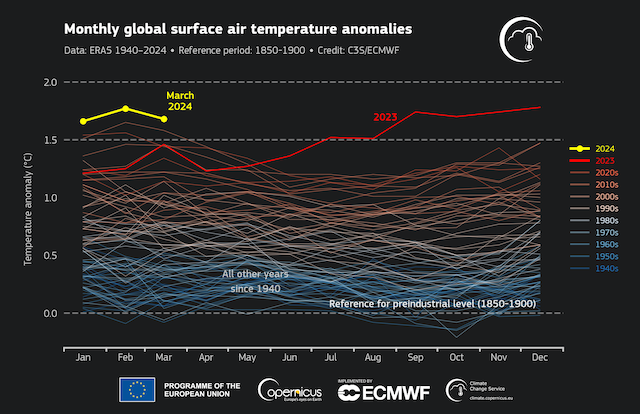
![]() New Report on Climate Change: A new combined study by the Institute for Public Policy Research in the UK, the Center for American Progress in the US, and The Australia Institute, entitled Meeting the Climate Challenge, supports the “2 degrees” hypothesis, that if we allow pollutants from human activities to push the global average temperature two degrees Celsius above the pre-industrial revolution average, the increase will become self-perpetuating and inevitably wreak massive climate change around the globe. Of course, since the danger cannot be proved beyond a shadow of a doubt, and would be astronomically expensive to address (even the US-repudiated Kyoto first steps would be woefully inadequate) the deniers are again out in full force saying it’s all biased alarmism. They haven’t come up with a credible explanation what motivation hundreds of scientific experts, many with Nobel prizes, would have to put their reputations on the line for a “hysterical” theory. Maybe they think the laboratories and scientific academies of the world are hotbeds of liberalism. This report is consistent with last year’s Pentagon report on the subject, which the science-hating Bush shrugged off saying he wan’t interested in hearing about “worst-case scenarios”. I guess Bush figures the Rapture is the answer to that. Countries Rated for Environmental Sustainability: A new research report by Yale and Columbia Universities rates some Scandinavian and South American counties best at environmental protection. The report, prepared for the annual corporatist Davos conference, uses 75 factors in its evaluation, but also factors in country size, letting the horrifically polluted Russia off the hook, ranking 33rd. Canada ranked sixth, also an outrageous greenwash, while the US, despite its size, ranked 45th. Map of all country indices is shown above. |
January 28, 2005
A Progressive Story-Book?
![]() In last Monday’s Salon, Jennifer Buckendorff links two ideas in an interesting way: Her article The Oprah Way suggests we need to portray progressive values in a person, emotional way, and suggests that one vehicle to do so is through the use of stories. She explains how Oprah has told the story of gay interior designer Nate Berkus, who lost his life partner in the recent Asian tsunami, in a very engaging, sincere and heroic way. By doing so, she has changed the perception of many of her viewers — including non-progressives — of gays from a stereotype of stridency, excessive showiness and anger to a new archetype of humility, courage and sensitivity. Buckendorff suggests that such stories can actually change people’s values. I’m not sure I would go so far, since I think values are pretty deep-rooted, but I certainly think stories can change perceptions, smash stereotypes, and enable accommodation of ideas and ideals that strike a common chord, and that’s worth doing. There have been always been best-sellers about people, often ordinary people, who have chosen a different way and demonstrated universal human values — bravery, love, perseverance, self-sacrifice, patience, commitment, altruism. One recent book even told stories exclusively about people who quit their wage-slave jobs and started second careers making the world, or at least their corner of it, a better place. Why not compile a story-book that tells heroic and honest tales of progressives, not big-name political leaders, just average Joes and Janes who quietly represent these universal human values and who also represent progressive values, and whose stories are told in engaging, emotionally-powerful terms? Each chapter could present a new progressive archetype, and in so doing smash an old progressive stereotype. I think Lakoff would approve. If we were to do so, what would some of those archetypes be, and whose stories would they tell? What future Obamas are today quietly representing progressive values in ways that can reach everyone, and start to draw us together in positive ways, in common cause? |
January 27, 2005
Simple Truths
Ci’-vi-lized [adj] subject to government, reduced to order, reclaimed from savagery Fe’-ral [adj] wild, untamed, savage, not civilized Choice’ [n] a variety of alternatives or options Pri’-son [n] a place of forcible (i.e. without choice) confinement, restraint or captivity A’-li-en [n] an organism that occurs in a region in which it is not native (i.e. not naturally at home) Sca’-ven-ger [n] an organism that feeds on carrion, or wild nuts and berries, a cleaner of refuse Sus-tain’-a-ble [adj] capable of being continued indefinitely, without depletion or diminution Can’-cer [n] a malignant pathological (i.e. destructive and unsustainable) growth that expands locally by invasion, and systemically by metastasis (i.e. transmitting its cells to other parts of the organism) until it kills the entire host organism. |
January 26, 2005
Innovation as Collaboration
A few years ago a furniture company flew me down to their headquarters to talk to them about innovation, and to get my comments on a new product that they’d developed for the professional services industry. This was a company that had been honoured for years as one of America’s most innovative companies, so I wasn’t sure how much I could help them. They ushered me first into the R&D department where I met with some very creative individuals who obviously knew a lot about their business, and about product innovation. The department featured a giant furniture ‘playroom’, stocked with a variety of furniture components, where creative minds could serendipitously experiment and build makeshift prototypes on the fly. I was impressed.
Being a consultant, the first question I asked them was about their innovation process. Specifically, I asked, how were customer needs, complaints and ideas routed from the front-line customer contacts (the sales and marketing people) to R&D. I got blank stares. New product ideas were developed in the laboratory, it seems, and the only customer input was from surveys and focus groups once the R&D people already had something to show them. An interesting discussion ensued. The gist of it was the company’s argument that customers, not being experts in furniture, don’t know what they want until they’re shown something. If you were to ask them what they want, they’d just respond “what can you offer me?” My response was two-fold: First, I said, you shouldn’t be asking people what furniture they want, because it’s not a piece of furniture that they’re looking for, necessarily, it’s the attributes and benefits that the furniture offers that people want: Comfort, orthopedic support, mobility, prestige, ‘workability’. I described a company I had recently read about that had abolished chairs. All the work surfaces had been raised to a comfortable work-level while standing, and each employee had been given a lightweight, personal ‘memory cushion’ to stand on that clipped to their belt, and a pair of personal orthopedically-designed shoes designed to make standing for long periods comfortable. In this company, people were constantly on the move and an enormous amount of time was spent booking meeting rooms. Now, the entire office could be configured as ad hoc meeting areas, chairs (with their high attendant cost and floor-space needs) could be eliminated, and mobility was optimized. People even found that they were more productive standing up and constantly moving around. This was a company that understood furniture was a means to an end, and the end for them was mobility and flexibility, so they ‘invented’ tools (furniture, cushions and shoes) that had those attributes. Secondly, I added, you need to use an iterative process to elicit what people need, want and would use, a process Imperato and Harari (in their book Jumping the Curve) call “Thinking the Customer Ahead”. This process entails a combination of visioning, asking a lot of ‘what if’ questions, and generally helping customers imagine the future state of their own organizations and needs, and how they would react if something new were suddenly available. This is an inherently collaborative process, as much as it is an innovative one. Just as asking people ‘what would you like to see on the company intranet?’ is likely to produce unimaginative (or no) answers, so would asking customers what furniture they need. But if you helped them to envision what the future of their business would look like, and then worked from that vision to ask an iterative set of ‘what if’ questions to elicit the kinds of furniture they could imagine using effectively in that future environment, and then collaboratively work with them to ‘design’ it, then you’d be getting somewhere. As it turned out, the new product they had asked me to evaluate was designed to solve a problem in the professional services industry that had been widely talked about for a generation. Now they had an answer, but it was an answer to yesterday’s problem, for which effective work-arounds had been found and were still evolving. And they had designed a product that had several critical inconvenience factors that were show-stoppers, and which they could have known about by spending more time talking to customers much earlier in the process. One of my creative suggestions to them, as a customer, was that if they really want to sell their top-of-the-line ergonomic chairs to CEOs, they should give them away free to hotels and conference centres for their meeting rooms, where CEOs hang out and where the chairs are notoriously uncomfortable. The proviso would be that the name of the chair be conspicuously emblazoned on each chair. I don’t think they ever took me up on the idea. I still think it would work, and pay for itself in no time. Specialization has created intellectual and imaginative silos in organizations, and a recent Wharton study written up in S+B Magazine has found, as I did on that trip, that these silos are a huge obstacle to innovation: “The most effective product development and commercialization processes encourage dynamic communication and idea sharing among engineers, marketers, and customers…Failure to incorporate the customerís perspective often seriously limits the potential financial and competitive value of corporate innovation…Often, engineers are tucked away so far within a company that they donít see firsthand what customers really need.” Other key findings of the study:
This study focused mainly on new product innovation, but the same need for collaboration with all the departments of the company, and with customers as well, applies equally to other types of business innovation. I like the Doblin Group’s Ten Types of Innovation, an excellent way of parsing all the innovation opportunities open to a company:
Collaboration within company departments and with customers is absolutely essential to the success of any of these ten types of innovation. My sense, however, is that in most large organizations collaboration (as opposed to mere coordination) is antithetical to corporate culture, modus operandi, and hierarchical structure. That’s why many innovation advisers think innovation is best done in a business unit separate from the main operating unit, where emphasis is inevitably on protecting the status quo. And that’s also why I was surprised to see the results of a new study, by KPMG and Ipsos-Reid, of Canada’s most innovative companies. Only three of the top 10 are small-to-medium sized businesses (Research in Motion, Westjet Airlines and Ballard Power Systems). The others include four of Canada’s five largest telecom and broadcasting firms, its largest grocery chain, its largest engineering firm and its largest software distributor. And while this ‘bias to big’ is less noticeable in the Innovation category than in the overall Most Admired rankings (which are top-heavy with banks), it struck me as peculiar — until I read how the winners had been selected: Only the CEOs of Canada’s leading (read: biggest) corporations got to vote. It’s not surprising, then, that they picked almost exclusively other large corporations. I wonder what the answers would have been if they had asked customers? |
January 25, 2005
AN IDEA FOR THE BIRDS
![]() “It happened again yesterday, a little bird flew into the window and went crashing to the ground in the snow. This time it was OK, it got up and flew away, but we have to do something to protect these birds.” Duck was talking to Bear, Snowman and Dog, who had gathered around for a conference. “Yes, and if the bird can’t fly away, it will freeze, or might get eaten by Chelsea, that Big Dog Who Goes Outside”, replied Bear. “Well what can we do?” asked Dog, climbing up onto the conference table. “We can’t very well wave our hands around all day and night to warn them away.” “I know”, said Snowman, “We could close the blinds, and that way the birds will know there’s a window there.” “No, that won’t work”, said Duck. “The people who live here like to watch the snow and the trees outside. They’ll just open the blinds up again.” They all sat thinking. Suddenly Bear had an idea. “I know. We can get those little silhouettes of birds that Cassandra, the little girl who visits here, plays with, and put them up on the window so the birds will know there’s a window there, and keep away.” “What’s a silhouette?” asked Dog. “And where are they kept?” “The silhouettes are over there on the window sill, of course, silly”, said Snowman, delighted with his play on words. “But how will we get them up there?” asked Duck. “I’m the only one here who can fly, but I can’t stop in mid-air to put them on the window. I’m not a hummingbird.” They all thought again. Finally Bear said “Well, there’s some string over there. What if Duck flew up and perched on the top of the blinds and lowered the string down so one of us could climb up and put the silhouettes on the window?” “Duck isn’t strong enough to hold our weight when we climbed up”, said Bear, “but Dog is. Suppose Duck flew Dog up to the top of the blinds to hold the string while one of us climbed up, and then carried Dog down again when the silhouettes were all up?” “I’ll climb up”, volunteered Snowman. “I’m the lightest.” The plan worked, and two hours later the bird silhouettes were all up on the window. “Very nice work, team”, said Dog. “It just shows what we can do when we all work together.” “We’re a bunch of bird-brains for sure”, said Duck. |
OWEN AND MZEE
![]() I suspect most of you have heard this story and seen the pictures already, but it’s such a heart-warming one I wanted to post it for those who haven’t. Here’s the story: A baby hippo rescued after floods in Kenya caused by the tsunami in the Indian Ocean has befriended a 100-year-old tortoise in a zoo. The one-year-old hippo calf, who keepers have called Owen, was found alone and dehydrated by wildlife rangers near the ocean. He was put in a wildlife enclosure near Mombassa, and soon became pals with the tortoise, who is a similar colour. Park officials say they sleep and eat together, and have become inseparable. Pauline Kimoti, from the park, said: “Since Owen arrived on 27 December the tortoise behaves like a mother to it. The hippo follows the tortoise around and licks his face.” The tortoise is called Mzee, which is Swahili for old man. The park plans to place Owen with Cleo, a lonely female hippo, when he gets bigger. |
TSUNAMI – MY STORY / MON HISTOIRE, PAR MARIE-FRANCE
Following is an astonishing first-hand account of the tsunami, from the young niece of a business associate of mine who was there on vacation when it happened. The English translation follows the original French.
Seuls quelques palmiers sont encore debout, par Marie-France. Plusieurs díentre vous connaissent líhorrible tragÈdie que nous a fait vivre le ´ Tsunami ª, qui a touchÈ líAsie du sud. Jíai ÈtÈ personnellement impliquÈe dans ce flÈau, Ètant en vacances sur líÓle de Kho Phi Phi, au large de Phuket en ThaÔlande, le 26 dÈcembre 2004. Vous en avez tous entendu parler par des proches, par les journaux ou par la tÈlÈvision. NÈanmoins, jíespËre parvenir ý vous conscientiser afin que vous soyez plus compatissants envers ce peuple que jíai eu la chance de connaÓtre et díadmirer pour leur tÈnacitÈ, leur grande gÈnÈrositÈ et leur solidaritÈ exemplaires. Ce peuple, sans aucune malice, dont on pouvait sentir le respect humain qui les caractÈrise síest vu dÈchirer, terroriser. Kho Phi Phi Island, toute petite Óle entre Krabi et Phuket dans le sud de la ThaÔlande, est constituÈe de deux gigantesques montagnes jointes par deux plages longues díenviron 300 mËtres (dos ý dos) et dont la hauteur est de 0 ý 5 mËtres au dessus du niveau de la mer. Toutes les constructions notamment les maisons, hÈbergements et commerces, sont fabriquÈs en majeure partie en paille, montÈs sur pilotis, sont localisÈs entre ces deux plages. Le 26 dÈcembre 2004, ý 8h00 du matin, les habitants de líÓle sentirent une Ènorme secousse, quelques minutes plus tard, la vie continue… Les ThaÔlandais síoccupent de leurs commerces pendant que les touristes se retrouvent sur les plages ou en plongÈe sous-marine. Deux heures plus tard, soit vers 10h00, trois vagues, une ý la suite de líautre, frappent avec une intensitÈ jamais ressentie, la paroi montagneuse de líÓle. La vague se sÈpare en deux et contourne líÓle pour ainsi venir engloutir les deux cÙtÈs des plages ne laissant ainsi aucune chance de sortie pour les personnes sur líÓle. Tout líespace habitable de cette Óle est complËtement dÈtruit. ¿ ce moment, je suis en plongÈe sous-marine, ý 30 mËtres en dessous du niveau de la mer ý environ 1h30 de la rive de líÓle. Je me fais bousculer par un courant dÈchaÓner. Heureusement, en quelques secondes, moi et mon Èquipe, nous parvenons ý atteindre une corde ý laquelle on síagrippe avec force. La secousse síÈtant apaisÈe, on remonte pÈniblement en faisant nos paliers de dÈcompression. Je míinquiËte pour les autres Èquipes qui níont pas eu le temps de parvenir ý cet appui. Heureusement, puisque nous Ètions assez loin de la cÙte, notre bateau nía pas chavirÈ. ¿ ce moment, nous níavions aucune idÈe de ce qui nous attendait. Nous avons toutefois dÈcidÈ de revenir au port tel que prÈvu. Tout en approchant du port, environ soixante bateaux Ètaient ancrÈs. On a reÁu comme consigne díattendre la reconstruction díun quai ´ temporaire ª nous permettant ainsi de dÈbarquer sur la rive. Les communications Ètant faites toujours en ThaÔlandais, personne díentre nous ne pouvait comprendre ce qui venait de se passer. Le bateau a commencÈ ý síapprocher de la rive tranquillement. Cíest ý cet instant que la peur síest emparÈe de moi. Personne ne parle, le silence est si lourd et provoque un immense malaise. Nous comprenons tous la gravitÈ de la situation, sans mÍme connaÓtre son ampleur, lorsque líon síapproche dans la baie. Aucun son, aucune expression, seuls des tremblements se manifestent. Des carcasses de maison, des tÈlÈviseurs, des rÈfrigÈrateurs, des poupÈes… et des corps sans vie flottent froidement. Le bateau doit avancer, reculer, avancer de nouveau et contourner pour passer. ArrivÈs au port, cíest le chocÖ nous descendons ý tour de rÙle du bateau. Le corps díun homme occidental, sans vie, nous y attend ý environ deux mËtres de nous. Sa peau díune couleur laiteuse, les bras tendus vers nous et ses yeux grands ouverts tÈmoignent de líatroce catastrophe qui vient de se produire. Nous sommes dÈtruits mais bien en vieÖ Les soixante bateaux, comptant environ six personnes chacun, arrivent ý tour de rÙle. Jíimplore mon corps de trouver en moi líÈnergie, le courage et le sang-froid qui me permettra díaider, il y a tant ý faireÖ La nuit approche, certains díentre nous se rassemblent pour faire un gigantesque feu afin díannoncer un lieu de ralliement indiquant ý tous les survivants quíils peuvent obtenir de líaide ý cet endroit. En quelques minutes et ce, pour environ cinq heures consÈcutives, des personnes avec des blessures indescriptibles commencent ý arriver de peine et de misËre. Ne comptant maintenant que sur seulement 30 volontaires dont 3 mÈdecins, nous faisons tout ce qui est possible de faire pour venir en aide ý des enfants, des personnes meurtries, polytraumatisÈes etc. Nous dÈfonÁons les chambres díun hÙtel, encore debout, pour en retirer les draps et les lits pour ensuite les utiliser afin díapporter un confort minimal aux centaines de blessÈs. Cíest ainsi que, sous la lumiËre de la pleine lune, les cris de souffrance et les pleurs constants se font entendre. Nous courrons, de tous bords et tous cotÈs, pour soigner les blessÈs de notre mieux, pour tenter de dÈloger des survivants coincÈs entre des murs, des dÈbris quelconques etc. Je míarrÍte souvent, je respireÖ je me pinceÖ Suis-je rÈellement dans cette situation ? Cíest impossible, je níy crois pas. Je míefforce de ne pas pousser mon regard mais je ne peux míempÍcher de voir les poissons ý travers les dÈbris et les nombreux bateaux dÈtruits par les palmiers. Au milieu de la nuit, un premier hÈlicoptËre nous vient en aide. Enfin, un roulement commence avec trois ou quatre hÈlicoptËres apportant de la nourriture, de líeau ou des mÈdicaments et repartant avec ceux qui ont le plus besoin de soins urgents. Au lever du jour, líachalandage reprend de plus belle. Les blessÈs qui ont attendu le levÈ du soleil pour venir nous arrivent. Je vois díÈnormes plaies ouvertes, dÈjý infectÈes et rapidement, ce scÈnario devient le quotidien des heures qui níen finissent plus. Les quelques 360 survivants síempressent tous de repartir. LíÓle devient rapidement dÈserte. Seuls quelques chiens se promËnent. La marÈe est montÈe durant la nuit laissant ý sa descente les pires atrocitÈs sur les plages nous entourant. Des corps empilÈs síÈtalent ý perte de vue. Rapidement, une odeur nausÈabonde síinstalle. LíintensitÈ de cette odeur est indÈfinissable, jamais je níoublierai. AprËs 48 heures, sans repos, un mÈdecin me recommande de rentrer ý la maison vu les dangers de contaminations. Cependant, pour me permettre de quitter líÓle, je dois retrouver mon passeport qui est dans un coffret de ma chambre ý líhÙtel o˜ je logeais. Je míaventure donc seule sur la plage qui me conduit ý líhÙtel. Je fais rapidement demi-tour. Je níai plus líÈnergie ni la force physique díendurer la vue de ce spectacle horrifiant. Cíest ainsi quíun ami, rencontrÈ lý-bas, me prend le bras et me guide jusquíý ma chambre díhÙtel. Les quelques ThaÔlandais restants ont donnÈ tous les biens qui leur restaient. Tristement, ils enlevaient leurs derniers T-shirts pour couvrir la plaie díun touriste. Ce peuple est extrÍmement gÈnÈreux et ceci restera toujours gravÈ dans ma mÈmoire. Je tiens ý vous dire que les ThaÔlandais ont fait tout ce quíils pouvaient pour venir en aide aux touristes, sans mÍme penser que ce grand malheur sera ressenti, pour eux, durant plusieurs annÈes encore. Jíai donc quittÈ líÓle le soir mÍme en bateau en destination de Phuket et par la suite par avion vers Bangkok la capitale. Cíest ainsi que quatre jours aprËs avoir vÈcu les moments les plus difficiles de ma vie, jíai pu rentrer chez moiÖ Jíai cru important de vous tÈmoigner de cette expÈrience pour la simple raison quíý ce jour, ma vie, mes valeurs ainsi que mes projets de carriËre sont ý jamais changÈs. La vie ne tient quíý un fil et jíai ÈtÈ en mesure de le rÈaliser. Il faut donc la vivre avec une grande intensitÈ. Je compte Ítre positive, vivre chaque instant intensÈment et jíespËre sincËrement vous avoir sensibilisÈ ý líimportance de vivre en harmonie avec soi-mÍme et de partager sans compter. Le bonheur est ý notre portÈe, je le sais maintenant. Ce peuple, capable de surmonter un si grand malheur, mÈrite notre admiration cíest pour cette raison que je crois que líon doit les aider. Je vous invite donc ý faire un don, quel que soit le montant, chez Tim Horton ou chez RÈno DÈpÙt ainsi quíý la Banque Laurentienne. Níoubliez pas que le10 dollars que vous avez dans vos poches est suffisant pour avoir des repas nourrissants pour la semaine. Je vous remercie de míavoir permis de partager avec vous cette histoire qui restera gravÈe dans mon cúur et dans celui de nombreuses personnes. All of you know of the horrible tragedy of the Tsunami which affected the South of Asia. I personally lived through that disaster while I was on vacation in Kho Phi Phi Island in Thailand on Dec. 26, 2004. You have all heard about it through people you know, the newspaper or TV. However, I hope I can make you feel and understand how the people of Thailand, who I was able to get to know, are very determined and have an extraordinary generosity and togetherness. They are without malice and when we interact we feel the respect they have towards others. Theyíve lost everything and lived through terror. Kho Phi Phi Island, a small island between Krabi and Phuket in the south of Thailand is made of two steep mountains joined by two long beaches of approximately 300 meters (back to back) 0 to 5 meters above sea level. All the construction: houses, resorts, and stores are mostly fabricated with straw, on pylons located between these two beaches. On Dec. 26, 2004, at 8 A.M., the island people felt an enormous shaking and a few minutes after, life was back to normal….The Tai people went about their business and the tourists lay on the beach or scuba dove. Two hours after, around 10 A.M., three enormous waves, one after the other hit with a force never experienced on the side of the mountains. This caused the wave to split in half, go around the island and engulf both side of the beaches. There was no possibility of escape for anybody on the island. All habitable space on the island was completely destroyed. At that moment I was scuba diving 30 metres below sea level and about 1 1/2 hrs from shore. I was hit by a raging current. Thankfully, in a few seconds, my team and I were able to reach a buoy cable onto which we held. The current calmed down and with great difficulty we swam up to the surface doing our decompression stages. I was worried about the other team members who had not been able to grab hold of the cable. Because we were so far from shore our boat had stayed righted. We did not know what had happened, nor what to expect, so decided to return to shore earlier than planned. As we approached the port there were approximately 60 boats anchored offshore. We were told to wait until a temporary dock was fashioned so we could come to shore. As the communications were all in Tai no one understood what was being said. As the boat finally and slowly approached shore fear came upon me: no-one was talking, a heavy silence hung in the air, provoking an immense sickness. While we all felt the gravity of the situation we didnít know, nor could we foresee, its scale. No sound, no expression, just uncontrollable shaking. Parts of houses, TVs, refrigerators, dolls, were floating coldly in the way intermingled with corpses. The boat moved forward, backward, forward again to traverse this devastation. When we got to shore ìTHE SHOCKî hit. We disembarked one at a time. Two metres in front of us lay the body of an Oriental man, without life, skin the colour of milk, arms stretched towards us, his wide eyes telegraphing the atrocities that had befallen the island. We felt destroyed but alive. The 60 boats with 6 people each arrived one at a time. I prayed that my body would give me the strength and courage to keep my head on my shoulders so I could help; there was so much to do. Night was approaching. We worked together to build a large fire to announce to the survivors where to rally for help. In a few minutes and for five hours people with indescribable injuries arrived by whatever means their injuries would allow. With only 30 people and 3 doctors, we did all we could, but never enough to help the wounded and multi-traumatized. We broke down the doors of the hotel rooms to find sheets and mattresses to give what minimal comfort we could. In these primitive conditions, under the moonlight, we heard the constant cries and screams of suffering. We ran back and forth rescuing the injured from between collapsed walls and under debris. I often stopped, breathed, and pinched myself. ìAm I really in this situation, itís impossible, I canít believe it.î I tried not to look. But I couldnít help seeing the flesh amongst the debris mingled with the numerous boats lying destroyed amongst the palm trees. In the middle of the night the first helicopter came to our aid, followed by a convoy of successive helicopters, bringing food, water, and medication, taking back those with the most critical injuries. At dawn, we got busy again; the survivors came down from the mountain to the beach. I helped people with enormous open wounds, many already infected. Rapidly this became my reality for hours on end. The 360 survivors were leaving fast by helicopter and the island was becoming increasingly deserted, with a few dogs remaining to roam amongst the debris. During the night the tide washed in. In the morning, when it receded it exposed the cruelest of atrocities: corpses piled on top of each other as far as the eye could see. Rapidly, in the strengthening sun, a sickening smell washed over us. The intensity of this ìodour of deathî is something I will never forget. After 48 hours without rest one of the doctors recommended I leave to forestall the risk of contamination. However, for me to leave the island I needed to retrieve my passport from my room, luckily one of the few remaining intact. I ventured by myself on the beach towards the hotel. I returned rapidly. No energy or strength remained in me to endure this sight of devastation. A friend took me by the arm and guided me to my room. The few remaining Tai people gave everything they had. Sadly, they took off the only shirts they now owned from their backs to cover the wounds of injured tourists. The generosity of these people will remain in my heart for the rest of my life. They did everything they could to help the tourists without thought of the great disaster that had befallen them and that will remain with them for many years to come. That night I left the island by boat, destination Phuket, and then by plane to Bangkok the capital. This is how fours days after the worst moments of my life I came home. I thought it was important to share this experience with you because now my life, my values and my career aspirations have changed forever. I now know with certainty the simple truth weíve all heard before ìLife is held by a thread.î We have to live our life with great intensity. Iím planning to be positive, to live each moment intensely. I hope Iíve been able to make you aware of the need to live at peace with yourself and to share with others without regard for payback. Happiness is within our reach, I now know that. The Tai people able to overcome this catastrophe are deserving of our admiration. That is why I believe we need to help them. I invite you to give a donation, whatever amount you can, at Tim Hortonís, Home Depot or Banque Laurentien. Remember, the $10 in your pocket will feed a family there for a week. Thank you for giving me the opportunity to share my story with you which is engraved in my heart and those of so many others. |
January 24, 2005
NOT SEARCH, RE-SEARCH
![]() I‘ve run into three situations lately where I’ve advised people trying to start up businesses to ‘do their research’. What surprised me is that they didn’t know how to do research. They are brilliant at doing searches, and even figuring out what ‘boolean strings’ to use to get quickly to the best search results, but the rest of the research process is a mystery to them. So this is a bit of a primer on the research process. The research process is the core of the three-component process of exposition (“a systematic interpretation or explanation, usually written, of a specific topic”), which is what virtually all non-fiction writing (and, to some extent, fiction writing as well) is all about. Exposition consists of (a) assembling pertinent facts and information, (b) using analysis and inference to extract meaning from these facts and information, and (c) composing a coherent and compelling statement of the meaning you have discovered. The process is iterative: In doing steps (b) and (c) you often have do go back and get more facts and information. And it is not at all uncommon (and very human) to start with (c) and then go back and get the facts and satisfy yourself that the analysis and inferences that led to your pre-determined conclusion were valid. Even if that means conveniently ignoring the facts and information and analysis and inferences that do not support your statement. Since research is the lion’s share of steps (a) and (b), let’s take a look at these three steps in a little more detail. You begin with a thesis (a statement of belief you will set out to prove) or a question (which you will set out to answer). An example of a thesis would be: There is a rigorous 12-step process that can be used to solve any problem creatively and effectively. An example of a question would be: Is there a rigorous process that can be used to solve any problem creatively and effectively? The choice between the two depends on how sure you are that you already have the answer. At this stage no matter what you choose is likely to change as you ‘do your research’, so it would be more accurate to describe your thesis as a hypothesis (a statement you will set out to prove or disprove). Now you go back to step (a) and start assembling the relevant facts and information. There are two sources of facts and information: Primary (first-hand) sources, that come from your own observation or conversations with knowledgeable sources, and Secondary (second-hand) sources, such as the Internet, books, newspapers and reference papers. Primary sources are more credible, but they are also harder, more time-consuming and more expensive to obtain. If you have the luxury of being able to tap primary sources, you need to learn how to document your observations (cameras and recorders are helpful), and how to interview people effectively. You also need to learn how to get the interview in the first place. Keep careful records of who you spoke to, and when and where your primary research occurred. And make sure you have your subjects’ permission to ‘publish’ what they’ve told you, and information about them. Here’s a great summary from MIT on how to conduct an interview. Secondary sources need to be cited. If you’re doing your research entirely online, this is relatively simple: Bookmark (add to your Favorites folder) each web page you find pertinent. Then, when you say something in your writing that substantially comes from that web page, put a hotlink to the page under the key word or phrase that draws on the source, so that readers who question what they’re reading (either because they doubt the facts or your interpretation, or want clarification) can quickly jump to the source you’ve cited. When I save pages to my Favorites folder I usually put a little ‘note to myself’ at the end of the page name to remind myself how I found the page — it’s common courtesy to thank someone in your article for bringing a particularly useful link to your attention. It’s also useful if you need to backtrack on your research later. If you’re citing a book or a report that’s not published online, it’s normal practice (if you’re publishing online) to put in a link to the author’s home page, a page where the book or report is reviewed, or even an online bookseller’s page about the book — anywhere readers can get more information, or a copy, if they want it. This is the online replacement of the more formal citation process (listing the book or article name, author, date and publisher in footnotes or endnotes, and page number if applicable). Here’s an excellent link to an excerpt from Online!, a book about online research, explaining how to cite secondary sources more formally. To determine what facts and information you need, you can draw on the journalist’s (and the detective’s) investigation process. This generally entails asking yourself, and others if you’re also doing primary research, the questions Who, What, When, Where, Why and How. And it entails following leads, clues and trails that come to light as you answer these questions. Whether it’s a trail of online links or a series of interviews of people, each suggested to you by the last, this is simple, patient, logical, bloodhound work. Eventually you will either end up with the facts and information you needed, or you’ll reach a dead end and have to backtrack. It’s time consuming, but investing in it will show in the quality and credibility of your final composition. And don’t forget to document everything along the trail, so you remember exactly ‘how you got there’. Although you will inevitably have to cycle back to get more facts and information, you’re now ready to go to step (b) — extracting meaning from the facts and information through analysis and inference. These two processes — analysis and inference — are quite different intellectual processes: Analysis is a deductive process, drawing on the left, logical side of your brain, while inference is an inductive process, drawing on the right, creative side. Suppose you have two pieces of specific information: A study that says stories are more easily remembered than bullet points, and another study that suggests that most business presentations use Powerpoint slides with bullet points on them, and that most business presentations are a waste of time because no one remembers their message. From this information you could deduce that business presenters should tell stories instead of showing slides full of bullet points. But suppose you also know that very few business presenters actually do tell stories. What could you infer from that? Possibly that business presenters don’t know that their presentations are ineffective, or that business presenters have never learned the art of story-telling. If the deductive statement (that business presenters should tell stories) is valid, then it makes more sense to believe the second inference (that business presenters don’t know how to tell stories) because if it was untrue, deductively business presenters, by experience, would quickly learn that they were more effective than bullet-point presentations. You’ve used a combination of inductive and deductive thinking to extract meaning (business presenters need to be taught how to tell stories) from the facts and information you’ve gathered. If that was your original thesis (or hypothesis) you now have what you need to write a compelling article in support of it. If it wasn’t, then you need to get more facts and information (return to step (a)), or do some more thinking (step (b)), or perhaps revise your thesis or hypothesis. I confess that half the time when I’m writing my daily posts I change my hypothesis (and with it, the article’s title) after I’ve thought through the meaning of my research. Since I save the article under the original name when I first start drafting it, my hard drive is full of articles with names that don’t come close to matching the names of the articles they turned out to be about. The other neat thing about Structured Thinking is that it makes writing your article much easier: The core part of your article is simply a top-to-bottom reiteration of your thinking process, including your citations. Then you need to ‘sandwich’ this between a compelling introduction and a memorable conclusion. Minto suggests that the introduction consist of:
This introduction is most compelling if you tell it as a story. In fact, if you’ve done some primary research, then telling your interviewees’ stories in their own words (i.e. with quotation marks), or, if you were an observer of the story yourself, telling it in the first person, is a very powerful way to establish the credibility of your argument and provide a context for your audience to understand it better. The conclusion, suggests Minto, should consist of:
The ‘action plan’ at the end reinforces the value of what you’re saying by confirming that it’s actionable. It also forces your reader to get off the fence — if they’re kind of going along with you indifferently and then all of a sudden you logically set out what they should do if they ‘buy’ your argument, they’re likely to re-examine their own thinking and either agree and commit to these actions, or challenge you, in which case you’re ready with your structured thinking ‘map’. All of this is, of course, easier said than done. It takes a lot of practice. But if you work at it, you’ll find you become an excellent researcher, and a more disciplined and critical thinker as well. And those are skills with value far beyond the world of writing. |


A few years ago a furniture company flew me down to their headquarters to talk to them about innovation, and to get my comments on a new product that they’d developed for the professional services industry. This was a company that had been honoured for years as one of America’s most innovative companies, so I wasn’t sure how much I could help them. They ushered me first into the R&D department where I met with some very creative individuals who obviously knew a lot about their business, and about product innovation. The department featured a giant furniture ‘playroom’, stocked with a variety of furniture components, where creative minds could serendipitously experiment and build makeshift prototypes on the fly. I was impressed.


Following is an astonishing first-hand account of the tsunami, from the young niece of a business associate of mine who was there on vacation when it happened. The English translation follows the original French.


Last year I