Dave Pollard's environmental philosophy, creative works, business papers and essays.
In search of a better way to live and make a living, and a better understanding of how the world really works.


July 21, 2005

The Terrorism Debate

Filed under: How the World Really Works — Dave Pollard @ 15:37
godbasketball
A
t least in London they weren’t afraid to have it”, writes Adam Gopnik in the New Yorker this week. “It” is a debate on the causes of and solutions to terrorism, and what precisely the word means. The British are used to terrorism — it has been used against them for centuries, and has followed them whenever and wherever their imperialist ambitions have taken them, including the notorious Boston Tea Party, where the terrorists were the people of the nation that, today, is afraid to have the debate. Why are they afraid? Because they know that there are few answers, and the ones they do come up with they won’t like. Better not to think about it, just prepare for it (but how?) and lash out with vengeance when it happens.

But let’s start with the definition of the term. Terrorism means, simply, the use or threat of force or violence to intimidate, to strike fear or to coerce action. Some dictionaries add the word “unlawfully”, but I think that addition is both unnecessary and problematic. So the regular behaviour of the world’s despots and their thugs is terrorism. Saddam Hussein was clearly a terrorist. So were and are the Taliban leaders. So are most of the third world’s governments, many of which we in the West recognize and treat as legitimate, and in many cases support with arms and other military assistance that facilitates their terrorism. The government and the muttawa’a (religious vigilantes) of Saudi Arabia, who hate each other but live in an uneasy truce, are both terrorists, as are the Ku Klux Klan, and those who threaten and bomb abortion clinics and assassinate doctors. The US Department of Homeland Security is (perhaps inadvertently) a terrorist organization — it certainly terrifies me, when I fly into the US, to know that they have unlimited rights to arrest, indefinitely detain and deport people to countries which then torture and murder them, based on nothing more than the personal judgement of any one civic official. Police forces everywhere in the world that depend on intimidation and harassment of people to keep order are terrorists. Indeed, in many cities and countries civil order would break down without the constant fear of crackdowns by officials — terror of authorities is used where respect for law is absent, and that it the case in at least parts of every country in the world. And in institutions like cults, schools, churches, and even many families, the threat of force (such as detention, corporal punishment, humiliation and expulsion — which inflicts shunning, one of the most effective forms of psychological violence to our naturally social species) is often omnipresent. Terrorism is everywhere, constant and unavoidable.

It is customary to ‘draw the line’ at terrorism that is aimed deliberately or recklessly at civilians or at officials and military personnel deemed to be well-intentioned, but here once again we get into trouble. If you are sufficiently desperate or ignorant that you see civilians as complicit in the support of terrorism against you, you could argue that suicide bombing is as much an anti-terrorist act as the overthrow of the Taliban. And who is to judge whether the actions of one group or state or military force, whether those actions be military, political, social, legal, or economic, are ‘well-intentioned’? The sanctions against Iraq during the reign of US-installed and US-supported Saddam Hussein killed hundreds of thousands, perhaps millions of civilians (by depriving them of medicines and other essentials of life). How can we fail to see why millions perceive the installation of Saddam and the later sanctions against the Iraqi people when we changed our minds about him (let alone the subsequent invasion and occupation of the country) as terrorist acts?

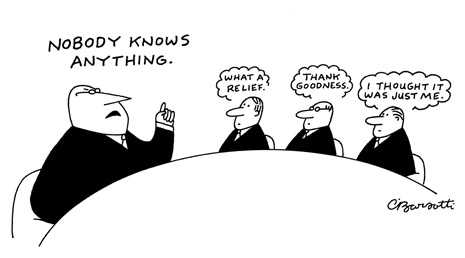
If you are a believer that many or most people are weak and prone to behave badly if not kept in line, this line is not hard to draw. It is simply the line between ‘good’ (people who terrorize others with good intentions or because they have no other alternative) and ‘evil’ (all other terrorists). It then becomes simple to define only the terrorist acts of ‘evil’ people as terrorism. The terrorizing actions of ‘good’ people are simply necessary. The irony, of course, is that, as the cartoon above shows, it is not at all uncommon to have opposing groups each seeing their actions as necessary and the other’s as terrorism.

For those of us who do not have such a jaundiced view of human nature, this distinction is much harder to make. When Bush says “you’re either with us or you’re with the terrorists” he’s trying to herd everyone into accepting this conservative and negative view of humanity. And he believes it. He and many other conservatives simply cannot fathom how other ‘good’ people could commit such an act. They are either insane or evil, and the conservative mind is not terribly fussed about which (as their proclivity for executing the insane demonstrates).

And here’s where the debate in the UK, where conservative thinking is less rampant than it is in the US, comes in. Indeed, the heading of Gopnik’s article is ‘Not Scared’, which suggests that the attempt to “intimidate, strike fear or coerce action” did not work and will not work in that country. Gopnik says the debate there is between

the old right and the old left against the Thatcherite right and the Blairite left. And, while in America the argument that a war on terror might not be ìwinnable,î or that the terrorists might not be madmen but shrewd and calculating militants with a clear cause, has often seemed almost unsayable, everyone in London was either offering it or offering a refutation of it… The antiwar left (and right) did not hesitate to blame Blair and Bush for what had happened in London… As early as Friday morning, journalists like Tariq Ali, in the Guardian, were saying flatly that what had happened had happened because Britain was in Iraq. The United States and Britain began the war in Iraq with the certainty, the argument goes, that they would cause many civilian casualties in pursuit of their political goal, and that the response, however brutal and inhumane, is part of the normal calculations of organized violence. Against this argument is the view that the new kind of terrorism is essentially nihilist and apocalyptic, and that Iraq is only a kind of inchoate excuse.

So, says Gopnik (after a bizarre and ill-reasoned dismissal of a BBC documentary’s argument that almost all terrorism is largely spontaneous and uncoordinated, and an equally bizarre dismissal of the legitimacy of George Galloway’s argument that some kind of terrorist reaction to Britain’s involvement in Iraq was inevitable), the British are debating whether the acts of the subway bombers were psychopathic and nihilistic, or shrewd and rational. He concludes that they were both.

When I read this I was stunned. Could it be that even staffers on the most informed and informing magazine in the US still don’t get it — that they really believe terrorists are either insane or evil? This is a profoundly conservative argument, and it is precisely Bush’s argument, the only difference being that the British at least respect the distinction between insanity and evil, and offer different solutions depending on which motivated the behaviour.

It’s hard to believe that Gopnik cannot see that the BBC documentary has it exactly right. There are conceivably as many as a billion people on this planet who, out of desperation or ignorance, see the West as the cause of their plight (with some justification) and who see attacks on the West as counter-terrorist activity, as necessary to end the terrorism that they perceive they are suffering from. You saw them cheering in the streets of Palestine the day after 9/11. This billion people is neither a ruthless, coordinated and evil group of shrewd schemers, nor are they a billion insane, nihilistic and deranged madmen. No one could organize that broad and intense hatred. And if there’s a billion people all suffering from the same form of madness, we need to think about our definition of insanity.

And, although he showed a deplorable lack of tact, George Galloway also has it exactly right. When you have a billion people who hate you, many of whom live in your midst, and many more of whom hear your Prime Minister with his arm around George Bush making preposterous excuses for attacking Iraq and killing thousands of civilians on top of the hundreds of thousands already killed by Saddam when he was the West’s ally and by the cruel sanctions imposed by the West, on the basis that it posed some kind of imminent threat to the West, some of those billion people are going to do what their Western counterparts, the American conservatives, did: take up arms against the perceived enemy. Any way they can. Why is this so hard to understand?

As many of you know, I live in Canada, a country that refused to send troops to Iraq despite fierce American threats (including some from the former US wingnut ambassador that met the above definition of terrorism), but which did put troops in Afghanistan, a country that outside of its capital city remains anarchic, destitute, and unimaginably brutal. Canada still has troops there. Canada also supported the sanctions against Iraq and has largely supported Western positions on most issues in the Third World including the Middle East. Canada has a large number of immigrants from the Middle East, many of whom are as vocal in their opposition to Canada’s foreign policy as the radicals from whom the London subway bombers came. I believe it is less likely that Canada will be the victim of a major terrorist attack, by anyone, for the simple reason that we are a smaller, less visible and less strident nation in our public policies. I believe, however, that it is absolutely inevitable that Canada will eventually be the victim of an attack of some kind, for precisely the same reason it was inevitable in the UK. After the London bombings the head of the Toronto subway system laughed that it wouldn’t happen here because the terrorists would first have to be able to find Toronto. The idiot should have been fired on the spot for that remark.

I also believe that there is absolutely nothing we can or should do about it. The British have been trying to be vigilant about terrorism for centuries, and are one of the most prepared nations on the planet, but they were unable to prevent either the bombings of two weeks ago or the ‘warning’ repeat occurrences that happened today. Canada is much less prepared than Britain, and we will handle the situation very badly when it occurs. The way we should handle it is not, as a Canadian government minister said after the London bombings, to step up preparedness and work ourselves into a frenzy of higher vigilance, but, when it happens, by showing, as the British did, that terrorism won’t work — by getting on with our lives, and picking up the pieces exactly as if it were a natural disaster — because that is precisely what it is.

The only way to prevent terrorists from attacking us is by doing much more to show the billion people who hate us that we care about them, by investing in their schools, their hospitals, their infrastructure, their know-how, and the institutions that, if they could be made to work effectively, would make life for this billion people immeasurably better. That also means we need to respect their culture, as long as it does not harm others, and not impose our culture and values on them.

It’s interesting that, six pages further into this week’s New Yorker, James Surowiecki laments the ineffectiveness of foreign aid, but urges us (no conservative, he) to carry on with it, trying our best to use distribution mechanisms (like NGOs), moral suasion, and audits to ensure the aid actually does get to the billion people who need it, especially in the forms I mentioned in the previous paragraph. He concludes:

Humility is no excuse for paralysis. In 2002, President Bush created the Millennium Challenge Account, which is designed to target assistance to countries that adopt smart policies, and said that the U.S. would give five billion dollars in aid by 2006. Three years later, a grand total of $117,500 has been handed out.

Compare this to the amount we’ve spent on war against Third World countries that have failed to improve the people’s lot. Tells you something, doesn’t it?

Cartoon by Wiley Miller from the wonderful strip Non-Sequitur.

July 20, 2005

Apology, and Some Early Thinking on Stuff

Filed under: Our Culture / Ourselves — Dave Pollard @ 15:18
hermanchart
It’s about time I stop pretending there’s nothing wrong. If you’re a regular reader of How to Save the World you’ve certainly sensed from my writing that something’s amiss — my writing is shorter, disjointed, unfocused, just not all there. My patient colleagues on our AHA! The Discovery & Learning Centre project must be ready to give up on me. I owe considered responses to thoughtful e-mails from 127 readers dating back six weeks, and have not participated in the dialogue in the comments threads of my weblog for eight weeks. Anita, to whom I owe everything, is justifiably angry at me, and worried about my mental health. And many of the daily and weekly chores I’d trained myself to do diligently, and found surprisingly therapeutic, lie neglected and undone. Whatever is the opposite of having one’s shit together, whatever is the opposite of paying attention, that’s me.

I say this not as a prelude to an important announcement, nor as a request for advice, or even as the pretext for offering some excuse. I say this just to let you know I’m aware of it, and I know you’re aware of it, and I’m sorry I have been so irresponsible to you all. This article is about where I’m at and what I’m thinking. This is my written ‘thinking out loud’ way of rocking the vehicle of my life back and forth in the attempt to get it unstuck.

I was always impressed at Neil Young’s ability to capture the essence of our humanness and the reasons for our behaviour in a handful of words, and these days I keep hearing these words of his in my head: “I am a child. I last a while”. I have no stamina. I get interested in things and get wrapped up in them for awhile and then my interest flags and I do something else for awhile. I don’t abandon things (though that’s probably how others see it), I just put them aside, and usually take them up again later with just as much intensity. When I wrote the article about the importance of Doing One or Two Things Really Well (Believe in yourself, Find 1-2 things you’re passionate about, Hone your skills, Stop doing other distracting things, Show others how good you are, Trust your instincts to guide you), I was trying to provoke and teach myself that very valuable advice, but I often do not take my own advice. I’ve stopped beating myself up for this, and accepted that that’s just the way I am. Just because you know just what to do, doesn’t mean you’re going to do it.

I’ve been doing some early thinking about several subjects and projects, and I’m not far enough along to write anything polished about them, but I thought I’d tell you about them anyway. Maybe thinking out loud will get me unstuck. Maybe it will get some of you unstuck.

AHA!

First, I want to talk about AHA!. I’ve changed direction on this so often that I’ve practically paralyzed my thinking on it, and in the process driven to distraction the online colleagues who have been so helpful in incubating the concept. Here is the essence of the idea:

  • Its objective is to explore and discover approaches to complex issues, from global warming and violence and poverty in the Mideast to the dysfunction and lack of innovation in large organization. We know that complex issues can’t be addressed using the old merely-complicated approaches (like systems thinking, reengineering, cause-and-effect analysis, etc.), and in fact the group that is most enthusiastic about AHA! are disgruntled consultants (mostly my age and older, some retired) who are fed up with using approaches that sell well but just don’t work — three years later you look back at the project you poured so much sweat into and nothing has really changed. AHA! implements Einstein’s advice that we won’t solve problems using the same kind of thinking that gave rise to them. Complexity theory is new and largely untested in this area but there are some fascinating and powerful techniques (open space, tipping points, narrative and storytelling, probe/sense/respond, conversations, appreciative inquiry, empowered autopoiesis, collaboration, mindmapping and concept mapping, passion bounded by responsibility, the gift/generosity/support economy, pattern recognition, improv, the wisdom of crowds and the four practices, all of which I’ve written about in these pages) that seem well-suited to support a complex adaptive system ‘discovery-and-learning based’ methodology.
  • We’ve identified a group of people who we think have the experience, knowledge, motivation and collective skill to develop this methodology, and put together (but not sent) an open space invitation (taking our own medicine) to attract them to come together for either or both of two sessions to co-develop it. A lot depends on who comes to these sessions, and I’m stalled on this point — before we can hope to get the world’s greatest minds working on this, we need to build momentum and recognition, but we need those minds to develop it effectively in the first place, and we need their reputation to attract others. My partners tell me “just start!” and they are of course right, but thanks to my not having my act together we’re still not started. I/we have a lot to learn about invitation.
  • Everything we develop will be open source and creative commons licensed. We may charge for-profit organizations to help them apply the methodology, but only for the purpose of funding sessions to use the methodology to solve the world’s most intractable problems for free. The business model here (how we make money, which we all have to care about to some degree unless we’re independently wealthy) is to earn money around the edges of AHA! — If this works as well as we think it might, those of us who are truly expert in applying it might well get some lucrative offers to talk about it, to teach people how to use it, to develop spin-offs etc. But it will not be proprietary.

I give my colleagues, especially Dave Davison, Rob Paterson, Chris Corrigan and Dave Snowden, 90% of the credit for this idea, which is brilliant, important and truly inspired. But an idea is only an idea, and implementation is everything. So what’s the matter with me that I’m not getting on with it?

Six weeks ago Dave Davison sent me a note with the chart above, taken from this wonderful article called The Inviting Organization by Open Space pioneer Michael Herman. The chart is now pasted on my Getting Things Done list under my daily reminders of what’s important. It seems to me that our answers to the four questions he asks: Why do I work? (passion/purpose), What do I make? (action/responsibility), Where should we go? (culture/story) and How do we get there? (structure/systems) largely define us as individuals and peoples. Herman quotes Angeles Arrien from her book The Four-Fold Way on how to answer those questions: show up, pay attention to what has heart and meaning, speak your truth, and let it go. To some extent AHA! aspires to be the vehicle that will enable us to do so more powerfully and more effectively.

The Importance of Self-Esteem

A while ago Chris Corrigan was kind enough to send me some notes he had taken from a presentation by Lakota leader Martin Brokenleg. The presentation was about reclaiming youth at risk, but its lessons are lessons for all of us. Here are a few of the key ones:

  • The self-esteem that makes us healthy and productive members of society stems from four traits: Belonging (your significance as a member of communities and through relationships with others), Mastery (becoming extremely competent at something, not through competition but by learning from role models), Independence (the personal power that comes from knowing that you can do things for yourself), and Generosity (the virtue of unselfishness and the self-worth that comes from helping others). Whales, ravens, eagles and wolves are the respective totem symbols for these four traits. As we get older, Belonging leads to Attachment, Mastery leads to Achievement, Independence leads to Autonomy, and Generosity leads to Altruism. This is what maturity is about. (Suddenly I feel very immature.)
  • Rather than using punishments, laws and other barriers, we can keep peace in society far more effectively by creating resiliency in people. We can do that by stressing the positive (rewards and appreciation for things people do that are healthy and helpful, rather than deterrence and punishment for destructive acts), by addressing the environment that causes behaviour rather than just the behaviour, by preventing rather than fixing problems, and by promoting and participating in activities that unify us and stress collaboration and cooperation rather than conflict and competition.
  • When you create a society that says children don’t matter, you create a society that says people don’t matter.
  • Education is about creating capacity and expanding choices, not developing skill. It’s about learning responsibility, not behaviour.
  • Restorative justice has a recidivism rate ten times lower than incarceration and punitive justice systems.
  • The need to belong is so strong that if we can’t find healthy, constructive, inclusive places and groups to belong to, we will choose unhealthy, destructive, exclusive ones and pick up their behaviours (gangs, snobs, addicts).
  • The need to learn to do things yourself is behind much ‘terrible twos’ behaviour and teenage rebellion (and perhaps mid-life crisis).
  • The love of learning is natural, and if someone doesn’t want to learn, the problem is in the environment, not the person. Learning needs to provide a sense of accomplishment.
  • Neither authoritarian nor passive parenting approaches work. Only the nurturing approach — parent as coach and cheerleader — works.

This is so utterly different from the way that we are raised today it is startling. We are taught to get self-esteem by winning, by competing, by overcoming obstacles through struggle dammit. How warped is that when we can get it more easily, more positively, more healthily through social, cooperative means? But instead we are taught to get self-esteem by rugged individual effort, and we measure it by our power over others, and by what we possess.

A belief system that finds no tension or conflict between belonging and independence, no incompatibility between attachment and autonomy, is one that is vastly beyond the sophistication of our ‘modern’ civilized belief systems. How much we have unlearned!

Mars and Venus

Lately I have been listening to a lot of music until late into the night, and almost all the music I’ve chosen to listen to is by women composers: Sarah McLachlan, Trespassers William, Michelle Branch, Sheryl Crow, Toby Lightman, Frou Frou, Alanis Morrissette, Jann Arden, Barlow Girl, Hope Sandoval and many others. I am led to understand that these tastes are very unusual for a guy in his fifties. And I confess that when I read the lyrics to many of the songs from these composers they aren’t very, well, substantial. Looking back at my postings on this blog almost all the song lyrics I’ve cited have been by male composers. And my friends Rayne and Aleah have pointed out that almost all the books I’ve recommended are also by male writers.

I’ve concluded that this has a lot to do with the very different ways in which women and men communicate. Since men have hogged most of the power since the dawn of civilization, it wouldn’t surprise me if most languages are skewed in favour of male communication styles, and their preferred subjects. So perhaps that explains why a lot of songs by brilliant women songwriters are kind of spare on words and rich in tones, harmonies and expression. Most of the emotion in music (and in conversation) is conveyed by those qualities anyway, not by the words. And I confess that when I study the lyrics of women composers I have to admit (a) they don’t seem to be about what I thought the music was about, and (b) I really don’t understand what they’re singing about. But it doesn’t matter — I love the music, I find it transporting, I connect with it in ways that I rarely connect with the music of male composers (exceptions: music by African and Latin American male musicians, male instrumentalists and a few guys like James Taylor and Neil Young). When Sarah sings “Elsewhere” or Michelle sings “One of These Days” or Sheryl sings “Light in Your Eyes” or Trespassers sing “In a Song” I am carried away, my eyes fill with tears, and somehow I understand.

Of course I do not. What is really scary is that this “illusion that communication has really occurred” (as Shaw put it) may actually be far more pervasive than just our (mis-)reading of music. It may be that almost none of what we think we are communicating, beyond the simplest and most unambiguous information, is actually understood by anyone else. In fact the tone and the body language and all the chemical messages flying between our bodies when we converse, and all the repetition that to a third party must seem almost comical, may all be necessary to stand even a 1% chance that 1% of the intended meaning of what we were trying to communicate was actually conveyed. And in communications between males and females that percentage is perhaps even lower. How else can we explain how it is the people we love, people with whom we share so many hours and experiences and even bodily fluids, can have such atrocious and inexplicable taste in music?

There’s a commercial out now for (I think) Right Guard men’s body spray (whatever the hell that is) that depicts a woman talking rapturously with another woman about how much she loves the clown practicing his horrific guitar-playing (or in another commercial, he’s making goofy noises with his buddies watching a sports event) in the next room. This passion is triggered entirely by how his body spray reminds her of her favourite moments with him in the past (shown as balloon flashbacks in the commercial, from a perspective of memory only a women would have). I think it’s a brilliant commercial, even if it’s a little too close to the truth for comfort.

Now I guess I need to figure out what ‘body spray’ is. Deodorant for places that don’t smell? Perfume that goes for quantity over quality?
. . . . .

Well, I guess that brings this strange apology to an end. I will try to be more responsible in future, and I hope you won’t give up on me. My heart’s in the right place, my head is full of very interesting and potent ideas. If only the rest of me could get in step, maybe I could actually get somewhere.

July 19, 2005

Why Is Innovation So Hard to Sell?

Filed under: Working Smarter — Dave Pollard @ 16:06
sanddragonWhenever I speak to some of my new online friends in the innovation consulting field, we lament the fact that, although everyone seems to agree innovation is important, few companies seem prepared to bring in someone professional to help them do it better. I’ve concluded there are four reasons for this:
  1. People don’t like to change. It’s not that hard to sell Change Management, because companies realize this, and when they have to change they recognize they need help to manage and ‘sell’ the change to their own people. But usually that happens when a change has been forced upon them (e.g. in a business merger). Change is reaction. It takes enormous courage to be proactive and decide you’re going to put yourself, and your people, through potentially gut-wrenching change when you may not absolutely have to, or before you absolutely have to. Business process improvement is largely incremental, small, manageable, painless stuff. Business reengineering was sea change, transformational, traumatic. Guess which one of these consulting disciplines is still around?
  2. Everyone thinks they can do it themselves. When a company accepts that innovation is needed (because the stock price has halved or the new offshored competitors are eating its lunch) there is generally a sense of collective embarrassment, and a groupthink quickly sets in that says “we got ourselves into this, we have lots of creative minds here, we can get ourselves out of it”. Often by the time they realize they need help, they need a receiver or bankruptcy trustee rather than an innovation consultant. There’s great skepticism that innovation consulting is a real discipline. An innovation ‘facilitator’ may be acceptable, to provide some structure and process to the company’s efforts to solve its own problems, but what outsider would be arrogant enough to presume they could tell a company how to transform itself into something very new and different? It’s like bringing in someone to teach your kids about sex or to advise you how to get your personal financial affairs in order — eminently logical, but embarrassing to admit you need outside advice to do these things well.
  3. It’s a ‘dragon‘ issue, so it involves a lot of trust. It’s frightening to open your kimono to a stranger. You have to admit that without innovation there is (or will soon be) a huge problem in your organization. There’s no such thing as a dragon, but there it is, wreaking havoc right in our midst. Anyone know a dragon-slayer we can trust not to tell our employees, our customers, our competitors that this fire-breathing monster is in our midst? In some sense it’s an admission of failure, so even calling it something else, or doing it when the dragon is still small, doesn’t entirely eliminate the discomfort.
  4. It requires understanding of how and why the market has moved on without you. Successful businesses have found a need and filled it, and are often intensely customer focused. When you need to innovate, that means those customers you’ve got so close to and so comfortable with are somehow unhappy with you (or alternatively are much happier with your competitor). This is hard to come to grips with, because
    1. it’s probably not your fault — it’s the market and the competitors that have changed, probably in disruptive and unforeseeable ways,
    2. customers also hate change, and it’s painful to discover that they’re getting something from a competitor that’s so much better, cheaper or whatever than what you offer that they’ve made (or are about to make) the switch,
    3. it’s unnerving to realize that customers ultimately have life-and-death power over your business, and often behave unpredictably, and
    4. it’s difficult and to start looking at your customers and market through a strange new perspective — which is where you have to start if you really want to innovate.

customersegmentsThe first three reasons are hard for anyone in innovation consulting to overcome. You just have to wait until the company is ready to buy what you offer. You’re as much at the mercy of your customers and their readiness for your service as they are. Quite often when I’ve debriefed over an unsuccessful innovation consulting sales pitch, the first realization is that I couldn’t have done a better selling job, the customer just wasn’t ready, emotionally, for what I was offering. When you know you have something of great value to offer companies, it’s easy (and deadly) to get ahead of the market. All you can do is give them a steady stream of interesting ideas that credentialize you and show you understand and care about their business and can be trusted, and wait until they’re ready to buy. The dilemma is that by nature innovation advisers are not an especially patient lot!

The fourth issue is one where we in the innovation advisory business could demonstrate some thought leadership and make it a little easier and more valuable for customers to retain our services. We all tend to look at customers in two slices or dimensions: (a) the demographic or affinity group they belong to, and (b) the types of needs and wants they have. So if we’re selling MP3 players, we may be focused on the 14-29 year old demographic (who are fastest to adopt new technology), and the seekers of high-capacity, portable, personalized music, as depicted  on the first chart at right. And as new features come out we incorporate them, and we ensure our software is compatible with different music formats and operating systems.

But suddenly we’re being blown out of the water by the Apple iPod. Why? Is it a better product? No. More reliable? No. More compatible or more advanced features? Not really. So where have out traitorous customers gone? And why are all these old fogies buying these things? What, even the Queen has one? Damn, they cost 50% more than our unit. What do they have that we don’t? If we don’t figure that out, and understand how the market changed beneath our feet while we were busy focusing on it, we’re goners.

As the second chart shows, the iPod is as much a fashion accessory as it is a music player. What it has that we don’t have is the logo and design that Apple are famous for. It also appeals to groups that might have felt self-conscious wearing something associated with younger users — like 30-something and older commuters and exercisers. And what’s worse, it has counter-culture appeal. Even though our product is more counter-cultural than anything a giant like Apple could produce, perception is reality, and Apple is (for now) the epitome of counter-culture, one of only two surviving competitors to Microsoft, the company everyone loves to hate. So the iPod is cannibalizing our 18-29 demographic, the part that also sees itself as counterculture. And most infuriating of all, some of the style and status seekers are leaving us to buy a unit like the iPod Mini that actually has a lot less music capacity than our machine, and costs more. Damn these fickle and irrational customers!

What’s happened here? We’ve defined the demographic and affinity segments in terms of what we have to sell, rather than how these affinity groups define themselves. And we’ve defined their needs in terms of the features and attributes we can offer, instead of much more broadly in the emotional terms that the customers define and recognize their needs themselves. This is a fatal error, but one which our intense customer focus almost drives us to commit. Once we get fixed in our mind what our demographic targets are and what needs we’re filling, we start to define our customer in the context of what we can sell to them, and we can’t shake that mindset. Meanwhile, the customers are defining themselves in completely new ways constantly — as the culture changes, as they get older, as their needs and wants evolve. While we were focused on them, the customers have left us behind.

I believe there is a great opportunity for innovation advisers to help their clients understand where the market is going (and has gone, and will be going soon) in a radically different way from what marketing consultants have done. It’s another opportunity for cultural anthropology — going out into the complex (not merely complicated) marketplace of ever-changing self-forming and self-defining communities, constituencies, and affinity groups and discovering how customers are redefining themselves, and how their wants and needs are simultaneously and constantly evolving. It is through looking at the patterns in customers’ stories that we can provide our clients with a startlingly different and enormously useful picture of the market and its direction — the most valuable input into an innovation strategy that anyone can offer.

Who knows, they could be so impressed that they’ll overcome their resistance to change, lack of trust, and skepticism of the value of external advisers to the point innovation consulting becomes a growth industry and Western business could once again become the most innovative in the world. Innovation advisory services could even become the intersection 3 career many of us are looking for.

July 18, 2005

There is No Justice

Filed under: How the World Really Works — Dave Pollard @ 22:25
roy“If You Want Peace, Work for Justice”

So read the bumper sticker on the car on the highway ahead of me today. It has a nice ring to it, and it does make sense on the surface: When they are constantly treated unjustly, how can we expect the oppressed to follow a peaceful path? The poor, the disenfranchised, the powerless, and minorities are treated appallingly all over the world. The only surprise is that there are not more violent uprisings among the billions who have never experienced our world as a just place.

Arundhati Roy, acclaimed author and advocate of both peace and justice, has made this point on many occasions, most recently when she gave her speech last month as spokesperson for the World Tribunal on Iraq, a group opposed to the political and economic oppression of the Iraqi people by criminals of every stripe, from the religious fanatics and despots past and present who brutalize, steal, terrorize and deprive citizens of their rights, to the Halliburtons and other war profiteers who cheat and steal from the country and its people out of bald greed, to the warmongers and imperialists who have used and continue to use lies and deception to justify atrocious actions, and to use that country as a whipping boy to advance their cynical partisan political agenda. None of these groups is interested in peace or justice for the people of Iraq or anyone else — injustice and war are far more profitable, politically useful and expedient.

Here are some of the points she made in an earlier speech, when she was awarded the 2004 Sydney Peace Prize:

The Iraq war is a sign that the world has lost the will to fight for true justice. Sometimes there’s truth in old clichÈs. There can be no real peace without justice. And without resistance there will be no justice. Today, it is not merely justice itself, but the idea of justice that is under attack. The assault on vulnerable, fragile sections of society is so complete, so cruel and so clever that its sheer audacity has eroded our definition of justice. It has forced us to lower our sights, and curtail our expectations. Even among the well-intentioned, the magnificent concept of justice is gradually being substituted with the reduced, far more fragile discourse of “human rights”.

War mongering is criminal. But talking of peace without talking of justice could easily become advocacy for a kind of capitulation. And talking of justice without unmasking the institutions and the systems that perpetrate injustice is beyond hypocritical. It’s easy to blame the poor for being poor. It’s easy to believe that the world is being caught up in an escalating spiral of terrorism and war. That’s what allows George Bush to say, “You’re either with us or with the terrorists.” But that’s a spurious choice. Terrorism is only the privatisation of war. Terrorists are the free marketeers of war. They believe that the legitimate use of violence is not the sole prerogative of the state.

The group No Peace Without Justice identifies four elements of a just society: human rights, democracy, the rule of law and international justice (recourse outside the country when the first three elements cannot be found within). In his book The Future of Freedom, Fareed Zakaria argues there can be no democracy, and hence no justice, without first having constitutional and economic liberalism, which he defines as including the rule of law, the separation of church and state, earned and reasonably distributed wealth (as calculated by the Gini index), defensible civil liberties and a balance of power (a system of check and balances to ensure no group accumulates enough power to be able to ignore the will of the majority). So all told justice has seven elements:

  • defensible human rights and civil liberties (freedoms)
  • democracy
  • the rule of law
  • the separation of church and state
  • earned and reasonably distributed wealth
  • checks and balances to prevent concentration of power that could subvert the popular will
  • international recourse when the other six elements cannot be found within

This is a tall order. History tells us that rights and freedoms are hard-won, and must be won again and again when despots come to power to curtail or eliminate them. Democracy and church/state separation are both fragile, and few countries have achieved either without a prolonged and violent period of popular unrest. The rule of law is ephemeral — not only do the laws need to exist and make sense to the people, they have to be enforceable and enforced, a situation that exists in few countries on the planet (many Latin American countries, for example, have strong environmental laws, but no money to enforce them and a high level of corruption and indifference among the few who are employed to enforce these laws). As measured by the Gini Index, only a handful of Northern European countries can reasonably claim that their wealth is earned and reasonably distributed — in many countries it is acquired by force, inherited for centuries, or claimed as a divine right, and in many others, including the US, its distribution is grotesquely skewed. And in even more countries one small group has an untrammeled monopoly on power.

The position of the US is particularly notable. Laws like the Patriot Act have seriously undermined human rights and civil liberties. Gerrymandering, unregulated campaign financing and a completely unreliable electoral system make the country’s claim to be a democracy highly dubious. There is no rule of law when overzealous, under-regulated and power-crazed enforcement agencies have the personal discretion to imprison people they don’t like without recourse to legal counsel and without limit, and to deport people to barbaric countries in order to outsource their torture and murder. There is no rule of law when the president, who has no respect for the concept or its importance, simply instructs federal employees not to enforce laws he and his corporate cronies don’t like. The separation of church and state in the US is unappreciated and under siege. The distribution of US wealth is among the most skewed on the planet, and a majority of the country’s rich elite inherited that wealth (and are working furiously to repeal the estate tax so that will continue). The checks and balances between the executive, legislative and judiciary (and the ‘fourth estate’, the media) are now extremely fragile and in danger of unraveling, and unelected corporations wield staggering and ever-growing power. And the US is one of the only first-world nations to have not only not ratified, but openly repudiated the International Criminal Court of Justice, and are now routinely using their veto power to undermine the legitimacy and authority of the UN. The current administration even believes it can ignore the Geneva Convention on torture of prisoners of war.

So on all seven scores, the US fails to live up to the standards of a ‘just’ society. Yet while this gun-crazed nation has a huge rate of violent crime*, it is politically a remarkably peaceful nation. If there is ‘no peace without justice’ how can this be?

I would argue that justice is a political and economic construct, while peace is essentially a social construct. Political and economic systems and dynasties are self-perpetuating — they are, after all, in control of the law, and they use it to hold on to the wealth and power they have become accustomed to. I have argued before that if we want to change — or save — the world, we are unlikely to do so by political and economic means — there is just too much of a vested interest in the status quo by those with all the political and economic clout.

By contrast, social change can occur quickly. Change to social systems is powered by information and education, not by laws and economic transactions. Information travels fast, and new technologies like the Internet allow it to travel much faster and more effectively than ever before. Information is, in its own way, power. Those with wealth and political power can sustain that wealth and power for a long time, but not indefinitely. Just as our remedy for an economic system that is ruinous and unsustainable is to use our social power to walk away from it, persuade others to join us, and starve that system to death as we set up a new, responsible one, so our remedy for a political system that is unjust is to use our social power to disassociate ourselves from it, persuade others to join us, and starve that system of legitimacy. Gandhi showed us how to do this, with non-violent resistance and civil disobedience, organization, and the establishment of a new responsible, responsive, community-based politic. It will take much longer to undermine the unjust political systems of this world by creating new political systems that work better — and we can expect a lot of angry backlash from those who find their power and authority and legitimacy undermined by our actions. But ultimately, now that the world is so crowded that there are no new frontiers, no refuges from political repression and injustice and outrage, this is the only answer.

There is no justice. With what we know about human nature and human history we should not be foolish enough to expect it in large, conservative, unwieldy governments, corporations and nation-states. And the road to peace, in the absence of justice, is a social one, not a political one. It’s a hard road, but we can have it, now, if we want it.

* a number of recent studies have indicated that it is the fifth of these elements of justice — earned and reasonably distributed wealth — that correlates most closely with the level of domestic peacefulness

July 17, 2005

What Do You Want to Do?

Filed under: Working Smarter — Dave Pollard @ 20:05
NatEnterpriseA contrast between a book on starting your own socially and environmentally responsible business by a British entrepreneur, and my own book on the same subject.

I‘m reading Neil Crofts’ book Authentic Business, which is entirely consistent with, yet utterly different from, my own book Natural Enterprise. Part of the difference is cultural — Neil is British, and his recommendations are designed for a UK/European business climate that is less ruthless but also less historically entrepreneurial than it is here in North America.

Neil’s book is more traditional than mine in several areas as a result: his recommendations for organizational structure (we both recommend unincorporated partnerships, but there is some hierarchy in his, none in mine), financing (my approach is more organic than his), and he acknowledges that stress and hard work are an inevitable part of entrepreneurship (I don’t).

But in some important areas his recommendations are almost identical to mine: He proposes creating a Constitution for your business instead of a Business Plan; I call it a Charter of Principles. Both our books stress integrity and responsibility to the community, to society and the environment, and to yourself. Both books talk about the importance of the community as more than just a source of customers. Both books talk about the importance of business alliances. Both books make decision-making a consensus process (Neil advocates use of Open Space processes). Both books stress viral marketing as the best way to make your business known.

The difference between the books that is most interesting to me is the determination of what the business will be. In this area, I am quite pragmatic — you need to start by carefully researching and finding a need that the market isn’t already addressing (and make sure you know why). My section on Expectations talks about finding the intersection between what you want to do, what you’re good at doing, and what there’s a need for. To Neil, what you want to do trumps the other two — he is more a believer than I am that if you’re passionate about wanting to do something, you will find an audience, and you’ll pick up the skills (or partners with the skills) that are necessary to make the business viable.

Here are the questions he suggests you ask to determine What you want to do:

  • When do you feel at your most motivated?
  • When do you get lost in activity or thought and lose all track of time?
  • When do you feel alive, focused and engaged?
  • What is the common thread between smiling at the rain, enjoying the earth in your hands, playing a sumptuous feast and playing with your child?
  • What is the focus of all your ‘flow’ activities, the pivot around which they turn, the outcome to which they all drive?
  • What is your non-negotiable dream, so precious that so far you have told no one about it for fear it will be compromised?

He says you should write this down, and discuss it with as many people as possible, starting with those you trust, until it is crafted into a repeatable catch phrase, Your Purpose. Then whenever anyone asks What You Do, you instead tell them Your Purpose. And you build from there, using the advice in the book until Your Purpose becomes your successful, ‘authentic’ business.

WhatToDoMy approach is to start by identifying needs, and then decide which ones you are passionate about filling (and competent to fill). I know my friend Rob Paterson is in Neil’s camp on this — his advice to someone who knows their Purpose is to be a rock guitarist to spend every spare second being a rock guitarist, practicing until you’re great at it, and not waste time pursuing a general education or a bunch of fall-back options. Same thing if you’re an athlete, or an artist.

I have no doubt that if you want to be successful in one of these overcrowded and fiercely competitive fields, you have to go at it with that single-mindedness. But I don’t think most of us are that exclusive in defining our Purpose. My guess is that for most of us, there’s at least one Purpose that sits in the intersection of What’s Needed, What You’re Good At and What You Love. I think what Neil is saying is that, on the chart at right, Your Purpose is whichever of the activities in intersections 1, 2, 3 or 4 you feel most drawn to. I think most people would be happier, and probably more successful, doing activities in intersection 3, since they wouldn’t have to wait for a market, or kill themselves practicing to be good at them. But a lot of us can’t find anything in intersection 3. I would agree that it’s a cop-out to do things in intersection 5 (the space most of us, alas, work in).

So it comes down, for most of us, to a decision: We can work like hell to try to take activities in intersection 2 and move them to intersection 3 — though it’s really tough to create a need, or even get an unrecognized need recognized (that’s where I’m at right now). And opportunities in intersection 4 are even tougher (and take courage) to find, though they’re probably easier to move to intersection 3 (practice, practice, practice). As a result, too many of us spend our lives doing jobs we hate in intersection 5, and we fill the empty place inside with hobbies in intersection 1 or (if we’re good) intersection 2.

My sense is that it’s easier to keep searching for opportunities in intersection 3, and, if that proves fruitless for too long, finding something in intersection 4 and working hard at it. This is hard work that requires great courage and enterprise, but books about people who have found great happiness in their lives are almost all stories of this type of journey. You have nothing to lose but your chains.

What do you want to do?

July 16, 2005

Saturday Mixed Bag

Filed under: Our Culture / Ourselves — Dave Pollard @ 20:33
secondlifeSix interesting links for the week:

Hummingbird Nest: Take a look at these astonishing pictures (be sure to check out all five pages) of the birth of hummingbirds. As you do, keep in mind that these pictures are twice actual size. Thanks to Susan Hales for the link.

iPod Flea: If you haven’t seen this it’s good for a laugh.

Second Life: I’m told that Second Life, a video game “framework” where the players create the content a sample of which is shown at right), is highly addictive. Here’s what the site says:

Second Life is a virtual world – a 3D online persistent space totally created and evolved by its users. Within this vast and rapidly expanding place, you can do, create or become just about anything you can imagine. Built-in content creation tools let you make almost anything you can imagine, in real time and in collaboration with others. An incredibly detailed digital body (‘Avatar’) allows a rich and customizable identity. A powerful physics simulation running on a backbone of hundreds of connected computers and growing with the population allows you to be immersed in a visceral, interactive world that as of April 2005 covers more than 12,000 acres and 20,000 owned plots of land. The ability to design and resell 3D content, combined with the ability to own and develop land and a microcurrency, which can be exchanged to real money means that you can build a real business entirely within Second Life. If you are simply curious about what it would be like to wander a world filled with colorful people in which the only limits are imagination, you will find the Second Life software easy to install, and the basic experience of moving around and experiencing the world simple and fun, with many friendly people waiting to help you once you arrive.

If I had more time on my hands, I might try this. Could this be used to simulate answers to global problems in some meaningful way, to see what the Wisdom of Crowds has to say about them before we try them in the real world?

Taiko Mania: If you don’t know about Taiko:

Taiko began as a cultural expression of the Asian American civil rights movement representing the dual (American and Asian) identities of the practitioners. Audiences, performers and young students gravitated to this art form that encouraged them to be both Asian and American. While enhancing Asian American identity and serving as a symbol of cultural empowerment, the first generation of American “taiko pioneers” nurtured students in youth groups and junior taiko programs throughout North America.

You may have seen some of the Taiko videos popping up all over, perhaps the new Mitsubishi Eclipse commercial.

Personal Productivity Improvement Gets Another Boost: A new article in HBR says that personal productivity coaching should take the place of bums-on-chairs (and computer-assisted) group orientation programs. I’ve been saying this for years. Maybe now that HBR is saying it, people will start listening. “Don’t tell me, show me.”

And The Gift Economy Gets Another Boost: A new article on Open Source explains to those who haven’t caught on yet the remarkable sense of giving away stuff free.

July 15, 2005

How to Write Like Dave Barry

Filed under: Our Culture / Ourselves — Dave Pollard @ 21:16
davebarryAdmit it: You think that Dave Barry‘s writing is funny, even when it’s silly. And you can’t help but be jealous of a guy who gets paid to write goofy stuff he just makes up every week (or which is prompted by something a reader sent him), and then gets paid again to compile this silliness into a book consisting of reworked columns on a common theme, such as boogers.

Well now you, too, can write just like Dave Barry and become rich and famous, thanks to How to Save the World‘s amazing Dave-O-Matic humour-writing program.

This works just like those old Chinese Food menus where you get to pick one item from each column to make your menu. Except that in this case, you choose one item from each menu to make your column.

Menu 1: Aw Shucks Jocular Introductory Set-Up Sentence
This sentence is to portray yourself as a regular guy/girl and put the reader off guard before you dazzle them with your brilliant witticisms. Of course, it also has to grab your attention, so you keep reading instead of turning to the comics page instead. Examples:

  • I swear I am not making this up.
  • So I got this letter from alert reader Barbara Zlobotnik with alarming news about imploding heads:
  • My policy with wine is the same as my policy with beer, which is pretty much drink it and then look around for more.
  • When someone looking at your house describes it as “interesting” they mean “Who installed this paneling, vandals?”
  • Today’s question comes from 12-year-old Bobby Smith, an imaginary child from Iowa who asks…
  • The problem with history is that everyone who knows anything about it first hand is dead.
  • Lately I have been thinking a lot about [enter any serious but obscure subject here, e.g. the Gross National Product of Japan], because it keeps my mind off [enter anything silly and personally embarrassing here, e.g. the sudden proliferation of hairs in strange places on my body since I turned 50].
  • I would have to say that the greatest single achievement in [enter country and discipline here, e.g. American medical] history is [enter something ludicrous but on-topic here e.g. Dr. Scholl's Odor Eaters].
  • Every now and then I like to suggest sure-fire concepts by which you readers can make millions of dollars without doing any honest work.

Get the idea? With a little practice you can make up your own.

Menu 2: Easy-Target-Group Subject
The subject of your column should be some individual or group, real or imagined (imagined is better, since you cannot be sued for libel or accused of political incorrectness) who are dead-easy targets for scorn, ridicule or even, if you’re hard up, contempt. Ideally the subject should be so funny that simply thinking about this individual or group gets you snickering. If that isn’t possible, you need to add a hyperbolic adjective or two to make them appear more laughable. Examples:

  • Pretentious French wine snobs with large pointy noses
  • Camel-oriented nations
  • Mummified sales representatives
  • A guy in Idaho with the IQ of Cheez Whiz
  • The Ty-D-Bol man
  • Bill Gates
  • Dyslexic telemarketers
  • Previous American Presidents and Vice-Presidents (the current ones are not funny)
  • Tupperware and other home-sold product salespeople
  • Bratty children of politicians or royalty
  • Civil servants, especially the DMV
  • Foreign despots, especially funny-looking ones or those with bizarre names like Muammar Ghaddafi
  • Anyone who works in the airline or fast-food industry
  • Hundred-year-old rock stars
  • Real estate agents
  • Trout
  • Surly men with low centres of gravity
  • Call center staff of large corporations
  • Any group known for exposing their butt crack while working
  • Lyndon LaRouche
  • Bosses from Hell
  • The IRS
  • Proctologists

Menu 3: Funny Dialogue or other Italicized Text or Capitalized Term
This is to get you conditioned to laugh at anything that appears in italics or Capitalized Words in the rest of the article or column. This is the written humourist’s equivalent to the television laugh track. If you fail to laugh in the designated spot, this suggests you might be too stupid to ‘get’ the humour. This ‘aside’ also builds suspense for the subsequent action that is going to occur to the Easy-Target-Group Subject. Examples:

  • “$89,500 may seem steep for a refrigerator carton, but it is located near a good school.”
  • “The Coca-Cola Company is changing the name of its soft drink in China after discovering that the name in Chinese translates as ‘bite the wax tadpole’.”
  • (The Mexicans aren’t going to attack us, seeing as most of them already work here, and although I suppose Canadians could attack us, their population is only about the same as that of the audience on Oprah, only quieter, so even if they did attack, no one would know, especially if it was rush hour.)
  • If we sent the State Highway Department instead of the Army to defend our allies from foreign invaders, first they’d have their Cone Placement Division strew millions of plastic traffic cones randomly all over the roads, then they’d have the Sign Erection Department put up signs explaining that all the lanes would be really messed up for the next 17 years to Help Serve You Better, and then the Traffic Direction Division would get all kinds of low-life derelicts out there waving flags and directing motorists right into oncoming trucks, and before you know it it would be impossible for any vehicle from the invading country to get anywhere near the border.
  • At some point a hormonal secretion takes place in women that enables them to see dirt men cannot see, dirt at the level of molecules, whereas men don’t usually notice it until it forms clumps large enough to support agriculture.

Menu 4: Violent Action Verbs
Eventually even a writer as skilled and creative as Dave Barry needs to include some verbs in his column. The important thing in humour is that these verbs must convey the same imagery as the special effects in Road Runner cartoons or reruns of Three’s Company. Every action must be extreme, violent, absurd and visual (though actions that conjure up your other senses can also work, especially smell). Examples:

  • Exploded in a giant fireball that could be seen in Nepal
  • Crash into a remote mountaintop and be eaten by wolves
  • Catapulted the pate with such force that it took out a picture window
  • Dropped a mobile home onto Long Island from a height of 60,000 feet
  • Vaporized a small Siberian city
  • Pumping out enough sweat to make your clothing smell like a dead rodent
  • Suck your brains out through your eye sockets

Menu 5: Absurdly-Described Objects
Just for balance, the column also needs some inanimate objects. Such objects can stand on their own if they’re comical or vulgar in their own right (like spittoons, or Mel Gibson films), but otherwise usually need improbable adjectives for elaboration. Examples:

  • exploding toilets
  • boogers
  • Tang
  • blobs of earwax
  • bat urine
  • rap music videos
  • Ding-Dongs
  • hummers
  • instruction manuals translated from Chinese
  • Toys-Backward-R-Us stores
  • rusty potato-peelers
  • beer commercials
  • the University of Texas
  • testicles
  • nuclear-powered barbecues
  • infomercials featuring self-made guys on yachts surrounded by women in bikinis
  • mandatory school prayer
  • essential internal organs
  • fast food “nuggets”

I think that’s enough for now. We don’t want you to become too funny, or you’ll put late night talk show hosts and presidential speechwriters out of business.

And, of course, I’m not making any of this up. All the examples above come directly from columns and books of the inestimable Mr. Barry.

July 14, 2005

Seven Principles of Social Networking

Filed under: Working Smarter — Dave Pollard @ 17:39
SNA
O
nce a month a group of us, KM directors from various companies in the greater Toronto area, get together for ‘Breakfast at Flo’s”, a trendy/retro restaurant in Yorkville, and we talk shop. We usually start with an agreed upon topic, but we go off on frequent tangents. Today we were talking about Social Networking, and why the tools designed to make it work virtually haven’t proved very effective so far.

What emerged from the discussion were a set of principles which might provide some clues on how to develop Social Networking Applications that really do work, and how to establish processes that could enable and encourage effective networking in organizations. Here are the principles we came up with:

  1. Social Relationships Must Meet Four Preconditions: Willingness to establish a relationship with someone presupposes the existence of mutual trust, respect, context, and self-disclosure between the parties. These qualities are exceedingly difficult to achieve without face to face contact. Social Software tries valiantly but for the most part unsuccessfully to provide a basis and framework for these qualities to emerge, using systems of recommendations and endorsements to create reputation, and degrees-of-separation referrals to create verification. The best these tools seem to provide is a rough filter of inappropriate candidates for relationships, a ‘negative assurance’ that there is no reason to believe you should not enter into a relationship with someone. But we tend to be distrustful of people’s online identities because they are so easy to fake and exaggerate. Online, no one knows you’re a dog. Weblogs seem to work better to establish credibility, perhaps because of their relative permanence and self-disclosure, but they demand a major investment in time and energy to maintain. It’s just a lot easier and faster to set up a face to face meeting and let the chemistry work (or not). Perhaps the next generation will find ways to do this virtually and more easily, but technology changes faster than culture, and I’m not optimistic that better software design can overcome our cultural resistance to share bits before we share atoms.
  2. Relationships Require a Conversational Ice-Breaking: Conversations are much denser and hence more efficient and effective ways of transferring a lot of information while filling in context, than asynchronous communication mechanisms. Likewise, interviews are much more powerful ways to glean information from a subject than surveys. Even telephony lacks the face and body language clues that convey so much information in in-person conversations. Skype seems to convey more voice nuance than regular telephony, but, strangely, videoconferencing seems to add very little to the information content of virtual conversations. Perhaps this is due to bandwidth constraints or brief time delays in video transmission, but I suspect that chemical atoms passing between the parties in face to face conversations play a greater role than we’d care to admit — even technophiles confess that it’s much easier to get to ‘know’ a stranger in person than using even the most powerful technologies.
  3. First Impressions Matter: Our quick Blink judgements about a person, an event or an idea (provided they fit with our frames of understanding and belief) are critically important, and seem very difficult to dislodge with later  information, no matter how compelling. Perhaps that’s why visual clues about strangers are so highly valued in establishing trust, context, disclosure and respect. “Sniff, sniff, it’s OK, he’s one of us”. Once we have established an impression or initial judgement, what we seem to seek most is reassurance that this initial assessment was valid. This introduces some obvious dangers: ideological echo chambers, groupthink and the proliferation of conspiracy theories for example. And just to make the situation worse. we tend to ignore and turn off information that we cannot (or don’t want to) change, which further entrenches those first impressions and judgements. Physical appearance hence becomes an icon of our identity.
  4. Information Conveyed by Observation Counts More Than That Conveyed by Language: We instinctively give enormous credibility to our direct sensory observations, while we tend to consider what we’re told skeptically. Observation is a rich source of fast understanding and shared context. Our senses simply have much more information-processing bandwidth than the part of our brain that processes the spoken and written word. As a result, it may actually be more important to a relationship to see the other person’s environment than to see them. As Dave Snowden says: “We can always know more than we can tell, and we can always tell more than we can write down”. Observation allows us to mine data that the person to whom we are speaking cannot convey in words, or may not even be aware of. “Don’t tell me, show me.”
  5. Collaboration is the Miracle Glue of Relationships: Doing something together, the more participatory and challenging the better, immediately establishes deep trust, respect, shared context, disclosure, even a shared identity (e.g. Lennon-McCartney). Collaboration is also an essential precondition to real community, far more effective than any amount of shared gossip, online chat and head-nodding agreement. Until we’ve worked on something together, our agreements may be simply politeness, insufficient to form the basis for a strong and lasting relationship. “We did that!
  6. Every Interaction Carries the Burden of Our Entire Networks: Throughout any relationship, conversation or interaction our brains are processing a series of social constructs: (a) Information (what am I learning from this interaction?), (b) Meaning (so what — what does this mean to me?) and (c) Implications (what should I do, decide or expect as a result?) Information, meaning and implications are rarely just personal — in each interaction we are considering how to forward or explain information and its meaning to others in our networks, how to justify and discuss its implications with others in our networks, and how to motivate others to take what we think are appropriate actions or decisions as a consequence. So there is a huge invisible ‘audience’ for each network interaction beyond the direct participants in it. Social Networking Applications need to recognize and involve this audience (by recording and forwarding the interaction, by inviting others affected to join in etc.) “I appreciate what you’re telling me, but how am I going to explain and work this out with A, B and C?”
  7. Social Networks are Complex Systems: Social Software is designed as a solution to a complicated, rather than a complex, problem. We hope that we can one day in some way completely diagram, understand, and optimize use of our complete social networks, but the best we can hope for are possibly dangerous oversimplifications. The complexity of our networks simply cannot be fully known, explained or applied in any predictive way — there are too many variables and nuances of relationship to fully know, depict, or expect complicated-system software to handle. We should probably therefore be humbler about what we hope Social Networking Applications will be able to do for us. Their goal should perhaps be simply to better understand how our networks benefit us, how we can use them more effectively, and how to improve the quality and value of conversations and other interactions.

So as a result, these are the types of questions I think the designers and proponents of Social Networking Applications should be addressing:

  • How is it that some people are able to manage larger and more sophisticated networks of people than others? What are those people doing that we should all learn about?
  • If the costs of travel (financial, social, environmental) reach the point that face to face meetings between people farther away than the next community become prohibitively expensive, how can we best design simple virtual presence tools that simulate as richly as possible in-person conversations and other interactions?
  • How can we enrich the experience of virtual collaboration so that it becomes almost as powerful, intuitive and adhesive as face to face collaboration?
  • How can we design ‘cameras’ that allow the remote person, rather than the person in the same room, in a virtual conversation to control them, much as they would control their own eyes were they in that room, so they can observe what they want and not what the observed person wants?
  • How can we make all of this technology essentially invisible and automatic to the users, so that they can focus fully on the conversation or other interaction instead of being constantly distracted by the technology?
  • How can we identify simple rules that can explain complex systems like Social Networks, so that we can better understand how to make our networks and our social behaviours more effective, instead of trying to rely on massive databases, network maps and other ‘merely complicated’ system tools that pursue the impossible task of trying to describe these systems?
  • How can we (likewise using complex systems techniques instead of hopelessly inadequate sociological and psychological models) understand the rules that influence the effective achievement of (or impede) trust, respect, mutual context and self-disclosure, so that we can build these more easily and recover when they are absent or lost?
  • How can we learn to be better conversationalists and interviewers (which means better understanding the different information, communication and networking behaviours of different people)?
  • How can Social Networking Applications allow us to easily bring in and drop off people from conversations and other interactions whose information or insight is highly pertinent, who are affected by the outcomes of the interactions, or who otherwise need to be temporary participants, so that we can actually leapfrog the physical limitations that currently constrain face to face meetings, so that in at least this respect virtual meetings will actually be more effective and robust (almost like the continuous interactions of bees or ants)?
  • How can we learn to better understand the differences between how our brains work (collecting, organizing, applying and disseminating information within a single organism) and how our collective intelligence (our network) works?

These are not questions for programmers, analysts, sociologists or psychologists, but rather questions for cultural anthropologists, complex adaptive systems experts, and those knowledgeable about heuristics, neural networks and the Wisdom of Crowds. We need to develop much more skill in these emerging disciplines, because the old disciplines and the ‘merely complicated’ mechanisms for addressing these critical human challenges simply aren’t up to the job. As Einstein said, our current problems are not going to be solved using the same thinking that has given rise to them.

July 13, 2005

Three Ideas That Will Grow On You

Filed under: Working Smarter — Dave Pollard @ 14:24
hempAgricultural subsidies in both North America and Europe top $150B per year. This is tax money used to support business that would simply not be viable without it. Much of that money goes to the handful of global agribusiness companies that have oligopoly control over almost all food produced in the West; very little of it actually goes to small, community-based farmers. Much of that money is to encourage hugely inefficient, wasteful, and heavily polluting operations that raise non-native crops and farm animals and soak them with antibiotics, pesticides, herbicides and petroleum-based fertilizers.

Meanwhile, with no big money behind them and no media attention given to them, there are some wonderful opportunities to make agriculture sustainable, healthy and beneficial to small, community-based farmers, that are completely ignored. In a previous article I wrote about the opportunity to grow Stevia, a native American plant that can be used for sweetening without either calories or the Frankenstein chemicals that today’s overpriced artificial sweeteners contain. Here are three more ‘growing ideas’:

Rooftop Agriculture: A combination of rooftop agriculture and hydroponics (using recycled ‘gray’ water) could make our cities self-sufficient in botanic (non-animal) foods. The benefits (health, cost savings, community self-sufficiency, security of the food supply, less reliance on foreign oil for both fertilizers and transportation) are obvious. And most city roofs aren’t used anyway.  We need to get the biologists and urban agriculture specialists working with green industrial designers to figure out how to make this happen. (Thanks to Dynamic Doug Alder for the links).

Hemp-Based Foods, Textiles and Other Products: Perhaps because agribusiness can’t corner the market on it, and hence are pressuring the Republicans and Democrats in the US to keep harmless and efficient industrial hemp illegal, neither party at the national level will stand up and advocate the repeal of the ludicrous federal law banning growing the crop in the US. Ironically, the US is the world’s largest importer of hemp, and representatives of both parties in farm states have been pressuring the government to at least turn over regulation of the crop to the states — so far unsuccessfully. If you’re an American, support the new bipartisan proposal for such a change. Hemp based foods are remarkably nutritious, hemp can produce more environmentally-friendly and durable paper and clothing than cellulose or cotton, and it can even be used to produce biodegradable substitutes for plastics, medicines, detergents and inks.

Afghan Poppies for Medicine: Today’s NYT has an editorial suggesting that licensing Afghanistan’s flourishing (90% of the world’s supply) poppy industry could take it out of the hands of drug dealers and use it to solve the desperate need for low-cost pain killers in much of the world (including the West). There are problems with the idea, which has backing from a major European drug research organization, but the real challenge is the bull-headedness of ‘war on drugs’ advocates. Perhaps the 30-50 million Americans who have suffered or will suffer from chronic pain at some point in their lives could put a bit of pressure on them. Solving two problems at once would seem like a slam dunk to me.

There are a lot of good ideas like this out there. Why is our economy so inept at capitalizing on them?

July 12, 2005

Observations –> Opportunities

Filed under: Our Culture / Ourselves — Dave Pollard @ 14:00
inuk
Yesterday I found myself in downtown Toronto a half hour before my business appointment, so I decided, as research for yesterday’s article on paying attention, to spend that time really observing — looking for confusion, barriers, wear patterns, user torture and duct-tape and string workarounds, and also for ideas and opportunities that might have application more broadly or elsewhere. In just 30 minutes I came up with the following observations, surprising myself at how quickly, after just five minutes of practice, I started noticing things and identifying ideas based on those observations.
  1. Pets and children welcome: There was a small library on the block where I was making observations, and on the gate to it there was a sign with a picture of a dog with a loose leash, and below it a picture of a child holding an adult’s hand. Both pictographs were surrounded by a green circle, instead of the usual red circle with a slash. I have never seen a sign welcoming well-behaved pets and supervised children before. Why not? When I went to my appointment, the president of the company introduced me to her dog at the door to her office. Children and pets are humanizing influences in everything we do, so why do we so thoughtlessly shut them out of so many places? If we were to print up and give away ‘pets and children welcome’ signs, could we simply transform our cities into warmer, friendlier places? Could we, just by doing so, make everyone more aware of the need to accommodate not only the needs of children and pets (so much of our urban environment is overtly hostile to both) but diversity in general, and make us all a little more open-minded, more tolerant, more aware of the needs of others?
  2. Where’s the nearest parking spot?: I watched cars circle a dozen times or more looking for scarce parking spots on the street or in the tiny lots off the main drag. We have cell phones that can talk to vending machines and pay for merchandise electronically. Why not have parking meters, and parking lots, that, when there are spots available, send out a beacon that the small computers in today’s cars could ‘read’? This is not rocket science, and could save an enormous amount of wasted time and fuel. If my car can tell me the best route to take from A to B, why can’t it also tell me where the closest parking spot to B is?
  3. Zoom, zoom: I noticed both pedestrians and drivers straining to read signs and street numbers and other information that was just too small to read from a distance. I saw one pedestrian with a digital camera use his zoom lens to hone in on some flowers on a balcony on the other side of the street (I think — either that or he was a Peeping Tom). Why don’t we have a zoom lens for everyday use? Could we fit such a lens into sunglasses, or cellphones, or MP3 players? And could it double as a magnifier for small print (on maps and CD booklets, for example)? Could such technology actually extend our vision, and increase our powers of observation?
  4. Wheels on shoes: Two people passed by in wheelchairs, navigating the whole block without difficulty or assistance. The world has become much more wheelchair-accessible, I’ve noticed, but in North America at least it remains largely roller-blade and bicycle hostile. It occurred to me that you can now go almost anywhere on wheels (physically, if not legally). I remember a recent fad for kids of sneakers with retractable wheels (or were they rollers)? What happened to that? Why hasn’t this caught on for adults, when wheels are just a more efficient way to move around (most of the time) than our high-friction feet? Surely technology can solve the safety and speed issues that such wheels might pose, and exploit the ubiquitousness of surfaces already designed specifically for people who live their lives on wheels?
  5. Language as art: The name of the aforementioned library was in Inuktitut, the phonetic alphabet (see complete alphabet above) adopted by the Aleut peoples of Canada’s North (and also, I am told, by the Cree). So Mahsinahhekahnikahmik looks like: mahsin. These letters have such flow, such expression compared to our harsh, angular letters. And because, like Arabic letters, a single ‘letter’ stands for a consonant and its following vowel, it’s also economical. Is there an opportunity to do this for English? And can letters, even those that are phonetic rather than ideographic, actually become art, enhancing rather than diminishing the urban landscape?
  6. The joy of umbrellas: In this part of Toronto there are still balconies everywhere, and restaurants use decks and rooftops as their al fresco dining areas (and last-ditch smoking areas). These spaces are covered with a profusion of brightly-coloured table umbrellas, a veritable riot of colour, and they are delightful, inviting, chaotic. These umbrellas are presumably furnished by the beverage companies that bear their names at little or no cost to the restaurant. Why can’t we all buy them, and why aren’t they to be found brightening up other places than just restaurants? The outside (or even inside!) areas of school and company lunchrooms. Over park picnic tables. Anywhere where people wait or gather outdoors.
  7. Using flat roofs: And while we’re on the subject of rooftop restaurant patios, why are so many flat rooftops in the city used for nothing? They could be made into meeting-places for apartment dwellers, thinking places with astonishing and inspiring views for workers in office buildings. Yeah, I know, the lawyers won’t let the rooftops be used in case someone falls off (or gets pushed, or jumps). But surely there’s a way to solve that problem. It seems like such a waste of wonderful space. In Stockholm people have gardens on their downtown roofs. What’s the matter with us?
  8. Fonts as history: The part of Toronto I was observing is old, and recently there has been a nostalgic rediscovery of the beauty of old things. I noticed that many of the new signs in the area use old fonts — flowery scripts, big clunky block letters and other extravagant and anachronistic typefaces. These have unique and extraordinary personalities, and imbue the places where they are found with a genuine flavour for the culture and lifestyle of these forgotten times. I looked through all the fonts on my computer and discovered that this rich and varied history and profusion of different type styles has been jettisoned in favour of clear, simple, utilitarian styles. This is a kind of voluntary poverty of expression.

If I could come up with these in just a half hour of consciously paying attention, think of what we all could do if we practiced doing this regularly, and if there were some mechanism for taking this torrent of observations, anecdotes and ideas, qualifying them, and implementing them as true innovations. Perhaps we all need to get out more, with no destination or purpose other than just relearning to pay attention and think about what it all means, and what we could do, simply, inexpensively, creatively, to make everyone’s life better.

« Newer PostsOlder Posts »

Powered by WordPress