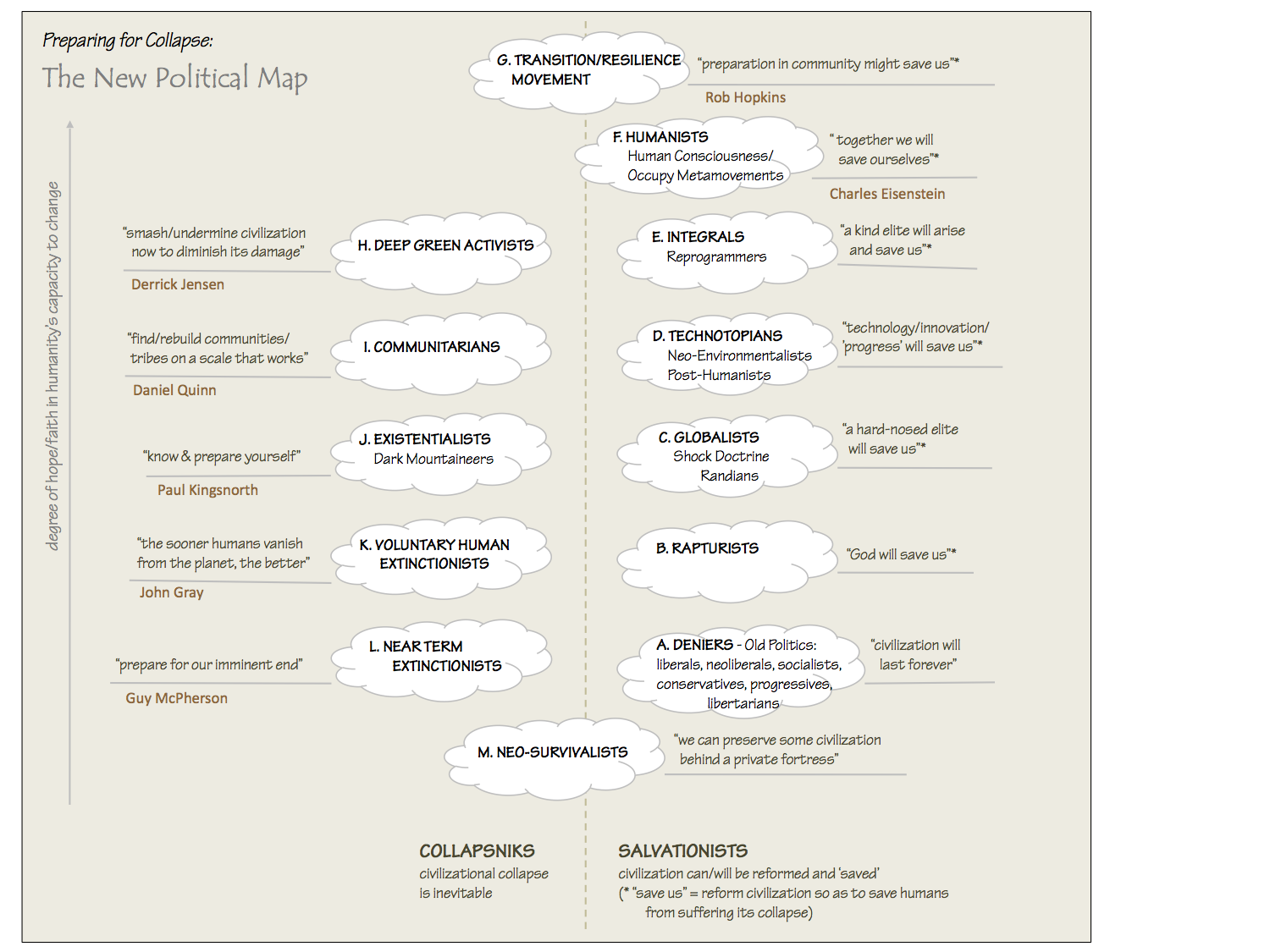
![]() When Jon Husband quoted these* words: “It’s far too late and things are far too bad for pessimism” at the recent conference we both attended, I immediately recognized it as the essence of my internal conflict over whether there is or is not hope for humanity. In many ways we are like individuals who have just been told they have a year to live, and told that their quality of life will deteriorate slowly but steadily over that year. Upon receiving such news you can react in one of five ways:
How do these five ways of reacting to warnings about our own death map to the ways we can react to warnings about the looming and inevitable death of our entire culture? Supposing we are presented with many expert opinions that our civilization will end by the end of this century, that life will get increasingly difficult as the century progresses, and that only a few thousand humans will survive. We, as a culture, could respond in these same five ways.
What makes the analogy imperfect is that in the first case, the death is personal and imminent, while in the second case, it’s our offspring who will mainly suffer, and there is more time to procrastinate and to deny the inevitable. It might be interesting to consider the five stages that Elisabeth Kubler-Ross says most people who are told catastrophic news pass through:
Kubler-Ross does not assert that all people pass through all five stages, or that they pass through them only once, or that they pass through them in any particular order. And although psychologists might have you believe that Resignation is the desired ‘mature’ final state, I think that’s monstrously judgemental. I believe that for the majority of us we can’t pick and choose how we’re going to react emotionally to catastrophic news. We’re not in control of our emotions at the best of times, and these are not the best of times. There is no ‘better’ stage and no ‘end’ state. I would argue that the five stages correspond to the five responses to news of our own personal imminent death, or the news of the death of civilization, our 30,000-year old culture. The Lomborgians, the Bush neocons, the evangelicals and the apologists for corporatism are locked into the Denial stage. You can’t argue with them — they can’t hear you. And since if you’re not part of the solution you’re part of the problem, we are all, much of the time, in the Denial stage. I think those in many parts of the world who engage in self-destructive behaviour are locked into the Anger stage. Those who are obsessed with and addicted to violence, from western militias to eastern suicide bombers, are unable to get past their anger, their belief that the misfortune that life has dealt them is not fair, and they are desperately looking for someone to blame. The fact that some wars between neighbouring countries and some civil religious wars go on for centuries, attests to the intensity and staying-power of this stage. Here’s where I’m going to annoy some of my pragmatist readers. I think those self-proclaimed optimists, technophiles and believers that anything is possible are locked into the Bargaining stage. My argument here is easier to appreciate if you think of a marital break-up as the analogy rather than a personal death. The ‘bargaining’ after a break-up is often a “let’s try again, I’ll compromise, we can make this work” type behaviour that is often self-demeaning and horrific to observe. It’s similar to denial, except instead of denying the reality of what has happened, you’re denying that you can’t undo that reality, that you can’t go back. Environmentalists in this camp get understandably upset at ‘pessimists’ who say it is too late to go back or who insist that technology does not hold the answer. Less controversially, I think the hopeless doom-and-gloom sayers are locked into the Depression stage. There is a strange solace in this state. It gives you an excuse to do nothing (because you believe nothing you can do will make any difference), and to some extent that is liberating, it frees you from responsibility (at least until you move to another stage). And finally, I think that those who have accepted the inevitability of this civilization’s collapse and our inability to prevent it, and are thinking ahead to what might come after it, are at the Resignation stage. Some may be activists, giving up their personal security in the search for ways to mitigate the more serious consequences of the end of civilization and to prepare the survivors for building a new, and hopefully less destructive and more resilient society in its place. Others may be simply resigned to it, and at least resolve to do nothing to make the situation worse. When I have lost loved ones I jumped back and forth among all five stages. I have not become better’ at handling such news, or the grief that follows it, and I don’t think I ever will. I suspect most people move through all these stages, back and forth, until the grief passes with time. My internal conflict over the state of our world reflects, I think, a continued vacillation among these five stages of coping with the overwhelming evidence of the massive and unsustainable damage we have done to our planet, and the inevitability that our civilization, like every one before it, has peaked and is now in a long, slow decline. When I do good work for some great companies, or work on projects with my neighbours, I am immersed in the realization of what a group of people collaborating together can do, and my awareness of what this century holds for us is shut out of my mind, temporarily denied. When I read about what Bush and his cronies are doing to accelerate the demise of our civilization, I am angry. In more hopeful times, when I discover just how many people have moved, at least for awhile, out of the denial stage and are energized about making this world a better place, I shift into the bargaining state, an idealist who believes, at least for awhile, that anything is possible. And then comes more bad news, another disease or natural disaster or act of violence, always ineptly mishandled by those who have a frightening amount of power in our society and an equally frightening indifference to the responsibility that should come with power, and I am depressed. And sometimes, when a remarkable idea or an astonishing project or a group of people who are actually doing something comes to my attention, I am resigned, either passively or actively — willing to give up everything to work to save our world. But then comes a stark realization of what is going to happen to this world, no matter what I do, and I’m back to anger or depression. And so on. You can read in this weblog how much my emotions are whipsawed by what I am learning every day. If you were looking for the Right Answer, the Higher State of Consciousness, you won’t find it, here or anywhere else. So back to “It’s far too late and things are far too bad for pessimism”. It’s obviously meant ironically, but what is it saying? It means, I think, that it is not in our nature to give up. All five stages can be viewed either with optimism or with pessimism, but I think, by nature, we’re inclined to take the “Glass half full” view no matter which of the five stages we are in.
I probably spend an equal amount of time in each of the five states. So if I seem to vacillate in my opinions and moods on this blog, now you know why. * the quote is variously ascribed to Barbara Marx Hubbard or Dee Hock |
September 20, 2005
It’s Far Too Late and Things are Far Too Bad for Pessimism
September 19, 2005
The Psychology of Information, or Why We Don’t Share Stuff
Lately I’ve come to the realization that the problem of under-use and misuse of information has little to do with technology or ‘knowledge management’ and a great deal to do with human nature and culture.
I use the definitions of data, information and knowledge shown at right. Information means literally “to put form to” and knowledge comes from the same root as the word “cunning” which suggests application, not collection. So, for example, laboratory sample results are data, a theory of the cause of a disease stemming from that data is information, and a vaccine for the disease is knowledge. Another example: Test scores of grade three students are data, an analysis of the learning needs of those students is information, and the resultant learning curriculum is knowledge. For the most part science and art are in the ‘sense-making’ business and their product is models, information, representations of reality, yielding products that are interesting and sometime useful. Most modern organizations are in the ‘application’ business, using information to create technologies (in the broad sense of the term) designed to improve people’s lives. Whether most technologies actually do make the lives of people better (other than their owners’ management and shareholders) is of course open to debate. I spent much of my last year, as global Knowledge Innovation leader at a major professional services firm, looking at what I call ‘information behaviours’, and I concluded that what impedes the sharing of information in most organizations is our personal and shared culture, rather than inadequacies in technology, knowledge management, or learning programs. Here are the cultural factors that, I would hypothesize, cause most ‘knowledge failures’:
What have I missed? What other ‘information behaviours’ are at work making it easier, or harder, for people to share what they know with others? With all these psychological barriers to the sharing of information, sometimes it’s surprising that the people, especially in large organizations, are able to communicate with each other at all. So what can we do? In a follow-up to this post I will explore some of the techniques that are, or might be, used by organizations to ‘work around’ these impediments to learning and sharing of knowledge. But we can’t expect technology to do the heavy lifting here. In fact, over-engineered tools can actually make the problems worse. And behaviour can be extremely difficult to change — people behave the way they do for a reason. More effective workarounds might include:
What other techniques have you found that help overcome the many behavioural obstacles to the sharing of information? |
September 17, 2005
Saturday Links – September 17/05: The Protection Edition
Protecting Migratory Birds: The 10,000 Birds Blog is part of an important new campaign to prevent the killing of wild, migratory birds out of ignorance and fear. Although the WHO asserts there is no evidence these birds are responsible for any transmission of influenzas that humans can catch, paranoia has led to calls for wild birds to be culled “just in case”. First step is to rename the “bird flu” what is is: poultry flu, a disease specific to domestic farmed animals.Protecting US Forests: The Wilderness Society is asking Americans to sign a petition to block the repeal of the Roadless Area Conservation rule, opening up 60 million acres of US forest to oil drilling, mining, road building and other destructive development. Protecting the Gulf Coast: Oxfam has launched a $2 million appeal to help with the tardy and inadequate relief work in the Gulf Coast. Their efforts will be focused on the poorest victims in the area. Protecting the Separation of Church and State: Another great speech from Bill Moyers shows the culpability of right-wing churches in the government’s abandonment of the poor and needy, and in ideological interference in matters of state. Thanks to Cyndy for the link. Protecting American Troops: The Bring Them Home Now Tour of US military and veterans’ families has mobilized to press politicians to stop exposing US troops to reckless dangers in the ill-conceived and unwinnable Iraq war, so that they can help with the work where they’re really needed, on the US Gulf Coast. Cartoon by Alex Gregory in The New Yorker. Buy it on a t-shirt, sweatshirt or as a print here. |
September 16, 2005
The Organization of the Future?
![]() I spent the day at an interesting symposium on the Organization of the Future put on by the Boyden Institute and hosted by Steelcase Canada. Attendees included Jon Husband, Bruce Mau and Barbara Moses. The objective of the session was to envision the organization of the future, define the principles it would operate under, and begin to explore what it would take to get there. Here are some of the elements of the picture that the participants painted:
Sounds good, doesn’t it? But suppose half the organizations of the future were like this and the other half were like most of today’s traditional large organizations, almost the antithesis of the above. Would customers know, and care, to give their business to the New Age organizations that had these qualities, even if it might cost a bit more to do so? Would employees be willing to forgo higher salaries (and much higher salaries if they reached the top echelons of traditional organizations) for the more human, healthy working environment of the New Age organizations sketched above? Would these New Age organizations work together and prefer dealing with each other rather than dealing with more traditional organizations, and would this preference be enough to counter the oligopoly power that small groups of traditional companies, working in collusion to crush new entrants, wield in many industries? Part of me is cynical, and thinks this is all wishful thinking. If there had been a few CEOs from large corporations present at the symposium, who could have reassured us (or disillusioned us), that might have been helpful. But part of me is also a believer in models, and I really think that if enough organizations were to emerge that exemplified this New Age behaviour, others would follow them, and the traditional model would become intolerable and be discarded, just as the slave-exploiting and robber baron models of industry yielded begrudgingly to better models in the past. What do you think? Is what we envisioned really the organization of the future, or just a dream of incurable optimists? |
Thanks to the organizers of this event. And if you ever have the chance to visit any of the showcase Steelcase facilities, go.
September 15, 2005
There Is No Superpower
![]() What if we progressives got our way? Suppose Bush was impeached or forced to resign for his wrongdoings, or suppose he so discredited the Republicans that they lost the presidency and both houses in 2008. Suppose the new leaders immediately ratified Kyoto, and radically reformed campaign finance, gerrymandering, voting machine and corporation law. Suppose environmental laws were restored to their strongest, and social and environmental travesties like NAFTA were scrapped. Suppose even that corporate subsidies were scrapped worldwide and government pork became unacceptable and impossible. Suppose Europe and Canada elected Green governments and ushered in bold plans to eliminate the use of non-renewable energy through a combination of alternative energy and serious conservation. Then what? The ten most intractable problems: Unaffordable health care, dysfunctional education systems, unsustainable energy and food systems, corporate psychopathy, lack of viable self-managed communities, the tragedy of the commons, overcrowding and overpopulation, poverty and violence, lack of innovation and loss of wilderness and biodiversity, would all still be with us. The oil that we conserve would be gobbled up by China and India, enabling them to prolong their reckless imitation of American profligacy a little longer. Corporation law reform would be bucked by addicts to the current overconsumption and overspending economy: corporate thieves would have to become cleverer (and they have more money to perpetrate their crimes than regulatory authorities have to fight them, so it is an unfair fight). Consumers who can’t get their fix of cheap, wasteful products would buy them on the black market, and finance them through usurers. Organized crime would start offering the things that the government tells us are no longer ethical or sustainable. “Pssst,,,wanna buy a Hummer, used only once by a little old lady, and I can get you gas for it at the ration price”. You thought the “war on drugs” was futile, wait ’til you see the “war on unsustainable consumption”. Governments, already pretty unpopular for telling people what they should and shouldn’t do, don’t stand a chance. Because, you see, there is no superpower. There is not, and never has been, a government that has been able to push the world to do what it wants to do, to make people behave. From the Romans to the British to the Soviets, those that have had the most power have faltered and collapsed like overinflated balloons when they simply got too big to sustain the illusion that they were somehow in control. The people just said no. Sometimes it was the colonized who started the revolution, sometimes it started right at the centre, sometimes nature lent a hand, using plagues or disasters to tear a hole in the thin veneer of ubiquitous might. There is no superpower in business, either. The mightiest coalitions of oligopolies have always fallen to upstarts who have exploited the complacency and arrogance of industrial dynasts and robber barons with disruptive innovations that met human needs that the giants no longer found profitable, and used them to infiltrate and then cannibalize the markets once thought unassailable. Even corporatists (like Mussolini and Salazar) who tried to merge governments and business leaders into insuperable bastions of power were toppled by those who realized the truth of Adam Smith’s famous saying “”the real purpose of government is to protect those who run the economy from the outrage of injured citizens”. And of course, as all but the most gullible know, there is no superpower watching over us from above, either. Those that are sure that the Rhapsody is going to happen just when things look at their worst, resemble no one so much as the broken gamblers who are sure that they just need one more bet, one more roll before their horse will come in, their number will come up, and they will be saved. I’m not trying to depress you (really!) — the fact that there is no superpower is good news. It means that there is a chance that we, the people, can take back our world from the political and corporate and religious czars and tyrants and megalomaniacs and psychopaths who seem to run and control and be in charge of everything, and it means we can break their hold on their deluded and addicted followers. All we need to do is to refuse to recognize their power over us — no, to recognize that they have no power over us. That means refusing to fight in their bloody and unjust wars, not for any side or any leader. That means refusing to obey their unjust laws. They can’t put us all in jail, and they can’t afford to kill many of us, since that just makes the resistance stronger. That means refusing to pay outrageous prices for shoddy crap (file-sharers are just the first wave of this rebellion) and refusing to pay blackmail prices for essential goods (like healthy food, and medicines, and houses that last, and land and water and air that is not full of waste and poisons). That means refusing to get into debt with them, refusing to become addicted to their products, refusing to fall into the trap of equating possessions with self-worth. That means demanding that the common good come before private interest, that those who have obscene wealth share it with the destitute and needy, that decisions be made in the interest of the well-being of all, not the wealth of a few, and that bads be taxed instead of goods. That means publicly repudiating and shouting down despicable and manipulative religious leaders of all denominations who prey on fear and ignorance and steal people’s money and bully the weak and the foolish and conspire with brutal governments. The bloated, overstretched, scarcity-based power structure of our world is teetering. It is no match for our own community-based, consensus-driven self-governments, no match for sustainable, community-based generosity economies, economies of abundance and egalitarianism and conservation, no match for a society and a spiritualism based on caring for each other and for our world, and on collective well-being. We have the weapon that brings all empires to their knees, the great equalizer. Knowledge, the truth. Listen to the words of the tyrants — the political bullies, the oligopolists, the preachers who claim to talk to the only guy even more powerful than they are. Listen carefully. You will hear the denials. “We are not losing the war on X. We are not to blame. Everything is not falling apart. We’re not failing. Things are not out of control. Things have never been better, and soon they will be better still. It’s just an isolated, a temporary setback. There is no choice but to stay the course.” Look closely, listen closely. See the doubt in their eyes. See the twitch, the fear that it is all unraveling. We have them on the run already. They know that their power is all illusion, that there is no one in control. Their great fear is that you will find out. That fear is about to be realized. Illustration from The Emperor’s New Clothes by Margaret Tarrant |
September 14, 2005
two poems by romana
|
romana is my perceptive and very talented fifteen-year-old grand-daughter
Boys They say it’s funny how they always notice That after we rip out their heart, stick it down their throat And still want to be friends, we always act like there’s nothing even wrong But then they always tell us they Would rather have had one breath of our hair, one kiss from our mouth, one touch of our hand, than an eternity without it Makes us feel like we were the jerks Although those boys always do push our very last button It begins to not matter so much ’cause What’s done is done, relationships take work, effort is pointless And in the end all you have is the memories The memories that haunt you until your very last breath of life Yet still we strive with our very last might about what could have been And what you should have seen Longing to be able to only take that one last breath with you _____ Glowing Light Sheets of dust Blowing all towards me They blow without a care in the world The sheets have all said the same thing They speak the same tale Across the world you have come To see me bless you with my hands And as they move up and down Not fulfilled with the things they say The newspaper still delivers the same message The town moves with no motion Listening to what they say unfold The path is transparent The sheets are now blown away The tale is over As I sit here alone I know where I am
|
moonstruck
in the moonlight, with the new-fallen snow you watch the snowflakes land and melt on your outstretched arms you stop to pick some berries and some nuts, and suddenly they eat, and then, mimicking you, wander out to gather more. the children curl up together and fall back asleep. you walk sure-footed, able to see and choose where your steps land. your walk becomes a dance as the sound of the wind in the trees your trip ’round the periphery of your home community takes half the night and as the first red-violet and lilac bands of dawn emerge on the horizon you sleep, caressed by J., and dream of the darkness. |
September 13, 2005
Open Source Business, Part One
There is as yet no consistent definition of Open Source Business. I’ve used the criteria for ‘Open Source’ from wikipedia to come up with this definition:
A radically transparent organization which (a) operates through open collaborative partnerships with customers, employees, suppliers, and the communities in which it does business, (b) shares its sources of information, designs, specifications and processes with them, and (c) allows open participation in and makes public all decisions it makes, all operating information, and all documents it produces, on a creative commons basis.
I think most businesses would be inclined to like the “open collaborative partnerships” part but be less enthusiastic about the “radically transparent” part. How can you have competitive advantage if your competitors have access to everything you do? But if you have a true and open partnership, that entails transparency, and you can’t have transparency that stops at the competitors’ door. It seems to me it’s all or nothing. So the real question is whether a radically transparent business can make money. In order for a competitor to exploit an Open Source Business, it needs to do more than just have access to all its information, it needs to operationalize that information. That takes time, money, equipment and supplies, and some expertise. How much of an entrance barrier are those things? To a small business, they’re substantial, but for a large, multi-national corporation, not so much. But the large corporation will only be interested if there’s volume and profit in it. So the Open Source Business (OSB) can choose to do something small and unscalable, or to make very little profit, and thus keep the competitors at bay. For that reason, I suspect that OSB isn’t for those who aspire to be millionaires. But suppose the objective of your business isn’t to make a profit, but to make a living. The OSB might work just fine. By making a living, I mean getting what you want out of the business. Joy. Personal satisfaction. Enough money to keep you going. Whatever it is that does it for you. That’s what Natural Enterprise is all about. But it’s not the way most businesses today operate. A business that operates not for profit, but for the satisfaction of its workers, as they define it, is an anomaly in the market economy, a vehicle of the Gift Economy. Such enterprises probably cannot be hierarchical or large — this would make them unmanageable. But there is no reason that a successful OSB in one community couldn’t be a model for dozens, or thousands, of similar OSBs offering similar products or services in other communities. Replication rather than growth. I’ve stated before my belief that because Open Source allows the simple and complete transfer of bits for no incremental cost, software and content will inevitably become free as Open Source gains acceptance and as technology makes their protection impossible. Companies that make money from software and from content (including books, music, news, and videos) will have to find innovative new ways to generate revenue — such as getting into hardware businesses as well (consumers are willing to pay a lot for an iPod but next to nothing for the ephemeral content it plays), and by offering customized services (like the bands and writers who are giving their CDs and books away to promote their concerts and consulting services). So suppose you have an idea for a new medical device that images and diagnoses problems with your musculoskeletal system and then performs therapy on the problem areas. As an OSB you would collaborate with medical device manufacturers, with business advisers, with physiotherapists and doctors, and with patients, among others, sharing all knowledge, research, designs, methodologies and surveys under creative commons licenses (so big competitors cannot patent them before you can get up and running). Your business will probably make its money selling the devices themselves and offering the training and services in using them. You won’t make money on licensing the design, hardware configuration or software of the devices, since these would be Open Source developments available to anyone. You will not make a lot of money on each device, to keep the price level below that which would attract larger corporations to enter the market. But you’ll make enough to keep the business going and healthy, and enough to allow the device to improve with the collective information from all the partners who will be testing and using it. Those partners will be your free, viral, marketing arm, so no advertising and promotion costs will be needed. Other OSBs will probably spring up selling similar units into markets you don’t have the resources to cover. But that’s fine. Most of the investment will have been gifts of time from a wide variety of interested and knowledgeable people, and you’ll have done well enough aggregating that knowledge into a successful little business. And customers will receive the benefits of your OSB’s work at a much lower price than would have been the case if it had been developed by a public corporation which spent a fortune on promotion and whose shareholders demanded a high ROI. And arguably the product will continue to evolve and improve more quickly than if it were ‘owned’ by a big company with a high investment in last year’s model and hence an aversion to further innovation. Next week, in Part Two on this subject, I’ll take a look at which industries would seem to offer the best niches for OSBs, and describe some ways that existing organizations might be able to make the bold transition to OSB form. |
September 12, 2005
The Bird Feeder and the Tragedy of the Commons
The gist of the Tragedy of the Commons, for those who haven’t read my blatherings about it before, is that when people own something personally they take care of it, but when no one owns it, when it’s a shared resource, like forests and parks and public toilets and recreation centres, nobody takes care of it, and it becomes the victim of the more talentless graffiti artists and litterers and vandals and pyromaniacs and guys who pee on toilet seats.
So I got thinking about whether this contemptible and careless ‘commons’ behaviour is something uniquely human, especially since I have yet to find any behaviour of any kind that is uniquely human, and don’t expect to. In a way, all of nature is a ‘commons’ to the rest of the species on this planet. Yet other creatures don’t damage and destroy common areas. And then I realized that these natural commons have something that human commons don’t — abundance. What human commons have in, er, common, is that they are all scarce, all set aside specifically as common spaces, in the midst of areas that are ‘private’ (‘private’ spaces being those that are arrogantly assume to be the property of some human to do whatever he wants to do with them regardless of the consequences). A much better analogy to human commons is the bird feeder, that (relatively) scarce and unnatural commodity that some of us who love watching other creatures set up for their, and our, communal benefit. At bird feeders you can see non-human creatures treating a common resource the way we humans do. Squirrels can literally demolish most bird feeders in a week. You put up a squirrel ‘baffle’ and they’ll dedicate their full diligence to defeating it. After all, why would you put out food just for birds? That’s not fair, is it? And why would you put out food just a bit in dribs and drabs, and keep the rest in a metal can? We squirrels have been managing fluctuating food resources since before you bipods appeared on the planet — just put it all out there and we’ll figure out what to do with it. The black squirrels have now figured out how to get around my baffle even though it’s six feet above the ground (beyond their jumping range) and on a pivot so they can’t stand on it even if they can get past it. They have their own baffle-less feeder ten feet away (feeder #1 in the above diagram). The food in it is accessible to all, and disappears in 24 hours from time of filling (every 2 days in winter, every 3 days in summer). So it is more often empty than not. Feeder #2 has a cylindrical container and perches designed for the smaller birds that tend to get bullied out of feeder #1 one by squirrels, chipmunks and the larger birds like grackles and redwing blackbirds. The process for a squirrel to get into feeder #2 took a lot of experiment and ingenuity, but now takes them about 5 seconds:
The chipmunks are not big enough to manage any of this, so they study where I keep the seed. I have tried keeping the seed in the garage, but they’ve found openings under the eaves and eaten holes in the bags when I leave them there. Now I keep it in the sunroom, in a large aluminum can. They’ve chewed holes in the sunroom screens to get into the room, and last week I caught one, obviously a keen observer, sitting on the aluminum can, making a hell of a racket trying to pry the spring-clip up. In the winter, ornithologists believe, chickadees, sparrows and some other small birds actually do depend at certain times on the food in bird feeders (they need to bulk up by evening to survive the coldest nights, using the food energy to ‘shiver’ vigorously to keep their body temperature up). They usually leave plenty of room for error (many creatures have three winter choices — migration, hibernation and bulking up — and generally the number that choose the third option is small enough that they don’t have to worry about shortages), so birds freezing to death are rare. Nonetheless, these small birds would clearly be more conscious of the value of using up bird feeder resources carefully. So I was amazed to discover that the chickadees, at least, conserve the seed in feeder #2 (subject to interference from other birds and squirrels), to last exactly the two or three days between fill-ups. Right after I fill it, the chickadees rarely take seed from feeder #2 (they use feeder #1 when available first, and even then eat at the feeders sparingly — I presume they are busy feeding elsewhere. At the end of the second day in winter, third day in summer, when it is getting low, they are there in large numbers, and the bottom half of the cylinder is consumed in a matter of a few hours. If I’m late the next morning, I get a scolding (at least that’s what it sounds like) from them, but once it’s filled they tend to take one seed each and then disappear for most of that first day. It seems to me that, much like humans planning our gasoline tank refills, these birds are conserving. While to most species the feeder is just a bonanza, a ‘commons’ to be plundered and abandoned, to the birds that may depend on it, it is factored into the overall food supply and managed accordingly, as if it were part of the natural supply. Perhaps I am reading more into this than I should, but despite the disruptions by the squirrels I can generally tell the day (feeder refilling day, second day, or third day) and the time, by how much seed remains in the cylinder. And when I switch between the winter (every second day) and summer (every third day) filling schedule, it takes less than a week for the birds’ usage pattern to adapt so that feeder #2 is empty just before it is scheduled to be refilled. So I am tempted to speculate that conservation, ‘resource management’, is not natural, because it is unnecessary in a world of abundance. It is only when there is some scarcity that creatures like humans and chickadees adapt to conserve. It is not natural behaviour for us, either — for most of our three million years we have migrated long before the foods we gathered became scarce (we also, like virtually every other creature on the planet, instinctively reduced our birth rate so that our numbers were stable and so we almost never faced scarcity — by the time the last stop in our migration began to run low on human food, the first stop had been fully replenished). So it is probably not surprising that a conservation ethic doesn’t come easily to us. The bird feeder, in this context, is a bit of a sad place. It brings out selfish and destructive behaviour in creatures that don’t quite understand what this strange, inexplicable cornucopia is for. Perhaps it’s not dissimilar in that sense to the antisocial and self-destructive behaviour that seems so often to come out in those who win lotteries or receive sudden great wealth or fame. And the bird feeder reflects how the Tragedy of the Commons arises, not because we are incapable of sharing and taking responsibility, but because when commons are scarce and strange, instead of ubiquitous and sacred, most creatures seem driven to take advantage of them, and assume they will not last. The real tragedy of the commons is that when we invented ‘private’ property, we forgot that the whole universe is a commons that belongs to all life in it, and we lost respect for it. Scarce, limited ‘commons’ are unnatural aberrations that we just cannot make sense of. |
September 11, 2005
Reforming Health Care
Confession time. The reason for my late and sporadic postings over the last week or so is that I pinched a nerve in my neck, and I’ve been doped up since then. The choice of the Resilience topic for the Open Thread during my absence was a bit ironic — the injury came from doing strenuous physical work (mowing and pushing my heavy scrub-cutter around our very hilly lot), when I get almost no proper exercise of any kind and have lousy posture. It’s given me some time to think about our troubled health care system, about why idiots like me get injuries like this when we know better, and about a suggestion from several readers that perhaps the solution to health care is to pay people for staying healthy.
The idea has a kind of immediate provocative appeal, but I don’t think it can work. In the first place, systems that provide financial rewards for staying healthy (like some insurance schemes) don’t actually reward you for staying healthy, they reward you for not seeking medical help and for not filing claims, which is not the same thing at all. This is the same perversity that encourages people who are victimized by vandals from not filing a perfectly justifiable insurance claim because they know their insurance premiums will then rise by more than the amount of their claim. This is a depraved but very profitable way to run an insurance business. As a means of providing equitable and functional remedy for accidents, illness or injury, it is horrific. It unquestionably results in unnecessary and avoidable human death and misery, overwhelmingly to the poor and weak, simply out of the fear of economic penalty. Some organizations offer standard “sick days” each year that you get as extra vacation days (or as a monetary bonus) if you’re not sick. The consequence of this is to treat sickness as a kind of crime that you get rewarded for not committing. It assumes what Malcolm Gladwell has called “the Moral Hazard Myth” — that whenever you offer insurance for something, it automatically leads to rampant abuse. In other words, that people — especially the poor, weak, and unemployed — are lazy exploiters of public largesse. Organizations I know that have tried “sick day” policies ended up with sick people coming to work, spreading their illness and doing poor quality work because of it, so they could “save up” their sick days for extended vacation. Insurance companies have also tried, in a superficial and sloppy way, to reward people for avoiding behaviours that cause illness (like having premiums for smokers that are twice those for non-smokers). The general consequence of such policies is (a) it encourages addicts to lie, and (b) it encourages insurance companies to spy on people so they can catch people lying so they can keep the premiums but not have to pay any claims. Great system, huh. The problem with all such schemes is that it is impossible to say when an illness is the result of hereditary factors (genetic predisposition), when it is the result of environmental exposures (in the home and workplace and society at large), and when it is the result of behaviours over which the patient has (according to some philosophies, anyway) some degree of control. Or, to put it another way, it’s impossible to say when and to what degree it’s the patient’s fault they were sick or injured. So while the idea of paying people to stay healthy appeals to me in a wry kind of way, I think it is basically an unworkable idea. So what might work better? Are there other ways, other than financial bribes and penalties, that can actually change behaviour in a way that will make people healthier? There’s a company in our community that provides a free, supervised exercise facility to all its employees, and a subsidized cafeteria that offers only healthy foods. I think they’re on the right track — they’re rewarding behaviours that repay them as an employer (through healthier, more resilient workers), without getting specific about who’s to blame when an individual becomes sick or injured. It’s a ‘no fault’ system. What is needed to supplement this is more honesty in our society and our economy about many of the things that are bad for our health, but which are very profitable, and which therefore are rarely recognized or addressed as the social evils they really are. Alcohol, for all its benefits, sucks billions out of the economy in death and violence and injury and illness every year, yet we still tolerate advertisements that show its consumption as an essential ingredient of personal happiness. The meats, and many other foods we eat that are advertised to the hilt (especially the fat, salt and sugar-laden “fast-food” varieties) are chemical cesspools that unquestionably add billions of dollars to annual health care costs. The real answer, I would argue, is not rewarding people for staying healthy (because we can never determine when their health or lack of it is due to their behaviour or factors beyond their control), but rather health care innovations that address the real, preventable causes of illness and injury:
We cannot expect those with vested interests in the current health care system to reform it. We need to create our own organizations to develop, in Open Source form, these three types of health care innovation. We will have to do battle with the lawyers, corporations, politicians and preachers and some medical practitioners, who will not yield power of the current massive, extravagant and dysfunctional system easily. But like all disruptive innovation, our work in these three areas will be subversive. The regular health-care system won’t know it’s been rendered obsolete until it’s too late. And there are many in the existing health-care system who recognize the need for these innovations and the distress of the current system, who will be more than willing to join us in making the new, responsible, patient-centred system work. |


Lately I’ve come to the realization that the problem of under-use and misuse of information has little to do with technology or ‘knowledge management’ and a great deal to do with human nature and culture.


There is as yet no consistent definition of Open Source Business. I’ve used the criteria for ‘Open Source’ from wikipedia to come up with this definition:
The gist of the
Confession time. The reason for my late and sporadic postings over the last week or so is that I pinched a nerve in my neck, and I’ve been doped up since then. The choice of the Resilience topic for the Open Thread during my absence was a bit ironic — the injury came from doing strenuous physical work (mowing and pushing my heavy scrub-cutter around our very hilly lot), when I get almost no proper exercise of any kind and have lousy posture. It’s given me some time to think about our troubled health care system, about why idiots like me get injuries like this when we know better, and about a suggestion from several readers that perhaps the solution to health care is