![]() Michael Gerber’s best-seller The e-Myth starts with some profound insights into why entrepreneurs fail, but then he prescribes a one-size-fits-all cookie cutter solution based on his unbridled reverence for franchises. In the process of dispelling some important myths about entrepreneurship, he ends up creating some new ones. His book is based on three propositions (I’m paraphrasing):
I agree with the first proposition. That’s why I have always believed that it is folly to go into business alone. What’s more, I think there are more than three roles in most successful businesses. There can be at least eight: You need partners to research, to teach, to imagine, to design, to create, to cultivate, to sustain and to connect. A successful business has people with all these competencies, directed at affordably meeting an identified unmet need. A sustainable business has people that not only do these things well, but love doing them, and whose competencies don’t significantly overlap. These are businesses in Area 3 of my graphic above, at the intersection of your people’s collective gift, passion and purpose. Such a sustainable enterprise, which I have called a ‘Natural Enterprise’, is a true partnership based on trust instead of hierarchy. Why? Because such an organization is self-managing, and hence is more resilient to absences of, judgement errors by and disagreements among one or two key people. Gerber’s ‘franchise model’ may be fine for mass-production businesses like McDonalds whose product line is small and rarely changes, but it will rarely work when every product needs to be customized. You just can’t automate or make such businesses idiot-proof, because there’s too much judgement and individual craftsmanship required by many people involved. And those who have a flair for such custom work are usually not content to work in an inflexible business run by someone else for which they’re paid very little. Researchers, teachers, ‘imagineers’, designers, creators, nurturers, connectors and sustainers tend to get impatient when someone else (or worse, something else, a ‘system’) is making all the decisions for them. For that reason franchises and branches have notoriously high turnover, and most franchisees (except those who are both uncreative and luck into very profitable franchises) tend to be very unhappy people. So I don’t buy Gerber’s second proposition, except for a very narrow range of businesses that I don’t think appeal to a lot of people. And while business planning is never a bad idea, most business plans are naive and inflexible, so what is needed more than planning is good improvisational skill. And improvisation isn’t fighting fires, it’s being alert to the changes that are affecting your business and industry and adapting to them, and, most important of all, continually innovating. Gerber argues that there are seven critical skills in entrepreneurship: Leadership, marketing, money, management, client fulfillment, lead conversion and lead generation. My experience has been that, except in the most mundane businesses, six of these are overrated and largely unnecessary:
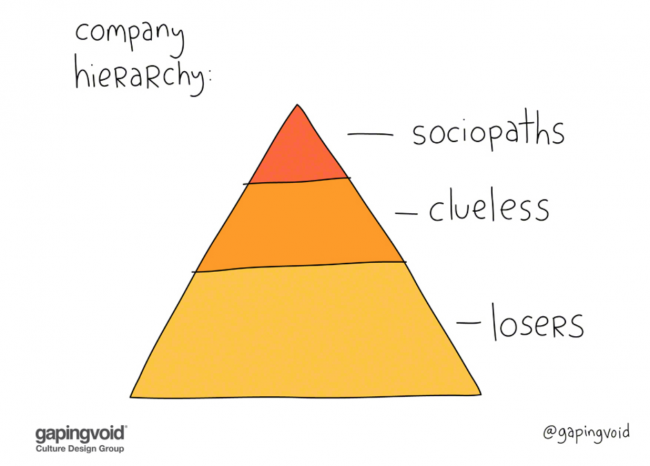
If your ambition is to create a pyramidal growing organization providing a large volume of identical goods competently, then I’m sure Gerber’s advice will work. But is working as part of a hierarchical machine, even one churning out a lot of profits, really what most entrepreneurs are looking for to replace their exhausting and boring jobs? The prototype for Gerber’s book is a woman who quits her job baking because she wants to start a baking business. Then she finds out she doesn’t want to start a baking business, she just wants out from under a lousy boss. She loves to bake. The problems of managing (all by herself) a baking business almost kill her. Gerber shows her how to be the next Sara Lee: She learns the skills Gerber thinks she needs to be a good manager and entrepreneur. But is this really what she, and so many others who leave their boring, dead-end jobs (voluntarily or not), and what so many young people who blanch at the thought of starting at the bottom of some mammoth Evil Empire corporation, really want? I don’t think it is. And I think by perpetuating the myths that entrepreneurship is usually grueling, administrative work, requires lots of money, opportunism (regardless of its social and environmental costs), endless selling and marketing, incessant growth and mindless low-paid drones to do what the ‘franchise machine’ tells them to do, Gerber is doing a bit of a disservice to most prospective entrepreneurs. There is a better way, one that’s sustainable, joyful, egalitarian, low-stress, responsive to real human needs, recession-proof, virally marketed, organically financed, creatively stimulating and good for society and the environment. It’s Natural Enterprise. Now if only I could find a publisher to get the word out. Category: Finding and Creating Meaningful Work
|
March 21, 2007
The Other E-Myths
March 20, 2007
Re-Learning the Art of Impromptu Consultation
Until about 15 years ago, the way people consulted with each other was through face-to-face meetings and visits (often impromptu, spur-of-the-moment occurrences). When that was impossible, people conversed by telephone, in real dialogue. Likewise, until about 15 years ago, the way people did research was to go and visit (or, if that was not possible, telephone) the library and talk to the information professional (IP) about what they needed, and then leave it to the IP to get it.
With the advent of ubiquitous e-mail and Internet access, that all changed and (yes I know I’m sounding like an old man) usually not for the better. E-mail is rarely the best way to consult or converse with business colleagues. Too often, it has replaced more effective face-to-face and telephone real-time interactive conversations. Worse, it has allowed introverts and arrogant people who believe their time is more valuable than others’ to duck real-time consultation and conversation entirely. The result: degraded communication and decision-making. Likewise, disintermediated Internet searching is rarely the most effective way to conduct research or to use non-IPs’ time effectively. Too often, it has allowed staff who are incompetent researchers to waste time browsing in the wrong places and cutting and pasting data into poorly-synthesized reports. The result: degraded research and analysis. Organizations that are aware of the dangers of misuse of e-mail and of amateur Internet ‘research’ have tended to put in place restrictions on inappropriate use of these technologies, and processes to actively encourage face-to-face and real-time consultation and conversation and the reintermediation of research through re-skilled IPs. Ironically, this has resulted in information behaviours that substantially resemble those of pre-Internet days. So what can be done to make effective use of technologies to:
Many years ago, when e-mail and Internet access were just becoming the norm in business, I met a guy named Bill Buxton (photo above), who was then with Alias Research. His passion was trying to make virtual ‘presence’ imitate, as much as possible, physical ‘presence’, to get the technology to adapt to our preferred information behaviours, instead of the other way around. Bill’s mantra was: Ultimately, we are deluding ourselves if we think that the products that we design are the “things” that we sell, rather than the individual, social and cultural experience that they engender, and the value and impact that they have. Design that ignores this is not worthy of the name.
To that end, he had computer screens around a circular table in his office, each showing the head and shoulders, and the computer desktop, of one his meeting participants, so that virtual meetings were as analogous as possible to ‘real’ meetings. He had another screen above his office door with a picture of a door on it, that he could virtually ‘open’ or ‘close’ to signify whether he was, or was not, available for impromptu e-consultations and e-conversations. It was a little hokey, but Bill was (and still is, in his new work) on the right track. Scheduling systems like Outlook are fine for events of an hour or more in length, but they don’t work well for just-in-time (unscheduled and unschedulable) consultations and conversation that last only a few minutes, yet which are critical to effective decision-making and knowledge exchange. Instant messaging has proven to be a useful stopgap (when users are practiced enough to use it effectively) but it is still too slow and lacking in the interactivity, body language and ability to ‘see’ what the others in the conversation are looking at, that quick face-to-face consultation permits. What we could do is to add to IM an ability to:
Then IM, instead of having to carry the conversation, would be used mostly to set up the conversation, in a way analogous to the ‘knock on the door’ that is used to set up a face-to-face just-in-time conversation (“do you have 5 minutes to resolve a problem we’re having withÖ?”). Once the IM ‘knock’ was accepted, the participants would then ‘one-click’ into a VoIP conversation with video and desktop-sharing ‘attached’ to the resizeable IM pop-up window. Voilý, Bill’s virtual meeting, updated to the mobile, wireless workplace. The same process could be used to consult with IPs about requests for research, and to review the research results with them. The advantages over e-mail are increased effectiveness (because the conversation is real-time interactive and spoken, not written and asynchronous), and improved context (because of the addition of aural, visual and body-language ‘clues’). This would not be difficult to do with today’s technology. Some organizations don’t permit or are unfamiliar with using IM, and others don’t (yet) have ubiquitous, wireless, audio and video transmission technologies. But these should not be difficult hurdles. This could be the rare case where if you built it they would come. The greater challenge with such an invention would be behavioural: the resistance of introverts and some managers to being accessible just-in-time, the way all of us were (had to be) a generation ago. E-mail and e-scheduling software have helped make it socially acceptable to be unavailable without a prior appointment. The only way to overcome this is to demonstrate how a technology-enabled return to impromptu real-time consultation and intermediated research will improve work effectiveness, knowledge exchange, research and decision-making quality. We’ll have to show people what they’ve been missing, starting with some pilot groups who ‘get it’. It will take time and practice to relearn this lost skill of accommodating requests for advice, information and insight on-the-fly. There were always people, in the days before e-mail, who abused this accommodation, and we’ll have to relearn how to say ‘no’ to them. There were always people who asked for five minutes and inarticulately blathered through thirty, and we’ll need to retrain them how to be precise and concise. But it will be worth it. Ubiquitous e-mail and Internet access in organizations have created more problems than they’ve solved, and it’s time to rein them in to situations where their use is appropriate and effective. To do so, we’ll have to relearn someold tricks, like how to consult, converse, communicate and research, professionally. It can’t happen soon enough. |
March 19, 2007
20 Ways to Become More Resilient
![]() Daveís personal well-being roadmap If weíre going to try to save the world and stuff, we need to stay well, and loose. Grief and sorrow for the suffering of Gaia are perfectly understandable, and thereís no point denying what we feel or what we know, but getting angry and worked up (like I do too often) is just a waste of time and energy, and can make you sick. So here, from various people who are much better at it than I am, are twenty Let-Self-Change ways to become more resilient. The first ten are physical techniques, the second ten social; Iíve indicated what works for me (WWFM) for the first fifteen, while the last five Iíve made really limited progress on:
Now we get to the five things I don’t do well, though it’s not for lack of trying.
Category: Let-Self-Change
Postscript for Those With Animal Companions: You’ve probably heard about the tens of millions of cans and pouches of dog and cat food recalled for possible poison contents, by the latest act of negligence by the food oligopoly, this time by a little-known Canadian-registered company (US-owned) that apparently sells the same crap to all the major oligopoly players in North America from Iams to Walmart No-name. So much for consumer choice. For a list of all 88 brands potentially affected, go here. This company has a record of rocky financial performance and has been implicated in animal cruelty in testing. Their entire website except the recall notice has suddenly disappeared; even the Google cache seems to have been wiped. Although it’s no longer possible to research, it would appear that the Canadian registration is a tax-dodge to exploit the now-canceled income trust loophole in Canadian tax regulations. The poisoning coincides with the use of a new (presumably cheaper) supplier of the grain filler that makes up most of what is sold as ‘premium’ pet food. Time to do your research and spare your pet the same toxic processed food oligopoly sludge you’re trying to wean yourself off. (Asyou can see, I’m still struggling with point 16 above.) |
March 18, 2007
Sunday Open Thread – March 18, 2007
![]() photo: Lagos Nigeria squatter community, from the Nov. 13, 2006 New Yorker by Samantha Appleton What I’m planning on writing about soon:
Over to you. What are you thinking about these days? |
March 17, 2007
Saturday Links for the Week – March 17, 2007
![]() Image: Acrylic Painting Turtle Prayer by Martha Greenwald “Nobody is Controlling What You Do Here”: Bob Neuwirth’s 2005 TED talk summarizes and expands on his book Shadow Cities. About 1.5 billion people, 20% of humanity, now lives in squatter communities in the world’s cities, mostly in struggling nations. By 2050, 3-4 billion people, a third of humanity, will do so. They are growing at a rate of 250,000 per day. Their homes are not recognized as legal, they have no political rights, and no legal services, though they beg, borrow and steal electricity and water. Their main products are garbage and sewage, which accumulate in massive nearby piles and cesspools. What they are are self-managed communities, probably as close as we have to large-scale intentional communities, though their intentions are not ambitious. Despite the squalour and disease, many residents say living there is addictive — you owe no homage to The Man, pay no taxes, don’t have to fight in unjust wars or kowtow to the boss or the customer. They are probably not in the census: Even the Canadian census authorities admit that they undercount by at least 3% because of incomplete surveys and forms. The numbers of those in the Shadow Cities might be much higher than the unofficial numbers — the global population may have already exceeded 7 billion, and the number of uncounted (as we try to assure ourselves that the population explosion is moderating) is soaring. Neuwirth wants them to be granted security from eviction (not property rights, which only make things worse) and the right to political self-management. They are, as Neuwirth says, the real cities of the future. Thanks to David Gurteen for the link. Replacing the Desktop Metaphor with…You!: A prototype $99 computer called the XO puts you, not your desktop, as the icon of its user interface, and instead of showing the architecture and connections of documents, it shows the architecture of your person-to-person networks. The project is controversial and unproven (both the technology and user acceptance) but its holy grail — affordably bringing a vast array of self-paced learning resources to communities that have none — is a worthy one. Thanks to Innovation Weekly for the link. Is Ethanol Fuel an Environmentally Devastating Corporatist Scam?…: Artist Martha Greenwald (that’s her painting above) writes: “In Heron Lake, Minnesota, they are constructing a 50 million gallon coal-fired corn ethanol plant, funded by farmer-investors. They are doing this because the price of natural gas is going up, and coal is cheaper in the Upper Midwest. Federal government subsidies support this expansion of agricultural production. These include a 51 cent tax credit for each gallon of ethanol sold in the U.S. Also, ethanol producers receive a 10 cent per gallon production income tax credit for the first 15 million gallons. There are so many things wrong with this picture.
… and Is a Prius Bad for the Environment?: Some of the assumptions and math are suspect, but a recent study suggests that, due to the environmental cost of extracting some of its materials, and the huge distances some of these materials and components are transported, the Prius is hardly green. After learning that long-haul ‘organic’ foods may be worse for the environment than locally-grown products, I guess we shouldn’t be surprised. Thanks to Scott Cale for the link. The Horrors of Factory Farming: In the NYT, a cattle rancher describes the unimaginable animal cruelty that personifies the US factory farming oligopoly, and calls for an end to it. Thought for the Week: From Amy Hempel again: I think of the chimp, the one with the talking hands [taught sign language]. In the course of the experiment, that chimp had a baby. Imagine how her trainers must have thrilled when the mother, without prompting, began to sign to her newborn: “Baby, Drink, Milk.” ”Baby, Play, Ball”. And when the baby died, the mother stood over the body, her wrinkled hands moving with animal grace, forming again and again the words: Baby, Come Hug, Baby, Come Hug, fluent now in the languageof grief.
|
March 15, 2007
Nobody But Yourself (Take Two)
![]() Almost anybody can learn to think or believe or know, but not a single human being can be taught to feel. Why? Because whenever you think or you believe or you know, you’re a lot of other people: but the moment you feel, you’re nobody-but-yourself. To be nobody-but-yourself — in a world which is doing its best, night and day, - ee cummings My article on Monday, Nobody But Yourself, was one of the worst articles I’ve ever written, not only because, in cluttering it with tangential arguments, I failed to articulate the point I was trying to make, but because, in the process, I made two outrageously dumb statements* that totally undermined my credibility. So rather than trying to clean up that mess, I’m going to start again from scratch, because this is important. Because we are social, we enter into tacit social contracts with others. These contracts entail giving something and getting something, mostly in a win-win proposition (or one party wouldn’t agree to the contract). What we get are some pretty important things:
In evolutionary terms these advantages have evolved into needs: We can no longer live without them, because they are now part of what defines us as a species, so that those who lack them tend to select themselves out of the gene pool. We have developed an insatiable appetite for these things, and we have invented tools that allow us to get more of them. The most notable of these is language, which we evolved to allow us to be more precise in giving instruction and in communicating what we mean (and perhaps what we feel, though that’s debatable). As a consequence of these inventions, and practice at using them, what has emerged is shared patterns of behaviour and activities, what we call culture. And because culture is social ‘software‘, it can evolve much more quickly than the hard-wired ‘hardware‘ parts of what makes us us ñ our bodies, our emotions and our instincts. And because they can evolve much more quickly, when it suits their purpose, they do. So we now live in a world where we are trying to employ 21st century social software while we remain trapped in bodies that are largely prehistoric ñ they evolve very slowly, and haven’t changed much in tens of thousands of years. One obvious consequence of this is the physical and emotional illness that comes from our visceral reaction to stress: What used to be an evolutionary advantage (the ability to move very fast and strike very hard when you’re about to be eaten by something bigger than you) has become an evolutionary handicap, a worse-than-useless vestige of our prehistoric past. I mentioned above what we get from the social contract. Other than the risk of losing our physical and emotional health due to stress, what do we risk or give up in this bargain? Cummings would argue, I think, that unless we are extraordinarily diligent and extremely self-aware and self-competent, we give up everything that make us us ñ we give up being nobody-but-ourselves and we become everybody else. Think about the nature of the social interactions you enter into every day:
Dave Snowden quotes Terry Eagleton as saying “you can only defeat an antagonist whose ways of seeing things you can make sense of”. I think the corollary is equally true: there is no point trying to persuade others unless they understand your frame or worldview. The need to make this constant, convulsive accommodation to achieve any kind of mutual understanding places enormous pressure on us to think more and more like everybody else. And the more we think and act like everybody else, the more we become everybody else. Suppress or deny your feelings, conform, do what you’re told, choose Brand A or Brand B (no other brand, and no opting out), look like everyone else, dress like everyone else, talk like everyone else, read and watch and talk about what everyone else reads and watches and talks about. There have been some remarkable studies of ‘wild’ children, those who have grown up without human social contact. They are generally considered to be mentally and socially ‘retarded’, but they appear to have amazing perceptual and intuitive abilities, and their brains’ neural patterns, not forged by constant exposure to monolithic language, are astonishingly different from ‘civilized’ people’s. They are nobody but themselves. Perhaps for the first few hours of our lives, we are all nobody but ourselves. After that, I’m not sure our species has ever been anything except everybody else. My anthropological studies would suggest that, at an astonishing pace over the past 30,000 years of civilization culture, we have become less diverse and more homogeneous, in both our thinking and behaviour, and that at an accelerating rate we are becoming more and more everybody else. Indigenous peoples are modestly less monolithic and more tolerant of personal differences of thought and action than civilized people, but they are more like us and everybody else than they are nobody but themselves. Cummings’ point, and mine, is that it is extremely difficult to be nobody but yourself, but that it is worth it, that we have paid far too high a price for the social contract we have struck, that our poor bodies and emotions and instincts are suffering for it, and that it’s getting worse. My novel-in-progress The Only Life We Know is about this, and it portrays a world after civilization’s collapse in which every child born is again free to be nobody but themselves, for their lifetime. Perhaps fiction will convey this idea, and its importance, in a more compelling and articulate way than I can in an essay. I just know there is something missing, something lost, something we have given up in civilization’s social bargain, something that we instinctively long for, something worth fighting the hardest battle that any human being can fight, and never stop fighting. That’s what I was trying to say on Monday. * My first ridiculously dumb statement in Monday’s post was that I don’t really care what readers think of my writing or ideas. The second was that, given the choice between a dialogue on something I’ve written and writing something new, there is no contest. A dialogue in a medium that allows for effective communication between articulate people who have substantial shared context and understanding of each other’s worldview is about as close to intellectual and emotional nirvana as it gets. You’d have to be seriously antisocial toprefer solitary writing to that.
Categories: Let-Self-Change, and Frames, Left & Right
|
March 14, 2007
Reducing Knowledge Management Failures
![]() Slide by Dr Dave Davis from U of T KTP site Today I attended a presentation on the application of Knowledge Management to changing the behaviour of doctors. The presenter, Dave Davis, a long-time family doctor himself, accomplished the extraordinary: He integrated leading-edge thinking about complex systems into a pragmatic, modest program to persuade, and make it easy for, doctors to manage knowledge better and hence make more informed, supportable decisions. It was the best presentation on knowledge management I have seen in over a decade. He began, as all good presentations do, with a story that set the context, engaged the audience, and created a sense of urgency. It was the story of Vanessa Young, who died seven years ago at the age of fifteen as a result of a reaction to a stomach drug called Prepulsid she was prescribed. The heart damage this drug can cause to patients with eating disorders was known to some, but alas, not to her doctor. Vanessa died of knowledge management failure. Doctors are a conservative and sometimes ornery group. They balance what they’ve learned in medical school, personal experience, colleagues’ experiences and judgements, their own instincts, and whatever they can glean from current reading and research they can fit into their schedule. They do their best, though some do much better than others. Dr. Davis’ goal is to help them do better. Traditional KM lore has it that you buy and deploy appropriate knowledge content, processes, and technologies to bring about ‘culture change’ and hence make people more effective in their work. Davis takes a different approach: He starts by trying to understand why doctors aren’t already figuring out how to do their best with what’s available. They are, after all, smart, motivated people. So he starts by looking for objective measures of the quality care ‘gap’: the measurable difference between what is reasonably achievable in a complex health system and what is actually being achieved. This gap is analyzed into components:
Then, the possible sources and causes of the gap are identified:
The next step is to identify the best available clinical evidence from the firehose of research, reports, trials and other data. To do that, they’ve created an organization called Guidelines Advisory Committee to review everything written about the areas where the gap was identified as being greatest, and assess, endorse and summarize Guidelines based on research and other knowledge (‘evidence’) in those areas. You can see what they’ve done on the GAC Canada website (take a look, for example, at their review of this Guideline on how to treat endometriosis). These reviews are governed by a rigorous system of evidence assessment called the AGREE system, and are just one of the mechanisms that the GAC is sponsoring to improve practices and policies informed by evidence. They are hoping to extend their reach beyond direct-to-practitioner actions, to include medical faculty development and curriculum reform, and to help nurses and pharmacists, and eventually patients as well (though the Guidelines are carefully written to be understandable and useful to the public, and they are available to everyone on the GAC website). And then, they look at what Davis calls the ‘barriers’ (yes, that’s complex adaptive systems language) to effective use of best available evidence — i.e. knowledge transfer. In other words, why are perfectly intelligent clinicians not already using this best available evidence? Some reasons:
Davis summarizes all this with his Seven Steps to Better Care:
These seven steps won’t work in every industry or environment, for reasons I’ve written about elsewhere (best available evidence, like ‘best practices’, only applies in situations where many people are doing, at least some of the time, very similar activities, like diagnosing or treating specific diseases). And Davis is pragmatic — he sees the value of intuition and personal judgement sometimes overriding what best available evidence might suggest is appropriate, in specific situations, as long as the best available evidence has at least been considered. I can see this approach working in quite a few areas, at least by analogy, and I’m already at work seeing if it will apply in the context of my current work project. If it could save some of the victims of knowledge management failure, people like Vanessa Young, it deserves serious study and consideration. In one hour Dr Davis managed to change my perceptions about what KM can and cannotachieve. Very impressive stuff. Categories: Science & Health, and Knowledge Management
|
March 13, 2007
An Imbalance of Power
![]() Those who preach that the ‘free’ market is the best solution to everything tend to be those who benefit from the fact it is distorted in their favour. Nowhere is this truer than in the modern industrialized food business, where a tight and ruthless agribusiness oligopoly has exploited these distortions to staggering advantage over the public interest. The chart above shows how the system works, and why it doesn’t. Market purists argue that business cannot be put in an impossible conflict of interest by having to meet the needs of both shareholders and the public. We have a political system, they assert, that balances the interest of corporations (to maximize short-term profit for shareholders) with the interest of the public (to maximize their personal and collective well-being). The politicians and judges, who, it is claimed, are beholden equally to both groups, have the challenge of balancing these clearly conflicting interests. If they get the balance wrong, the citizens will vote them out or the shareholders will starve their re-election campaigns, and they’ll be replaced with a crew who will do the job right. So in the case of agribusiness, it is in the interest of the food production oligopoly to squeeze out all family farms and replace them with massive factory farms that inflict unimaginable suffering on farm animals and deplete the soil until it is dust and needs to be ‘replenished’ with oil-based fertilizers and soaked in oil-based chemical pesticides and herbicides. In order to be viable, agribusiness (in North America alone) then needs to be subsidized to the tune of $150B/year. To keep costs down and profits up, the agribusiness oligopoly uses the cheapest possible ingredients (notably corn, corn sugars and other low-nutrition ‘fillers’) and adds dangerous chemicals that make foods look better than they really are, taste different than they really do, addict the customer on sugar and salt, and have the micronutrients processed out of them. They then collude to charge the public as much as possible for this processed garbage. Oh, and the factory farms are also the breeding ground for poultry flu. Their political actions to achieve this objective include lobbying for deregulation, for immunity from prosecution by farmers whose livelihoods have been destroyed and by a chemically poisoned, nutrition-starved, price-gouged public, and for the aforementioned massive subsidies. They also mount fierce opposition to new regulations drafted in the public interest. On the other side, it is in the interest of the public to have prosperous, local, organic family farms that do not inflict suffering and chemical poisoning on farm animals and do not exhaust and poison the soil, producing healthy and safe foods. The political actions to achieve this include lobbying for regulation against the excesses of the agribusiness oligopoly, and for enforcement of existing regulations and full disclosure of what agribusiness is doing and what is in (and not in) their foods. And the pursuit of class actions when the politicians fall down on their job as regulators. Theoretically, these incompatible objectives and means, and conflicting lobbying actions are reviewed and balanced by politicians who must weigh the personal financial consequences of pissing off the oligopoly against the political consequences of pissing off the voters. Alas, the theory doesn’t work in practice. The oligopoly has a lot more resources to apply to tip the balance in their favour, shown in the lower part of the graphic above. They can muzzle the mainstream media, which depend heavily on them for advertising dollars, not to investigate or report on agribusiness misdeeds (fortunately we still have Oligopoly Watch). They can get politicians to simply ignore the regulations, citing a shortage of inspectors. This is perfect for politicians: They can placate the public by passing stiff regulations that seemingly favour the public interest, and at the same time placate the oligopoly by ignoring the regulations. This is how political business is done all the time in struggling nations (Mexico has some of the strongest environmental laws in the world, none of them enforced), and now the practice is catching on in affluent nations as well. The oligopoly can also intimidate political opponents by running huge (and tax-deductible) public advertising campaigns specifically directed against them under the name of anonymous, phony ‘public interest groups’ with Orwellian names. And they can have their armies of lawyers threaten farmers and the public with crippling lawsuits if they utter a peep of complaint, while their huge advertising campaigns are full of blatant lies that pander to public ignorance, fear, and aversion to bad news that doesn’t have a simple fix. So you end up with a citizenry which is largely ignorant and misinformed, and fearful of prosecution. The public lobbying ends up being done by a small group of informed progressives on behalf of a public that is unaware, unappreciative and unsupportive of their efforts, and not prepared to use their votes when that lobbying fails (as it increasingly does) to counter the more extensive, powerful, expensive and effective campaigns of agribusiness. The result is what we have now: An agribusiness oligopoly that is obscenely subsidized with handouts from political parties grateful for the oligopoly’s generous campaign contributions. Factory farms that inflict horrific suffering. Polluted air, water, soil and food. Food that is unhealthy and even dangerous, virtually devoid of nutritional value. And political parties complicit in the continuation of this deliberate poisoning of our bodies and our environment. You could develop a similar chart for the corporatist oligopolies of just about every other industry. The Big Pharma oligopoly, for example, is a huge beneficiary of a poisoned and malnourished public ñ more chronic diseases to come up with expensive drugs to combat for lifetimes. There are two possible approaches to trying to restore the balance so that the public interest at least has a fighting chance:
There are compelling reasons why neither will ever come about, and why neither would work even if it did. If fixing this complex problem was easy, someone would have already proposed a solution and some vanguard jurisdictions would have acted on it. But this is a global problem, and no one has found an answer to it. There may be no answer, even if we can one day prove beyond a reasonable doubt that the agribusiness oligopoly’s actions kill thousands of people every day. But getting more people to be aware of the problem, and to realize that the ‘market’ is utterly incapable of resolving it in any balanced way, is astart. One step at a time. |
March 12, 2007
Nobody But Yourself
Almost anybody can learn to think or believe or know, but not a single human being To be nobody-but-yourself — in a world which is doing its best, night and day, - ee cummings I confess I have not yet read Dawkins’ book The God Delusion (it sits, unopened, in favour of a collection of short stories by Amy Hempel, on my bedside table), though I think I have read more than a book’s worth of discussion about it. I may well write about it once I’ve read it, but in the meantime all the discussion of the book has caused me to think about something much more important, IMO, than the existence of superhumans: Our growing inability to think for ourselves. The OED defines religion as “human recognition of superhuman controlling power and especially of a personal god entitled to worship and obedience”. Religions (plural) are in fact shared sets of beliefs about the nature of superhumanity and about which form to worship and obey. The word religion means “to bind” or constrain, to tie down. In this sense a religion is merely a specific type of culture, culture being a shared pattern of beliefs or activities. We now live in a world with one overwhelmingly dominant Culture, within which a variety of religions and other subcultures exist which quibble among themselves (constantly, and often violently). This Culture and these subcultures can now hardly be escaped ñ there is no place to go to get away from Civilization Culture, its artifacts, its messages ñ to be, as Cummings says, “nobody-but-yourself”. I find this terrifying. It is what I mean when I describe the modern world as a prison. There is no escaping it. The wardens are always watching you. Your fellow inmates are always correcting you, competing with you, pushing you around, compelling you to be “everybody else”. To stop trying to be nobody-but-yourself. To stop thinking for yourself. To be one with the BorgÖ er, I mean Culture. I don’t believe in moral judgement, and I don’t view this reality as good or bad. It is just the way things are, and getting more so, as the last vestiges of cultures that differ significantly from Civilization Culture are extinguished, indoctrinated, and absorbed. Why would this be? Because in the short run it is an evolutionary success. In a world with a natural human population level in balance with all life on Earth, there is room for diverse cultures to have their own space, and for individuals to have enough room and resources to be nobody-but-themselves. By contrast, in our horrifically overcrowded world, survival without constant war demands that we eliminate diversity, to have monoculture. Just as we have replaced permaculture (resilient, natural, self-managing, self-sufficient, abundant, sustainable) with monoculture agriculture (uniform, fragile, high-maintenance, unnatural, catastrophic, but efficient enough to keep many more humans alive, while it lasts), we have largely replaced astonishing indigenous human diversity (resilient, natural, self-managing, self-sufficient, abundant, sustainable) with human monoculture (uniform, fragile, high-maintenance, unnatural, catastrophic, but efficient enough to keep many more humans alive, while it lasts). Monoculture confers short-term evolutionary advantage and so it was probably inevitable. In the long run, it is unsustainable and hence will ultimately and inevitably collapse and be replaced with new diversity. Darwin’s rules. We have, in addition to all the religions, political subcultures in the form of political parties, either owned by rich and powerful corporatists committed to Civilization Culture, or longing for a taste of power themselves, to perpetrate the variation of Civilization Culture that they believe in. And, in the pursuit of electoral popularity, they will compromise without limit, to the point that all that distinguishes the Tweedledum party from the Tweedledee party is the style and colour of their logos and their rhetoric. And in addition to the religious and political subcultures we have the economic, social and technological ones. We have those who worship the ‘free market’. We have those who worship size and growth. We have those who pay homage to the latest edicts from the fashion world. Or the latest technology. Or the latest successful business tycoon. Or the latest sports/entertainment idol. We have those who follow their new age gurus and those who are obedient to their Twelve Steps. We have people who seek the promise of eternal life in nano-form, and those who believe technology will bring us salvation. And others who pursue the coming of a global ‘collective consciousness’. These are all subcultures within the global Civilization Culture. The rich and powerful are delighted to have us endlessly distracted by these subcultures, to believe there are significant differences between Tweedledum and Tweedledee. But you can’t jam the culture. Even the majority of the poor and disenfranchised eagerly support the culture, and aspire to ‘succeed’ in it. All the subcultures and the artificial choices and illusory differences between them keep us distracted from realizing that we have become everybody else. They keep us obedient to the larger Civilization Culture, keep us busy, keep us in line. Those in a monoculture must be kept in line. There is no room for anyone who is nobody-but-themselves. Our Civilization Culture’s subcultures are remarkable not for their differences but for their crushing sameness: Like the ‘choice’ between McDonalds or Burger King, they offer an illusion of freedom to choose. They all tempt you to ‘join’, to sign up for their ‘brand’ of Civilization Culture. To stop thinking for yourself and be everybody else. (Ah, but sir, just look, our brand of everybody else suits you so well!) We have thousands of subcultures, many of them at war with each other (in order to keep the members ‘bound’ together through having a common ‘enemy’). The prosperity of the Tweedledum subculture depends on its unifying enmity for the Tweedledee subculture, and vice versa. The continuation of Civilization Culture depends on us being everybody else, through one subculture or another. Dawkins takes issue with those who seek a reconciliation between the religious subcultures and the science & technology subcultures. He doesn’t think we should be tolerant of subcultures which preach hate for other subcultures or which question the truths of the science & technology subcultures. Like a preacher or an advertiser or a car salesman, he wants to convert us from one subculture to another. We debate, we fight wars and elections, but its all about which ‘everybody else’ everybody should be. Let me put it in simpler terms. Religions and other subcultures are all forms of groupthink. Groupthink is easy, it is comforting. It enables more people to live in crowded, unpleasant and unnatural conditions, because we have the group, ‘our’ beliefs to fall back on. They explain away everything. They promise a better future in return for suffering, obedience and worship today. They keep us in line and in thrall. Groupthink, as Cummings was I think trying to tell us, is essentially a form of self-loathing. For some this takes the form of self-prostration or confession or admitting we’re addicted or other forms of self-abasement. But there are newer forms: Screaming hysterically at the mere sight of a celebrity. Doing what you’re told, 9-5 every day, without question. Living in a squalid, over-crowded, unnatural urban or suburban world among neighbours you don’t know or don’t like, without question or complaint. Longing for, and working to ‘earn’, the latest cult artifact that shows you belong to the brand of your ‘choice’. I don’t disrespect religions and other subcultures. I empathize with their members, as I empathize with inmates of jails and hospitals and institutions and personal hells, confined as they are in a hollow figment of a real life, never free just to be themselves. We are all in the same boat. What is now called ‘low self-esteem’ is absolutely essential to the continuation of Civilization Culture. You must believe that others have the inherent right to tell you what to do and how to think. You must believe that the choice between Tweedledum or Tweedledee is your most important decision. You must know your place in the line and the hierarchy. And you must be kept busy enough doing meaningless work, and scared enough about the scarcity lurking just around the corner if you stop, that you never dare think for yourself. Our planet’s remaining indigenous cultures are based more substantially on respect for and trust in the individual to know what to do, and the freedom to make one’s own decisions. Their cultures respect all life on Earth, and respect their elders and ancestors, but they do not worship them or necessarily even obey them. They have evolved in a way that is antithetic to groupthink because, unlike us, they have had space to accommodate diversity and are not dependent on the constraints of monoculture agriculture. Where there is room for diversity, it’s an evolutionary advantage, since it makes the culture more resilient. We have learned enough about our world to know, intellectually, emotionally, instinctively, that there are no superhumans, that No One is In Control, and that Civilization Culture, in its headlong race to self-perpetuate and grow without limit, has launched our planet’s sixth Great Extinction. Still, we take turns reassuring ourselves everything will be alright. We have met the enemy and he is us. There are readers who have claimed that I am religious and that my ‘god’ is nature or Gaia. But while I am in awe of nature’s ability to evolve self-organization for the collective well-being of all life on Earth over millions of years (you have to admit, unless you’re a creationist, that that’s a remarkable achievement), I do not ‘worship’ nature. Nature is merely a remarkable adaptation, though not without its cruelties. It has its rules, and they have evolved to work. Nature just is. It is not a god, or superhuman, or all-powerful, or divine. I am and probably always will be in thrall to Civilization Culture. I have been fortunate to have had the time and opportunity to step back and study and learn about our world and our history and different cultures. And I’ve acquired a capacity to imagine possibilities very different from the reality in which we live today. As a result, I am very slowly extracting myself from the hold of this culture, by spending time thinking for myself. I am still far from being nobody-but-myself, but I am getting closer. As I get further from the Centre and closer to the Edge of Civilization Culture, its hold on me is weakening. What freed me most of all was John Gray’s book Straw Dogs, because that book made me realize that we aren’t going to save the world, it’s just not in our nature, and that you cannot change culture (even counter-cultures are really just subcultures that either self-extinguish or become part of the larger Civilization Culture). Ultimately we cannot be what we are not. So despite the title of this blog (which has once again become ironic), I have no desire to sway people to think like me. I’m merely keeping a public journal of my experiment in learning to think for myself, and of my journey to our Civilization’s Edge. If my writing provokes you to acknowledge that you’re in thrall to Civilization Culture but are making the arduous, life-long journey in the hope that you might just briefly understand what it means not to be everybody else, well then I wish you fare well (or as Eliot said, fare forward), wherever that journey may take you. Postscript: Thinking about and writing this article has made me realize why I am so impatient with, and tardy in responding to, comments and e-mails about my articles. I’ve come to realize that I don’t much care what others think of my writing or my ideas. I write to think out loud, to clarify my own thinking and feeling and sensing and instincts. Whenever I’ve written an article espousing the starting of some movement or collective action (and boy is it tempting to do so!) an alarm bell goes off in my head, saying don’t do that. So I’m going to stop worrying about and apologizing for not replying to e-mails and comments. I read them all, I appreciate them all, but giventhe choice between a dialogue on what I’ve written and writing something new, there is no contest.
Category:Let-Self-Change
|
March 11, 2007
Sunday Open Thread – March 11, 2007
![]() Mutts Shelter Stories by Patrick McDonnell What I’m planning on writing about soon:
Thought for the Day, from the NYT: What’s on your mind this week? |


Until about 15 years ago, the way people consulted with each other was through face-to-face meetings and visits (often impromptu, spur-of-the-moment occurrences). When that was impossible, people conversed by telephone, in real dialogue. Likewise, until about 15 years ago, the way people did research was to go and visit (or, if that was not possible, telephone) the library and talk to the information professional (IP) about what they needed, and then leave it to the IP to get it.