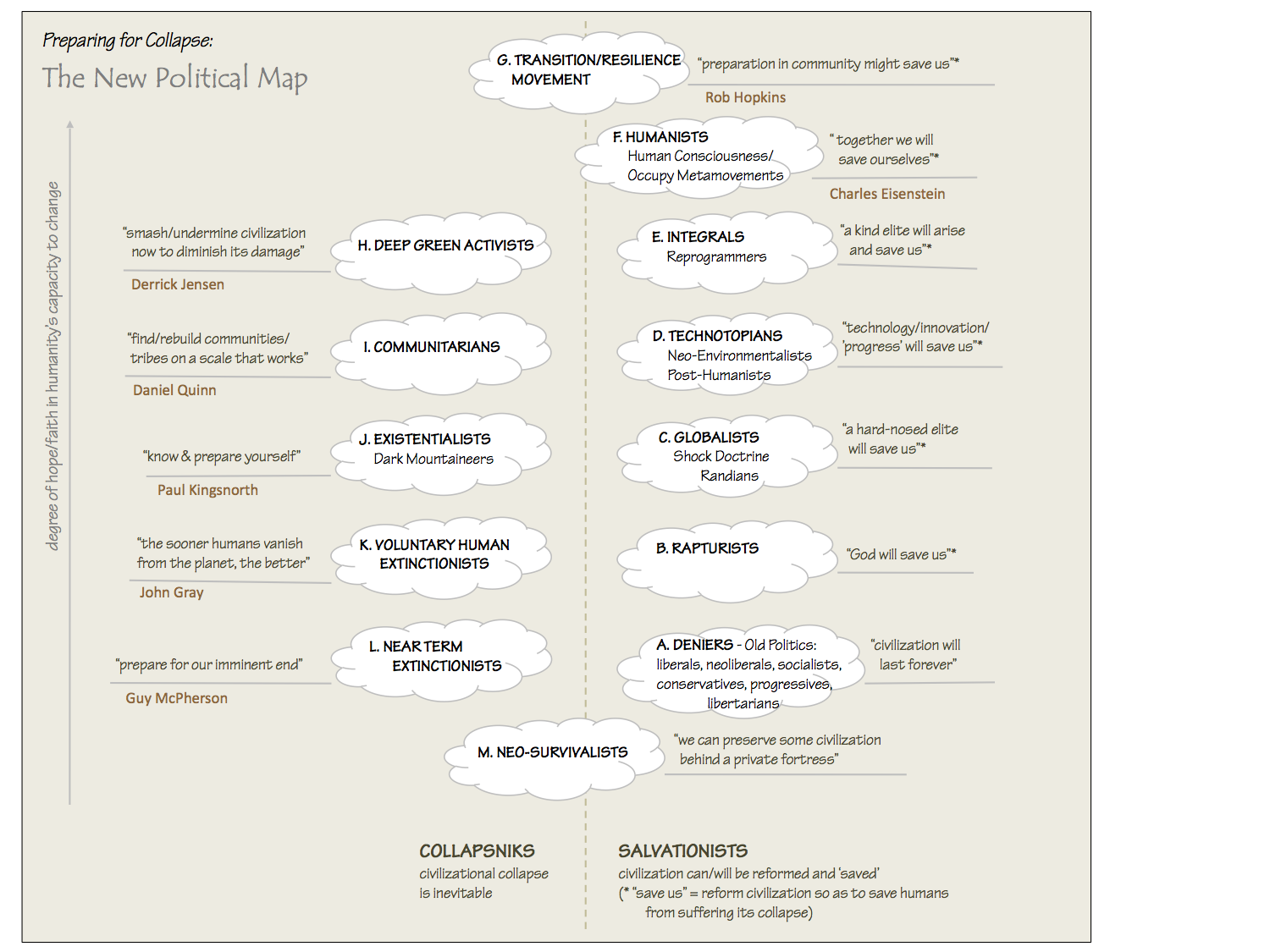
![]() A bit of a homework assignment for you today, dear readers:
What’s your reaction to Korten’s proposal? Mine was that it’s exactly the impossible and unachievable change we need. Citizens just don’t rise up against a dysfunctional socio-economic-political system and replace it with something else. And if they did, they would be fighting the government of the day to the death, since that government exists precisely to defend and sustain the existing dysfunctional economy. We are not going to have a collective anti-capitalist uprising and revolution, and even if we were governments certainly wouldn’t be responsive to it. Let me say it again: Whether you want to change the political or economic system, save the whales, stop global warming, reform education, spark innovation or anything else, the answer is in how meaning, and understanding of what needs to be done, emerges from conversation in community with people you love, people who care. That’s the way you see the solution to problems when you take the ‘feminine’ Natural social worldview in the lower right of the graphic above. If (let’s be optimistic, when) communities start having conversations about this, and start to really care about it, so it goes from the ‘nice to do’ list (that never gets done) to the ‘have to do’ list (that does get done) — when that happens, the kind of emergence of ‘what needs to be done’ is unlikely to be revolution, mass uprising, or pressuring of governments. The consensus on ‘What needs to be done’ is more likely to be a walking away from the existing economy, a refusal to do business with ‘private-benefit’ corporations, and the creation of local, mostly women-run cooperatives, Natural Enterprises within a cooperative local Natural Economy. We’ll just drop out of the industrial economy, and starve it to death. It’s our consumption that drives the current dysfunctional economy, after all. I wonder if I can persuade my publisher, Chelsea Green, to give copies of my book on Natural Enterprise awayfree to aspiring women entrepreneurs. Categories: Natural Enterprise and Understanding Economics
|
November 29, 2007
This is Exactly the Impossible and Unachievable Change We Need
November 28, 2007
Jealous Men, Generous Women: About Compersion
Compersion is the capacity to take pleasure in the joy that one’s lover gets in the company of another lover. I’m using ‘love’ and ‘lover’ here in the broadest sense — intellectual, emotional, sensual, aesthetic, and/or erotic love. Compersion is by definition generous, un-jealous, un-possessive.
Imagine that you love someone completely, and that they passionately crave and enjoy the company of another for one of the following reasons:
How would you feel? Insecure? Inadequate? Threatened? Jealous? Angry? Hurt? Envious? Vulnerable? Turned off? Fearful? Now imagine that this lover told you you were silly to feel this way, that his/her love for you was undiminished or even strengthened by his/her other loves, and that it would be good for you to also find other lovers whose company you enjoy. Now how would you feel? Rejected? Humiliated? Ridiculous? The key to compersion is to learn not to feel any of these negative emotions, and instead to feel delight in the pleasure your lover finds in others that enlarges his/her happiness and frees you from the expectation that you must be all things to him/her. This allows you to be, for him/her, exactly what you are that he/she loves, and at the same time frees you to find other lovers who spark something in you, not necessarily better than what you get from him/her, but different. Now imagine that each of you has five other lovers, making a dozen people in all who you both love, either directly or because of what they do for the ones you love directly. And imagine that these twelve people in your polyamorous circle have made a pledge of polyfidelity (to love only these same 12 people, and to leave the circle if they choose to love others outside the circle, the community. Do you feel better now? Does the ’safety in numbers’ of the circle, the absolute abundance of love available to you, make compersion possible when it wasn’t when the circle was small or uneven? In many recent conversations with people who are in, or were in, or think they might one day be in such a relationship, I’ve heard these three comments over and over:
I’d like to believe the first of these finding is just the result of lack of practice setting aside the negative feelings we associate with our lovers loving others, but I’m not so sure. I’ve felt pangs of these negative feelings myself, despite the deep and growing circle of loving and generous friends that are in my life. Is there something wrong with me, or is this just the way men are — are our bodies just telling us to choose one person to love and battle other men jealously for her (or his, if you’re gay) exclusive love? To try to get at the answer to this question, I considered what would be an evolutionary advantage — would polyamory or monogamy bode better for the health and well-being of the whole circle, community or culture? To me the answer to this is a no-brainer: polyamory groups should be better equipped and inclined to defend and advance the interests of the whole. So polyamorism should be the natural way to live and love. So if this is true, what’s wrong with us (men in particular) that we now find it so hard to behave naturally? I suspect it comes down to “it’s the only life we know” — we won’t viscerally believe in polyamorous circles and communities, where compersion holds sway, until we’ve seen models, first hand, that show such communities work. For those of us who want to make the world a better place, then, our job would appear to be clear: Try, experiment, learn from polyamorous circles and intentional communities until we have evolved some working models, with the bugs worked out of them and the natural rules of engagement for them re-discovered. We owe it to ourselves, our sad love-deprived world, and the generations that follow. For the rest of my life, this will be, I suspect, one of my key goals, purposes, and intentions. In a world gone mad, where every conceivable political and economic approach to saving it has been tried and found wanting, this may be our last chance. I said yesterday that life’s meaning emerges from conversation in community with people you love. The rediscovery of compersion as natural human behaviour may therefore be the way home, to the place we have always belonged, and the essential way of living we have tragically forgotten.. Photo by Rhonda Miller from this remarkable Metroactive article about polyamory. Category: Our culture
|
November 27, 2007
Love, Conversation, Community: Three Magic Words
![]() Since I began my weblog in 2003, I’ve shifted my topics and the vocabulary of my articles from those associated with a traditional ‘Civilization’ social worldview (i.e. mostly articles about the prevalent political and economic regimes, the existing social structure and culture) to a more holistic (and some would say idealized) ‘Natural’ social worldview (i.e. mostly articles about more natural political, social, economic and education systems — see graphic above, lower left). Recently, as a result of many conversations (almost all with women) about the subjects of love, conversation and community*, I’ve come to realize that this ‘Natural’ social worldview has two flavours: a ‘masculine’ analytical one and a ‘feminine’ integrative one (lower right graphic), with different vocabularies and different understandings of how change occurs in the real world — the feminine integrative understanding being one of one person at a time Letting-Themselves-Change, rather than the evolutionary/revolutionary change process espoused by most male progressives. This article is an attempt to explain how these masculine and feminine ‘Natural’ social worldviews are consistent. I originally wanted to synthesize them into one, but they seem to be as irreducibly binary as yin and yang. When there is love, conversation has purpose, context, engagement, trust (while, without love, conversation is sterile and selfish). The best conversations are in fact a form of play. Good conversation entails listening and paying attention, and it is through this that we learn (unschooled), discover, develop capacity to understand how the world works and how to make it better. The best conversations are a form of ‘making love’ — empathetic, collaborative, even erotic. One could even argue that sex is a form of wordless conversation. The best conversations are also polyamorous (all participants love and trust each other) — this provides safety from hurt and cruelty, and this safety encourages openness, honesty, courage, and true innovation. We are constrained in our ability to change by our inability to envision different ways to do things, see things, live, make a living. We can overcome these constraints, and Let-Ourselves-Change, only when we see a demonstration of other, more intuitively sensible, working models. How are such models created? As experiments, as play, by the right, loving people, conversing in community about the right issues, using the right methods. Not communities of practice or communities of interest. Communities of passion, of love. Intentional Communities (and communes) are examples of models of a better way to live and self-manage our political and social affairs, an improvement over the corporatist-dominated and disconnected state politics and the atomized nuclear families that characterize our lonely and dysfunctional civilization society. What I have called Natural Enterprises — non-hierarchical, joyous, customer-responsive, responsible, sustainable, community-based businesses, are similarly models of a better way to make a living, compared to the destructive, acquisitive, competitive, oligopoly-prone corporatist businesses. Natural Enterprises are a form of Intentional Community, and both are products of their partners’ shared passion and love, created by self-managed communities through conversation with the larger communities in which they operate. Natural Enterprises exist in a Gift/Generosity Economy, one of sharing, giving away in love in the expectation that others will give generously in return. The work of self-management, consensus, self-creation of such communities are acts of love which evolve through conversation. Conversations could be seen as a form of Open Space event. Like other Open Space events they begin with a generous invitation, and their success depends on how well the invitation is crafted, who it attracts, the love and passion of participants, and their capacity to listen, pay attention, Let-Themselves-Change, and converse. (The word ‘converse’ comes from the Latin meaning ‘to move with’; the word ‘community’ comes from the Latin meaning ’shared, unified’.) Do you see how these masculine and feminine Natural social worldview models and vocabularies relate to and complement each other? They are different ‘languages’ saying the same thing — about a better way to live, perceive, understand, relate, and make a living. Since I’ve learned to use the ‘feminine’ language (with the help of my suddenly predominantly female commenters and e-mailers) I’ve found it a more powerful, intuitive, grounded language than the analytical ‘masculine’ language. But boy it’s tough to learn a new language when you’re so comfortable with the old one! Life’s meaning emerges from conversation in community with people you love.
This pretty well says it all, doesn’t it? Just about anything important you have to say about politics, economics, education, society, technology, art etc. can be couched in the language of these three magic words: love, conversation, community. Take Knowledge Management for example. Forget trying to explain it in terms of content, websites, sharing and social networking. KM is simply the art enabling trusted, context-rich conversations among the appropriate members of communities about things these communities are passionate about. That’s it! Whether you want to change the political or economic system, save the whales, stop global warming, reform education, spark innovation or anything else, the answer is in these three magic words, in how meaning and understanding of what needs to be done emerges from conversation in community with people you love,people who care. Now you know how to save the world. Category: We need a new one for this!
* I credit Nancy White and her colleagues, Juanita Brown, Nancy Margulies and Amy Lenzo with getting me on this three-word jag; they ‘got’ this long before I did. |
November 24, 2007
Saturday Links for the Week — November 24, 2007
![]() Dry Season, by the astounding and talented artist Mary Mattingly (check out her 7-firm oligopoly posts) Mostly about love, conversation and community this week. My new holy trinity. All I am thinking about, and all I seem to care about these days. No Love Left in the World: A lovely little Thanksgiving post from Jen Lemen. A heartbreaking work of staggering genius. A Polyamorous Potpourri: Since I’ve recently become somewhat obsessed with this subject (in the context of creating natural intentional community), I’ve been reading a lot about it. Here’s some of what I’ve discovered. Thanks to the wonderful women who pointed these articles out, and who, just to be on the safe side, I won’t publicly identify here:
Jeff Buckley’s Everybody Here Wants You: Melisa’s nomination for most romantic song ever, a perfect choice. Thought for the Week: from The Feet of Duende by Michael Meade (thanks to Eric Lilius for the link) Duende is anything that knows earth, that has black sounds, anything that has enough shadow and blue descending to black. Pena Negra, the black sounds that rise from the mystery of ’Äúthe root fastened in the mire’Ķthe fertile soil that gives us the very substance of art.’Äù The mysterious sense of life wound around death speaking dark sounds into the ear of memory, whispering where the breath of day gathers in the blindrecesses of the soul.
|
November 22, 2007
A Gift of Knowledge, Art and Appreciation
![]() © 2007 Melisa Christensen My friend Melisa, an extraordinary artist and blogger based in NYC, has decided to forgo the usual Christmas gifts in favour of gifting knowledge. She is sending people copies of her favourite documentary films. I think this is a brilliant idea, and an important statement. It conveys to the people you are sending gifts to that you care about the world we all live in, that you want them to know what you know, that you appreciate their intelligence and sensitivity to things that matter. It is a gift of art, and an appreciation of art. It is environmentally responsible. It is socially responsible and consistent with the Gift Economy — if you can afford to buy copies, the proceeds will go to great documentary filmmakers to help finance additional work, and if you can’t, well, your handmade copies may spur your recipients to support the artist by buying her/his other work. And it deprives the corporatists of the revenue they might otherwise get from sweatshop labour, fouling the environment, depleting resources and screwing the workers of affluent nations, if you’d bought some Chinese crap instead. In the spirit of this, I asked Melisa to help me compile a list of great documentaries to consider. Her list is more political than mine, while mine skews more to naturedocumentaries with a message. Here’s our combined list: The Corporation That’s 15 to start. What’s missing? If we get enough suggestions we’ll create a permanent list and put it on the sidebar. (And for those who love documentaries, here’s a blog with links to dozens of free online documentaries) Category: The Arts
|
November 21, 2007
The Politics of Monogamy
One of the things that has surprised me most about my recent voyage into polyamorous love is the effect it has had on my appreciation of music and film. As most of you know, I’m a hopeless romantic, and music and films about discovered and celebrated and lost love transport me. But now I’m starting to look at these films, and listen to this music, with a completely different eye and ear. They are almost all about:
So now I find myself hitting the fast forward to next song button on my mp3 player over and over to get past these really annoying songs about monogamous love being the one true way. What’s that about? How come I never noticed before that these seemingly great songs and seemingly heartwarming movies are actually political propaganda? I don’t by any means think this is deliberate. This is just one more example of the “only life we know” phenomenon, by which we extol the virtues of the only way we know to do things, through good and bad, and laugh about how crazy it all seems to be. It’s the same reason that books about entrepreneurship reinforce the deadly and dangerous myths about the only way to make a living, and the same reason that our political and economic and educational debate is all centred around how to tweak the existing systems (to the left or right, usually) when any fool should be able to see that the existing systems are hopelessly broken and that tweaking them or depending on them is simply being co-opted by them, a distraction from the essential work of imagining and creating wholly new models that can be tried when the old ones collapse. We are, alas, our own propagandists, urging each other on to be ‘everybody else’ in an insignificantly and unhelpfully different way. When will we start listening to the artists and the dreamers? They have been telling us this all along. Why can’t we,won’t we, hear them? Category: Our Culture
|
November 20, 2007
Principles of a Polyamorous Natural Community
Of late, most of my conversations have been about love, about conversation and about community, specifically the creation of model intentional communities that are essentially polyamorous in nature (i.e. membership in the community is self-selected in such a way that all members of the community love each other, equally, with no pervasive pair bonds). My article Communities Based on Love has sparked quite a bit of discussion on this subject, notably the 16 natural capacities I suggested members in such a community should have:
Many readers thought this long list too onerous and exclusive, but I sense that a Natural Community whose members significantly lack any of these qualities would be extremely fragile. I also believe we are all born with these capacities, and for most it’s just a matter of Letting-Oneself-Change to re-engender them. I have already begun, with a woman I have met in Second Life who I will call Eve, to create one such community in Second Life to test whether all these capacities are necessary, and to test my hypothesis that such communities should naturally and advantageously be polyamorous. Eve and I are beginning to explore the operating principles that might govern such communities. I see these principles being fluid, emergent and co-developed by the community members, so what we come up initially with will be merely a first stake in the ground. My recent obsession with love, conversation, polyamory and community has been such that I’ve also been talking with real-life friends (some of whom are physically close and others whom I have never met face-to-face but love nevertheless) about these principles. Some of these people I hope to invite to be part of our Second Life MPNC (model polyamorous natural community). Here are some of the principles we’ve been thinking and talking about:
There may well be other principles, and perhaps we’ll find some of these principles are unnecessary or need to be changed. This is all about practice, and it is through practice, in Second Life, and paying attention to what works especially well and what doesn’t work well, that these principles will evolve into a set of principles that guide the flow of the community. And it is through practice that we’ll learn to become better community members, lovers and friends. There is, I think, no other way to make this work. And it is important, both to our broken modern society and to the generations yet unborn who may have to create a new society fromthe ruins of civilization, that we make it work. Category: Intentional Community
|
November 19, 2007
The Strategy Paradox
![]() I had the pleasure recently of meeting with Michael Raynor, author of The Strategy Paradox and co-author of The Innovator’s Solution. I wanted to try to convince him that the solution to the Paradox is designing for organizational resilience, an idea I’ve been exploring with Steve Barth. Michael wasn’t having any of it. In a nutshell, the Paradox is that the more you plan and commit to certain strategies for your organization’s future, the more likely you are to achieve exceptional results, and the more likely you are to achieve disastrous results. The greater your commitment, the greater you opportunities and your risks. The reason for this is that, by committing to particular strategies and executing based on those strategies, you will, if your expectations about the future prove correct, achieve competitive advantage as a result of that commitment. But, if your expectations about the future turn out to be very wrong, you will have over-committed your energies and resources to the wrong things, and will lose big time. As a consequence, organizations tend to be shy to commit to strategies unequivocally. They’ll avoid both risks and opportunities. And their performance will be mediocre. Michael’s solution is to do two divergent things:
This combination minimizes risk (by keeping longer term strategic options open) and maximizes return (by committing aggressively to shorter-term strategies). He argues that the reason the Paradox is so little understood in business is that most research on performance focuses only on successful companies, and ignores the lessons from spectacular failures. The process of strategic uncertainty management or strategic flexibility therefore entails the following four steps for the executive office:
Michael argues that, because the future is so unpredictable, rapid changes cannot be adapted to (no matter how resilient the organization) and slow changes encourage incrementalism and expose the organization to disruptive innovations from competitors. As a consequence of the lack of good strategic uncertainty management competence in most organizations, Michael suggests that the best investment strategy might be:
I also spoke with Michael about Elliott Jaques’ Requisite Organization which argues that “managerial hierarchy is a reflection in post-tribal organizational life of discontinuities in the nature of human capability”. My regular readers will not be surprised that I violently disagree, and believe that such hierarchy exists because it’s essential to compel acquiescence and obedience of the majority of workers to mindless, meaningless, soul-destroying work. But that’s a subject for another article. Michael’s newest project revolves around his organic view of business organizations whose essential purpose, he argues (contrary to The Corporation’s view of their essential pathological nature) is to secure its own survival. That requires, at least in a ‘perfect’ market, satisfying all stakeholders in a balanced way including maximizing their social welfare, even more than making profits. We discussed how market ‘imperfections’ (the ability to form oligopolies, the ability to externalize costs to other countries, the environment and future generations) distort this seemingly natural and evolutionary development in the real world. I’m not willing to concede that organizations are truly this organic. Just as unhealthy societies are perverted by scarcity, corruption, psychopathy, acquisitiveness, thirst for power, and greed, so too are corporations in a world where too many people are chasing too few resources and jobs. When this happens, agile social structures based on abundance and collective well-being are replaced by mechanistic, fragile ones based on deliberate perpetuation of scarcity, power and inequality. Can organizations, at least non-hierarchical, responsible enterprises designed for sustainability truly be resilient? My experience, with much smaller companies than Michael has studied, is that they can. I believe that size, and the number of degrees of separation between an entrepreneurial organization and its customers, partners and community, is the real cause of lack of organizational resilience, which gives rise to the need for the complicated and counter-intuitive solution Michael proposes for giant monoliths. There is no strategy paradox for Natural Enterprises — their capacity for and focus on excellent need-driven research, innovation, continuous improvisation and acting responsibly and responsively is their competitive advantage over the arthritic hierarchical giants, and the key to their inherent resilienceand sustainability. Category: The Innovation Process
|
November 18, 2007
Sunday Open Thread — November 18, 2007
![]() Image by Christer Rosewell What I’m Thinking of Writing (and Podcasting) About Soon: Principles of Natural Polyamorous Community: I’ve found a remarkable woman in Second Life (or rather, we’ve found each other) who shares my vision for creating an intentional polyamorous community (we actually share a lot more). Like Noah, or Adam and Eve, we’re going to build it in Second Life, carefully adding one couple at a time we both love, who share our values, philosophy and lifestyle, and work out, together, the social principles by which it operates, all built on generosity and abundance of love. And I thought my life couldn’t get any better! Coping With the Strategy Paradox: I met recently with Michael Raynor, who wrote The Strategy Paradox. He’s now looking at what else we can do to deal with this paradox, and he poked some holes in my argument that what we need is resilience, not planning. The Evolving Role of the Information Professional: Since I listed the five major ‘products’ of my new employer, some people have suggested that this list might define the new role of the information professional in all sorts of organizations. Gangs and the Malleability of Human Ethics: Observers of the now decade-long intractable genocides and civil wars in Darfur, Somalia, Chad, Zaire and other African nations describe the same gang phenomena repeated endlessly: Men horrifically tortured and slaughtered, women systematically and repeatedly raped, children kidnapped and forced into slavery and military duty, animals and other resources stolen, and villages burned to the ground. What is it about human nature that so many can perpetrate such atrocities for so long without remorse? Vignette #7 Blog-Hosted Conversation #4: Inevitably, my fourth podcast will be about love and/or Intentional Community. Not sure who it will be with, yet. Possible Open Thread Question: What’s the most romantic song, and the most romantic movie, you know? |
November 17, 2007
Saturday Links for the Week — November 17, 2007
![]() Map from Carma-Carbon Monitoring, via Cass Allowing Space: Cassandra writes a profound and important article about art and blogging. “I risk losing you if I don’t post often. I risk losing myself, and the rests between my words, if I post too often.” This brought tears of understanding to my eyes. If you’re an artist, a blogger, or a lover, just go read it. Now you know, dear readers, why I reply to your comments and e-mails so rarely, though I read and savour every word. If I Were to Do Only One Thing, What Would It Be?: La Marguerite explains why green activists need to simplify their messages, not dumbing them down, but prioritizing and customizing to engage and enable meaningful action. Simple Formula for Change Through Conversation: Conversation as a Radical Act says it’s about finding the intersection between the important, appreciated issues (the what), the right, passionate, responsible, informed people with diverse ideas (the who), and the right methodologies and process arts to explore these issues (the how). Simple, and brilliant. Nancy and Nancy and Juanita and Amy, you’re on to something. When the Spark in Your Relationship Has Flagged: A wonderful and deftly-written article by TherapyDoc with advice for women on how reawakening your libido starts with focusing on yourself. Should be compulsory reading for men, too. Eat Food, Not Much, Mostly Plants: That’s the advice from food politics expert Michael Pollan in Grist. Thanks to David Parkinson for the link. The US Drought Worsens: The Independent updates us on just how bad it is. Thought for the Week: My own, for a change: Ever since I began to learn and write about Natural Enterprise, I’ve become aware of how the propaganda of Hierarchical Business and Meaningless Work pervades everything in the information and entertainment media, teaching us that there is only one way to make a living.
Ever since I began to learn and write about Natural Economy, I’ve become aware of how the propaganda of Industrial Economy pervades everything in the information and entertainment media, teaching us that there is only one way to steward Earth’s resources. Ever since I began to learn and write about Natural (Intentional) Community, I’ve become aware of how the propaganda of Disconnected Community and Dependent Politics pervades everything in the information and entertainment media, teaching us that there is only one way to live together Ever since I began to learn and write about Unschooling, I’ve become aware of how the propaganda of Institutional Education pervades everything in the information and entertainment media, teaching us that there is only one way to learn. Ever since I began to learn and write about Polyamory, I’ve become aware of how the propaganda of Monogamy and Nuclear Family pervades everything in the information and entertainment media, teaching us that there is only one way to love. It’s only when we learn, discover, explore, or create another way that the current way of doing things appears ridiculous, outrageous, tragic,obscene. |


Compersion is the capacity to take pleasure in the joy that one’s lover gets in the company of another lover. I’m using ‘love’ and ‘lover’ here in the broadest sense — intellectual, emotional, sensual, aesthetic, and/or erotic love. Compersion is by definition generous, un-jealous, un-possessive.


Of late, most of my conversations have been about love, about conversation and about community, specifically the creation of model intentional communities that are essentially polyamorous in nature (i.e. membership in the community is self-selected in such a way that all members of the community love each other, equally, with no pervasive pair bonds). My article