Dave Pollard's environmental philosophy, creative works, business papers and essays.
In search of a better way to live and make a living, and a better understanding of how the world really works.


December 29, 2007

Sunday Open Thread — December 30, 2007 — The Way Forward

Filed under: Our Culture / Ourselves — Dave Pollard @ 23:39
olympic 2
What I’m Thinking of Writing (and Podcasting) About Soon:

“Stupidity is a place of grace.” So says my dear friend Andrew and I hope he’s right. I’m feeling very stupid these days, in the true sense of the word — “stunned, dazed, or incoherent”. Clearly, of late, I have been all three.

And for that reason I think I will try to say, and write, relatively little for the next while, until I have something intelligent to say (in the sense of being “supported by evidence of its empirical validity”) rather than just something intuitive and conceptually interesting.

For the next while I will be reposting (with modest updates) some of my more enduring articles from the past five years. But first I will be posting my New Year’s Intentions (as distinct from New Year’s Resolutions).

I remain absolutely resolute (or perhaps I should say intentional) that my Purpose is to establish and nurture the establishment of Model Intentional Communities. The principles and competencies I think they might need or aspire to (including polyamorism) are completely negotiable, and will be arrived at by consensus of our members. I will respond briefly to the critics of this intention shortly, and will then move on — rather than debate the validity of my ideas endlessly, I think it makes sense for us to just begin, and discover whether they make sense, and whether they work, or not.

I have started a blog with my Second Life intentional community partner, and as our experimental community evolves you will be able to read about it, from the point of view of all its members, on this new ‘group’ blog. New articles on that blog will likely be cross-posted or cross-linked here. My goal is transparency, and our new blog will be a true journal of learning and discovery.

I am also resolute in my belief that the best way to approach and cope with all the challenges of our time is through Love, Conversation and Community, and specifically:

Whether you want to change the political or economic system, save the whales, stop global warming, reform education, spark innovation or anything else, the answer is in how meaning, and understanding of what needs to be done, emerges from conversation in community with people you love, people who care.

As a consequence, while I will be writing less on this blog, I will be engaging in more loving conversations, one-to-one and in community. If you want to be part of that, please sign up for gmail and email me at dave.pollard (at) gmail.com; we will be able to see each other’s online status for instant message conversations (and, depending on your operating system, VoIP voice-to-voice conversations as well). I have come to prefer the latter, because voice-to-voice conversations are more iterative and provide richer clues as to meaning (voice inflection etc.) than mere text. I will make as much time available as possible for such conversations but you’ll have to be patient with me, because I only have so many hours in the day for conversation, and may have to ‘schedule’ something with you rather than (what would be more ideal) be able to converse with you immediately and ex tempore. I am not interested in debates or adversarial conversations — I find them a waste of time and energy. If you are willing to entertain a discussion full of “yes…and” rather than “yes…but” expressions, then I want to talk with you.

I am not abandoning this blog. It has over 2500 pages of material in it and I will add to it as often as I have something new to say — not new abstract ideas or promising models but new learnings, discoveries and experiences from actual practice that you, dear readers, may hopefully find valuable. This will include posting conversations that I have with others (in text and/or podcast form).

You’ll get a better sense of where I’m going in my upcoming New Year’s Intentions article.

“Everybody sails alone, but we can travel side by side.”
     – KT Tunstall, Heal Over, a truly amazing song you can find on YouTube

Hope to see you, dear friends and lovers, on our journey, nearby, within voice range, and perhaps close enough to touch, to feel. A journey oflove, peace, understanding and joy.

“Not farewell, but fare forward, voyagers.”
     – TS Eliot, Four Quartets

Saturday Links for the Week — December 29, 2007

Filed under: Our Culture / Ourselves — Dave Pollard @ 22:03
Christmas 2007
One of my Christmas 2007 pics.

Let’s go back to ourselves in the present moment:
An inspiring post from Patti Digh on being present, every day. That reminds me, it’s time for me to do my next semi-annual list of intentions.

Written Off as a Crazy Person:
Jim Kunstler, in his Christmas Eve blog post, recounts how a friend of many years, learning of his position on Peak Oil, basically wrote Jim off as crazy. In a week when my ideas on intentional community, and more specifically those of the poly variety, have been excoriated by more than one friend, I found his response inspiring and delightful, and I dedicate it to my critics, who I love dearly despite their sometimes-visceral disagreements with me:

It was disheartening, of course, to be written off as sounding “like a crazy person” by an old friend. I don’t doubt that his perception is genuine. I’m prepared to live with the disconnect between what my friends believe and what I think. I even reserve a portion of my mind for the possibility that their view may be more realistic than mine — but I won’t torture myself about it. Someday, surely, I’ll meet this old friend again and perhaps he’ll say something like “…things didn’t work out quite the way I expected….”

(Jim’s previous post on why the US financial systems are failing is also worth a read — thanks Jon.)

The Anti-Monogamy Song: Performed by Sarah Burton. Reminds me a bit of Laura Kipnis’ “Against Love”. Glenn, maybe you and I should just shut up and let the women tell it.

A Village is Not an Intentional Community: An interesting distinction between responsible, sustainable community models that are intentional, and those that are not, from Village Forum. Anyone out there tried this type of ‘village’ who can tell us if it’s just (like mine) and interesting and promising idea, or something that actually works?

The Missing Tapes and the Bush/Cheney Torture Agenda: Naomi Wolf chillingly explains what the worst president in the history of the US, and his regime, have to hide. It seems that nothing much has changed since Hoover planned to lock up anyone that didn’t agree with the Truman regime in 1950, without charges or a trial, forever, in military prisons. A nation gone mad.

A Group That Gets the Importance of Wilderness: I’m supporting the Habitat Trust because they’re willing to buy and set aside wilderness areas and not let any humans into them. Thanks to Teresa for the link.

Do It Yourself Music Video: An Alley Somewhere by Scott Andrew. Could this kind of home-made, self-published work be the future of art? (Thanks, Martin.) Meanwhile Karen Shanley points out a fun Christmas music video.

Thought for the Week: The story of Maya’s Veil, summarized by Mariella Rebora:

First there was Brahma, all alone and very bored…
so he decided to create a beautiful goddess to have some company and he created Maya…

he told her that he was bored and wanted to play…
OK she said… but you must promise me you will do whatever I ask you to…
and he accepted…

she asked him to create the sun, moon, stars, earth, water, animals, plants…
then she said, now you must create an intelligent creature able to understand the beauty of your creation…

so he created men and women…
(now close your eyes and wait…)

she took Brahma, cut him into tiny pieces and put a little piece inside the heart of every human…
and she told him…. now the game begins… you will forget who you are, and you will have to find yourself and get together again…

and until today Brahma is still playing the game…trying to remember who and where he is…. trying to get together again.. and he will play until Maya¬¥s veil falls from his eyes….

December 28, 2007

Looking for Working Models of Intentional Community

Filed under: Preparing for Civilization's End — Dave Pollard @ 20:33
IC Meeting Place Colorado
an Intentional Community meeting-place in Colorado

Well, clearly I haven’t been able to articulate the argument to support my instinctive belief that model intentional communities (MICs), to be effective, need to be polyamorous. I’ve read all your comments, and thank you for them. I remain convinced of the benefits of polyamorism to the social health of a community, but what’s more important is that we start identifying and creating MICs that work, both for the benefit of our present civilization and for possible use by the generations that will grow up after civilization’s fall. So I’m not going to say any more about polyamorism*, at least not for a while.

I have been delighted at how many of my readers, and those I have spoken to about it face-to-face and in Second Life, agree that it would be more fruitful to create MICs, better working models of how to live, than to try to fight to reform the existing political, economic, social and educational systems. Just to reiterate, those MICs will need to agree on both essential capacities and operating principles for their members. My first crack at as possible list of each:

Natural Capacities: deep capacity for love, passion for the community’s shared purpose/intention, trust, emotional strength, sensitivity/openness/perceptiveness, good instincts, self-sufficiency, honesty, intelligence/critical thinking ability, curiosity, imagination, creativity, responsibility, expressiveness, flexibility, and tolerance.

Responsible and Sustainable Operating Principles: stop at one child per woman, practice radical simplicity, pledge to buy local, leave the Earth as you found it, practice bioregionalism & permaculture, cooperate & collaborate, practice consensus democracy, value everyone’s time equally, pay attention to nature, be self-sufficient, incur no debts, be generous, organic and responsible, and understand and use the power of relationships.

Each MIC will of course have to develop its own list, but as I work to create MICs both in Second Life and, later, in Real Life, these are the ones I would propose to start with. The idea would be to have an association, an alliance, of MICs, helping each other out with lessons learned, success stories, etc. Each MIC would be a circle within a circle, the larger circle being Gaia, the community of all-life-on-Earth.

In fact, I’m beginning to think of Natural Enterprises, the concept I outline in my book to be published in the Spring, as a specialized type of MIC. Natural Enterprises also require the above natural capacities and responsible, sustainable operating principles.

MICs are, by their socio-ecological nature, inherently complex networks. Dave Snowden suggests that, because the evolution of such networks is unpredictable, they cannot be planned or directed. What can be done, however, is influence their “initial conditions” — using attractors and barriers to ‘steer’ behaviour in ways favourable to obtaining and retaining members with the necessary capacities and who share the beliefs underlying the operating principles. That means the membership has to be self-selected and ‘discriminatory’ — diverse yet picky. This is a tough balancing act. The Natural Enterprises I know that ‘work’ the best have an almost ideal makeup of people — respectful, loving partners whose business capacities (‘Gifts’) are mutually exclusive and collectively sufficient to achieve the enterprise’s shared Purpose. Usually, I confess, the selection of members has been serendipitous and fortunate, rather than deliberate. Nevertheless, it’s the people in a Natural Enterprise who make or break it.

Same thing applies to MICs of people who want to live together. You want diversity, because MICs only work when their members are so interesting and lovable that they cohere — the members want to spend as much time with each other as possible, learning, loving, discovering, collaborating, innovating, making it work. This is so unlike modern disconnected neighbourhoods who are usually only physically together out of convenience. Because they lack cohesion, they acquiesce to the imposition of top-down, indifferent, modern hierarchical political and economic and social and educational systems on them, and ultimately, because their neighbourhood is incapable of self-sufficiency, become dependent on these hierarchical, irresponsible, unsustainable systems.

To be self-sufficient, responsible and sustainable, the MIC needs to have everything (the capacities, the space, the time, and the resources) to be independent. While I don’t know of any modern examples of this, my pioneer ancestors in the early 1800s were, of necessity (they were completely isolated), completely self-sufficient. Seventeen families (about 150 people in total) including Joshua Pollard’s family moved into 8000 acres in the lower Peel region of Canada together — no electricity, no communications — and thrived together as an intentional community. They lived in harmony with another IC — the Mississagua Indians — who sold the land away from the rivers to these new settlers. The two ICs lived completely different lifestyles, but both were self-sufficient, responsible and sustainable, and extremely comfortable, joyful communities (my ancestors, I’m told, loved to dance and sing, and opened the region’s first school and a subsistence tavern). Other than their large families, they adhered to the above principles and, from what I can piece together, had the above natural capacities. They were ultimately undone by overpopulation and, as their community became interconnected with other Ontario communities over the ensuing century, by a switch from self-sufficient permaculture to commercial monoculture, which proved disastrous when the economic recessions of the 1880s and 1890s hit and trade virtually ceased.

Modern ICs have had to try to work under modern constraints — a shortage of land, horrific overpopulation everywhere, depleted soils, an utterly interdependent, fragile, technology-dependent and resource-constrained economy, and the loss of knowledge of how to live self-sufficiently. Because most of them have not been very ‘discriminatory’ in their membership, and many have lacked commitment, capacity and/or principles, most have stayed small or disappeared, and have not had responsibility or sustainability as principles, so they are not useful models (if you know first-hand of any modern MICs that I could profile here, please let me know). Some of these constraints (shortage of land, depleted soils) will be hard for any MIC to overcome, but most require nothing more than re-learning what has been forgotten, and applyingsome sustainable, responsible modern knowledge and technologies.

And then just learning from trying, from experimentation, from collaboration, from innovation, what works and what doesn’t.

And just being a model.

Time to get started.

* I will be responding directly but briefly to comments on my Dec. 19, 20 and 24 articles soon, in the comments threads.

December 27, 2007

a midnight conversation

Filed under: Creative Works — Dave Pollard @ 15:57
house brick
sitting in the darkness
in the middle of the night,
and staring through the window
smiling, thinking thoughts of you.

i throw another log upon the fire
and light a candle on the table
where i write, cross-legged
listening to madrigals.

each gentle note of the guitar wafts
quietly around the room and
speaks to me its haunting melody
its voice, both calm and wild
is like a creature crying in the dark
its song of love and loneliness.

outside, a single coach-lamp
shines its light on red-bricked walls
creating colours that did not exist
before invention of electric lamps
transformed the deep and silent night;

these colours stir a pure emotion
cold and stark and still and proud
inviting
in the way that only wintry nights
can welcome you.

i sit in wonder, of this life,
of nature’s awesome beauty, and of you,
who are a part of me, forever, now,
with me, each place i go
i feel you, leaning back against me,
smell you, earth and sweat and jasmine,
taste you, berries, yogurt and the taste of me, and
hear your voice, so breathless, laughing,
see those little curves, those hidden places,
eyes in candles’ soft reflection gleaming in the dark,
with me, here, now and always, you
who i can love so easily, so naturally, and so completely,
always and all ways.

no more ‘hard work’ love
all ridden with those anxious thoughts and struggle,
expectations and distractions and demands,
and doubts, and silly jealousies, and
insecurities and fury and the endless unwept tears —
now my love for you flows hot and raw like lava
effortless and unrestrained, with
laughter, ecstasy and all-consuming joy
just to be,
here,
now,
in this still and endless moment, outside time, with you
connected and a part of all the life on Earth:

a conversation, in hushed voices, in the dark,
alert, and listening
filled with love of every man and woman, beast and beauty,
wild and gentle, tame and savage,
in this place, our Home,
in unrestrained communion.

now the wind comes up
the firelight flares, the candles flicker–

in the silence all alone
i hear your voice, the whisper in the winter’s cry
the song of one awoken chickadee
its trill the story man has long forgotten how to hear
of how to live, and love;
she tells the world
of joy that needs no ‘saviour’.

just hold me now, and know, that in my arms
in love and conversation we will find
the answer to life’s mysteries is simple:
walk away, let yourself soar, be
self-sufficient, owning nothing, needing nothing, loving all –
just one to one with trusted friends in Gaia’s warm embrace,
a circle in a circle of belonging,
nothing more.

Category: Poetry

December 24, 2007

Intentional Communities: Mono vs Poly

Filed under: Preparing for Civilization's End — Dave Pollard @ 13:35
Merry Christmas, everyone!
I wish you all peace, love and joy, learning and discovery in the year ahead.

We have so much work ahead of us, but it will not be tedious — it will be astonishing, delightful, intentional, and, in a million small ways, Earth-changing.
We cannot fail.  
 :: Dave ::
Christmas

In last week’s article I attempted to explain why I thought it made more sense to create new models than to try to fight or reform the existing political, educational, social and economic systems. I promised to write about why I think polyamorism is an essential element of what I’ve called ‘model intentional communities’ – models that are not abstractions or concepts, but real working models, people striving together with common purpose, showing rather than telling people a better way to live.

Let’s start with what an intentional community (IC) is. Diana Leafe Christian defines it as an autonomous, self-managed, democratic association of people with shared social, cultural and economic intentions and aspirations. My own definition of a model intentional community (MIC) is one that is:

  • exemplary — it works well, and represents the best of what ICs with similar focus and talents have to offer
  • egalitarian — it is non-hierarchical, has no dominant leader, and is free of the coercive characteristics that can cause healthy communities to decline into cults
  • replicable — other successful ICs could be created by following its example
  • educational — by spending time in it, you can learn a great deal, including how and why it is successful
  • responsible and respectful – members take responsibility for, and are respectful of, the welfare of other members and their environment
  • self-sufficient and sustainable — it’s not dependent on the largesse of outsiders, or on subsidies or low commodity prices
  • diverse — substantially different in focus, style, and/or structure from the other MICs

In a recent post, I argued that for an MIC to be effective, its members probably had to have most or all of 16 natural capacities: deep capacity for love, passion for the community’s shared purpose/intention, trust, emotional strength, sensitivity/openness/perceptiveness, good instincts, self-sufficiency, honesty, intelligence/critical thinking ability, curiosity, imagination, creativity, responsibility, expressiveness, flexibility, and tolerance.

And in a follow-up, I suggested that MICs should adhere to certain collective political and economic operating principles: Stop at one child per woman, practice radical simplicity, pledge to buy local, leave the Earth as you found it, practice bioregionalism & permaculture, cooperate & collaborate, practice consensus democracy, value everyone’s time equally, pay attention to nature, be self-sufficient, incur no debts, be generous, organic and responsible, and understand and use the power of relationships.

Diana’s research suggests that the average active IC has about eleven members, meaning it’s about the same size as a pioneer family. My guess is that that’s not big enough to be self-sufficient and sustainable.

My argument is that our civilization society deliberately contrives to keep our social units this small. It doesn’t want us to be self-sufficient and sustainable. It wants us to be dependent on it for jobs, for money, and for the things that money buys, so we continue to support it even though it is inhuman, degrading, tedious, and keeps most of us in constant struggle and misery.

This civilization society is full of people in monogamous nuclear family units. It’s a society full of pain and disability, where millions live in one form or another of imprisonment. It’s a society devoid of imagination, incapable of change, grim, conforming, obedient, co-opted, brainwashed. Dependent and co-dependent. Obsessed with security, possession, survival. Addicted to consumption. Mostly joyless, tedious, jealous of others’ power, possessions, beauty, material and political and social and sexual success. The monogamous nuclear family unit is held together by a ‘marriage’, which we are taught is hard work, requires total commitment, struggle, sacrifice. Just like our jobs.

The information and education and entertainment media brainwash us into believing that this is the only way to live. They celebrate the arduous overcoming of hardship, the practice of fidelity, self-sacrifice, defeating the competition. The media adore the ritual of marriage, the giving of two people to each other, exclusively. Infidelity is always punished in the end, in film, in music, in literature. Jealousy and possessiveness are portrayed as natural, evidence of love.

So it’s not surprising that polyamorism — a group of people who love each other without restriction or restraint, with compersion (taking pleasure in the pleasure that someone one loves finds in the company of others) — is viewed as suspect, greedy, selfish, disrespectful, faithless, undisciplined, immoral, even exploitive.

There are four forms of love — intellectual, emotional, sensual/aesthetic and erotic. No one should be expected to love only one person in any or all of these ways. No one should be expected to fulfill everything that another person could want or need, to be that lovable in all four ways.

Several readers have told me that making the community polyamorous will only make it harder to find members, harder to self-manage the complex arrangements, elitist, and preoccupied with love among its members instead of being a true, generous, outward-focused model for others.

The important issue, I think, is whether such a polyamorous MIC would best manifest the behaviours consistent with sustainability, responsibility, generosity and self-sufficiency, and the operating principles listed above. Would a polyamorous community be more likely to have fewer children each generation, consume less, borrow and ‘import’ less, be more peaceful and cohesive, freer, and, perhaps most important, happier and better able to learn, imagine and adapt?

I think it would, but it’s hard to articulate my reason for believing so, other than to say:

  • my instincts tell me it would, 
  • I believe wild creatures live in community this way, and 
  • my own joy loving many people without limit or constraint feels like a natural way to live, one that most people would find joyful and healthy, if they weren’t so brainwashed to believe that monogamy is the only way to live.

There are about two dozen people on my current Love Conversation Community list, people I love deeply and I think I would enjoy living in an MIC with, either in Real Life or in Second Life or some other ‘virtual’ community, if those people were so inclined. Most, but not all, are women, and heterosexual, though, and I believe an MIC needs balance and diversity, so this group is not, and could not be, an MIC, though, hypothetically, it might be the nucleus of one. Some of these two dozen people I am intellectually infatuated with — I really love their minds, their imaginations, their creative genius. Others I love emotionally — they have a combination of strength and sensitivity, and they care about much the same things I do and articulate these shared passions and purposes well. They fulfill something in me that is otherwise unfulfilled, and they have told me that I likewise fill something in them.

Others I have an aesthetic love for — they are just beautiful people, physically, a joy to watch, to listen to, to admire for their art, or the way they move, their grace, their strength, their physical talent, their agility. And still others I have an erotic love for — expressed or (mostly) unexpressed, likely or unlikely to be reciprocated, but present and powerful nonetheless — as one of them put it “we want to fuck who we want to fuck”, and it is our bodies, not our minds, that choose this.

It is not even as simple as checking off which of these four types of love I feel for each of these two dozen people, because there are different aspects and means of loving and appreciating people in each of these four ways. I may love one person emotionally for their generosity, what they offer to me and to others, the way they exemplify openness and the raw gifting of their soul. I may love another person emotionally for their sensitivity, their perceptiveness, their ‘emotional intelligence’. I may love yet another person emotionally for their energy, their intensity, and be attracted to them the way a moth is attracted to a flame.

So the idea that I could or should love only one person exclusively, and expect to get everything I would want or need from them, and that I should strive also to be able to provide that one person with everything they want or need seems like the stuff of romantic fantasy, an impossibility, a recipe for disappointment. No wonder monogamous marriage is such hard work — so many compromises, self-denials, frustrations, struggles to be enough, to do better, to make the marriage ‘work’!

I can see the value for a brief pair bonding during a woman’s pregnancy, and this is also manifest in the natural world of wild creatures. For this period, some self-sacrifice is necessary, and that requires a huge and personal commitment to one other person. But once the child is born, the bond should relax and re-permit polyamorism in all its dimensions, as the role of raising the child once it is born is a community-wide role.

My sense (and the purpose of trying out different IC approaches is to experiment, discover and learn what actually works, before presuming to offer a model to others) is therefore that the members of a polyamorous community would be happier, more relaxed, more trustful, more knowledgeable about other people’s feelings, beliefs, purposes, gifts and passions (through greater intimacy), less selfish, less insecure, less risk-averse, more imaginative and creative, more peaceful and adaptive and resilient. Mainly just because they know more and know and trust each other better, because there is an abundance of love, because the support network is broader, because there is emotional ‘safety in numbers’. And also because there is more time and space for love, conversation and community. Surely the consequence of this must be an emergent collective understanding of a better way to live?

And so, my intention is now to co-create with others not one, but a host of MICs, different experiments, full of people who love each other unequivocally. A dozen and then a hundred and then a million people, walking away from the bankrupt and dysfunctional systems of our civilization and discovering and learning together a better way to live, through Love Conversation and Community. Evolving the principles above in a way that works for each community, but with a shared vision of sustainability, responsibility, and gentle joyfulness. And networked together and with all-life-on-Earth, sharing stories of what works, co-creating a whole new and resilient society, with zero hierarchy and unlimited abundance. A natural society.

This may be just my crazy idealism. But my instincts are not usually wrong. At any rate, when we put this to the test of experiment and see what evolves, we will know. I just can’t imagine any community structure working worse than the monogamous isolated nuclear family structure. Despite all the propaganda in its defence, I am sure most of us can, in time, see that that structure is both cause and effect of our grotesque, greedy, hateful, thoughtless, violent, careless and unsustainable modern civilization.

Are you persuaded? What would it take for me to show you (rather than just try to convince you) that a polyamorous MIC is probably the best model for how to live, a model that we can create and offer to others? Do you still feel that polyamorism is a distraction, a red herring in the collective search for answers to our society’s most pressing and intractable problems? Is there a monogamous model out there that actually works?

December 23, 2007

Sunday Open Thread – December 23, 2007

Filed under: Our Culture / Ourselves — Dave Pollard @ 22:19
Zero Level by Sigit Prasetio
from Deviantart — Zero Level by Indonesian artist Sigit Prasetio

What I’m Thinking of Writing (and Podcasting) About Soon:

Love, Conversation and Community: I remain obsessed with the idea that

Whether you want to change the political or economic system, save the whales, stop global warming, reform education, spark innovation or anything else, the answer is in how meaning, and understanding of what needs to be done, emerges from conversation in community with people you love, people who care.

I owe my readers a further explanation of why I think polyamorism is a necessary ingredient of effective Model Intentional Communities. I also want to talk about the meaning of ‘leader’ in the above process, and whether or not ‘leadership’ in self-managed, non-hierarchical relationships, conversations and communities.

OK So How Do We Save the World?: Morphing Love Conversation and Community into a prescription for change. For example, in his acceptance speech this week, Al Gore said: “So today we dumped another seventy million tons of global-warming pollution into the thin shell of atmosphere surrounding our planet, as if it were an open sewer. And tomorrow we will dump a slightly larger amount.” How can Love Conversation and Community stop this? Can it?

Self-treatment: I’m ambivalent about modern medicine, and also about naturopathy. Ultimately I believe we need to learn to take charge, knowledgeably, of our own health and well-being. That means focusing on prevention of illness rather than treatment, on self-diagnosis and self-treatment as much as possible, and on drawing on the understanding of many, rather than just ‘experts’ and ‘specialists’. What I want to discover is a regimen for self-treatment, based on indigenous learning but informed also by the discoveries of modern medicine.

Have Customers Taken Power from Producers?: James Surowiecki thinks so: “Plenty of us shop the way Homer Simpson orders wine: buy the second-least-expensive thing on the list. And one obvious example of consumer irrationality continues to work in stores’ favor; namely, the Christmas shopping season itself. It’s not surprising that, as traditional tactics have become less useful, retailers have responded by making the holiday season weeks longer than it used to be. Still, there’s no disguising the fact that power has shifted from sellers to shoppers. And that’s left retailers in a strange position: soon the only hope of turning a profit will be to offer good value for money. What a radical concept!” Well…..maybe. Or maybe customer power is just an idealist illusion, like the other corporatist illusions: ‘Free’ markets, ‘free’ trade etc.

Vignette #8

Blog-Hosted Conversation #4: I’m going to interview one of the women who’s lived in a polyamorous relationship or circle, and who believes that such communities can work and are the natural way to live, and love. I have five candidates, but they are, understandably, a little shy about being spokeswomen for such a complex and controversial lifestyle. So be patient, this will be worth waiting for.

Possible open thread conversation: What’s your self-managed health regimen? When it is human nature to do what we must, then what’s easy and fun, how do you discipline yourselfto look after your health proactively?

December 22, 2007

Saturday Links for the Week – December 22, 2007

Filed under: Our Culture / Ourselves — Dave Pollard @ 21:36
karen
A dear friend of mine, out on the town.

Making Knowledge Management relevant: I’ve recently cited Nancy White and the remarkable group of women working with her about Love Conversation and Community being the means of addressing all modern issues and challenges. Now Luis Suarez has taken up the cause, and is proposing a Knowledge Management event this Spring based on my radical KM 0.0 idea: “KM is simply the art enabling trusted, context-rich conversations among the appropriate members of communities about things these communities are passionate about”. We might have us a movement here!

If you want to love me…this is how: An astonishing, raw, articulate piece of writing by my friend Michelle on what we want from love. I quoted a few weeks back from the movie The Last Kiss: “Telling someone you love them is not enough. Loving someone only really matters to you. It is what you do for those you love that matters.” Michelle tells us what to do, to matter.

Where to get locally grown foods: My friend Paul Sawtell pointed out this excellent directory of local farms and food markets across North America. If you’re interested in the 100-mile diet, this is an excellent place to start.

Show up like magic: Jen Lemen writes: “There are moments when you absolutely need someone to show up like magic, not because you need something nice, but because you need your world view transformed. You need some hope to be born in you. You need to know in one moment that someone believes in you. You need a kindness midwife to hold the space so you can show up like magic for someone else the next time around.” Increasingly, as I think about what models to build of a better way to live, I fill in the spaces of my time trying to do this. It’s the least I can do.

Help make an abandoned dog’s or cat’s life better: You don’t have to rescue or adopt every stray yourself. Karen Shanley relays 100 other ways you can help.

More food –> more people: A rather leaden presentation of a very important idea, first espoused (I think) by Daniel Quinn: Human population growth is directly proportional to the increase in human food production. As long as we keep producing more food, and contrary to the ‘population projections’ of the experts, human population will continue to soar. Population will never level off until we run out of the oil that is now essential to food production in our massively depleted and exhausted soils. Thanks to Lugon for the link.

Iranian cleric calls for death of women who don’t wear headscarves, along with the death of their husbands and fathers: A religious extremist in Toronto recently murdered his daughter for not wearing a headscarf. I guess killing women is now an act of self-preservation. The world has gone insane.

Thought for the Week: A Lokoffian idea, author unknown, cited by Dale Asberry:

“A pathological trance is a belief, a behavior, a mindset that acts in conjunction with other things like this to limit your choices. A huge amount of the control mechanisms in our society are pathological trance inducers through words. If someone can determine how you think about something, then they can determine how far you think about something.”

December 20, 2007

Two Dangerous Lessons from Second Life

Filed under: Our Culture / Ourselves — Dave Pollard @ 07:20
mask 3
(I’m still working on Part Two of my response to critics – specifically a defence of polyamorism as an essential component of effective Model Intentional Communities. Coming soon, I promise — Dave)

I want to confess two things I’ve learned about myself — things I’m not particularly proud of — from my time in Second Life. I suspect I’m not alone in these two sad admissions, and I even wonder if they are precisely what makes Second Life so appealing, and keeps so many addicted to it:

1. We judge people, and assess their ‘lovability’, by their appearance: “In Second Life, everyone is young and beautiful.” Those of us who are neither of these things in ‘Real’ Life have the opportunity in Second Life to:

  1. appeal to others who would probably, if they met us in ‘Real’ Life, not give us the time of day, let alone their hearts, and
  2. discover and love beautiful, attractive people, the people of our idealistic dreams.

No matter if it’s a two-way illusion.

Or maybe it isn’t an illusion at all. Stephen Downes has argued that ‘Real’ Life is no more real, no less an illusion, no less a construct of our minds and imaginations, no less an invention, than any dream, any Second or Third Life we may choose to ‘live’ in. Whether or not you buy Stephen’s argument, the sad reality is that we do assess and ‘value’ people on their looks. ‘We’ want to love who we want to love, and ‘we’ want to fuck who we want to fuck. Our bodies decide this, and fairness and rationality have nothing to do with it.

It’s insane that we should want to spend time with, and love, shallow young pretty airheads, instead of brilliant, sensitive, wise, articulate, informed, self-knowledgeable people, but we can’t help ourselves.

In Second Life we can have both. Everyone in Second Life appears lovable, aesthetically and erotically. So from the safety of our lovely avatars we can afford, and have a platform, to put our hearts and minds out there, completely, nakedly, and be accepted for who ‘we’ truly ‘are’.

2. We are attracted to those who offer mystery, passion, attention and appreciation, even when that is unhealthy, insincere, needy or manipulative:

These qualities feed our curiosity, or desire to ‘fill in’ and complete, our egos and self-doubts, and our need to love and be loved and wanted and needed. It’s the chase, the Game. In Second Life everyone is enigmatic.

We are all looking for people who complement us, who offer us what we want and lack and who let us offer what they want and lack. That is our social nature. When people give us attention and appreciation they are almost impossible to resist. No matter if that is mature and genuine, or childish, greedy and needy. Or false and cynical or psychopathically contrived to seduce us.

When it’s needy or manipulative it can get really ugly. It can lead to bizarre and co-dependent relationships that are sick, depraved, horrifically and endlessly painful. It can exhaust us, consume us and all our time.

We also love to be charmed. People who burn bright, who entertain and tease and lure us with their cleverness or brashness are irresistible. But often like magicians what they offer is illusion, and illusion is hard to sustain. Once you know the tricks they become tedious, the magic wears off, and the magician must, for their sake and ours, find new people to seduce with their sleight.

And, equally, we love mystery. One of the astonishing qualities of Second Life is its ability to make perfectly ordinary people who live mundane and (yes I know I’m being harsh and judgemental) rather superficial lives appear mysterious, profound and enigmatic.

It does this through the use of text rather than voice-to-voice communications (in Second Life you can use either though most people prefer to stick to text, with the excuse of conserving bandwidth, but in most cases I think really to create this mystery, and to allow more time to think and be clever). We all love to ‘fill in’ spaces, and it has astonished me when I’ve read and reread the ‘scripts’ of Second Life conversations (you can choose to save all your conversations automatically) how much I have ‘filled in’ those spaces to make the person I am speaking with exactly as I would want them to be, rather than who they really are.

And I am sure they are doing precisely the same thing, ‘inventing’ me to be exactly who they want me to be.

As long as this is done as a form of creative entertainment, as exercise for the imagination, it’s wonderful (and totally addictive). But I suspect in many cases we are creating in these other people impossible fictions, making them out to be what no human could ever possibly be, and then loving them, these creations of our own imaginations, hopelessly, unreasonably, dangerously.

We do this in ‘Real’ Life too, I think. We never really know the people we think we know and love (and until Vulcan mind melds become possible, we never will). We love who we imagine people to be, and that can create terrible problems when, as the relationship matures, they are revealed to be something very different from who we imagined.

That’s enough from me on this. These are half-formed, scary thoughts, and I just wanted to get them out there. What do you think?

Category: Human Nature

December 19, 2007

Walking Away from Civilization: Working Models Based on Love, Conversation, Community

Filed under: Preparing for Civilization's End — Dave Pollard @ 15:42
Living On The Edge 2
I‘m feeling a bit bruised from the mild raking over the coals I’ve received from some political activist readers. I can understand this criticism: I’ve been so fortunate in my life that it’s been easy for me to work around the political and economic obstacles I have faced in my life. My whole life has been, compared to that of most, incredibly easy.

At the same time, I think the criticisms that have been made of my recently espoused ‘Love Conversation Community’ philosophy-of-everything are unfair and a bit unfounded. Although this will be exceedingly difficult (I’ve been writing this article for three days, and keep scratching it out and starting over) it’s important that I give it a try. So here goes:

I believe that:

Whether you want to change the political or economic system, save the whales, stop global warming, reform education, spark innovation or anything else, the answer is in how meaning, and understanding of what needs to be done, emerges from conversation in community with people you love, people who care.

Generally, when that understanding is allowed to emerge, the consensus seems to be that, as Bucky Fuller noted, “You never change things by fighting the existing reality. To change something, build a new [working] model [of a better way to live] that makes the existing model obsolete“, a model that others can follow.

And while many doubt that such models are scalable i.e. that they could become pervasive in our society and actually replace what’s dysfunctional, I believe that (a) Margaret Mead is right in saying “Never doubt that a small group of thoughtful, committed citizens can change the world. Indeed, it is the only thing that ever has.” and (b) when our civilization inevitably collapses later this century, such working models are likely to be essential to the building of a new, viable society.

If you don’t share these beliefs, I am not going to be able to convince you of anything. It took me a long time getting here, and a lifetime of experiences and all the study in my Save the World reading list to understand this, but if your worldview is different from mine, if you’re not ready to appreciate what I believe (or vice versa), then we’re wasting time and energy debating — go save the world your own way and I wish you every success.

If you do ‘buy’ the beliefs above, but think I’m wrong-headed in how I’m going about acting on these beliefs, then please bear with me; that’s what I’m now going to try to explain.

The criticisms I have received on my recent articles generally fall into two categories:

  1. That this ‘build new models based on love conversation and community’ approach is naive, romantic, impotent, and/or an abrogation of the progressive’s responsibility to confront and defeat our corrupt and horrifically destructive political, social, educational and economic systems, and
  2. That polyamorism is a red herring, a distraction from what urgently needs to be done, and a self-indulgence.

Let me try to address the first one first.

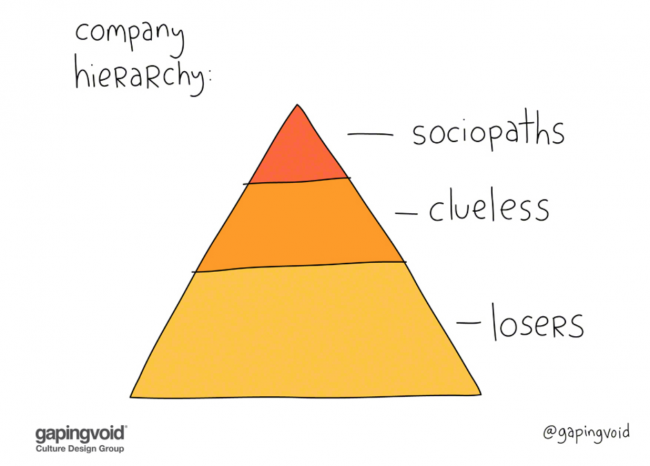
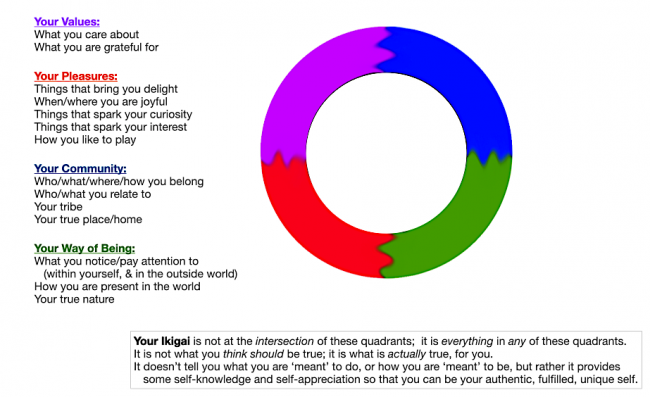
Progressives have been trying to confront the existing power structures for centuries. These power structures are based on and sustained by hierarchy — centralization, inequality, the use of force against those who do not obey those with power. We are taught from birth to play our designated role in the hierarchy, whether that be in the red, orange or yellow band in the graphic above. We are taught to know our place. If we are brought up conservative, we are encouraged to strive to be closer to the centre, to ‘succeed’ in moving higher up the hierarchy (picture the graphic above as being a pyramid, with the red as the peak towering over the ‘lower’ rings around it). If we are brought up progressive, we are encouraged to work ‘within the system’ for greater justice, to make the hierarchy a little less uneven in wealth and power, and ‘fairer’ for those who work hard to move within it as they wish.

Criticism #1 above comes, I think, mainly from those who are ‘caught’ in the light green band, the semi-marginalized, the disaffected and conflicted liberal/progressives and conservatives who have been tossed out or partially disentangled themselves from our dysfunctional and ruinous civilization, the technophiles who dream of something better but can’t quite unplug from the mainstream ‘power grid’, the libertarian idealists who think that individualism is the key (and can’t understand why all those other individuals can’t get with their program), the co-opted (mostly young) counter-culturals who are really just feeding the Man, and those who because of personal misfortune or lack of opportunity haven’t had the opportunity to Just Walk Away from this hierarchy to the very Edge.

The hierarchy survives the disaffection of the light green band by feeding the myth that it can evolve, that it is open to revolution. So we have petitions and demonstrations. The ‘light greens’ are the Howard Deane and Barack Obama supporters, the ones who believe that we can find replacements to prevent collapse before The End of Oil and The End of Water, who believe that there is a political solution to global warming. They are the ones fighting for regulations to prevent corporatist oligopoly, massive global corruption, the wrenching despair of global poverty, and the despoiling of our planet, ever hopeful that numbers alone will bring them victory. They are the ones who think the right to clean air, water, food, and soil, to free speech, to security from despots, torturers, rapists, murderers, thieves and criminals, to justice, can be ensured through laws and law enforcement.

I ache for these people. I was one of them most of my life. I love their ideals. It should be possible. They have occasionally won great and important victories, briefly ‘beat’ the system. And if you compare civilization today to what it was at its worst, a few hundred or a few thousand years ago, there is the illusion that we are making progress, that we are moving inexorably in the right direction. The Man wants those in the light green band to believe — their hope pacifies them, keeps them distracted, keeps them co-opted, participating, keeps them from Just Walking Away. The Chinese built the Great Wall early in our civilization not to keep the Mongol hordes out, but to keep the newly enslaved and dubious peasants, the pawns of the new civilization, in. To keep them from Just Walking Away.

But if you compare today to the way we lived before civilization, before what Daniel Quinn calls ‘The Great Forgetting’, you can quickly see that there has been no progress. It’s a dream. From this distance, from a prehistoric perspective, from The Edge, you can see that our civilization, like all the civilizations that preceded it, is an exercise in untrammeled excess, careening over the cliff to its own collapse. We’re skidding at breakneck speed on sheer black ice into a chasm. Those in the red, orange and yellow bands can’t see it, won’t see it. Those in the light green bands are scrambling frantically to grab the steering wheel, the brakes, the accelerator, trying to get it back under control, yelling at the rest of us to “Do something!”. But those of us on the Edge, in the dark green, know it is far too late. We only have a little while before the crash, so we might as well enjoy our time, in love, conversation and community, as best we can. While we are physically in that spinning, hurtling, out-of-control vehicle that is civilization, in our minds and hearts we have Just Walked Away.

Activist Barbara writes “I assume you have abandoned your efforts on the social/political front and wish you all success in your personal life”. She is a victim of The Man — her disease is much more debilitating than mine, though both are diseases of civilization’s excesses. I completely appreciate her position, and why she feels this way. But I have not abandoned my efforts on the social/political front. I am building new models of how to live and make a living, based on conversation in small community with people I love, models of how a ‘political’ and ‘social’ and ‘educational’ and ‘economic’ ‘system’ should work, and can work. I don’t know if they can work on any scale before civilization’s collapse — I’m just a local model builder. I doubt it, in fact. But that won’t stop me building them. This is who I am and this is my Purpose. These models will not save the world, because I don’t think it can be saved. But they will enable us, here, now, to make a meaningful life together, to learn, to discover, to share joy, and perhaps to create a legacy for the seven generations to follow, some of whom will live or be born after civilization’s collapse — some models that they just might find useful as they build in the ruins left from the catastrophic destruction we have, with the noblest of intentions, wrought on our lovely fragile blue-green planet.

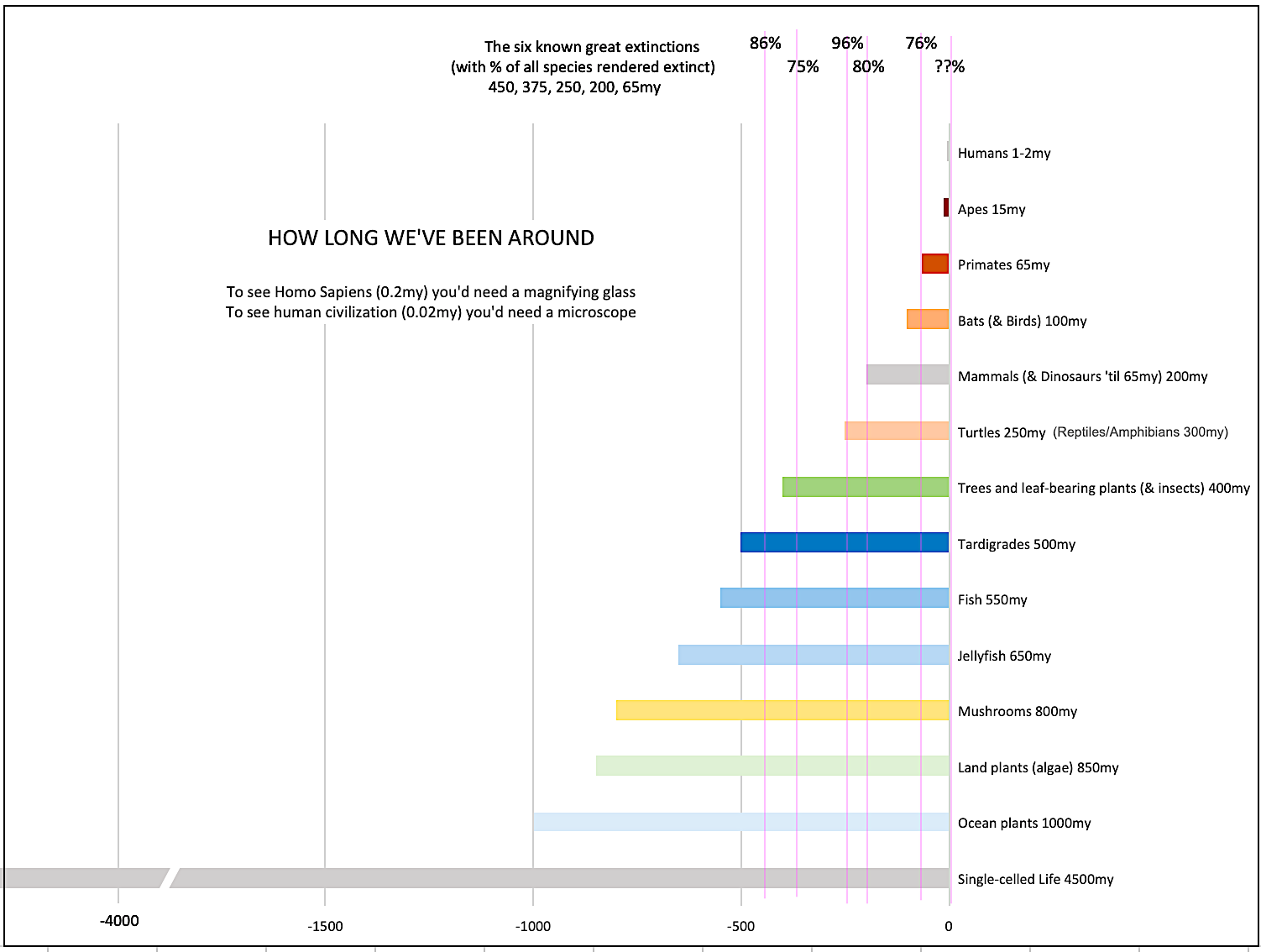
Our civilization will have one, and possibly two, legacies. The first will be the Sixth Great Extinction of life on this planet. It is already well underway, and accelerating at a rate we are only just beginning to realize.

The second, if we create it, in love, conversation and community, will be some working models of what we might have done differently if we’d only known in time. They will be the only important learning of 30,000 years of astonishing and ruinous civilization — the learning from our mistakes. We sit here, those of us on the Edge who I love so dearly, so ecstatically, amidst the Dark and Gathering Sameness of the World, building these models, quietly, joyfully, in the hope that, one day, they might be of use.

(Tomorrow — I’ll tackle criticism #2, that polyamorism is a self-indulgence andnot necessary to effective self-sufficient ‘model’ communities.)

December 16, 2007

Sunday Open Thread – December 16, 2007

Filed under: Our Culture / Ourselves — Dave Pollard @ 21:44
coachweedWhat I’m Thinking of Writing (and Podcasting) About Soon:

Love, Conversation and Community: I remain convinced that

Whether you want to change the political or economic system, save the whales, stop global warming, reform education, spark innovation or anything else, the answer is in how meaning, and understanding of what needs to be done, emerges from conversation in community with people you love, people who care.

So if it seems as if, these days, I don’t write about anything else, that’s why. This week I’m going to write about what ‘leadership’ means when you believe understanding and appreciation of the need to change evolves collectively. I’m also still intrigued about compersion and the question of whether jealousy is an innate or learned propensity.

Self-treatment: I’m ambivalent about modern medicine, and also about naturopathy. Ultimately I believe we need to learn to take charge, knowledgeably, of our own health and well-being. That means focusing on prevention of illness rather than treatment, on self-diagnosis and self-treatment as much as possible, and on drawing on the understanding of many, rather than just ‘experts’ and ‘specialists’. What I want to discover is a regimen for self-treatment, based on indigenous learning but informed also by the discoveries of modern medicine. (Image at right is coachweed, or cleavers, a vitamin-C and tannin-rich aboriginal medicine used to treat inflammation and skin diseases).

Vignette #8

Blog-Hosted Conversation #4: I’m going to interview one of the women who’s lived in a polyamorous relationship or circle, and who believes that such communities can work and are the natural way to live, and love. I have five candidates, but they are, understandably, a little shy about being spokeswomen for such a complex and controversial lifestyle.

Possible open thread conversation: Leadership is about ‘going first’. If you believe, as I do, in bringing about change through emergence of understanding, consensually, without compulsion, what does it mean to lead? Is it about being a model of the change you want to see, or is it something more — being adversarial,persuasive, political, compelling, pushing for change?

Older Posts »

Powered by WordPress