Dave Pollard's environmental philosophy, creative works, business papers and essays.
In search of a better way to live and make a living, and a better understanding of how the world really works.


August 31, 2008

Saturday / Sunday Links for the Week — August 30-31, 2008

Filed under: Our Culture / Ourselves — Dave Pollard @ 16:03
gustav
My thoughts and hopes go out to all the people and creatures of New Orleans and the Gulf Coast. We are going to learn a lot in the next few days about human nature, resilience, our inability to understand the lessons of history, and the uselessness of centralized emergency “plans”.

All You Need to Know About the Election, the Electorate, and US Politics: A series of articles in the past week really hit home on the realities of American politics and the current state of politics in the US. Joe Bageant’s anonymous political consultant friend has an analysis of Obama’s “move to the center”, and concludes:

  • Obama had to move sharply to the right on his position on trade, economics, globalization, social services and taxes, to avoid having the US power elite put all their money to work for McCain. With a dumbed-down electorate and a compliant mass media, lots of negative advertising (i.e. lots of campaign money) is now all you need to win an election (with rigged voting machines as a backup).
  • Obama’s social polition is just fine with the power elite (who actually disdain social conservatives). But if Obama doesn’t move on economic issues, they’re just fine with the white socially conservative working class helping them defeat Obama.
  • “Elite consensus on [foreign policy] is center to right, discussion are allowed on the mechanics of running the empire and the management of the military industrial complex, but never regarding the reality of its existence, its necessity or usefulness to most Americans.” War is the only healthy industry left in the US economy, and the US military machine is needed to protect the global financial interests of the power elite, so peaceniks need not apply to be its president. The fraudulent Let’s Bomb Iran house resolution 362 is bipartisan; there is no significant difference between the two parties on this issue (thanks to Valdis Krebs for the truthout links).
  • The power elite has already got Obama rehashing what is now conventional wisdom in the US, that it is the responsibility of individuals, not the government, to make people’s lives better. The “ask not what your country can do for you…” anti-regulation, taxes-are-evil, privatize-everything, anti-social-services rhetoric is firmly entrenched in both of the two look-alike brands Americans get to choose from in November. If the government screws up, or if you’re poor or sick or unemployed or ignorant it’s your fault, you stupid, lazy voter. And both brands are “produced” by the same company, the power elite that owns both parties.
And the sad reality is that most Americans fear change, the word that appears so prominently on all Obama’s messages. Yes, 90% of them are victims of a relentless thirty-year class war pursued ruthlessly by the power elite, but they have been conditioned by learned helplessness to feel impotent to change anything, and to distrust anyone changing things for them. So no matter how bad it is, Americans have been propagandized to believe that getting government to change anything will just make a bad situation worse. And since it’s the individual to blame for all the ills of the society, not government, best thing is to have no changes at all, and to weaken government (excepting the military of course) so there can be no changes in the future, either. And, incidentally, when McCain has a heart attack and dies in office in the midst of the Iran War, do you really think the power elite will allow a small-town Alaskan woman mayor to run their country? In the meantime, Olbermann responds to McCain proclaiming recently to those poor dumbed-down working class guys “victory in Iraq is finally in sight.”

Major Life Changes: My brave Cheryl embarks on a one-year tour around the perimeter of Australia today; she has been through so much tragedy lately, so help me wish her bon voyage! Karen Crone is off to Nigeria to work in a medical centre. Patry Francis is recovering from painful surgery that has re-sensitized her to others’ more constant suffering. And Jen Lemen is still coming to grips with her recent astonishing and heart-breaking trip to Africa. Is it time for your life to change in a major way? What’s holding you back?

Why Feminism Must Be Anti-Capitalist: Or more precisely anti-corporatist. A brilliant essay by Jessica Hoffman argues that all forms of oppression are connected, and freedom for all of us depends on the destruction of all forms of oppression, including corporatist oppression.

collective decision makingThe Collective Decision-Making Process: Chris Corrigan has created a new model of “talking our way to a decision” based on Otto Scharmer’s Theory U. I liked it so much I changed some of the words to create the collective decision-making process shown at right. The activities in the top half are individual, personal, while those in the bottom half are collective. Those on the left side are reflective while those on the right side are active. Through invitation and “opening space”, personal passion is engaged and leads to collective conversation, which through collective understanding leads to collective consensus, and then, through collective and personal decision, to personal responsibility for actions. This is what took me a long time to understand: While decisions may be collective (or may be made by fiat), actions are always ultimately personal; even in those actions that we undertake together, we are each, literally “doing our own thing”. If we are not first engaged, and if we are not part of the conversation that leads to consensus, and if we don’t then take personal responsibility to act, nothing gets done. I have seen in business that bad decisions are always ignored — people will jump through hoops to appear to be doing what they are told while actually doing what they believe makes sense. Our sense of personal responsibility is that strong. Passion –> Conversation –> Consensus –> Decision — That’s how things get (effectively and sustainably) done in this world.

What MBAs Don’t Know: Tony Wanless reiterates the arguments about the shortage of true entrepreneurship skills in our society that prompted my book. Thanks to Jon for the link.

Life After Birth: Another compelling, brooding, poetic essay and photo from Pohangina Pete.

The Ants Go Marching One by One: “We must think of ourselves as a line of ants bringing food to our Queen. But If we step out of line and decide to distribute the food amongst ourselves we will no longer be only receiving portions for our hard work. We will no longer be starving and working for more. The Queen will now be the hungry one and she will eventually die of starvation. All we have to do is step out of line; itís that simple.”

How to Design a Web Page: Liz Danzico’s slideshare presentation on the usability of WordPress is very smart: “People will do stuff [workarounds] when design fails…Most people ignore most of the [web page]…People don’t like surprises [i.e. changes]…People prefer verbs [over nouns] to navigate web pages…[after completing a task online] users need suggestions, nexts, and reassurance…Show, don’t tell.” Thanks to Kathy Sierra for the link.

Why Cap-and-Trade Solutions to Global Warming Won’t Work: “‘Cap and trade’ is the rage today as a primary solution to global warming. But the European Union’s struggle with this approach indicates it has an uncertain future. This is because global warming, at its core, is not a technology or policy problem. It is the greatest failure of thought in human history.”

Predictions Tell Us Nothing About What is Possible: Tom Atlee tells us (in addition to providing us with a poem) the three steps to realize what’s possible: Let go of outcome; Come to grips with our own intrinsic participation in Whatever Happens; and Look for positive possibilities and ways to partner them into greater probability. Thanks to David Parkinson for the link.

Create Your Video Calling Card: Natalie Shell shows us how to use video to tell the world what you’re all about. I want one of these.

Republican Platform Proposes Journeys to Mars: As if they hadn’t fucked up this planet enough.

Great Vegan Recipes: The cookbook Veganomicon, and a whole bunch of simple, wonderful online vegan recipes. Thanks to Patti Digh for the link.

Just for fun: Crow adopts kitten (thanks to Sam for the link). And the dumbest invention ever (thanks to my sister-in-law Morva for the link).

Thoughts for the Week:

  • From Upton Sinclair: “It is difficult to get a man to understand something when his salary depends upon his not understanding it.” (thanks to William Tozier for the quote)
  • From Esther Dyson: “Always make new mistakes” (thanks to Natalie Shell for the quote)
  • From JP Rangaswami: “More and more, knowledge management is going to be about reducing the cost of, and simplifying the process for, letting someone watch what you do. Nonintrusively. Time-shifted. Place-shifted. Searchable. Archivable. Retrievable.” (thanks to Nancy White for the quote)
  • From Charles Bowden in Blood Orchid: “We are an exceptional model of the human race. We no longer know how to produce food. We no longer can heal ourselves. We no longer raise our young. We have forgotten the names of the stars, fail to notice the phases of the moon. We do not know the plants and they no longer protect us. We tell ourselves we are the most powerful specimens of our kind who have ever lived. But when the lights are off we are helpless. We cannot move without traffic signals. We must attend classes in order to learn by rote numbered steps toward love or how to breast-feed our baby. We justify anything, anything at all by the need to maintain our way of life. And then we go to the doctor and tell the professionals we have no life. We have a simple test for making decisions: our way of life, which we cleverly call our standard of living, must not change except to grow yet more grand. We have a simple reality we live witheach and every day: our way of life is killing us.” (thanks to Beth Taggard for the quote)

August 29, 2008

Friday Flashback: The Virtuous Cycles of the Gift Economy

Filed under: Preparing for Civilization's End — Dave Pollard @ 16:30
From two years ago: 

Gift Economy Cycles
Our society puts a value on human activities only when they can be monetized ñ when a transaction involving an exchange of money occurs. We tend to equate our time with money: If the ëmarket valueí of an hour of our time exceeds the cost of hiring someone else to mow our lawn or make a present for a loved one or look after our children or our home, we conclude that it makes sense to buy those services and to work longer hours to pay for them.

This false economy leads us to buy what we donít need, which requires us to work harder to pay for those unnecessary goods and services, leaving us even less time to look after ourselves and our own needs and forcing us, in a vicious cycle (cycle 1 in red on the chart above) of consumption and debt, to ëoutsourceí even more of the things we might be doing for ourselves. All this phony economic activity is added to the GDP and employment data. Do-it-yourself and other ëunpaidí work, and things we make for ourselves, are not considered ëeconomicí activities and hence not included in the statistics that drive our societyís political and economic decisions. No surprise then that the government encourages us to buy what we donít need and what we could provide for ourselves.

By contrast, the Gift Economy does not value monetized activity more highly than un-monetized activity. It suggests, on the contrary, that our time is invaluable and that therefore we should ëspendí it, as much as possible, doing things we love and things that are our personal responsibility, and only buy goods and services we cannot possibly provide for ourselves. In doing these things ourselves, we learn to do them better, more efficiently, more effectively and more economically, saving the cost of outsourcing them to a third party.

[The rest of this article explains how valuing our time highly produces Virtuous Cycle 2 (time-saving cycle) and hence Virtuous Cycles 3-5 (well-being, capacity and gift economy cycles), and why the existing political and economic powers are doing everything in our power toprevent us from doing so.]

Read the full article.

August 28, 2008

How to Find Community

Filed under: Our Culture / Ourselves — Dave Pollard @ 22:58
byron bay
Byron Bay, Australia

caves branch
Caves Branch, Belize

woodland home
The 500sf home above was built using local, healthy, natural materials into a woodland hill in Wales, is sustainable and energy-efficient, and cost about 1500 hours plus £3000 ($6000). They are now planning to build a whole community of such buildings.
On Saturday I’m off to my second meeting with an impromptu Natural (Intentional) Community forming group. The guy who brilliantly researched the 18 very diverse people he invited to the first meeting has moved aside and is letting the group self-organize, which is an inspired move. Those who have self-selected out of the group won’t show up again, and each of us has been invited to bring some additional candidates for membership Saturday. So there will be a whole new playing field.

It’s a strange experience, accepting an invitation to meet a bunch of strangers in a huge house in the forest. I felt like I was in one of those mystery movies, looking for clues for why we were all there!

The greatest single challenge in creating a sustainable Natural Community, or for that matter a Natural Enterprise (which is a form of Natural Community) always seems to be finding the right people. For it to work, you need to have a shared purpose, and trust and love for all the other partners in the community. If the chemistry is bad, forget it.

So I got to thinking about the Natural Enterprises I know, and the Natural Communities I’ve heard about, that work, and how their members found each other and made it happen. In some respects Natural Enterprises are a little easier, because you need to go in knowing what your shared Purpose is, and what Gifts and Passions you bring to the endeavour that complement (but don’t seriously overlap) those of your prospective business partners. Not simple, but it’s a bit more methodical than what I’ve seen among those in Natural Communities, whose members often seem to be drawn together for the strangest and most illogical reasons.

It is very much a self-selection process, and a self-managed one. There are a huge number of Natural Communities that are perpetually in the formation stage, always looking for the right site, the right financing, but mostly, the right people. Never realized. Perhaps the best idea is just something like a big Open Space event, where you work very hard on the invitation, and let whoever shows up find affinity where they will. 

Or maybe not. Those people who created Natural Enterprises by discovering the people who shared their Purpose and had complementary Gifts and Passions, those people who have created Natural Communities, mostly small but sometimes bigger, mostly physical but sometimes virtual, mostly fleeting but sometimes enduring — these people all have one important thing in common:

They know themselves.

Every once in a while I find myself in the company of some physically stunning young woman who gives me the impression that she might be interested and I imagine her as part of the Natural Community I hope to create or discover…and then I think better of the idea. With very few exceptions, young people don’t know themselves very well. They don’t know what they want, only what they think they might want. They don’t know where they belong or who they belong with. They have these dumb ideas of monogamy and parenthood and owning stuff, ideas that I have long outgrown and realized aren’t what I want or who I am. I know who I am, now. It took me fifty fucking years but I know.

I am only interested now in finding community with people who know themselves. Not perfectly, of course. Parts of us constantly emerge and surprise ourselves, and we look at them and say “how can that possibly be me?” but it is, and it’s all good. One more piece of the puzzle, and we can see enough of it now that we recognize the overall picture, and know what’s missing to make it complete.

On Saturday I will probably disappoint a lot of the people at our second meeting. I am going to tell them that, rather than the Natural Community close to where we all live now that they’ve already picked out, a big, beautiful, hilly wetland East of the city, I would prefer to live in a Natural Community in a subtropical to tropical place, like Queensland (top photo above) or Costa Rica, or Belize (second photo above) or AÁores, and that rather than a large modern house with suites and a common area I’d prefer to live in a community of adjoined small multi-purpose units blended into the landscape (like the third photo above) made from local materials, by the members, together.

I will tell them that my dream is such a community with about 50 people in it, in the forest, not too far from the sea. I will tell them that my intention would be not to work hard there, but rather to spend my time in reflection, and writing, and in permaculture forest gardening, and that I would not be prepared to spend a lot of money or invest a lot of sweat equity because I don’t think life should be or needs to be that much work, or that expensive. I will tell them that I’d like our tropical subsistence hobbit-like permaculture forest community to be open to others as a model, to show them not so much a better way to live, as how easy and simple and joyful and responsible and sustainable life can be when you don’t complicate it unnecessarily. When you just be who you are.

I will tell them all these things, even though they will be disappointed in me (and will probably indicate, subtly, that I might find something better to do with my time than attend the third meeting), because I know what I want, and who I am and what I want to be and do. This yet unfounded community, far from here, simple and sustainable and lazy and responsible, is where I am meant to live. I know that.

In coming months, some of them will undoubtedly work desperately, idealistically, diligently, to make this promising fledgling community a success in the designated place East of the city, and will make themselves believe it’s what they really want, and in the process make themselves into something that they’re not just so they can be a part of this adventure, so that they can be admired and appreciated, and belong. Hey, not too long ago I would have done the same. I didn’t know who I was, and I was prepared to try to be everybody else, if that’s what they wanted.

The only thing that can prevent us from being everybody else is to know ourselves. No one can be nobody-but-themselves if they don’t know who that is. And we can’t possibly know who we’re meant to be in community with, all the people we’re meant to live with and make a living with and love, sustainably, until we know who we are, what makes us happy, what makes us unique. What makes us us.

That self-knowing is the start. It is the way out and the way forward. It is the only way. My self-knowing has taken an agonizingly long time, since I’m a slow learner. I repeat my mistakes because often I just don’t recognize them as mistakes, if you can imagine anyone being that self-unaware. 

I’m sure you can do better, make it in half the time. I can’t tell you how, because it’s probably different for everyone. But it’s important. Maybe reading Patti’s book will start you on your way. Maybe for you it’s presencing, or meditation, or just paying attention. Maybe it’s getting outside yourself, or getting outside your head. Maybe drugs might help. Maybe learn to really love yourself, or write your future obituary and work backwards. Become the author, at last, of your own story. Get out there and try stuff and discover what you really love being and doing, and where, and how, and why. Stop waiting or looking for permission to become who you want tobe, who you really are.

Know yourself. With self-knowledge, anything is possible.

Without it, you are just everybody else.

Category: Being Human

August 27, 2008

Do This. Now.

Filed under: Our Culture / Ourselves — Dave Pollard @ 21:36
life is a verbJust do this, now. Go here, and buy a copy of Life is a Verb. For these reasons:
  1. It will change your life. Seriously. It will show you (not tell you), through extraordinary true stories, how to live your life more intentionally. How to stop doing what’s merely urgent and start doing what’s really important, to you. How to become who you really are, and do what you were intended to do. It will empower you, not by telling you what to do, but by making you believe, passionately, that you can be better, can do more, can be more authentically yourself. And how to start.
  2. It’s enormous fun. Patti is funny. Her stories (some about her own life, some those of people she knows) are more than instructional, they are entertaining. This book will make you laugh, cry, and do lots of other things you didn’t think you would or could do. It will move you.
  3. It is extraordinarily well written. If you are a writer, and want to learn how to write well, this is your model. Every word in this book counts. There are no false notes. The stories are surrounded by stunning colour graphics submitted by dozens of different artists on the stories’ themes, and by quotes and poems that are such perfect complements to the stories that you will treasure the book just for its collection of the most succinct and powerful turns of phrase on subjects that matter you will find anywhere. A 200-page bravura performance of clear, precise, concise, transporting prose.

I could give you other reasons, such as that this is going to be a best-seller, a blockbuster, and if you buy now she’ll sign it for you and you’ll be able to show it off to others (”I was reading Patti’s work before she was famous”). Or that this is the book that accomplishes what the acclaimed Eat, Pray, Love merely hinted at: it creates a whole new genre — something like Inciting Narrative. Or that I’m so convinced you’ll be blown away with it that I’ll buy it back from you if you aren’t, and give you the address of someone to pass it forward to. Or that you really need to buy a bunch of copies because you’ll be giving copies away to people you love, for their good, for your good, before you’re half way through it.

But enough.

You haven’t bought a copy yet? Go, now. It’s only $20. What’s holding you back? Suspicious of my motivations? I have never met Patti, and I don’t get any royalties. This book is just that good. You read this blog because you have some trust, some expectation, that you’ll learn something useful. So trust me. You’llthank me. Promise.

Fund your own revolution. Risk your significance. No excuses. Just do this. Now.

August 26, 2008

Ugly

Filed under: Our Culture / Ourselves — Dave Pollard @ 19:12
reflection
As part of my program of self-change and intentionality, I have been spending more time in natural places, more time in reflection, and more time practicing paying attention, really looking and listening and sensing and intuiting what is going on. I don’t claim to have become good at these things, but practicing is now an end in itself for me, and I think I’m getting better.

Most days I commute to the city (Toronto) and most days spend a lot of time in the company of strangers, whether I’m walking, driving, or picking up necessities in the local stores. The contrast of the dreadful human places and faces I see, with those that I see in the forest where I walk, or in my back yard where I run and meditate (or even in some of the Edens of Second Life) is remarkable, and disturbing.

Toronto is one of the more attractive cities in the world, but now it seems to me incredibly ugly. Office buildings and stores are stark and devoid of imaginative design. Houses are crowded together, shabby-looking, and afflicted with a terrible sameness. The grey roads and highways that we have paved over greenspace with are abominable, and they are littered with grotesque poison-belching cars packed together like oversize sardine cans. The spaces we have allowed to recover after we razed them to the ground to make ‘development’ easier and cheaper are now cowed imitations of nature, constantly cut back, infested with invasive species that gardeners deem more attractive than what grew naturally. They would take centuries to return to their natural grandeur through a pace of slow succession that we have no time for, and which we inhibit anyway, so they are awash in weeds and the grim, hardy plants, insects and small animals that thrive in recently-razed monoculture landscapes — the denizens of post-catastrophe.

And after looking into the faces of wild creatures (far away from the city, in places where there is no sign or sound of homo sapiens) the hordes of humans jammed together everywhere also look unsightly, lost, fearful — the word ugly is from the Norse word for fear.

They walk hunched and with effort. They carry far too much weight, and far too little muscle. They spend too much time indoors and too much in the direct sun, and their skin has a pallid, blotched, flabby, exhausted look to it. They work far too hard and far too long. Their faces are strained, even in moments of forced and vulgar laughter. The quiet desperation that seems to define their existence, the constant dreadful stresses that confront them and worry them, sitting relentlessly in the back of their minds, have taken their toll on their appearance and bearing. They wear hideous clothes to cover their mostly monstrous bodies. A teeming, diseased sea of swarming flesh, slaves rushing to do meaningless work to feed their (our) ruinous addictions. I do not except myself from this harsh description. Nor, any longer, do I except the young, who are often now as glassy-eyed, disengaged and filled with anomie as their cynical and exhausted seniors.

When I walk in the woods I encounter many wild creatures, birds, animals, fish, even insects, all of them stunning or at least strangely beautiful. I realize that almost all my photographs in recent years have been devoid of human faces and human artifacts. What has happened to me that I am so repelled by the sights and sounds of humans and all their detritus, yet so attracted and at peace in the company of other creatures, in places where, at least to my untrained eye, no recent human footprint can be seen?

I have no explanation for this. Perhaps it’s a form of reverse speciesism, this loathing for humanity and its wretched fabrications. Perhaps its a revulsion towards its sheer unsustainability, the fact that most people and all of their junk get cast off, discarded without thought, because they are of no use, and are part of no cycle of renewal that will quickly, when they come apart, make them new and beautiful again, naturally. We have become unnatural, and perhaps that is the most damning adjective of all in a universe that is simply, effortlessly, and staggeringly natural. I see wild creatures who coexist with each other peacefully flee in terror at the first whiff of human presence, my own included. I shrug and nod at this — how can I blame them?

When I was young I was awed and terrified by the story of the Ugly Duckling. It made no sense to me, to conceive that a duckling could possibly not be beautiful, or to believe that anything that was grotesque would somehow naturally become aesthetically delightful, or be perceived to be so in some different context. My parents tried another example from nature — the caterpillar reinventing itself as the butterfly — but this simply distressed me more. Should I feel revulsion at caterpillars? What about the fact that most caterpillars become moths? These were absurd teachings, and I discounted them like the religious and political and economic teachings I have tried to make sense of since, without success.

Aesthetics — the study and science of beauty and perception and our response to them — seems to me the ultimate human intellectual arrogance. It is as if the rulers of the world’s most violent nation presumed to declare themselves the arbiters of global peace (oops, bad example). The natural world is inherently beautiful for the same reason it is inherently cooperative and peaceful — because we (all-life-on-Earth) collectively wanted it that way and made it so, conferring Darwinian advantage on the beautiful, the collaborative, and the fit.

No such advantage is conferred in our terrible modern and disconnected human world. And so we get uglier, more competitive and quarrelsome, and more, in every sense of the word, unfit.

This is a problem. If we’re going to make our best effort to make this world (or at least the part of it over which we temporarily hold sway) a better place, it is important that we really care about each other. But how can we care about each other when there are too many of us, fighting over the dwindling resources that have artificially sustained us, and when we don’t like each other, have no appetite or energy to work together, and, too often, can’t even bear the sight of each other?

That’s what’s really ugly.

Category: Being Human

August 25, 2008

The Space Between Despair and Hope

Filed under: Our Culture / Ourselves — Dave Pollard @ 22:53
hope despairEinstein said that in his experience, the more people know about what happening in the world, the more pessimistic they become. I’ve become more pessimistic, but less depressed, as I’ve learned and studied and talked about the state of our fragile little planet and all its creatures. But I’ve also become less of an activist, more inclined to think and read and write and do things locally in my own communities (including my online ones), and less inclined to actually do anything physically. I’ve been content to let-myself-change and encourage others to do likewise. Content, or some might say, paralyzed.

When I was younger, ignorant and driven by hormones, I vacillated between ecstasy and misery, spending long stretches of my life in blissful denial of the grim realities of our world, and equally long stretches in black, suicidal depression. Both extremes were largely disconnected from reality.

These days I’m less prone to either extreme, and I’ve learned to navigate my way through good news and bad, rarely getting euphoric even at times when everything seemed positive (because my unbearable grief for Gaia is with me, always), and rarely getting despondent even at times when everything seemed to be falling apart (because what’s the point of that, really?)

But I am an incorrigible idealist, and my expectations are often high. I think this is because I have such a vivid imagination. I can see opportunities, envision possibilities. I am convinced we could, under ideal circumstances, live lives of astonishing joy, ease, and peace. I am persuaded by recent anthropological research that suggests that, prior to the ice ages, we lived such a life, and that most creatures live such a life even today, engrossed in the wonder of Now Time, intimately and utterly and blissfully connected with all-life-on-Earth. When I study concepts like polyamorism and intentional community I can imagine these concepts realized, if only we could overcome our prejudices, fears and inequality. “If only” — the idealist’s siren song.

So I navigate the narrow channel between hope and despair, steering clear of both unwarranted optimism and useless pessimism. With practice, I’ve learned to be good at this, adept and flexible to changes and challenges that once would have got the better of me.

But this keeps me busy. I aspire to becoming a realist, to gain a little more room for error, more room to maneuver emotionally. Like idealists, realists navigate the channel between foolish optimism and useless pessimism, but in their case the channel is wider, more forgiving. Their expectations and hopes are lower than the idealist’s, so the point at which they founder into euphoria (and then return from it, disillusioned) is further from the point of despair.

Realists therefore have more freedom to be activists than we idealists — we idealists furiously processing exuberant ideas and dreadful news and steering ourselves through the rocky and narrow passage between hope and despair. It’s a survival skill that allows us no time or energy for more altruistic and generous activities, and too little time for reflection. Maybe that’s why idealists are often also procrastinators, and often tired: “Just give me a sec to catch my breath before I face the next set of rapids.” Or perhaps that’s just a rationalization forinaction.

Can an idealist become a realist? Not sure. Perhaps meditation will help. Dreaming impossible dreams is a hard habit to break.

More strange ideas tomorrow.

Category: Being Human

August 23, 2008

Saturday Links for the Week: August 23, 2008

Filed under: How the World Really Works — Dave Pollard @ 21:41
bella
Cheryl’s family’s new pup Bella, taking a break from chasing the sheep.

No Bad News Please, It Ruins My Day: Justin Kownacki: “Instead of making us all give a damn, however, this overwhelming surge of negative news is simply making us all more jaded. Now, instead of caring about how one person (or government) is destroying the lives of innocents, we lament that this negativity is ruining our day. Harshing our mellow. Making us aware that the world is not always a bright, shiny (and stark white) iPhone commercial.“ 

Conversation Embodies and Brings Forth Change in Culture: Juanita Brown met and spoke with Humberto Maturana recently, and took notes: “As a co-inspirator, I can be intentional about the nature of the conversations I introduce into the conversational network that is the organization or the culture I am part of. This is serious, responsible, daring and playful work! How I open spaces of conversation is of the utmost importance to our capacity to co-inspire worlds we choose to live in. All cultural change, for example, is a change in the network of conversations and the manner of living that arises in it. Language and conversations are ‘doings’ that lie at the heart of our capacity to intentionally bring forth worlds that are life-affirming and ethical… Everything changes around what we want to conserve.” Thanks to Amy Lenzo for the link.
 
js bouchard model

A Brilliant Decision-Making Model for Business: My friend Jean-SÈbastien Bouchard has co-developed the model above to describe what type of approach to decision-making is needed in organizations, depending on whether the issue is simple or complex (vertical axis) and whether future outcomes are predictable or unpredictable.

  1. In simple, predictable situations (area 1) the traditional command-and-control decision-making of most organizations (”do what I say”) works fine. 
  2. In more complicated buy still predictable situations (area 2) education and persuasion are needed (”here’s why we need to do this”) to ensure the decision is understood and properly executed. 
  3. In simple but unpredictable situations (area 3) you need a more collaborative, consultative approach using scenario planning and similar techniques (”this looks like the best choice now but we’ll meet regularly to confirm as things change”). 
  4. Most 21st century decisions are made in situations that are (a)complex, (b) very unpredictable, or (c) both complicated and unpredictable (area 4). In these situations, management and ‘expert’ decisions are inevitably incompetent, and the wisdom of crowds is needed (”let’s collectively understand what’s happening here, and explore our options together”). Jean-SÈbastien calls this approach co-creation, and his partnership Grisvert uses Open Space and similar methods to help organizations achieve it. 
  5. There are, alas, a growing number of situations that are both complex and highly unpredictable (area 5), where effective decision-making is essentially impossible. I would argue that climate change and Peak Oil are beginning to emerge as such issues. My sense is that organizations will soon realize that our entire economy needs to migrate from a growth economy to a steady-state economy, one in which business must migrate from having a primary responsibility to the short-term wealth of its owners to having a primary responsibility to the long-term health and well-being of all-life-on-Earth. But it is impossible to know how or when that will happen, and impossible to decide what to do about it now. It is too complex to fathom and too uncertain to navigate. In such ‘chaotic’ situations, Dave Snowden says we tend to turn to charismatic (or tyrannical) leaders, and let them make decisions for us, on the basis that “anyone’s guess is probably as good as anyone else’s”. Chris Corrigan chimes in on chaos: “There are tools for being in the chaosÖIndividually I think these include presencing practices, discerning and sitting and journaling and making sense of things. Socially I think these are practices of simply being in community in a skillful way, like a jazz ensemble, so collective improvisation and collective presencing. I would [recommend you] flesh that section out a bit, because people want you to be able to offer something in that [area 5] corner.” Brave new world, here we come.

…and What Management Needs to Learn to Use It: As if in response to the above model, Kathy Watt of LearnNB says business leaders “need to experience some personal and professional humility, and admit that we donít really know how to solve some of the complex challenges that we are facing.”  Thanks to Harold Jarche for the link.

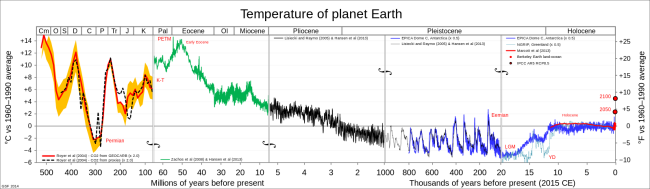
A Research Report from Real Climate Scientists: While the well-financed and opportunistic Lomborgians go on denying the reality and need for action to tackle global warming, James Hansen and an international team of climate scientists do real research using real data, and their conclusions are understandable even to the layperson:

The eventual response to doubling pre-industrial atmospheric CO2 likely would be a nearly ice-free planet, preceded by a period of chaotic change with continually changing shorelines. Humanityís task of moderating human-caused global climate change is urgent…Remaining fossil fuel reserves should not be exploited without a plan for retrieval and disposal of resulting atmospheric CO2. Paleoclimate evidence and ongoing global changes imply that todayís CO2, about 385 ppm, is already too high to maintain the climate to which humanity, wildlife, and the rest of the biosphere are adapted… Although a case already could be made that the eventual target may need to be lower, the 350 ppm target is sufficient to qualitatively change the discussion and drive fundamental changes in energy policy. This target must be pursued on a timescale of decades…A practical global strategy almost surely requires a rising global price on CO2 emissions and phase-out of coal use except for cases where the CO2 is captured and sequestered…With simultaneous policies to reduce non-CO2 greenhouse gases, it appears still feasible to avert catastrophic climate change. Present policies, with continued construction of coal-fired power plants without CO2 capture, suggest that decision-makers do not appreciate the gravity of the situation. We must begin to move now toward the era beyond fossil fuels. Continued growth of greenhouse gas emissions, for just another decade, practically eliminates the possibility of near-term return of atmospheric composition beneath the tipping level for catastrophic effects…The stakes, for all life on the planet, surpass those of any previous crisis. The greatest danger is continued ignorance and denial, which could make tragic consequences unavoidable.

[Our reaction: The Democrats now favour some offshore drilling, and the Republicans are ready to invade the Arctic to stake their claim to fossil fuels under the melting ice, and the Canadian Northwest Passage for shipping. Sigh.]

The Most Secret Place on Earth: “American planes dropped an average of one planeload of bombs on targets in Laos every eight minutes, 24 hours a day for nine years, making it the most heavily bombed country on earth per capita in the history of warfare.”

Michael Pollan Talks About What We Should Eat: A video of Pollan, espousing his Eat [Natural] Food, Not Too Much, Mostly Plants message, in which he explains that eating well is expensive, because the industrial food system is heavily subsidized and externalizes the environmental, animal welfare and disease costs that result from its operation. A free podcast of the full 74 minute interview is downloadable here. Thanks to Craig De Ruisseau for the link.

…and Here’s a Modest Proposal for Sustainable Eating: A ten-point program (with a few embellishments from me):

  1. Know what youíre eating. Find out where it comes from and whatís in it. Think about what’s in season now. A lot of these foods will turn out to be local.
  2. Get cooking. And try making things from scratch. You’ll save money and rediscover skills you forgot you had.
  3. Plant something. 
  4. Pack a bag lunch.
  5. Drink tap water. It’s healthier for you, and it’s free. And better for the environment.
  6. Learn about and celebrate the food traditions your family and community still possess. 
  7. Invite someone to share a meal. Strengthen the bonds of friendship and community by cooking and eating together.
  8. Learn about endangered local foods and how we can bring them back to our tables.
  9. Conserve, compost and recycle. Build a cold cellar.
  10. Vote with your fork and your wallet. Say no to overpackaged, processed, chemical-ridden foods. Say no to factory farms. Say yes to local, organic foods.

Economic Slide Just Beginning, Says the Guy Who Predicted the Subprime Collapse: Nouriel Roubini has been exactly correct in every prediction he’s made since 2005. Now he says, it’s going to get much worse. “Our biggest financiers are China, Russia and the gulf states; these are rivals, not allies.” and in response to those who think the worst is over, he says our problem isn’t a subprime mortgage market, “it’s a subprime financial system”. Thanks to Jerry Michalski for the link.

Biden’s Long History of Anti-Russian Sabre-Rattling: The always-insightful Billmon explains why the Joe Biden-led attempt to expand NATO to include Georgia and Ukraine is no different from China signing a military accord with Mexico and then calling for New Mexico to be returned to Mexico. If this kind of hypocrisy is what Biden will push as VP, we’re all in deep trouble. Really dreadful choice, Obama.

Last Word on the Ivins – Anthrax – Squalene Case: Lots of coverage this week of the hopelessly weak case against Ivins in the indymedia, but it’s not going to make any difference. The mainstream media are allowing the government to sweep it under the rug. Case closed. US servicemen used as guinea pigs for a toxic vaccine as part of the US’ own secret bioweapons program. Bush regime needs Saddam-anthrax connection to justify Iraq war, so they concoct one and mainstream media dutifully report it as fact. Yawn. Move on. Thanks to EMJ in BC for the link, and the one that follows.

Telling a Story Persuasively With Pictures: I wrote last month about Back of the Napkin, which teaches you to use sketches to tell a powerful story. Franke James uses graphics to write “visual essays” on her blog, most recently to tell the story of last week’s Toronto propane plant explosion, and why it should never have happened.

Just for Fun: Communicatrix Colleen will have you rolling on the floor with her Dirty Keywords Search Song. Only 520 views of this YouTube video when I posted this. Wonder how many there will be afterwards. Also hilarious are The Man Rules (thanks to Cheryl for the link).

Thoughts for the Week:

From Robert Koehler, writing about Russia’s invasion of Georgia, Georgia’s invasion of South Ossetia, and the endless violence of the powerful inflicted on the powerless: “Human evolution is at a terrifying juncture, as we face, at last, a nightmare that is 2 million years in the making.”

A poem from ee cummings (thanks to Loren Webster for the link):

may my heart always be open to little
birds who are the secrets of living
whatever they sing is better than to know
and if men should not hear them men are old

may my mind stroll about hungry
and fearless and thirsty and supple
and even if itís sunday may i be wrong
for whenever men are right they are not young

and may my-self do nothing usefully
and love your-self so more than truly
thereís never been quite such a fool who could fail
pulling all the sky over him with one smile

August 22, 2008

Friday Flashback: The Real Innovator’s Dilemma

Filed under: Working Smarter — Dave Pollard @ 18:42
research & innovation processesFrom 2006:

In his celebrated book The Innovator’s Dilemma, Clay Christensen explains how successful companies can be “held captive” by their best customers to the point that they become vulnerable to disruptive innovation from competitors and new entrants, and unable to sustain the types of innovation that brought them those loyal customers in the first place.

He’s absolutely correct, but there are a set of business dilemmas around innovation that are even more profound, pervasive, and culturally entrenched. It is only when you get past the heady idealism of innovation (”the entrepreneur’s competitive advantage”) that the gravity of these dilemmas becomes apparent, and the reasons for thecurrent dearth of innovation in our society become clear.

The three real dilemmas for innovators are:

  1. Most entrepreneurs aren’t innovative (and don’t know how to be)
  2. Most customers don’t really want innovation
  3. Those who really need innovation usually can’t afford it

Read the whole article.

August 21, 2008

Why We Watch Sports

Filed under: Our Culture / Ourselves — Dave Pollard @ 19:19
NJ DevilsThis morning I listened to two fans of the Saskatchewan Roughriders (Canadian Football League) talk about how they had supported their team for forty years despite the fact it had only won the Grey Cup twice in all that time.

It reminded me of my experience as a young child going to football games with my father. He organized a bus that picked up about 30 fans from the area of Winnipeg in which we lived, drove us to the game and then back home again afterwards. I would often fall asleep on the bus on the way home, but I loved every moment of this experience, even though I wasn’t much of a football fan. I knew all the players’ names by heart, however.

In the winter seasons I would watch all the Montreal Canadiens hockey games, in black and white on TV Saturday nights, since we had no local professional hockey team in Winnipeg. Because of the time difference we would never see the first period, since it would have interfered with the dinnertime CBC news, which was sacrosanct. My walls were covered with black-and-white photos of Les Habitants best players like Boom Boom Geoffrion and Rocket Richard, most of them signed by the stars themselves. My parents were forced to buy hundreds of boxes of teas and dessert mixes so I could get the treasured plastic Hockey Coins inside, each depicting one of the 120 active players in the NHL at that time.

In my adult years I ceased to be a sports fan, preferring to play rather than watch, and while I still partake of hockey playoff pools, I rarely watch sports of any kind. I briefly cheered on the Toronto Blue Jays during their two back-to-back World Series championships, and got to know all the players then, but a year later they were all but forgotten. For all kinds of reasons I am boycotting the corrupt freakshow propaganda circus called the Olympics, this and every year.

I’ve tried to figure out why I watched sports, and why so many still do, but it’s hard to fathom. Although for many Americans (and Chinese) winning seems to be everything, fans in most of the rest of the world seem to enjoy the sport no matter who wins. The endless kitsch of propagandist Hollywood movies where American (”Yoo-Ess-Ay!”) team X or individual athlete Y overcomes staggering odds to become the champion (at the last moment, when all seems lost), and in the process he/they find true love, just makes me nauseous. (When the underdog-turned-champ is a Canadian, or a furry animal, it’s no better.)

There is something at work here besides insecure nationalistic vicarious competitiveness. Why do we watch sports?

I started paying attention to my own occasional spectator behaviour. I noticed that I was more attentive when “my” team was on offense than when they were on defense. After the game I felt the same no matter which team or individual won, unless there was some cruel injustice served up by cheaters or corrupt or inept officials, in either team’s favour, in which case I was sullen. The Hollywood movies play on this relentlessly, of course, since it’s a cheap way to stir up audiences. Hollywood does the same in the endless and banal “women as victim” movies, which are essentially identical to the sports propaganda movies except they involve women losers-turned-victors instead of men, and take place in homes and courtrooms instead of arenas.

But when it was just a game, and I somehow got caught up in it, it was a wonderful feeling at the end of the event (barring having to face terrible traffic going home). The more I thought about it, the more I concluded that we love to watch sports for two reasons that have nothing to do with competition:

  1. Shared ‘expertise’: Real fans know who’s playing, and everything about them, and what they’re good and bad at. Armchair quarterbacks all, what they love, and love talking about, is what they know about the game, the expertise they share. We all love to be an expert, especially knowledgeable about something, and there is no easier way (with the possible exception of blogging?) to become known and respected as something of an expert than to study and follow a sports team.
  2. Affinity: We all love to belong, and sports teams are not called “clubs” for nothing. We are social animals, and we love to wear insignia that give us instant affinity with others, something to smile and talk about with strangers, and hence become friends. We actually spend more on sports affinity paraphernalia than we spend on tickets.

Alas, in the context of ‘professional’ sports all of this comes at a major cost. Propagandists (from political thugs to opportunist corporatist advertisers) have exploited sports to the point of ruin, and disgust. Ticket prices for professional teams are obscene, relegating all but the elite who can tax-deduct them to the bleachers and TV screens. Most professional sports are replete with cheaters (drug users — performance-enhancing and pain-numbing — and judge bribers), bullies, and arrogant hacks both on the field and in the media. To come second is a disgrace, the media tell us — heads should roll. And the health and fitness level of sports watchers who would never dream of actually playing a sport is abysmal.

The solution, I think, is to find entertainments that provide us with the opportunity for affinity and to develop an impressive expertise, that are not competitive. That is, entertainments (like ballooning, hiking, and theatre-going — other than to theatres that show the aforementioned Hollywood schlock) in which there are no winners and losers, only good, enjoyable performances and those that could be improved (and we’re all armchair critics) and which, most importantly, are participative, both for our health and for our level of social and intellectual engagement.

I keep saying we need to re-learn to entertain ourselves. We suffer from a dreadful imaginative poverty in our modern world. We are unfit, both physically and in our creative and critical thinking capacity. For all our information sources, we are appallingly ignorant about history, geography, the arts, science, and what is going on in the world. And we are fiercely, unnecessarily and destructively competitive.

From now on, every time I am tempted to watch a “spectator sport”, or a mass media information or entertainment production, I am going to stop myself and ask: What could I be doing instead that is more collaborative, and more participative, and take myself off the sidelines and out of the chair and into action, doing something, cooperatively, with others.

I hope you will too. There is a difference between entertainment and fun, and we’re buying far too much of the former and taking part far toolittle in the latter.

Category: Our Culture

August 20, 2008

Understanding Media Redux: Making Better Use of Space and Time Online

Filed under: Our Culture / Ourselves — Dave Pollard @ 22:27
wordle poetry
Last month I contrasted the wordle (a collage of words with size proportionate to frequency of use) of the contents of my personal profile and my friend Siona’s, and commented on how hers seemed more reflective of me than mine did.

As a second experiment, I produced the wordle above of the contents of a collection of five of my own poems, and below it the contents of my favourite poem, TS Eliot’s Four Quartets. I was kind of hoping that the result would be poetic, and it really isn’t, but it is, I think, instructive. What jumped out at me immediately were the words time and world, in both wordles. It occured to me that most poetry, as re-present-ation, is essentially preoccupied with time and space, what happened where and when. Many of the prominent words in these wordles are temporal or spacial. The word now features in both, and while Eliot’s place is the sea, mine is the forest.

If poetry is infatuated with time and space, I wondered why most poetry makes such poor use of both to make its message. Most poetry is linear, row on row, though ee cummings for example was more playful with the placement of words on the page. Even spoken poetry adds little, and sometimes even detracts from the mood and meaning, since poetry is very much a conversation in which the reader takes part, fills in the blanks from his or her own experience, adds context, which a dissonant reading can destroy.

The poem below, Swan and Shadow by John Hollander, is quite clever in its use of space.

swan and shadow

What could we do, in the brave new world of the Internet, to make better use of time and space, in poetic ways? We know that the eye and the brain process information visually, from the centre out to the periphery, not linearly. Should we, could we write poetry that way?

We can now use video to make words move in ways that are both informative and expressive. Could we write poetry so it appears before us a few words at a time, at the speed we would read it, using text in clever and expressive ways, the way Michael Wesch uses animation to explain social media? I’ve spoken at business conferences about how visualizations can add meaning and value to information. Could they add meaning and value to poetry?

What role could/should sound and video play in enhancing, supporting, reinforcing the written poem? Is it like a spoken reading of a poem, that can make it better (if it’s well done) or worse (if it intrudes on the reader’s own sense-making about the poem)?

I’m interested in the answers to these questions in the context of poetry, because if the Internet presents us with opportunities to make poetry more communicative, evocative, ’successful’ in some sense or other, then surely it can do the same for other written media, like blogs, newspapers, magazines, stories, novels. We have seen the addition of audio and video to these media, but in very prosaic, unimaginative ways. How could we do better? How could ‘multimedia communication’ be really innovative, integrative, reinvented from the ground up to convey feeling and meaning to us in richer, natural ways, to move us to the time and place of the writer of words, so that our conversation with him or her is more real, richer, more sensory, synaesthetic?

The Internet is itself innovative, but I can’t shake the nagging feeling that we’ve been very un-innovative in how we’ve used it to convey the meaning of language, that we’re too rooted in the hard-copy and one-way broadcast way of thinking about media. What do you think? If Marshall McLuhan were alive today, howwould he be using the Internet?

Older Posts »

Powered by WordPress