Dave Pollard's environmental philosophy, creative works, business papers and essays.
In search of a better way to live and make a living, and a better understanding of how the world really works.


October 31, 2008

CCK08: Connectivism and the Challenge of Making Connections in Vast and Complex Networks

Filed under: Our Culture / Ourselves — Dave Pollard @ 20:05
invitationWe’re now 2/3 the way through the 12-week MOOC (online course) on Connectivism and Connective Knowledge. Next week we get into the role of the teacher and the future of education in an online, connected world, and I’ll have a lot to say about that. But while there has been some discussion about complexity in this course, we have made little progress in dealing with the ultimate question that I think this course raises:

In a world with a billion people online, connected in multiple and unfathomably complex ways, how do you find, and then connect, with just the right people to do what you need to do?

Here’s a summary of some of the ideas I’ve written about on this blog about how to do this:

  1. Know yourself well, so you really know what you’re looking for in a partner (in enterprise, in community, or whatever). You can’t find the right people until you know what you’re looking for.
  2. Get attention by saying or doing something important or interesting. Articulate an unrecognized need or a creative idea or a provocative possibility or an intriguing offer. Do something bold and imaginative. Make something truly novel that the world needs (a prototype will do). This is not easy, but if you can get people’s attention, you are more likely to have the people you need to find, seek you out and connect with you.
  3. Craft an invitation. Write up something compelling and send it out to as many people as possible, asking them to forward it to others. The people who accept your invitation will be the right people.
  4. Get out there and have a lot of conversations and collaborations. Sometimes you have to kiss a lot of frogs before you find a prince. So join groups that will expose you to people with common interests, and converse and work with their members. The more people you talk with, seriously, about things that matter to you, the more people you are likely to find who share your passions and your purpose — the people you are meant to make a life or a living with, or just work together with on an important project.
  5. Be loving and generous. Great collaborations and partnerships have great chemistry. Open yourself up to that chemistry, and let others know you are open to it. 
  6. Be attentive. The people who can make a difference in your life, on your project, and in the world are often not the people you would expect. Listen, watch, feel what’s being felt but not said, draw people out. 
  7. Seek diversity. The wisdom of crowds demands diverse perspectives, ideas, ways of thinking. Echo chambers are terrible places to generate new ideas and ways of thinking.
  8. Draw on the strength of weak links. The people you seek may well be two or three degrees of separation from the people in your immediate networks. Ask the people you know who they know that fit what you’re looking for.

This is a big list, but it’s an unsatisfying one. A lot of people are doing these things, yet finding people this way still seems very much a hit-and-missproposition.

What else do you know that works? How do you find the right people? Where do you look?

Category: Communication

October 29, 2008

The Careless Society

Filed under: Preparing for Civilization's End — Dave Pollard @ 22:51
Natural Economy

For most of our civilization’s 30,000-year history, most of us made our living in agriculture. Then, about a thousand years ago, we began making other goods in a more organized fashion, through guilds, apprenticeship systems etc. Later still, about 250 years ago, with the advent of the industrial era, we realized that mass production could allow us to produce more, for more people, than personal craftsmanship. This era was powered by inexpensive energy — slaves and animal power and then coal, and now, oil.

The problem with this cheap energy is that, while it was powering mass production, bringing more and more of the labour force into manufacturing, it was also enabling automation, that was destroying those same jobs, and destroying jobs in agriculture. By the middle of the last century, we began to realize that there were far too many people to keep gainfully employed in manufacturing or agriculture. We needed to find something else for billions of people to do, so we could justify paying them so they could buy more and more of the products that our industrial economy produced — an economy now addicted to endless growth, as the failure of the Great Depression so clearly showed.

What we invented were “service” businesses, businesses that produced nothing tangible, but instead did things for us that we (as members of communities) had always done for ourselves and for each other without charge. The first of these services to be developed were the risky services — fire, police, justice. Soon we added education (including ‘babysitting’) services and a raft of health services. More recently we added ‘professional’ services (legal, accounting, consulting etc.), construction and maintenance services, nursing home services, bereavement, funeral and other counseling services, financial services, security services, mental health services, religious and spiritual services, and so on.

In each case we took some activity that we once self-managed, collaboratively within our communities, and made it into a ’specialty’ someone else did for us, for money. We went from self-sufficiency to helpless dependence, from collaborative citizens to ‘clients’. Now, the large majority (and growing) of our society’s jobs, costs, and GDP, all come from this vast, amorphous ’service sector’.

This is the principal message of John McKnight’s 1995 book The Careless Society. He blames our headlong rush to turn everything we used to do for ourselves and for each other into a ’service’ for the breakdown and alienation of our communities, for the vulnerability of our economy, and for an anomie and indifference to others that comes from being paid to care — health care, child care, elder care, funeral care etc. that are increasingly care-less. We can’t care for an assembly line of people who take a number to be served, and who we don’t know.

These services have ‘colonized’ our communities, he says, and they are distinguished from authentic provision of care by three pervasive characteristics:

  • Commodification: Services are provided as one-size-fits-all commodities (it’s more ‘cost-efficient’ that way) instead of customized filling of individual needs. 
  • “Professional” Management: The hallmarks of professional ‘management’ are hierarchy, corporatism and control, rather than local self-empowerment, prevention, collaboration and self-management. 
  • Curricularization: Every profession has its curriculum that dictates how services must be delivered, and what professional credentials you must have to ‘care’ for another person.

The shocking reality is that the ‘customers’ of these service ‘industries’ don’t need these services — the service-providers need us as customers. We are no longer the customer at all — we are the product, the raw material to be ‘processed’ into a ’serviced’ end-product.

As a consequence, when we attempt to look after these ’services’ ourselves, the response from the service industry is annoyance: We are competing with them, unprofessionally, not letting them do “their” jobs, depriving them of the raw material they need. The service industry lobbies to prevent us from doing so, with money we can’t match, and point out that when they do something it’s part of the GDP while when we do it ourselves it is not. It is unpatriotic of us not to outsource our caring for our children, seniors, and sick loved ones. And it’s difficult now, as anyone trying to look after these loved ones in our own homes quickly discovers.

No matter that eight out of the top ten reasons for admission to hospital are not disease issues, but holistic community issues that the hospital ’service’ industry is not designed to address — traffic accidents (mostly caused by overtired or drugged drivers), personal attacks (often related to the anger and hopelessness of poverty), and misuse of drugs (in search of escape, or because of mis-prescription). The hospital ’service’ merely processes bodies, it does not concern itself (i.e. it does not ‘care’) about the cause, or possible prevention, of the circumstances behind the presence of those bodies in the hospital.

What’s worse, our feelings of helplessness as the mere product of these systems exacerbates other social problems — reduced self-worth, poverty (because of the high cost of these ’services’), alienation and segregation from community and family (schools, hospitals, jails, old age homes, nursing homes, and child ‘care’ services all incarcerate us away from our loved ones), and disempowerment.

McKnight offers some solutions to this problem, but they will take a great deal of political and social will to implement:

  • De-institutionalize services and re-integrate them into community life, through “communities of associations”, such that these associations are interdependent, self-managed, essential to the community’s success, acknowledged as fallible (and hence capable of great, local learning), open and participative, diverse, responsive, creative, adaptable, individualized, and expressive of that community’s identity and ideals
  • Cease treating people as products and clients who are “labeled, exiled, treated, advised, counseled and protected”, and instead “incorporate them into community where their contributions, capacities, gifts and fallibilities allow a network of relationships involving work, recreation, friendship, support and the political power of being a citizen”.
  • Stop counting the cost of services that people could be doing for themselves in community for free, as part of the GDP

In short, he says, we must regenerate communities, and allow them once again to take charge of their responsibility for the essential services of community, collaboratively and inclusively, to genuinely care for their members. “There is a mistaken notion that our society has a problem in terms of effective human services”, he concludes. “Our essential problem is weak communities.”

This is our “essential problem” in many other areas as well. The breakdown and alienation of our communities has allowed them to be colonized not only by “service” industries but by hollowed-out workplaces where people do not live near where they work, and where faraway owners do not care a whit for the welfare of anyone living in these communities. It has destroyed our sense of place, and the differentiation of place that made our homes what they were. It has produced the Tragedy of the Commons. It has prevented our young people from learning what they can do, and are meant to do, in the communities in which they leave, forcing them into exile. It has hugely complicated the simple tasks of sharing local knowledge and capacities, and of collaboration and innovation suited to local needs. It has made us terribly vulnerable to economic events that occur far away and over which we have no control. It has eaten a hole in our souls and in our sense of identity and belonging.

This task of “regenerating community” may well become one of the greatest challenges and imperatives of this century. Kurt Vonnegut famously said:

Human beings will be happier — not when they cure cancer or get to Mars or eliminate racial prejudice or flush Lake Erie but when they find waysto inhabit communities again. That’s my utopia.

Before we can inhabit them, we need to build them, create or recreate them. We have a lot of work to do.

October 28, 2008

Making a Living Naturally: The Fifteen Qualities of Natural Enterprises

Filed under: Working Smarter — Dave Pollard @ 22:47
research and innovation processes

This is the fourth in a series of articles about my new book Finding the Sweet Spot. The book is available from most booksellers or online from the sites listed in the right sidebar. A synopsis of the book is here. A complete set of reviews of the book (thank you, reviewers!) can be found on Beth Patterson’s site here.

One of the things I learned this past weekend at Bioneers By the Bay was that progressives are generally suspicious of business and entrepreneurship. In Finding the Sweet Spot I try to dispel the myth that you have to compromise your principles (notably principles of sustainability and responsibility) to survive in (what as seen as) the “dog eat dog” world of business.

Even the terms business, company and entrepreneurship are suspect. At the same time, “social entrepreneurship” has this connotation of “not-for-profit” and therefore dependent on the largesse and generosity of governments, philanthropists and/or volunteers to succeed. Ugh. How sad that a whole set of progressive activities are defined by what they are not, and are assumed to be preoccupied with pleading with do-gooders to fund what is otherwise economically unviable! What a terrible and wrong-headed assumption! I am hoping to work with John Abrams, author of The Company We Keep, to create frameworks and messages to convey just how untrue this is — that enterprise can be, and must be, responsible, sustainable, community-based and joyful (not difficult, not impoverished, not stressful). Sigh — it seems we still have a long way to go.

Do we need a new term for Natural Enterprise? When I first wrote about this concept, I talked about “collaboratives”. Instead of using “tainted” terms like business and enterprise, should we be talking instead about Natural Collaboratives, cooperatives, and Making a Living Naturally?

This post is deliberately provocative. Its purpose is to get people to think differently about the whole idea of business, and smash the stereotypes of entrepreneurship that are perpetuated by — how do I put this delicately? — the sad preponderance of misguided, ineffective, unsuccessful (on any terms) entrepreneurs.

So here is a short questionnaire. If you can answer at least 12 out of 15 of these questions ‘yes’, then you’re making a living naturally. If not, it’s time to re-evaluate what you can do to find more meaningful work, to find a better way to make a living, and in so doing to make the world a better place. Here we go:

  1. Are you doing the work you know you were meant to do? Does it allow you to spend most or all of your time doing work you are uniquely good at, work you love, work that is genuinely needed in the world, and ‘on purpose’ for you?
  2. Is the organization you work with a true partnership of equals with complementary skills and talents (i.e. not a proprietorship, not hierarchical, and with no ’skill gaps’ and no significant skill overlaps with your colleagues)?
  3. Was the decision on what you offer based on extensive face-to-face world-class research (see process chart above) with potential customers to discover what they needed that was not met by anyone else in the marketplace (i.e. your customers co-developed your offering with you, and you have no real competitors)?
  4. Does all the capital invested in your enterprise come from people in your community who know and love what you are doing (i.e. potential customers, partners, local co-operatives etc.) so that you are financially beholden to no outsiders?
  5. Are your customers so delighted with what you offer that they do all your marketing for you (i.e. you spend essentially nothing on advertising, promotion and marketing)?
  6. Are you scanning the marketplace so well, and are you so connected to your customers, that innovation for you is as simple as responding to the changes you see and hear in the marketplace?
  7. Do you continuously innovate new and improved offerings (see process chart above), and do you always do so collaboratively with customers and others in your community?
  8. Is your enterprise so good at meeting an important need no one else is meeting that you are virtually recession-proof (i.e. your customers simply cannot do without what you offer)?
  9. Is your enterprise able to thrive by continually doing better, each year, without any need whatsoever to grow bigger?
  10. Is virtually all the work you and your partners do collaborative i.e. there is no point in you having one-person ‘offices’ because almost everything you do is done with others?
  11. Is your work so principled that decisions can always be made easily by reference to principles you have established with your partners, to the point self-management through trust and consensus is easy and uncontroversial?
  12. Would the people in your community describe your enterprise as very socially responsible and responsive to the community’s needs?
  13. Is your enterprise environmentally sustainable (i.e. you use no non-renewable supplies, reuse or recycle everything you produce, and produce substantially no pollution or waste)?
  14. Do you and your partners define ’success’ on your own terms, collectively-determined (but responsive to partners’ different needs), and according to those terms, is your enterprise an unqualified success?
  15. Is your workplace one of joy, energy, empowerment, meaning and personal fulfillment, to the point your partners simply cannot imagine doing anything else for a living?

Many of the people I speak to believe such enterprises are impossible, that I’m just being an idealist to think they could exist. Yet they can and do exist, and more are being created every day. My book describes the processes such enterprises use to be able to answer ‘yes’ to all these questions. I believe that if all enterprises operated this way (if so, they would be much more numerous, smaller, less dependent on foreign trade, government subsidies, bailouts, and reckless levels of consumer spending and debt, and more connected and cooperative with each other) they would comprise a Natural Economy that would be virtually fail-safe, a steady-state economy that, instead of being part of the problem that is pushing our society and civilization to the brink, could be part of the solution, a foundation for a loving, joyful and sustainable community-based society.

We can do it, one enterprise, one workplace at a time, allowing the fragile, irresponsible and unsustainable industrial economy and its voracious globalist corporations to crumble and fall by the wayside, to make roomfor it — a better way to make a living.

October 27, 2008

Bioneers: Effective Activism

Filed under: Preparing for Civilization's End — Dave Pollard @ 22:53
HtStW 3
The annual Bioneers By the Bay conference this past weekend in New Bedford MA had a wide range of themes, but far and away the most valuable session was a “kitchen table” discussion with Bioneers founders Kenny Ausubel and Nina Simons. This Q&A session had no formal presentation, and was focused on helping change advocates find more effective ways to bring about that change. Its lessons are useful for any activist or change champion:
  1. Developing Holistic Change Frameworks & Approaches: The changes we are trying to accomplish are in systems that are all complex and all interrelated. We cannot isolate approaches to just environmental sustainability, or social justice, or health and nutrition, or quality affordable housing, or media reform, or education, or poverty, or women’s rights, or racial equality, or economic reform. We need to realize that change needs to occur in all of them, integrally, or no enduring change will occur in any of them. What is required is a coordinated “movement of movements”, a whole ecology of collaborative, shared ideas and activities. These efforts need overarching “big picture” frameworks that show the interconnectedness of the problems we face and how efforts in one area can reinforce (or impede) efforts in another. For example, we need to appreciate that many health problems have social (e.g. addiction), educational (e.g. ignorance of nutrition) and environmental (e.g. food toxins) problems underlying them. 
  2. Focusing on Two Common Causes: Many of the aforementioned connected problems have our separation from nature and the weakening of local community at their root.
  3. Reaching Across Ideology to Find Shared Values: Our belief systems by themselves are not enough to bring about change. The movement has to be about more than shared ideology. It needs to build bridges, and “reach across” cultural divides to find common cause. Our opinions are not as important as what we value, because many people who differ in opinion share values.
  4. Using the Leverage Points: To be effective, we need to find the leverage points in the system, the places where the need for change is understood, where change is relatively easy to achieve, and where that change will provoke positive changes elsewhere.
  5. Relocalizing + Connecting: The change must be rooted in community, in a massive relocalization and decentralization and de-institutionalization of attention, connection, understanding, power, and effort. Communities need to coalesce, self-organize, and do things for themselves, and then connect with other communities to share their success stories and lessons learned. At higher levels, our political states are bureaucratized, disconnected, unmaneuverable, corporatist, and corrupted, and trying to reform them is largely a waste of time, money and energy.
  6. Making Change Easier: We need to focus on making it easier for people to change. We prevented an ozone layer disaster by simply making CFCs illegal, so refrigeration companies found and invented non-ozone depleting coolants, because they had no choice. Likewise, by ensuring that only energy-efficient light bulbs can be sold in the market, and that only energy-efficient, healthy new homes can be certified for sale, we make it easier for citizens to do the right thing. Working models that let people see how and why they work, and how to replicate them, are likewise useful.
  7. Educasting: A major obstacle to change is the public’s ignorance and lack of capacities to bring about needed changes. We need to start using the new media for “educasting” public information to inform and build capacities. While we should not give up trying to reform public education and mainstream media, we cannot rely on either to support educasting so we need to work around them.
  8. Delivering to Those in Need: We need a renewed focus on delivery systems for change, so that resources get to where they’re needed.
  9. Thinking Generations Ahead: We need long range thinking so that we always know where we are going, balanced with pragmatism and effective, sustained implementation. Example: The 50 Top Future Crops for New Mexico is a long-range objective that inspires and directs thinking and action about food production and nutrition in that state.
  10. Speaking in Understandable Terms: We must make sure the language we use is inclusive and accessible to people outside our circles of activism. Jargon can be a useful shorthand but also an impediment to communication and persuasion. The terms “environmentalist” and “activist” are not helpful because of connotations of “otherness” and anger, which is why the more inclusive, positive term “bioneers” was coined. Stories, of course, are immensely useful in increasing understanding.
  11. More Listening and Facilitating: We need to substantially and continuously improve our active listening and facilitation skills.
  12. Taking the Responsibility That Comes With Privilege: We have to understand that our privilege — just being in an affluent nation, white, working, healthy etc. — imposes on us a responsibility to help those without such privileges, and even more importantly, to take risks that, in the interest of fairness and egalitarianism, may jeopardize our own comfort or security.
  13. Learning What We’ve Forgotten from Aboriginal Cultures: We have an enormous amount to learn from indigenous communities, who still retail [edit -- oops I meant retain] important knowledge, capacities and values we have lost or forgotten.
  14. Bridging the Generations: Our projects and thinking and collaboration must involve all generations, to bring different perspectives and cross-pollinate ideas and knowledge. Did you know more people visit zoos each year than attend sporting events?
  15. Self-Knowing: Effective activism requires self-knowledge, because we each need to discover our purpose, develop our capacities and focus our effort on the work we do best, not just what is most needed. And self-knowledge also allows us to cope with the emotional stress and grief that activists necessarily deal with every day.
  16. Dealing With Religious Groups: In dealing with organized religion, we must deconstruct and separate its spiritual, social and political components, and use our common cause with adherents’ spirituality and social goals to enlighten them politically.
  17. Preparing for Recession and Enabling Volunteerism: As the financial situation worsens, funding for important work will get scarcer. We must be prepared to tap into more volunteer work; one advantage of unemployment is that it frees up time. Instead of sitting listening to boring lectures, why don’t we get students out repairing watersheds?
  18. Connecting With Social Entrepreneurs: We must get past our aversion to business and ‘profit-making’ enterprise and realize that many entrepreneurs are (or could be) part of the solution not part of the problem. The current model of psychotic capitalism is not the only model for successful enterprise. The new model is cooperatives and community-based business — what I’ve called Natural Enterprise. [John Abrams gave a brilliant speech at Bioneers on Sunday morning; I intend to work with him to establish a framework for Natural Enterprise creation.]
  19. Overcoming Learned Helplessness: Too many people are still looking for people (and governments) to do things for them, to lead them, and to tell them what to do and how to do it. Activists need to activate by getting people past reliance and dependence and learned helplessness, to believe in their collective capacity to decide what needs to be done and to accomplish anything they set out to do. The new ‘leadership’ model is not hierarchical and adulating, it is one of reciprocal mentoring, balancing critical and creative thinking, supportive and challenging conversation. Finding and deploying power through, not over, people.
  20. Making the Movement Political: Holistic environmentalism needs to move from a cultural phenomenon to a political movement, like the movement for women’s suffrage and the abolition of slavery. To do this means both resisting and creating, fighting against regressive and repressive forces while innovating and acting at the local level to show how we can accomplish real change. But this does not mean becoming politicians, it means influencing and educating the politicians.
  21. Creating Holistic Coalitions: We need to engage cross-disciplinary innovators and knowledgeable people to help us address the intractable problems that are blocking progress. Example: If birth control pills are polluting struggling nations’ waters, rather than fighting amongst ourselves (family planners versus water conservationists) we should be tasking the medical and pharma profession to innovate green solutions to this.
  22. Embracing Biomimicry: The answers are out there. We just need to ask nature.
  23. Developing a Practice of Gratitude and Kindness: We must resist the tendency to anaesthetize ourselves against the grief, anguish and pain that comes from facing hard truths and grim realities about our current world. We have to be empathetic and give each other permission to feel the powerful emotions that we will inevitably feel in our work. This is a long-term, challenging task. We need to acknowledge and feel the pain, and at the same time we must be patient, appreciative, joyful, supportive, kind to ourselves and each other, and ‘grace-full’. 
  24. Balancing Pessimism, Realism, and Hope: This work, as important as it is, depends on us being true to ourselves, self-appreciative, giving ourselves permission to take risks, learning to accept compliments, “smelling fear and heading straight for it”, and managing our own and others’ expectations. We have to balance idealism and realism, perseverance and pragmatism, masculine aggressiveness and feminine perceptiveness and resilience. We must see that the glass is half full and half empty. We have to get past the internalized oppression that we carry inside us, the fear of saying and talking about what we most care about, even though doing so makes us vulnerable and may expose us to disbelief and even ridicule. 

Lots here to think about and act upon. Thanks to Kenny and Nina, John and others for making this a thought-provoking and valuable event, to the organizing team for their hard work, and to Margo Baldwin and all my new colleagues at Chelsea Green for inviting me, making me welcome, encouraging and teaching me, and making my book part of the solution.

Thanks too to the new friends I made there. Our conversations will continue.

.     .     .     .     .

One feature that distinguishes this event from so many others is the degree to which it has successfully recruited young people. Of the 1500 people at the conference, over 500 were under age 21. Part of this success is due to the inclusive nature of the program, which featured do-it-yourself sessions in music, art, food production, nutrition, making clothing, and design, and young performance artists, including one group whose anthem told a story about the next “Noah’s ark” catastrophic climate challenge for our world, the consequence of global warming, coming soon. It concluded:

No more water. The fire next time.


Category: Activism

October 26, 2008

Links of the Week – Saturday/Sunday October 25-26, 2008: The Sacred Places Edition

Filed under: Our Culture / Ourselves — Dave Pollard @ 21:28
tom toles halloween
Cartoonist Tom Toles shows us this year’s scariest Hallowe’en costume. Thanks to my daughter Tiffany for the link.

The Power of Place: My friend Amy Lenzo is working on a four-woman project called The Power of Place with the Collective Wisdom Initiative to discover ‘transformational’ meeting places, where collaborative work just works better. Bowen Island, which is the first such place that comes to mind for me, is already on their map. Their plan is to identify the principles and practices that make such space work (a kind of pattern language exercise) and then see if they can be extended to create such places virtually. Brilliant project! If you have thoughts on this, post your comments to CWI. Specifically they want to know:

  • Where are these meeting places that have demonstrated their transformational influence? 
  • What are the characteristics and qualities they demonstrate?
  • How do they contribute to experiences of transformation and generativity?
  • What is the potential of transformational meeting placesó if made visible worldwide ó collectively committed to service in the world?

Being Poor: Three years ago John Scalzi wrote an extraordinary (and suddenly timely) article about the agony of poverty, and what it means, every day, to your sense of hope and self-esteem. Thanks to my Alaskan friend Chris Lott for the link.

The Most Radical Thing You Can Do:  The most radical thing you can do, says Rebecca Solnit in Orion, quoting Gary Snyder, is stay home. Live there, create work there, connect there, build new bottom-up authentic community there. Stop driving and flying and running away and make things work right where you are. It’s your right, and your responsibility.

Silence Like Scouring Sand: Also from Orion, Kathleen Dean Moore writes a lovely article on the attempt to make some places free from all human noise. Just listen:

How shall I describe the beauty of this place? Itís an open glade, like the nave of a cathedral, carpeted in deep green moss and deer ferns. There are huckleberry bushes, their bare green branches standing in the rosy litter of their own fallen leaves. The bunchberry leaves have turned red, but the wood sorrel is intensely green. From the forest floor, the columns of the trees rise impossibly high, closing at last in a vaulted green ceiling. Everything glitters with scattering rain. Even the air twinkles, as if it were champagne.

And what do I hear? A tiny lispóa bushtit maybe. Tick, tap, pock of waterdrops, different sounds for every surface they strike. I hear a drop of water pop when it hits a maple leaf forty feet way. There is the faraway rustle of the river. Time passes, unmeasured. Then the quiet is filled with the clatter of a bald eagle, a sound like stones shaken in a tin pot. Sitting on his heels in the damp moss, Gordon grins, but doesnít speak.

Next to him, almost hidden under the log, is a small metal canister. This is the Jar of Quiet Thoughts. Gordon put it here, an invitation to people who visit One Square Inch to record their responses to the silence. I open the jar and pull out crumpled scraps of paper. Many wrote of love. One couple came here to be married, a person came to pray, another found deep connection here, in the call of a thrush. Others wrote of wonder, to hear the voices of the deep quiet. I realize that One Square Inch has become a sacred placeósilence has made it so. Quiet is a kind of reverence.

A small wind shakes a huckleberry bush. A crow calls from the crown of an alder. A hemlock needle falls on my shoulder, and I turn, astonished to have heard it land. 

us financial debt gap
Deeper in Debt:
My friend Rob Paterson has posted the scary chart above showing the gap between household financial assets and financial liabilities in the US. That’s minus $4 trillion, folks, and this was before the recent housing and stock market collapses.

…But They Still Don’t Get It: Bush economist Greg Mankiw admits that the IMF and other deniers of the possibility of another Great Depression on the horizon are oblivious to the 1929 patterns forming, and the lessons of history. I’ve asserted, for the record, that I think such a depression is still a couple of decades off, though we’re going to have some grim times ahead before then. What astounds me are the dreamers who still expect the economy to bottom out, turn around, and resume perpetual growth imminently.

Shrinking Our Way to Survival: New research shows that, to achieve CO2 reductions needed to avert climate catastrophe, we need to shrink the global economy by between 1 and 3 1/2 percent every year through 2050. The recent contraction in affluent nations, if we embraced it instead of panicking over it, could move us along that path, provided (and this is a huge ‘provided’) the rich and powerful (who received almost all the incremental wealth in the last 40 years), do most of the shrinking over the next 40, and restore some level of equity to our society and economy.

Canada Dumps Toxic Asbestos in Struggling Nations: Canada remains the only affluent nation that still hasn’t banned the use and export of asbestos, which has horrific health consequences for both producers and users, and the right-wing Canadian minority government is working hand in glove with the asbestos industry this week to keep it that way. Shameful. Thanks to Graham Clark for the link.

The Law, American Style: So let me get this straight: The “tough on crime” Bush administration supports “three strikes” laws allowing repeat offenders to be imprisoned for life, and supports capital punishment for a host of crimes, but if they, in their absolute discretion, decide that something in the law (like a prohibition on torture or extraordinary rendition) is not to their liking they just need to write a “signing statement” exempting themselves from it. So the President, charged with upholding the law, is above the law, and the constitution doesn’t apply to him. “The Bush administration has informed Congress that it is bypassing a law intended to forbid political interference with reports to lawmakers by the Department of Homeland Security.” Can someone explain to me why for that reason alone this whole regime is not in jail?

Credit Default Swaps: 55 Trillion Dollar Time Bomb: Even the head of the SEC says the completely unregulated CDS market has played a big role in the collapse of financial markets, and could yet undo the trillion dollar patch we’ve placed on the wound, unless it’s properly regulated, and fast. And even Alan Greenspan is now basically admitting that “self-regulated” markets are unregulated, rogue markets, a colossal failure of policy and political will, and a catastrophic mistake.

Just for Fun: Two wonderful and inspiring and lovingly crafted songs on YouTube. From the UK’s Imogen Heap, the wonderful anti-procrastination song Headlock. And (thanks Patti for the link) from Tracy Chapman, the romantic and moving song The Promise.

Thought for the Week: From the writer’s preface to the controversial play Doubt by John Patrick Shanley (thanks to Tree for the link):

What is Doubt? Each of us is like a planet. There’s the crust, which seems eternal. We are confident about who we are. If you ask, we can readily describe our current state. I know my answers to so many questions, as do you. What was your father like? Do you believe in God? Who’s your best friend? What do you want? Your answers are your current topography, seemingly permanent, but deceptively so. Because under that face of easy response, there is another You. And this wordless Being moves just as the instant moves; it presses upward without explanation, fluid and wordless, until the resisting consciousness has no choice but to give way.

October 24, 2008

CCK08 Week 6-7: Complexity, Connection and Learning

Filed under: How the World Really Works — Dave Pollard @ 14:25
snowden's ontologies of systems
I‘m a week behind in my weekly Friday writing about the connectivism MOOC, but last week’s subject was complexity, which is interesting, so I’ll post about it now and then skip a week.

I’ve written a lot about complexity here, so just to recap for the uninitiated:

  • systems/processes/networks tend to be simple, complicated, complex, chaotic, or some combination thereof
  • simple and complicated systems/processes/networks are ‘ordered’; it is possible (and in simple systems/processes/networks, easy) to identify all the variables, do cause and effect analysis, and predict outcomes in such environments — the process for making toast is simple, while the process for making a toaster is complicated
  • complex and chaotic systems/processes/networks are ‘unordered’; it is not possible to identify all the variables, or determine cause and effect between them, or predict outcomes — the process by which all people in your community decide what to have for breakfast (including perhaps toast) is complex
  • while most human management methodologies (the way we parent, the way we teach/learn, the way we communicate information, the way we run organizations, etc.) are designed for simple or complicated ‘problems’, most social and ecological systems/processes/networks are complex; as a result, most of these methodologies are highly dysfunctional, and become more so as the number of people they try to ‘manage’ increases

This dysfunction, in an increasingly globalized world, has reached catastrophic proportions. Our health, education, security, social ’service’ and justice systems now mostly make things worse for their ‘customers’ (hence 9/11 and the ‘response’ to Katrina). Most businesses have become unmanageable (hence Enron and the recent market meltdown caused by the fact no one understands what is going on in financial markets). We are incapable of responding to new complex crises (like global warming, and the global nihilism that leads to arbitrary acts of desperation).

We keep trying to treat all these complex problems as is they were merely complicated, so we have Sarbanes-Oxley, a massively complicated checklist methodology that is useless to deal with the complexity that led to Enron. We have the monstrous and completely inept bureaucracy of ‘Homeland Security’ with its millions of arbitrary and staggeringly complicated ‘measures’ that cannot begin to address the complexity of human rage against oppression and suffering. I could go on and talk about our health ‘care’ systems, our criminal justice systems, our emergency preparedness systems, our anti-poverty systems, our regulatory systems, and more, but you get the idea: Complicated ’solution’ applied to complex problem = dysfunction, worse than no solution at all.

If you want another example of this, take a look what happens when traffic signals go out. If you have police on ‘point duty’ they will make the resulting traffic problem much worse. But if you leave it up to the drivers to self-organize, you will probably have minimal disruption, and may even have less congestion than the ‘complicated’ traffic signals produce normally. And if you leave the signals out of order long enough, people will ‘learn’ to self-manage the intersections better and better over time. Here’s how well an uncontrolled intersection works in India. People are actually pretty good at handling complexity if you don’t force them to use complicated solutions. What looks like chaos is merely complexity.

So how does this apply to learning, which is what this course is all about?

Well, for a start, our education system attempts to impose order (in a very complicated way) on a complex system (a large number of young learners). Instead of allowing them to learn, it attempts to ‘teach’ them in a highly controlled and inflexible way. It also prescribes ‘curricula’ which attempt to tell people in what order, and using what tools, processes and media, they should ‘learn’. The result is that learners are brainwashed to believe there is only one correct ‘order’ to learn things in, and that they need to be ‘taught’ in order to learn. As a result (from lack of self-confidence and lack of practice), they lose the innate capacity to learn, the ability to decide what to learn, and the ability to decide how best to learn things. The complicated system makes the situation much worse.

A complex approach to education would provide only the minimal amount of structure to encourage the recapture of these lost capacities. Eventually every learner would decide what was important to learn, and self-direct the way and pace they learned it. More importantly, they would learn by being shown, by observing, by exploring, by enquiry, by discovering, and by doing/practicing, not by being told. That means the whole community would have to become partners in the learning experience. The benefit would be that the learner would acquire much deeper capacities much faster, and be more able and more willing to give back much more to the community from which she learned. This is the essence of ‘unschooling’ (as contrasted to ‘home schooling’, which often merely moves the same dysfunctional processes from the school environment to the home environment).

The challenge with doing this is the disconnectivity of our current society. We may be electronically connected, but these connections are no substitute for face-to-face, patient connection to allow the learner to observe, practice, and ask questions. Our modern society is highly fragmented into frenetic ‘families’ and ‘organizations’ that are restricted (insofar as learning is concerned) to ‘members’, and whose organizations value and restrict work to that which is immediately and measurably ‘profitable’ and ‘productive’. The natural, ideal learning environment consists of small, open enterprises within open communities, that embrace and respond to the learning needs of everyone in those communities.

Online ‘communities’ I think realize this, which is why they attempt, with varying and usually limited success, to replicate the tribal, open community environment. But until our civilization collapses (which is likely, from the sheer weight of all these dysfunctional systems and their unintended consequences) such ‘relocalization’ of education is unlikely.

Perhaps we could do some experiments, though. What if we got some (open-minded) schools to partner with their communities and with local libraries, museums, business associations, unschoolers and universities to allow pilot groups of students to direct their own education for one year, with the ‘guarantee’ of a passing ‘grade’ so they could return to the regular school program if they chose to after that time. What do you think would happen?

I was part of such an experiment, with a group from my high school nearly 40 years ago. We won all the scholarships, even though we wne to no classes. It was a smash success. Why wasn’t it continued? Perhaps it threatened the existing system too much. Perhaps it produced, in us, liberated self-learners who could never be forced back into any of the systems that our civilization nowdepends on.

October 22, 2008

This is Who I Am, Now

Filed under: Our Culture / Ourselves — Dave Pollard @ 22:10
dave pollard portrait 6
I confess that my rambling post on Monday was my way of thinking through what I wanted to say in this one. Over the past couple of years, after transforming the way I lived as a result of my serious illness, I have learned an enormous amount about myself, and in the process, about other people, about the way the world really works, and about how we might live and make a living better. As a consequence, this is who I am, now:

I am, as I have become fond of saying, a space through which stuff passes. Like all animals, I am in substance a container, a water-filled bag of self-organizing, self-managing, interdependent creatures that have evolved this container as an effective means for their survival, health, mobility, and comfort. This staggeringly-complex container, including the brain and senses these creatures evolved as their feature-detection system, is wonderful, and it brings them great joy. I am happy for them, and honoured to represent them to the rest of the world. They are very clever, these creatures who constantly tell ‘me’ what to do. They have a million years of knowledge in their DNA, and they are almost invariably right in the billions of decisions they make for me. This despite the fact that the unnatural world that has evolved in the last few millennia is utterly different from the world their knowledge is adapted to, so they need to be improvisational as well as instinctive. And they are.

What they tell me to do, most of the time, is engage in nine activities that suit their purposes, allow me to coexist with other humans in this terribly overcrowded and overstressed world, and amuse me in the process. I told you they were clever! These nine activities:

playing learning loving
conversing giving (ideas,
knowledge, competencies)
self-managing
being present writing reflecting

I used to do these and other things with specific goals and intentions in mind, but I’ve come to realize that I do best when I let go of outcomes and just focus on practicing these nine things, making time and space for them, getting a little better all the time — and when I do, the right outcomes seem to emerge automatically. So now I spend most of my waking hours practicing these things. This is what I do.

In spending my life doing these things, I have grown astonishingly and almost continuously happy. After fifty years mostly filled with anxiety and depression, I am lighter than air, filled with joy every day. I am becoming, inexorably, what I was always meant to be, and it is a wonderful journey. The grief I feel for Gaia is always with me, a part of me, but now it is my strength, my connection, my understanding, and it no longer saps me. I know I cannot save the world from the dreadful extinction that’s begun, yet I know that what I do, now, is making a positive difference, and has made and will make the world a better place. It’s all I can do, and I’m proud of it, and of me.

I have developed a consistent approach to doing all of these things, that seems to make me a better practitioner of them:

Sense:
Observe, listen, pay attention, focus, open up your senses, perceive everything that has a bearing on the issue at hand. Connect.
Self-control: Don’t prejudge or jump to conclusions. Don’t lose your cool. Focus.
Understand: Make sure you have the facts and appreciate the context. Things are the way they are for a reason. Know what that reason is. Sympathize.
Question: Ask, don’t tell. Challenge. Think critically.
Imagine: Picture, hear, feel what could be. Be visionary. Every problem is an opportunity. Anything is possible.
Offer: Consider. Give something away. Create options, new avenues to explore. Suggest possibilities. Lend a hand. Help.
Collaborate: Create something together. Solve a problem with a collective answer better than any set of individual answers. Learn to yield, to build on, to bridge, to adapt your thinking.

My “sweet spot”, what I do uniquely well and love doing which is of use to others, is to facilitate self-understanding and self-change, in myself and others, by imagining possibilities. Imagining possibilities greatly enriches the quality and pleasure of all nine of the things I do. What is then done with those possibilities is not of great concern to me — I’m an idealist, not a realist, and I’m not very practical, coordinated or good with details. I’m a dreamer, which can be a problem. I’ve been known to walk into trees.

I’m also somewhat self-preoccupied. I love to love, and be in love, and give things to people, and play, and converse, and these are very social activities, but I confess they’re very selfish. Being loved, being understood, having the things I give to people appreciated, are not really important to me at all. If the people I love and converse with and play with don’t get what they want from interaction with me, then that’s fine, I will find others to be with, no problem, and I hope they find what they seek from others, too. I’m like a child, impatient, easily distracted. Love (all five types of it) is the addiction the creatures who make up ‘me’ have chosen to give me — there is never too much of that exquisite chemical rush of arousal, euphoria, bliss, affection, delight, pleasure and appreciation. Yet strangely, for reasons that I can’t fathom, I don’t really like people that much — given a choice, I generally and consistently prefer the company of wilder creatures. The truth is I love the people I imagine those I love to be, not who they really are (if I could ever know who they really are). Yet those I love rarely disappoint me as I learn more about them — my ability to imagine them as more lovable still is limitless and incorrigible.

I do have a problem with neediness. Although no one believes me when I say it, I don’t think I have any (one-on-one social) needs myself. And for whatever reason, I tend to disengage when I am with others who profess or appear to need something from me personally. Call it a fear of intimacy or commitment or responsibility, it is what it is. I don’t want to be needed; it makes me feel trapped. I have to be free. Perhaps it’s because I’m working hard to become more authentically myself, to be nobody-but-myself, so that when someone needs or expects something from me I fear they’ll make me everybody-else in the process of being what they need or expect me to be. I try to warn people about this (I tell them I am polyamorous, and lazy, explain about compersion, and warn them of my selfishness and insensitivity and intolerance of neediness and expectation) but I still end up hurting people, which does make me unhappy. I try to be absolutely honest and yet gentle with others, and I have no tolerance for dishonest or cruel people. Maybe I need to wear a sign.

That’s not to say that I don’t need other people in order to be healthy and happy and to do many of the nine things I do. I just don’t need any specific person to do these things. The more people I love, talk with, and am in community with, the happier and more social I become. I like to spread myself around, probably too thin for others’ benefit, but then I already admitted I’m selfish. That doesn’t prevent me from being generous, but only if you don’t need or expect it of me. Let’s play, talk, learn, share, love together, but then let me go and I’ll let you go. I’ll see you again when our paths next cross, and we can do it all again. And I need time alone, too, to reflect and recharge, and time in nature, away from the cities and suburbs and farms that become each day more alien and atrocious to me.

Last month I wrote:

I am just the space through which stuff passes, a part of the unfathomably complex dance of all-life-on-Earth. A part of that dance, it seems to me, is learning to improvise which of that passing-through stuff to touch, and which to just let go. It’s not a choice, so much as a knowing, a collective and connected knowing, an instinctive and sensual knowing. “Ah, I know how I can make this better, or clearer, or more interesting, or more useful, or more innovative, or more fun — there!” Like the expert who just knows, from practice, where the puck or ball is going to be, I’m learning, perpetually, to be there, to do that stuff I do that helps just a little bit, to know what to do and to have fun doing it.

The wild creatures whose world I increasingly share understand this well, and it will take a lifetime of practice to become half as wise as they are in the arts of living, and making a living, and being of use, and being happy, without even trying. Just being the space, and touchingthe right stuff in just the right way as it passes through.

This is who I am, now.

Category: Human Nature

Postscript: Where I’ll Be This Weekend Oct 24-26: Bioneers By the Bay Sustainable Enterprise Conference in New Bedford MA. If you’re going to be there let me know!

October 21, 2008

Finding the Sweet Spot — In Your Community

Filed under: Working Smarter — Dave Pollard @ 21:25
traditional corporation vs natural enterprise
This is the third in a series of articles about my new book Finding the Sweet Spot. The book is available from most booksellers or online from the sites listed in the right sidebar. A synopsis of the book is here. A complete set of reviews of the book (thank you, reviewers!) can be found on Beth Patterson’s site here.

We are all longing to go home to some place we have never beenóa place half-remembered and half-envisioned we can only catch glimpses of from time to time. Community. Somewhere, there are people to whom we can speak with passion without having the words catch in our throats. Somewhere a circle of hands will open to receive us, eyes will light up as we enter, voices will celebrate with us whenever we come into our own power. Community means strength that joins our strength to do the work that needs to be done. Arms to hold us when we falter. A circle of healing. A circle of friends. Someplace where we can be free. — Starhawk

A number of the radio stations that have interviewed me about my book have asked about community-based businesses. Specifically, they have asked whether small locally-owned businesses stand a chance against the Wal-Marts of the world with their massive buying power, advertising reach and (when they need rezoning and favourable tax incentives to locate in your community) political clout. They’ve also asked whether you really can be a “good corporate citizen” – whether you can succeed without inevitably compromising your principles and quality just to compete with the big ugly multinational corporations.

These are good questions. The answer to both is Yes — provided you go about it the right way.

Most small businesses, unfortunately, start with a product or service that they would like to provide and/or think they can provide well (usually one not very different from what already exists in the community), and then try to find a market and financing for it. This gets entrepreneurship exactly backwards.

The Natural Entreprise approach starts by going into the community and talking and meeting with its people, and discovering their unmet needs. Then, you work with your partners, your networks, prospective customers and suppliers, and members of the community to innovate a solution to that need that is significantly different from anything out in the market now. Something that prospective customers, as “co-inventors” of your product or service, are already sold on. Something the people you have met in the process of doing your research and innovation are likely so enthused about that they may well seek to invest in your enterprise, as partners with you. Something that the people in your community, having been involved in the design and development process, will want to encourage and support as something that benefits the whole community, not just the company’s absentee owners.

Traditional corporations rely on a few “competitive advantages” (aside from using their power to lobby governments for subsidies, tax breaks, trade agreements, and other favours, and forming oligopolies to reduce choice and fix prices), to attract customers and try to dominate their markets — including those in your local community.

These “competitive advantages” are: (1) name recognition, (2) popular brand, (3) low price, and (4) operating “efficiency”. These advantages come at a steep cost to those in our communities:

  • The popular brand comes at a cost of reduced choice and variety. It’s one-size-fits-all, and if that size doesn’t fit the needs of your community, they don’t care — they’ll sell it elsewhere.
  • The low price often comes with an horrific social and environmental price tag, which these corporations “externalize” to us as citizens, taxpayers, unemployed and wage-slave workers, and sufferers from the effects of environmental degradation. Not to mention the future generations who have to clean up the problems they leave behind when they close to seek more lucrative markets and lower costs elsewhere.
  • The efficiency comes at a cost of quality, service, attention, and care. These corporations reduce us from people to mere consumers, and they are driven to push us to buy more and more, of the same stuff everyone else buys, and reduce us to automatons who, as my friend Jerry Michalski famously put it, become merely “gullets who live only to gulp products and crap cash.”

Many people are beginning to rebel against the offerings of these large, faceless, global oligopoly corporations, and rediscover the advantage of buying locally-made, healthy, carefully crafted products and services from producers who actually care about what they do and the people they do it for.

This is what Natural Enterprise is all about. The advantages of dealing with a Natural Enterprise as customers and community members are:

  • Personal relationship, which brings with it knowledge, trust, partnership, friendship, and even love
  • Customization, the ability to really have it your way
  • Local, just-in-time, responsive and responsible service
  • No pressure to buy what you don’t want or need, since the Natural Enterprise is not dependent on growth for survival, and has already established that the community’s customers need what they produce
  • Reciprocity, since the Natural Enterprise is part of the community
  • Cost savings that stem from the local Natural Enterprise not having to pay large management salaries, charge big markups (to achieve the high return on investment demanded by shareholders), or heavy advertising, marketing, transportation, or packaging costs to bring stuff in from far away and try to pressure you to buy it
  • Resilience and sustainability, because of Natural Enterprises’ superior improvisational capacity and focus on customers’ evolving needs and effectiveness rather than “efficiency”; they won’t leave town or suddenly go broke when economic or market conditions change
  • Quality and durability (no tainted crap from indifferent factories half a world away)
  • The appeal to altruism: It feels good to do business with an enterprise that is good to its people, its community, and its environment and good for the local economy

In a real sense a Natural Enterprise is a community within a community, and the principles and processes and values of the Natural Enterprise “community” and the neighborhood community in which it operates reflect and reinforce each other.

In his book The Company We Keep, John Abrams explains how the dynamics of his company and the dynamics of the greater community in which it is located interact powerfully, and how his company and his community partner and help build and strengthen each other. It is essential that Natural Enterprises be involved and active and engaged in building and helping the neighborhood that is their home, and draw in return strength from that larger community.

I think one of the things that is so appealing about Natural Enterprise, beside the fact that it is instinctive and joyful, is that in our modern world we long for a renewed sense of community, to belong to a place as part of a group of people with common Purpose, and, as Dave Smith argues so eloquently, to be of use, of service, to that community. Natural Enterprise, as a community within a larger community, gives us that sense of belonging, purpose, and usefulness twice over.

Give people a real choice between a responsible, local, community-based Natural Enterprise and a sprawling, anonymous and indifferent industrial corporation, and it’s pretty obvious whom most will choose to do business with. They’re just waiting for you, and your NaturalEnterprise, to give them that choice. 

October 20, 2008

What Makes Us “Us”

Filed under: Our Culture / Ourselves — Dave Pollard @ 22:58
chemistry of love 2
Last year I wrote a 2-part article on The Chemistry of Love. It describes (a) the four self-reinforcing chemicals that make us “fall in love” emotionally (phenylethylamine, dopamine, norepinephrine* and oxytocin), (b) the chemicals that produce erotic feelings (testosterone and estrogens), and (c) the “attachment” chemicals that keep us attracted to love partners after the “falling in love” chemicals wear off (endorphins).

For most creatures, including humans, nature cycles us through these chemicals to encourage us to procreate regularly, responsibly, and (to encourage diversity of the gene pool) polyamorously. The cycle lasts approximately four years:

  • the “falling in love” hormones are secreted at the start of this cycle, and they endure only long enough to maximize the probability of procreation (any longer than that and they would detract from our paying attention to the needs of the community)
  • the erotic hormones are synchronized to the reproductive cycle of the lovers, to maximize the probability of conception
  • as the effect of the “falling in love” hormones naturally wears off, endorphins (opiates) are produced to replace them, as the ecstasy of early love is replaced by the attachment drug, to encourage temporary pair-bonding for the benefit of the young offspring
  • for the normal four-year breast-feeding cycle of the young, the mother produces hormones that prevent pregnancy and increase attachment to the child
  • at the end of the four-year cycle, as the young are weaned and able to walk on their own, the endorphins wear off, and the cycle begins again, with attraction to new and different lovers (this is probably why four years after marriage is when divorce peaks)

In other words, we are “programmed” by our bodies to fall hopelessly in love approximately every four years, with multiple and diverse partners, and, if that falling in love produces offspring, to hone in on a partner-bond (not necessarily between the parents of the child, which indigenous humans would not be able to identify in any case) until the end of that four-year cycle, and then to break that partner-bond and start over again with a new round of falling in love.

Our bodies do this “programming” to us because this is the most successful formula for creating healthy and enduring communities, in balance with all-life-on-Earth. It has taken them a long time to evolve this formula. Living organisms, humans included (as Stewart & Cohen have explained), are a complicity of the separately-evolved creatures in our bodies organized for their mutual benefit. And our brains, our intelligence, awareness, consciousness and free-will, are nothing more than an evolved, shared, feature-detection system jointly developed to advise these creatures’ actions for their mutual benefit. Our brains, and our minds (the processes that our neurons, senses and motility organs carry out collectively) are their information-processing system, not ‘ours’.

Our bodies self-manage (or, if you prefer, control ‘us’) through two complex networks: nervous (electromagnetic) and endocrine (hormonal). The two networks have co-evolved to deal with different challenges and needs. Both networks are excellent learners. Throughout the body, especially in the brain and digestive system, the two have learned to work together very effectively. As a consequence of mutually-beneficial communication and collaboration, most species have developed cultures — sets of agreed-upon shared beliefs and behaviours.

If you think erotic love is all about sex, you’re mistaken. The term is taken from the god Eros, and he wasn’t (originally) the god of sensual love. He was the god of playful love. This past weekend, as I went for a long walk in the woods in the autumn sunshine, the love I felt for Gaia was pure eroticism. Watching the wild birds soar, feeling the bark of the trees and the wind, running through the leaves and into a strand of forest so thick that no sun reached its floor. I’ve had the same feeling flirting, or playing outside in the rain, or in clever, playful banter with dear friends of both genders. No question in my mind that the rush of testosterone imbues each of these arousing experiences with love and delight. And the best sex (whether with or without a partner) is likewise, I think, joyful, light, unhurried and playful. So much of the sex that is depicted in stories and films strikes me by contrast as desperate, cathartic, escapist, even violent. Not playful, or erotic, at all. Like the difference between a sip of a fine wine and the addict’s quivering injection of enough narcotic to stem the pain and anxiety of withdrawal.

As I teased out the subtlety of erotic love, and realized it was more (and more complex) than I had thought, I began to think about whether intellectual, sensual and aesthetic love might, similarly, be more complex. Can they be teased apart from the emotional love that the potent chemical cocktail I described earlier provokes?

To take an example from public consciousness, I will confess to a certain infatuation with the artistry of both Sarah Polley and Johnny Depp. I find both actors beautiful. I am irresistibly drawn to people who are very intelligent (without being arrogant about it), people who are very talented, and people who are very passionate (in an un-needy, independent way). Both actors strike me as having these qualities, and both have a huge fan base who would probably say they ‘love’ them.

What is the chemistry here? I think the aesthetic love, the love of beauty, is the same, and probably stems from the same chemical stirrings, as the love one feels for one’s favourite music, poetry or other works of art. Being emotionally “in love” certainly intensifies aesthetic appreciation (when it doesn’t completely distract from it), but I believe they are two different types of love with different chemical catalysts.

Intellectual love, likewise, I think, is something apart from these other loves. The spark of imagining, creating, appreciating an idea or argument or learning or having an aha! realization creates a delight that is quite different from that of falling in love or appreciating beauty. It is, I think, a form of pattern creation or pattern recognition that fires the synapses of the brain, and hence might be more a chemistry of the nervous system than the endocrine. Learning brings joy and a chemical reward for the same reason we feel elation when we fall in love or recognize beauty — because our bodies want to reinforce that behaviour for Darwinian, survival advantage. We love learning and ideas because they are good for us.

And finally, I suspect that sensual love, teased apart from the aesthetic, emotional, intellectual and erotic, is also chemically induced and a reward for behaviour our bodies want to reinforce. Pleasant tastes and smells, especially, tickle our ‘taste buds’ but I am sure also provoke a neural message that says “yes, please, more of this”.

No question that, in this chemical soup, the different forms of love are conflated, merge into one in our romantic consciousness, and reinforce each other. But they are, nevertheless, the result of different chemical reactions and can exist in isolation.

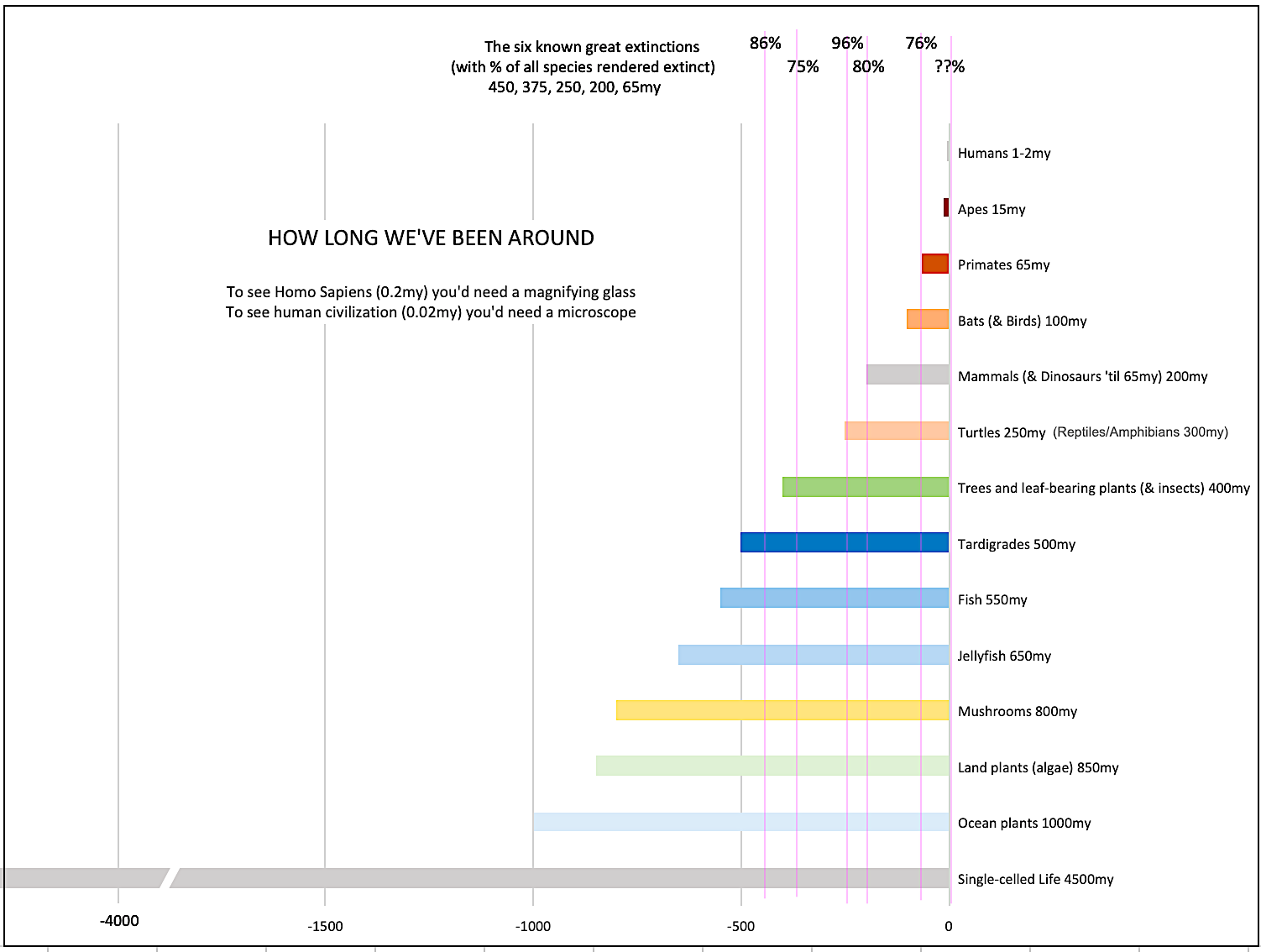
The reason for our catastrophic population explosion is simply that (1) we acquired technology that allowed us to keep babies alive without mother’s milk (and hence accelerate the renewed fertility of mothers after childbirth), and (2) we acquired technology that allowed us to kill off our natural predators and diseases, which would in a healthy system kill off enough of us, mostly painlessly, to keep our numbers in balance and cull out the weak. In so doing, we screwed up a million years of effective evolutionary development in a mere thirty thousand years, and as a consequence have precipitated the sixth great extinction event in our planet’s known history, including our own extinction. Oops.

Unfortunately, as our species began to overpopulate and desolate the Earth, we had to evolve a new culture, the stress-responsive, hierarchical, constraining, passive-consumer culture we call ‘civilization’. Without these cultural constraints — this obedience to hierarchy, this managed scarcity, and this becoming-everybody-else conformity — we could not live together under such horrifically crowded, constantly struggling, unhappy circumstances. There is now a war of wills going on inside us — between the will of our body, to do what it has been programmed to do over a million years of constant learning, and the will of our culture, to do what we must do just to survive in our terrible modern and unsustainable world. There is no reconciling the two, which is why we are so ill with the symptoms of this war — chronic diseases caused by chronic modern stress our body is not equipped to cope with, and the mental illness that plagues every creature denied the freedom to be nobody-but-herself.

This is who we are — a joyous complicity of the creatures in our bodies, now wracked with the stress of having to be everybody-else, of having forgotten who we are and where we belong and how we are a part of all-life-on-Earth, connected.

And still we are driven by the beat of that ancient drum to fall in love, anew, every four years a new beginning, a new ecstasy, that bliss, that desire, that spasm of pure joy that eclipses so briefly all the griefand loss and sorrow and anger and shame we feel.

It is all we can do.

* incorrectly spelled as neopinephrine in the earlier articles

Category: Human Nature

October 18, 2008

Saturday Links for the Week: October 18, 2008

Filed under: Our Culture / Ourselves — Dave Pollard @ 22:52
Colleen's Dog
Photo: Colleen’s dog, just because just looking at him makes me smile.

What Moves the Artist: Most of my circles, and my readers, are artists in one way or another, so I was intrigued by Malcolm Gladwell’s portrait of two forms of artistic genius — the conceptual prodigy (e.g. Picasso), who peaks early, and cares about outcome, versus the experimenting slogger (e.g. CÈzanne), who peaks late, and is preoccupied by learning and process. TS Eliot, my favourite poet, made the transition, and though Prufrock (written at age 23) is his most loved work, the Four Quartets (written a quarter century later) is, in my opinion, far more accomplished. In a piece a couple of weeks ago PS Pirro wrote “I visualize the end product, but not the daily process. That’s my error. Because one page at a time, one sentence at a time, it’s the doing that matters. What’s done is just… done.” I am like her — I have tried to make the transition from the flashes of brilliance in my young writing (with much inactivity and some ghastly and embarrassing stuff in between) to the more careful, studied work I do today. My great learning from Bowen Island was: There is only the practice. The genius of the prodigy is electric, inspiring, lyrical, transformative, but the genius of the patient and present practitioner is ultimately more connective, recognizable, and even (I suppose I should say this with an apologetic shrug) — useful.

The Real Battle for American Hearts and Minds: The anonymous political pundit who guest-posts on Joe Bageant’s blog has another brilliant analysis of what’s happening in the ‘heartland’. Excerpts:

The primary motivating factor in the development of the religious right is a defensive response to the challenges posed by the power of popular consumer and entertainment culture and not a backlash against progressive or liberal ideas and social movements…

When it comes to predicting the outcome of this struggle, there should be no doubt which side will ultimately prevail in this fight. Religious fundamentalism here and abroad is no match for the powers of popular, consumer and entertainment culture. The reason for that is very simple: popular consumer culture is the most powerful and attractive ideology in human history.[Unlike all other religions and ideologies] it demands no sacrifice from its faithful. It demands only that you purchase and consume and that you become passively entertained…

If progressives are serious about winning victories that can realign our politics, they must find a way to marry the legitimate criticism of the decadence of popular culture with criticism of the decadence of an economic system that creates the savage inequalities we see in America today. Once that is done, the entire project of the right collapses under the weight of its own contradictions.

Writing in Circles: Pohangina Pete writes poetically about how complexity touches us.

Winged Pilgrimage: Cassandra writes rhapsodically about the annual migration of the snow geese and asks whether our pilgrimages might have been inspired by our observation of birds, the dinosaurs’ flying descendants. I think it is entirely possible. Having made two pilgrimages this year, on the heels of saying I would trade places with a chickadee in a heartbeat, I think what we must realize is that for most birds migration is not an automatic instinct, it is a choice, a decision that flight to another climate is worth the many dangers that flight brings with it. Migration is a conscious movement, one dictated by necessity and the drive to survive. Our own pilgrimages are no less so. Excerpt:

My own inarticulateness, in the face of the emotions the geese arouse in me, tells me I’m in the place that contains fire and the great waterfalls; the sound of the hermit thrush and the flash of a school of bright minnows; a silent shaft of sun on moss in a dark woodland. The snow geese fly in that space of porosity between myself and the rest of nature, following a map imprinted in my own marrow, a route stretching forward beyond language, and back to a time before tongues.

And Wheeled Pilgrimage: Cheryl is chronicling her amazing pilgrimage around the perimeter of Australia with pictures and stories of the people she’s meeting and the astonishingly beautiful places she’s discovering. If you’ve never been to Australia, reading this blog will give you a flavour for life “down under”.

Stories of Transformation: Jen points us to a remarkable TED talk about Stories of Transformation, by Chris Abani, that shows us why stories are so powerful and illuminating. In one story he explains how his mother broke down when a Portuguese woman at an airport where Chris’ family was fleeing the horrors and atrocities of the Biafran war, emptied her suitcase to give her and her family everything she had packed, to help them begin to rebuild their lives. Her explanation for this breakdown after stoically coping with all the outrages and terrors of war:

You can steel your heart against any kind of trouble, any kind of horror, but a simple act of kindness from a complete stranger will unstitch you.

Just for Fun: Taller Than Trees, a delightful stop motion animation short by Joseph Mann. Thanks to Our Descent for the link. And in a sillier vein, Beth Patterson points us to Palin as President (click on the items in the oval office and make sure you have sound on).

Thought for the Week: Forget What “Is” (and What Is Wrong) Now and What/Who Caused It, and Just Start Over: From Jack Martin Leith, commenting to Geoff Brown and expanding upon Peter Block’s argument that we need to stop looking at things as problems to be ‘fixed’ (and people as their ’cause’) and start over with a fresh sheet of paper looking at what we want to create now (not solutions, not future state, not incremental approaches):

Solutions imply problems, in the way that yes implies no and day implies night. Itís not a shift from problems to solutions we need, but from problem solving to creating what we want – and making what we wantnot our desired future, but our desired present.
Older Posts »

Powered by WordPress