Dave Pollard's environmental philosophy, creative works, business papers and essays.
In search of a better way to live and make a living, and a better understanding of how the world really works.


June 15, 2009

It’s Our Turn to Eat: How Politics Works and Why Activism is So Important

Filed under: Preparing for Civilization's End — Dave Pollard @ 23:02


HtStW3
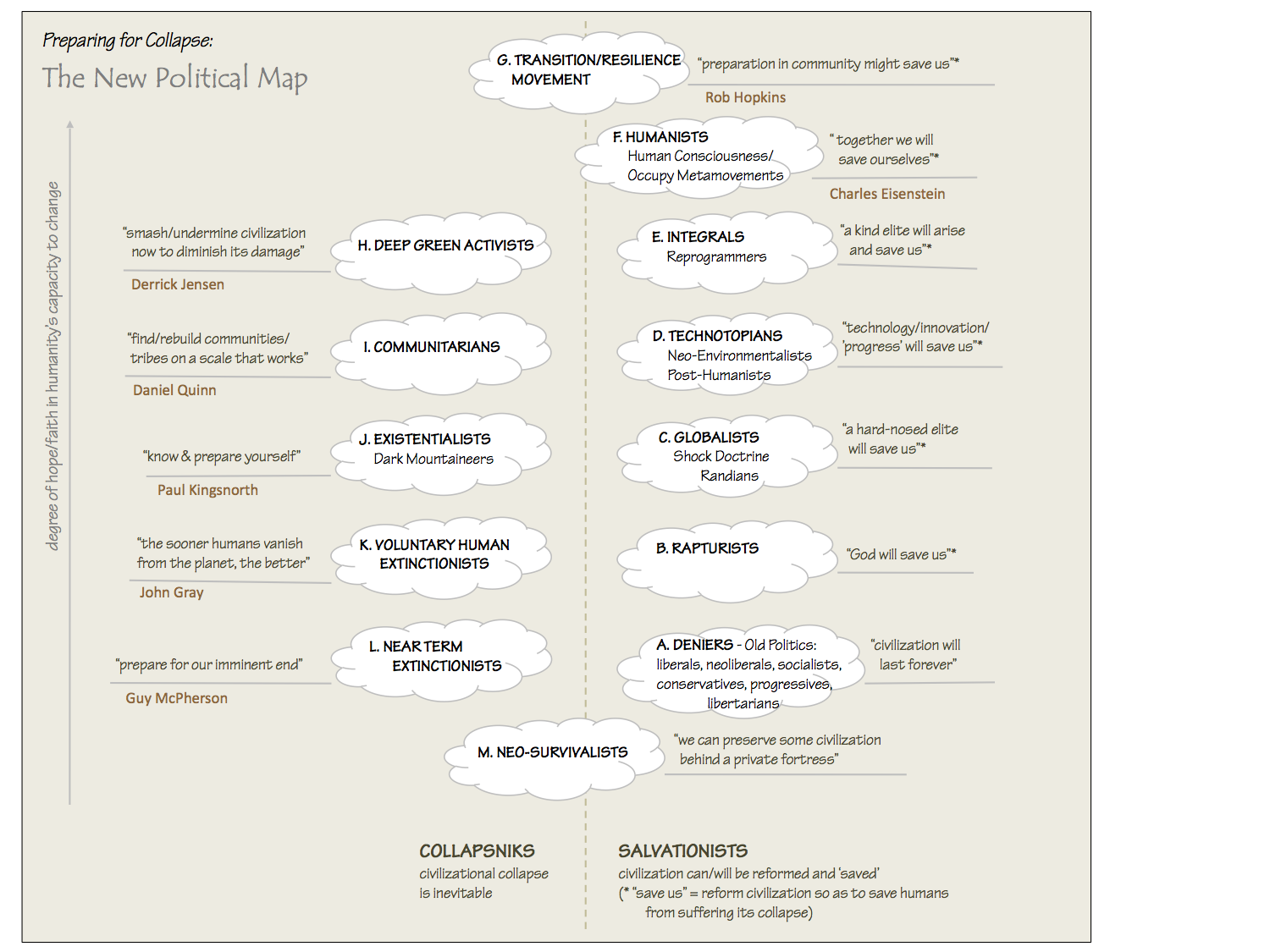
After the Bioneers conference last year, I wrote about the 24 steps to make political activism more effective. And, as the chart above shows, activism has long been part of my “what you can do to help save the world” list.

Recently, however, I’ve become more skeptical in my writing about whether or not political activism really has any effect. Most of my attention has been focused on personal change, on adapting to the world rather than trying to make it better.

More recently still, I’ve begun to think that personal change is equally futile: that we cannot be other than who we are, and that the best personal coping strategy is to know and accept yourself. My friend Janene has tempered my thoughts on this somewhat; she says that while we may not be able to change who we are, we can change what we do.

To some extent this takes us full circle. If we have the opportunity and responsibility to change our behaviour, our activities, to make different choices about what we do, and don’t do, what is this if not political activism? And if those actions do make a difference, then skepticism about the effectiveness of political activism is at best unwarranted, and at worst defeatist. My political activist friends have called me on this, and I promised to recant any suggestion on these pages that political activism is a waste of time and energy.

So I’m doing so. As Margaret Mead said, “Never doubt that a small group of thoughtful, committed citizens can change the world. Indeed, it is the only thing that ever has.” She was right. Social and political movements have always pushed people and institutions to make important and meaningful change that they would not otherwise make, by appealing in part to their sense of what’s fair and just and reasonable (an intellectual appeal), but more importantly by appealing to human emotion, by moving them. Without such movements there would be no movement, and we would probably be living in a world with much more slavery, violence, destruction and tyranny than the one we live in now.

I’ve been trying to figure out why this is so. I have a fairly optimistic view of human intention and behaviour, as befits an incurable idealist. But I also confess to being misanthropic — I don’t much like most people. I find them stupid, unimaginative, indifferent to the suffering of others, and conveniently ignorant and agnostic. It is easy to give up hope on people, and to blame “the system” that grinds the sense and sensibility out of them, and just give up.

I believe, as John Gray has argued, that we humans, like most creatures, are preoccupied with the needs of the moment. We are myopic, both in time and space — unable to really care about what we cannot see and feel, or about what the future consequences of our actions might be. That’s not a criticism, just a Darwinian truth. That is who we are.

The problem is one of scale. When something affects us, or our immediate circle, personally, it is in our nature to care about it, and, with some struggle (because in our modern world we do not get much practice building consensus, resolving conflicts, and really caring about those we haven’t personally selected to be part of our networks) to resolve it congenially, fairly and effectively.

But the further away something gets from those intimate circles, the less capacity we have to understand it, to care about it, or to deal with it effectively. With distance and size it becomes remote, invisible, complex, unfathomable. We introduce hierarchy (whose effect is to increase efficiency and the concentration of power and reduce effectiveness, resilience, information-sharing and peer communication). We introduce agents, brokers, intermediaries, media and ‘representatives’ to whom we cede power and responsibility.

shirky network of dense clusters

As we become more distant and as the circle becomes much larger, we cannot care as much. Soon it takes a massive fear-based propaganda machine just to make us vote, or fight a foreign ‘enemy’ thousands of miles away. Likewise, when politicians are far removed from their constituents, they cease to know or care what those constituents individually want or feel, and focus instead on how to broadcast messages to get re-elected. If they’re business leaders, likewise removed by many layers and floors and oceans from the front line people, they cease to care about those people, and begin to think of them merely as ‘resources’ to be managed.

There’s a new book out about government corruption in Kenya called It’s Our Turn to Eat. The title refers to the appeal of each elected government to its own tribal supporters that they have to seize power and gorge themselves quickly because after the next election some other tribe will be in power and they too will look after ‘their own’. The twist is that the elite in Kenya, across all tribal groups, exploits this tribal animosity and fear to distract the electorate from the fact that, whoever is in power, the elite still pull the strings, pay off the politicians, and hoard the resulting wealth. The objective is to subjugate and discourage the people, because that allows the elite to continue to rule unopposed. Then it all becomes a game of perpetuating power and wealth — stealing elections, ever-increasing disparity, police state laws, bribes, pork, subsidies and payoffs, propaganda, intimidation, media control, divide and conquer, and massive corruption. US 2000, Kenya or Iran 2009, it doesn’t matter. To think that this is a struggling-nation problem only is pure conceit. Thanks to distance, size, and scale, the benign inclinations of human nature are coopted, perverted and corrupted. Everything that works at a community level fails at the level of corporation and nation. We have shown, all over the world, again and again, that once we reach a certain size we become depraved, ungovernable.

The role of the activist is to act as a counterbalance to this perversion, to speak truth to power, to bridge the distance, to hold those who are irresponsible and unaccountable, responsible and accountable. To intervene. To break down what is already broken. To enable what the people really want to be realized, despite everything. A step forward for every step back. A holding action.

This is thankless work. So I want to say thank you.

Without activists, the Republican neocons would still and forever control the US government. Without activists, the world would be full of gulags, torture prisons, brutalized, silent spouses and children. Without activists, the forests would all be gone, the air fouled, the oceans dead, the glaciers and ice-cap and permafrost melted into a brown sea. Without activists, women would have no vote and no right to choose, and people of colour would have no freedom. Without activists, the books with the most important ideas in human history would be banned, or never published. Without activists, the world’s children would be working in mines, and the world’s adults would be working in chains. Without activists, we would all be addicted to the poisons that Big Tobacco and Big Agribiz and Big Pharma and Big Energy try to convince us we cannot live without. Without activists, the only non-human animals would be farmed animals. Without activists, the world would be awash in billions of unwanted children.

All of us must be activists, if we are to give this world a fighting chance.

ftss circles

What should you do? Picking your cause is just like picking the work you’re meant to do, as I explain in my book Finding the Sweet Spot. This is not work for the half-hearted or easily-discouraged. So, just as in choosing the paying work that gives your life meaning, you need to identify and choose a cause that’s in your ‘sweet spot’ — something you love doing, and that you’re good at, and that is needed in the world, and that you care about. If you are no good at it you’ll get discouraged or burned out. If you don’t love the cause, you’ll end up disengaged. If it’s not really needed, if the world’s not ready for it, you’ll be unappreciated and frustrated.

To find this, you must learn something about yourself, and then do some research about the world, about what’s really going on, about the points of intervention that will allow you to make a difference. There are a few ideas in the brown box in the top chart above, but it’s only a tiny segment of the work that needs to be done. Whether your cause is health or corruption or energy or pollution or water or food or conservation or animal welfare or urban despair or suburban sprawl or power or inequity, the process is the same: Find partners, a community of people who share your purpose and your cause and whose work and strengths complement your own, so that you get to do what you love and are good at and so that the sum of the team’s work is greater than its parts.

Next, you need to be for something, not just against something. Always fighting against, as important as that work is, will drain your energy unless you also have a vision of a better way, something to replace what you’re battling. So you need to be not only an informed warrier but also an innovator, an entrepreneur, a visionary.

And you need to be prepared to search insatiably and undogmatically for the truth, because ultimately that is your most powerful, and sometimes your only, weapon. Without it, your belief and passion are not enough.

You also need to be able to articulate, simply, clearly and honestly, what you believe and why. There is power in intention and strength in numbers, but you will be unable to achieve either unless you are able to convey what is, and what needs to be done, to those who are ready to listen and to make common cause with you. You cannot do it alone, and you have to pace yourself. You need to understand too that many people will not be ready for your explanation, and that your response when you meet them is to be polite and to move on, not waste your energies trying to make them believe what they are not ready to believe. You must have faith that they will come around, in time, and you or one of those you have joined in common cause will be there, then, to welcome them.

tiananmen square

And at times you need to be ready to fight. You might think this would require courage, but if you believe in the cause, and you know it’s right, fighting for it will not be hard; in your mind there will be no choice.

(What else, activists? What am I missing? Lessons from the trenches? Secrets of success?)

We must all be activists, and relentless, and patient, and brilliant at it, because as long as the majority are hopeless, there is no hope. And because we cannot fail. We cannot.

Until the day when it’s no one group’s turn to eat. Until there is enough for all, and more.

6:20

Filed under: Creative Works — Dave Pollard @ 00:13


nursingthis is my first attempt at translation of a creative work. i hope the author will forgive my misunderstandings and my clumsiness.
the poem is the first prize winner of the en route poetry prize for 2009. it was written in french. comments and corrections to my translation are welcome.

6:20
by judy quinn

december 6, 1998
you are already into the second chapter of it,
and not a word has been said.

you are just an extension:
the flower spike that opens and scatters its seeds.
your happiness is joyless,
your pain exposed.
you no longer belong to yourself.

sainte-justine, montreal,
just like at saint-raphael, san jose –
4:50, notes the nurse:
you make your way earthward
where even invisible things fragment apart,
one year pressed against the other,
your forehead pressed against the table:
to replace, says the book,
break apart, then replace.

towards those who, before you,
dressed up their web of illusions,
a picture of hands, lost,
bubbles trapped on the surface of a lake,
bloop, blip:
all these lives that once were yours.

they have plugged in their probes,
plunged into the restless waters.
you see nothing, but everything’s clear.
on the screen, a raised arm hails a taxi,
a lawnmower scrapes the sky,
let me out of here before the storm.

they have pumped the blood,
drawn back the doors, and remade the bed.
they played with your mother’s hair, and said:
it’s nothing, relax, this is normal,
everything’s perfectly normal.

5:03, notes the nurse, and leaves:
for millennia, our words depreciate each day,
the same lamp, carried from room to room
shines on each blinding day:
it’s been this way for millennia, she writes, and leaves.

your mother admires the houseplants,
the green unpleated drapes,
your father, sitting, his schoolbag at his feet.
an island that the merest word cracks.

5:53, december 6, 1998,
what separates the sky from the window,
your father’s bedside chair,
disappears,
the centrifugal force that glues us, skin to skin,
time has left the room.

one day, you’ll see, says your mother,
no one will have to be buried anymore.
and the nurse notes:
elevated pulse
bloodshot eyes
slight delirium
everything is perfectly normal.

silent bell-towers toll our distress.
dressed in green feathers,
under the worried eyes
of the stars, we will cease
all procreation –
my child
you will be born without me.

6:20, december 6, 1998
buried in billions of light-years of dust,
silent and sterile
a hand unblocks a plumbing pipe.
from black to red, nail polish
like the beginning of the cosmos.

6:20, local time
peeps, diving flights,
the yellow pink of a summer evening’s heat –
the rain, the clouds of bees,
complement each other.

you are coming. we will empty the world.
outside the room
a tree sways in the languid morning,
the final outcome of the growing dawn.
a brown apple pressed against a face.

when you get free from the vice,
the one you weren’t even aware of,
when you have not cried, in today’s book,
you were already real enough.

for a first note:
nine out of ten, white, you
failed the colour test.

when you came, carrying on your skin
that whiteness from the time before
we each looked out for ourselves,
and the tree, and the rose.
this counterweight so sensitive to words
that without them, it would have fallen over.

you are this spot, as soft as infinite clay.
your eyes are the seal of renewal.

you expect heaven — do not seek it.
smell the soiled linen, the vomit and blood,
these diapers down here, nothing higher.
you would have to have been born
in another time.
here, they’ve placed a limit on our dreams.

once you’ve frowned, looked at nothing,
your black almond eyes, with no blue hue,
unable to tell your mother from a blot of ink
you already knew
that to live, you must forget.

omit what’s essential, don’t be concerned about it.
it’s a long trek. on the uneven road
you’ll get lost a million times, and a million times
lay down your dusty burden
looking for the break in the wire that holds your life
back at the starting line.

6:20 am
they tossed you on top of your mother,
the frozen ghost,
under the neon lights of the room
furnished to please the administrators.
i love you, and i want so much to love you
says your mother,
so much that i want you to live forever.
without asking, they picked you up again.

you will set up so many ideals,
says your father
and they will rise up against you
he says, for his own benefit.
there will be enough of them,
they’ll beat you back
and stay alongside the living.

don’t pay any attention:
everything is perfectly normal.

just born, mechanically,
you brought your lips to your mother’s breast
and sewed her back up with a web of drool.
your mouth is partly played.

you were baptized even before you were born,
this twisted name swollen
with a russian hero’s pride.
it carries the scent of the plains.

in the moment when the earth steals it,
a field of wheat at the other end of the world
grows and moves with the sound of your name.

they wish you to be noble,
but you will be nothing but earth.
they will prevent you from leaving.
you’ll be left alone.
they will regain their former whiteness.

don’t think about it,
it will be done for you.

head turned towards childhood,
your hand feels out eternity, and with the other
you hold death by its collar,
its body on the cross.

don’t think about it.

they barely had to wash you,
they wiped out your nostrils, cleared your lungs,
they drew from your mouth your mother’s voice
which called out the world’s promises,
then they threw her away.
they dug for the words that you threw out to her
without finding them,
threw them out with the water.
only one remained.
only one was never delivered.

they tagged you,
measured the rest of the night on your wrists.
weighed your future
with nothing but a sketch of your heart.
then they put you in a bell jar:
so wise.

perhaps they dreamed about
the sunken cheeks they gave you.
that they raised, meager offerings
from the bottom of a well.

these cheeks where laughter will take shape in you
will capsize boats which, within you
well before this december 6, nineteen hundred and…
at 6:20 am
dead planets drifted.

image: from salon.com

June 14, 2009

Words and Pictures: Thoughts for the Weeks of June 7 and 14, 2009

Filed under: Our Culture / Ourselves — Dave Pollard @ 02:41


Taking a bit of a hiatus from links of the week. In its place, here are some remarkable words and pictures that you have pointed me to over the past fortnight. Hope you find them inspirational.

THE INVITATION

It doesn’t interest me what you do for a living.
I want to know what you ache for
and if you dare to dream of meeting your heart’s longing.

It doesn’t interest me how old you are.
I want to know if you will risk looking like a fool
for love
for your dream
for the adventure of being alive.

It doesn’t interest me what planets are squaring your moon…
I want to know if you have touched the centre of your own sorrow
if you have been opened by life’s betrayals
or have become shrivelled and closed
from fear of further pain.

I want to know if you can sit with pain
mine or your own
without moving to hide it
or fade it
or fix it.

I want to know if you can be with joy
mine or your own
if you can dance with wildness
and let the ecstasy fill you to the tips of your fingers and toes
without cautioning us
to be careful
to be realistic
to remember the limitations of being human.

It doesn’t interest me if the story you are telling me
is true.
I want to know if you can
disappoint another
to be true to yourself.
If you can bear the accusation of betrayal
and not betray your own soul.
If you can be faithless
and therefore trustworthy.

I want to know if you can see Beauty
even when it is not pretty
every day.
And if you can source your own life
from its presence.

I want to know if you can live with failure
yours and mine
and still stand at the edge of the lake
and shout to the silver of the full moon,
“Yes.”

It doesn’t interest me
to know where you live or how much money you have.
I want to know if you can get up
after the night of grief and despair
weary and bruised to the bone
and do what needs to be done
to feed the children.

It doesn’t interest me who you know
or how you came to be here.
I want to know if you will stand
in the centre of the fire
with me
and not shrink back.

It doesn’t interest me where or what or with whom
you have studied.
I want to know what sustains you
from the inside
when all else falls away.

I want to know if you can be alone
with yourself
and if you truly like the company you keep
in the empty moments.

chimp tigers
Photo of chimp in South Carolina looking after tigers orphaned by Hurricane Hannah. Unfortunately this animal rescue organization makes the animals pay for their keep by putting them in movies, commercials etc. Thanks to Miranda for the link.

   
    TEN YEARS LATER

    When the mind is clear
    and the surface of the now still,
    now swaying water

    slaps against
    the rolling kayak,

    I find myself near darkness,
    paddling again to Yellow Island.

    Every spring wildflowers
    cover the grey rocks.

    Every year the sea breeze
    ruffles the cold and lovely pearls
    hidden in the center of the flowers

    as if remembering them
    by touch alone.

    A calm and lonely, trembling beauty
    that frightened me in youth.

    Now their loneliness
    feels familiar, one small thing
    I’ve learned these years,

    how to be alone,
    and at the edge of aloneness
    how to be found by the world.

    Innocence is what we allow
    to be gifted back to us
    once we’ve given ourselves away.

    There is one world only,
    the one to which we gave ourselves
    utterly, and to which one day

    we are blessed to return.

             – David Whyte (thanks to Melinda for the link)

dog fireman
An urban myth photo. The story is that the dog in the picture was thanking the fireman for rescuing her and her puppies, but it seems the truth is that the dog escaped the fire by herself, and there were no puppies at that time. Still a good photo, and bravo/brava to firefighters for their respect for all life threatened by fires. Thanks to Tiffany for the link.

I think that if the land starts speaking to me in a human language I will have to move to a boat on the sea…After a dozen years on this farm, I can name most of the plants and nearly all the birds. But what’s the word for the wake the pileated woodpecker leaves as it dips, flying across the pasture? How can I imagine that land speaks in a language when I’m surrounded by animals whose wordless attention is at least as great as mine?

Advice to friends. Advice to fellow mothers in the same boat. “How do you do it all?” Crack a joke. Make it seem easy. Make everything seem easy. Make life seem easy and parenthood and marriage and freelancing for pennies, writing a novel and smiling after a rejection, keeping the faith after two, reminding oneself that four years of work counted for a lot, counted for everything. Make the bed. Make it nice. Make the people laugh when you sit down to write and if you can’t make them laugh make them cry. Make them want to hug you or hold you or punch you in the face. Make them want to kill you or fuck you or be your friend. Make them change. Make them happy. Make the baby smile. Make him laugh. Make him dinner. Make him proud.

Hold the phone, someone is on the other line. She says its important. People are dying. Children. Friends. Press mute because there is nothing you can say. Press off because you’re running out of minutes. Running out of time. Soon he’ll be grown up and you’ll regret the time you spent pushing him away for one more paragraph in the manuscript no one will ever read. Put down the book, the computer, the ideas. Remember who you are now. Wait. Remember who you were. Wait. Remember what’s important. Make a list. Ten things, no twenty. Twenty thousand things you want to do before you die but what if tomorrow never comes? No one will remember. No one will know. No one will laugh or cry or make the bed. No one will have a clue which songs to sing to the baby. No one will be there for the children. No one will finish the first draft of the novel. No one will publish the one that’s been finished for months. No one will remember the thought you had last night, that great idea you forgot to write down.

home project
Excerpt from the remarkable free-online film Home. Thanks to 6 readers for pointing me to this film.

A lot of readers complain when I wax poetical about the charms of some obscure grasshopper instead of spraying the aerosol whupass on Saudi Arabian misogyny or condemning the actions of lunatics who murder abortion providers, but I tell you: the perceivement of grasshoppers is at least as important as those other things. And not just from some la-la-la eccentric amateur naturalist perspective, either. Grasshoppers — and every other non-human being — once appreciated, are more easily identified as members of the casualty class of human domination culture.


lucy and the waterfox david robinson
Drawing from the wise ‘children’s’ book Lucy and the Waterfox by David Robinson

If you need a relationship to be happy, you’re not free. If you need to be alone to feel free, you’re not free. Took me all year to realize.

Loneliness does not come from having no people about one, but from being unable to communicate the things that seem important to oneself, or from holding certain views which others find inadmissible.

-  Jung

cartography of water by judith meskill
Cartography of Water, by Judith Meskill

For every poet it is always morning in the world. History a forgotten, insomniac night; History and elemental awe are always our early beginning, because the fate of poetry is to fall in love with the world, in spite of History.

- Derek Walcott (thanks to Sheri Herndon for the link)


may my heart always be open to little
birds who are the secrets of living
whatever they sing is better than to know
and if men should not hear them men are old

may my mind stroll about hungry
and fearless and thirsty and supple
and even if it’s sunday may i be wrong
for whenever men are right they are not young

and may myself do nothing usefully
and love yourself so more than truly
there’s never been quite such a fool who could fail
pulling all the sky over him with one smile

- ee cummings

June 12, 2009

Slowing Down, Making Space

Filed under: Preparing for Civilization's End — Dave Pollard @ 11:28


self-portrait in words

As you may have guessed from recent posts, I’m in a very contemplative and self-preoccupied space lately. Much of my writing has been about what I call “Let-Self-Change”, based on the principle that we can’t really hope to change the world very much, so what we should concentrate on is adapting to the world, letting ourselves change.

But now I’m not so sure on either count: I’m beginning to think we have more power to change the world than we might imagine; more on that in an upcoming post entitled Why Activism Works. And I’m beginning to think we have less power to change ourselves than we might expect: We cannot be other than who we are. Look at all the self-help books out there, and from what I can tell almost none of them has any enduring effect.

I’ve been talking a lot about my three latest self-improvement projects: To connect better with my own (largely suppressed) emotions, to become more empathetic, and to learn to live in Now Time instead of Anxious Time. I certainly believe that practice and exercise have value, but I’m increasingly convinced that any changes they provoke are likely to be modest, and perpetually difficult to sustain.

So what if I were to just slow down, make space, and pay attention to who I really am, now? And then just accept that that is who I am, already, this nobody-but-myself I keep aspiring to become?

The result of my doing so (aside from some consternation and self-dissatisfaction I had to sit with for a long time to quell), is the word self-portrait above. Here’s what it acknowledges:

  1. I am, and I think we all are, largely a product of two forces over which we have little control: our bodies, that “complicity of organs that evolved our brains as an information-processing and feature-detection system for their benefit”, and our civilization culture, that molds us with language and socialization to behave and fit into this overcrowded world. The two lower boxes of my self-portrait list the qualities that I think each of these forces have instilled in me. I am not blaming ‘them’ for this, just acknowledging that they have played important roles in formng who I am. Had I grown up in a natural environment outside of civilization, the qualities in the lower left would still be present.
  2. There are some other qualities, that I list as Things I’m Not, that I’ve repeatedly acknowledged, but I’m not sure where they ‘come from’ — they’re not clearly attributable to either my body/metabolism or the influences culture has had on me. Perhaps it doesn’t matter; whatever their cause, these qualities too are a part of who I am. I’d love to be present, empathetic, sensitive, patient, a fast learner, and carefree ‘the space through which stuff passes’, but instead I am absent, inattentive, insensitive, impatient, a slow-learner, and intense. It’s not for lack of trying to change.
  3. I tell myself 5 stories, shown in the upper left box, that I believe to be true stories (to the extent any ‘story’ can be ‘true’), that I don’t think I can significantly change, and which evoke in me the flurry of what Richard Moss calls “tamed” emotions in the box connected to my box of stories (they are called “tamed” because one can learn to live with them, in contrast to the ones that eat you alive). I’ve tried Moss’ approach of declaring such stories to be fictions to free myself from these emotions, but with limited and unenduring success. I can suppress these emotions, and perhaps it’s useful to do so, but I cannot deny them, or indefinitely distract myself from them. They, too, are an integral part of who I am.
  4. Finally, since who we are and what we do are inseparable, I’ve listed the six ‘groups’ of things I love to do. Most of my time is now spent doing these things, which is distracting me from my tamed emotions and making me, most of the time, extremely happy as a result (is happiness just the absence of negative emotions and anxieties?; I don’t know). The first two groups (imagining/reflecting, and writing), are my Sweet Spot: They are things that I do well, and which are needed in the world, besides being things I love doing. The rest of this list are things I love doing but confess to no particular competency at them. These things, too, are who I am.

That’s my self-portrait, my honest-as-possible assessment of who I am. Suppose I just accept that, and acknowledge that this rather unflattering portrait is authentic, and reflects who I have always been, and am largely fated to be for the rest of my life. And, most importantly, suppose I just accept that here, now, in this moment, this is who I am. No escape, no correction, no denying, no path to ‘betterment’.

Nobody but myself.

Is ‘knowing’ this, consciously, all that is needed? If I just let myself be this, and if I let this authentic self-knowledge guide me in deciding what to do, moment to moment, can I give up all the Let-Self-Change machinations, let go of all the gunk and intentions and expectations that are not-me, and just soar? Might it even, unintentionally, make me more empathetic, more present, less anxious, more like the space through which stuff passes?

Hmmm…

Thanks to Nick, Cheryl, Tree, and Patti for the conversations that enabled this. Egret photo is by Eileen Nauman.

June 9, 2009

the way we are

Filed under: Preparing for Civilization's End — Dave Pollard @ 22:22


broken eggshell
it seems to me
that the description of our world
as an asylum, a hospital, a prison,
is a fair one.

everything tells me
there is something terribly wrong
with the way we live now,
that this is not how we’re meant to live.

people behave in unnatural ways
ways detached from reality,
from others, from themselves.
it’s as if reality is too terrible, too hard,
more trouble than it’s worth.
so we live in these imaginary places,
in our heads,
in our stories.
it’s safer here.

i can imagine how it was
to live in a primeval world,
a world where our senses and instincts held sway,
a world of astonishing colour, and surprise,
a world without politics, without scarcity
without fear.
a world that just was.
and of which we were, from birth, a part.
accepted, loved, honoured.
even by those who would devour us.

our intellectual and emotional selves
are a natural evolution:
more thought enables us to innovate,
to survive in places we are not naturally endowed to live.
more feeling enables us to care –
and when times are challenging
those who care will outlive those who do not.
now we are smart, and fierce, creatures,
evolved, grimly, to survive.

but that intellect can also imagine
things far more fearsome than other creatures,
and can make those terrors a reality,
while those sensitive emotions
can make those terrors unbearable.
unintended consequences,
enough to suggest that nature made a mistake with us,
a big enough mistake to usher in
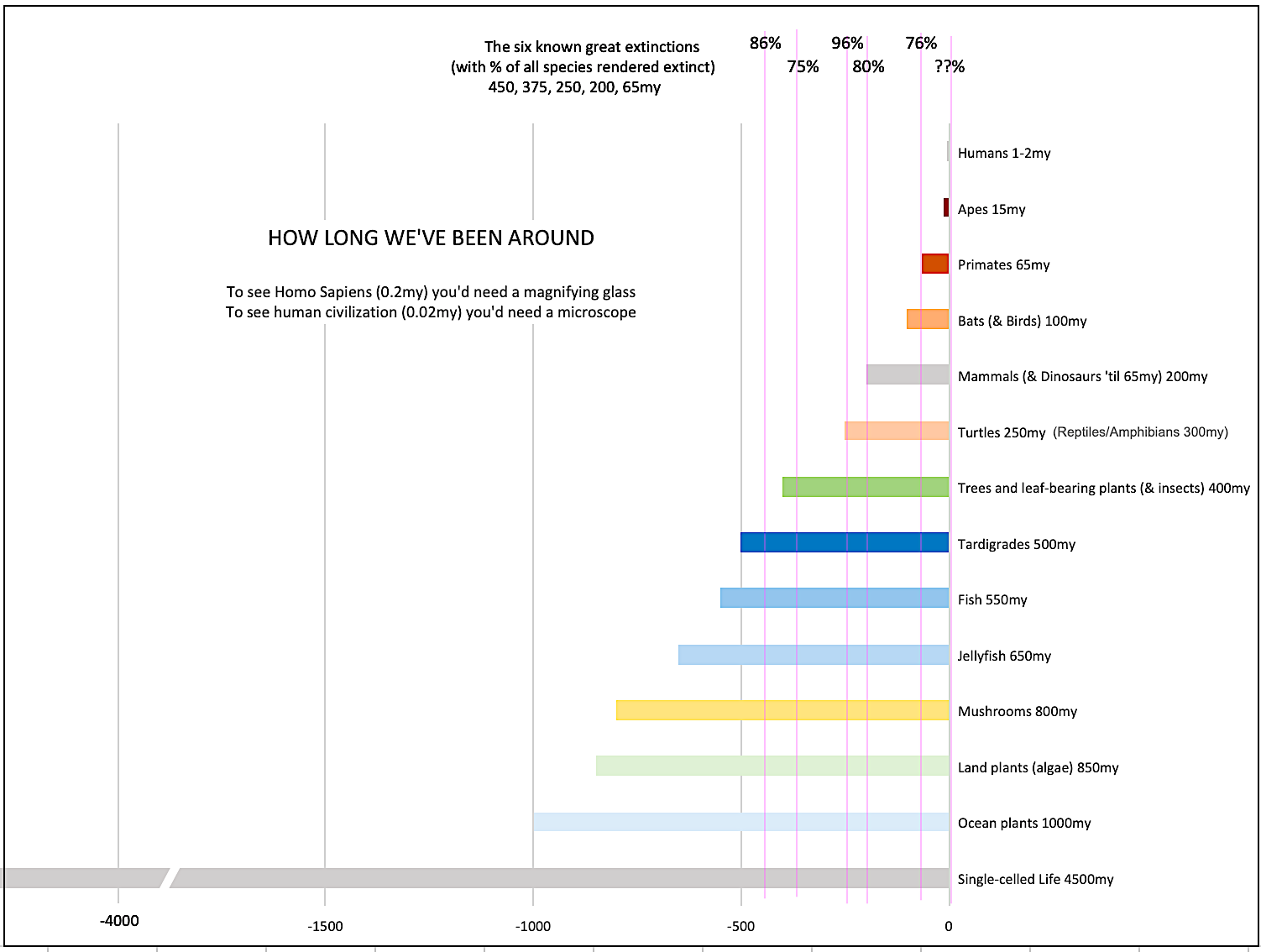
the sixth great extinction of life on Earth.

so here we are, as we wait to discover
what we have wrought.
out of control, over-bred,
damaged by stresses we could not foresee,
self-imposed, and self-compounding.

all creatures value freedom above all else,
even above love.
in a world of horrific overcrowding,
constrained to live in a social compact
that inhibits us everywhere,
that deprives us of everything in life that’s natural,
we have ceded all our freedoms
for survival:
obey, or die.

hence the asylum: deprived of freedom
we quickly go mad:
we kill, wage war, sacrifice our souls,
pray to gods of suffering,
eat our young.

so what are we to do?
inure ourselves, become machines,
live in our heads, suppress our feelings,
do what we must,
keep our heads, enough to help others,
to be of use, while we wait
for a salvation beyond hope?

or walk away from civilization,
be selfish, find oasis for ourselves and those we love
and live as free and natural lives
as can be found in soils untouched
by the asylum, as humble models
for the seventh world that will arise
with our demise?

June 2, 2009

Steps Toward the Present: More Mindful Wandering

Filed under: Preparing for Civilization's End — Dave Pollard @ 00:38


rain walk 1

Last week I was recuperating from a back injury, so I had more than the usual amount of time for reflection, time to do nothing, and I really like the space it’s left me in. For someone who spends too much time thinking, too much time in his own head, I have to admit that having unrushed time to think about things that are actually important to me, and with it, time to feel, to pay attention to my senses, and to listen to my intuitions, seems to be good for me. Perhaps rather than thinking too much, my problem may be that I think reactively too much.

It has occurred to me that, rather than some kind of ‘self-improvement’ actions, what I should be focusing on is getting rid of the gunk — the anxiety-creating stories and commensurate emotions, the tasks I’ve undertaken that are not essential to anyone, all the stuff that needs to be looked after — gunk that is preventing me from having the time to just be Me. I don’t need more things to do, I need fewer. And perhaps if I create more time for myself to just be Me, I will find that I am living in the Now.

rain walk 2

Rather than starting this week stressed and ‘behind’ as a result of having not done much on my ‘to do’ list last week, I started the week relaxed, refreshed, focused. I accomplished twice as much today as I usually do, and I did it better. I was more attentive to the people I work with, more centred, able to bring more concentration to the problems at hand, and more imagination and creativity. I was more helpful.

I recently pledged to learn to increase my awareness of my own feelings, manage my own emotions better, improve my emotional communication, and become more attentive and appreciative of others’ feelings and the context that has created them. I am starting to sense that by just being Me, just living in the Now, I might automatically and immediately become better at doing these five natural things. Living in the Now, it seems to me, must accelerate one’s self-knowledge to the point one becomes more intelligent (in useful ways), more emotionally intelligent, more aware and ‘sensitive’, more intuitive, more present.

Today I felt closer to people, more sympathetic. Could this living in the New even be the remedy for my misanthropy?

rain walk 3

Perhaps it’s just the euphoria of feeling better after feeling ill. But maybe all these struggles to try to meditate, to try to get myself into a space, this simpler ‘space through which stuff passes’, are bearing some real fruit. If so, here are the things that I’ve been doing differently, that might be worth making more time for:

  1. Deliberately doing less, just enjoying the passage of time, guilt free, lazily. 
  2. Long walks in the forest, in the rain, and in the moonlight.
  3. Listening to favourite, well-crafted music.
  4. Watching sunrises and sunsets, with a cup of tea.
  5. Surrounding myself with lovely smells — scented candles, flowers, spices.
  6. Looking at flames — candles and fireplaces.
  7. Smiling and laughing — at funny cartoons, poignant stories, playful kittens.
  8. Eating simple whole foods — berries, nuts, fruits, raw vegetables.
  9. Dancing by myself.
  10. Looking at things from unusual perspectives — up close, in shadow, looking up.

These attentive, solitary, sensory pursuits slow my breathing, my heart rate, and silence the machine in my head. Perhaps this is my meditation.

After I’ve spent some time doing them, I seem to be more centred, more ready for social activities, more competent at them. I enjoy them more. I’m more present.

I’m more Me.

« Newer Posts

Powered by WordPress