OK, yes, I suppose this article is a bit of a rant, again. Sometimes I can’t help myself. I blame my conditioning. (Not all workplaces are like this.)
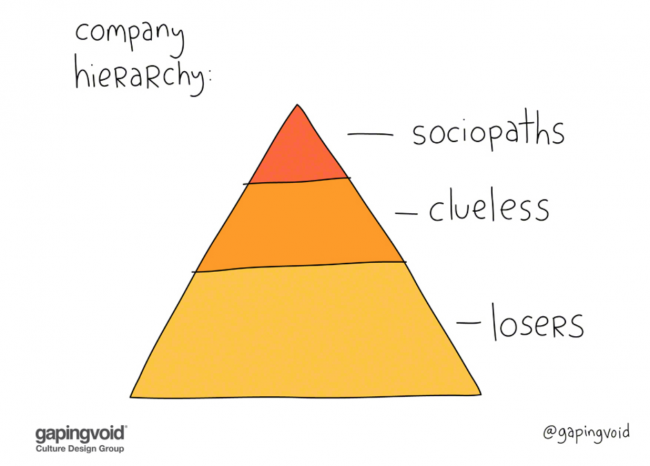
from GapingVoid.com by Hugh Macleod — In his comment on this cartoon, Venkatesh Rao wrote: “Organizations don’t suffer pathologies; they are intrinsically pathological constructs. Sociopaths, in their own best interests, knowingly promote over-performing losers into middle-management, groom under-performing losers into sociopaths, and leave the average bare-minimum-effort losers to fend for themselves.”
As you are no doubt tired of hearing me say, our beliefs and behaviours are entirely the result of our biological and cultural conditioning, given the circumstances of each moment. And nowhere is our conditioning more intense than in the workplace, whence comes the income most of us depend on to feed, clothe and house ourselves and our families. “On-the-job” training and learning is perhaps far more insidious than we might imagine.
Here are a few of the terrible things we can learn in our workplaces (or in the military, for that matter):
- That democracy is an optional, and inefficient, way of doing things. Why, when we pride ourselves on living in ‘democracies’, do we put up with utterly undemocratic workplaces? In corporations, decisions on salaries, promotions, and business strategies are made by unelected ‘managers’ (most of whom have never done the jobs of their ‘subordinates’ and couldn’t do them if their life depended on it), and by ‘directors’ who are selected by external shareholders (one $hare one vote, and most ‘shareholders’ are not even slightly involved in the operations of the corporation and have no idea how it works). So we get conditioned during most of our waking hours to believe that undemocratic processes are the unquestioned norm. No surprise, then, that when we face incompetent, ‘bought’ political leaders who do what their financial donors tell them, and definitely not what their voting citizens want, we shrug and accept this blatant corruption of the democratic process as ‘normal’.
- That bullying is acceptable, if it is done by someone higher in the hierarchy or better connected to those in power. In most workplaces, might makes right. If you want to work there, you’d better be prepared to sign a non-disclosure agreement that bars you from discussing even the most egregious workplace abuses, at least if they involve the ‘higher-ups’. At the very best, if management’s abuse of you is especially bad, they might buy off your silence with an out-of-court settlement. Most of the sociopathy in our corporatized world never comes to light. You have no ‘right’ to know about it.
- That blowing the whistle on illegal and unethical behaviour is extremely dangerous and almost never worth the risk. You blow the whistle, first thing that happens in most organizations is that you get fired, and then the employer sics its army of lawyers on you to threaten you if you don’t shut up about what you know.
- That you should never challenge anyone in authority, and never share your knowledge with others. Challenge your boss and you will likely be told to your face “this is not a democracy”. If you dare suggest your boss is making a suboptimal decision, better make sure there are no witnesses, and that you have another job ready when you lose that one. And in the workplace, knowledge is power, and confessing that you don’t know the answer when you’re the boss may well panic your subordinates (who have probably never heard such an admission before). Giving your staff information when there’s not a strict ‘need to know’ my well earn you a reprimand. The key to promotion in most organizations is: keep your head down, do what you’re told, do not ask questions, and do not rock the boat. Kinda like most schools, but harder.
- That it’s who you know, and who you’re related to and close friends with, that counts in getting ahead, not what you know or what you do (as long as you’re not a complete fuck-up). It’s laughable to think that any workplace is a meritocracy. Stay in any workplace long enough, and you’ll likely discover that those who get promoted are the ones who are the most obedient, fit the current boss’ ‘image’ of a ‘good manager’, or are good friends with the current boss; competence is usually way down the list of factors.
- That the key to achieving and using power to your advantage is to always ensure you have more authority than responsibility, that your subordinates have more responsibility than authority, and that you have knowledge that no one else has (see point 4 above). You want to be in a position where you have the authority to tell others what to do, but where when that instruction turns out to be disastrous, they’ll be held responsible for the failure, not you. And giving ‘subordinates’ responsibility without the commensurate authority is the perfect way to keep them anxious, obedient, and in thrall. And as long as you have knowledge (where the skeletons are buried, who actually majorly fucked up on that mega-project, how to do this obscure but essential task no one else was ever taught to do), you can probably rest assured you have a job for life.
- That setting objectives (for others to achieve) is demonstrating ‘leadership’, and is ‘strategic’ work. In our modern society, ruled by members of the Professional Managerial Caste (admission only by family succession or special circumstances), the people in charge, mostly equipped with nothing more than useless MBAs, no longer have any business strategy skills. They can’t tell you how to achieve the organization’s goals, objectives, or ‘targets’, because they have no practical, nitty-gritty, down-to-earth, front-line experience in how to do anything. They think ‘management’ is about setting goals, objectives, and ‘stretch targets’ for the next year or quarter (something any grade 5 arithmetic student who can add 10% to last year’s numbers could do), for ‘subordinates’ to achieve. No surprise that our political leaders, from the same PMC caste, keep talking wishfully about goals, objectives and targets (eg ‘targets’ for greenhouse gas emission reductions) for the coming years (often past the next election, so they won’t be held responsible for failing to achieve them). When there’s no real strategy, there is no ‘leadership’, and the chances of success at achieving the ‘targets’ are pretty much random. But it sure makes ‘management’ easy!
- That the higher up you get in an organization, the more likely you will be to be both rewarded and blamed for things you actually have absolutely no control over. This is the double-edged sword of having useless ‘leaders’ and ‘managers’ who actually control nothing, and whose work probably has less impact on the organization’s effectiveness and success than that of the poor sap on the outsourced ‘tech support’ desk, who is at least trying to help customers (to the extent the company software doesn’t prevent them from doing so). If the economy is buoyant, or the competitors stumble, the ‘executives’ will get seven-figure bonuses and extra share options. If the economy flounders, or some lean competitor muscles in on market share, the ‘executives’ will get a seven-or-eight-figure ‘buyout’ option and quietly leave the scene.
- That the carrot works better than the stick in ‘motivating’ people, but if you have neither carrots nor sticks, you’re done for. The presumption in most organizations today is that no one works just for the intrinsic reward of doing a good job. Given the incompetence of most management and the complete shrugging off of responsibility of most organizations for their staff, that presumption is understandable. Why give loyalty to an organization that gives you nothing in return? But the reality is that most people, even those who acknowledge working for shitty, badly-managed organizations, still give their best, every day. They may not respect their boss, but they do respect their customers. Neither a carrot nor a stick is necessary, but don’t tell that to PMC ‘management’, busy rating ‘their’ staff ‘on the curve’ to reward the ‘stars’ (who met their ‘targets’) and get rid of the ‘non-performers’, and to brutalize them all into competing harder and harder for that last carrot.
- That it is the boss, not the customer, who is “always right” (even when they’re not). And that if you make the customer happy by contravening instructions from the boss, you will be punished, not rewarded.
If you believe these ten things are true, well then congratulations (or condolences): You have probably been effectively conditioned by the workplaces you have worked at to achieve this level of cynicism (or realism). If you’re lucky enough to have been born into (or invited into) the PMC, you will probably work hard to condition others in your workplaces to believe (or at least understand) they are true as well.
And if you believe these things are true, you have probably also internalized this “on-the-job” learning so well that you apply it to your worldview and your dealings with people outside the workplace as well. You probably have a cynical view of politics, and have come to the conclusion that “democracy” may not be the most “effective” way of getting things done in the political sphere. CEO’s don’t have to run for re-election every four years, after all.
And maybe it would be better to “privatize” everything so that it is “professionally managed”, and more “profitable”. Maybe we don’t need a government at all, except for defence and security of course.
Maybe there are times when bullying is warranted — in dealing with countries that don’t share ‘our’ values, for example. Maybe there are times, in arming our police forces, for example, when “might makes right”, and when a ‘stick’ is called for to ‘motivate’ those lazy, sinful people who would inevitably do nothing or worse unless they were threatened with unemployment (as Janet Yellen keeps telling us) or with imprisonment, or even capital punishment.
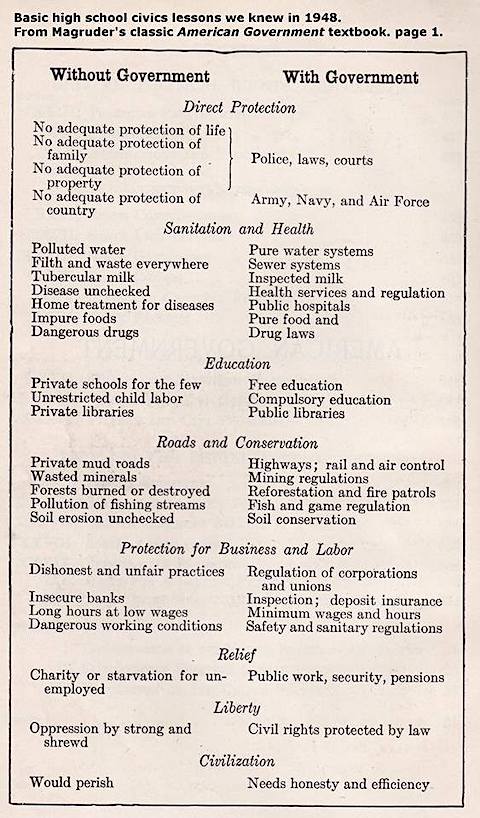
Maybe obedience, keeping your head down, ruthlessly competing dog-eat-dog with everyone else, letting the end justify the means, keeping your mouth shut, putting ‘success’ ahead of principle, and turning a blind eye to malfeasance that is ‘none of your business anyway’, is the best ‘strategy’ for being a citizen in today’s untrusting, viciously competitive, corporatized world. If you think it is, you probably got your worldview conditioning from your workplace, not your civics textbook.
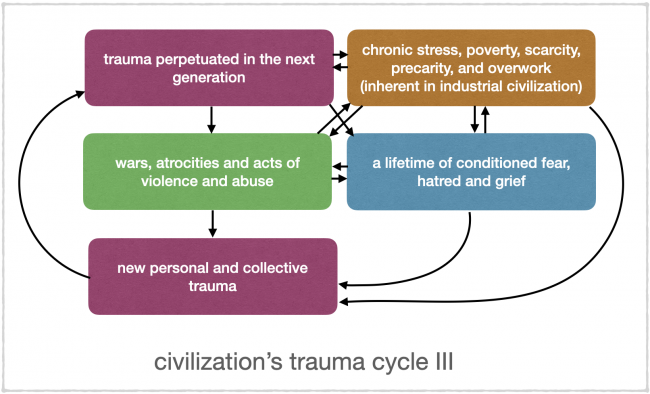
PS: Just to be clear, I am not slamming, or blaming, people anywhere in the work hierarchy: This is the way they have been raised, and this is what they have been conditioned to believe and to do. I have met many business executives who are really decent, caring people, but who in most cases nevertheless have come to accept and even espouse most of the above beliefs, and behave accordingly, on the basis that this is how businesses must operate if they hope to stay in business, and this is how “most folks” are and how they need to be treated for the business to be successful. We’re all doing our best, even the sociopaths, who often, in my experience, carry the burden of trauma from bullying and belittling parents and act it out in dysfunctional ways when they’re plunked, or driven, into positions of power.
The really sad thing about most of the “business books” you find in the airport bookstores, is that they were written by (or ghost-written for) ‘leaders’ who genuinely believe(d) all the bullshit about ‘leadership’ they (and their sycophantic followers) were conditioned to believe and write about in their narcissistic books. I’ve met a few of them; nice, troubled, bewildered folks. In some ways they’re the most clueless of all.