Dave Pollard's environmental philosophy, creative works, business papers and essays.
In search of a better way to live and make a living, and a better understanding of how the world really works.


October 31, 2009

Links and Tweets of the Week: October 31, 2009 (Scary Hallowe’en Edition)

Filed under: Preparing for Civilization's End — Dave Pollard @ 16:38


debt to GDP

PREPARING FOR CIVILIZATION’S COLLAPSE

Here Comes the End of Debt: Stoneleigh from Automatic Earth, in an interview with The Oil Drum Europe, argues that we’re in for an unprecedented and prolonged deflationary period, and that while wages will plunge, so will prices of everything, even oil and gold as demand falls faster than supply:

Credit bubbles [see chart above] are inherently self-limiting, proceeding until the debt they generate can no longer be supported. We have already passed that point and we are now two years into a contraction phase that is about to accelerate. As the aftermath of a credit bubble is typically proportional to the scale of the excesses that preceded it, we should be in for the largest economic contraction for at least several hundred years, and it will be global. Real estate, which is a major focus of the mania, should do particularly badly in the coming years (in fact the coming decades or longer)…

As demand falls, and with it prices, investment in the energy sector is likely to dry up. Many projects will be uneconomic at much lower prices, meaning that the projects which might have cushioned the downslope of Hubbert’s curve (and the much steeper net energy curve), are unlikely to be developed. In this way a demand collapse sets the stage for a supply collapse that could place a hard ceiling on any prospect of economic recovery. That is a recipe for extremely high energy prices in the future…

The scale of the problem has been temporarily concealed by a market rally and the shovelling of tens of trillions of dollars of taxpayer’s money into a giant black hole of credit destruction. This has done nothing to reignite lending, but the temporary (and entirely irrational) resurgence of confidence has restored a measure of liquidity. As that confidence evaporates with the end of the rally, that liquidity will also disappear.

Deflation is ultimately psychological. Without trust we will see hoarding of the cash which will be very scarce in the absence of the credit that currently comprises the vast majority of the effective money supply. The combination of scarce cash and a very low velocity of money will be toxic.

Money is the lubricant in the economic engine and without enough of it that engine will seize up as it did in the 1930s, when farmers dumped milk they couldn’t sell into ditches while others were starving for want of the money to buy food. There was plenty of everything except money, and without money, one cannot connect buyers and sellers…

Big Oil Says Reducing Carbon is Impossible: Some interesting quotes from oil industry executives suggest they know, better than the average citizen, and more than the politicians are saying, that the only way to reduce carbon to levels that will prevent catastrophic climate change is to end industrial civilization. Thanks to Keith Farnish for the link. Here are quotes from various oil execs:

The Copenhagen targets are basically completely illusory. There’s no way to hit those targets and it would be very silly to think that we can…

The world does not have the scale, time frame or economics to devote to the complete eradication of carbon emissions from sources of fuel within the next four decades…

Nuclear doesn’t have the flexibility to be a suitable option…

Globally [renewables] will be too small to make a real dent in the targets…

Just wait for one catastrophe and that will be the end of nuclear. And who really thinks biofuels will really work in the long run? You can’t have food as an energy source.

climate interactive scorecard

Mind the Gap: Climate Interactive Scoreboard graphically depicts (see above) the gap between what governments have pledged to do to combat climate change and what is needed. What is really needed (a reduction to 350ppm or perhaps even 280ppm within two decades) is, well, off the chart. Mind the gap: over the next year it will become an abyss. Thanks to Tree for the link.

The Banks Have Just Stopped Making Loans: “The real economy is dying. This quarter is going to be a bloodbath” for the big banks, says yet another analyst. Thank to Sam Rose for the link.

And in China, Apocalyptic Growth: An extraordinary award-winning photo-essay on pollution in China shows a nation plunging into toxic apocalpyse. And this is the world’s largest and fastest-growing economy, on which the global industrial growth economy now depends for cheap labour, cheap materials (no standards), and new ‘customers’. Thanks to Craig De Ruisseau for the link.

LIVING BETTER

Psst! Wanna Get Something Made?: 100k Garages will find and connect you with a job shop that will make anything you can imagine. And the Global Village Construction Set will help you design and fabricate anything that your community-based permaculture or transition project needs. Thanks to Michael Wiik for the links.

CarrotMob Green Businesses: A great international initiative organizes local progressives to “mob” green, responsible businesses with new customers. Thanks to Tree for the link and the three that follow.

“Agriburbia” Converts Lawns and Hinterlands into Gardens and Farms: A growing trend to make suburbs a little less dependent on imported food.

Japan Pioneers Peer-to-Peer Car Rentals: A step beyond commuter car-sharing, this online reservation system allows people to rent their cars to others at times they don’t need them, reducing the need for so many cars to be manufactured and parked.

Free Do-It-Yourself Sustainability Books: A substantial resource of free online plans for renewable energy and other sustainability projects.

A Crash Course on the Coming Crash: A 3-hour crash course in economics covers the essentials of the pending economic (debt), ecological (climate change) and energy (peak oil) crises. Thanks to Mireille Jansma for the link.

POLITICS AND ECONOMICS AS USUAL

US Official Resigns Over Obama’s War: A foreign service leader quits in protest over the impossible war in Afghanistan, and urges Obama to bring the troops home. Thanks to Raffi Aftandelian for the link.

Civil Liberties Watch: The Civil Liberties Defense Center (boy those Americans spell funny!) fights to overturn laws that outrageously restrict personal freedoms, such as the Animal Enterprise Terrorism Act (making it illegal to protest animal cruelty), aggressive use of tasers by police, and an Oregon law that made it illegal to protest old-growth forest destruction (they just succeeded in getting that ruled unconstitutional — yay)! Thanks to Tree for the link.

FUN AND INSPIRATION

mumbai slum from theplaceswelive.com

Visit a Third World Home, Virtually: Amazing photography and journalism lets you use your cursor to see 360-degree views of homes in slums in 5 countries, and hear their residents’ stories. Thanks to Sue Braiden for the link.

Animated Credit Reform: A great new cartoon from Mark Fiore spoofs the new fees that credit card companies are rushing in before new (tepid) anti-usury rules come into effect. Thanks to Mireille Jansma for the link.

The Botany of Desire: Michael Pollan’s new book explains how plants seduce us with their sweetness, beauty and intoxication. Link is to a PBS special on the book, viewable online. Thanks to Tree for the link.

“You’ll get so much candy you’ll have to be towed.”a fun poem about Samhain, the celtic/wiccan sister festival to our Hallow’een.

Last Chance Texaco: Rickie Lee Jones sings one of her earliest, cleverest songs, about our dependence on cars, and love.

THOUGHTS OF THE WEEK

From Melissa Holbrook Pierson, bumper stickers from talk show host Chris T.:
  • Why do you love animals called pets, and eat animals called dinner?
  • Be nice to America, or we’ll bring democracy to your country.
  • (perfect one for a bicycle or car, for different reasons) This Too Shall Pass

From Lydia Davis (in last week’s New Yorker):

HEAD, HEART

Heart weeps.
Head tries to help heart.
Head tells heart how it is, again:
You will lose the ones you love. They will all go. But even the earth will go, someday.
Heart feels better, then.
But the words of head do not remain long in the ears of heart.
Heart is so new to this.
I want them back, says heart.
Head is all heart has.
Help, head. Help heart.

October 28, 2009

Maybe That’s What It Takes

Filed under: Preparing for Civilization's End — Dave Pollard @ 23:32


What You Can Do
As my retirement looms closer, I’ve been giving some more thought about exactly what I’ll be doing with my days when I retire. In my previous post Intention to Practice I summarized the nine steps that I am following (and urging others to follow, in their own way) to make the world a better place, illustrated in the graphic above.

To implement these practically into my new life, once I’ve moved, I have organized my day into three blocks of time: 10am to 1pm for reconnection practices, 2pm to 6pm for learning, facilitating action and model-creating practices, and 8pm to 12pm for reflection and writing practices. Starting with these three blocks of time, I developed the chart below that shows my long-term intentions, the long-term practices that “stretch toward” those intentions, and the short-term, daily intentions (exercises) in alignment with the longer-term ones. The long-term practices tie into the nine steps in my What You Can Do graphic above, and the colour (red, yellow, green) is from my ’scorecard’ and shows how much work I have to do on each.

Long-Term Intention Long-Term Practices Short-Term Intentions (Exercises & Projects) Hrs/day
now
Hrs/day
intended
A. Reconnecting with All Life on Earth, Instincts & Emotions Appreciation (1) 
Presence/Paying Attention (2)
Heart-Opening/Letting Go (3)
10am to 1pm: personal/group reconnection:
– Forest/ocean walks
– Presencing exercises
– Gratitude exercises
– ‘Breathing through’ meditation
0 3.0
B. Increasing Capacity & Competency
(
Personal and Collective)
Understanding How the World Works (4)
Capacity-Building (6) 
2pm-6pm: learning/exploring:
– presentation/conversation skills
– demonstration skills
– creative writing exercises
SSUQIOC exercises
– balance and empathy practices
1.0 1.0
C. Undermining and Dismantling Civilization Activism (7)  2pm-6pm: facilitating action:
– Open Space: Stopping the Tar Sands
– Open Space: Ending Factory Farms
0 1.5
D. Creating Models of a Better Way
to Live and Make a Living
Model-Building (8) 

2pm-6pm: creating:
– novel: The Only Life We Know
– film: Earth 2200: A Travelogue
– workbook: Finding Your Sweet Spot
– unschooling: personal practice guide
0.5
1.5
E. Joy, Understanding Self-Knowing (5)
Being Myself (9)
8pm-12pm:
– reflection/questioning exercises
– blogging
– play: drawing, photography, with animals (original play)
3.5
4.0
(activities not directly related to
any of my intentions — my Y-stuff)
other hours:
– self-care (sleep, exercise etc.)
– networking; serendipitous reading
– self-management (gardening etc.)
 19.0 13.0

I’m now starting to drill down into what I’m going to do, especially to move from “red” to “green” in steps 1, 2 and 7. Here are some of the exercises I’m intending to do:

Reconnecting Exercises (preferably, but not always, in company with others):

  • Listening and talking with other creatures during forest/ocean walks — paying attention to their songs and sounds, to try to understand, viscerally and intuitively, what they are saying, and ‘talking back’ to them in something like their own voice
  • Spell of the Sensuous exercises — those described in David Abram’s book, connecting time past and future back into the present
  • Sleeping in the wild
  • Acknowledging my grief for Gaia, letting my heart be broken, and showing my broken heart to the word — with others, using some of Joanna Macy’s exercises like the truth mandella (taking turns speaking of these feelings of grief, anger, fear, pain and dread), and confessing sorrows to each other, drawing on Joanna’s Six Principles:
    • This world, in which we are born, and take our being, is alive.
    • Our true nature is more ancient and encompassing than the separate self defined by habit and modern society.
    • Our experience of pain for the world springs from our interconnectedness with all beings, from which springs also our powers to act on their behalf.
    • Unblocking occurs when our pain for the world is not only validated, but experienced (i.e. it is not enough to listen to the bad news in the media).
    • When we reconnect with all-life-on-Earth, by willingly enduring our pain for it, the mind retrieves its natural clarity (or as Derrick Jensen puts it “When you listen, really listen to the land, you will know just what to do.”)
    • The experience of reconnection with all-life-on-Earth arouses desire and intention to act on its behalf. Conversely, as long as we remain disconnected, we will remain unmotivated, helpless, part of the problem.
  • Trust walks with others (taking turns blindfolded, guided by a partner, and sensing without seeing)
  • Meditation in wilderness, especially guided meditations on the theme of affirmation and gratitude
  • Intentional exercises (like this article, except done in groups)
  • Artistic expression exercises — drawing, painting, dance, composing music, sculpture — including collaborative work

Facilitating Action (organizing and enabling groups to design and take actions that will undermine the worst and most destructive facets of industrial civilization, with the goal of ultimately dismantling it):

My belief is that this work must be collaborative, creative, and self-critical. It must achieve measurable results effectively i.e. without hurting others and hence creating martyrs of the supporters of our unsustainable systems, and without getting ourselves arrested. The results it achieves have to be more than public attention, even if that achieves some change in understanding, beliefs and behaviours. My two “starter” projects are to bring an end to factory farming (at least in Canada), and to halt the Alberta Tar Sands.

We have to be more creative than chaining ourselves to tractors and “liberating” farmed animals. These are PR stunts and they don’t achieve the results we seek: less (and eventually no) factory farming, and less (and eventually no) Tar Sands operations. We cannot rely on changing people’s buying behaviour (I’ve learned what battery caged hens hellish life is, but even I still eat food with eggs from unknown sources of supply — it’s just too difficult under the current industrial agriculture system to bring about real change through consumer movements alone). We cannot rely on politicians or lawyers or changes to laws and regulations and enforcement. These are the clowns that have got us into this mess, and they are fully invested in keeping it going. We are not going to be able to embarrass corporations to behave better — ExxonMobil is at once the world’s worst polluter and the most profitable company in the history of civilization. We need to find better, more effective ways to bring these horrific practices to an end.

What we need to do, I think, is bring together a lot of creative minds, with a great breadth of knowledge, experience, and deep understanding of how the Tar Sands and factory farms currently operate. And then we have to be methodical in identifying all the vulnerabilities of these systems and how they can be exploited. To that end, I think a good place to start is with Open Space as a methodology to enable a large group of invitees to self-organize to develop understanding and action plans, coupled with Donella Meadows’ 12 Places to Intervene in a System, which can focus our attention on actions that will achieve maximum results.

So, for example, how could we deprive tar sands and factory farm operators of critical sources of supply? How could we deprive them of funds? How could we disrupt production? How could we prevent them getting their ‘product’ to market? How could we reduce their market? How could we change the purpose of the energy sector from increasing supply of non-renewable energy, to reducing global carbon output to zero through sequestration etc.? How could we change the purpose of the farming industry from producing the maximum amount of food at the lowest price, to producing a healthy diet for everyone with minimal production and zero waste? How can we enable local energy and food coops to spring up and meet the needs of their communities so they have no need at all for the products of the tar sands or factory farms?

I don’t have the answers, but between us, with effort and shared knowledge and creativity, we do. There is a better way to live. We just need to seize the opportunity and power to create it, demonstrate it, and at the same time bring down the corrupt, cruel, wasteful, toxic, unnatural, irresponsible, unsustainable operations that the lawyers and politicians and corporations and educators and media have brainwashed us into believing is the only way to live. My job is to facilitate making that happen, and also to apply what I do uniquely well (imagining possibilities, and writing) to provoke the thinking that will bring these essential changes to fruition.
That’s some of what I intend to do, anyway.

Category: What You Can Do

October 27, 2009

Bailouts for Dummies

Filed under: How the World Really Works — Dave Pollard @ 20:06


Chart of U.S. Consumer Inflation (CPI)
Chart of U.S. Unemployment
Chart of U.S.Dollar Indices

Lately I’ve been reading more about economics, in self-defence against all the corporatist-government thievery and lies going on out there.

I’m aware that most people find what is happening in our economy and financial systems unfathomable, so I thought I’d try to simplify the complex. I confess up front this is a substantial over-simplification, and I’m not a professional economist. Recent events really boil down to governments doing what they’re told to do because their self-serving advisors have made them so terrified of the consequences of not doing so, that they feel they have no alternative. It’s not so much “too big to fail” as “failure is not an option”.

Our modern economic system is founded on a false premise — that unregulated ‘free’ markets are the most efficient (free of waste) and effective (they will produce better ‘collective’ outcomes than markets that government manages or intervenes in). This has been repeatedly shown to be false, but it still governs mainstream economic, and conservative, thought. In most countries (other than the US and struggling nations) experience with the failures of the ‘free’ enterprise market system — laissez faire capitalism — has led governments to play a significant, if not dominant, role in economic regulation and decision-making. These are what are called “balanced economies”, where governments intervene to limit the excesses of self-serving private interests and to provide goods and services (like health care and education) that the majority believe should be available to all, regardless of wealth or income.

Where there is no balance, as in struggling nations where the government is weak or hopelessly corrupt, the result is a hegemony (total dominance) by a wealthy elite that effectively owns and dictates policy to politicians, regulators and judges. This near-monopoly of consolidated power is variously called corpocracy, corporatism, or fascism. Many right-wing ideologues like Mussolini believed such a hegemony was the much-sought “benign dictatorship” that would act in the collective interest more knowledgeably and efficiently than any democracy. There is a second school of right-wing libertarian ideologues, especially in the US, who believe that the ‘market’ is able to act in this fashion, and that any government intervention will necessarily worsen every situation.

The problem is that the US has never had a ‘free’ market economy. It subsidizes large corporations to the tune of hundreds of billions of dollars, and ignores international legal and ‘free’ trade rulings that go against American corporations. It uses its economic wealth and power to bully other nations into giving it easy and uncompetitive access to their resources, labour and markets at bargain prices. So the current state in the US is an “unbalanced economy” — one where a few rich corporations essentially dictate policy to governments. Any government that refuses to play ball is threatened with the withdrawal of reelection funds by these large corporations in favour of other parties and candidates. In the US it takes a huge amount of money to get elected, and dueling with the corporatists is political suicide. It is not surprising, then, that the wealthiest 1% of Americans now control more than half of the nation’s total wealth, resources and private property, and that while the top 5% of Americans have achieved staggering real increases in wealth and income over the past 40 years, real net wealth and real income for everyone else have declined.

The US economy was substantially built on war. Most of the accumulated wealth of the country was made through war and “defense” activities, a large proportion of American innovations stemmed from huge military investments, and military and defense spending still directly or indirectly provides 20-30% of US economic activity (economic production and jobs).

On top of this, our global economy is addicted to growth. Without steady, continuous, unending growth, corporations could not raise capital or borrow money, so they would collapse. The stock market requires sustained double-digit growth in profits to keep it from collapsing — current share prices have an implicit “price/earnings multiple” that assumes continuous rapid growth in profits, forever, and if you took away that profit growth, shares would be worth substantially nothing. Every stock market ‘investment’ is a gamble on perpetual growth.

This exhaustive need for growth has led to (a) globalization — opening up markets in struggling nations to fuel affluent nation revenue growth, (b) a huge supply of credit to encourage citizens to borrow more and more, and spend more and more (notably larger and more expensive houses), and throw out and replace more and more, (c) the replacement of one-income families with two-income families, so that more cars, gasoline, child care, restaurant meals and other expenditures are needed to permit these two-income families to focus most of their lives on their jobs, and (d) ridiculously and artificially low ‘official’ interest rates, to encourage reckless borrowing to be used for even more consumption.

Over the last 50 years, this system has been ratcheted up tighter and tighter, because if any of these four growth factors dries up, growth ends, the stock market collapses, housing prices collapse, corporations collapse, and the global economy plunges into depression. Bad for corporations, bad for incumbent governments — we can’t have that. To keep this whole thing going, governments began, in the Reagan years, to lie to their citizens. They ‘recalibrated’ how unemployment and inflation are calculated, so that both ‘official’ numbers were much lower than the more honest numbers that had been reported up until then. If they reported honest inflation numbers, people would panic and demand higher wages and indexing of pensions and social security benefits. If they reported honest unemployment numbers, people would riot. So, while the ‘reported’ average rate of inflation in this decade has been about 2%, the true average rate of inflation (as anyone who manages the family finances intuitively knows) has been, until recently, about 10% — a doubling of the cost of living every 7 years (see first chart above). And the true US unemployment rate is not 10%, but 21% (see 2nd chart above), and has averaged 12%, not 5%, this decade. If you’re not feeling ‘better off’ as a result of all the reported GDP growth over the last few decades, that’s why.

A couple of years ago, this whole system of ‘perpetual growth’ and deception started to come unsprung. Essentially, American citizens ran out of money, and spending capacity. They’d maxed out their credit cards, borrowed against their inflated home values to the hilt, and, thanks to real inflation, their 30-year slide in real disposable income had pushed them to the point they just couldn’t spend any more. On top of this, they were so deep in debt that they were terrifyingly vulnerable to a loss of either bread-winner’s job, or to illness, or to an increase in interest rates. Many of them were already paying usurous interest charges on ill-advised debts and sub-prime mortgages — rates as high as 30% annually, and, as the book The Two Income Trap describes, an average rate of 16%. When you can get 16% or 30% annual return on your mortgage loans, you’re prone to take a lot of risks.

The last straw was the spike in gasoline prices. So US citizens, responsible for driving 72% of all domestic GDP, suddenly stopped buying. Housing sales, especially in cities, collapsed as buyers vanished from the market. Housing prices followed suit. The whole set of dominos started to fall. Without inflated house values to borrow against, credit started to dry up. Suddenly banks realized that house prices couldn’t be depended on to rise forever, and their mortgages were suddenly higher than the value of the properties they ’secured’. People unable to pay the outrageous interest on their debts realized this too, and rather than banking on a recovery, just defaulted, and walked away from their homes. This was especially true among speculators, who weren’t living in those houses anyway — they were just buying them no-money-down (like the infomercials said) and waiting for them to go up for a quick flip.

Now you have all these financial institutions, which over the last 50 years have grown from 10% of the US GDP to over 30%, panicking. They’d bought all these junk mortgages and repackaged them to hide their risk and now people were saying they weren’t going to buy any of these ‘financial instruments’ until they were sure they weren’t contaminated with these now-worthless ’sub-prime’ loans. That included other banks, which suddenly refused to lend to each other. With no liquidity, the entire over-extended, risk-crazy banking system went into free-fall. No one could get money. Everything started to collapse.

The banks went to the government (then run by the idiot Bush) and said “You have to bail us out, we’re too big to fail. You have to give us trillions of dollars in loans and loan guarantees. You have to basically underwrite, with US taxpayer dollars, the entire US financial system — 1/3 of the whole US economy — and indemnify us all from losses on these bad loans. There is no alternative. It’s not just us on the line, it’s the whole economy, and perhaps the stability of the government.”

So the governments, Bush’s and Obama’s and all the governments of all the affluent nations of the world (because some of them had more invested proportionally in this worthless US debt than the US itself had), all ponied up trillions of dollars to guarantee or refinance all the (unknown amount of) worthless debt that the financial institutions had created. They wrote a blank cheque to the banks, with virtually no strings attached. A catastrophe was averted due to a whole series of fortunate occurrences. Because the crisis was global, the printing of trillions of US dollars with no underlying value didn’t collapse the US dollar. Ironically, because the crisis pinpointed the fragility of all the world’s banking systems and currencies, it actually drove people to buy more US dollars, since it is (for a while longer anyway) the world’s official ‘reserve’ currency — the one all others are officially gauged against. It’s the currency that the World Bank and IMF have essentially deemed ‘too big to fail’. So (as the third chart above shows), the 25-year-long steady collapse of the US dollar — due to its impossible debt levels and trade deficits even before the crisis — actually paused during the crisis. It is now resuming, as worry sets in about US debt levels that have spiked by several more trillions of dollars.

Now, the interesting thing is that, when the governments paid trillions of dollars in extortion to the banks to bail them out for their reckless lending decisions, what they did with these trillions was not use them to restore liquidity to the banking system and start lending again to banks and mortgage companies and people whose houses had lost most of their underlying value. No, that would be risky behaviour, because these houses just weren’t good collateral in the first place. The banks found it was far more profitable to evict homeowners and sell off their homes for what they could get for them, than to lend money against houses that were worth — who knows what? So instead, they plowed those trillions into something they thought less risky — the stock market that had collapsed on the heels of the housing market collapse.

When they started doing so, the S&P 500 had fallen from nearly 1600 to 680 (i.e. it had lost 60% of its value, as had the Dow Jones Index). Once they’d thrown those billions in taxpayer dollars into the stock market, they’d pushed the index back up to nearly 1100 (an increase of over 50%). And because much bank investing is leveraged, they’d made a fortune in the process. The banks were happy — and ready to hand back most of the free taxpayer bailout money they’d received. The corporations were happy — their share value was back up so they were no longer in serious financial difficulty. The government, looking at these huge paper profits, and increases in share values, could joyfully declare the recession “over” and pat themselves on the back for averting a Great Depression.

Unfortunately, it’s been one more quick fix, one more ratcheting of the fragile, creaking machinery of the industrial growth economy one click tighter. The underlying weaknesses remain unaddressed, and the wreckage is massive. Real unemployment is 21%, and it will take decades to recover from this. US housing prices remain, well, unknown. There are so many houses that have been put on and taken off the market in despair that no one really knows what any property is now worth. When there’s so much supply and no demand it’s anyone’s guess. The ability of citizens to spend their way out of this recession remains horrifically low, even if they’re stupid enough to bid prices back up again until they’re hopelessly in debt. The value of the stock market today bears no reality whatsoever to the earnings of the companies in it — it’s driven solely by excess liquidity created by the government using taxpayer dollars, which has no ’safe’ place to park, so it’s in the stock market by default (bonds, the other ’safe haven’, are earning paltry rates like 1%).

What effectively happened is that our governments printed trillions of dollars in currency that will have to be paid back by future generations (i.e. they ‘borrowed’ trillions from future taxpayers) to give to banks to prop up the stock market. That’s what the bailout was all about.

Alas, it’s even worse than that. Obama and the bankers have to find some way to push up the value of real estate, because as long as most people’s wealth is tied up in it, they’re going to be unwilling or unable to spend on anything else. They came up with a clever idea. They’re using government money, via the housing authorities and Ginnie Mae (soon to be as bankrupt as Freddy Mac and Fannie Mae), to tempt people with small amounts of cash that they can use towards down payments on new homes. Because this allows people with no money and no credit to buy houses that they can just walk away from (thanks, taxpayer!), and because of the leverage this ‘free’ money offers, its effect, according to the researchers at Automatic Earth, could be to keep the value of houses at more than twice what their ‘real’ value would be in an unsubsidized market. So what happens to house prices, borrowing capacity and the taxpayer’s guarantee money when these artificial ‘incentives’ are removed? The same thing that will happen to the stock market when all that bailout money has to be paid back to the government. Crash.

mortgage guarantors

As the chart above shows, the US federal government (i.e. the taxpayer) is now virtually the sole lender in the US housing market. In today’s analysis in Automatic Earth, there’s a prediction of how much damage is to come from this ‘mini-bailout’:

It has cost the American people trillions of dollars to prop up the market to the present day, where general price levels have fallen “only” 30%. All attempts to keep the market alive have failed miserably, at least, that is, from the point of view of ordinary Americans.

With the government support about to vanish, the future prospects for home prices and the building and mortgage industries are Halloween material, while Bank of America (which bought Countrywide) and Wells Fargo (the country’s largest mortgage lender) face increasingly shaky days. Home prices are ready to go into a freefall. When the smoke clears prices will be down 80-90% from their peak. Needless to say that will cause such a chaos it’s hard to predict what America will look like.

Now, here’s a quote from today’s CNN economic summary:

The dollar rose to a two-week high against the euro Tuesday after a report showing U.S. consumer confidence deteriorated sharply in October boosted the greenback’s safe-haven appeal. The disappointing confidence data bodes ill for U.S. growth because it indicates lower consumer spending, which accounts for 70% of the economy. Without U.S. consumers, the world economy is also unlikely to recover as swiftly as hoped.

“When the U.S. consumer is not likely to continue spending, it means it’s going to be a long, drawn-out type of recovery. Nothing is going to happen overnight,” said Dan Cook, senior market analyst at IG Markets in Chicago. “So we see that drive to risk aversion.” The Conference Board’s U.S. consumer confidence index fell to its weakest since July and well below forecasts.

The insanity continues. Investors are rushing to the ’safe haven’ of the US dollar because of bad economic news, despite the fact that that US dollar now has almost no fundamental value. The possibility of the US ever being able to repay $16 trillion in government debts, even in the mythical perpetual growth industrial ‘free’ market economy, is zero. The US dollar has value for the same reason the stock market has value — money has to go somewhere, and the other places to put it look even worse.

This is how Ponzi schemes are built — on the psychology that some idiot will always pay more than something’s worth if they can be convinced that another idiot will come along who will pay even more.

Until we run out of idiots.

So now you know, in oversimplified terms, where our precarious economy sits, and how it got there. Prices are going to go down, a lot, as sure as gravity, and in an economy that is addicted to growth, and whose existence depends on perpetually increasing prices, and debts, and spending, and profits, that will be catastrophic. How soon that will happen, no one can say. It probably depends on when we run out of idiots. Because it’s going to be ugly, I hope it happens gradually. For the sake of our children and grandchildren, the victims of this theft, who will suffer its consequences for decades, I hope it starts soon.

(If you want to keep up to date on where all this is going, and learn more, The Automatic Earth is worth reading regularly).

October 25, 2009

Dave Talks With Themselves

Filed under: Creative Works — Dave Pollard @ 19:45


chemistry of love 2

Pssst! Hey, you! Mind Figment Processor That Believes Itself To Be ‘Dave’ (M-BID)!* It’s us, the Complicity of Dave’s Organs (CODO). You know, the ‘real’ Dave you have deluded yourself into believing ’you’ somehow embody.

Why are you sitting around making our fingers write blog articles when you should be contacting that woman ‘Kira’ who you met at that party a couple of weeks ago? We’re not getting any younger you know. The chemistry was wonderful — pheromones sparking, pupils dilating, facial flushes, sweat glands pulsing — no question that the Complicity of Kira’s Organs (COKO) and us were vibrating at the same universal frequency.

Don’t be put off by the fact the Mind Figment Processor That Believes Itself To Be ‘Kira’ (M-BIK) hasn’t replied to your last e-mail. M-BIK is kinda slow like you; it hasn’t really figured out that what it should be doing is merging CODO and COKO repeatedly and addictively in order to replicate our DNA.

What is holding you back? You know you want to. We’ve been pumping out testosterone, phenylethylamine, dopamine and norepinephrine ever since we met them. You think COKO are aesthetically beautiful, and you are somewhat infatuated with M-BIK intellectually (OK, OK, we know you have some doubts about some of the ideas that it has espoused, but give it a break, it’s still young).

So adding that to the erotic and emotional connection, which we’re looking after, we’ve got a royal flush here. And don’t doubt for a second that it’s reciprocal. You saw the way they looked at us. And M-BIK’s initial messages to you were gushing, if a bit slow in coming. Yeah, we know, we’re impatient — if we had our way we’d have just got down on the floor and started as soon as we and they met. And we’d now be one, completely addicted (oh, OK, call it what you want then, ‘in love’), merged, and mingling bodily fluids several times a day like jackrabbits (those COJOs have it so easy)!

So what’s up, M-BID? Why aren’t you calling M-BIK?

[M-BID replies] Well, for a start, CODO, we’re too old for them. They should be ‘merging bodily fluids’ with those their own age. You may not be able to appreciate how offensive the idea of COOs of very different ages falling in love and/or having sex is, but we M-BO’s have a thing about that.

And before I get started, I’d like to understand why, to communicate with you or talk about any person, I am forced to use the plural. If you’re indeed a complicity, that’s singular. Talking about yourself (I’m sorry, yourselves) in the plural is just pretentious. And what’s with this “Believes Itself To Be Dave” crap? What makes your claim to be ‘me’ (sorry, us) any more rational than mine? Just because Stewart and Cohen say so?

But the real reason I’m not calling M-BIK is that I’m not sure what our relationship will turn out to be, if we have any relationship at all. It may not be love. It may not even be friendship. I just don’t know her (sorry, it) well enough to know yet. Social relationships, unlike chemical attraction, are complex, subtle. They take time, they need to be sussed out, explored, given space. It takes years to even think you know some-body, and your intellectual, aesthetic, sensual and emotional connectedness can change over time.

[CODO responds] Hmmm… well, the reason we speak of people as plural is because we are. We could do an organ-count if you like. The brain that you muddle-headedly believe ‘you’ reside in is just one of us, and a slow-witted (thank gaia for instincts!) and unsophisticated (compared to our digestive system the brain is a dope) one at that. We are. You just think you are.

As for whether we’re too old to merge bodily fluids with COKO, get us close and we’ll see. We’ve had a few million years to learn how to get past your ‘things’. We know, and so do COKO. You just think you know. It’s possible the social conditioning that you and M-BIK have been subjected to will prevail when we get together. But we wouldn’t bet on it.

And we have no qualms about letting you have time and space to discover whether you and M-BIK can develop the kind of intellectual, aesthetic, sensual and emotional connectedness that you call ‘love’, and if so whether it will endure. We just want to mix our DNA with COKOs’ now, and, if we get the chance to do that enough times, we’ll generate enough oxytocin and endorphins in our bodies to keep us all together long enough to give that connectedness a real chance. And if it turns out the connectedness you think you need isn’t there, or won’t last, well, we’ll all have had a lot of delicious, intoxicating fun in the meantime.

So what do you say? Stop telling our fingers to type more of this conversation, and start telling them to type out COKO’s e-mail address or phone number. What do you th…

——–

* For those who haven’t read Stewart and Cohen’s Figments of Reality, here’s its thesis, which is essential to understanding (and hopefully appreciating) this story:

Living species, including humans, are emergent properties of the body’s semi-autonomous processes — We are a complicity of the separately-evolved creatures in our bodies organized for their mutual benefit (i.e. we are an ‘organism’). And our brains, our intelligence, awareness, consciousness and free-will, are nothing more than an evolved, shared, feature-detection system jointly developed to advise these creatures’ actions for their mutual benefit. Our brains, and our minds (the processes that our neurons, senses and motility organs carry out collectively) are their information-processing system, not ‘ours’. 


   So this story is about Dave’s body — the complicity of Dave’s organs (CODO),  speaking to his mind — Mind Figment Processor That Believes Itself To Be ‘Dave’ (M-BID).

——-

Category: Satire

October 24, 2009

Links and Tweets of the Week: October 24, 2009

Filed under: Preparing for Civilization's End — Dave Pollard @ 22:35


sietch blog alternative 350


PREPARING FOR CIVILIZATION’S COLLAPSE

Why Demonstrations Aren’t (Nearly) Enough: Keith Farnish, who made the ‘alternative’ 350ppm logo above, argues that if we really think that participating in a 350.org event is going to achieve anything, we’re delusional. “If an international grassroots movement holds our leaders accountable to the latest climate science, we can start the global transformation we so desperately need,” trumpets 350.org. Keith’s reply: “If you are planning to go to a 350.org event, then please go, but don’t go expecting the group’s aims to change anything: go with a view to helping people understand that only by rejecting the system that the group’s organisers are still pandering to, can the atmospheric carbon levels go below 350 parts per million. Either that, or the Earth will reject humanity.” Exactly.

Our Economic System is Now a ‘Corpse’: Ilargi points us to my friend Joe Bageant’s brilliant rant about the Democrats’ betrayal of working Americans:

The solutions we aren’t allowed to discuss: adoption of a Wall Street securities speculation tax; repeal of the Taft-Hartley anti-union laws; ending corporate personhood; cutting the bloated vampire bleeding the economy, the military budget; full single payer health care insurance, not some “public option” that is neither fish nor fowl; taxation instead of credits for carbon pollution; reversal of inflammatory U.S. policy in the Middle East (as in, get the hell out, begin kicking the oil addiction and quit backing the spoiled murderous brat that is Israel).

Our economic, financial, capital, and credit system is done and gone. What you’re looking at today is a corpse propped-up by the promise of future tax revenues from millions upon rapidly increasing millions of homeless and jobless Americans. Unfortunately, that’s just the beginning. Because the financial system has been allowed to infiltrate the political system to the degree in which it has (a full-scale take-over), America’s political system is as bankrupt as its financial system is. It will take a long and hard time to replace.

Hacking Industrial Civilization: There are three ways to make the world a better place: (1) Creating new working models of a better way to live and make a living (so we can opt out of industrial civilization’s models); (2) Increasing our capacities and competencies (so we’re less dependent on industrial civilization and more aware of its dangers); and (3) Acting to undermine and ultimately dismantle industrial civilization (without hurting anyone or getting arrested). We have to do all three, but for many, the third one is the hardest and scariest, and the one we least feel comfortable knowing what to do. The Yes Men show us the way with their brilliant punking of the shameful US Chamber of Commerce, Dow Chemical and others. In the same vein, Keith Farnish suggests 100 ways to hack industrial civilization (my favourite: print up stickers that say “energy waster”, “made in sweatshops” etc. and stick them on appropriate products in stores — I’m also going to make stickers that say “harmful to your health”, “environmental hazard”, “not locally made”. and “there are green alternatives to this product”).

LIVING BETTER

What If You’d Been Born Someone Else?: A new educational tool lets you virtually ‘live’ the life of someone in Pakistan, or Uganda, or Rio, one year at a time, with life events based on the historical likelihood of that happening in real life. Thanks to Sue Braiden for the link.

The Digital Evolution of the Book: Utne describes some innovations in online reading and e-publishing that go far beyond transferring content to a new flat medium. The article mentions CellStories, daily fiction you can read while you sip your morning coffee (and which will probably inform you better than the daily paper). I’ve always thought digital media would help us to read in more natural ways (the way we see, not the way books are commercially required to be laid out). Thanks to Paul Heft for the link.

A Depression Diary: If we can’t learn the lessons of history from textbooks, perhaps we can learn from stories. A new unedited diary of a man struggling through the Great Depression tells us a lot that the economics textbooks leave out. Thanks to Paul Kedrosky for the link.

POLITICS AND ECONOMICS AS USUAL

The Eco-Holocaust of the Alberta Tar Sands: A terrifying series of three short videos explains how, and at what cost, oil is extracted from the tar sands. (Sorry, I’ve forgotten who sent me the link to this — if it was you, please remind me!)

FUN AND INSPIRATION

David Vaine sends up Knowledge Management, brilliantly. Thanks to Nancy White for the link.

The amazing Chris Pureka singing Burning Bridges. Modern torch song with brilliant lyrics. “You can’t choose who you love.”

Another heartbreaker by Sarah Bettens (K’s Choice), 20,000 Seconds.

THOUGHTS OF THE WEEK

under the highway by dave bonta
photo ‘Under the Highway’ by Dave Bonta. thump-thump.

From the late Kurt Vonnegut:

Many people need desperately to receive this message: ‘I feel and think much as you do, care about many of the things you care about, although most people do not care about them. You are not alone.’

October 21, 2009

Nobody Knows Anything

Filed under: Preparing for Civilization's End — Dave Pollard @ 23:58


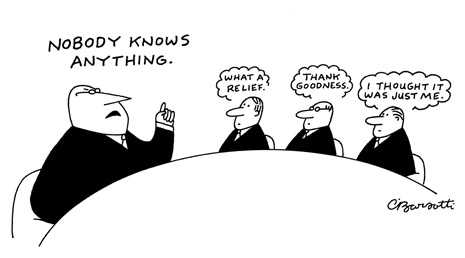
barsotti nobody knows anything
It’s been forty years since I graduated from high school, and I’ve spent most of that forty years in the business world. Now I’m about to retire and I’m thinking back on what I’ve learned that will be useful as I begin my nine intentional practices that I hope will really make a difference in the world.

I think the most important thing I’ve learned is captured in Charles Barsotti’s cartoon above: Nobody knows anything.

Because of our horrific overpopulation and exhaustion of our planet and its resources, we have entered into a period of chronic, massive, global stress, and it’s made us all crazy, like rats in a lab fighting over the last few scraps of food. We’ve stopped listening to ourselves and started looking for saviours — ‘leaders’ and ‘experts’ to show us and tell us what to do.

The so-called ‘leaders’ and ‘experts’ I’ve met are mostly very intelligent people, but they haven’t a clue. They’re buoyed by their own press and by sycophants fighting their way up from the bottom or desperate to believe that someone is in charge, in control, and knows what needs to be done. These ‘leaders’ hang out with other people just like themselves, and their groupthink persuades them that they’re right, they’re important, that what they say and do and decide really matters.

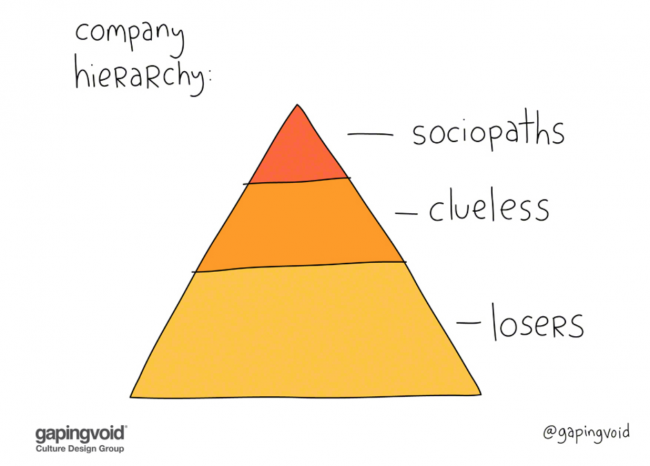
gaping void hierarchy

But it’s all fraud, papered with self-delusion, self-aggrandization and hubris. What gets done in large organizations (corporations, non-profits, governments) is the sum of what everyone in those organizations does. The people at the top generally have no more real impact, and no more useful knowledge with which to make decisions, than the people at the bottom. The ‘leaders’ are responsible neither for the organization’s successes, nor its failures — a few people just don’t make that much difference, except when they make some hugely expensive, incompetent decision or rip the company off so it goes bankrupt.

Almost all mergers and acquisitions actually destroy value — their only real purpose is to eliminate competition. The “competitive advantage” and “economies of scale” that big organizations lay claim to are a fiction. Their success is really mostly due to massive, incessant propaganda aimed at dumbed-down customers, subsidies, discounts and favours bought with political donations, the crushing of competition and innovation through legal intimidation and offshoring, cornering and squandering precious natural resources and treating the natural environment as a free dumping ground.

Economists, financial ‘experts’, psychologists, consultants, pundits, celebrities, policy wonks, advisors, barons of industry, doctors — none of these people really know what they’re doing. They want you to believe they know what they’re doing, so that they can justify what they’re taking out of the system in salaries, bonuses, perks, commissions and fees. But they’re making it up as they go along. They have come to expect bailouts when they fail financially, and indemnity from prosecution when they screw up, or get caught breaking the law. And they get away with it.

It’s all veneer. Beneath each $2000 suit, behind all the swagger, from the boardroom to the office of the commander in chief, there’s an insecure, terrified little boy pretending to be in charge, faking it, and easily swept away by the first pretty young adoring intern who will go down on her knees before him.

We would be much better off looking to the crowds for wisdom. The collective knowledge of employees, customers, community members, while far from perfect knowledge for decision-making, would at least be better than the staggering ignorance of megalomanic ‘leaders’ making decisions in their echo chambers and information vacuums.

No one is in control. Obama isn’t getting anything done, despite being the most powerful person on the planet, because he can’t. The ‘leaders’ aren’t going to deal with climate change or peak oil or pandemic disease or unsustainable debts, because no one has the power or authority to do anything, and because it would be political suicide to admit that the only solutions that might work will be radical, painful, and require a lot of sacrifice from everyone. So all you get is posturing, and it’s just going to get worse.

This is what unsustainable means.

We have destroyed this planet for future generations and for all-life-on-Earth, and the worst culprits are still doing it, while we sit around stupidly watching them, wondering what to do, waiting for someone, anyone, to save us from us.

We need to stop listening to these know-nothing, cowardly ‘leaders’. We need to stop paying them. We need to stop working for them. We need to stop investing in them. We need to stop trusting them, and stop believing the nonsense they are telling us. We need to stop voting for them, and paying taxes to finance their backroom deals. We need to stop buying overpriced crap from their fat, mismanaged organizations. We need to send some of them to jail for criminal fraud and the rest out to pasture, and take back our society, our economy, our Earth from these thieves, these self-deluded con men. No more leaders.

We could start, one community at a time, to know, again, what it means to live responsibly, meaningfully, modestly, sufficiently, sustainably.

But we will not. We have become disconnected from all-life-on-Earth, and forgotten the simple knowledge of how to live as part of it. And we’re too busy to think about what that means for our grim future, as the dark and gathering sameness of the world rolls over us, like an impenetrable fog.

October 19, 2009

World Made By Hand

Filed under: Preparing for Civilization's End — Dave Pollard @ 23:57


world made by hand

Since I’m working on a novel and/or screenplay called The Only Life We Know, set in 2200, long after industrial civilization’s collapse, I’m busy researching other utopian/dystopian novels about the future. James Kunstler’s book World Made By Hand was an obvious choice, since Kunstler is an experienced novelist and one of the most informed and articulate speakers on civilization’s impending collapse.

I’m going to damn the book with faint praise. I think Kunstler has the facts right about how the availability of resources will disappear, and hence the things we will have to relearn and do without. He also joyfully describes how we will rediscover our ability to connect in community (because we will have no other choice), and how to entertain ourselves. It’s important that we come to grips with this terrible reality, and, as a companion to Kunstler’s masterful analysis The Long Emergency, his novel helps us imagine this, and is therefore well worth reading.

What concerns me about the book is that it envisions a future for the American West that is far, far too similar to the American West of the early days of the European invasion. As such it reads a bit like a quirky American Western. From my reading of history and culture, I think it more likely that the future will be astonishingly unlike the past millennium, and will represent a cultural discontinuity consistent with the economic and social discontinuity that the Long Emergency is going to usher in. In his novel A Scientific Romance, set in 2500, Ronald Wright (another writer of both fiction and non-fiction who is pessimistic about the future, as he explained in his masterful analysis A Short History of Progress) reached back to medieval British times, and envisioned a world of guilds and small, highly diverse and scattered, disconnected community-societies.

Having spent some time studying scenario planning, I would guess that our post-civilization future will be wildly different than either the American Wild West or Medieval Britain. That’s what I hope to convey in my book and/or movie. As the protagonist of A Scientific Romance explains in thinking about what has happened to the world he knew, “no culture is normal or inevitable”. What emerged after the collapse of dinosaurs in the last great extinction were birds — reptiles taken to the air. We have no reason to believe life in the world after the next great extinction will be any less astonishing. Just imagine.

Invitation to KMWorld 2009

Filed under: Working Smarter — Dave Pollard @ 23:16


KMWorld2009

I’m not sure whether, since I’m retiring soon, I’ll be invited to present at Knowledge Management conferences from now on. So if you’re able to make it to KMWorld 2009 in San Jose November 16-19 this year, I’d love to see you. I’m running a half-day workshop, Introducing Web 2.0 to Your Organization: A Practical Guide, on Monday, November 16. Then on Tuesday November 17 I’m doing a presentation on Risk Management: A KM Approach, as well as serving on a panel later in the day. The links above are to my Slideshare presentation decks for the workshop and presentation, which you can download if you want to assess whether they’re worth attending. Always the best part of these conferences is the networking between the sessions, though. More on the conference here. Full brochure here.

October 17, 2009

Links and Tweets of the Week: October 17, 2009

Filed under: Our Culture / Ourselves — Dave Pollard @ 23:43


peak oil timeline

economist forecasts

PREPARING FOR CIVILIZATION’S COLLAPSE

The Cascading Crises of Civilizational Collapse: An excellent, fact-packed, carefully-argued explanation of peak oil and how it will, in combination with other crises of this century, bring about civilization’s collapse, by Andre Angelantoni, is available in a free series of videos (images above are excerpts from these) and a free online book. Thanks to Tree for the link.

Why You Shouldn’t Get the Swine Flu Vaccine: No, I’m not a conspiracy theorist. And I recognize that swine flu could quickly become virulent and you have to make up your own mind about the relative risks. But consider these facts:

  • Most (not all, yet) of the swine flu vaccines use an olive oil extract called squalene injected into your blood stream to provoke a violent reaction called a cytokine storm in the body, as the body rushes to reject this (to your blood stream) foreign substance. This cytokine storm reaction is precisely what kills so many very healthy people (those with the strongest immune systems), and those with hyperactive immune systems, in pandemics. 
  • If you have or might be vulnerable to any of the sixty autoimmune (immune system hyperactivity) diseases (and incidence of these diseases is skyrocketing), or allergies, or if your immune system is compromised, or if you’re a woman who is or might be pregnant, the last thing your body needs is a shock that will severely stress your autoimmune system.
  • Use of squalene and other ‘adjuvants’ is only permitted (in some jurisdictions like US and Canada) in the case of a “declared medical emergency”, since these additives have not been approved for use on humans because of their frequent, chronic, crippling effects on test animals. Pharma companies are pressuring health agencies to qualify the current H1N1 pandemic as a “declared medical emergency” so they can sell these staggeringly profitable vaccines, with untested adjuvants, all paid for by the taxpayer.
  • This is all about money: The pharma companies can use much less vaccine per injection when they supercharge the vaccine with squalene. The pharma companies are saying, of course, that if squalene is not permitted, they will not be able to create enough vaccine to go around. But this is really about profit margin.
  • Incidentally, the guy who first pushed (unsuccessfully) to allow squalene to be used in vaccines in the US was Dr. Bruce Ivins, the guy charged (after his “suicide”) with the anthrax envelope killings. Ivins allegedly wanted US soldiers in Iraq to be used as guinea pigs for squalene-charged anthrax vaccine, and was furious when they wouldn’t allow it because of the horrific side-effects on test animals. That’s purportedly why he mailed the anthrax — he wanted to increase the urgency of bringing squalene into the vaccine process by creating a public panic. Ironically, the swine flu pandemic has done the job for him, and now we are getting squalene. Like thalidomide, which was also inadequately tested before being rushed to market, we probably won’t know if it’s dangerous to humans until years from now. 
  • Big Pharma opposes the introduction of the Precautionary Principle, which would preclude the use of untested adjuvants. Because it is being ordered “knowingly” by public health agencies, the pharma companies in most countries are indemnified from litigation for any deaths, permanent injuries and diseases caused by their vaccines

Earth’s Life Support Systems Failing: New research shows that freshwater ecosystems world-wide are in free-fall, with whole river systems drying up and biodiversity plummeting.

LIVING BETTER

An Economic Nobel for Nuance and Complexity: Andrew Leonard describes the contribution of the first woman Economics Nobel prize winner, Elinor Ostrom, and co-winner Oliver Williamson. Their award is for moving past the simplistic economics of the past, and understanding that markets are complex systems, unpredictable, not subject to cause-and-effect analysis, inherently irrational, and impossible to control. And in a related story, Joseph Mandelbrot, the renowned inventor of fractal geometry, explains why the “efficient markets hypothesis”, which laissez-faire capitalists and corporatists still cite to support their opposition to government intervention in the economy, is absurd, simplistic and unsupported by empirical data. Thanks to Valdis Krebs for the link.

Power to the Patients: Clay Christensen says patients need to take charge of their own health, including disease prevention and diagnosis. “So far, there’s no general patient lobby that receives the same attention, or possesses the same financial resources, as the American Medical Association and American Hospital Association. But surely if more patients realized how much influence they could have in their own care, they would discard their roles as passive health care consumers, and would instead become its agents of change.”

POLITICS & ECONOMICS AS USUAL

Big Coal Sics Frightened Miners on Environmentalists: At issue is the decision of the US Army Corps of Engineers, subject to public hearings, to end the blanket approval for mountaintop coal removal and the dumping of removed earth into local freshwater, the so-called Nationwide Permit #21. Big Coal, fearful that their right to massively pollute Appalachia for profit is threatened, has told its mining employees that if “environmentalists” prevail at these public hearings, their jobs are threatened. So the hearings are scenes of angry confrontation between two groups, orchestrated (in the model of the “tea parties”) by Big Coal. If you’re in an area affected by this, please study the talking points and try to bring reason to these hearings. Thanks to Sarah Vekasi (via Tree) for the link.

The Government’s Owners: Glenn Greenwald explains how the financial services industry has taken over the government, and is making decisions for its own benefit, to the detriment of the American people. And there is nothing anyone can do to stop it.

Canadian Poultry Agency Makes ‘Organic’ Illegal: Organic turkey farmers in Canada are caught in a bind: Organic standards require turkeys to be raised outdoors free-range, but new marketing board standards (all Canadian poultry producers must sell through marketing boards) mandate confinement operations for poultry, allegedly to reduce the risk of avian influenza (though all known vectors for avian influenza outbreaks have been through confined animals). It’s a blatant move by the giant factory farms to crush competition, but, because they have the money and power, it will probably work. Thanks to Tree for the link.

Recession Specially Hard on the Poor: Bob Herbert at the NYT explains how the inner cities and slums, always struggling at the best of times, have been devastated by the downturn, with no improvement in sight.

And It’s Been Going On For Centuries: Keith Farnish points us to a video about the Levellers and Diggers, 17th-century opponents of corporatism who were brutally suppressed.

And One Unusual Political Item: Elizabeth Warren, author of the wonderful book The Two Income Trap, is now a fox in the bankers’ chicken coop: “Warren is applying that people-first philosophy by simultaneously running the Congressional Oversight Panel, which monitors the $700 billion TARP bailout program on behalf of the taxpayers, and pushing for a new agency to protect consumers from predatory lenders. Now, as Congress seriously considers her proposal (and lobbyists maneuver to kill it), the question is: Can a middle-class populist in Ivy League garb change the world — or at least Big Finance?

FOR FUN AND INSPIRATION

Garrison Keillor Admits He Was Wrong: Keillor’s confession to wanting to deprive Republicans of health care is rolling-on-the-floor funny.

“Yes Men” Impersonate Dow Chemical Spokesperson: BBC falls for it, and $3 billion disappears from the stock’s market value until the hoax is revealed.

“Mac vs PC” Moves to Second Life: Draxtor Despres animates Bill Gates to tell us why PCs are better than Macs. Thanks to Cheryl for the link.

THOUGHTS FOR THE WEEK

From Melissa Holbrook Pierson:

By this point in life, we are wheeling our broken and patched pasts around like filth-encrusted old shopping carts that have had too many hard meetings with parking lot curbs. Ba-ba-dump. Ba-ba-dump. On and on we go, the off-kilter wheel beginning to seem normal, the way it always was. Though once it spun free, chromed… I am going to spend some time figuring out, out loud, what it means to be here like this, at this particular time, with these particular people I’ve suddenly found myself in the midst of. Their extreme need to ride, if not mine…

I find I know less and less, like I am growing backwards with the years, into a fresh young creature, a baby ignorant as bliss.

From Roger Harrison, former consultant (via Jon Husband):

I learned [from Joanna Macy] not so much to release the sorrow as to embrace it as a necessary companion on my journey, an aspect of being awake. I find now that I am moved again to find ways of contributing to the lives of people in business organizations, but, consistent with my having achieved some degree of detachment, my aims and expectations have changed.

I seek [now] to provide opportunities for people to engage in dialogue about what is happening in the world and in their organizations, to find the courage to speak their truth, and to support one another in finding what has heart and meaning for each one. Although my own path leads me to deepen my connections with the natural world and to work co-creatively with nature in search of truth and healing, I feel this can only be entered into when one is attracted to it. I have no expectations of changing the people with whom I work, nor of changing their organizations.

Both will be changed by the force of events, in ways we can only guess at. My own hope is to support the learning and healing of those with whom I work, as they enter the great turning which I believe lies ahead.

From Arundhati Roy (thanks to Sheri Herndon for the link). I wonder whether Ms. Roy foresees a future with or without humans?:

Another world is not only possible, she is on her way. On a quiet day, if you listen carefully, you can hear her breathing.

From John Graham:

Most momentous of centuries, what does it mean, that I’m alive, here, in this?

October 15, 2009

Sustainable Work, Sustainable Life

Filed under: Working Smarter — Dave Pollard @ 23:33


ftss circles
Earlier this month I wrote about the possibility of developing a Finding Your Sweet Spot Workbook to accompany my book Finding the Sweet Spot. I proposed a schema of nine types of what might be called Natural Work, that might help people hone in on their Gifts (what they’re uniquely good at doing) and their Passions (what they love doing):
  1. Explorers, whose work is study and research, and whose work-product is discovery and insight
  2. Interpreters, whose work is mentoring and facilitation, and whose work-product is understanding
  3. Inventors, whose work is imagining, and whose work-product is ideas
  4. Designers, whose work is crafting, and whose work-product is models
  5. Generators, whose work is creating and building, and whose work-product is ‘goods’ and services
  6. Nurturers, whose work is cultivating, and whose work-product is well-being
  7. Menders, whose work is sustaining, and whose work-product is regeneration
  8. Actors, whose work is re-creating, and whose work-product is fun
  9. Connectors, whose work is distributing, and whose work-product is cross-pollination

I also proposed to take the various published lists of ‘green’ jobs and jobs that meet real needs of the 21st century, and classify them into these nine categories, to help people identify their Purpose (what’s needed in the world that they care about).

Quite a few readers of the book have told me that, while they love the concept of the three circles and the Sweet Spot where they intersect, they have two practical problems using the model. First, they say that the exercises in the book to help them find their Gifts, Passions and Purpose don’t ‘work’ for them — they’re too conceptual and require more self-knowledge and more knowledge of what the world needs than they, or the average person, can be expected to have. Second, they assert that most of what they think fits in their Sweet Spot (work that they love doing and are good at, and which meets a real need) is not ‘valued’ highly enough for them to make a decent living at it — either it’s something (art, literature, software, music, design etc.) that so many people do (or which is so easy to copy) that the market price for such work is nearly zero, or it’s something (e.g. legitimate, practical health, mental health, and geriatric health products and services, and healthy, unpolluted foods) that their desperate customers are too poor to afford.

As I thought of this, I began to realize two things that I should have noticed earlier:

  • People learn (including learning what they love doing and are good at doing) by doing things, not by thinking or reading lists of ideas or types of jobs.
  • The entire economy is shifting, fairly quickly and radically, from the unsustainable Industrial Economy to a post-industrial Natural Economy characterized by high prices for scarce materials and low prices for labour. [At a conference of financial forecasters I attended yesterday, I heard that this will be a long-term trend. That means lower prices (as in free) for non-commodities and services, and hence an increasing struggle for entrepreneurs (anyone who isn't subsidized by government handouts, payoffs and bailouts)].

Learning-by-doing is in fact how most Natural Entrepreneurs I know discovered their Sweet Spot. So, my workbook will be light on intellectual exercises (like thinking about what tasks in your life you’ve been most praised for, or most relished taking on) and heavy on real-life adventures (like going and observing and talking with the owner of a small, local business you admire, with a list of questions to talk with them about, or taking up a new hobby or volunteer role you’ve always wanted to do, or at least thought you did). My hope is that, just as my friends Paul and Grace had their aha! moment about their Sweet Spot (helping the world eat better) after they made an excursion to Tibet, encouraging people to just get out and try stuff they’ve never thought of doing, might help a lot of readers really discover their Gifts and Passions, those they might never have considered if they’d stayed inside the confines of their house and workplace.

Another thing my Workbook will offer is a way to take some of the research activities discussed later in my book, and apply them earlier in the process of discovering your Purpose. Many people, I’ve discovered, don’t see unmet needs that are staring them in the face and which offer wonderful entrepreneurial opportunities, because they don’t know how to look for them, recognize them, research them and ask the right questions to surface them. As I explain in the book, you can’t just ask people what they need, because usually they don’t know. (I described a product much like an iPod to people in 1971 as part of my university thesis work, and respondents looked at me as if I were from Mars.) Surfacing needs that you can turn into entrepreneurial opportunities is an iterative, emergent process that comes from exploring and prompting and imagining possibilities with the people who will become your customers. The same thing applies to discovering your Purpose. You’ll never discover it inside your own head, no matter how knowledgeable and imaginative you may be. So the workbook will take a much more externally-focused, conversational, research-based approach to finding your Purpose, and hence ultimately your Sweet Spot.

The issue of how our economy is shifting, quietly but tectonically, from an Industrial Growth economy that rewards wealth, size, ruthlessness and political connections, to what I am calling a Natural Economy characterized by much lower prices (except for scarce resources), generosity, reciprocality, trust, modesty, responsiveness, responsibility, sustainability and the importance of relationships, is staggeringly important, and I’m kicking myself for not recognizing the signs of its emergence earlier. Chris Anderson’s book Free demystifies the phenomenon that has delinked price from value and obsolesced hoarding of intellectual capital. The proportion of a car’s ‘dealer cost’ attributable to labour is expected to plummet from 70% to 30% within a decade. Generation Y is justifiably complaining that their wages are subsistence with little hope of improvement, and the returns for fledgling entrepreneurs, no matter how lucky or bright, don’t look much better to them.

This is a world that no longer pays fair.

Unions will wail. Overpaid executives and fat financial industry Ponzi-scheme artists, recently or soon to be laid off, will sell their sports cars and buy taxi licenses. And the poor, working long hours in multiple jobs for pathetic wages, will become even poorer. Not fair, but it’s here to stay. Five billion people vying for jobs means labour supply is so much higher than demand that your work is worth next to nothing.

What’s good about this is that much of what we want and need now will also soon cost next to nothing. Your income will keep dropping, but so will a significant proportion of your costs of living. It’s called deflation, and while it’s currently being hidden from consumers by price-gouging corporatist oligopolies who are stealing the labour savings as obscene profits and more obscene bonuses, it’s only a matter of time before wage-earners run out of money and stop buying products with outrageous markups, opening the way for new providers who will disintermediate the corporatists and offer their products and services for next to nothing. For a short while these may well be Chinese providers, but as oil and commodity and resultant transportation costs soar, the providers will ultimately be mostly your neighbours. We are headed for a relocalized, community-based Gift Economy, with low prices for most things, and low wages. Such an economy will not respond to advertising or hype. It will be based on trust, generosity and reciprocity, and those who try to exploit it will be quickly identified and ostracized. It’s already begun, as Chris’ book explains.

Just as Generation Y has blurred the distinction between work and non-work activities, they are learning that sustainable work is inseparable from a sustainable life. With that worldview, the Sweet Spot no longer identifies just the work you’re meant to do, it identifies the way you’re meant to live. So, instead of complaining that the work in their Sweet Spot (what they love to do, and are good at doing, that meets a real need in the world) doesn’t pay enough, Generation Y is beginning to look at how much they need to earn to do what is in their Sweet Spot, essentially turning my whole model on its head. Some retirees with inadequate pensions are doing the same thing. They are looking not only to find work that is sustainable, responsible and joyful, but to find a way of life that is sustainable, responsible and joyful, of which work is an indistiguishable part. This is part of what Thomas Princen calls The Logic of Sufficiency, and some of us now get it, and a lot more will soon have no choice but to follow.

My workbook then, will not just help readers discover the work that is in their Sweet Spot, but help them to determine how much they need to earn, and what they need to do in their non-work lives, to “afford” that work. It will explore, for example, the paradox that often an extra dollar of income can actually ‘cost’ (in taxes, higher clothing, transportation, child-care, late night fast-food meals, etc.) more than a dollar, and that conversely accepting a lower income can actually increase both your quality of life and your net wealth.

The workbook will be, in short, not only a more practical guide to discovering how we can discover the work we’re meant to do; it will be a guide to discovering the life we’re meant to live.

Older Posts »

Powered by WordPress