Dave Pollard's environmental philosophy, creative works, business papers and essays.
In search of a better way to live and make a living, and a better understanding of how the world really works.


October 14, 2009

Confused and Abused (oops I Mean Misused) Words

Filed under: Our Culture / Ourselves — Dave Pollard @ 00:08


punctuationSee how many of these word pairs you’ve confused in your writing. These are the subtlest (and hence easiest-to-get-wrong) word pairs from a list of several hundred on the Alpha Dictionary site.

22 of the Most Often Confused Words in English:

  • Abused vs Misused: Abuse implies improper or immoral; misuse implies inappropriate or mistaken
  • Continual vs Continuous: Continual means “repeated, with breaks in between”; continuous means without breaks
  • Convince vs Persuade: Convince someone that something is needed/true; persuade someone to do something
  • Disinterested vs Uninterested: Disinterested means unbiased; uninterested means doesn’t care
  • Each Other vs One Another: Each other for two; one another for more than two
  • Enormity vs Enormousness: Enormousness for physically very large things; enormity for metaphorically very large things
  • Exceptional vs Extraordinary: Extraordinary is outside the usual range; exceptional is not even comparable to the ordinary range
  • Extensive vs Intensive: Extensive means a large quantity; intensive a large proportion or concentration
  • Farther vs Further: Farther relates to physical distance; further to an additional amount
  • Flaunt vs Flout: Flaunt means to show off; flout to show scorn for
  • Founder vs Flounder: Founder is to run aground; flounder to move clumsily
  • Literally vs Figuratively: Literally means ‘strictly, word-for-word’ (it’s often misused as a throw-away adverb to add emphasis); figuratively means metaphorically
  • Gibe vs Jibe: Gibe means to taunt; jibe to agree
  • Hanged vs Hung: People are hanged; clothes and other items hung
  • Historic vs Historical: Historic means momentous; historical means related to history
  • Holistic vs Wholistic: Wholistic is used by NLPers and others who don’t know how to spell holistic
  • Jury-rig vs Jerry-build: Jury-rig means to improvise a temporary substitute; jerry-build is to make something poorly (sorry Jerry)
  • Mantel vs Mantle: A mantel is above the fireplace; a mantle is a cloak
  • Militate vs Mitigate: Militate means to influence for or against a change; mitigate means to lessen
  • Practical vs Practicable: Practical means easy to use; practicable means possible (often ‘impractical’ is used when ‘impracticable’ is meant)
  • Sensual vs Sensuous vs Sensory: Sensual means physically or sexually pleasurable; sensuous means appealing to the senses; sensory means pertaining to the senses
  • Tortuous vs Torturous: Tortuous means winding or convoluted; torturous pertains to torture

The true meaning of seven much-used (especially on this blog) adjectival superlatives:

  • Astronomical means of a very large magnitude
  • Enormous suggests a marked excess beyond the norm in size, amount, or degree
  • Immense refers to boundless or immeasurable size or extent
  • Huge implies greatness of size or capacity
  • Gigantic refers to size approaching that of a giant
  • Massive refers to large weight or volume
  • Tremendous suggests awe-inspiring or fearsome size (= “causing one to tremble”)
  • Vast refers to greatness of extent, size, area, or scope (not necessarily desolate)

Some other great sites for word nuts

Online Etymological Dictionary: Font of all knowledge of where words came from.
Document Readability Tests: Performs 5 tests of readability of your writing, and picks out your longest and most tortuous (hopefully not torturous) sentences.
Guide to Punctuation: Yes it’s British but it does entertain the US rules of sequencing quotes, commas and periods.

What blog readers want

Since people keep telling me that the list of what blog readers (and writers) want to see more of is impossible to link to (it’s at the bottom of my right sidebar), here it is reproduced in the main body of my blog.

Blog readers want to see more:
– original research, surveys etc.
– original, well-crafted fiction
– great finds: resources, blogs, essays, artistic works
– news not found anywhere else
– category killers: aggregators that capture the best of many blogs/feeds, so they need not be read individually
– clever, concise political opinion consistent with their own views
– benchmarks, quantitative analysis
– personal stories, experiences, lessons learned
– first-hand accounts
– live reports from events
– insight: leading-edge thinking & novel perspectives
– short educational pieces
– relevant “aha” graphics
– great photos
– useful tools and checklists
– précis, summaries, reviews and other time-savers
– fun stuff: quizzes, self-evaluations, other interactive content

Blog writers want to see more:
– constructive criticism, reaction, feedback
– ‘thank you’ comments, and why readers liked their post
– requests for future posts on specific subjects
– foundation articles: posts that writers can build on, on their own blogs
– reading lists/aggregations of material on specific, leading-edge subjects that writers can use as resource material
– wonderful examples of writing of a particular genre, that they can learn from
– comments that engender lively discussion
– guidance on how to write in the strange world of weblogs

October 13, 2009

Natural Learning

Filed under: How the World Really Works — Dave Pollard @ 17:52


critical life skills
Since the recent Unschooling conference call that Jerry Michalski put together, I’ve come to realize how much damage schooling does to us, and how essential it is for us to rediscover natural learning, if we hope to make the world a better place. I intend to create a “personal practice guide to unschooling” over the next year, and I’m starting to think what it might contain.

Because the terminology is fraught with misunderstanding, let me start with a few definitions:

  • Unschooling is taking your child, or yourself, out of the school (institutional education) system, and allowing learning to occur more naturally. 
  • Deschooling a society is the dismantling or abandonment of its school systems. The term can also be used in the sense of deschooling oneself — by becoming aware of and unlearning the institutional propaganda of how learning really occurs that we have picked up from our own years in the school system.
  • Home Schooling is an ambiguous term. It often means replicating the school system in the home, with the curriculum and indoctrination of the parents replacing that of employed teachers — really the antithesis of unschooling. But some people use the term to mean unschooling that occurs principally in the home.
  • Natural Learning is my own term for allowing learning to occur naturally, i.e. without structure, goals, timelines, grades, measures, programs, teachers, classrooms, coercion or curricula (think of how foxes learn from their mother).

Many of those whose children are unschooled appreciate that, if you really want your children to learn naturally, you need to first examine your own schooling and how it has affected your view of how learning occurs, and deschool yourself. The paradox is that most of us have no other model — we have at some point come to accept that institutionalized, formal schooling is the only way to learn. And, just as we cannot be “taught how to learn”, my attempt to develop an alternative framework for learning, to share with others trying to deschool themselves, could understandably be seen as both fruitless and ironic.

We have two things going for us: Nature is constantly showing us another, more natural way to learn; and the Internet has provided us with an astonishing amount of unstructured information that requires us to stretch our natural learning muscles to use it effectively.

I had the good fortune to have one year of unschooling during my formative years, which ruined me for subsequent schooled education but which gave me an appreciation for natural learning’s effectiveness, joyfulness and inherent superiority. I know it works. And while many shrug off this kind of learning as something only suited for people with unusual native learning ability and parents willing and able to mentor their children, I think this is defeatism. This defeatism is evidence of the learned helplessness that is inculcated in us in order to perpetuate our ghastly neoliberal education system that, in my opinion, saps children of their natural creativity and capacity for learning. It’s the same defeatism and learned helplessness that prevents most of us from making a living for ourselves in Natural Enterprises — even though we’d be happier and more productive if we did so, and the world would be much better off.

My model for deschooling yourself, my “personal practice guide” for natural learning, will be based on a combination of my own unschooling experience, my observation of how people are using the Internet to learn, and my observation and study of how wild creatures learn.

It will start with the principle that there is no ‘best’ or ‘right’ way to learn — we all learn differently. What’s more, we are constantly learning — taking in, assimilating, filtering, processing, storing and applying information — even when we’re not conscious of it.

Although there are a host of different learning styles, the work of Nancy Dixon and David Kolb suggests that learning generally involves five activities: experiencing, observation, reflection, conceptualization, and application. The richer the experience, and the more competent we are at observation, reflection, conceptualization and application, the more we will learn.

The experience of actually doing something, or at least watching someone who is competent at doing it, is obviously richer than having someone at the front of a classroom tell us about it, or reading about it in a textbook. So one way to rediscover natural learning is to get out of classrooms and away from books and screens and learn something by watching experts, by doing it ourselves, and by practice — the true meaning of apprenticeship. Alas, in our modern world many craftspeople no longer have the time, and are insufficiently accessible, to offer to demonstrate their craft for others to learn. Fortunately, just as young people are inherently curious and delighted to learn, most skilled practitioners are delighted to demonstrate what they do. All we need to do, most of the time, is ask politely and ensure that we aren’t disruptive.

So step one in the process of deschooling yourself is learn something new, not online or in a book or classroom, but through apprenticeship — experience, observe, reflect, conceptualize, apply, and practice it. And as we do that, ask questions, because that is not only critical to learning, it is critical to the craftsperson’s or practitioner’s development of the capacity to demonstrate, an absolutely critical and increasingly rare ability that is essential to natural learning. Don’t look up or design a curriculum for your learning of this new skill. Just go learn. Discover how natural and intuitive it is.

Once we have learned something this way, we can then try learning something online or through reading and research. If we really want to learn it competently, we need to identify a mentor — but not a teacher. The mentor’s role is very similar to the demonstrator’s role in apprenticeship learning — answering questions and acting as a ‘sounding board’. The mentor doesn’t tell you what to learn, or how to learn, or assess how well you’ve learned. That’s the learner’s responsibility. The mentor is responsive and the process is conversational. The mentor is selected by the learner, not assigned to him or her.

I learned this as an advisor to entrepreneurs over many years. My role was to listen, to answer questions and. occasionally, to tell interesting and useful stories, never to tell people what to do or how to do it. I’ve tried to apply the same hands-off, sounding-board approach in my work as a manager, but it was largely unappreciated — most people have been so propagandized and beaten down by the school system and the hierarchical work world that they want to be told what to do and how to do it. They don’t want the responsibility for doing so themselves. They have lost interest in learning, and then lost the capacity to learn.

This learning is (like schooling) a collaborative process, but the roles — learner, demonstrator, mentor — are very different from the roles of “teacher” and “student”. Even as we practice things we are just learning, we are already beginning to exercise all three roles. Others (including demonstrators and mentors) have much to learn from observing us demonstrating our mistakes, and the process of our becoming more competent.

So the key, I think, to natural learning lies in developing capacity in all three roles (learner, demonstrator, and mentor), allowing ourselves more (and more varied and stimulating) first-hand experiences, and becoming more competent at observing, reflecting, conceptualizing, applying and practicing what we’ve learned. In the process, we learn not only new skills and competencies, but about ourselves.

The second great challenge in rediscovering natural learning, it seems to me, is in recognizing the impediments to such learning that our modern dysfunctional society has put in the way of learning. In my earlier study I identified these ten obstacles:

  1. We don’t allow ourselves (and our society doesn’t allow us) enough time for wonder.
  2. Our workplace activities and our home routines are often repetitious and stimulus-poor.
  3. We don’t do anything together anymore.
  4. We get too much of our life experience second-hand (from books & movies, and online).
  5. We suffer from imaginative poverty — we won’t let ourselves imagine, and now we’ve largely forgotten how to imagine.
  6. Our lives are too organized and too scheduled to allow serendipitous experiences and hence serendipitous learning.
  7. In this world full of terrible knowledge and awful realities, we are becoming afraid to learn. We cannot bear too much reality, too much bad news, and we don’t want to accept the awful responsibility that knowing and learning brings with it.
  8. The current institutional schooling system impedes and discourages self-directed and undirected learning.
  9. The media have addicted themselves, and us, to facts rather than meaning.
  10. We have ‘desensitized’ ourselves — we process everything mainly with our left brain, so we no longer really see, really hear, really smell, really taste, really feel.

The workarounds to these ten obstacles are fairly self-evident, I think.

If you’re a natural learner.

October 9, 2009

Intention to Practice

Filed under: Working Smarter — Dave Pollard @ 21:18


What You Can Do 2009

A couple of years ago I posted some mid-year and year-end “intentions”, to distinguish them from “resolutions”. Intentions are not aspirations; they are things we are in the process of doing, achieving, or becoming. They are what we’re meant to do, and who we’re meant to be. We have already begun to realize them. They are, as the word’s etymology implies, what we are “stretching towards”.

I later shifted from intentions that are results-oriented (goals) to intentions that are process-oriented (practices), because I realized that all of the things that are worth doing for a lifetime are complex, and can never really be completed. There is no mastery, there is only the practice.

More recently, I described the importance of aligning our long-term intentions (what we are meant to do and be for what’s left of our lives) and our short-term intentions (what we are meant to do and be right now, today, this week). Until they are aligned, we will continue to live in this unreal space, in the knowing/doing disconnect — we know we should be doing X (we are good at it, we love doing it, and it is needed in the world), but we keep on doing Y. We do Y because it is urgent, because it is easy, because it is fun, or because we don’t think we have any choice. Things are the way they are for a reason, and until we understand what that reason is, we will not be able to change it, or adapt ourselves to it. We will keep on doing Y, and X will never get done.

If our long-term intentions are X-stuff, then when we identify short-term intentions that are also X-stuff, that are “stretching toward” the same place, we will see starkly the disconnect between it and the Y-stuff we’re actually doing. Something then has to shift. Either we stop doing (some of) the Y-stuff to make time and space for the X-stuff, or we acknowledge that we don’t actually intend to do X at all. We’re merely dreaming about it, or hoping it will happen magically. Recipe for unhappiness, self-dissatisfaction and a life wasted. If we were able to hear our future obituary, and it was all Y-stuff, would we see it as a life well-spent? And if not, what’s holding us back from doing the X-stuff? And if it’s lack of time or money holding us back, are we really intending to do X?

Example: One of my long-term intentions is to create working models of a better way to live and make a living. I’ve written a book about how to create sustainable, responsible enterprises. I’m working on a novel/screenplay that depicts what life in a sustainable world 200 years from now might look like, to help us imagine possibilities. Right now I have James Kunstler’s book World Made by Hand sitting beside me — airplane reading as I make my way to visit my father for the Thanksgiving weekend. In this, my long-term and short-term intentions are aligned.

Second example: Another of my long-term intentions is to work with others to stop the Alberta Tar Sands. I have a book, Andrew Nikiforuk’s Tar Sands sitting beside Kunstler’s, but beyond the vague idea of some kind of Open Space event, to brainstorm with others creative ways to disrupt and close down this ecological nightmare, I have no short-term intention stretching towards that longer-term one. Worse, I’m anxious about the longer-term intention: I have no passion for this kind of work (though I have great passion for helping others do it), and I know people whose lives have been devastated as a result of having been arrested, for nothing. No question this is holding me back, and that my intentions in this area, if that’s what they are, are out of alignment.

This brings me back to practices. It occurs to me that, when I retire (soon), I will be best able to align and stretch toward both my short-term and long-term intentions by allocating specific time blocks to three kinds of practices every day (though I recognize I’ll have to be flexible on the times): (a) Reconnecting practices, (b) Capacity-building, activism and model-building practices, and (c) Reflecting practices. Or, put more simply, sensing (mornings), doing (afternoons) and thinking and playing (evenings).

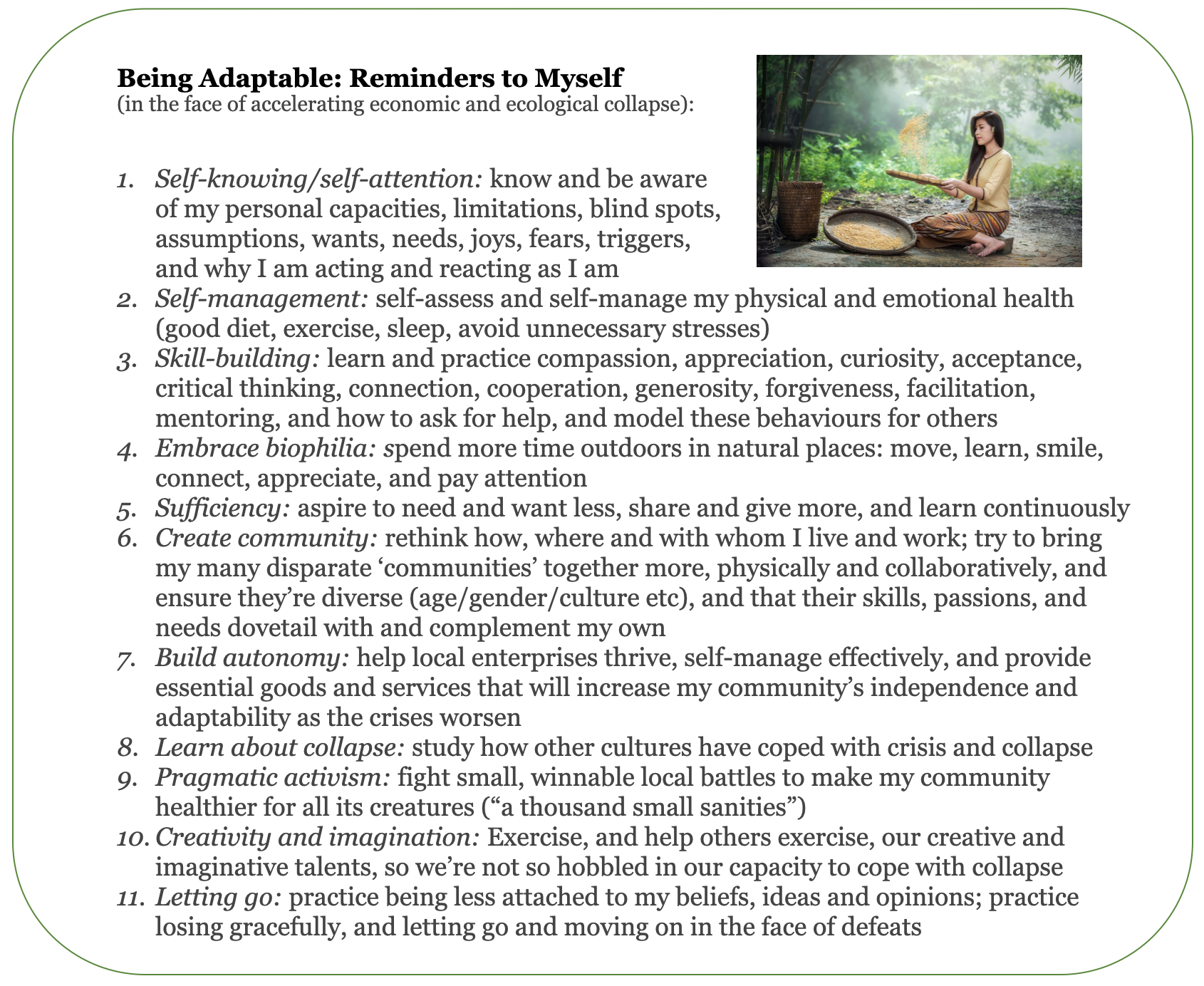
Starting with these three blocks of time, I developed the chart below that shows my long-term intentions, the long-term practices that “stretch toward” those intentions, and the short-term, daily intentions (exercises) in alignment with the longer-term ones. The long-term practices tie into the nine steps in my What You Can Do graphic above, and the colour (red, yellow, green) is from my ‘scorecard’ and shows how much work I have to do on each.

Long-Term Intention Long-Term Practices Short-Term Intentions (Exercises & Projects) Hrs/day
now
Hrs/day
intended
Reconnecting with All Life on
Earth, Instincts & Emotions
Appreciation (1) 
Presence/Paying Attention (2)
Heart-Opening/Letting Go (3)
10am to 1pm: personal/group
– Forest/ocean walks
– Presencing exercises
– Gratitude exercises
– ‘Breathing through’ meditation
0 3.0
Increasing Capacity & Competency
(
Personal and Collective)
Understanding How the World Works (4)
Capacity-Building (6) 
2pm-6pm: learning/exploring:
– presentation/conversation skills
– demonstration skills
– creative writing exercises
SSUQIOC exercises
– balance and empathy practices
1.0 1.0
Dismantling Civilization Activism (7)  2pm-6pm:
– Open Space: Stopping the Tar Sands
– Open Space: Ending Factory Farms
0 1.5
Creating Models of a Better Way
to Live and Make a Living
Model-Building (8) 

2pm-6pm:
– novel: The Only Life We Know
– film: Earth 2200: A Travelogue
– workbook: Finding Your Sweet Spot
– unschooling: personal practice guide
0.5
1.5
Joy, Understanding Self-Knowing (5)
Being Myself (9)
8pm-12pm:
– reflection/questioning exercises
– blogging
– play: drawing, photography, with animals (original play)
3.5
4.0
(activities not directly related to
any of my intentions — my Y-stuff)
other hours:
– self-care (sleep, exercise etc.)
– networking; serendipitous reading
– self-management (gardening etc.)
 19.0 13.0

What I discovered in putting this chart together was that (a) many of the things I do today, things which take up most of my day, really don’t contribute at all to my intentions, and (b) when I reallocated time in my day to these three blocks of time (right column), it required a lot of thought, imagination and work to come up with a list of short-term intentions (exercises and projects) with which to usefully fill that time — exercises and projects that would stretch toward the long-term intentions. And even with retirement, I suspect “freeing up” six additional hours a day for intentional work will be a challenge — it will mean less time on e-mail and casual reading, for example (i.e. getting away more often from this computer).

The third column of this chart is new and tentative and incomplete, but it’s also for me a personal breakthrough. I am not sure whether this is the solution, for me, to the knowing/doing disconnect and the tyranny of the urgent over the important — the real formula for Getting Things Done.

But I intend it to be. With practice.

October 6, 2009

The Problem with Rights

Filed under: How the World Really Works — Dave Pollard @ 14:40


g20There’s an interesting editorial in the NYT today that argues that, abhorrent as they might be, videos depicting extreme animal cruelty should not be banned in the US, because to do so would undermine the right of free speech/expression. The Supreme Court, it appears, is poised to agree with them, in reviewing a recent ruling from an appeal court.

The Times’ editorial staff weasel around the issue of whether the two current exceptions to the right of free speech (“obscenity”, whatever the courts in their arbitrary wisdom choose to define that as, and “child pornography”, including cartoons) are justifiable using the same reasoning — clearly the NYT doesn’t want to wade into the maelstrom over whether the depiction of child abuse, as distinct from the actual commission of that horrific crime, should be illegal.

Even more weasel-y, they bring up the old red herring — if animal torture videos are banned, will PETA ads become illegal if they depict animal cruelty committed by consumer product labs, the military and factory farms. And they suggest that if courts are allowed to further broaden the exceptions to first amendment rights, it’s a slippery slope that will lead to no free speech rights at all.

This is a cowardly act by the Times, and it’s intellectually dishonest. They had an opportunity to grapple with the whole complex issue of “constitutional rights”, which is an important issue that this case directly relates to. They weaseled out, and the only result will be to legitimize violent “entertainment” and obfuscate the truth about what laws, courts and police actually protect.

Although the UN, and most countries, have promulgated whole codes of “human rights”, the truth is that there are no inherent “inalienable rights”. What is called a “right” in any society is an evolving collective judgement, and convention, of what is and is not acceptable behaviour. The invention of “rights”, if you read their history, was designed to protect minorities and the disempowered from the actions of ignorant majorities and corrupt politicians. What they protect today is something else entirely.

If you want to see what a sham the US first amendment and similar “rights” of free speech are, just go and protest against the G20 or any other body with wealth and power. You will see that you have no “rights”. In many cases, so-called charters of rights are actually coopted by the rich and powerful to justify and defend oppressive behaviour. Corporations in most countries now have “rights of personhood” that are used to leverage their already vast power and bully those who dare challenge it. The view of Homeland Security (and many other law “enforcement” bodies) has consistently been that all “rights” are contingent on their judgement of whether they pose any threat to the existing power structure, and can be ignored or abrogated at their discretion.

So, thanks to “constitutional rights”, you have today an “inalienable” right to organize a Nazi goose-stepping march in military uniforms through the communities of oppressed minorities; to bring concealed weapons to public political events; to make and circulate videos of hideous animal torture; to pollute the world beyond the tipping point of climate collapse; to incarcerate and abuse political opponents in secret prisons, compliant adult family members in “the privacy of your own home”, and helpless farmed animals in pursuit of profit; and, if you have enough money or power, to buy politicians and lawyers who will ensure that you get away with any behaviour.

But you do not have the right to protest against any of the above atrocities in any effective, disruptive or “disorderly” way. You do not have the right to a clean or safe environment, free from suffering, poverty or oppression.

It’s time progressives gave up the fantasy that codes and declarations of “rights” are anything other than a sham, a smokescreen to conceal the fact that laws and principles protect and defend only the rich and powerful, and that what is acceptable (to enforcers of the law) behaviour in the world is what the rich and powerful say it is. It’s time the NYT and other organizations that purport to reflect and influence public opinion spoke the truth: there are no “rights”, only responsibilities and obligations, of every individual to speak out and act against all behaviour that causes harm or suffering to any living creature.

Like the abused animals in these videos, we have no “rights”, and the sooner we all realize it the sooner we can start to bring about changes that are needed to make this world livable and humane again. We cannot count on lawyers, judges, courts, police and politicians for support or help — they are lined up precisely against us in this work, in defence of their rich and powerful clients.

And, apparently, we cannot count on the New York Times, either.

October 4, 2009

A ‘Finding the Sweet Spot’ Workbook?

Filed under: Working Smarter — Dave Pollard @ 23:38


Natural Economy
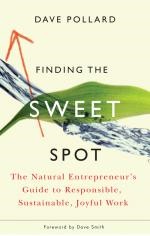
Since my book Finding the Sweet Spot was published, I’ve been thinking about how to make it more useful. I did set up a companion website, but I was far too ambitious in its design, and was naive in the expectation that people could/would actually compare ideas, Gifts, Passions and Purposes with others online, and that there would be anough traffic on the site to create a self-organized ‘market’ of ideas and potential partners.

Lately I’ve wondered whether it might be possible to create an online workbook to accompany the book, one that would include exercises to discover your Gifts, Passions and Purpose, and find the Sweet Spot at their intersection. Rather than starting with the industrial classifications, the way most career counselling guides do, I thought it might be more appropriate to start with the types of activities that go on in a Natural Economy and Natural Society. My first attempt to delineate these (which was part of the research for my novel) is illustrated above. Nine “meta-careers” are identified:

  1. Explorers, whose work is study and research, and whose work-product is discovery and insight
  2. Interpreters, whose work is mentoring and facilitation, and whose work-product is understanding
  3. Inventors, whose work is imagining, and whose work-product is ideas
  4. Designers, whose work is crafting, and whose work-product is models
  5. Generators, whose work is creating and building, and whose work-product is ‘goods’ and services
  6. Nurturers, whose work is cultivating, and whose work-product is well-being
  7. Menders, whose work is sustaining, and whose work-product is regeneration
  8. Actors, whose work is re-creating, and whose work-product is fun
  9. Connectors, whose work is distributing, and whose work-product is cross-pollination

I developed this framework in the context of essential work of a post-civilization society. These are all things that are needed in a community, and which we offer to others (because no individual is self-sufficient), to make the community self-sufficient. They cut across all of the modern, specialized ‘disciplines’ that have become our modern economy’s strait-jacket: we think of disciplines like ‘sales representative’ or ‘engineer’ or ‘musician’ or ‘athlete’ as the only way collective effort can be divvied up and parsed, because it is the only way we have ever seen work categorized. So, for example, the work of a scientist can entail all nine of the work categories listed above, as can the work of an artist or a programmer.

My belief is that our natural affinity is more for one or a few of these nine work categories, than it is to a modern ‘specialty’: People who are good at designing could be as useful designing shirts as designing recipes. People who are good at mending people (e.g. doctors) could be as useful and passionate about mending trains (e.g. mechanics). So I think it might be useful to think about what we are meant to do using these nine meta-ways of being of use, that draw on similar natural Gifts and similar Passions.

In thinking about my own Sweet Spot, I generally identify “reflecting” and “imagining possibilities” (category 3 activities) and “writing” (a category 4 activity) as being what I’m meant to do. I am passionate but not especially gifted at facilitation, conversing and demonstrating (category 2 and 9 activities). I am competent but not especially passionate about research (category1 activity). And I am neither competent nor passionate about category 5-8 work, though I recognize their great value and would not start an enterprise that didn’t have partners who were both gifted and passionate about such work.

When I look at wild creatures, I see evidence of learning and practice of all nine of these categories of essential work. The need for us to be social, to associate and collaborate and, together, to do all nine types of work effectively, transcends history, geography and species.

Another thing I like about this categorization of essential work is that it demonstrates the uselessness of a lot of the work that is being done today by millions of highly-paid people, and hence might give pause to young people drawn to these ‘professions’ simply because they’re easy and lucrative. Lawyers, stock-brokers and insurance agents come to mind, for example. None of these professions produce anything of essential value. They are parasites of the current, unsustainable and dysfunctional industrial economy. The post-civilization world will not need anyone to do these things.

So if I were to develop a Finding the Sweet Spot workbook, to help people discover the work they’re meant to do, I would be strongly tempted to use this nine-category classification of essential work as the basis for doing so, and to re-cast the exercises about discovering your Gifts, your Passions, your Purpose and your Partners (those with complementary Gifts who share your Purpose) accordingly. So, for example, in listing the dozens of possible and needed ‘green’ careers in Roberts and Brandum’s book Get a Life! I would reorganize them into the nine categories above.

I’d welcome your thoughts on this plan. Is this way of discovering what you’re meant to do too conceptual for most people? Does it require a degree of self-knowledge and the workings of an economy (Natural or Industrial) that is beyond most people’s capabilities? Is it counter-intuitive?

Although the book has not been a popular success, I still think it could be very valuable to young people about to embark on their careers, boomers about to ‘retire’ from their first careers, and frustrated and underemployed workers of all ages. I’m just trying to figure out how to make it accessible and useful enough that it gets the attention it deserves.

October 3, 2009

Links and Tweets of the Week: October 3, 2009

Filed under: Preparing for Civilization's End — Dave Pollard @ 23:51


mask in mask
westcoast indian art — a mask open to reveal another mask — from the mcmichael collection (artist name misplaced)

PREPARING FOR CIVILIZATION’S COLLAPSE

Endgame: If there was any remaining doubt that we’re too late to rescue civilization from collapse, the latest climate change report has put it to rest. This report predicts at least a 6.3 degree Celsius (correction Oct. 5: that should read 6.3 degree Fahrenheit) rise in global average temperature this century, even if all announced emissions programs by every government in the world are introduced on schedule and achieve all targeted emission reductions. Failing that, the increase will be at least 8.1 degrees. Since any increase over 2 degrees Celsius will precipitate catastrophic climate change, we’re already far past the tipping point. It’s just a matter, now, of how bad the collapse will be, when precisely it will happen, and what the survivors’ lives will be like. Thanks to Tom Atlee for the link.

The Roof Is On Fire: Ilargi, who usually writes about economics, reposts a 2-year-old article about the future of the planet that resonates with John Gray’s Straw Dogs and reiterates Pollard’s Law. Excerpts:

The only things in the natural world that have a value in our particular breed of economics are those that can be sold at a profit, today; and that is all the value they have. All else is luxury.

Preservation only has a chance in times of plenty, and even then only in theory. After all, we are today coming out of the by far most plentiful time in human existence, but it has not exactly been a time of preservation. Quite the contrary, it has both led to, and was accommodated by, the worst destruction of the natural environment ever in history. That is not a coincidence; it’s destruction that gave us our riches.

Now, we are entering a much poorer time economically, and that will lead to an even worse destruction, by an order of magnitude, if only because the riches made us multiply like so many rabbits…

Groups like Greenpeace are almost religiously accepted as being highly beneficial, but in reality they are some of the worst players around, since they facilitate the perpetuation of the lies and illusions about saving and preserving, while the roof, the roof, the roof is on fire. If we are to save this planet, we will have to throw out our economic model

it can be puzzling at first glance: while they obliterate the natural world without which their sons and daughters have no chance of survival, most parents would die to save their kids from a fire today. And there is the essence: it’s about today. Everything we do is. We are no better at “doing future” than yeast is.

The Unspoken Assumptions of Our Civilization: Andrew MacDonald riffs off the ideas of Bohm and Block, and says that the unspoken assumptions of our conversations (what can and cannot be said, how it can and cannot be expressed, how the interaction dynamic can and should work etc.) determine the direction, outcomes and value of the conversation, yet for some reason these assumptions are never questions. The same thing, he speculates, applies to our entire civilization, which is why there is this debilitating disconnect between what we know and what we do. Related to this, he posts a video that shows just how meek we are at accepting and never challenging these assumptions.

The Descent of Man: Dave Bonta reviews a NYT report on the discovery of the oldest-known ancestor of our species, a 4.4 million year-old walking-erect tree-dweller named Ardi. It turns out the depiction of human evolution from hunched-over to erect is nonsense, and that chimps and our other primate relatives are more evolved (i.e. changed more substantially since their first appearance) than we are.

The Third Way: An interesting post by “Tony” on the Ishmael group board with two novel ideas: (a) that there is a third alternative to smashing the system or working within it, and that is living alongside it, and (b) that we need to cede much of our individual volution to new ‘tribes’ (i.e. become more collective, more integrally ‘part of’ community. Thanks to Janene for the link.

LIVING BETTER

Confessions of a Home Schooler: Outstanding exploration of the defensive reaction that home/unschooling parents get from others: ”People think we’re all conservative Christians who hate the government and wear denim jumpers.”

POLITICS AND ECONOMICS AS USUAL

Chamber of Commerce Sues EPA for Doing Its Job: The perfect symbol of how grassroots political will is subverted by money and power comes from the huge monolith Chamber of Commerce. The plan of the corporatists is to push phony climate change bills (actually worse-than-useless bills with big subsidies for megapolluters) through Congress (Waxman-Markey and Kerry-Boxer) with clauses that prohibit the EPA (which is not subject to political pressure from corporatists) from doing its job of regulating pollution in the public interest. And even these feeble bills are being effectively blocked by right-wing corporatist idealogues. So when the EPA announced plans to actually regulate megapolluters, the Chamber of Commerce brought out its army of sleazy expensive lawyers to say: You can’t do that! We don’t own you so you’re not allowed to do anything.

Baby Boom Resumes for the Rich: Andrew Leonard points out something I’ve said repeatedly here over the years: When people become affluent (or at least live in nations that are), they don’t have less children because they’re better off or better educated, they have their children later. The birth rate is already spiking in the UK and is on the upswing in North America as well. If you thought population was no longer an issue in civilizational collapse, think again.

CO2 is Good For Us: Keith Farnish points us to a slick commercial by coal and oil shills that is so grotesque and absurd that some viewers thought it was a spoof. It wasn’t, but Keith is right: let’s propagate the reaction that it’s a spoof. Orwell would be proud.

Justice is Deaf: The G20 protestors were subjected not only to unreasonable restraint on their right of dissent, harrassment and arbitrary arrest, but a new police terror weapon to go along with the tasers: machines that create deafening noise and hearing loss aimed at peaceful protestors.

FOR FUN AND INSPIRATION

Smash Junk Mail: A brilliant campaign to disrupt the junk mail industry. We need something analogous for telemarketers! Thanks to Jerry Michalski for the link. Some of these monkeywrench ideas are also ingenious.

THOUGHTS FOR THE WEEK

From Charlene Phipps (excerpted from a personal conversation):

Sometimes the best way to change beliefs is to change behaviour first (approaching the knowing/doing gap from the opposite direction).

From ee cummings (thanks to Panhala for the link):

LET IT GO – the
smashed word broken
open vow or
the oath cracked length
wise – let it go it
was sworn to
go
 
let them go – the
truthful liars and
the false fair friends
and the boths and
neithers – you must let them go they
were born
to go
 
let all go – the
big small middling
tall bigger really
the biggest and all
things – let all go
dear

so comes love

October 2, 2009

What Would a Better World Look Like?

Filed under: Preparing for Civilization's End — Dave Pollard @ 23:53


olympic 2
In a post last week Sharon Astyk challenged us to create a vision of a world that works better than our failing, unsustainable one. Not an impracticable ideal, but something we can actually envision in our lifetime, or as Sharon puts it, is immediately accessible. A vision is not a strategy, and does not have to deal with the issues of how we get there from here. But it must be intuitively feasible. And since showing works better than telling, some actual working models would be preferable to a conceptual “future state vision” or utopian fiction.

Why is this so important? Because in our modern world, where what was done in past and what is done elsewhere (i.e. outside of globalized industrial civilization) is generally (and not subtly) discounted as inferior to the way things are here and now. We are led to believe the way we live now is the only way to live. Given enough time (and an education system and media that both work to crush imagination) we start to see the only life we know as being the only life that’s possible. The (utopian, post-civilizational-crash) novel I’m working on now is called The Only Life We Know.

In working on the novel, I’ve given a lot of thought to what a better world would look like, and I’ve changed my mind on this a lot over the last few years (I hope in a less idealistic, more realistic direction) — my views on what’s possible have both broadened and narrowed as I learn more about other cultures, past and present, human and animal. I keep coming back to a natural model, since Gaia has had a billion years to evolve ways of living that work and are sustainable. Anthropologists and biologists confirm that, contrary to what we’re taught, wild non-human cultures, indigenous cultures and prehistoric cultures are (to the extent they are not stressed by industrial human civilization) and were not only sustainable, but joyful, healthful and peaceful. Prehistoric humans mostly lived long, healthy lives (except when they were eaten by predators), showing few signs of the immune system (e.g. stress) and nutritional deficiency (e.g. bone) diseases that have plagued us for the last ten millennia. Average human lifespan reached its nadir relatively recently — during the Roman Empire and again during the Medieval Era, and quality of health and life in those periods was horrific for most.

So what would a better world look like? Here’s a list of adjectives, as a starting point for this visioning:

NATURAL ATTRIBUTES
  1. Healthy
  2. Joyful
  3. Fearless
  4. Safe
  5. Beautiful
  6. Abundant
  7. Peaceful

    SELF-EXPRESSION ATTRIBUTES

  8. Actualizing
  9. Present
  10. Creative
  11. Open
  12. Appreciative
  13. Honest
  14. Intentional

    MODESTY ATTRIBUTES

  15. Sustainable
  16. Resilient
  17. Improvisational
  18. Self-Healing
  19. Sufficient (in the Thomas Princen sense)
  20. Leaving Nothing Behind

    CAPACITY ATTRIBUTES

  21. Self-Knowledgeable
  22. Learning
  23. Competent

    ORGANIZATIONAL ATTRIBUTES

  24. Self-Managing
  25. Self-Sufficient
  26. Diverse
  27. Responsible
  28. Non-Hierarchical
  29. Egalitarian
  30. Networked
  31. Community-Based
  32. Communicative
  33. Collaborative

    RELATIONSHIP ATTRIBUTES

  34. Loving
  35. Supportive
  36. Generous
  37. Respectful

You probably think this is a pretty idealistic list. But all I have to do is look out my window at the creatures in the forest and the pond and at the bird-feeder, and I see a world that exemplifies all of these qualities.

So what would a world where we humans exemplified and manifested these qualities look like? I think it might look like some of the alternative cultures that have arisen since the 1960s as a reaction to and rejection of industrial civilization. But whereas these were often fragile, stressed and exhausted, I imagine this better world to be one of strength, sensitivity, and grace.

Most of all I see it to be astonishing diverse, the antithesis of modern civilization’s ruthless and relentless homogeneity. I see it as dozens of wildly different cultures, experiments blossoming and evolving until they just work. This heterogeneity, variability and impermanence is probably very difficult for those of us raised in monolithic industrial civilization to imagine, attuned as we are to one-size-fits-all models that become pervasive through colonization, acculturization and propagandization.

But great variety and diversity is endemic to healthy ecology, and an essential prerequisite for evolution and adaptation to change.

The biggest challenge in imagining this, and then realizing it, is the immense amount of relearning of capacities and competencies that wild creatures and cultures learn easily and early and hone throughout their lives. Just as land that has been subjected to catastrophic monolithic agriculture or urbanization needs to go through a succession of ugly and difficult steps before it returns at last to a natural state of dynamic complexity and balance, so too perhaps we dependent and specialized civilization-monoculture humans need to go through a period of awkward struggle before we again become graceful, natural creatures. At that point it will all become easy, intuitive, delightful. Until that point, without the help of some very clever visionaries, it will be simply unimaginable.

« Newer Posts

Powered by WordPress