Dave Pollard's environmental philosophy, creative works, business papers and essays.
In search of a better way to live and make a living, and a better understanding of how the world really works.


January 29, 2010

… and miles to go before we sleep

Filed under: Preparing for Civilization's End — Dave Pollard @ 19:42

miles to go before we sleep

January 28, 2010

Words and Pictures (and Music)

Filed under: Preparing for Civilization's End — Dave Pollard @ 23:40

Now that my amazing new home is basically furnished and functional, I’m getting down to my reconnection practices. I’ve been exploring the rainforest next door, resuming my regular 5k runs, and beginning my meditation and presencing practices, both outdoors in ‘my’ park with the brooding stone circle, and indoors, where I have a view from my living room of the town of Gibsons and the mountains of the Sunshine Coast across Howe Sound (astonishing at night), and of the mountains of Cypress Provincial Park across Queen Charlotte Channel out the adjacent window.

In the process, I’ve been focusing more on poetry than on non-fiction writing, and on the images, smells, and sounds that I found so inviting when I discovered this place. So I thought I’d share some of these words, pictures and sounds with you:

Bowen4

part of the rainforest beside my new home on Bowen Island

The Cat’s Song (by Marge Piercy)

Mine, says the cat, putting out his paw of darkness.
My lover, my friend, my slave, my toy, says
the cat making on your chest his gesture of drawing
milk from his mother’s forgotten breasts.

Let us walk in the woods, says the cat.
I’ll teach you to read the tabloid of scents,
to fade into shadow, wait like a trap, to hunt.
Now I lay this plump warm mouse on your mat.

You feed me, I try to feed you, we are friends,
says the cat, although I am more equal than you.
Can you leap twenty times the height of your body?
Can you run up and down trees? Jump between roofs?

Let us rub our bodies together and talk of touch.
My emotions are pure as salt crystals and as hard.
My lusts glow like my eyes. I sing to you in the mornings
walking round and round your bed and into your face.

Come I will teach you to dance as naturally
as falling asleep and waking and stretching long, long.
I speak greed with my paws and fear with my whiskers.

Envy lashes my tail. Love speaks me entire, a word
of fur. I will teach you to be still as an egg
and to slip like the ghost of wind through the grass.

Bowen5

a sign we discovered in the middle of the forest on Bowen Island; it points in the approximate direction of the upcoming Winter Olympics

Style (by Howard Nemerov)

Flaubert wanted to write a novel
About nothing. It was to have no subject
And be sustained upon the style alone,
Like the Holy Ghost cruising above
The abyss, or like the little animals
In Disney cartoons who stand upon a branch
That breaks, but do not fall
Till they look down. He never wrote that novel,
And neither did he write another one
That would have been called La Spirale,
Wherein the hero’s fortunes were to rise
In dreams, while his walking life disintegrated.

Even so, for these two books
We thank the master. They can be read,
With difficulty, in the spirit alone,
Are not so wholly lost as certain works
Burned at Alexandria, flooded at Florence,
And are never taught at universities.
Moreover, they are not deformed by style,
That fire that eats what it illuminates.

hugh wyeth photo

photo by hugh wyeth

The Principles of Concealment (by David Wagoner)

If you’re caught in the open
In an exposed position, alone,
Disarmed, and certain you may be
Attacked at any moment, you should settle quickly
All your differences with whatever lies
Around you, forcing yourself to agree
With rocks and bushes, trees and wild grass,
Horses, cows, or sheep, even debris
To find what you have in common. You no longer
Want to seem what you are, but something
Harmless and familiar: in a landscape
Given to greenness and the cold pastels
Of stubble and field stone,
Protective coloration may be too much
To hope for, beyond your powers
Like the beatitudes of browsing
And those conspicuously alarming colors
That declare you’re poisonous
Or taste terrible—all may be doomed
To fail with an enemy equipped to kill
From a distance. Your shape betrays you,
And you should try to break it
With disruptive patterns: if an enemy sees you,
Not as a whole, but as a head distinct
From a torso, as legs or arms
By themselves—he may ignore you
And let you have your moment
In the sun as an abstraction gone
To pieces, as a surface mottled and dappled
Ambiguously by intercepted light
Like a man cancelled. But all these efforts
Will come to nothing if you move: one gesture
May catch all eyes. If you stand
Still then, or stay seated
If you’re sitting down, or go on lying
Down if you’re lying, an easy solution
May occur to you, cheek to cheek
With the hard facts of inorganic life:
That you have no enemy,
That no one is hunting you,
That all your precautions were a waste
Of attention better given to more rewarding
Evasions and pursuits. If so,
And you take your place again
As a distinct departure
From your foreground and background,
You should know it’s possible
For you to feel, after all,
At the first step, at the first crack
Out of the box, that lethal impact,
That private personal blow marking your loss
Of the light of day, the companionship
Of the night, and the creature comforts of home
As you become a member
Of that other civilization spreading itself
Around you, ready and able and still
Called the natural world.

John Martyn, Small Hours

For the young who want to (by Marge Piercy)

Talent is what they say
you have after the novel
is published and favorably
reviewed. Beforehand what
you have is a tedious
delusion, a hobby like knitting.

Work is what you have done
after the play is produced
and the audience claps.
Before that friends keep asking
when you are planning to go
out and get a job.

Genius is what they know you
had after the third volume
of remarkable poems. Earlier
they accuse you of withdrawing,
ask why you don’t have a baby,
call you a bum.

The reason people want M.F.A.’s,
take workshops with fancy names
when all you can really
learn is a few techniques,
typing instructions and some-
body else’s mannerisms

is that every artist lacks
a license to hang on the wall
like your optician, your vet
proving you may be a clumsy sadist
whose fillings fall into the stew
but you’re certified a dentist.

The real writer is one
who really writes. Talent
is an invention like phlogiston
after the fact of fire.
Work is its own cure. You have to
like it better than being loved.

mindful wandering

photo by Maren Yumi

Learning by Doing by Howard Nemerov

They’re taking down a tree at the front door,
The power saw is snarling at some nerves,
Whining at others. Now and then it grunts,
And sawdust falls like snow or a drift of seeds.
Rotten, they tell us, at the fork, and one
Big wind would bring it down. So what they do
They do, as usual, to do us good.
Whatever cannot carry its own weight
Has got to go, and so on; you expect
To hear them talking next about survival
And the values of a free society.
For in the explanations people give
On these occasions there is generally some
Mean-spirited moral point, and everyone
Privately wonders if his neighbors plan
To saw him up before he falls on them.

Maybe a hundred years in sun and shower
Dismantled in a morning and let down
Out of itself a finger at a time
And then an arm, and so down to the trunk,
Until there’s nothing left to hold on to
Or snub the splintery holding rope around,
And where those big green divagations were
So loftily with shadows interleaved
The absent-minded blue rains in on us.
Now that they’ve got it sectioned on the ground

It looks as though somebody made a plain
Error in diagnosis, for the wood
Looks sweet and sound throughout. You couldn’t know,
Of course, until you took it down. That’s what
Experts are for, and these experts stand round
The giant pieces of tree as though expecting
An instruction booklet from the factory
Before they try to put it back together.

Anyhow, there it isn’t, on the ground.
Next come the tractor and the crowbar crew
To extirpate what’s left and fill the grave.
Maybe tomorrow grass seed will be sown.
There’s some mean-spirited moral point in that
As well: you learn to bury your mistakes,
Though for a while at dusk the darkening air
Will be with many shadows interleaved,
And pierced with a bewilderment of birds.

Postscript: For those who have worried that, living in this place of astonishing peace and beauty, I will lose touch with what is going on in the real world, and all the work that needs to be done, my post tomorrow will describe what I intend to do, from my quiet place, to make a real difference, and to help others coalesce in ways that will bring the brightest progressive minds to bear on ways in which we can undermine and end the industrial economy and the brittle, cruel and devastating industrial society that holds the world in thrall.

January 22, 2010

Living Alone

Filed under: Preparing for Civilization's End — Dave Pollard @ 17:22

So here I am, suddenly living alone for the first time in thirty years, winding down to retirement in a matter of weeks after thirty-five years of full-time work, living in a new community for the first time in thirty years, and parentless for the first time, ever. A lot of change in a month!

Bowen1

I am writing this, as is my wont, standing up, in the great room of my new home. The view in front of me is this one, and there’s a similar view to my right. To my left and behind me there is garden and forest, rising into the mountains. There is forest, in fact, all around me, and here it stays green all year round. I really am alone – there are no neighbours within eyesight or earshot. The nearest house, at least from what I’ve discovered from my walks so far and from the Google aerial shots, appears to be an organic foods restaurant and permaculture garden about a five minute walk down the hill and down the road.

Bowen2

Here’s the house from the front. At the moment, I’m waiting for my first furniture to arrive – a sectional sofa and a bed. I’m shipping a small amount of furniture from my last home in Ontario next month, but it’s basically furnishings for the other two bedrooms, so I can welcome visitors (I’ve invited lots of friends to visit, but they’re so scattered around the globe I suspect visitors will be few and far between). I really have all I need here – three suitcases of clothes and one of artwork, plus my laptop and the other portable electronics I take everywhere I go, and my bicycle. I have some kitchenware and linens to buy, and some stools for the kitchen bar, but that’s about it. The organic food store in town, a twenty-minute bike ride away, has all my favourite vegan foods and raw ingredients.

Bowen3

Beside me is a large and lovely park that is largely unknown, even to my fellow Bowen Islanders, since it is brand new and not yet on the ‘map’, so it is almost as if it is my own. Not that I need the space or the privacy, but this park, with its deep dark ponds, bridges and moss-covered stone circle will be, for now at least, the site of my morning meditative, presencing and reconnecting practices. Picture me walking barefoot down to this park, along the wood-chip trail, in a kimono (or caftan in cooler weather), my cushion and candle in hand, my iPhone with the appropriate music and guided mediations clipped to my belt.

Bowen4

The interior space is open and large and full of light — perfect for Open Space sessions I plan to facilitate to plot our campaign to stop the Tar Sands and factory farming in Canada. And the bathroom upstairs is a romantic fantasy – an old-fashioned tub in the middle of a large room, with skylights above it. The perfect place for soaking in the evening beneath the stars. Hot water always seems to stimulate my imagination and creativity, readying me for an evening of writing, or the composition of music.

All my life I have been blessed with incredible good fortune – great parents and friends, love, security, health, material comfort, well-paying and (mostly) rewarding work that just seemed to fall into my lap. Accidentally discovering blogging seven years ago – the most important turning point of my life, and catalyst for a dozen fortuitous events since then. Even the serious illness that befell me three years ago was a blessing, prompting me to make changes to my lifestyle and life’s intentions that have been transformative and entirely positive.

And now this – this eden.

But I won’t be spoiled, or diverted from my intentions.

January 19, 2010

Memorial

Filed under: _ Uncategorized — Dave Pollard @ 19:54

This is what I plan to read, next week, at my father’s memorial:

Dad June 2007

A few years ago, a number of weblogging colleagues and I began a practice of maintaining, and updating once a year or so, the obituary for ourselves we hoped would be able to be read truthfully once we’d died. The purpose of the exercise was and is to focus us periodically on our intentions, on the things we hope to accomplish but have not yet done. I would recommend this exercise to you, because, as Goethe once said, there is power in intention.

It occurred to me as I wrote these words that if my father had written his own annual ‘intentional obituary’ he would never have had to change a word from year to year. He always knew what he was intended to do, set his expectations low, worked hard, and achieved, quite early in life, almost everything he wanted to accomplish. Having done so, he was free to pursue his insatiable passion for learning.

For most of his life this passion for learning was his principal hobby, beyond enjoying music and the arts, and gardening, and he pursued it with a tireless curiosity and critical thinking mind, with the objective of understanding how the world really worked. His learning imbued in him a very progressive worldview, one that was out of sync with that of many of his friends and family, but which made him, for me, a mentor, an example of how to live thoughtfully, courageously, authentically and responsibly, and a sounding board for my own radical ideas. He gave me the courage to be different, to be myself, and he introduced me to the poem by e e cummings that suggested a way of being and doing that he exemplified and that I have tried all my life to emulate:

Almost anybody can learn to think or believe or know,
but not a single human being can be taught to feel. Why? Because
whenever you think or you believe or you know,
you’re a lot of other people:
but the moment you feel, you’re nobody-but-yourself.

To be nobody-but-yourself — in a world which is doing its best, night and day,
to make you everybody else — means to fight the hardest battle which any human being can fight;
and never stop fighting.

My father lived modestly, in every sense of the word, and abhorred conspicuous consumption. He was interested in politics but cared about action, not rhetoric. He measured himself and others on what they did, and what they did not do, rather on what they said or professed. He believed in conserving, in listening and understanding, in helping others, in seeking consensus, and in striving for peace.

He told me once that the true measure of what we do in the workplace is not the physical or procedural or financial outcomes achieved in the short run, since these are always transient. The true measure is what we have demonstrated personally, one-on-one, to others we work with and for, that changes forever what they know, that gives them capacities and competencies and understanding that will last their whole lives and which they in turn will pass on to others, and so on, for generations. That wisdom has guided me in my dealings with work colleagues all my life, and with my children and grandchildren as well, and its intangible product is his lasting legacy, and that of everyone he has touched.

Through his actions and his example I learned how to be empathetic, how to listen appreciatively, the importance of honesty and generosity, and of thinking before you speak, that showing is more effective than telling, that we need to slow down and look and really see what is happening. I learned from him the importance of home, the value of writing and imagination and curiosity and critical thinking, and, in his final months, I learned from him how to let go.

He was, in short, an extraordinary father, in a world where so many fathers are dictatorial, intolerant, impatient, demanding, abusive, ignorant, tactless, lacking in self-knowledge, or simply absent. I will do my best to exemplify the qualities that he did, to be as good a role model as he was, all his life, in everything he did.

There’s a poem by the Canadian poet Oriah, called The Invitation, that’s about being authentic and which reminds me a lot of my father’s advice, so I’d like to conclude by reading it:

It doesn’t interest me what you do for a living.
I want to know what you ache for
and if you dare to dream of meeting your heart’s longing.
It doesn’t interest me how old you are.
I want to know if you will risk looking like a fool
for love, for your dream
for the adventure of being alive.

It doesn’t interest me what planets are squaring your moon…
I want to know if you have touched the centre of your own sorrow
if you have been opened by life’s betrayals
or have become shriveled and closed
from fear of further pain.
I want to know if you can sit with pain, mine or your own
without moving to hide it, or fade it, or fix it.

I want to know if you can be with joy, mine or your own
if you can dance with wildness
and let the ecstasy fill you to the tips of your fingers and toes
without cautioning us to be careful, to be realistic
to remember the limitations of being human.
It doesn’t interest me if the story you are telling me is true.
I want to know if you can disappoint another
to be true to yourself.
If you can bear the accusation of betrayal
and not betray your own soul.
If you can be faithless
and therefore trustworthy.

I want to know if you can see Beauty
even when it is not pretty
every day. And if you can source your own life from its presence.
I want to know if you can live with failure, yours and mine
and still stand at the edge of the lake
and shout to the silver of the full moon, “Yes!”

It doesn’t interest me
to know where you live or how much money you have.
I want to know if you can get up
after the night of grief and despair
weary and bruised to the bone
and do what needs to be done
to feed the children.
It doesn’t interest me who you know
or how you came to be here.
I want to know if you will stand
in the centre of the fire with me
and not shrink back.

It doesn’t interest me where or what or with whom
you have studied. I want to know what sustains you
from the inside when all else falls away.
I want to know if you can be alone with yourself
and if you truly like the company you keep
in the empty moments.

January 17, 2010

Links & Tweets of the Week: January 17, 2010

Filed under: Preparing for Civilization's End — Dave Pollard @ 19:29

primate by xurrilla

primate, from the mysterious and remarkable photographer xurrilla (from andorra?)

PREPARING FOR CIVILIZATION’S COLLAPSE

The Problem of Community: Most of us who’ve studied how the world really works agree that the answer lies in community — decentralizing, ending the vast waste, colonialism, inequity and destruction of ‘globalization’, and strengthening local self-sufficiency. So why are there so few models of effective community, and why are so few of us actually working in community, instead of just talking about it? Sharon Astyk offers some answers, rooted in some feminist ideals and the need for many of us to break the tie to the industrial economy workforce/consumption model that consumes all our time:

I know a lot of people who want to build community – but only with people like them, who agree with them. I know a lot of people who do seriously want to build community – but are exhausted and overburdened by the job…

I don’t deny that we’re afraid of community. I don’t deny that many of us who try burn out from exhaustion, and others just don’t want other people in our lives… We have to be willing to pay the price – to deal with the fact that community doesn’t just mean working together, it means putting in the hours to talk to your boring neighbor and resolving disputes and being the subject of gossip and putting up with people you don’t like much, when it is easier not to… It is also true that the re-establishment of an American political power requires also that many of us disengage from the workforce – I mean that quite seriously… We’re going to have to find time to live on one income – by combining households and reducing costs if we’re to have a meaningful democracy – and this is not easy. I don’t understate the enormous difficulty for people, the cost to their lives. And yet, what is most needed to establish community is time, the hardest single thing to claim.

City or Country: Where Should You Live When Civilization Collapses?: Also from Sharon Astyk (on her other blog), an explanation of why the answer to this question isn’t so easy. A lot depends on which city, and how big, or on which rural area. Much boils down to the inherent resiliency of where you live, and the potential for community-level self-organization self-sufficiency when centralized structures and markets collapse due to economic, energy and ecological crises.

Making Co-operatives Work: Jerry Michalski points us to the key operating principles of co-operatives. These will also be the essential operating principles of communities that survive civilization’s collapse. Openness, democracy, participation, autonomy and self-sufficiency, continuous learning, collaboration, caring, responsibility and sustainability — everything that the current corpocracy is not.

LIVING BETTER

Good News for Vegans: Meat Substitutes Making Great Strides: I’ve long been convinced that it wouldn’t take much to develop organic, non-GM, healthy and delicious substitutes for meat and dairy that would make veganism easy — and help a lot more people make the move to vegan. There are some new products that do just that.

Taking the Power and Politics Out of Your Conversations: Jerry Michalski points us to a variation on non-violent communication (NVC) — called powerful non-defensive communication (PNDC),

… a new communication model that is open, direct, sincere, honest, vulnerable, and can eliminate power struggle… we make a commitment to model the power of non-defensive communication first in our own behavior, treating each person and group with dignity and respect — even in cases where we find the person/group engaging in attitudes and actions that we consider dangerous; at the same time, we will speak clearly and honestly about our own beliefs regarding the need to eradicate attitudes and behaviors that alienate people from each other through misunderstanding, prejudice, hatred, or violence.

The 4 Principles of Knowledge Sharing: Dave Snowden describes the 4 principles that govern our ability and willingness to share what we know with others (and promises, in future posts, to tell us how to leverage them). The principles: social obligation (our inherent drive to connect with and care about others), individual context (without establishing a shared context, sharing knowledge is difficult), adaptation and exaptation (we creatively adapt what we learn to our own, and new, situation, and exploit opportunity for applying new knowledge in novel contexts), and natural limits (we can only communicate meaningfully with so many people, and with so many people at once, before meaning is lost).

POLITICS AND ECONOMICS AS USUAL

Extended House Price Collapse Imminent: Echoing what The Automatic Earth and others have been saying, the economist who the housing price index is named after sees housing prices poised to plummet again, for a protracted period. “He noted that housing prices fell for 15 straight years in Japan after its real estate market collapsed in the 1990s. ‘Unfortunately, I think it’s a model for what might happen,’ he said.”

How Corporate Culture Took Over the Obama Administration: Naomi Klein from the new edition of No Logo (thanks to Michael Wiik for the link):

Personally, none of this makes me feel betrayed by Barack Obama. Rather I have a familiar ambivalence, the way I used to feel when brands like Nike and Apple started using revolutionary imagery in their transcendental branding campaigns. All of their high-priced market research had found a longing in people for something more than shopping – for social change, for public space, for greater equality and diversity. Of course the brands tried to exploit that longing to sell lattes and laptops. Yet it seemed to me that we on the left owed the marketers a debt of gratitude for all this: our ideas weren’t as passé as we had been told. And since the brands couldn’t fulfill the deep desires they were awakening, social movements had a new impetus to try.

Perhaps Obama should be viewed in much the same way.. What the election and the global embrace of Obama’s brand proved decisively is that there is a tremendous appetite for progressive change – that many, many people do not want markets opened at gunpoint, are repelled by torture, believe passionately in civil liberties, want corporations out of politics, see global warming as the fight of our time, and very much want to be part of a political project larger than themselves. Those kinds of transformative goals are only ever achieved when independent social movements build the ­numbers and the organisational power to make muscular demands of their elites. Obama won office by ­capitalising on our profound nostalgia for those kinds of social movements. But it was only an echo, a memory. The task ahead is to build movements that are – to borrow an old Coke slogan – the real thing. As Studs Terkel, the great oral historian, used to say: “Hope has never trickled down. It has always sprung up.”

The Disappeared Middle Class: Joe Bageant rants delightfully about why progressive ideas can never get real traction in the US:

A month or so ago I watched news footage of some fat guy being interviewed inside his the three car garage of his $300,000 cardboard house. The poor fellow was about to lose his bass boat, and maybe his home too. From the looks of it, I’d say the bass boat was a Ranger X520. Now these babies start at $45K, not to mention the $30K for the four wheel drive usually seen pulling. Looked like it was sitting on a 20-plus foot Hurricane boat trailer, another $4K or $5K. My wife, who was watching the show with me, turned and said, “What class is this man supposed to be in?” “I don’t know, they say middle class.” “Hmmm. Whatever it is, we’ve never been members.”

Entrepreneurs Who Make Millions Aren’t Risk-Takers: Malcolm Gladwell reviews the history of upstart businesses that made vast fortunes, and discovered that, far from being risk-takers, they made their millions by hedging risks and using others’ money so there was no downside at all. Unlike the gangsters in the financial services industry who made fortunes by being reckless (and then came begging for handouts when these bets went south), the shrewder gamblers bought assets for no money down, or bought credit-default swaps that let them profit obscenely from the fall in the market, with no risk if the market rose. These guys give entrepreneurship a bad name, but they do have one thing in common with legitimate entrepreneurs: They don’t take a lot of risks. As I explain in my book, Finding the Sweet Spot, entrepreneurship isn’t risky if you do it right. But if you’re moral about it, it’s not enormously profitable either. What it is is responsible, sustainable, and joyful. Note: the link above is to an abstract only; you have to buy the hard copy, or wait a while, to get the full article free online, but the abstract covers it pretty well.

FUN AND INSPIRATION

Rick Mercer has a delicious rant on the usurious interest rates charged by credit card companies, a wonderful spoof of the new US airport security regulations that affect Canadians traveling there, and a hilarious explanation of everything you ever wanted to know about Canada but were afraid to ask. Thanks to Isabella Mori for the links. Bonus: Isabella also points us to Pat Robertson Voodoo Doll: All Proceeds to Haiti Relief.

THOUGHTS OF THE WEEK

Some thoughts from Brian Tracy, writer of a lot of so-so books on business, motivation, selling and getting things done, who seems, in the process, to have learned some important things about intention, adaptation, and collaboration:

If what you are doing is not moving you towards your goals, then it’s moving you away from your goals.

Never say anything about yourself you do not want to come true. We will always tend to fulfill our own expectation of ourselves.

It doesn’t matter where you are coming from. All that matters is where you are going.

Whatever you believe with feeling becomes your reality.

Communication is a skill that you can learn. It’s like riding a bicycle or typing. If you’re willing to work at it, you can rapidly improve the quality of every part of your life.

You cannot control what happens to you, but you can control your attitude toward what happens to you, and in that, you will be mastering change rather than allowing it to master you.

No one lives long enough to learn everything they need to learn starting from scratch. To be successful, we absolutely, positively have to find people who have already paid the price to learn the things that we need to learn to achieve our goals.

January 14, 2010

Not So SMART: Replicating (Instead of Growing) Natural Small Organizations

Filed under: Working Smarter — Dave Pollard @ 22:16

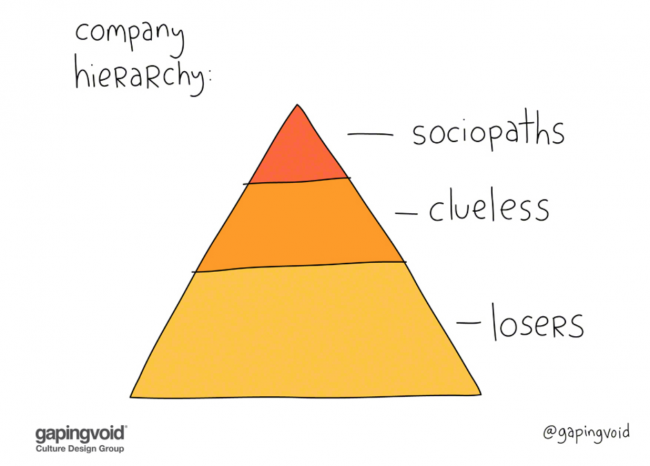
gaping void hierarchy

drawing by hugh mcleod at gaping void

Consulting ‘guru’ Peter Drucker introduced the concept of Management by Objectives in business and government affairs a half-century ago. The idea was that if you set objectives and measure ‘progress’ against them, more will get accomplished. These objectives, he said, had to be ‘SMART’: Specific, Measurable, Achievable, Realistic, and Time-Based. Drucker was one of the last of the old industrial model thinkers, but these ideas have caused a huge amount of damage since he introduced them. Essentially, they mistake complex environments (which most social environments — communities, enterprises and institutions — are) for merely complicated environments. They assume you can control the elements that lead to achievement of objectives. They assume you can get a handle on all the variables that affect an organization’s success. They assume you can predict outcomes. They assume that, because they have been fortunate enough to have been in the right place at the right time and therefore been present during a period of organizational ’success’, they know what is needed to achieve more ’success’. They assume their subordinates understand and do what they are told to do.

All of these assumptions are wrong. The reality is that, in business enterprises as in other complex environments, what gets done is the sum of the collective effort of those doing the work. The ‘leaders’ produce, in real terms, insignificantly more than the most junior workers, and have the power to wreck the work of many others, but not commensurate power to improve subordinates’ work. The hierarchy is all about authority, but in fact most of us (especially in non-manufacturing roles) do what we think is right, not what we’re told to do — even if we have to twist ourselves in knots to conceal our non-compliance. We do this because in this age of specialization, we really do know our jobs better than our bosses (who probably have never done those jobs).

So Management by SMART Objective leads to this ludicrous and dysfunctional dance:

  • Leaders hire ‘expert’ consultants, or huddle among themselves, or decide by fiat, what the SMART objectives should be for their organization: “increase revenues by 10% and profits by 20% next year by introducing ‘improved’ versions of 15 selected products that can be sold for an average price 25% higher than the old version, and which, through internal efficiencies, cost 15% less per unit to produce”.
  • These leaders then ‘cascade down’ these objectives and command subordinates to come up with SMART business unit plans that will, if successful, collectively achieve these top-level objectives.
  • The subordinates understand that their success depends on ratcheting up profits, and that the objectives set by the leaders are ridiculous, magical thinking. So they come up with alternative plans to increase profits by 20% through a series of difficult, but realistic, moves. These entail offshoring everything to China, layoffs, pressuring staff to work longer hours for no more money, and, if all else fails, firing people or leaving vacancies unfilled.
  • The good people in the organization all leave, because they know this short-range thinking is dysfunctional, damaging to the organizations in the longer term, unsustainable, and a recipe for a miserable workplace. Their departure creates more vacancies that aren’t filled, which in the short term reduces costs.
  • The clueless and the losers, who are left, attempt to pick up the slack. They work harder, find workarounds for the dumbest management decrees, and do their best to achieve these objectives. Those fortunate enough to be in the right market areas in the right economies get promoted into some of the vacant spots left by the good people, but without the commensurate salary increase.
  • The leaders, as a result, achieve their short-run objectives, award themselves huge bonuses, profit from increases in the value of their stock options, and repeat the whole cycle the next year.
  • At some point the utter sustainability of this “management process” becomes apparent. There is a really bad year. The economy is blamed, perhaps. Or the top leaders are fired, and rehired in other organizations suffering from really bad years. Or the company is bought out, or ‘reorganized’ so that all the old objectives and measures no longer apply, and a completely new set is established.

The byproduct is a blizzard of plans, budgets and strategies, which are substantially meaningless. Everyone does ad hoc things to protect their ass and try to make the best of impossible targets and incompetent, arrogant leaders self-deluded about their own brilliance and about their ability to control what is really happening in the organization and the marketplace.

There are, however, some things of real value happening in these organizations. None of them are ‘SMART’ so none is recognized or rewarded, and most of these things are actively discouraged. Nevertheless, because most people take pride in what they do, these valuable things happen. They include:

  • Learning: People learn by making mistakes (that they don’t admit to), and this makes them better at doing their jobs.
  • Conversations: People share, peer-to-peer, what works and doesn’t work, through mostly informal conversations, and this too makes them better at doing their jobs. These conversations are often surreptitious, since they are not considered ‘productive’ work.
  • Practice: The more people work at doing a particular task, the better they get at it. Most such practices are substantially workarounds, self-developed ways to do their particular specialized work optimally, despite instructions to the contrary from leaders and published manuals, and despite the burden of reporting SMART data up the hierarchy, which has to be creatively invented and explained so that the practices aren’t disrupted by new orders from the leaders.
  • Judgement: Through the above improved learning, conversations and practice, people develop good judgement. They make better decisions. The leaders get all the credit for these decision, but it doesn’t matter.
  • Trust Relationships: Through peer-to-peer conversations, trust relationships develop. When people trust each other, whole layers of bureaucracy are stripped away. People are left to do what they do well. Unfortunately leaders in large organizations almost never trust their subordinates, so these trust relationships are almost always horizontal, not vertical. Despite this, these relationships profoundly improve productivity.
  • Professionalism: The net result of all of the above is increased professionalism. People just become more competent.

This is why, in all my years as a manager, I always saw my role as listening and clearing away obstacles my staff were facing, identifying and getting rid of the small percentage who could not be trusted (too ambitious, too self-serving, uncollaborative, secretive or careless), and trusting the rest to do what they do best, and staying out of their way. In recent years I started to lose the heart to do this, but I still tried.

The ideal organization is therefore not SMART, but self-organized, trusting (no need to measure results, just practice your craft and the results will inevitably be good), highly conversational, and ultimately collaborative (impossible in large organizations because performance is measured individually not collectively). It’s one where the non-performers are collectively identified by their peers and self-select out by sheer peer pressure. It’s one without hierarchy. It’s agile, resilient and improvisational, because it runs on principles, not rules, and because when issues arise they’re dealt with by the self-organized group immediately, not shelved until someone brings them to the attention of the ‘leaders’. It’s designed for complexity. It’s organic, natural.

In my experience, such an organizational model can be replicated, but it doesn’t scale. This is true for social and political organizations (transition communities), economic organizations (Natural Enterprises, permaculture and renewable energy co-ops), educational and health organizations (unschooling groups and preventive/self-managed health clinics). This is why our models of a better way to live and make a living need to be small, demonstrative, and replicable — it needs to be clear how to adapt these small sustainable successes to other locations and situations.

There are some good models out there, but they are complex, and it is not at all apparent how we can replicate them. So instead, we try to grow them, until they reach dysfunctional size. If we really want to make the world a better place, we need to stop trying to grow small successes and start finding ways to replicate them, not as cookie-cutter ‘franchises’ under a command-and-control central hierarchy, but as autonomous adaptations. Drucker couldn’t fathom complexity, nor can most of the so-called business ‘thinkers’ of our day. We need some new thinking, aimed at prosperity without growth, at evolutionary cellular replication and adaptation as the means of getting more of a good thing. Small model organizations that are somehow viral, so you can just take the seed, the set of principles, of one, and transplant it and adapt it to work elsewhere. Model enterprises, communities and cooperatives.

I have no idea how to do this, but we need to find a way. Not so SMART. But really important.

January 12, 2010

Bringing Down the Monster

Filed under: Preparing for Civilization's End — Dave Pollard @ 22:20

corporation bakan

When I was young and idealistic in the 1960s and 1970s, I blamed “the system” for the problems of the day. I didn’t give much thought to the connection between “the system” and the people who, presumably, ran it, directed it, and were responsible and accountable for it. We even used the anonymous term “the Man” to refer to those who were responsible for creating, perpetuating and enforcing “the system”. At about that point I began meeting some of the people who were associated with “the system” — senior politicians, business leaders, regulators, and police. I was puzzled that they didn’t seem to know as much as I thought “the Man” should know about what was going on, and didn’t seem to have any real control over “the system”. In more charitable moments I even admitted that they seemed to be as much victims of “the system” as the rest of us.

Fast forward 40 years. In last week’s New Yorker, Hendrik Hertzberg writes something eerily similar to what I began to suspect all those years ago:

[What is called] “pathetic fallacy” is … the false attribution of human feelings, thoughts, or intentions to inanimate objects, or to living entities that cannot possibly have such feelings, thoughts, or intentions—cruel seas, dancing leaves, hot air that “wants” to rise [or "America", or "the company", or "the government"]. The American government has its human aspects—it is staffed by human beings, mostly—but its atomized, at-odds-with-itself legislative structure (House and Senate, each with its arcane rules, its semi-feudal committee chairs, and its independently elected members, none of whom are accountable or fully responsible for outcomes) makes it more like an inanimate object. In our sclerotic lawmaking process, it is not enough that the President, a majority of both Houses of Congress, and a majority of the voters at the last election favor extending health care to all citizens.

So, “the system” again. Not “us”, not an identifiable “them”. It. This Frankenstein monster that defies the will of the people, even that of the people supposedly in power. In his book “The Corporation”, Joel Bakan personifies the corporate monster, this “it”, as having a psychopathic “personality”, as the graphic above shows. The same prognosis, using Hertzberg’s analysis, could be given to governments, and in fact to all institutions — political, economic, entrepreneurial, educational, health, media — especially those that have grown to a size where they have taken on a life and mind of their own and are no longer simply extensions of a small group of identified individuals. Lawyers and judges, not the swiftest profession at the best of times, have greatly compounded the problem by granting corporations (and most institutions are now incorporated, even political ones) the “rights of personhood”, without the commensurate responsibilities.

It’s easy to say that any institution, even the collective set of institutions that comprise “the system”, is/are made up of people, and if there’s something wrong with “the system” it can/should be fixed by piercing the institutional veil and obligating the people behind it to act responsibly. Unfortunately, if you’ve spent any time trying to get “the system” to work from within, at various levels in the hierarchy, you quickly discover, as Hertzberg says, that the institution is not merely the sum of its people. I’ve spoken to oil company executives, cabinet ministers, university presidents, and many other “leaders’ in “the system” and they are, mostly, informed and aware of the need for reforms. But they feel helpless to institute that reform unless everyone moves at once and together. A”level playing field” is needed so that one irresponsible or opportunistic company or national government or other institution does not gain “competitive advantage” by refusing to make the change. And we know from WTO and G20 and Copenhagen and the US Health Care debate, just to give a few recent examples, that getting “everyone” on side is impossible. All it takes is one renegade and you have a race to the bottom with the renegade in the lead. That’s the way the “system” inherently works.

So to change “the system” it is not sufficient to persuade a majority of the people who work within it (up and down the hierarchy) that a change is needed and appropriate. Like Frankenstein’s monster, “the system” has enormous inertia when you want it to start moving somewhere new, and enormous momentum when you want to stop it or shift its direction. As Clay Christensen has written, the larger a corporation gets, the less capable it becomes of any innovation whatsoever, and the same is true for other types of institution.

So what can be done about it? How do we “bring down the monster” if persuasion and democratic means, even when available, will inevitably be ineffective? If changing “them” isn’t enough, how do we change “it”?

Perhaps the first thing we need to do is to get past the “pathetic fallacy” and realize that this “monster” has no human attributes. It is not capable of feeling or morality or judgement. It is an automaton, doing what it has been programmed to do. It is not psychopathic or like Frankenstein’s monster — these are both personifications. It is not really a “monster” either — the word literally means an omen or portent. It is not sentient, not like any living creature in that sense, since it has no identity or singularity. It is, in a sense, programmed to grow.

The best analogy for this monster is probably cancer. Cancer is an unintended consequence of the evolution from unicellular creatures to organisms. The survival advantage of organisms (ranging from amoebae to whales) comes with a price — individual cells in an organism can’t replicate without restriction like their simpler cousins or they’d outgrow the boundaries of the organism, so nature evolved processes called cellular apoptosis (death) and senescence (cessation of replication) to keep the total number of cells of each specialized type in the creature’s body in balance. These processes are set off by chemical triggers in the body. Cancer cells don’t respond to the triggers, so they grow out of control. In the short run, that’s an evolutionary success; in the long run, since it kills the organism and then the meta-organism (the creature), it’s a failure.

By analogy, our industrial systems, which ignore nature’s checks and balances designed to keep each type of creature in the global organism Gaia in balance, are an unintended consequence of our evolution of large brains, a short-run evolutionary success and, in the longer run, will kill our species and, through the sixth great extinction now in process, many, perhaps most, of the species in Gaia.

In both cases, these monsters are ultimately self-limiting — when they kill the host (the creature, or the species), they will lose the support mechanism they need to survive and will die themselves. Cancers are very very rarely contagious, and aren’t passed down from one generation to the next. Our cancerous human civilization systems, likewise, aren’t likely to be picked up by other Earth species, or inevitably recreated by the small number of survivors of civilizational collapse who build post-industrial human society. That post-industrial human society is therefore likely to thrive, in balance with the rest of all-life-on-Earth, for millions of years (weather, or rather climate, permitting) before it develops another monster.

Doctors talk bravely about defeating cancer but it’s very unlikely they’ll succeed. Because cancers are evolutionary phenomena, trying to prevent cancers is like trying to prevent evolution. Only members of highly delusional religions believe you can fight (or deny out of existence) the reality of evolution.

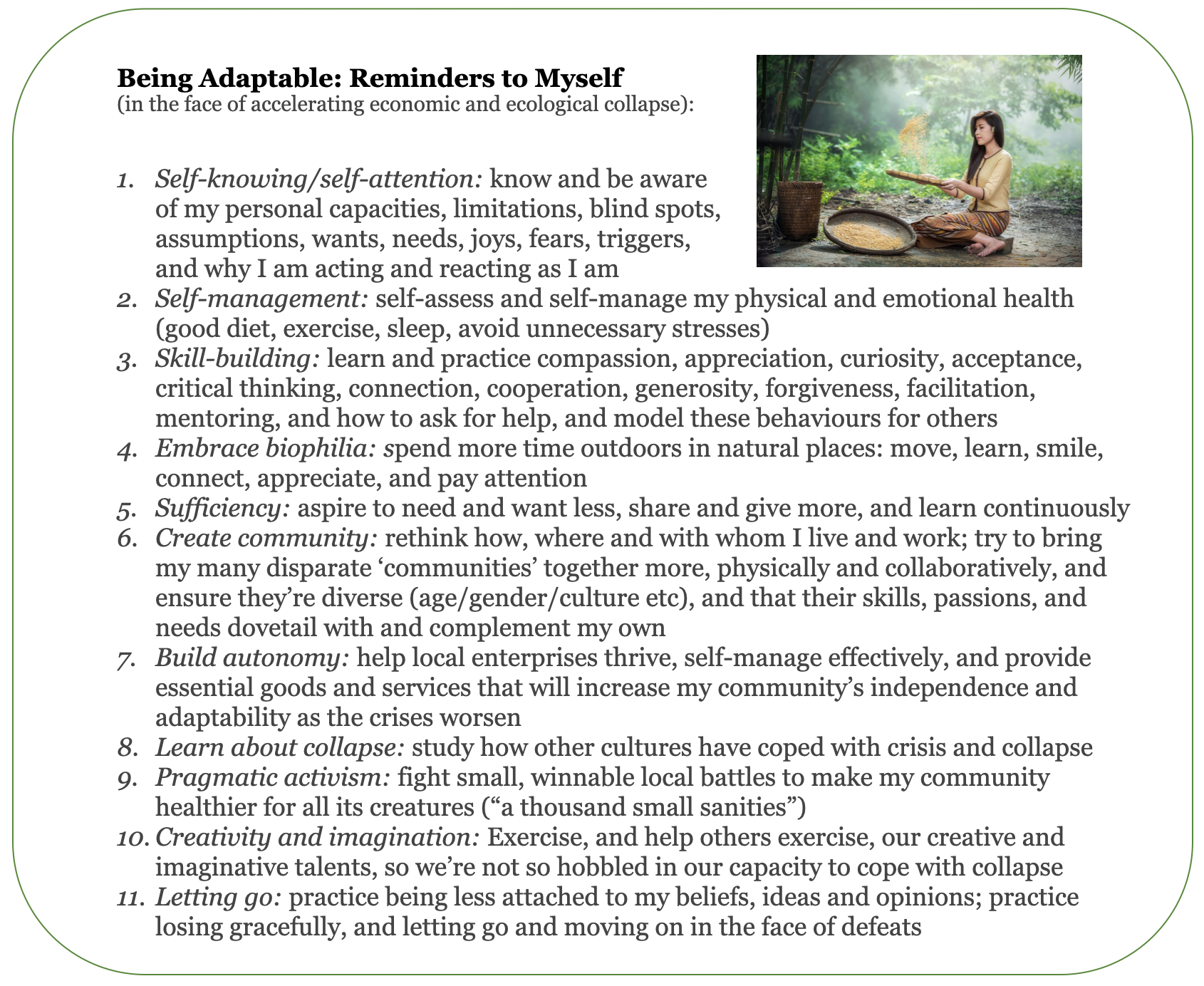
But bringing down the monster of “the system”, like fighting cancer, is not hopeless. It’s just very difficult. Best way to prevent both is to live a healthy life that discourages the monster from preying on you or your community. The three types of actions that Joanna Macy talks about in her work, and which I have adapted in my “what you can do” diagram, map analogously to the three ways in which doctors and patients fight cancers:

Strategy As applied to cancers As applied to civilization
Learn, self-manage Know what you can do, and how cancers develop and spread, build personal and support network capacity and competence Know what you can do, and how “the system” really works, build personal and collective capacity and competence
Fight Work to defeat the cancer through healthy living, good practices, positive attitude, and use “holding actions” (therapies) to prevent the disease from growing and getting worse Work to undermine and defeat industrial systems, use “holding actions” to prevent the systems from growing and  getting worse
Live differently Feed your healthy cells, your body, and your immune system so that the diseased cells have less opportunity to grow Create new natural structures and model communities, that show people an alternative so “the system” has less opportunity to grow

The analogy isn’t too far-fetched, is it? In both cases, the options to ‘reform’ what’s sick and dysfunctional, to ‘persuade’ it to behave better, are limited, and insufficient. We have to use a combination of strategies, and manage our expectations. In both cases, there’s a chance we can bring down the monster, at least for awhile, and a chance we cannot. In both cases, if we limit ourselves to personal actions, try to go it alone, we’re not going to succeed nearly as well as if we work collectively and collaboratively with our communities. We can either try or we can give up.

Giving up, for me at least, is not an option.

January 9, 2010

Links and Tweets of the Week: January 9, 2010

Filed under: Preparing for Civilization's End — Dave Pollard @ 15:38

Bowen Island by Marcela

photo taken on Bowen Island, my new home, by Marcela

PREPARING FOR CIVILIZATION’S COLLAPSE

Resilient Systems vs Efficient Systems: Ever since I read David Ehrenfeld’s Beginning Again I have been intrigued by the stark contrast between modern ‘efficient’ industrial processes and systems, and ‘inefficient’ but effective and resilient natural systems. Natural systems are full of deliberate redundancy and constant evolutionary experiment and adaptation, whereas industrial systems are wound tight, change-resistant, fragile, seeking their own perpetuation by trying to control and prevent outside factors. Stoneleigh has done an exhaustive study and review of the work of Buzz Holling, Bob Prechter and Joseph Tainter, leaders in adaptation and resilience theory, and it’s hard slogging but important reading. See the Thoughts for the Week below for more on this theme.

How Online Activism might work: Andrew Mason presents some interesting ideas on why online activism hasn’t worked and how, using ‘tipping point’ methods, it might. Thanks to Tom Atlee for the link. Some key points:

  • It’s not that most people don’t care; it’s that they don’t see activism as effective.
  • The Internet lets us do 3 things we couldn’t do before as activists: Identify groups/communities with a common interest, collaborate virtually, and coordinate activities virtually and instantly.
  • In keeping with Pollard’s Law (”We do what we must, then we do what’s easy, and then we do what’s fun.”) our objective must be to push people, and through them decision-makers, past the tipping point where the desired action becomes more attractive than other actions, or inaction — to the point we must, or can’t resist, or really want to, take the desired action.

What a Difference a Decade Makes: The end of a decade tends to make us reflective, and it can be helpful to think about the journey we have taken over the past decade, and how far we’ve come, and how far we’ve yet to go. Such a review, if written down, can also be very helpful for readers/listeners to understand and appreciate the context for what you write and say. I’m therefore going to do such a “decade recap” soon, and put it in my bio. Here are two good recap models to follow: Sharon Astyk’s “How We Got Here” and Janene Smith’s “What a Decade It Has Been”. Anyone else up for such an exercise?

Move Your Money: Several readers have pointed me to this site which explains how leaving your money with big banks is bad for the economy, the ecology, and society, and how to move it to credit unions and other small, community-based financial institutions.

LIVING BETTER

PersonalKanban

Getting Things Done: Personal Kanban Approach: Jim Benson suggests that when we lay out our work in a tableau like the one shown above, we can visualize what needs to be done, see the bottlenecks and impracticalities, and manage our workflow better. Thanks to Jerry Michalski for the link. The steps in the process:

  1. Lay out the 3-column tableau above, with most urgent/important stuff at the top and using colours for different types of tasks.
  2. Put all your “to dos” in the backlog column — all of them.
  3. Set a limit on the number of things that can be in the middle WIP column at once — maximum 5.
  4. As you finish and begin work projects, pull those items across the columns to the right.
  5. Periodically scan the whole board to prioritize, refine and reduce.

One-Word Theme for 2010: Colleen Wainwright’s theme word for the year is ROOM. She writes about the theme word for 2010 of other bloggers. I think mine, in various connotations, is MOVE. What’s yours?

POLITICS AND ECONOMICS AS USUAL

Hendrik Hertzberg on America’s Pathetic Fallacy: The brilliant New Yorker writer describes how the US political system is hopelessly broken and why Obama, under the circumstances, is doing what he can and what he must. Excerpts:

The pathetic fallacy is a category mistake. It’s the false attribution of human feelings, thoughts, or intentions to inanimate objects, or to living entities that cannot possibly have such feelings, thoughts, or intentions—cruel seas, dancing leaves, hot air that “wants” to rise. The American government has its human aspects—it is staffed by human beings, mostly—but its atomized, at-odds-with-itself legislative structure (House and Senate, each with its arcane rules, its semi-feudal committee chairs, and its independently elected members, none of whom are accountable or fully responsible for outcomes) makes it more like an inanimate object. In our sclerotic lawmaking process, it is not enough that the President, a majority of both Houses of Congress, and a majority of the voters at the last election favor extending health care to all citizens…

The health-care bill now being kicked and prodded and bribed toward passage will not “do the job,” either—only part of it. Are Barack Obama and the Democrats in Congress doing enough? No. But they are doing what’s possible. That may be pathetic, but it’s no fallacy.

Wandering in the Wilderness: Some stunning writing by Starhawk at the conclusion of her vigil in Egypt protesting the plight of Palestinians. Thanks to Tree for the link. Excerpt:

From a heritage of pain, you can draw a number of different conclusions.   You can say, “In a world of slaves and masters I choose to wield the whip rather than suffer the lash.  You can say, “Never again will I let this happen to me or mine!” Or you can stand with [Holocaust survivor] Hedy and all those like her, and say, “Never again will I let this happen to anyone.”  Not in my name, not to my benefit, not by my silence.

We are still wandering in the wilderness.  Over a far horizon, we can sometimes catch a glimpse of a new Promised Land–a place without walls, without checkpoints, without prisons, without masters and slaves, us and them, our tribe and their tribe—a place where everyone is free.  But we have a long journey still before we get there, and we do not know the way.

What America Can’t Do: The astonishing thing about this scorecard on America’s succeeding and failing institutions is that all of the ’successes’ on the list are, in my view and that of most of the people I know, failures. Thanks to Raffi Aftandelian for the link:

‘Succeeding’: Biotech, Silicon Valley, Civil Society, Philanthropy, The Military, Small-Town Life, the Arts (so let’s see: GM foods, Big Pharma price-fixing, viagra, fascist ‘tea parties’, guilt money from billionaire foundations mostly spent on real estate, Abu Ghraib, Blackwater, Appalachia, Nascar, dogs tearing apart wild boars for public spectacle, and violent Hollywood porn directed at adolescents — have I missed anything on this ’success’ list?)

‘Still Functioning but Struggling’: Higher Education, Environmental Protection, Energy

‘Failing’: Elementary Education, Federal Government, State Governments, Infrastructure, Airlines & Airports, Rail Transport, the Financial System, Electronic & Print Media, Manufacturing

Canada Suspends its Government: Canada’s right-wing extremist minority PM Harper has prorogued parliament for three months to avoid facing more criticism over his total capitulation to Big Oil in Copenhagen and the disastrous war in Afghanistan he so fanatically supports. Comedian Rick Mercer provides a scathing indictment of Harper’s lack of responsibility. Thanks to Eric Lilius for the link. Excerpt:

It is too bad that prorogation isn’t something that our soldiers had in their arsenal. When faced with the order to head out on a foot patrol in the Panjwai district of southern Afghanistan, to risk their lives to bring democracy to that place, wouldn’t it be nice if they could simply prorogue and roll over and go back to sleep? Soldiers don’t get that luxury. That is afforded only to the people who ultimately order them to walk down those dangerous dusty roads in the first place.

Mackenzie Valley Pipeline Approved: This ecologically devastating pipeline from the Canadian arctic permafrost to the Alberta Tar Sands (its main purpose is to provide clean energy to power the production of the Tar Sands’ dirty energy) has passed the next-to-last hurdle, and all it needs now is a rubber-stamp by the Big Oil-controlled Harper government and the similarly-controlled National Energy Board. Oh, and it needs lots of government money. I fought this project as a student 40 years ago, and we managed to stall it off, but it will be tougher this time. Our best bet is to dump the Harper government and lobby furiously against any public funding of this project.

FUN AND INSPIRATION

Heather Gold, a kind of NoCal version of Colleen Wainwright, explains how to turn a presentation into a conversation. Thanks to Jerry Michalski for the link. Excerpt from Heather’s ‘unpresenting’ notes:

Techniques:
Care.
Contain everyone. Go first.
Be vulnerable: Be genuine. Express yourself. Emotions affect energy more than data. Your vulnerability allows others to do the same.
Accept everything that happens. (classic improv: “Yes, and…”)
People are interesting if youʼre interested. More will participate if they feel listened to and invited.
Energy follows attention. Arthur Miller was right: Attention must be paid.
Feature people not as an end unto themselves (ie experts) but as kindling to start and scale the conversation
Translate everything: what did they say? what did they mean? If youʼre not sure: ask.
Mirror / give acknowledgement to all contributions.
Connections are strengthened more quickly by difference. More energy released.
Thread and make connections. Acknowledge others who thread and respond. Eventually the “room” will thread itself some if you model it.
Domino effect: drawing in someone on the fringe (“low status”) has exponential effect. Amplifies connection.
Release tension: name the unnamed.
Have cake.

The year’s 10 best tech ideas.

If you’re familiar with Myers-Briggs personality testing, you’ll enjoy this Pumpkin Soup recipe adapted for each personality type. Thanks to Isabella Mori for the link.

THOUGHTS FOR THE WEEK: On Collapse:

From Joseph Tainter in The Collapse of Complex Societies:

Collapse, if and when it comes again, will this time be global. No longer can any individual nation collapse. World civilization will disintegrate as a whole. Competitors who evolve as peers collapse in like manner.

From David Ehrenfeld, in Beginning Again:

There goes a chunk — the sick and aged along with the huge apparatus of doctors, social workers, hospitals, nursing homes, drug companies, and manufacturers of sophisticated medical equipment, which service their clients at enormous cost but don’t help them very much.

There go the college students along with the VPs, provosts, deans and professors who have nor prepared them for life in a changing world after formal schooling is over. There go the high school and elementary school students, along with the parents, administrators and frustrated teachers who have turned the majority of schools into costly, stagnant and violent babysitting services.

There go the lawyers and their hapless clients in a dust cloud of the ten billion codes, rules and regulations that were produced to organize and control an increasingly intricate, unorganizable and uncontrollable society.

There go the economists with their worthless pretentious predictions and systems, along with the unemployed, the impoverished and the displaced who reaped the consequences of theories and schemes with faulty premises and indecent objectives. There go the engineers, designers and technologists, along with the people stuck with the deadly buildings, roads, power plants, dams and machinery that are the experts’ monuments.

There go the advertising hucksters with their consumer goods, and there go the consumers, consumed with their consumption. And there go the media pundits and pollsters, along with all those unfortunates who wasted precious time listening to them explain why the flywheel could never come apart, or tell how to patch it even while increasing its crazy rate of spin.

The most terrifying thing about this disintegration for a society that believes in prediction and control will be the randomness of its violent consequences. The chaotic violence will include not only desperate ruthless struggles over the wealth that remains, but the last great violation of nature. What will make it worse is that, at least at the beginning, it will take place under a cloud of denial and cynical reassurances.

January 7, 2010

My New Bio

Filed under: _ Uncategorized — admin @ 15:45

In 2010, after 40 years trying to work within the industrial growth society, Dave walked away from it. During that 40 years he advised entrepreneurs about innovation, research, sustainability, coping with complexity, and the effective use of knowledge and social media, started a blog in 2003 called How to Save the World, which documents what he’s learned about how the world really works, and how we might create better ways to live and make a living, and in 2007 authored his first book, Finding the Sweet Spot: A Natural Entrepreneur’s Guide to Responsible, Sustainable, Joyful Work.

Now he spends his mornings in meditative practice, alone and with others, reconnecting with all-life-on-Earth, with his instincts and senses, and with the pain so many of us feel for Gaia and its suffering. He spends his afternoons in facilitation practice, organizing and helping activists to develop innovative and effective ways to undermine and end industrial growth society, so that a new, healthy, natural society can take its place. He is not optimistic about this happening. He spends his evenings in reflective practice, play, imagining possibilities, and writing.

after us the dragons

...

Not sure this will get me invitations to speak at conferences, or to collaborate on projects. But it’s who I am, now, and perhaps, under all the gunk I’d accumulated, who I’ve always been. Nobody-but-myself. It just fits.

January 6, 2010

Civilization Disease

Filed under: Preparing for Civilization's End — admin @ 22:45

homeless

Image of homelessness from the now-defunct Italian blog Moving & Learning.

Big Pharma loves to invent new ‘diseases’ so that they can then invent dubious new drugs to ‘cure’ them, give them an official-sounding acronym (”ED” for hawking Viagra to men with low self-esteem), and then frighten you into hounding your doctor to ask if their new drug “is right for you”.

Ever since the term Information Sickness was coined, and ever since I started saying that in our modern overcrowded world we’re all suffering from a form of mental illness, I’ve been looking for a label to put on this ‘illness’. So I thought I’d invent a new disease. I’ve decided to call it Civilization Disease. I thought of calling it a ’sickness’ but the term ‘disease’ is truly ancient, and before the invention of medicine meant literally ‘lack of room or opportunity’. Ancient peoples understood that crowding and confinement really are the causes of ‘dis-ease’.

So having named this new disease, it’s only appropriate that I provide an appropriate medical summary of it : Symptoms & Diagnosis, Causes, Treatment & Prognosis, and Prevention.

Symptoms & Diagnosis:

  • Patient frequently appears anxious, distracted or depressed
  • Patient seems to be ‘disconnected’ from and distrustful of his/her instincts, feelings, sensory surroundings, and the natural world, all-life-on-Earth, with a tendency to retreat inside his/her head
  • Patient fears and hates nature and natural things, and sees nature as something that must be conquered, defeated, overcome
  • Patient is constantly competing with and trying to outperform and diminish others
  • Patient has delusions that the planet actually ‘belongs’ exclusively to his/her species
  • Patient is addicted to consumption unrelated to actual needs or even wants; this addiction is aggravated by encouragement from the corporatist establishment to get hopelessly into debt to feed this insatiable craving for ‘more stuff’
  • Patient may in particular be addicted to things made from or requiring oil, things containing artificial sugars, starches, alcohol and salt, and to desensitizing depictions of extreme violence and other activities that stimulate dopamine, adrenaline and testosterone release/reaction

Causes and Sources of Infection:

  • Disease is a form of deep-seated and chronic psychosis brought on by sustained trauma, beginning with parental humiliation whenever the infant/child patient’s behaviour is non-conforming, continuing with psychological abuse and  ritualized, relentless ‘normalizing’ propaganda from infected peers and adults in the competition-based education system, augmented by an imposed, unnatural hierarchy and scarcity in the ‘work world’ where approval is withheld, criticism and competition are constant, and the constant fear of never having enough, and by media which portray the patient as inadequate, a ‘loser’ and inevitably unhappy until/unless he/she acquires bigger, more and newer stuff
  • This continues life-long as the symptoms are reinforced by peers, friends and colleagues suffering from the same disease until the patient begins to believe this behaviour and this situation are normal, the only way to live
  • The disease is aggravated by chronic physical and mental malnutrition caused by:
    • eating processed, chemical-laden foods lacking in nutritional variety or micro-nutrients,
    • a disorienting separation from natural and peaceful places,
    • prolonged times spent in cities and other horrifically overcrowded, stressful and unnatural places,
    • exposure to unnatural toxins in the air and water, and
    • exposure to propaganda agencies that oversimplify complex issues and starve the mind of intellectual stimulation, replacing it with artificial adrenaline and dopamine stimulation.
  • The resultant stress responses disorient and confuse the patient until he/she chronically suffers from the symptoms above, and also acquires related physical and mental stress-provoked diseases, notably auto-immune diseases, asthma and allergies, cancers, attention-deficit diseases, and anxiety, depression and bipolar diseases

Treatment & Prognosis:

  • Proper treatment is unavailable and unaffordable for the vast majority, who are fated to suffer with the disease from onset in young childhood until death from diseases with related causes
  • Patients need to be removed, ideally at a young age, to a natural, healthy, sustainable environment, away from other sufferers, and for a protracted period; there, with therapy from others who have recovered and with practice, they can begin to reconnect with their instincts, senses, feelings and all-life-on-Earth, and come to understand how industrial civilization really works and why it must be dismantled to provide hope to other sufferers, and begin to discover a better way to live and make a living — the prognosis for such patients is good, though the threat of relapse if re-exposed to the above causes is constant
  • Until the causes noted above are systemically reduced or eliminated, the prognosis is for the current global epidemic of Civilization Disease to infect every human on the planet, as there is no natural immunity for the disease

Prevention:

  • For children not yet infected:
    • move the child to a natural, peaceful place, away from the sources of infection above
    • unschool the child, to enable him/her to learn naturally
    • bring the child up collectively in natural community with others who are not infected
  • There is no vaccine for this disease
Older Posts »

Powered by WordPress