Dave Pollard's environmental philosophy, creative works, business papers and essays.
In search of a better way to live and make a living, and a better understanding of how the world really works.


April 29, 2011

Links for the Month: April 29, 2011

Filed under: Preparing for Civilization's End — Dave Pollard @ 18:00

terje-sorgjerd
Still from the astonishing videos of Terje Sorgjerd. Watch them all! Thanks to Fergus McLean and Tree for the link.

PREPARING FOR CIVILIZATION’S END

Learning About Transition, Online: A great archive of online webinars on transition. Thanks to Paul Heft for the link.

The Elements of Collapse Video Collection: Videos about all aspects of energy, ecological and economic collapse, from the Nation. Thanks to the 3Es Newsletter for the link.

The Challenge of Collective, Collaborative Decision-Making: Thomas Homer-Dixon, Elisabet Sahtouris and others talk about one of the greatest challenges of civilization’s collapse: How we will make critical decisions about matters of public interest when governments (and corporations) crumble and fail. Thanks to Tree for the link.

The Impossible Road to 350 ppm: Joe Romm explains the 12 things we need to do now to achieve 350-450 ppm atmospheric carbon level stabilization. When you read them, you can probably appreciate why I’m so pessimistic. They would require a collective political will and action agenda unprecedented in history. Thanks to the 3Es Newsletter for the link.

Five Ways to Help Your Community Go Local: As a citizen, consumer, member, here’s what you can do.

How to Invest Your Money, Now: Dimitri Orlov says: Nohow; no forms of money will survive collapse.

The End of Ownership: Re-thinking the “ownership” society and finding a new relationship with “stuff”. Read all three parts. Thanks to Natalie Shell for the link.

The 10 Most Nutritious Vegetables: How to grow them in your garden.

Richard Heinberg on Peak Water: An excerpt from his latest book explains how water shortages will soon exacerbate oil shortages. Also, Heinberg speaks to Transition Town Totnes about The End of Growth. Thanks to 3Es Newsletter for the link.

The Coming War Between Generations?: Are the Middle East political uprisings the start of a global war against boomer gerontocracy? In the US, young Americans want the Obama they voted for to show up. But he’s just not into us.

The Saudis Admit They’re Running Out of Oil: Wikileaks reveals what the Saudis don’t want the public to know.

Films for Action: A new website has a ton of free viewable and online-orderable documentaries on energy, ecological and economic issues. A great one to start with is Gasland, last year’s investigative film on gas fracking. Thanks to 3Es Newsletter for the link.

LIVING BETTER

Child-Led Learning: A resource guide to unschooling. Thanks to reader Lauren Jackson for the link. And on the same theme, why not let kids rule the school?

Fate of the World: An environmental video game, where players fight collapse and overpopulation 2020-2200. Anyone tried it?

Could an Enforced Precautionary Principle System Work?: Improbably, Derrick Jensen suggests that instead of acting as thugs and perps for corporatist criminals, with the right laws and enforcement lawyers could actually make the system work better. Dream on, Derrick.

Monsanto Sued by Organic Farmers: A consortium of US organic farmers has sued Monsanto for its GMO seeds’ “trespass” on their lands. I wish them luck.

Morin-Miami-Herald

Cartoon by Jim Morin in the Miami Herald

POLITICS AND ECONOMICS AS USUAL

Obama Believes We Can “Grow” Our Way Out of Trouble: Robert Reich: Stop Kidding Yourself, Mr. President.

Mexico Discards Its Farmers: But they’re fighting back.

US Military Uses Psy-Ops on Visiting US Senators: And this is surprising? Thanks to Raffi Aftandelian for the link.

The Broken Money System: A Canadian cartoon strip explains how Friedman’s economic theories caused the current financial crisis, and how we might fix the system now.

Dirty Alberta Tar Sands Oil Starts Flowing to US: Just wait until it’s the main source of US oil, and it starts spilling.

Corporatists Bully States to Make Investigative Journalism Illegal: Big Agribusiness has now succeeded in getting laws enacted in several US states making investigative journalism about factory farming cruelty a felony. Mark Bittman, long-time NYT food writer, has recently taken up animal cruelty as a cause, as the situation worsens.

who me

Who me? It was like this when I got here! Photo by Justin Baeder.

FUN AND INSPIRATION

Thought of You: A short, delightful animation by Ryan Woodward. And how it was made.

Literature’s Gender Gap: Male publishers don’t publish women writers, says Laura Miller, because men simply don’t care what women have to say.

DIY Gladwell: Make Your Own Malcolm Gladwell Book with One Click

Growing Up: This is Why I’ll Never Be an Adult. (Thanks to Tree for the link.)

Walls With Stuff: Graffiti Par Excellence

Dave Gets Profiled: on Bowen in Transition in the Bowen Island Undercurrent

THOUGHTS FOR THE MONTH

From Robert Jensen:

Not every human society has gone down this road, but we live in a world dominated by those who not only exhibit that arrogance but embrace it, refusing to accept the reality of decline. That means our individual awakenings may be taking place within a much larger dying. To face that is to live in a profound state of grief. To stay true to a radical political consciousness is to face that grief.

From Khalil Gibran: “But let there be spaces in your togetherness and let the winds of the heavens dance between you. Love one another but make not a bond of love: let it rather be a moving sea between the shores of your souls.”

From David Hazen: Victim, Rebel or Co-Creator? (Thanks to Fergus McLean for the link.)

From Sy Safransky:

Every year, new words are added to the language — too many, if you ask me. Nouns are dragged into alleys, beaten into submission, then sent back into the world dressed as verbs like “transitioning” or “gifting” or, if you pardon my English, “languaging.” Marketers invent new words to move more inventory. Specialists invent new words to keep feeling special. My spiritually sensitive friends invent new words to show how spiritually sensitive they are. Such people are likely to be surprised that Ernest Hemingway rewrote the last page of A Farewell to Arms thirty-eight times. When asked what the problem was, Hemingway replied, “Getting the words right.” He didn’t need new words to describe such fundamental experiences as love and death and loss and joy, just as an accomplished pianist doesn’t need 96 keys or 110 keys; 88 will do just fine.

From Peter Bolland: Meaningful Work (thanks to Raffi Aftandelian for the link)

From Brian Doyle: The Greatest Nature Essay Ever Written and Football Hero’s Homeless Grace. And also from Brian Doyle (thanks Tom Atlee for the link), Irreconcilable Dissonance.

And yet more from Brian Doyle, in the Kenyon Review:

Sometimes I daydream of having rejection slips made up for all sorts of things in life, like for moments when I sense a silly argument brewing with my lovely and mysterious spouse, and instead of foolishly trying to lay out my sensible points which have been skewed or miscommunicated, I simply hold up a card (BRIAN DOYLE REGRETS THAT HE IS UNABLE TO PURSUE THIS MATTER), or for when my children ask me to drive them half a block to the park (GET A GRIP), or when I am invited to a meeting at work I know will drone and moan for hours (I WOULD PREFER TO HAVE MY SPLEEN REMOVED WITH A BUTTER KNIFE), or for overpious sermons (GET A GRIP!), for oleaginous politicians and other mountebanks (IF YOU TELL ONE MORE LIE I WILL COME UP THERE AND PUMMEL YOU WITH A MAMMAL), etc.

On the other hand, what if my lovely and mysterious spouse issued me a rejection slip on the wind-whipped afternoon when I knelt, creaky even then, on a high hill over the wine-dark sea, and stammered would would would will will will you you marry me? What if she had leaned down (well, not quite leaned down, she’s the size of a heron) and handed me a lovely engraved card that said WE REGRET TO INFORM YOU THAT WE CANNOT ACCEPT YOUR PROPOSAL, DESPITE ITS OBVIOUS MERITS? But she didn’t. She did say yeah, or I thought she said yeah, the wind was really blowing, and then she slapped her forehead and went off on a long monologue about how she couldn’t believe she said yeah when she wanted to say yes, her mom had always warned her that if she kept saying yeah instead of yes there would come a day when she would say yeah instead of yes and really regret it, and indeed this very day had come to pass, one of those rare moments when your mom was exactly right and prescient, which I often think my mom was when she said to me darkly many years ago I hope you have kids exactly like you, the ancient Irish curse. Anyway, there I was on my knees for a while, wondering if my lovely and mysterious paramour had actually said yes, while she railed and wailed into the wind, and finally I said, um, is that an affirmative? because my knees are killing me here, and she said, clearly, yes.

April 27, 2011

There’s Something Happening Here…

Filed under: Preparing for Civilization's End — Dave Pollard @ 00:04

world-without-usSome things I’ve noticed lately:

  1. The NYT, and the few other mainstream media that still have a shred of credibility remaining, have recently been filled with Op Eds and editorials urging various powers (corporations, Obama administration, Supreme Court) to do (or not do) things. But these urgings have an increasing tone of hopeless wishful thinking, since to the informed reader it is almost absurd to believe that what they are urging will actually transpire, given that these powers have been doing precisely the opposite for years now and show no inclination to change.
  2. The progressive alternative media have become tedious reading lately. When Bush was in power, they were all about the need to overthrow that psychopath and undo all the damage he had done. Now it’s all whining about how terrible things are still. There is no action agenda, just a growing sense of hopelessness, anger, and despair. Will the anomie and disenchantment of the young build into anger, and a ’60s-style outpouring of generational outrage ? Will there be a new party of the left working to take over the Democratic party like the tea party of the right is striving to take over the Republicans?  As the US continues to go bankrupt and its citizens give up on the ability of its federal government to work even at a rudimentary level, is there a tipping point here signalling the Soviet-style collapse of the US (Dmitri Orlov seems to think so), and if so will power devolve to communities, and how quickly?
  3. I have always believed, based on my study of history, that change happens only when (per Pollard’s Law) there is no alternative to change left, or when it’s easy to change, or when it’s fun. Times of great change seem to occur either at tipping points (when some seemingly-minor event is just enough to start an avalanche of people dramatically changing behaviours or beliefs, who weren’t ready to change before), or after “black swan” events (unexpected, unpredictable events with catastrophic consequences). But lately we’ve seen at least three “black swan” events (Katrina, the BP Oil Disaster, and the Japan Tsunami/Reactor leaks) that, rather than shifting the collective will, beliefs or actions, have caused us to retrench, and resist making any change that might avoid recurrence of such events.
  4. A lot of the political discussions of the day seems to presume that our civilization’s problem is one of power imbalance and collective political and social will (or lack thereof). Their premise seems to be that with the right people in power and the right re-balancing of power (political/legal, economic, police/military, and ideological/media, all could be right with the world. These arguments seem oblivious to the reality that, in our complex modern world, no one is in control. Not the government. Not vested interests of the left or right in the US. Not the global corpocracy. No one.

Put these things together — a tone of hopelessness in the mainstream progressive media, a largely useless outpouring of outrage in the indymedia, a giving up of citizens on the viability of centralized representative governments, reactionary responses to black swan events instead of constructive ones, the ratcheting up of existing systems to prolong the period before tipping points, and a naivete about the powerlessness of even the most powerful in modern complex systems — and what do we have?

In his book Beginning Again, David Ehrenfeld describes our civilization as a ragged flywheel, over-built, patched and rusty, spinning faster and faster and beginning to rattle and moan. He describes its coming apart in chilling terms:

There goes a chunk — the sick and aged along with the huge apparatus of doctors, social workers, hospitals, nursing homes, drug companies, and manufacturers of sophisticated medical equipment, which service their clients at enormous cost but don’t help them very much.

There go the college students along with the VPs, provosts, deans and professors who have nor prepared them for life in a changing world after formal schooling is over. There go the high school and elementary school students, along with the parents, administrators and frustrated teachers who have turned the majority of schools into costly, stagnant and violent babysitting services.

There go the lawyers and their hapless clients in a dust cloud of the ten billion codes, rules and regulations that were produced to organize and control an increasingly intricate, unorganizable and uncontrollable society.

There go the economists with their worthless pretentious predictions and systems, along with the unemployed, the impoverished and the displaced who reaped the consequences of theories and schemes with faulty premises and indecent objectives. There go the engineers, designers and technologists, along with the people stuck with the deadly buildings, roads, power plants, dams and machinery that are the experts’ monuments.

There go the advertising hucksters with their consumer goods, and there go the consumers, consumed with their consumption. And there go the media pundits and pollsters, along with all those unfortunates who wasted precious time listening to them explain why the flywheel could never come apart, or tell how to patch it even while increasing its crazy rate of spin.

The most terrifying thing about this disintegration for a society that believes in prediction and control will be the randomness of its violent consequences. The chaotic violence will include not only desperate ruthless struggles over the wealth that remains, but the last great violation of nature. What will make it worse is that, at least at the beginning, it will take place under a cloud of denial and cynical reassurances.

That, I think, is what is happening here.

The corollary to Pollard’s Law is: Things happen for a reason. If you want to change things, first understand what that reason is.

So what is the reason that, despite millions of people being aware that the “flywheel” of our civilization is starting to come apart, and wanting to change it, we seem unable to do so?

I believe the reason that all human civilizations have crumbled is that the qualities of our species that produce civilizations are precisely the qualities that make them unsustainable. We have those qualities because they — notably our exceptional intelligence and exceptional ferocity — have been an evolutionary success story. Intelligent species that are not ferocious (perhaps including Bonobos and Neanderthals) have been unable to adapt to the niches that humans have. They were, I think, not up to the violence towards the rest of nature, and towards each other, that was needed to survive in places they were not biologically equipped to live.

We admire and reward both ambitiousness and ferocity, so it should be no surprise that the most ambitious and fiercest of us have dominated the gene pool. We admire winners. Our myths, in literature and film, are overwhelmingly about people with the determination and ferocity to overcome incredible adversity, to defeat those more powerful, to tame wild lands. That ferocity, I believe, is fed by our inherent assertiveness. Women love, and have children with, men who are assertive, powerful, “successful” at having and doing more, so the propensity is reinforced and carried on.

At the same time, our ambitiousness is driven by our intelligence, our realization of what is possible. We aspire to be more than we are and have more than we have. We want to build, to create, to “develop”. When we imagine something, we want to realize it.

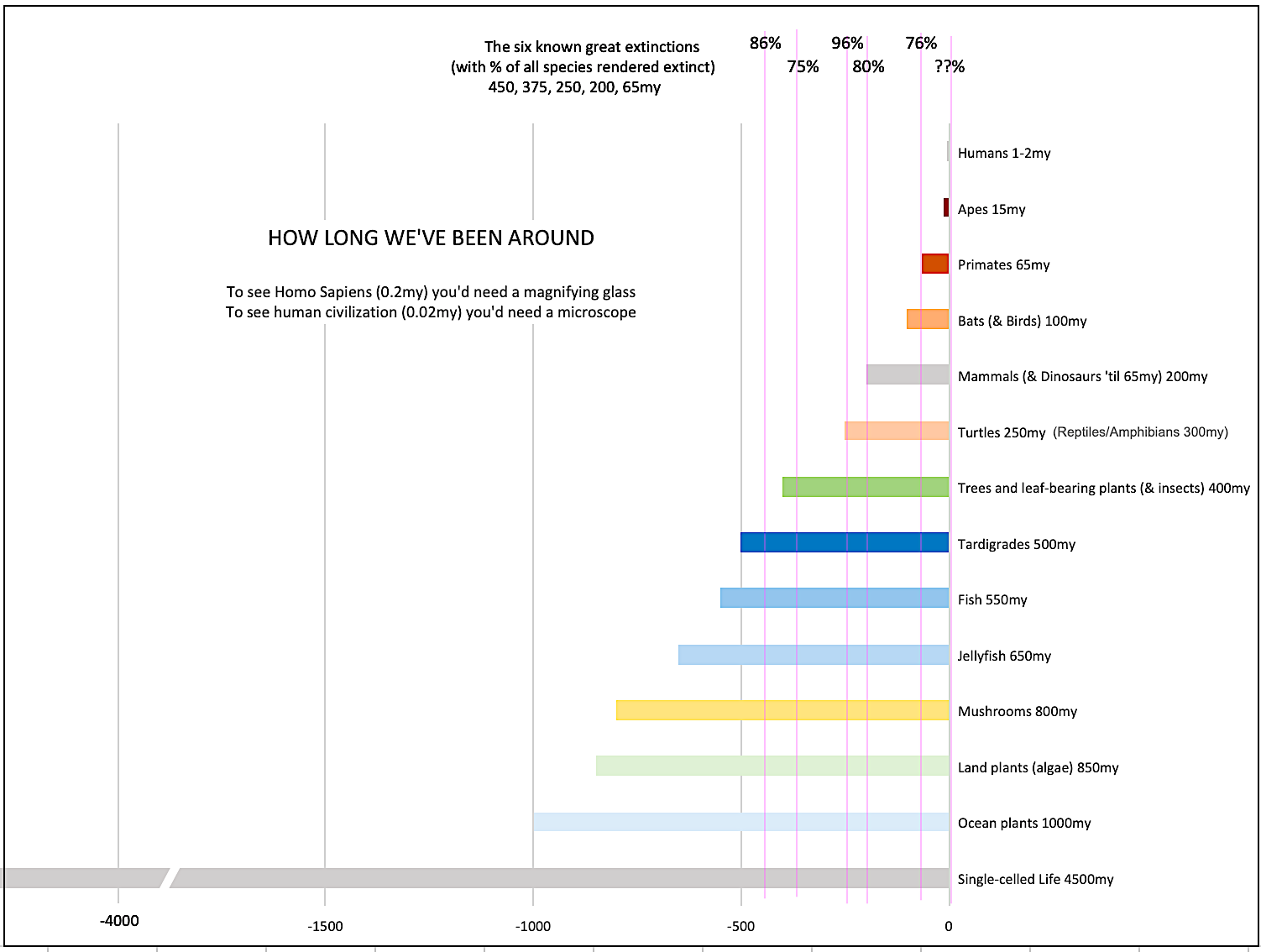
When there were only a few intelligent (and hence ambitious), assertive (and hence fierce) members of our species, there was room in Earth’s laboratory for their excesses. But as they “succeeded”, they grew in numbers and impact, overcoming natural balances and constraints, and finally created a civilization embodying this ambition and ferocity — the industrial growth civilization that has, since its beginning, been catapulting us towards the sixth great extinction on our planet, and the first “caused” by a living creature. Our world is now exhausted, overcrowded with humans and our decaying artifacts, and taxed to the point we are all suffering from stress-related physical and mental illnesses.

As we begin to realize this, our tendency is to think that the way out of the excesses and crises of industrial growth is, not surprisingly, more of the same. If our intelligence and ingenuity have gotten us into this mess, perhaps technology and innovation can get us out of it? If ferocity and assertiveness have created the problem, perhaps great collective determination, hard work under some brilliant and inspiring leader, and if necessary violent subjugation of those not doing their share, is the answer? And both progressives and reactionaries see centralization — globalizing and making even more “efficient” what we are already doing — as the means to make things better, though for progressives it is globalizing and centralizing “rights” and social services, while for reactionaries it is globalizing and centralizing the military and industry.

Einstein famously said that you cannot solve a problem with the same kind of thinking that gave rise to it. But that is the kind of thinking that the vast majority of people have, thanks to natural selection, and there are no levers of power that will allow a small minority with some different kind of thinking to prevail over the majority, not for long anyway, and not enough — there is, after all, no one in control of our industrial growth civilization, no switch that anyone can flip to stop it.

Most people find the above analysis terribly defeatist and pessimistic. Since I read John Gray’s Straw Dogs, however, I have found this realization liberating. “We cannot save the world”, Gray says, “and happily it doesn’t need saving… Homo rapiens is only one of very many species, and not obviously worth preserving. Later or sooner, it will become extinct. When it is gone Earth will recover. Long after the last traces of the human animal have disappeared, many of the species it is bent on destroying will still be around, along with others that have yet to spring up. The Earth will forget mankind. The play of life will go on.”

So what, if anything, should we do, now that our creaking and unsustainable industrial civilization is beginning to fly apart?

I think it depends on what you’re good at, and what you have passion for. There is a need for rear-guard actions to mitigate what Ehrenfeld calls the “desperate ruthless struggles over the wealth that remains” and “the last great violation of nature.” There is a need for reskilling ourselves and our children and grandchildren with the essential capacities needed to make it through the difficult transition to a post-collapse world. There is a need for models, at the community level, of more sustainable and resilient ways to live and make a living.

I don’t have the ferocity (or energy or courage) for the rear-guard actions, the good fight that activists have always fought and will continue to do so until the end. I am open to supporting them, however, with my imagination and my writing ability, if they think that would be of use. I am working slowly to learn or relearn some essential capacities so that I will be less helpless as our civilization faces the crises ahead. And while I’m not sure I have the patience (or collaborative ability) to help build real-world models of more resilient local community, I am exploring ways to combine my gifts for writing and imagining possibilities in some unique ways (games, visions, simulations?) that might help others cope better, or see their way through these crises better. As I wrote recently, I think the key to resilience will be our ability, in the moment, to imagine ways around the crises we cannot prevent, predict or plan for, and I think I can help with that, at least at the local level.

There’s something happening here, and it’s the beginning of the end. The signs are everywhere. There is no reason to celebrate (it is going to be a hard ride, and there will be no Rapture, no collective consciousness rising, no deus ex machina invention, or other form of salvation). And there is no reason to despair. We were unable to change, so now change is being imposed on us.

Sproing. There goes a chunk.

April 22, 2011

Letting Go

Filed under: Our Culture / Ourselves — Dave Pollard @ 22:34

Surf_the_Sky_Paragliding

paragliding photo from wallpapers.org

I have started working on a project with Cheryl to create a place on our island in Second Life that will allow our members and visitors to go through a “letting go” exercise. The idea is that they will have their avatar (the character that represents them in the Second Life virtual world) willingly jumping off our island’s mountain, and being wafted by updrafts as they consider what is involved in “letting go” of some thought and/or feeling that is holding them back from being happy and truly themselves, and then landing safely on the ground. It’s intended as a metaphoric journey that may enable them to make a similar liberating journey in real life.

There are many, many websites, self-help books, methodologies and therapies that prescribe ways to “let go”. We are not presuming to tell people what to do or how to self-treat illnesses, phobias or traumas. We recognize that in the immediate aftermath of a tragic or unexpected event, not only should one not “let go” of one’s feelings, they are an essential and healthy reaction and part of the coping and healing process. We also recognize that treatment of profound or chronic mental stress and illness may need professional counsel, or at least the support of people who have the context to appreciate and guide the healing process. But in many cases the need to “let go” is just a matter of self-acknowledging, understanding, appreciating and accepting what is, and what we’re trying to do is create an experience to help people get past their “stuck” places and do this.

So with those caveats, here are some of my early thoughts on what the Letting Go experience might look like.

For those not familiar with Second Life, it’s a virtual world, created by its millions of “residents”, in which the residents create an avatar (a customized cartoon-like character) to represent themselves, and interact with others and the places they have “built”, in real time. Many people in Second Life create a space that gives them what they can’t or don’t have in real life — often a great body, youthful face, dazzling wardrobe, ideal home and longed-for possessions — and allows them to safely act out their avatar’s life anonymously, and in the process practice social skills, learn about themselves and other people, role-play doing things they would never dream of doing in real life, and even fall in love.

The magic of Second Life is that behind each avatar is a real person. And of course those real people have real feelings and real issues, one of which, often, is the inability to let go of thoughts and feelings that hold them back from being who they are, from being happy, or from doing what they really want to do.

Here’s how the Letting Go ritual might work:

  1. You walk up the mountain trail thinking about what it is that you want to let go of. It might be a cycle of thoughts and feelings that brings you a recurring sense of grief, sadness or shame. It could be some idea or situation that repeatedly instills anger. It could be some irrational belief, hope or expectation that imprisons you. It could be some constantly triggered anxiety or fear. As you walk up the trail, you just think about it, name it, articulate it in your own mind.
  2. As you reach the top of the mountain, you now have clarity about the thought or feeling you want to let go of. Now, you state it, in whatever way works for you. You might just say it quietly. You might shout it, or sing it, or dance it. You might write it down. You might draw it, or otherwise portray it visually.
  3. At the edge of the mountain, you pick up a rock from a rock pile. This rock symbolizes and embodies what you want to let go of.
  4. Now, you jump. Initially, you fall quickly, but as soon as you throw away the rock, your descent slows and stops, and breezes begin to waft around you, and you are carried by the updrafts so that you are “flying” instead of falling. You might choose to say certain affirmations as part of the Letting Go process, such as
    • I acknowledge and honour my feelings and thoughts as valid and real for me.
    • I will give myself time to understand and heal the damage that holding on to this thought or feeling has caused me.
    • I will spend some time focused on things that I enjoy or care about as I’m working through this issue.
    • I will accept what is, and what can’t be changed, predicted or controlled.
    • I will accept that I am a good person, and be good to myself.
    • I will seek closure about these issues, so they will not be re-stimulated in future if similar situations arise.
  5. Finally, you land gently on the ground. At your feet, there is a selection of shells, crystals and other beautiful mementos of your “letting go”. You select one that you like, which you carry as a reminder of this experience, so that if/when something happens to you that might once have provoked the old thought or emotion, you can look at it and remember that you have let go of this thought or emotion, and that it no longer troubles you.

I am not an expert in ritual, so I’d value your thoughts on this idea. What do you think?

April 18, 2011

First, Self-Accepting

Filed under: Our Culture / Ourselves — Dave Pollard @ 13:57

forest-france-Luca-Montanari

forest in France — photo by Luca Montanari

~~~~~

Go for long walks.
Indulge in hot baths.
Question your assumptions,
Be kind to yourself,
Live for the moment,
Loosen up, scream,
Curse the world,
Count your blessings,
Just let go. Just be.

— Carol Shields

~~~~~

For more than eight years now this blog has chronicled my discovery of, and attempts to articulate, how the world really works, and how we might find ways to live better. It’s mainly been written as a public diary of my personal journey of learning and self-discovery, and my search for what I’m meant to do, and how I’m meant to be of use to the world.

When I retired from paid work a year ago, I thought I knew what I would do with my time. I was wrong. Instead of giving back to the world, and working on the projects (like stopping the Alberta Tar Sands, and ending factory farming) I had intended to work on, I have spent most of the past year doing nothing, and wondering why. It is likely a combination of exhaustion, anxiety, inability to handle the sudden freedom, and bewilderment at having too many choices, and not enough.

So for the past six months I’ve been trying to follow a set of principles of personal awareness and behaviour. My hope is that, if I can learn to be truly myself, in the moment, aware and relaxed, I will best be able to see what is, and hence know what I should do, both in the moment, every moment, and intentionally over the longer term.

Those principles are:

  • [In relationship to self]: To self-accept and self-manage, and let go of stories. I have been trying to understand myself better, and not try to change or “improve” myself. I now accept that I am most “myself” in warm, beautiful places, and when I am in love. I accept that I handle stress badly, and that I cannot hope to avoid stress in my life, so I need to be aware of it, and of whatever I’m feeling and thinking, and assess and cope with it appropriately. And I have been working to let go of the stories I’ve come to believe about Gaia’s dying, about (what I perceive as) people’s cruel and stupid behaviours and beliefs and unreasonable expectations, about what I imagine will happen if my worst fears are realized, and about my own perceived “failings”.
  • [In relationship to others]: To be generous and appreciative. I have been trying to help others, to give, to share, to be open, to see the best in people and situations, to be thankful, and to help radically imagine and generate new things and ideas and possibilities.
  • [In relationship to Earth]: To live naturally and presently. I have been trying to reconnect with my senses, my emotions, and with all-life-on-Earth, to trust my instincts, to value my time and enjoy its passage, to live sufficiently and sustainably and resiliently and not fearfully, and to learn to be more present in the moment.

I am told I have been modestly successful in doing these things recently, largely, I suspect, because they don’t require me to be anything other than who I am or do anything I am not inclined to do anyway.

Yet I have a long way to go. I’m not a patient person. I keep making the same mistakes, of unawareness and insensitivity, of inarticulateness, of inattention, of inappropriate reaction, of mismanagement of my time. I’m behind in my blogging and in my project work, and haven’t allowed enough time for reflection and creative writing. I have tried and pretended to be somebody else for so long it’s infuriatingly difficult to just be myself, to just be. I can’t “just be” until I have a good sense of who I really am, under all the “not-me” gunk that has become, over the years, attached to me.

So now I’m forgiving myself. I’m doing the best that I can. The work of saving the world, or my tiny portion of it at least, will inevitably go better when I’m present and ready for it, and when I know at least a bit better what “it” is.

What might “it” be? Damned if I know. I’ve decided to let go of presupposing to know what I’m intended to do to be of use to the world. I have some thoughts, but my sense is that if these things were really my intended purpose I would already be pursuing them, relentlessly. Here are a few things that might be my intended purpose, and why they might not:

  • Writing a collection of poetry and songs, or a film. But isn’t this just a self-indulgence? What are the chances my work will be good enough, and sufficiently recognized as such, to make a real difference?
  • Developing a series of games that are collaborative instead of competitive, consensual instead of violent, clever instead of derivative, experiential and immersive instead of pedagogical, that could improve how we learn about ecological, social and other complex systems. Such games could allow us to learn more powerfully and enjoyably about transition, about effective facilitation, about living in community, or even about ourselves (I’ll be writing soon about a project I’m working on to create a metaphoric “letting go” experience in Second Life.) Such games might even enable us to shift our perception in important ways that traditional learning tools (courses, books) can’t do. Imagine for example if we could, by entering into a simulated world that has no “clock time” but operates in the “Now time” of wild creatures, completely change our sense of time and free ourselves from its control over our lives, and its constraints? All interesting ideas, but would our dumbed-down, incurious, complexity-loathing culture ever accept such an innovation? And can we really be radical and bold enough in what we imagine to deliver on such a promise anyway?

I believe that my ability to write and to imagine possibilities are my gifts to the world, the things I do uniquely well. Perhaps my way of being of use to the world involves applying both gifts in ways that no one has ever done quite the same way before. Perhaps instead of writing words I’m meant to write musical notes, or images, or scripts of one sort or another, or some new construct for communicating meaning and for imagining that hasn’t even been invented yet.

I believe the key to resilience in the coming decades will be our ability, in the moment, to imagine ways around the crises we cannot prevent, predict or plan for. Maybe I can help with that.

I am hopeful enough these days to believe I could yet become the existential creature I once aspired to be: just “the space through which stuff passes, touching the right stuff in just the right way as it passes through.”

But I think I must start with the work of self-knowledge and self-acceptance, generosity and appreciation and imagination, living naturally and presently. That’s the road I am, at last, falteringly, taking.

~~~~~

PS: Last month my friend Joe Bageant died. I had the privilege of visiting Joe in his tiny writing studio in Hopkins Village, Belize. Joe taught me the importance of understanding why things (and people) are the way they are, before we begin any work to try to change them. And he taught me that community is born of necessity, so, while we might imagine it, we cannot hope to build a sustainable community-based society until the fall of our globalized industrial society is well-advanced. Damn. We will miss you, Joe.

Powered by WordPress