Dave Pollard's environmental philosophy, creative works, business papers and essays.
In search of a better way to live and make a living, and a better understanding of how the world really works.


July 30, 2011

The Second Denial

Over the past decade, a significant proportion of the world’s population has moved past denial that human activity is killing our planet, and that our current way of life is utterly unsustainable. But very few have moved past denial that our civilization is finished, most likely in this century, that there’s nothing we can do to prevent it, that the descent, as civilization crashes, will cause much damage and suffering, and that our human descendents will be much fewer in number and live radically simpler, relocalized lives. I call this the Second Denial.

Until we get past this second denial, most of those privileged and enlightened enough to have been able to move past the first denial will continue to waste everyone’s time and energy trying to “reinvent” civilization, prescribing utopian technological, innovative, behavioural or social fixes to prevent collapse.

Meanwhile, those who have not yet moved past the first denial will be doing everything in their power to sustain the industrial growth status quo. They include:

  • The corporatists who “own” most of the land, resources and media, whose vast stolen wealth is fiercely and relentlessly devoted to generating even greater acceleration of industrialization, resource use, production, and control and propagandization of their “consumers”, no matter the cost, because as soon as growth stalls, they lose everything;
  • The billions (mostly in struggling nations) who aspire to live the way the well-off in affluent nations live today, and who don’t understand why this is impossible; and
  • The passive consumers of affluent nations who have been bred from birth to be fearful of change and who cling desperately, even violently, to the American Dream of universal prosperity and endless “progress”.

As our civilization begins to reel under the combined effects of the end of cheap energy, the end of stable climate, and the end of the industrial growth economy, this majority will resist every attempt to mitigate the damages our civilization is causing, in the desperate hope that they can get, or keep, a piece of the Dream. Those already struggling will do everything they can to stay alive as civilization crumbles, including razing what’s left of our forests, building nukes, burning coal, and exhausting the world’s fresh water. Complicit with them will be the passive consumers, who will give anything to protect their lifestyle — the only way they know to live — and the corporatists, dependent on never-ending bailouts and ever-increasing production, consumption and debt for their overly-leveraged, growth-addicted political and economic enterprises.

The informed progressives and idealists who have moved past the first denial will be no match (in numbers, power or desperation) for the billions who believe their survival depends on sustaining the unsustainable. Idealistic progressives’ actions to try to move to a more sustainable way for us all to live, to “reinvent” civilization, or to find some kind of utopian technological or social “solution” that will allow a gentle descent and a soft landing for civilization, will be overwhelmed by the horrific damages the majority will inflict on our planet in the desperate attempt to survive. The result will be more pollution, faster acceleration of atmospheric warming, rapid abandonment of environmental regulations and attempts at enforcement, and more (mostly local) resource wars.

Only when a significant proportion of our species moves past the Second Denial can we start working on mitigating and resilience actions that will actually help those facing the crises of civilization’s collapse. Only when we give up our “we can control this” mentality, and our magical thinking dreams and schemes — belief in and wasted effort on global consciousness raising, spontaneous voluntary massive change, technological cures, gentle transition programs, wishful incremental-change-is-enough (if we all do it) thinking, individual preparedness plans, social/economic reinvention and “innovating our way forward” projects — will we be able to face the stark reality of what our children and grandchildren are going to face because of our stupidity, and get to work on actions to mitigate its worst effects and develop the capacities we and they will need to cope with cascading crises as they unfold.

Since I made my own reluctant way past the second denial, I have found myself arguing more often with those who have worked past the first denial than those who have not. I have been accused of defeatism and “doomer” thinking and “unhelpful” negativity. “We want hopeful projects that make a difference now”, they tell me.

I don’t want to argue. Daniel Quinn said famously:

People will listen when they’re ready to listen and not before. Probably, once upon a time, you weren’t ready to listen to an idea than now seems to you obvious, even urgent. Let people come to it in their own time. Nagging or bullying will only alienate them. Don’t preach. Don’t waste time with people who want to argue. They’ll keep you immobilized forever. Look for people who are already open to something new.

While Quinn was undoubtedly speaking about people still at the First Denial stage, I’ve found his advice works just as well when dealing with people at the Second Denial stage.

But it’s pretty lonely here, too far ahead of myself for my own, or anyone else’s good. Granted, there are some others who’ve made it past the Second Denial: many of the Dark Mountain artists, some grief counsellors who recognize the symptoms of denial, three leading climate scientists I’ve met (a seriously depressed group), some post-civ writers and readers, and some fans of John Gray’s Straw Dogs.

While I’m waiting, I’m trying to understand why so many bright people are still stuck at the Second Denial stage. They really don’t want to hear any information that would push them past denial.

I’ve been looking at the famous (and controversial) five-stages-of-grief model, which is pictured on the chart above. Here’s why I think it’s so hard for people to make it through these stages, starting with the stages of grief related to the First Denial (that our current way of life is unsustainable):

  • Denial: “I can’t believe this is happening”. We’ve always figured out how to overcome problems in the past; this won’t be any different. Look outside, it doesn’t look like anything is wrong. We’ve always been taught, and told, that times have never been better, progress is endless, and our civilization is the culmination of centuries of learning, adaptation and wisdom. And there are a bunch of scientists and other experts out there who say this is all speculation and fear-mongering; I believe them. If it were that serious, we’d know, we’d be acting, our leaders would be fixing it.
  • Anger: “It’s not fair; who’s to blame?” I’ve raised my kids so they’ll have a chance to live better lives than mine, and no one told me this is now impossible. It’s the government’s fault. Someone should go to jail for this. Why didn’t someone do something about this earlier, so it wouldn’t have got to this point? Why is God testing us this way?
  • Bargaining: “I would give anything for this not to be true now”. Let’s do what we have to do — deregulate coal mining and nuclear power development, so at least we put this off for a few generations. Maybe by then there’ll be some better answers that won’t require any real change in behaviour. I’ll drive a smaller car, recycle and turn off the lights, and if we require everyone to do that surely that will buy us some time? Let us pray for salvation.
  • Depression: “What’s the point in doing anything then?” Might as well give up, since nothing that I do will make much of an impact anyway. How do I talk to my kids about this? Was it my fault for not knowing, our generation’s fault for not acting when we had time?
  • Acceptance: “OK, it’s true and I can’t fight it, so what can I do now?” Lets see what will be needed to make the transition to a way of life that is sustainable. I’m willing to sacrifice more now, so that future generations will have a good quality of life. Let’s tell everyone about this, get global consciousness up to the point we’re all working to make it better. God will look after us anyway. And human ingenuity, when push comes to shove, can find ways to make life both sustainable and materially comfortable, so we don’t really have to change much. Let’s get on with it.

And now, the stages of grief related to the Second Denial (we can’t prevent collapse, and it’s going to be profound and difficult):

  • Denial: “I can’t believe this is happening”. Civilizations don’t die. We’re living in the greatest time ever, a time when the human species has learned and invented more than ever before in history. We’ve put people on the moon, so surely we can solve this problem. I don’t want to hear this defeatist crap. If we all work together, there’s nothing that can’t be done. There are signs everywhere of global consciousness raising — we still have time to reinvent civilization to be sustainable, and even better than it is now. And the people I trust tell me not to worry — that this is just a temporary hiccup before we get back to healthy sustainable growth again. If it’s really that bad, why isn’t anyone talking about it, and why aren’t the signs of it obvious?
  • Anger: “It’s not fair; who’s to blame?” Damn the corporatists, the lawyers, the greasy politicians and governments, the neo-cons, the people with large families, the people with large SUVs, the media, stupid fucking moronic people in general — they’ve conspired and been complicit in letting the world get to this impossible place. We were crying for action when we saw this crash coming and everyone else was just arguing over the seating arrangements. Humans are so greedy, so selfish, so thoughtless, so ignorant. When things get hard, I’m just going to look after myself and to hell with everyone else. My spiritual icon, why have you forsaken us, you’re supposed to look after us?
  • Bargaining: “I would give anything for this not to be true now”. If civilization is doomed anyway, why not live it up, take everything we can get, ratchet everything up to get a few more years of good life. Turn off that bad news, I’m convinced already, we’re fucked, I don’t want to hear about it anymore. Tell me you still love me, that you know we all did our best, that we’re not to blame, that it’ll be OK at least for a while longer. Buy me a spaceship, find me an all-powerful saviour, transplant my consciousness into something that will survive the crash.
  • Depression: “What’s the point in doing anything then?” It’s hopeless. Might as well blow it all up now and stop the suffering early. It’s only going to get worse. Our children and grandchildren are going to hate us forever for what we’ve done to them.
  • Acceptance: “OK, it’s true and I can’t fight it, so what can I do now?” John Gray:

The mass of mankind is ruled not by its own intermittent moral sensations, still less by self-interest, but by the needs of the moment. It seems fated to wreck the balance of life on Earth — and thereby to be the agent of its own destruction. What could be more hopeless than placing the Earth in the charge of this exceptionally destructive species? It is not of becoming the planet’s wise stewards that Earth-lovers dream, but of a time when humans have ceased to matter…

Humans use what they know to meet their most urgent needs — even if the result is ruin. When times are desperate they act to protect their offspring, to revenge themselves on enemies, or simply to give vent to their feelings. These are not flaws that can be remedied. Science cannot be used to reshape humankind in a more rational mould. The upshot of scientific inquiry is that humans cannot be other than irrational…

We can dream of a world in which a greatly reduced human population lives in a partially restored paradise; in which farming has been abandoned and green deserts given back to the earth; where the remaining humans are settled in cities, emulating the noble idleness of hunter-gatherers, their needs met by new technologies that leave little mark on the Earth; where life is given over to curiosity, pleasure and play. There is nothing technically impossible about such a world…A High-tech Green utopia, in which a few humans live happily in balance with the rest of life, is scientifically feasible; but it is humanly unimaginable. If anything like this ever comes about, it will not be through the will of homo rapiens

Political action has come to be a surrogate for salvation; but no political project can deliver humanity from its natural condition. However radical, political programmes are expedients — modest devices for coping with recurring evils. Hegel writes that humanity will be content only when it lives in a world of its own making. In contrast, [this book] Straw Dogs argues for a shift from human solipsism [belief in our aloneness and our disconnection from everything else]. Humans cannot save the world, but this is no reason for despair. It does not need saving. Happily, humans will never live in a world of their own making…

Homo rapiens is only one of very many species, and not obviously worth preserving. Later or sooner, it will become extinct. When it is gone Earth will recover. Long after the last traces of the human animal have disappeared, many of the species it is bent on destroying will still be around, along with others that have yet to spring up. The Earth will forget mankind. The play of life will go on.

[And in the meantime, he says, we should take joy in the astonishment of being alive, in idle pleasures and play, and in reflection, contemplation and living in the Now; we should be as responsible as we can in the context of our own communities, and take consolation from the value of our just actions even though their impact is small; and we should fill our lives with awareness, new experiences, love and learning, and just be.]

The stages-of-grief model is far from perfect, but it describes pretty well the roil of most of the people I know who are transitioning past either the First Denial or the Second. When you are coping with grief of the kind this terrible knowledge invokes, it is easy to get stuck, to backslide into earlier stages, even to experience all the stages at once.

I’m not an advocate of feeling grief just to progress past denial. My guess is that many people can’t handle it, and are probably better off living in denial, at least as long as possible. I’m just suggesting that when I got past the Second Denial I found it very painful, much more painful than what I felt when I moved past the First.

Denial is certainly understandable, especially when it relates to something as massive, impersonal, gradual, “invisible” and unimaginable as collapse of a civilization. Studies of past civilizations suggest their citizens believed they would last forever too. Talking about civilization’s collapse is even less socially acceptable than talking about climate change — the kind of subject that leaves people uncomfortable, depressed, feeling helpless, and anxious to “change the subject” (or the channel).

As long as there are 1000 articles talking about the importance of returning to economic growth, increasing profits and GDP, for every article advocating a zero-growth economy, it is those who have moved past the first denial who feel cognitive dissonance with what they know to be true, not the First Deniers. And when there are even fewer articles saying that even moving to a steady-state economy is a pipedream, and that what is needed is actions to dismantle the worst elements of the industrial growth economy now, it is no surprise that talk of the need for such actions causes the eyes of First Deniers to roll back in their heads, and brings exasperated cries of “doomer”, “unhelpful”, “defeatist” and “polarizing radical” from Second Deniers who feel caught in the middle. They are caught in the middle, just as those who’ve moved past Second Denial feel isolated and alone.

Richard Bruce Anderson describes the grief that accompanies the First and Second Denials:

At the heart of the modern age is a core of grief. At some level, we’re aware that something terrible is happening, that we humans are laying waste to our natural inheritance. A great sorrow arises as we witness the changes in the atmosphere, the waste of resources and the consequent pollution, the ongoing deforestation and destruction of fisheries, the rapidly spreading deserts and the mass extinction of species. All these changes signal a turning point in human history, and the outlook is not particularly bright. The anger, irritability, frustration and intolerance that increasingly pervade our common life are symptoms associated with grief… Grief is a natural reaction to calamity, and the stages of grief are visible in our reaction to the rapid decline of the natural world…

Even if we face the consequences of our assault on the natural environment, we may still find that the problems are too big, that there’s not much we can do. Yet those of us who feel this sorrow cannot forever deny it, without suffering inexplicable disturbances in our own lives. It’s necessary to face our fear and our pain, and to go through the process of grieving, because the alternative is a sorrow deeper still: the loss of meaning. To live authentically in this time, we must allow ourselves to feel the magnitude of our human predicament.

I’m also suggesting that until I moved past the Second Denial I was one of those idealists who wasted a huge amount of time and energy (mine and others) on dreams and schemes to “save the world” — by means of innovation, technology, mass behaviour change, consciousness-raising and the other forms of salvationist magical thinking, the kind that the deniers of the inevitability of civilization’s collapse so love. And from my perspective the sooner we get past dreams of salvation, and move on to undoing, stopping and mitigating the worst current effects of industrial civilization (like the Alberta Tar Sands and factory farming) , the better.

We can stop some of the suffering, and the destruction to our planet, if we’re willing to take the (potentially enormous) risks that stopping it entails. Hoping and expecting that we (a) will invent our way out of it, or (b) can persuade billions of people to stop supporting it and thus disable it, is just wishful thinking, and it’s useless.

I don’t know if I’m prepared to take those risks. But my reticence is not due to denial that the Alberta Tar Sands and factory farming are atrocities creating massive destruction and suffering, or denial that stopping them wouldn’t be of enormous benefit to the world, or denial that there is no magical way to achieve the same end safely and gently. And these atrocities are, in microcosm, what is happening with our entire industrial civilization.

Perhaps when there are more of us…

July 29, 2011

The Limits to What You Can Learn Online or Alone

Filed under: Our Culture / Ourselves — Dave Pollard @ 02:55

I want to learn to meditate. More than that, I want to learn presence, the art of being in the moment, aware, relaxed, attentive, competently and appropriately responsive and adaptive, taking everything in intellectually, emotionally, sensuously, and instinctively, collecting, engaging others, letting things come, challenging, playing imaginatively and creatively with them, reflecting, understanding, synthesizing, integrating, acting responsibly and passionately, and letting go of what I cannot change or control. I think this is an essential competency, and I suck at it. I’m unintentionally inattentive and insensitive, and I have a terrible memory.

I am a great belief in self-directed learning — that, with sufficient self-knowledge, we are vastly better off deciding personally when, what and how to learn, and learning our own way at our own pace, than relying on education systems and processes that inflict a one-size-fits-all process that presumes what we should know and how we should best learn it. Most of that self-directed learning is solitary (though a mentor might be selected to bounce questions and ideas off).

I am also a great believer in on-line learning, since the essentially infinite resources of the web are vaster in breadth, depth and media than any preset course or curriculum taught in a classroom could ever hope to match.

But I’m learning that there are limits to what you can learn online, and what you can learn alone, even if your research and self-directed learning skills are exemplary. For example I have tried a dozen self-paced, self-directed ways to learn to meditate, from books, recordings and even a few real-time mentored telephone and face-to-face instructional sessions (thanks in particular to Indigo Ocean). Still, I cannot meditate.

I have come up with several excuses for this:

  • I have taken hands-on courses in swimming, dancing and playing musical instruments, and haven’t learned from them either, so perhaps the problem isn’t that I’m trying to learn meditation online, it’s just that I’m hopelessly uncoordinated.
  • I haven’t practiced much. There is a substantial consensus that learning difficult skills like meditation often only occurs with lots and lots of practice. So perhaps the problem is lack of practice, combined with lack of patience.
  • There are limits to what anyone can learn, period. Perhaps with meditation I’ve just pressed up against another of those limits.

But I find these excuses unconvincing.

I’m wondering whether some critical skills and capacities are far better learned face-to-face, real-time, in a group. We often learn well from observing others doing and learning. And it seems almost ludicrous to think that essential skills like collaboration, empathy, mentoring and facilitation could possibly be learned online or alone, no matter how brilliant the simulation of others’ presence the Internet or self-paced learning exercises and case studies might provide.

My friend Raffi asked me the other day if I think I can really learn to meditate without a real-time, real-space ‘expert’ teacher. Reluctantly, I’m beginning to think the answer is no.

We all learn differently, of course, and for each individual there is a need for different types of learning to acquire different knowledge, skills and capacities. The chart above summarizes everything I’ve learned over the years about learning styles, along with a few really outrageous generalizations. I have always aspired to learn naturally (the left-side choices in the table above). However, thanks to my upbringing, my learning style might more accurately be labelled Old Liberal Male learning style.

Most of my actual, meaningful, useful learning (none of it in educational institutions) has come from either (a) solo research and study (mostly online) or (b) conversation and collaboration with people in real time and space (mostly working on real, long-term, important projects). I find (a) easy and fun, and I’m good at it. I find (b) arduous, and I’m terrible at it. I talk a good story about the value and importance of stories, learning-by-doing, empathy, learning from mistakes, facilitation, conversation and collaboration in community, and I really believe it, but if you want someone with skills in any of these areas, you had best look elsewhere.

Hence I am constantly bumping up against the limits of what one can learn alone and online. Here’s a controversial list of things I believe you can’t learn (very well) alone and online (or from books for that matter, since they’re more or less all online now):

  1. The social skills and capacities of getting along well and effectively with others (e.g. empathy, facilitation, conversation, collaborative skills, consensus, invitation, conflict resolution, improvisation, elicitation, story-telling).
  2. The wisdom of crowds (it’s just too hard to organize group brainstorming, focused knowledge-sharing, and Open-Space style creative interactions online).
  3. Anything about human nature.
  4. To really know yourself.
  5. Most self-sufficiency and survival skills.
  6. What you’re meant to do in this world, and with whom.
  7. How to be more truly yourself (e.g. generosity, vulnerability, taking responsibility, caring, drawing on instinct, intentionality, adaptation, resilience).
  8. How to really play.
  9. How to make a living for yourself.
  10. Competencies and capacities that require real-world practice (e.g. meditation, being present, languages, physical recreations and sports, dealing with illnesses and traumas, self-management, acceptance, and a host of technical skills).

This is an important list, and it’s just off the top of my head. What’s even more annoying is that learning a lot of these things doesn’t lend itself well to natural (or Old Liberal Male) learning styles.

So if I’m serious about learning to meditate and become present, not only am I going to have to turn off the computer and get with other people in real space and time, I’m going to have to try a new style. I may have to be perseverant and studious, learn to accept and follow instruction, follow a prescribed curriculum, get results-orient, and practice, a lot, even when it’s no fun. Ugh. Do I really want to learn this that badly?

That’s really what it comes down to, when push comes to shove on difficult learning. Pollard’s Law states: We do what we must (what we ‘have’ to do, our personal imperatives), then we do what’s easy, and then we do what’s fun. For me at least, learning meditation and presence is not going to be easy or fun. Is it enough of a personal imperative that I ‘must’ learn it, or will I fall back into the habit of doing things that are easy and fun instead?

The answer to that question is depressingly obvious. Things are the way they are for a reason. I have the time to learn these things, and I know I want to learn them, but I’m not doing it. Same applies to a lot of the things I think I want to do. Instead, I’m learning about and playing with Google+, online and alone (easy and fun). I know my limits.

July 26, 2011

Dreaming of Prehistory

Filed under: Preparing for Civilization's End — Dave Pollard @ 20:05

I‘ve explained before that I’m not a believer in the myth of the Noble Savage. We are by nature, when faced with adversity, fierce creatures, capable of extraordinary violence and cruelty.

I’ve also written that, as many contemporary anthropologists have explained, the claim that prehistoric humans (i.e. humans prior to the recording of our culture, which began about 30,000 years ago) lived short, brutal, dangerous lives is complete nonsense. Although we can never know for sure, and while the believers in endless “progress” continue to pour on the propaganda that life has never been better, there is now compelling evidence that:

  • Prehistoric humans who weren’t eaten by predators or struck down by diseases lived long (70-90 year) healthy lives. They suffered few illnesses except in areas of temporary overcrowding, had almost no dental diseases, musculo-skeletal or chronic diseases, and exhibited almost no signs of malnutrition.
  • Because there was abundant food and an ideal climate at hand in the forest, and our numbers were small, we were, for most of our first million years on the planet, vegetarian gatherers (our running speed, teeth and fingernails are not designed for hunting or eating raw flesh), who “worked” to provide for our essential needs only about an hour a day. The rest of our time was spent in leisure.
  • Prehistoric humans were tribal, communal, generous, social, cooperative and peaceful. Only on rare occasions, when tribal territories were invaded by another tribe which had (most likely) suffered from some natural catastrophe and were in search of new land, did we exhibit violence, and then it was fierce and short-lived. This is nature’s last resort, when peaceful means of dealing with unsustainable numbers (like diseases, and falling fertility rates) fail to rectify the balance.

With the advent of climate crises like the ice ages and volcanic supereruptions (which may have repeatedly reduced human population to a few thousand people, perhaps as recently as 70,000 years ago), our species would probably have become extinct, had it not been for our extraordinary intelligence and (in desperate times) ferocity. First, we invented the wedge (the arrowhead, knife and spear) about 30,000 years ago, during the latest ice age, which allowed us, for the first time, to catch and eat large animals, so we could survive outside the jungle, our natural homeland for a million years. We then discovered (independently it seems, in many places around the globe) catastrophic agriculture about 10,000 years ago, which allowed us to settle. The result is the civilization we write about in our history (we have conveniently forgotten how we lived for a million years before history and civilization). Jared Diamond explains the consequences:

As population densities of hunter-gatherers slowly rose at the end of the ice ages, bands had to choose between feeding more mouths by taking the first steps toward agriculture, or else finding ways to limit growth. Some bands chose the former solution, unable to anticipate the evils of farming, and seduced by the transient abundance they enjoyed until population growth caught up with increased food production. Such bands outbred and then drove off or killed the bands that chose to remain hunter-gatherers, because a hundred malnourished farmers can still outfight one healthy hunter. It’s not that hunter-gatherers abandoned their life style, but that those sensible enough not to abandon it were forced out of all areas except the ones farmers didn’t want.

Archaeologists studying the rise of farming have reconstructed a crucial stage at which we made the worst mistake in human history. Forced to choose between limiting population or trying to increase food production, we chose the latter and ended up with starvation, warfare, and tyranny. Hunter-gatherers practiced the most successful and longest-lasting life style in human history. In contrast, we’re still struggling with the mess into which agriculture has tumbled us, and it’s unclear whether we can solve it.

No one is to blame. We did what we had to do to survive the catastrophic effects of climate change — and that has precipitated the sixth great extinction of life on Earth. We cannot change who we are, and we cannot undo what we have done. What is interesting to ponder is if, as I and an increasing number of students of history and current events believe, our civilization will crash by the end of this century, and we will be back to a situation similar to that of prehistory, what might we do then , to avoid repeating “the worst mistake in human history”?

afterculture
(conception of art after the collapse of civilization culture by afterculture)

Suppose that, by 2200, with the collapse of our civilization, the world looks like this:

  • Human population is back to 1800′s level of about one billion people, declining slowly by 1%/year (the reasons for this continuing decline are complex, and I may explore them in another article).
  • About 97% of the population is living as farmers, using a variety of catastrophic agriculture and permaculture methods. Cities are mostly abandoned and used as a source of materials for scavenging for one-off manufacture of essential products, since there is no oil to power industrial machinery to make new mass-produced goods.
  • A high quality of life has been achieved, due to the retention of knowledge about sanitation and disease prevention, and the abundance of scrap materials for building, making clothing etc. Most of our time is spent in leisure activities.
  • There are much lower chronic disease rates, due to less stress, less pollution, and improved nutrition. Frequent pandemic diseases, however, ravage humans, farmed animals and catastrophic-agriculture crops — Our descendents are still suffering from the effects of lost biodiversity during the last civilization, one of which is increased susceptibility to pandemics.
  • Societies are principally peaceful, and community-based. Everything is done on a small, local scale.
  • Because of drastically reduced contact between communities (motorized travel has ended, and long-distance communications and information technology has proved too expensive to maintain due to material shortages), the new societies are astonishingly diverse and heterogeneous.
  • Conflicts between communities are rarer, partly because contact is rarer, partly because lower population density and falling population means less stress on local resources, and partly because war technologies available for conflict have become unaffordable and fallen into disuse. The few conflicts tend to be between communities ravaged by monoculture crop diseases or severe climate events (mostly a consequence of what our civilization has done to our atmosphere) and nearby thriving permaculture communities.

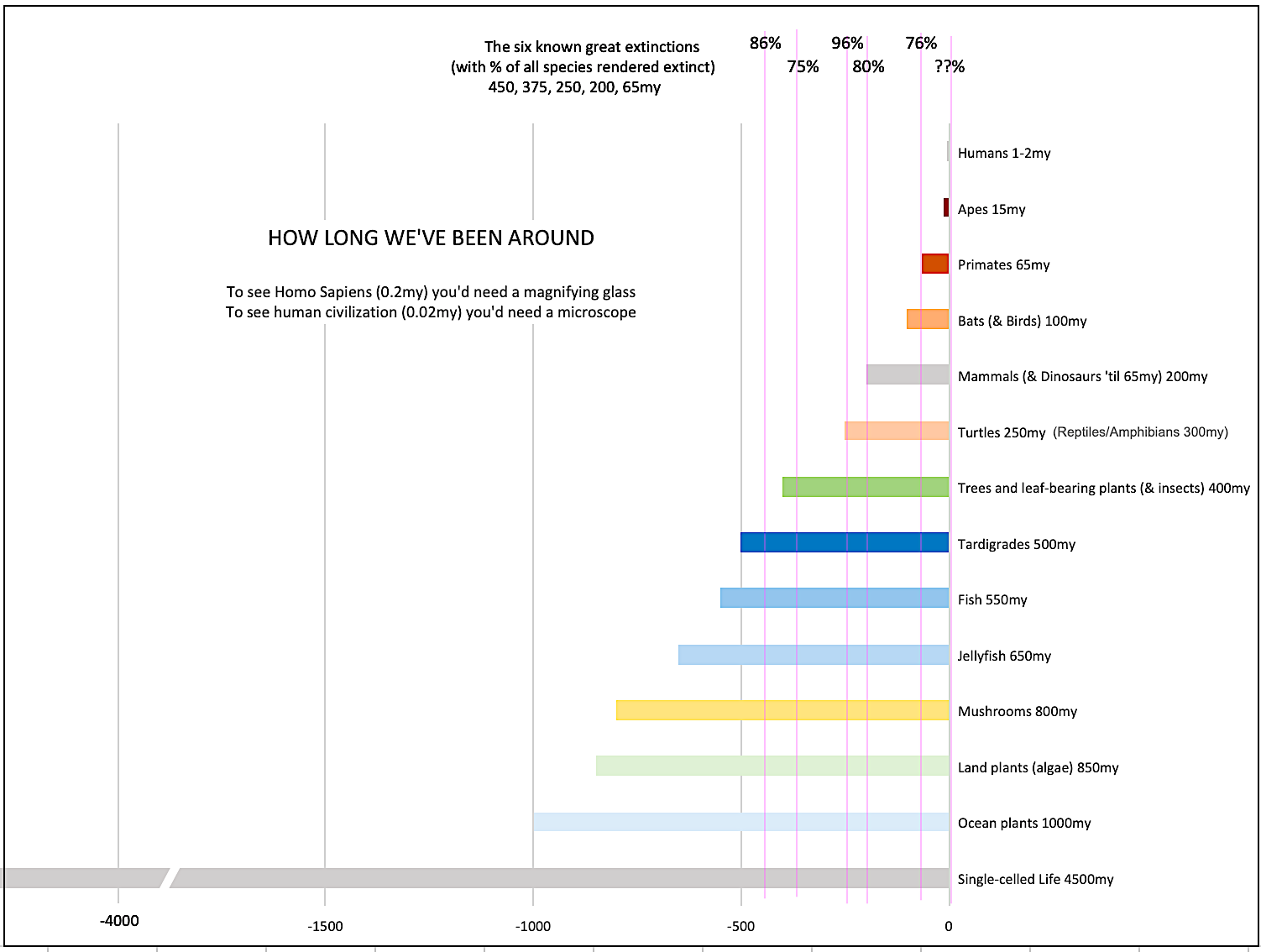
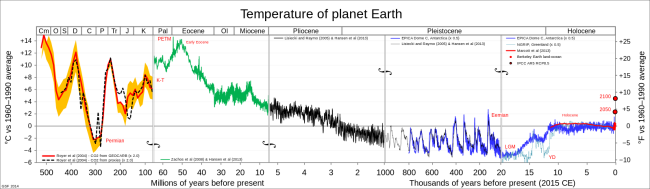
This is not a nomadic, gatherer-hunter society, since even before civilization desolated the Earth and its natural food-production capacity the global population of humans that could be (and was) comfortably supported as gatherer-hunters was only about three million, not a billion (see top chart above). These post-civ societies are, in this vision, slowly migrating from catastrophic agriculture to permaculture (the growing of plants sustainably in such a way that they require no weeding, watering or artificial chemicals, and propagate naturally).

Nature has, of course, always practiced permaculture. It is extravagant and inefficient compared to catastrophic agriculture, which is what she shows us after severe floods, fires and other land-clearing events. Our ancestors thought that the more efficient catastrophic agriculture would serve us better than permaculture, and that is what Jared Diamond calls our “worst mistake”. Might we be smart enough next time to adopt permaculture instead? My sense is that we will, but it will take time and ideological struggle before we get there, and by the time we do our population may well have decreased back to a hundred million or so (perhaps two millennia from now). All other things being equal, this might be the next great time to be living as a human on Earth, a time as full of peace, love, health, joy and abundance for our species as much of prehistory.

But there is another variable that Jared Diamond refers to — population growth. Gatherer-hunter societies self-limited their populations, partly by abortion or infanticide, and partly biologically — these societies nursed their babies until they were old enough to travel on their own feet with the tribe, and natural selection evolved us in such a way that women rarely get pregnant while they are still breast-feeding. So women normally only had one child every five years or so, since more than that would be too much of a burden to carry around on the nomadic treks of the society.

Civilized societies have no such burden, and nature (she works slowly) has not yet evolved a physical mechanism to reduce human fertility naturally (though sperm rates in males are now declining precipitously) to compensate. We have not been smart enough to balance our own numbers in the current civilization. Will we be smart enough to do it in post-civilization societies, especially when population is still declining?

I was thinking about this when I read Sex at Dawn, the book on prehistoric society and sexuality by psychologist Christopher Ryan and psychiatrist Cacilda Jetha. They cite several anthropologists whose conclusions about prehistoric life jibe with my own, above, and how agriculture changed the way we live: “Farmers, afraid of the wild, set out to destroy it.”

They explain how it is in our species’ best interest to be cooperative. Human remains older than 10,000 years show almost no evidence, they say, of violence or injury, especially the types of injury that result from conflict. They also dismiss many of the arguments about prehistoric human behaviour extrapolated from the study of today’s indigenous peoples, explaining that there are no gatherer-hunter cultures left on the planet whose ways of life have not changed drastically as a result of contact with the dominant civilization culture. We are all civilized, now.

They go on to compare the genetic makeup of humans compared to that of other mammals and conclude that we are much closer to bonobos than our other cousins, the chimps. For example, we share an oxytocin-release mechanism that brings us enormous pleasure and relaxation when we have sex, that chimps don’t have at all.

They also argue that, prior to the discovery of catastrophic agriculture, women were equal to men in all respects and in all group activities, because there was no need for specialization. With agriculture and the invention of civilization, the concept of personal property necessarily arose for the first time, and women became, like land and slaves and other ‘resources’, the unequal property of men. And with property came hierarchy, power politics, and then, as Jared Diamond said, “starvation, warfare and tyranny”. And as a result, women, enslaved in a patriarchy of scarcity, became anxious about their own security and jealous of others who had more. Women’s desire for male partners who offer them security, and both males’ and females’ jealousy and possessiveness are not inherent human nature, the authors claim, but the result of what civilization culture has done to us. They rail against the “Flintstonization” of our prehistory and the unquestioned belief (reinforced by the theories of Darwin and Hobbes) that prehistoric humans were much like civilized humans in their behaviours.

In fact, they say, what we know about anthropology and evolutionary biology suggests that prehistoric humans were almost certainly “fiercely egalitarian” (they would have found any hoarding, jealousy or possessiveness highly insulting and contemptible to the tribe, behaviour worthy of ostracism). As part of this fierce egalitarianism, they were, while responsible and nurturing of the young in the tribe, highly polyamorous (sexually active with many partners), free of jealousy, and generous in their openness to sexual advances.

They point to our (and our ancestors’) extraordinarily large testes, high sperm production, huge and constant sexual curiosity and appetite, and natural tendency towards (what is now disparagingly called) promiscuity (original and etymological meaning: “in favour of mixing without discrimination”), as evidence for their claim that, rather than competing for mates before copulation (as most mammals do), we are like the bonobos in letting our sperm compete post-copulation to ensure the optimal diversity and health of our offspring. Hence we are wired, they claim, to have sex often (many times per day) and without discrimination with many members of the opposite sex. Hence:

  • the multiple orgasm capacity and loud vocalizations of women in sex, to attract more males, and make multiple couplings pleasurable for women,
  • the fact that women’s orgasms tend to draw in the current partner’s sperm and expel the previous partner’s,
  • the fact that having lots of orgasms reduces aggressiveness and stress and makes daily tribal life happier,
  • the fact that paternity was impossible to establish and hence must have been irrelevant in prehistoric cultures, and
  • the fact that monogamous marriage is such immensely difficult, unhappy, self-effacing work, and so often fails to last.

If prehistoric humans had a name for the members of their tribe they had sexual relationships with, that word would not be “spouse” or “partner” or any other word implying some form of exclusivity. It might instead be “consort” — literally “someone one shares and joins with”. We are meant, the authors conclude, to enjoy a lot of sex every day with many “consorts”, because it feels good, and is good in every way for us and our “tribe”.

So back to the question of whether or not, especially if we were to give uncivilized vent to our normal voracious sexual inclinations, a post-civ society would be able to control its population to avoid all of the problems that overpopulation produces. What’s interesting is that, despite their sexual promiscuity and vitality, bonobos on average give birth (to a single baby of course) only every five to six years — which is how long they nurse their young. Even before human habitat destruction made them an endangered species, their population was kept stable by the natural “birth control” of lactation, and by natural predators and diseases.

Post-civ human societies may well go back to nursing their young for four or five years, which may, in a healthy, natural human population, drastically reduce birth rates. Nature has already reduced human male sperm rates, though some of this may be due to high stress rates, hazardous substance abuse, environmental factors and modern malnutrition. But if post-civ societies retain our knowledge of health (especially sanitation and disease prevention), and if populations of human predators only slowly return to levels sufficient to significantly affect human numbers, what are the chances we will be able to avoid another human population explosion, and the commensurate catastrophic problems that would produce, all over again?

Perhaps I’m a dreamer, but I think the odds are pretty good. As our descendents rediscover that they are an integral part of all-life-on-Earth, and reconnect with each other and with the land where they live and the other creatures who belong to that land, I think they will instinctively and voluntarily reduce their birth rate to levels that are sustainable. I would argue that the low birth rates in affluent nations today are due primarily to awareness and hard-nosed adjustment to economic realities rather than a conscious or unconscious altruism, since citizens of those nations are especially inculcated in the civilization culture that inherently disconnects us from each other, from our senses and instincts, and from all life on Earth, and treats “the environment” and its inhabitants as an “other” for our arbitrary and exclusive use.

I’m also concerned that, along with the rest of the oil-economy-driven mass-produced trappings of global civilization, post-civ humans will probably not have access to reliable birth control products.

But somehow or other I believe that reconnected humans will just know that they have to reduce their numbers back down to the levels of sustainability. There is something about living a natural life integrally, as part of all life on Earth, that drives you to behave responsibly, not out of guilt, but out of love. Our inherent, human, lost biophilia.

If I’m right, after the dark of civilization’s collapse, life and sex at the dawn of the next human experiment on Earth may not be all that different from what is described as our prehistory in Sex at Dawn. A life and world full of fun and sensuality and connection and joy and peace and love and ease and passion and discovery and abundance and responsibility within community. This is what I see now and always in the life of wild creatures, having freed myself from the propaganda of “wild” life as “solitary, poor, nasty, brutish and short…[in] nature red in tooth and claw” (to conflate two pro-civilization shills, Hobbes and Tennyson).

I dream of such a natural life. I mourn its loss for myself and my fellow humans who will likely never truly experience it, that magic connection, that true presence, that unimaginable joy. My recent nighttime dreams have been of my prehistoric ancestors, back in that astonishing time when we were free.

And I dream for such a natural life for my tribe’s descendents two hundred (and two thousand) years from now, when the mess of civilization is behind us. That is who we’re meant to be, and how we’re meant to live.

I will do what I can do to make that dream true for them.

(charts above from Wikipedia)

July 19, 2011

Liberation from Civilization!

Filed under: Preparing for Civilization's End — Dave Pollard @ 17:21

(this article is an attempt to shorten, personalize and update my signature post A Framework for Personal Action)

collapse scenario 2025-2050

third chart in my collapse scenario for civilization

For many years the thesis of this blog has been: Our civilization is in its final century, and there is nothing we can do to prevent its collapse. When I began writing this, I was largely dismissed as a defeatist and a depressed ‘doomer’ (or worse). As awareness has grown about the now-inevitable end of (a) cheap energy, (b) stable climate and (c) the growth economy, there is a growing acknowledgement that the collapse scenario I have written about is at least conceivable.

This acknowledgement tends to come from people fortunate enough to have the intellectual curiosity, critical thinking ability, undiminished instincts, and time to study and learn how the world really works (not how we are told it works by those powerful and moneyed interests best served by denying the extent and potential impact of these crises and prolonging as long as possible the current unsustainable way we live). And to the extent those knowledgeable people find their way to this blog, they tend to ask the same question:

If the collapse of industrial civilization cannot be prevented, what should we do now?

In a way, much of what I’ve written on this blog is an attempt to answer that question, without being too presumptuous, and appreciating that there is no one right answer to it. My answer: Liberate myself, from civilization’s bonds and destruction, before it collapses on top of me.

Here’s what I’m doing to that end:

1. Understanding what is really going on now

The newspapers and the other media, including most of the independent and progressive media, are of little help in this regard. Here’s what I have written before about more useful reading:

Our world (like all ecological and social systems) is inherently, staggeringly and wonderfully complex, but everything we are taught about the world and how it works (in schools, and in the mainstream media) is reduced to simplistic, mechanistic terms. We continue to believe that “the environment” (something that is portrayed as somehow apart from us) is just facing “problems” that need “solutions” (political, economic, scientific, technological, or spiritual). In complicated systems (like your car), “problems” can be fixed. But in complex systems there are no problems, only predicaments, unintended consequences of actions that cannot be undone. Nature teaches us (if we will only listen) that we don’t fix a predicament, we adapt to it. The reason so many of our modern crises are so wicked and intractable is that they are not problems, but predicaments, unintended consequences of (mostly) well-intended human actions. To understand how the world really works, and how we can start to learn to adapt to our modern predicaments, we need to understand complexity.

With that context, of the need for adaptation rather than futilely chasing “solutions”, these are the books and articles that have given me a better understanding of how the world really works and what to do about it. Seven books, which I read in approximately this order, have been the most illuminating:

  1. Full House, by Stephen J. Gould. The improbable emergence of humans on Earth.
  2. Story of B, by Daniel Quinn. A radical revisionist history of civilization, in fictional format, and an explanation of how we got to where we are now.
  3. A Language Older Than Words, by Derrick Jensen. A dark explanation of the reason for the core of grief at the heart of the modern age.
  4. A Short History of Progess, by Ronald Wright. Why all civilizations collapse. A survey of past civilizations’ savagery and short-term thinking. Jared Diamond but shorter.
  5. Against the Grain, by Richard Manning. Why Jared Diamond said monoculture agriculture was the greatest mistake in human history, and what it’s come to now.
  6. Straw Dogs, by John Gray. While we have a responsibility to try to make the world better and joyful, for those we love and leave behind, we cannot be other than what we are: a fierce, brilliantly adaptable species destined to bring about the next great extinction, and annihilate ourselves in the process.
  7. The Long Emergency, by James Kunstler. What the near future will look like when this century’s looming ecological, economic, political and resource crises begin to cascade.

I also regularly read the blogs and other resources listed in the Post-Civ Writers section of my Gravitational Community in the right sidebar. And of course I talk regularly with people who have reached a similar understanding of what’s happening in the world. As a result, I think I have a relatively solid understanding of our current situation.

2. Acquiring essential knowledge and abilities for living sustainably in community

essential capacities

As the collapse worsens, large, centralized institutions (corporations, governments, universities, social services, banks etc.) will start to fall apart, as their analogues did in previous dying civilizations. As this happens we will need to re-acquire the knowledge and skills of resilience and community-based, sustainable self-sufficiency. We will have to reinvent local, small-scale institutions within our communities to do all the things we now depend on large, far-away organizations to do for us.

The knowledge we will need includes, first and foremost, knowledge about ourselves: Our strengths, motivations, needs and personality traits. It also includes knowledge of what we’re meant to do in this world, which entails knowing what we are uniquely good at, what we love doing, and what the world needs now that isn’t being provided, or at least not sustainably so. That kind of self-knowledge can’t be learned in books: It requires experiment, exploration, research, discovery, taking risks, just trying things. It’s taken me a lifetime to figure out. There’s a great Jessica Hische poster circulating on Google+ that suggests “The work you do while you procrastinate is probably the work you should be doing for the rest of your life.”

Some of the skills we’ll need are technical skills (like growing our own food, making our own clothes and repairing things instead of replacing them), but more of them are ‘soft’ skills and personal and collaborative capacities that we were born with (like curiosity), or which our ancestors learned just to get along in their local communities (like presence, and empathy), but which we no longer learn in our disconnected, fragmented, hyper-competitive society. I created the chart above and this downloadable checklist, to self-assess which of these abilities I have, which I would look for in community partners, and which I aspire to acquire or practice.

One of the critical abilities on this list is the ability to learn. To acquire it, and to instill it in our children, we may all need to deschool ourselves and unschool them. I was fortunate enough to experience a year of unschooling, but completely deschooling myself will be a lifelong endeavour.

When our economic systems collapse, our investments, currencies and commodities will become worthless, so I’m investing in learning instead.

3. Reconnecting with the Earth, with my instincts and senses, with the place I live and the other creatures who live there

Our civilization tries to break the bond between us and the natural world. We are taught that the “environment” is something apart from us. Before I can really understand what is happening and what I can and must do about it, before I can be ready to face the enormous challenges ahead in ways other than denial and attempts to perpetuate the status quo, I need to reconnect, to re-become a part of all life on Earth, to see just how empty, meaningless and intolerably destructive our consumerist industrial civilization really is. I need to become centred, aware, and outraged.

There are many ways to reconnect, and each of us must find the way that works for us. Joanna Macy teaches courses in reconnection, based on the principles of appreciation, presence, and openness. Eckhart Tolle and Richard Moss describe meditation-based ways to live in the Now, instead of being paralyzed by the past or fixated on the future as so many humans have become. Derrick Jensen talks about listening to the land. David Abram shows us how to rediscover the spell of the sensuous by paying attention to the natural world until we just melt into it, become part of it.

This is a long and difficult journey. I’m still trying to find my own way.

4. Living as sustainably and responsibly as possible

Here’s Keith Farnish’s summary of how to do this, which is advice I follow seriously:

Don’t buy anything that you don’t need. If you have to buy something, remember the 4 R’s: Reduce, repair, reuse and respect. Become vegan, or as near as you can to remain healthy. Buy local. Eat simply. Reduce the energy used in your home to the bare minimum. Change your behaviour to allow for this. Become energy independent. Have fewer [than replacement level] children. Travel as little as possible. Don’t fly. Don’t drive. Instead: walk, cycle, use the bus, go by train.

I could do better, but I’m working consciously at it, every day. I understand that this is not enough to make much of a difference, even if everyone in the world could and would do so. But it is still necessary. I feel I must try to stop feeding the machine of industrial civilization, and at the same time try to minimize my personal contribution to the damage that civilization inflicts upon the world, as the sixth great extinction of life on Earth continues to accelerate. I am striving to become a model of a better, more responsible, more sustainable way to live.

5. Daring to tell the truth, and showing others how to prepare for collapse

Talking about the collapse of industrial civilization as inevitable, in “polite company”, takes courage. Most people don’t understand, and don’t want to. They want to believe that the future will be wonderful, that ‘leaders’ will fix what’s broken in the world. As Kenny Ausubel and Nina Simons explain, I have to get past the internalized oppression that I carry inside me, the fear of saying and talking about what I most care about, even though doing so makes me vulnerable and may expose me to disbelief and even ridicule.

I have found it easiest to begin by talking with others that seem to get it — people in the Transition initiative, people living in intentional community and people living an alternative culture lifestyle. But I’ve discovered that even these relatively enlightened people don’t really grasp the speed, extent and inevitability of collapse, and, as a result, are mostly clueless about what really needs to be done. It’s easy to get disheartened, and to stay silent, complicit with the inadequacy of our response to the cataclysm we have unleashed on this planet.

I am striving, through this blog and in my daily conversations, to make the discussion of our civilization’s inevitable collapse and the preparations we need to begin now to equip ourselves and our children for a post-collapse world, part of mainstream social discourse. I will continue to do so until a critical mass of people turn off their TVs and stop listening to the propaganda and denial of the media, corporations and politicians. I believe that the creation of the self-sufficient communities we will need after collapse will only begin when we are ready, in large numbers, to talk about it. I am not optimistic that this will happen in time, but I have to try.

And recently, I am beginning to have this discussion in a new light: Not the grim business of surviving a long series of cascading crises, but the joyful business of liberating ourselves from a way of living that has never been right for us, and which has always been constraining, oppressive, debilitating, and horrifically destructive to our world and to our souls.

6. Fighting back against those destroying the Earth

I have met many of the ‘leaders’ whose actions and organizations are destroying the Earth. I have met few who are doing so intentionally. Many of my post-civ writer colleagues believe that if we’re going to shake ourselves out of our complacency we have to get angry, have to identify the perpetrators of destruction and confront them with all our energy and will. I can’t sustain that kind of anger, but I have no illusions about the fact that we are destroying this planet, so quickly and utterly that its recovery to full health will take centuries, even millennia, after we’re gone. And that destruction is causing unimaginable amounts of suffering.

My passion to reduce suffering motivates me more than anger. So that’s the motivation I’m trying to draw on, to put to work fighting back against the destruction.

The ways in which anyone chooses to fight depend on their personal passions, energy, time and appetite for risk. I’ve decided it’s important to avoid getting sucked into methods of fighting that don’t work (petitions, writing letters, protest demonstrations, and donations to environmental groups seem to me to be usually ineffective, which is why I guess they are the most tolerated forms of activism). I’ve decided it’s equally important that I not exhaust myself quickly (e.g. by getting caught and arrested) — this will be a long fight.

We each must select our own battles and what tactics we’re willing to use. I plan to do my part to fight the Alberta Tar Sands and factory farming, but I’m not yet sure how I will do that. My sense is that I need to meet and collaborate with others who have chosen the same battles. My sense is that guerrilla tactics that capitalize on the vulnerability of civilization’s massively centralized, globalized, hyper-efficient systems will work better than direct confrontation or symbolic actions, no matter how well covered or clever the latter may be.

What matters, I think, is results — less destruction, less suffering, a less ghastly transition to a post-civilization world.

7. Living joyfully

Lately I have been writing a lot about living more joyfully: Spending time with people I love in gentle, natural, beautiful places. Filling my day with healthy, natural pleasures. Finding and conversing with bright, informed, creative people. Learning to laugh, and let go. Playing.

I don’t see this as being at odds with preparing for civilization’s end. Just as I seek to be a model of responsible, sustainable living, I also want to be a model of joyful living. I want to show others that there is a better way to live, a way that does not depend on consumption and acquisition and ownership of stuff for gratification, for fulfillment, for pleasure, for joy. For all the material wealth it bestows on a fortunate few, our civilization is too often a joyless place, a place of endless insecurity, anxiety, envy and despair. The laughter I hear is mostly forced, mean-spirited, alcohol-induced, and almost desperate.

Living a simple, joyful life is not only exemplary, it is essential, I think, to keeping our sanity and our energy in a world seemingly gone mad with acquisitiveness, escapism, violence, war, competition, arrogance, fear, sadness and anger. We need our wits, and our strength, for the challenges ahead.

.     .     .     .     .

Liberation

All seven of these actions — (1) understanding what is really going on, (2) acquiring essential knowledge and abilities, (3) reconnecting with the Earth, (4) living responsibly, (5) showing and telling others why and how to prepare for collapse, (6) fighting back against the destruction, and (7) living joyfully, are aspects of what I am now calling my liberation from civilization. They are analogous to seven steps one might go through to liberate oneself from an abusive spouse or relative.

I feel for that reason ambivalent about liberating myself from civilization. I have become dependent on it. For most of my life I felt it treated me pretty well. Or maybe not — maybe it was just, like an abusive spouse, psychopathically clever at convincing me it was good for me. Part of me says liberation is scary. Not ready to change yet.

But the other part of me, responding to Gaia’s quiet and unwavering voice, cries out for liberation. I long to be feral. As anarchist writer Wolfi Landstreicher wrote:

In a very general way, we know what we want. We want to live as wild, free beings in a world of wild, free beings. The humiliation of having to follow rules, of having to sell our lives away to buy survival, of seeing our usurped desires transformed into abstractions and images in order to sell us commodities fills us with rage. How long will we put up with this misery? We want to make this world into a place where our desires can be immediately realized, not just sporadically, but normally. We want to re-eroticize our lives. We want to live not in a dead world of resources, but in a living world of free wild lovers. We need to start exploring the extent to which we are capable of living these dreams in the present without isolating ourselves. This will give us a clearer understanding of the domination of civilization over our lives, an understanding which will allow us to fight domestication more intensely and so expand the extent to which we can live wildly.

This yearning to be feral is something I feel every time I see a bird or wild animal, every time I harvest and eat wild, raw, pure food, every time I walk in the woods, and every night when I sleep outdoors, naked. It is a yearning to be free, free of a civilization which, with the best of intentions, has abused me, enslaved me, placed a veil between me and the natural world, as it has for everyone.

We can’t prevent civilization’s collapse, but we can still make the world a better place as it falls, and, despite our justifiable fears of the suffering its collapse will surely cause (much as its awesome and brutal reign has) celebrate its fall, and our liberation.

July 16, 2011

Love in a World of Scarcity

Filed under: Our Culture / Ourselves — Dave Pollard @ 00:25

steiner cartoonSalon.com has been running a series of articles by Tracy Clark-Flory on monogamy, prompted in part by a New York Times Review article that quizzed sexpert Dan Savage about the Weiner affair, and in part on the seemingly endless list of celebrity infidelity scandals. The first Salon article interviewed marriage historian Stephanie Coontz on how monogamy has evolved (basically, from an arranged economic compact to a personal commitment based on romantic love). The second article interviews cultural anthropologist Judith Stacey, author of the book Unhitched, on the world’s non-monogamous cultures.

I wrote a review a few years ago of  Laura Kipnis’ wonderful book Against Love, in which she argues that monogamy is unnatural and unhealthy, and possibly complicit in our emotional detachment from political life and our ecosystem as well. Kipnis sees monogamy as part of the cultural indoctrination that leads to wage slavery and mindless consumerism — it’s all about creating scarcity (in this case, scarcity of love and sex) to drive up the ‘value’ of both, and hence needlessly drive up the hunger, desperation and jealousy (and, alas, resultant domestic violence) of so many in their anguished search for them. And ultimately, it’s all about creating a ‘consumer’ populace that is (financially and emotionally) endlessly needy, unsatisfied, and wanting more, that can be exploited and oppressed.

The problem with the pontifications of Savage, Coontz and Stacey is that they all seem to equate monogamy with sexual fidelity to a single partner. Mark Oppenheimer, who interviewed Savage, notes:

What if a woman, or a man for that matter, looks outside marriage for the other emotional satisfactions that come along with sex? Savage has less to offer that person. He does not tell people to take long-term boyfriends or girlfriends. He is skeptical that group marriages, of three or more partners, can last very long. Nor could he have much to offer the person who feels a partner ought to constrain his urges. There is a reason that sex advice is easier to give than relationship advice. Satisfying a sexual yearning is easier than satisfying a hole in your life.

It’s pretty clear that a lot of ‘infidelity’ in monogamous relationships is in search of something other than sexual excitement or variety. The whole argument behind polyamory is that it is unreasonable to expect any one person to fulfill all your life’s desires (social, intellectual, emotional, financial, physical, and sexual). The “marriage is hard work” mantra that we are inculcated with in our culture calls on us to stifle our desires, suppress our impulses and disappointments, and accept our one partner for who s/he is and what s/he can offer us — in other words, to settle for less. Anthropologists have concluded that such settling is unnatural, and that is why the chemistry of love binds us to a single partner only for a brief period sufficient to produce offspring and ensure they are sufficiently provided for until they are weaned.

In my review of Against Love I speculated idealistically about the emergence of a new polyamory society within our culture, one that in retrospect sounds very much like the Mosuo culture in northwest China described in glowing terms in Unhitched. This is what I imagined:

A lot of people, some of their own free will, and many more who have been pushed, have recently broken free of wage slavery and are now working, mostly for much less income, for themselves. That’s probably a good thing in many ways — it reduces the supply of the remaining wage slaves, which might actually, in time, allow them to bargain from a position of at least a bit of power. It increases self-sufficiency. It reduces excessive consumption. What if there were a similar revolution against marriage slavery? What if a whole generation just refused to define themselves (in more ways than one) as married, or to live with the constraints of monogamy, and instead opted for a polyamory life-style?

Paternity ‘rights’ and responsibilities would both probably suffer, as the new family unit would be a woman (or possibly, and more logically, a group of women, in self-selected community) and their children. They would have the power, and could strike whatever contract they chose with males who wanted the responsibilities and privileges of fatherhood. The nuclear family and the ‘single-family dwelling’ would disappear. Conjugal relations would not attach to parental responsibility, and could be negotiated between any two people as individuals on a one-shot basis, with no responsibility other than the responsibility to prevent unwanted pregnancy and disease. This would probably be bad for the oldest profession, as the supply/demand ratio for quick couplings would soar. Jealousy and the consequent domestic violence that is the scourge of our nuclear spouse-as-property society would, slowly (old habits die hard), disappear. I think the vast majority of men, driven by million-year-old biological imperatives, once they reached a certain age, would choose to attach themselves to one of the matriarchal communities (if so invited), and would do their share to provide for its well-being, in return for the company and sense of purpose that would bring.

Since my marriage ended three years ago I have opted for polyamory, not for any ideological reasons as much as because I enjoyed “playing the field” in my youth and see no reason why I should not do so again, having lived monogamously, faithfully and responsibly, for the better part of three decades. Poly just works for me, and makes sense to me. I am much better at it now than I was thirty years ago, I think: I am more knowledgeable about who I am and hence can be far more honest about what I seek and what I offer in loving relationships. I am much fussier about who I love, and can’t envision trying to juggle more than two or three relationships.

I’ve actually found I’m quite willing to make a (non-monogamous) commitment to those I love, and I think I’m a lot more generous than I used to be in what I’m willing to offer. What is critical to me is that my relationships be mutually healthy and happy (and it’s my intention that, if and as long as they are, they be lifelong), and that they leave enough room (time and space) for me to be alone, since I’ve discovered I really like, and perhaps even need, time alone in warm, natural, beautiful places.

This got me thinking about, if we were to shift our society from a scarce-love monogamous one to an abundant-love polyamorous one (not that everyone would have to be poly in such a society, just that it would be equally acceptable as, and probably more popular than, monogamy), what would people look for in an ideal poly partner?

I think the list would be very different from the list of qualities for an ideal monogamy partner, mostly because love in a world of abundance is very different from love in a world of scarcity. Our modern love-scarce world, I think, is due partly to social and cultural conditioning (what we ‘learn’ from experience about love, from infancy to adulthood), and partly to the enforced busyness of our lives, which leaves a scarcity of time for everything, including love.

Based on my own experience with both, and on a superficial review of some sites that suggest what these qualities might be, here is my list, in approximate order, of the (somewhat overlapping) qualities that would seem to make an ideal partner:

Love-Scarce World: Ideal Monogamy Partner Qualities? Love-Abundant World: Ideal Polyamory Partner Qualities?
1. Compatibility: Ability and willingness to reciprocally meet all or most (enough) of one’s partner’s social, intellectual, emotional, financial, physical, and sexual needs. 1. Chemistry: The combination of physical attractiveness, right pheromones, and general good vibes that make you instinctively know it’s going to work.
2. Fidelity: Ability and willingness to restrict intimacy (as both parties define that) to your one partner. 2. Honesty/Integrity: Being totally transparent, candid, up-front and forthcoming about your relationships, wants, needs and feelings.
3. Maturity/Patience: Ability to work at the relationship and overcome the inevitable challenges, conflicts and stresses. Acceptance of partner’s family and friends. 3. Self-knowledge: Awareness of who you are, what you seek and have to offer, and your strengths and vulnerability.
4. Respect/Responsibility: Willingness to honour and support the other person for who they are and what they believe, no matter what happens. 4. Generosity: Thoughtfulness, attentiveness, effective listening, and genuine affection. Freedom from narcissism.
5. Forgiveness: Willingness to acknowledge and allow for occasional foolish mistakes and misbehaviour by the other person, and not let it destroy the relationship. 5. Compersion: Ability and willingness to take joy from one’s partners’ loving relationships with others. Freedom from jealousy. Acceptance of partners’ families and friends.
6. Honesty/Integrity: Ability and willingness to see and acknowledge what has happened, is happening and may happen in the future. 6. Playfulness: Ability and willingness to bring pleasure and joy to and find pleasure and joy in others’ company, to laugh and have fun.
7. Physical Appearance/Mannerisms: Acceptable level of attractiveness of looks and behaviours, cleanliness, neatness etc. 7. Compatible Energy: At the end of a busy day, and balancing needs of other relationships, comparable levels of energy, attention span, passion, patience with working through relationships etc.
8. Shared Worldview and Interests: Belief in the same principles, goals and ideals. Enjoying doing, reading about and talking about the same activities and subjects. 8. Shared Worldview and Interests: Belief in the same principles, goals and ideals. Enjoying doing, reading about and talking about the same activities and subjects.
9. Compatible Energy: At the end of a busy day, comparable levels of energy, attention span, passion, patience with working through relationships etc. 9. Respect/Responsibility: Willingness to honour and support all your partners for who they are and what they believe, no matter what happens.
10.  Generosity: Thoughtfulness, attentiveness, effective listening, and genuine affection. Freedom from narcissism. 10. Time Management: Ability to provide sufficient time to each partner, while leaving enough for your work, and for yourself.

Not much doubt which I’m better suited for. It just took me most of my life to figure that out.

It was the writing of Glenn Parton that first got me thinking about love as (in modern monogamist society) a commercialized, scarce-ified resource. When I discovered polyamory, it was liberating — I had not thought that there was an alternative to monogamism. And then it occurred to me that our way of thinking about love is analogous to the way we think about everything in our society: from a worldview of scarcity, competition, jealousy/envy, and insecurity.

Perhaps if we can start to liberate our thinking about what is possible by discovering that love is abundant, if we want it to be, we might then be able to realize that everything in our society and economy is abundant, if we want it to be. If we choose to stop competing, to stop working for, voting for, paying taxes to, listening to, buying from, and otherwise supporting corporatists, then we might liberate ourselves from corporatism the same way we liberate ourselves from monogamism — by just rejecting it, and choosing another way to live. I’ve called this the Generosity Economy, but it’s commonly called the Gift Economy. It’s an economy — and in fact a whole set of systems: social, political, economic, technological, health, educational, etc. — based on abundance and self-sufficiency. And the only thing holding us back from realizing them is our false belief, instilled through centuries of propaganda, that the only way to live is a life of scarcity and struggle.

Such a realization, if acted upon, would not only make us much happier, and less driven by stress, it would dramatically reduce our impact on the environment and greatly increase our resilience in the face of the crises we will have to face in the coming century — crises not of scarcity, but of the consequences of believing for far too long that a society driven by anxiety about scarcity and the endless need for more is the only way to live.

Cartoon: By Peter Steiner from The New Yorker, in the Cartoon Bank

July 11, 2011

Google+: On Communities, Circles, Friendship and Love

Filed under: Our Culture / Ourselves,Using Weblogs and Technology — Dave Pollard @ 02:42

A member of my community, visiting my yard yesterday

I‘ve signed up, somewhat reluctantly, for Google+, the latest foray by Google into the quagmire of social networking. Given the failure of Orkut, Buzz and (the one I really liked) Google Wave, you’d think I’d know better.

Google+ (it’s interesting that even the Google search engine doesn’t seem to know what to make of “Google+” — maybe a serious naming gaffe here) has a mix of features, most of them recycled and/or Facebook-like, but two of them are new. The first of these is Hangout, an app that lets you quickly announce to select lists of people that you’re “hanging out” right now in a video chat, so that up to 10 people from those lists can “drop in” and join the chat. The app appears quite intuitive and a definite improvement over existing free videoconferencing tools.

The second of these are “Circles” — your designation of the people you care about, categorized any way you want (there are preset categories for friends, family, acquaintances, work/professional colleagues and “following”, but you don’t have to use them). These are analogous to the “groups” in a GMail contact list. You can choose to send stuff, or make your stuff visible to, people in any or all of your designated Circles, or to the Public (which means it will go to all of your circles plus anyone who has listed you in their Circles, even if you haven’t reciprocated). You can even choose to send it to Extended Circles (the people in the Circles of the people in your Circles). The stuff you can send includes simple text (Twitter-like, but not limited to 140 characters), photos, videos, and links to your own posts and others’ web pages you think would be of interest to your Circles.

An intriguing design twist is that, while people are notified when you have added them to one of your Circles, they are not told which Circle. It could be a Circle of “Very Sexy People” or a Circle of “Morons”, and they will never know. Some users are developing an optional feature that will notify you of which Circle someone is putting you in, or even let you negotiate it. It’s also interesting that Circles need not be synchronized or reciprocal — you might have 6 people in one of your Circles, none of whom have you in their Circles (or they may have you in a very different configuration of Circles). It will be interesting to see how this will evolve.

Everything you send enters the “Stream”, and what you see on your Google+ home page is the combined Stream of all the people in any or all of your Circles (Facebook-style, with the ability to add comments and replies).

I ended up putting most of the people who are in my Gravitational Community, shown on the right sidebar of my blog, in my ‘Friends’ Circle on Google+ (even though most of them are not yet using Google+, I can still add them and, if I so choose, posts in my Stream will be e-mailed to them in the meantime). This list of about 70 people is a subset of the ‘Friends’ in my GMail contacts list. I sync’d them up a few months ago at the same time that I slashed my GMail contacts list from over 2000 people to about 400.

When I added my Gravitational Community to my Google+ Circles I noticed a few things. First, my GMail ‘Friends’ list has about 40 people on it who are not shown in my Gravitational Community. A surprising number of these people are people I have met in person. In fact, I have met a larger proportion of these ‘non-Community Friends’ face-to-face than I have my ‘Community Friends’. In addition, my GMail contact list has over 40 people who live on Bowen Island, where I now live, people I really like but have not classified as ‘Friends’. Why is that?, I asked myself.

Both the people on my ‘non-Community Friends’ list and the people on my ‘Bowenfolk’ list are, if I were to be honest, really acquaintances, not friends. I feel a bit guilty about my relationship with them: I like them all, and they seem to like me, but there just isn’t enough affinity between us to make me care enough about them to want to spend my time with them. I am starting to value my time much more than I used to. I am concerned that, in doing so, I may have closed myself off to new relationships, undervaluing (as idealists are prone to do) relationships with people who I’ve come to know quite well, and overvaluing those with people (due perhaps to their powerful online presence) who I don’t know well at all. Perhaps my idealism is preventing me from discovering what real friendship, and real community, can offer. Or perhaps it’s because, although I do like most people, a lot of people seem to have an endless supply of personal “stuff” and an inexhaustible need to talk about it, and I just can’t get myself to care about it; is it me, or are we living in an age of epidemic narcissism?

My Gravitational Community list of 70 people is broken down into 7 categories: Artists, Community Makers, Entrepreneurs, Healers, Post-Civ Doomers, Storytellers and Teachers. A number of readers have told me that they were flattered to be added to this list, but many have also bristled at the category they were listed in (and are dubious whether I should have categories at all). I put this down to my propensity to look for patterns in large groups of data (a list of 70 people is, to me, a large group). But most of all I think the categorization answers what is an essential question for me: Why exactly do I care about these people?

I wondered why I didn’t make these 7 categories into 7 separate Circles of Friends on Google+. I concluded it was because the categories don’t have any real bearing on what I want to communicate with these people about. This got me wondering what use Google+ would be to me at all. I use Facebook and Twitter almost exclusively to republish/link to my blog posts. Why would I use Google+ any differently?

My blog is my online presence. I use it to think out loud and to seek out extraordinary people who have been blessed with the curiosity, critical and creative thinking skill, and the luxury of time to learn about what is really going on in the world, and to imagine how we might make it better. What does Google+ add to my ability to do this? If my Gravitational Community of 70 people are the people I really want to spend my time with, what’s the best way to use that precious time with them — Reading/writing Google+ Streams? Impromptu/themed Google+ Hangout video chats? Whirlwind tours of face-to-face meetups? How do I make the people in this Gravitational Community the real friends that technology keeps promising they could be?

I’ve also begun to realize that my reticence to spend much time using other social media, and even to reply regularly to comments on my blog posts, comes down, I think, to the fact that I’m tired of talking. I’m conversed out. I’m open to new, actionable information, and to novel, credible, well-thought-out ideas on what we might do to make the world a better place, but that’s about all the bandwidth I have these days for conversation.

So I’m spending about half of my time these days just hanging out with people I love, extraordinary people who I know get what is happening in the world and are working in their communities on what is needed. I’m not talking much with them, just enjoying their company, in various forms of play. How do I reconcile my stinginess with social networking time, and my stinginess with time for acquaintances who are accessible enough to become true friends, with my willingness to fritter away half my life in play?

I have attributed this in previous posts to laziness, and to exhaustion, but I’m not sure it is either. Pollard’s Law: We do what we must, then we do what’s easy, and then we do what’s fun. This is not only human nature, it’s the nature of most intelligent species, and it’s been an enduring evolutionary success for millions of years. So now that there’s little I “must” do, my appetite for relaxation and fun is inexhaustible. I just want to play all the time.

The other half of my waking hours is split between time on various work projects I believe in (which I’ll be writing about more here), and time spent alone on this beautiful island. That “alone” time is also spent in various forms of play. It’s part of my journey, I think, to become present, to become who I really am. But it’s also fun, and easy. My life is good, more full of joy and love and peace than it has ever been, and I have given up beating myself up for not saving the world, which cannot be saved in any case.

Bottom line then:

  • I don’t think Google+ meets any essential need that isn’t already being met, so it will likely go the way of other social networking tools. But I was wrong about Google Wave (which I thought would succeed) and Facebook (which I thought would have passed into MySpace oblivion by now), so don’t take my word for it.
  • I’m intrigued about Hangout, since I’ve always thought that free, intuitive web-based desktop videoconferencing would be a winner in business, as travel becomes more expensive, and in our personal lives, because it conveys the eye and voice and body language nuances that are so absent in text messaging. All I need to start using it is a surface for my laptop to sit on that is high enough that I don’t look so “downcast” on camera when looking at the screen. And better lighting. Oh, and to start wearing clothes.

July 8, 2011

Links for the Month: July 7, 2011

Filed under: Preparing for Civilization's End — Dave Pollard @ 21:59


Aftermath of the recent Missouri tornados

The political and economic fabric of our society continues to unravel, slowly and (usually) quietly. Much of the news of any enduring significance is about unsustainable behaviour run amok: more bailouts and subsidies for rogue megacorporations, the Ponzi scheme of investment in inevitably worthless commodities, securities and properties, the incurring of ever-more unrepayable debts, China’s plan to stave off massive drought and desertification with a water diversion scheme that dwarfs even the Tar Sands in recklessness, cost and ecological devastation, the slow collapse of centralized education, health  and social security systems.

There seem to be some signs that the weary acceptance and self-blame for the ills of our time among citizens has peaked and is beginning to wane, at least here in North America. Most workers have become accustomed to working ever harder for less income and benefits, to being lied to by corporations, media and governments, to getting less and worse service and shoddier products. They have already given up on governments as worth supporting, and are starting to catch on to the worthlessness, rapacity and amorality of corporations despite being subjected to a half-century of relentless pro-corporatist propaganda. As the gap between ultra-rich and everyone-else soars, there seems to be a growing anger in the land.

Particularly among the young, there also seems to be a growing anomie, a giving up on hope for a bright future, on having any control or influence on what happens in the world, a cynicism and thrill-seeking and who-gives-a-fuck resignation. This neo-survivalism has been prevalent in much of the world for decades, especially in struggling nations with relatively high literacy rates (notably Eastern Europe and Latin America). As we begin the Fourth Turning, however, this appears to be becoming a more global, trans-racial, trans-cultural phenomenon. Generation Next is more social and less individualistic than recent generations, which historically has meant a rise in class struggles, tribalism and vulnerability to charismatic (often psychopathic) leaders.

It may be that as our physical climate is becoming more turbulent, so too will our global political climate.

So: Question of the Month: Many national governments are now so bankrupt that their default seems inevitable, while at the same time we are seeing the rise of right-wing parties prepared to simply abandon publicly-funded health, education and social services, and also a growing multi-partisan loathing for endless futile wars. If national governments are no longer wanted (or able) to provide a social security net, or needed as war machines, what good are they? Might we soon see Soviet-style “peaceful collapse” of large federal governments (the breakup of the EC, and perhaps even the US)? What would worldwide Balkanization and tribalization mean for globalization, for peace vs war, for the UN, and for our civilization?

PREPARING FOR CIVILIZATION’S END

Guerrilla dissent: Vera Bradova calls for a kind of revolution by walking quietly away from industrial civilization. “The job of guerrilla dissenters is not to resist the Leviathan, but to stop feeding it. Our job is not to resist the Powers That Be, but rather to grow another kind of power and another way of life. Because both will be vigorously undermined if done visibly and loudly, guerrilla tactics are called for. It’s as clear-cut as that.”

Bringing Down the Gangster Banks: Ilargi warns us that unless we stop the banks soon, they will squeeze the rest of the economy dry:

The core of the problem here is this: If you believe that we are witnessing a financial crisis, or you’re even still convinced this crisis is over or soon will be, you’re missing the point entirely. As I’ve said for years now, this is not a financial crisis, it’s a political one. And until and unless we solve that political crisis, the financial crisis that is part of it can, will and must, of necessity, only deepen. And at the end of it we will all be left with nothing at all. No shelter or clothes to keep our children warm, and no food to feed them.

The crisis can or may be labeled ‘financial’ in that it expresses itself in ever more dire economic terms. But that’s not where it started, nor is it where the core resides. The core lies in the fact that our economic systems have been hijacked by privately owned financial institutions. Any and all economic activities, whether it’s at an individual, small business or government level, depends 100% on the willingness of private banks to lend into existence the debt that is needed to finance said activities.

The Russian Canary: Time profiles an area of Russia that is literally falling apart, a victim of extreme poverty, unemployment, epidemic alcoholism and drug abuse, and hopelessness. It is becoming uncivilized, and the rest of the country, and the world, may not be so far behind.

“North China is Dying”: The world’s most populous nation is out of water, and it’s trying to stave off collapse by diverting trillions of gallons of water from the south, itself suffering from unprecedented drought. If they can do it, which is dubious, it will buy the world’s largest economy a few more years. And then, endgame.

Peak Debt: Chris Martensen explains how the economy depends on ever-accelerating borrowing, and how current global debt levels, at 5 times annual GDP and many more times annual income, have necessarily peaked. Here’s an excerpt from part 1 (annoyingly, you have to pay for part 2):

Debt-based money systems operate best when they can grow exponentially forever. Of course, nothing can, which means that even without natural limits, such systems are prone to increasingly chaotic behavior, until the money that undergirds them collapses into utter worthlessness, allowing the cycle to begin anew. All economic depressions share the same root cause. Too much credit that does not lead to enhanced future cash flows is extended.  In other words, this means lending without regard for the ability of the loan to repay both the principal and interest from enhanced production; money is loaned for consumption, and poor investment decisions are made. Eventually gravity takes over, debts are defaulted upon, no more borrowers can be found, and the system is rather painfully scrubbed clean… On a pure debt, deficit, and liability basis, the US, much of Europe, and Japan are all well past the point of no return.

Houses of Cards: As US house prices teeter on the edge of another collapse, Americans are abandoning the desire to own their homes. For most Americans, even with interest rates near zero, renting is now a much better option than buying (use the calculator to see if that’s true for your home). And now Canadians are following the US example, borrowing more and more against their homes right before the fall.

LIVING BETTER: THE UNSCHOOLING EDITION

Teachers as Mentors, Working For Students: Salman Khan “calls for teachers to consider flipping the traditional classroom script — give students video lectures to watch at home, and do “homework” in the classroom with the teacher available to help”. This is a small step towards the shift from teaching to mentoring, and eventually, unschooling. Thanks to Tom Atlee for the link.

US Undergrad Education Hits Rock Bottom: The NYT explains why undergraduate teaching in the US is now essentially worthless — it has become an expensive day-care program for unemployable youths.

It Takes That Long to Break a Child’s Will: From Derrick Jensen (thanks to PS Pirro for the quote): “Even when I was young it seemed to me that most classroom material could be presented and assimilated in four, maybe five, years… I’ve since come to understand the reason school lasts thirteen years.  It takes that long to sufficiently break a child’s will.  It is not easy to disconnect children’s wills, to disconnect them from their own experiences of the world in preparation for the lives of painful employment they will have to endure.  Less time wouldn’t do it, and in fact, those who are especially slow go to college.  For the exceedingly obstinate child there is graduate school.”

POLITICS AND ECONOMICS AS USUAL

Professional Climate Sceptic Willie Soon Funded By Big Oil: Soon received $1M from Exxon, Koch Brothers and the API to wage a war of misinformation on climate change.

Canada to Privatize Nuclear Reactor Business AECL: But the debts, ongoing research and financial guarantee costs will be paid for in perpetuity by — guess — the Canadian taxpayers. Another Harper give-away to his corporate buddies.

Bush/Obama War Secretary Robert M. Gates Weary of ‘Wars of Choice’: Having presided over the disastrous Iraq and Afghanistan wars under two opposing presidents, the leading war-monger, now about to write a book, says he thinks that wars that are not in response to a direct attack are, perhaps, usually a mistake. Duh. Three trillion dollars and thousands of lives too late.

THE WAR ON “ANARCHISTS”

Anarchism is the belief that the world would be better without large centralized authority. Per the Oxford Companion to Philosophy: “In broad terms, anarchism is the rejection of coercion and domination in all forms, including that of the priests and the plutocrats…. The anarchist…abominates all forms of authoritarianism, and is the enemy of parasitism, exploitation, and oppression.” Anarchists believe the best form of governance is by non-hierarchical, self-selected, self-regulating small communities. But the media continue to spout the corporatist propaganda and lies of right-wing governments and enforcement agencies, asserting that somehow anarchists are terrorists and believers in violence.

So it is not surprising that a self-styled anarchist would be relentlessly harassed and persecuted for years by Obama’s ever-more powerful police state. Obama’s intrusion into the lives of anyone who dares to dissent from American political orthodoxy is even worse than Bush’s. These two presidents have, through the Patriot Act, quietly dismantled the US Bill of Rights (thanks to Raffi Aftandelian for this link).

In Canada, we witnessed last year a colossally expensive orchestrated event at the G20 meeting in Toronto: Undercover cops dressed up in masks and black hoods and trashed stores and cars and then disappeared as the “official” police stood idly by, watching, with no confrontation and no arrests. Shortly thereafter, the cops, many of them imported from the US, waded into quiet protest demonstrations and beat and arrested thousands of innocent people. The victims were labelled “anarchists” and the staged damages and massive arrests were used to vindicate the staggering cost of policing the corporatist G20 event and the thuggery of the police. A year later, despite mountains of damning evidence, no police have been charged for this fraud.

Not surprising then, that when violence broke out after the hockey playoffs in Vancouver last month, the riots were called premeditated and blamed by police on “organized anarchists”. The truth is much more complex, and hard to find, as the mainstream media, as always, only reported what the police and governments told them. If you’re interested, here are a few links that suggest what really happened: Not a staged event this time, but not “anarchists” either:

The sad, painful truth about the Vancouver rioters’ true identities
Embarrassing (Posthegemony blog)
Aftermath of “Canucks Riot” (Vancouver Media Co-op)
Understanding Vancouver’s ‘Hockey Riot’ (The Nation)

FUN AND INSPIRATION

Photographer “Blamethemonkey” explains how post-processing can turn a mediocre photo, left (this one of Belem Tower, Portugal, at sunrise) into an award-winning one (right). See more or learn how he did it.

Journal Peer Review: A Worthless Waste of Time and Money: A recent meta-research study (ironically, a peer-reviewed one) concludes that peer review of scientific journals produces no improvement in quality, stifles controversy and innovation, wastes time and costs a prohibitive amount. With the Internet, the authors say, such review is obsolete; better to publish everything and let post-publication peer review separate the good from the bad. Thanks to Tree for the link.

Coal Cares: A hilarious takeoff on greenwashing by the coal industry.

How we came to misunderstand dogs: A refreshing new book shows that “showing the dog you’re the alpha” is a mean and ludicrous strategy for getting along with companion animals. Bravo for love and positive reinforcement!

Apple cloud vs. Google cloud: The philosophical differences: An important report in TechRepublic explains that Apple wants the Web to operate like nature (effective, redundant, inefficient, with sync’d copies of stuff in several places) while Google wants it to run like a machine (efficient, dependent on everyone being online always, and hence fragile and in the long run less effective). Google needs to understand that always-on high-speed Internet isn’t available to everyone, and isn’t wanted by many. Apple has it right, this time.

Mac vs PC: A Psychographic Profile: An entertaining study of the preferences and personalities of self-identified “Mac” versus “PC” people.

The Eaglets of Hornby Island – Eagle Cam: It’s the time of year to look in on the little ones (they’re about 6 weeks old) again.

Werewolf: A Mind Game: Rules for an intriguing collaborative/competitive “party” game of group psychology (an evening’s fun for groups of 7-20). Thanks to Geoff Brown for the link.

Love’s a Game: My newest favourite song by the British group The Magic Numbers. Great composition, guitar work and harmonies. Reminds me a bit of the Stones’ great hit Almost Hear You Sigh.

THOUGHTS FOR THE MONTH

Sipress Amazing Race

Cartoon by David Sipress in The New Yorker

From Dear Sugar, the amazing advice columnist for Rumpus magazine, on deciding whether or not to start a family (the advice works as well for any momentous decision you face) Thanks to Tree for the link:

What don’t you know? Make a list. Write down everything you don’t know about your future life—which is everything, of course—but use your imagination. What are the thoughts and images that come to mind when you picture yourself at twice the age you are now? What springs forth if you imagine the 82 year-old self who opted to “keep enjoying the same life” and what when you picture the 82 year-old self with a thirty-nine year old son or daughter? Write down “same life” and “son or daughter” and underneath each make another list of the things you think those experiences would give to and take from you and then ponder which entries on your list might cancel each other out. Would the temporary loss of a considerable portion your personal freedom in middle age be significantly neutralized by the experience of loving someone more powerfully than you ever have? Would the achy uncertainty of never having been anyone’s father be defused by the glorious reality that you got to live your life relatively unconstrained by the needs of another? What is a good life? Write “good life” and list everything that you associate with a good life then rank them in order of importance. Have the most meaningful things in your life come to you as a result of ease or struggle? What scares you about sacrifice? What scares you about not sacrificing?

So there you are on the floor, your gigantic white piece of paper with things written all over it like a ship’s sail, and maybe you don’t have clarity still, maybe you don’t know what to do, but you feel something, don’t you? The sketches of your real life and your sister life are right there before you and you get to decide what to do. One is the life you’ll have, the other is the one you won’t. Switch them around in your head and see how it feels. Which affects you on a visceral level? Which won’t let you go? Which is ruled by fear? Which is ruled by desire? Which makes you want to close your eyes and jump and which makes you want to turn and run?

From me, a thought that came to me today (in the bath — hot water is wonderful for stimulating the mind and imagination):

Corporations treat citizens (“customers”) exactly the way circus owners treat “their” “wild” animals – as beasts to be trained to obey.

From Derrick Jensen et al. in their new book Deep Green Resistance:

This is the moment when you will have to decide. Do you want to be part of a serious effort to save this planet? Not a serious effort at collective delusion, not a serious effort to feel better, not a serious effort to save you and yours. But an actual strategy to stop the destruction of everything worth loving. If your answer feels as imperative as instinct, then you already know it’s long past time to fight. After that, the only question left is: how? And despite everything you’ve been told by the Eichmanns of despair, that question has an answer. They have insisted that there is no answer, but that’s the lie of cowards. Every system of power can be fought—they’re only human in the end, not supernatural, not sent by god. Industrial civilization is in fact more vulnerable than past empires, dependent as it is on such a fragile infrastructure of pipelines and overhead wires, on binary bits of data encoding its lifeblood of capital. If we would let ourselves think it, a workable strategy is obvious, and in fact is not very different from the actions of partisan resisters across history.

So, will you think it—that one word: resistance? Will you notice that they’ve come for our kin of polar bears and black terns, who are right now being herded into the cattle cars of industrial civilization? Will you join the others who are yearning to action? The train can be derailed, the tracks ripped up, the bridge blown down. There is no metaphor here, as any General Officer could tell us. There is a planet being murdered, and there are also targets that, if taken out relentlessly, could stop it. So think “resistance” with all your aching heart, a word that must become our promise to what is left of this planet. Gather the others: you already know them. The brave, smart, militant, and, most of all, serious, and together take aim. Do it carefully, but do it.

Then fire for all your worth.

From Jonathan Franzen’s recent brilliant, lovely commencement speech (read it all!):

Finally, in the mid-1990s, I made a conscious decision to stop worrying about the environment. There was nothing meaningful that I personally could do to save the planet, and I wanted to get on with devoting myself to the things I loved. I still tried to keep my carbon footprint small, but that was as far as I could go without falling back into rage and despair.

BUT then a funny thing happened to me. It’s a long story, but basically I fell in love with birds. I did this not without significant resistance, because it’s very uncool to be a birdwatcher, because anything that betrays real passion is by definition uncool. But little by little, in spite of myself, I developed this passion, and although one-half of a passion is obsession, the other half is love.

And so, yes, I kept a meticulous list of the birds I’d seen, and, yes, I went to inordinate lengths to see new species. But, no less important, whenever I looked at a bird, any bird, even a pigeon or a robin, I could feel my heart overflow with love. And love, as I’ve been trying to say today, is where our troubles begin.

Because now, not merely liking nature but loving a specific and vital part of it, I had no choice but to start worrying about the environment again. The news on that front was no better than when I’d decided to quit worrying about it — was considerably worse, in fact — but now those threatened forests and wetlands and oceans weren’t just pretty scenes for me to enjoy. They were the home of animals I loved.

And here’s where a curious paradox emerged. My anger and pain and despair about the planet were only increased by my concern for wild birds, and yet, as I began to get involved in bird conservation and learned more about the many threats that birds face, it became easier, not harder, to live with my anger and despair and pain.

How does this happen? I think, for one thing, that my love of birds became a portal to an important, less self-centered part of myself that I’d never even known existed. Instead of continuing to drift forward through my life as a global citizen, liking and disliking and withholding my commitment for some later date, I was forced to confront a self that I had to either straight-up accept or flat-out reject.

Which is what love will do to a person. Because the fundamental fact about all of us is that we’re alive for a while but will die before long. This fact is the real root cause of all our anger and pain and despair. And you can either run from this fact or, by way of love, you can embrace it.

When you stay in your room and rage or sneer or shrug your shoulders, as I did for many years, the world and its problems are impossibly daunting. But when you go out and put yourself in real relation to real people, or even just real animals, there’s a very real danger that you might love some of them.

And who knows what might happen to you then?

July 4, 2011

Nothing Much Left to Say About Civilization’s End

Filed under: Preparing for Civilization's End — Dave Pollard @ 09:31

Crow photo by (and photoshopped by) Dave, taken at the beach in Stanley Park, Vancouver.

I‘ve been pretty quiet on this blog for a while, and it’s not because I’ve been too busy to write. I just don’t have much new and important to report, or to say. This blog has been, first and foremost, my means of thinking out loud, challenging what I’ve been told, articulating what — I’m learning — is really going on in the world, and imagining what might be done about it.

The evidence continues to pile up that our civilization is inevitably in its final century, that its collapse has already begun and will occur not all at once but rather will play out as a series of growing and quite ugly cascading crises. I’ve been writing about this for years now, and there is nothing much left to say.

My upcoming Links of the Month post will start with some specific thoughts on how this timeline is progressing and what I am doing in response to, or in anticipation of, what I see happening now, and next. These thoughts will be based on data that are largely unreported in the mainstream media, since these media have neither the time nor inclination to look at any complex issue in enough depth to provide any meaningful guidance on what their ‘news’ means, or how one should act on it.

These data come in part from reading books and alternative media (that’s what my Links of the Month posts try to summarize), but mostly they come from personal observation and reflection, and from a growing trust of my intuitive and somatic knowledge — what my body and my instincts, which synthesize what I know consciously with what I ‘know’ subconsciously, are telling me is real, now.

Recently, for example, they have been telling me that the political, social and economic “news” reported by both the apologist corporatist mainstream media and the (mostly) whining cowardly alternative media, are a dangerous distraction from our urgent need to face squarely the many intractible, longer-term issues facing our planet.

Specifically, we are now being distracted by the nonsense written on all sides about an “Arab Spring” and how the revolt of a minority of courageous and/or desperate people against corrupt despots heralds a blossoming of democracy in the region and ultimately in the world. A basic reading of history would convince the most optimistic person that what it in fact heralds is orchestrated brinksmanship that will show (a) that despots are generally replaced by other totalitarian regimes that are, on average, no better than those they followed, and (b) that a sufficiently vicious despot will sacrifice his own people, and cost the world billions in wasted effort to support his opponents, in order to keep power a little longer.

We should have learned this from Afghanstan and a dozen Western interventions before it, but we just keep repeating the same mistakes while hoping stupidly for a different outcome. In the meantime the horrific threats of global economic meltdown, ecological catastrophe, and energy collapse loom closer and larger, and are being mostly ignored, while meaningful debate about them is lost in a blizzard of simplistic rhetoric, magical thinking and cynical propaganda.

My instincts are also telling me that the well-intentioned efforts of the small cohort who are no longer in denial about what is to come — efforts to prepare for these threats, and to increase our resilience so we can contend with them better — are probably misplaced. The first stages of all three crises have been completely mishandled by those with the responsibility to prepare for and respond to them, and we are so afflicted by imaginative poverty, ignorance of history, and total dependence on the very systems that are starting to crumble around us, that we are blind to just how badly we are coping with early-stage collapse. Just witness:

  • Our responses to the recent massive banking fraud, the collapse of the housing market and endless international debt crises (our response: bail out the mismanaged gangster mega-corporations and ratchet the system up even tighter so it is even more fragile and the eventual cost of failure more horrific)
  • Our preparations for and responses to recent hurricanes, earthquakes and tsunamis (they have been pathetic, and we remain oblivious to how ill-prepared we are to cope as extreme climate events grow in intensity and frequency)
  • Our response to the peaking of cheap energy production, soaring extraction costs and plunging reserves (our response: invest speculatively to further fuel the crisis, and placidly accept the preposterous government and corporate claims about the extent of the crisis)

What does this incompetent response to early warning signals of civilization’s collapse tell us about ourselves and our institutions? First, it tells us that we will continue to choose to deny the need to change our current unsustainable behaviours until it is too late. We will do our little bit to recycle and waste less, and then we will hope, ridiculously, for the best. Second, it shows us that there is no one steering this ship as it careens towards catastrophe. Our “leaders” will never risk the political consequences of telling us the situation is worse than we wish it to be, and it is increasingly apparent that, even if they did, or if we miraculously replaced them with “leaders” who did tell us the truth, our present momentum and the lack of any central power to enact and enforce mandatory global changes in behaviour, ensure that they couldn’t act effectively anyway.

There are many prescriptions for saving the world out there today, but they are all based on magical thinking. Technology/innovation, the “market”, “radical democracy”, religious salvation, new age consciousness-raising, grassroots collectivism — belief in any of these “solutions” is an act of pure faith, as none of them has “solved” any problem even a fraction the size or complexity of those we face today. Belief in and pursuit of these “solutions” has, on the whole, worsened not ameliorated these problems. It is time for us to give up hope in such solutions.

And then do what, you might ask? I don’t know. Perhaps just be. If you have the luxury of time, capacity and opportunity to do so, listen to your instincts, and to the place you live, and wait for them to tell you what to do, There is no one right answer, and there is no saving this civilization, or this world. It will be fine, long after we’re gone.

As for me, I have been trying, successfully, to be generous in supporting people and projects that I think are important and will help a lot of people. I have been successfully spending time with people I love, and am slowly learning to be present, to let go, to be a responsible, sustainable hedonist, and to self-accept. I am looking to spend more time in creative and imaginative pursuits, with creative and imaginative people, and more time mentoring, and learning resilience skills and capacities. I am still seeking gentle natural warm beautiful places to live, and safe ways to help stop the Tar Sands and factory farming.

I think I might try posting short daily thoughts here, instead of waiting days or weeks until I have something substantive to post. This blog might become, at least for a while, more of a diary than an overly-ambitious chronicle of civilization’s collapse. If so, it will likely become more personal, and less rhetorical — more about my activities and reflections and the people in my life, and less about my ideas.

We’ll see.

Powered by WordPress