Dave Pollard's environmental philosophy, creative works, business papers and essays.
In search of a better way to live and make a living, and a better understanding of how the world really works.


January 16, 2013

Want To Want To

Filed under: Our Culture / Ourselves — Dave Pollard @ 11:35

image: “surreal dimension”, by hartwig kopp-delaney

I really want to spend some time learning to meditate, and practice it faithfully every day. I really want to complement my running program with upper body and flexibility exercises, and integrate them into a whole body/whole mind “presence” practice. I really want to get back to more regular blogging. I really want to compose more music, drawing on a dozen scraps of words and music I’ve been carrying around everywhere I go for months now.

At least that’s what I tell myself. The truth is that when I have free time (which, being retired from paid work, I have often) I use that time doing other things: online reading, playing, daydreaming, sleeping in, hanging out, etc.

The truth is that I want to want to meditate, strengthen my upper body, become present, blog more, and compose more music. When I actually push myself to do these things I enjoy it. But I don’t push myself. Because I don’t really want to do these things. I just want to want to do them. They correspond with my perception of spending time usefully, becoming a more complete, well-rounded person, producing stuff that I can be proud of.

I will accept that I’m lazy (until things get urgent); I think that’s very human. I don’t believe there is anything ‘wrong’ with me (e.g. that this is self-defeating behaviour, that I’m suffering debilitating effects of trauma, etc.), though I think we’re all damaged to some extent by our civilization culture. So why do I do what I do, instead of what I want to want to do?

Part of the reason, I think, is that I’m exhausted. Still, in retirement. I can’t recall the last time I was, for an extended period of time, not exhausted. Another part of the reason, which may be related to exhaustion, is that these things I want to want to do aren’t much fun. They’re “work”, and I’ve done enough work, for now; I want to play. I want the outcomes of these things (presence from meditation, resilience from exercise, outstanding written and musical compositions that bring me a sense of accomplishment), but I’m not that keen on the practices that produce them. They’re not hard work, these practices, but they’re work.

I think this is the reason that the cliche “whatever you want to do, just begin” resonates with me. Once I start, I cease to be aware of these practices as work, and sometimes they’re even fun (it’s mostly the learning component that’s fun). Perhaps that’s the essence, at least for most people, of practice. We don’t want to do it. We want to want to do it. Once we begin, we are happy doing it. Practice is the key to doing just about anything well, and the stock advice of “teachers” of writing, music, art, and just about any other skill of value.

Why do I want to want be present, resilient, and the author of great works of art and imagination? In other words, why do I want to be something a little different from, a little “more” than, everything I am, now? I think this goes back to my feeling that I’ve wasted most of the last 40 years — learned terribly little, terribly slowly, and have terribly little (skill, enduring “output”, evidence of positive effect on others) to show for it. Yes, some work colleagues and clients have told me that they received transformative value from what I did when I worked with them, but, ever the Doubting Thomas, I’m not so sure they really have. Yes, my blog has almost undoubtedly had a greater and more positive impact on more people than all my work life produced. But John Gray (in Straw Dogs) explained more powerfully, eloquently and succinctly than I could ever do how the world really works and where it is headed, and Paul Kingsnorth, in his Manifesto and Orion articles, articulates more effectively how those of us who have moved past the second denial now feel, now that we know why we cannot save the world, and what we might do instead.

So why then, after ridiculing the despicable and opportunistic “self-help” industry and after calling for all of us (by which I mean myself, and perhaps anyone else who might serendipitously be reading) to simply accept ourselves as we really are and always have been, do I want to practice being “better” or “more”? Part of it is self-protective, I think. We’re all traumatized to some extent, and being more present and more resilient would seem a way to cope with and move past the trauma, fears, anger, grief, old absurd fictional stories, and chronic anxiety that dwells in me and be “more fully myself”. That will make me happier, and more useful to others and to the world. If practice can help do that, I think it’s worth pushing myself to practice.

The other part, I think, is the utterly human desire to find my true calling, Sweet Spot, “work I’m meant to do”, passion, gift, purpose, or whatever you want to call it. My distinctive competency. The thing I do (or could do, with practice) better than anyone else, even John Gray or Paul Kingsnorth or TS Eliot or Frederick Barthelme or Neil Young. The song that, if I were a bird (and I wish I were), I would sing. My enduring self-expression.

I appreciate the value of being a competent generalist, a connector, someone who transplants ideas to terrains where no one else could see them taking root. Many have told me that’s what I do, and do well, and I should be content with that, and keep doing it. And I will. But I won’t be content with that. Something in me is still waiting, and struggling, to get out, to escape all the not-me gunk that I have let be attached to me over the years to the point that something important in me has become invisible, even to me. Most of all to me. With practice, I think, I could find it, and set it free.

That’s all. This is just an exhortation to myself to practice what I want to want to do. Even if I think, or know, I don’t really want to do it. An exhortation to just begin. I’m off to do that, now.

January 15, 2013

The Cause of Our Disease

Filed under: How the World Really Works — Dave Pollard @ 18:31

(image: from the toronto star, taken during the 2010 G20 protests, via state of collapse)

~~~~~

You poisoned my sweet water. You cut down my green trees. The food you fed my children was the cause of their disease.
My world is slowly fallin’ down and the air’s not good to breathe. And those of us who care enough, we have to do something.

I work in your factories. I study in your schools. I fill your penitentiaries, and your military too.
And I feel the future trembling, as the word is passed around: “If you stand up for what you do believe, be prepared to be shot down.”

Your newspapers, they just put you on. They never tell you the whole story. 
They just put your young ideas down. I was wonderin’: Could this be the end of their pride and glory?

And I feel like a stranger in the land where I was born. And I live like an outlaw. I’m always on the run.
I’m always getting busted, and I’ve got to take a stand. I believe the revolution must be mighty close at hand.

I smoke marijuana, but I can’t get behind your wars. And most of what I do believe is against most of your laws.
I’m a fugitive from injustice but I’m goin’ to be free. ‘Cause your rules and regulations they don’t do nothing for me.

And though you may be stronger now, my time will come around. You keep adding to our numbers, when you shoot my people down.

– Quicksilver Messenger Service, What About Me (1970)

Esteemed evolutionary biologist Richard Lewontin, author of the award-winning Biology as Ideology, which attempted in 1990 to dismantle the illusion of near-perfect knowledge of much of modern science and the arrogance of much of its establishment, more recently wrote a book called The Triple Helix, which brings complexity theory to the interrelationship between genes, organisms, and environments. The thesis of this book is that most of our thinking about all three phenomena is dangerously oversimplified and wrongheaded because it is so difficult to get our minds (even scientists’) around the inextricable connection between them: each creates and is created by the other two, so any attempt to isolate, study and effectively intervene in any one will inevitably result in unexpected results because of impacts from, and on, the other two.

It’s a short but challenging read, and full of interesting information that, with hindsight, appears obvious but when revealed to us seems somehow astonishing. Take for example the idea of the “wind chill”, the effect of high winds on our perception of temperature. Meteorologists use a measure called “feels like” to inform us, for example that a temperature of 0F (-18C) with a wind of 25mph (40 km/h) “feels like” -24F (-31C). Our skin will suffer frostbite proportionally faster. But Lewontin tells us that actually it is only when the wind is high that the temperature “feels like” what it really is. That’s because we constantly walk around within a small self-made envelope or “environment” of heated air, due to our respiration and the higher ambient temperature of our (in cold weather) heat-radiating bodies. So it always “feels like” closer to our body’s normal internal temperature than it really is — except when a harsh wind blows away that envelope of illusory warmth and exposes us to the true temperature around us. This is just one example of this gene/organism/environment complexity. What we call the “environment” is substantially a co-creation of the organisms (including, recently, humans) that have co-evolved within it and which are constantly evolving it in turn.

The most provocative argument in the book, however, is in the chapter on causality, where Lewontin deconstructs some of the simplistic cause-and-effect arguments that underlie much scientific and political “understanding” and decision-making. He writes:

The distinction between causes and agencies can have important effects on the actions that are taken to intervene in human affairs. In the nineteenth century in Europe the chief “causes” of mortality were not cardiovascular disease or cancer, but infectious diseases. The mortality statistics show that the most important killers were diphtheria, smallpox, tuberculosis, bronchitis, pneumonia, and, in children, measles. At the time of the first systematic recording of these sources of mortality in the 1830’s, the death rates from all of these diseases were decreasing, and 90 percent of the decrease had already occurred by the time of the First World War. What was the reason for this dramatic change? It was not the discovery of the pathogens, because there was no observable effect on these death rates after the germ theory of disease was announced by Robert Koch in 1876. It was not the introduction of modern drug treatments, because from 90 to 95 percent of the reduction in death rates from these “causes” had already occurred when antibiotics were introduced after the Second World War. It was not improvements on sanitation, since all these principal killers were airborne, not waterborne, diseases. Nor could the change have been entirely caused by measures designed to prevent diseases from spreading. Measles was the principal fatal disease of children in the nineteenth century, but when I was a child no one died of measles, although every child contracted it.

The most plausible explanation we have is that during the nineteenth century there was a general trend of increase in the real wage, an increase in the state of nutrition of European populations, and a decrease in the number of hours worked. As people were better nourished and better clothed and had more rest time to recover from taxing labor, their bodies, being in a less stressed physiological state, were better able to recover from the further severe stress of infection. So, although they may still have fallen sick, they survived. Infectious diseases were not the causes of death, but only the agencies. The causes of death in Europe in earlier times were what they still are in the Third World: overwork and undernourishment. The conclusion to be drawn from this account is that the level of mortality in Africa does not depend chiefly on the state of medicine but on the state of international production and exchange, although it would be absurd to say that medical care is irrelevant.

The same distinction between causes and agencies is relevant to problems of pollution and the management of waste. When popular and legal action is successful in preventing a particular industrial process that poisons workers or destroys resources or accumulates non-degradable wastes, industry switches to a different process in which other poisons or wastes are produced and other resources consumed. Paper consumes trees and puts sulfites into the water and air. Its replacement by plastic consumes petroleum and creates a non-degradable end product. Miners no longer die of black lung from coal mines as coal is replaced by petroleum. Instead they die of cancer induced by the products of refineries. Sulfites, deforested mountainsides, non-degradable waste dumps are not the causes of degradation of the conditions of human life, they are only its agencies. The cause is the narrow rationality of an anarchic scheme of production that was developed by industrial capitalism and adopted by industrial socialism. In this, as in all else, the confusion between agencies and causes prevents a realistic confrontation with the conditions of human life.

What does this mean for our response, as citizens and healers and caregivers in the modern world? If our attempts to improve the health of those in struggling nations by improving sanitation and access to medicines are misguided, since they’re focused on ever-changing agents of the problem instead of the real cause of the problem (overwork and malnourishment), what should we do instead?

Likewise, if our attempts to improve the “environment” by enacting laws to reduce pollutant emissions and waste are misguided, since they’re focused on ever-changing agents of the problem instead of the real cause of the problem (industrial capitalism/socialism), what should we do instead?

A number of recent research studies have surfaced some distressing and perplexing data about “the conditions of human life” since this book was published:

  • While life expectancy in most countries continues to rise, there is growing evidence that the quality of that life is deteriorating — people are spending more of their lives physically and emotionally ill, and the severity of these illnesses is increasing.
  • The number of people suffering from debilitating chronic illnesses, notably the ever-growing list of auto-immune diseases, is skyrocketing, and the increase is most noticeable in affluent nations. All reputable studies show this increase is not due to either increases in diagnosis or the simple elimination or reduction of other lifetime illnesses. And now there is growing evidence that the auto-immune diseases suffered by pregnant mothers may be responsible for the epidemic increase in autism, Asperger’s and ADHD in their children.
  • Life expectancy for the American poor is plummeting, following a trajectory similar to that of the people of Siberia and some southern former-Soviet republics after the breakup of the Soviet Union.

All the evidence suggests that we are continuing to try to cope with these disease problems by attacking the agents — bacteria and viruses, and toxins in the air, water, food supply, soils, and in utero. And by blaming the victims (for poor eating habits, laziness, bad genes, weakness to addictions, ignorance etc.), America’s favourite pastime. And so industrial medicine, industrial pharmacy, industrial agriculture, industrial technology, industrial psychology, industrial law, industrial education, industrial social services, industrial nutrition, industrial “self-help”, industrial economics, industrial politics, industrial government, and even what might be called “industrial activism”, continue to be our principal means of trying to make the world a better place.

If Lewontin is right, we should instead be attacking the real causes of these things: Overwork (exhaustion and chronic stress), malnourishment (not to be confused with simple hunger), and industrial capitalism/socialism (and their associated industrial systems, which we’re trying to “re-form” to be what they inherently cannot be). Stress in the poor has been attributed to lack of autonomy (power), manufactured scarcity, and lack of self-sufficiency. Poverty per se doesn’t seem to be a factor, though inequality does. But we are discovering that these causes of horrific environmental and social “dis-ease” are essential, even integral, to the industrial systems we have (mostly with good intentions) created and now utterly depend on.

Perhaps taking refuge in his authority only as a biologist, Lewontin doesn’t proffer ideas on how we might undermine and/or cope with these ‘real’ causes. In the passages above, he doesn’t talk about solutions, but rather about “a realistic confrontation with the conditions of human life.”

He is known to be a Marxist, but Lewontin refuses to allow political ideology to trump his scientific (or logical) judgement. In a 2001 article in the New York Times Book Review, he dismisses the grounds for opposition to GMO crops used by most critics as scientifically indefensible, and is scathing in his review of shoddy anti-GMO research. What he rails against instead is the entire system of industrial agriculture, which he accuses of having reduced the farmer to a life of corporatist servitude. He doesn’t differentiate between the capitalist and socialist regimes that practice this type of agriculture.

If he has any ideas on how his sociopolitical ideology might guide us to assess what could actually be done, today, to rid the world of overwork, malnourishment, the lack of autonomy and self-sufficiency, manufactured scarcity and other chronic social stressors, and industrial capitalism and socialism (and their industrial support systems), he isn’t saying what they are. He’s written scathing critiques of the concepts of social/cultural evolution, which he portrays as pseudo-science, and it is clear that he doesn’t believe that cultures “progress” any more than they “evolve”. Perhaps he’s a believer in revolution. Or perhaps he’s just waiting, with a scientist’s detachment, for civilization to collapse once more, to see what emerges from its ashes.

January 6, 2013

Several Short Sentences About Earth’s Distant Future

Filed under: Preparing for Civilization's End — Dave Pollard @ 19:50

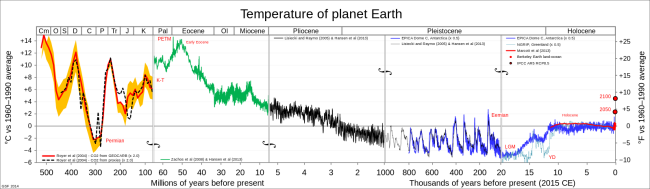
image: earth during the eocene epoch, the last time the average surface temperature was 25C, via bbc nature

image: depiction of eocene rainforest in the antarctic, from this site, original source uncredited

baraka

image: from the documentary film baraka

Imagine this:

  1. Imagine that, a few millennia from now, down the steep slope that followed Peak Everything, the sixth Great Extinction is finally winding down. The pace of species extinction is slowing, and landscapes, while still often showing the signs of many recent ecological catastrophes due to ongoing tumultuous climate change, are beginning to show more patterns of succession. Our lovely planet has been through this kind of change many times before: At least twice it’s been choked in dust after meteorites or volcanoes that produced a global night that lasted a year and soaked the planet in a deluge of rain with the pH of battery acid. At least once it’s been totally encased, pole to pole, in a sheet of ice miles thick.
  2. Imagine that this Future Earth looks about as different from the way it did in the 21st century as it did the last time the average surface temperature was 25C rather than 15C — during the early Eocene epoch about 50 million years ago. Imagine that more than half of the planet is therefore now desert, including the Western US, Southern Europe, the Western 2/3 of all tropical areas, and all of the areas that were already desert in the 21st century. Much of the rest of the planet is now rainforest, subject to torrential and relentless monsoons, including former Arctic and Antarctic areas. There are no ice sheets or glaciers now. Rising sea levels have engulfed the formal coastal areas and reduced overall planetary land mass by about 20%, and coasts are now mostly steep and mountainous.
  3. Imagine that human population has declined to about 50 million, and is still declining, though much more slowly than during the earlier stages of the Great Extinction. The remaining humans have abandoned all technologies, in part because there is no cheap accessible energy to power them, and in part because with population now so small and declining, there is no real need for technologies for a full and healthy life. Population is still declining because humans are just not naturally well-adapted to very hot or changeable climates, whereas many of the succession species that now feed on humans (jaguars and crocodiles, for example) are much better adapted to prevailing climates. Nuclear radiation from abandoned 21st century power plants has also created ongoing birth rate and illness problems for humans and other species.
  4. Imagine that humans have readapted to living in the trees (because it’s safer and more comfortable), to gathering rather than growing food (because it’s more reliable and easier), and to a vegetarian and insect diet (because it’s better suited to our digestive system and more accessible in post-tool-use societies). Humans still look much like they did in the 21st century (and, for that matter, much like they have for the past million years), but they behave much differently. They have given up abstract languages because such languages are no longer of value or use, though they can communicate essential messages very accurately through vocalizations (whistles, calls and songs) and gestures. They retain a passion for art and music and practice these extensively. They live in small, autonomous tribal cultures, each with a territory large enough to provide abundant food even when catastrophic climate events occur, and little or no contact with adjacent human cultures, which are, as a result, very diverse.
  5. Imagine that such humans have given up their sense of time, again because they have no need for it. They live entirely (except for brief periods when under attack by predators) in the present, joyfully, in the moment. They have, of course, memories (so do most creatures) but their minds, without clocks, calendars and abstract language, now evolve differently from the way they did in the old “civilization” times, so they cannot and do not dwell on the past, nor fear nor long for the future. They live lives of great joy, leisure and abundance, and are unaware of the trajectory that will inevitably lead, many millennia hence, to their ecologically maladapted species’ slow and final extinction. And they are unaware of how humans live/lived in other places and times. It doesn’t concern them. They do not fear death; they accept it. Their curiosity is focused on here, and now.
  6. Imagine that such humans have begun to evolve cultural and coping characteristics more aligned with their forest-dwelling bonobo cousins than their savannah-dwelling chimp cousins. Their best-adapted societies are peaceful, gentle, matriarchal, affectionate, and egalitarian, and resolve internal conflicts and stress through embrace, caress, and sexual calming methods rather than through the expression of violence.
  7. Imagine that, despite the apparent similarities between these post-civilization humans and prehistoric tree-dwelling humans, there are a number of qualities that clearly distinguish them. These differences are not physical but behavioural, due to differences in selected genetics, learned behaviours passed between generations, and differences in environment. Post-civilization humans are still not as intuitive as prehistoric humans, but they are more imaginative and hence more playful. They are more empathetic, because they still pass on the embodied grief of having experienced massive suffering and hardship just a few hundred generations ago. They still retain vestiges of skill at abstraction and capacity to synergize, that comes through in and is practiced in their art and music composition. They also ironically retain vestiges of competitiveness, even though this no longer serves a useful purpose.

Imagine that.

If you can imagine that, perhaps you can understand why some of us are no longer working to save or reform this sad, damaged, unsustainable, juggernaut civilization culture, or even to try to make a “transition” from it to some other large-scale, high-technology, global-scope culture. Perhaps you can understand why I say “It’s hopeless, but we’ll be fine.”

If you can, perhaps you can help me imagine how we can make it to this strange and wonderful future Earth, from where we are now, with the minimal amount of intervening suffering of human and other creatures, and the minimal amount of damage to this planet we call home. What could we do, now, and in stages over the coming few decades as the ragged flywheel of our civilization comes violently and shudderingly apart, that would prepare us to cope better, to be hurt less, to do less harm?

I’m trying to imagine that.

December 20, 2012

Preparing for Collapse: Non-Attachment, NOT Detachment

Filed under: Preparing for Civilization's End — Dave Pollard @ 11:15

normal curve left half

There is something seemingly unfathomable to the human mind about exponential curves. As I wrote last fall:

There is an old story about the invention of the chessboard, in which the inventor as his reward asks for one grain of wheat on the first square, two on the second, four on the third, and doubling until all 64 squares are full. The seemingly modest request adds up to many times more than all the wheat the world has ever produced. The purpose of the story is to teach about our inability to grasp the impact and unsustainability of accelerating increases in anything, particularly in the final stages. Even when more than half of the squares have been filled the inventor’s request still seems manageable. It is only when it is too late that its impossibility is realized.

 Even when almost all the squares have been filled, the request still seems manageable. We are now living in a world where almost all the squares have been filled. We have used up the easy-to-get half of the Earth’s resources, which accumulated over billions of years. We have used most of that in the last two centuries, and most of that in the last two decades. In the process we have destabilized the planet’s climate systems. We are nearing what is now being called “peak everything”.

normal curve

And there is certainly nothing “normal” to human eyes in what mathematicians call a “normal curve”, at least when time is the independent variable. We always seem to perceive the future as much like the present, only more so, and our favourite works of utopian and dystopian fiction turn out to be mostly somewhat hyperbolized reflections on the best or worst of the world as it was when the authors wrote them.

Even when we try to conceive of the downside of the normal curve — sharp at first and then tailing off slowly — we can only see everything going backwards, back to the way it was when the curve was at that height before. A simple, rapid decline, like those that befell previous civilizations and unsustainable cultures, is unimaginable. We can’t picture it because it’s never been that way for us. Even the current set of collapsnik writers, like James Kunstler, portray a post-collapse future that is almost nostalgically like the old American West.

In recent months, we have seen the news from climate scientists become exponentially worse. A decade ago we were hand-wringing about a 1C rise in average global temperature by 2100. A year ago it was a 2C rise by 2050 and a 4C rise by 2100. Now it appears all but certain that our failure to consider the “positive feedback loops” inherent in our astonishingly delicately-balanced climate systems made us absurdly optimistic, and a 6C rise by 2050 is quite possible. I can’t blame you if you haven’t been keeping up — neither had I. Two recent videos, one by Grist’s David Roberts and a second, even more recent one by fellow collapsnik Guy McPherson, will bring you up to speed.

The message of these videos, and the data underlying them, is simple, but it’s a lot like hearing news of a terrible and sudden loss in the family, the death of someone you knew was at risk but somehow believed would get through it, or at least last a while longer. It’s too soon. It can’t be that fast. We cannot accept it, as the trickster piles a mountain of grain onto the third-to-last square of the chessboard.

The message is two-fold:

  1. Not only are we fucked, but it’s coming much sooner than we expected. It’s coming in the first half of this century, not the second. By 2050 life for all but the simplest and most well-protected species on this planet will almost certainly be impossible, except for small numbers in a few marginal areas.
  2. The whole issue of mitigation and the need for activism is now more-or-less moot. Even if we were to collectively and massively change our behaviour starting tomorrow, it would only delay collapse by a few years, and quite possible make the collapse even more catastrophic. Until recently there was at least a chance that perhaps a combination of behaviour change and the reduced availability of cheap fossil fuels might combine to pull us back from the brink, or at least make a much-changed and simpler life possible for a much smaller population of humans and other creatures. That chance is gone.

The climate scientists, abetted by the ecological economists, have pronounced the certain and imminent (i.e. within most of our lifetimes) death of the vast majority of life on our planet, including the human species. Now, we can mourn. Most of our human family will continue to fall into one of the three categories of non-acceptance of this pronouncement that I wrote about in my If We Had a Better Story post:

  1. The incredulous: Those who either know so little or haven’t had the opportunity to think about what they know, that they find the idea of collapse preposterous, unimaginable, and/or unthinkable.
  2. The hopeful: Those who believe that collapse is not inevitable or can be significantly mitigated, or believe that even if it is inevitable and can’t be significantly mitigated, we should try anyway.
  3. The deniers: Those who are intimidated or offended by, or overwhelmed with anger and/or guilt at, the very idea of collapse.

None of these are unusual reactions to horrific news, but they’re likely to be crazy-making to those of us who are past this stage, and trying to get on with preparing ourselves and those we love for what is to come.

The most intriguing reaction is from collapsniks like Derrick Jensen and John Duffy who, against hope, want us to work (as they do, indefatigably and to their great credit) to kill the economy. John starts out his essay by saying “We are going to go extinct.” and near the end says:

If we want to not die, then we need to stop doing the things that are going to kill us… We need deindustrialization, and we need to wring the bloody neck of capitalism, before hanging it, drawing it, quartering it, and setting the remaining bits of its corpse on fire to make sure it can’t rise from the dead like the unholy zombie that it is… This is all to say, I can’t fight my enemies and my allies at the same time. Liberals, lefties, environmentalists and everyone else who purports to give a damn has to give up on being capitalism apologists who somehow think we can keep this gravy train of mass consumption going.

It’s a great rant, but he’s like the lover of the recently-declared-dead patient who insists on trying CPR interminably and punching the people trying to take the defibrillators away from him. Or, perhaps, he’s like the angry griever trying to assemble a posse to kill the ones he believes caused the death of the one he loves. It’s understandable, but it’s futile. It’s too late.

In the comments to John’s post, Paul Chefurka writes:

I’m not particularly angry or outraged any more. Once I was, but now I’m just fascinated, amazed, amused, bemused, curious. I attach no moral dimension to this unfolding any more, though once I did. Now there is no blame, no more agonized wishes to rewrite the past, no more fearful visions of a shattered future.

We are what we are, we did what we did, we ended up here.

I’m very curious to see what comes next. Aren’t you?

Paul didn’t get a terribly sympathetic response, so I wrote to Paul and asked him how he had managed to reach this stage of acceptance. I also asked him about a gorgeously-written and deeply-moving recent article in Orion, Gaze Even Here, about “evoking a consciousness of brokenness”, in which the author, Trebbe Johnson, says that she and her companions found solace in spending time “gazing” at clearcuts and videos of animals dying in oil-slicks until their grief and anger and revulsion turned to curiosity, acceptance, compassion and even love. I mentioned that some people in my circles had seen my attempts at non-attachment, at letting go of what I know I cannot change, as detachment, as an emotional shutting down or turning away. Paul replied:

I’ve faced the same accusations about detachment. They generally come from activists for whom action is the inner imperative, and who have no exposure to Buddhist principles. Also, they haven’t hit bottom yet, which is why the still think that action is an answer. Only once someone hits the bottom and bounces off the rocks do they usually start looking for truly radical responses like non-attachment.

As a first thought – perhaps what Ms. Johnson is suggesting isn’t really that radical at all. What she’s suggesting is a starting point for someone who wants to wake up in this new world. It’s where Joanna Macy begins as well. The bigger question may be, where do you go once you’ve taken the grief on board – how do you find the will to move, and how do you pick your direction?  This is where doing deep inner work around grief, shame and the Shadow come in.

Out of that work comes the beginning of non-attachment. To people who conflate it with detachment, I explain that non-attachment is what allows me to confront the big issues directly, to engage fully but not be paralyzed by emotion. It’s not an abdication of feeling, but a way of seeing the world around me with complete clarity and doing what the world needs, rather than being selfish and getting mired in my own suffering.

Sometimes that helps people understand, but for a lot of activists it’s still a step too far. They are still focused on their own suffering, and in order to validate their response they have defined that suffering as a virtue. It’s not, it’s a trap. Non-attachment is the most functional way out that I’ve discovered so far.

What are the elements of non-attachment that might be applied to coping with the knowledge of the inevitable collapse of organized society amidst the chaos of economic collapse and runaway climate change? What makes sense to gaze at, and what should we, for our own sanity, leave unseen? How can we be, and act, in a fully engaged, joyful, curious, productive, useful-to-others way, without becoming either “detached” (emotionally disconnected or inured) or exhausted? Here are some of my early thoughts on this:

1. We cannot, must not, prescribe one “right” behaviour or approach for everyone. We are all different, and the best way for each of us to cope will be different. What’s important is to patiently wait for those we care about to realize what is ahead, and then support them to find their own way to cope with it productively.

2. I think it could help to develop, working with climate scientists and enlightened (non-classical) economists and energy analysts and artists and musicians and film-makers, a set of nuanced, candid, non-idealized, non-sensationalized visions or stories of what our world in collapse will look like, by 2020, 2030, 2040 and 2050, and then, as Trebbe might put it, to “gaze” at them. These stories would be based on data, and on an appreciation of history of how people behave in an accelerating (but not relentless) series of cascading crises where there is no scapegoat, no one to blame, where everyone is largely in the same boat. These stories would be focused on what collapse will mean for the day-to-day lives of people living in cities, towns, the country, in nations at different levels of “development”. My guess is that for most of the world, in the already-struggling nations and places, life will not be much different, except that the death rate (mostly from disease and malnutrition) will be somewhat higher and the birth rate much lower. We have a lot to learn, I think, from people in the third world, in impoverished cities, and in the streets, who are already living with collapse. The image below shows in red/purple/white areas that, due to climate change-induced chronic drought, will be largely ununhabitable within a few decades, so our stories for them, billions of people, would likely be stories of migration. The stories would be varied, and stark, and, perhaps to our surprise, inspiring and astonishing.

Map of serious chronic drought areas, per research simulations by UCAR/NCAR, an agency of the National Science Foundation. This map is forecasts for the 2060s, but is based on outdated climate change data, so it is likely to come true considerably earlier. Thanks to resilience.org for the link.

3. Perhaps most importantly, we will all be better off, I think, if we were to learn non-attachment, empathy, presence, resilience, relocalization, community building, and a host of other skills and capacities, technical and ‘soft’, so that we can tolerate the changes we will face to our way of living and the very foolish actions many (with the most to lose, in wealth or power) will inevitably try to do, unsuccessfully, to “control” the situation. We must expect the emergence of charismatic dictators, genocides, civil wars, geo-engineering, the burning of almost everything flammable for fuel and electricity, and cults, and deal with them the best we can without letting them unhinge us. We may be fortunate enough that as our centralized systems collapse, the resources for possible authoritarian atrocities will rapidly diminish, so the decline could be relatively peaceful, if not free of suffering or misery. We may well discover that crisis brings out the best in us, but should be prepared in case it brings out, in some, the worst. We may find that, with a sufficient voluntary decrease in birth rates (not an unlikely scenario), over the coming decades we might reach a human population level well below one billion without a dramatic increase in death rates, though we should be prepared for a rising death toll and what it may do to our collective psyches. In all of this, non-attachment and presence can enable us to live, even through these crises, lives of love and joy and appreciation for the miracle of life.

A final thought, and one that perhaps is the most unimaginable of all for those of us brought up to believe the way we live now is the only way to live. What’s on the right side of the normal curve, after collapse, isn’t another growth cycle. It’s the proverbial long tail. We may become an endangered species by century’s end, but we’re unlikely to become extinct for several millennia after that — just increasingly few in numbers and increasingly irrelevant to the ecosystems and recovery of the planet from yet another great extinction. Without vast amounts of cheap energy to power technology, we’re just not going to be very well adapted to post 21st-century Earth. Just as we don’t notice the 200 species going extinct every day, I doubt that the species that thrive after the great extinction will notice the death of the last of the species that once believed it could rule the Earth forever.

Thanks to Tree for the link to the Orion article, to the authors of the articles/videos cited above, to Sue Bullock for the link to Kill the Economy, to John Duffy for the link to the Grist video, and to Paul Chefurka for the ideas prompting this article.

December 2, 2012

Links of the Month: November 30, 2012

Filed under: Preparing for Civilization's End — Dave Pollard @ 03:07

illustration from my book Finding the Sweet Spot

About half the people on Bowen Island, where I live, commute daily to Vancouver via a heavily taxpayer-subsidized car ferry. The reason they do this is, basically, that whatever they have to sell can’t be profitably sold here, because it doesn’t directly meet any of our needs. Much of what they produce does make it back here, in the form of gasoline, imported products, processed foods, bank, insurance, accounting and legal ‘products’, construction materials, pharmaceuticals and household goods. And interest and rents paid to absentee mortgagors and landlords. Little of what we really need — food, clothing, building materials, drugs, energy, household products, health services etc. — is made here in significant quantities. We ‘import’ just about everything.

The other half of the population is either retired, unemployed, or (from what I have ascertained) constantly struggling to make a living. We have many artists, craftspeople and artisans, musicians, and service people of all kinds (hairdressers, therapists, construction workers, seamstresses, retailers, caterers, water taxis, maintenance people, restaurants etc.). The price of land and property here is insane, thanks to our proximity to Vancouver, so a lot of people work from their homes instead of offices. The citizens, struggling with the high cost of living, mostly find the prices charged by the locals “expensive”, while these prices are often not enough to cover the local service-provider’s rent. Turnover and business failure rates are therefore high, as is the number of people who give up and move ‘back’ to the mainland.

So we suffer from a double predicament: Our local economy is utterly unsustainable; and our residents (both commuters and non-) have so little left after paying for essentials — money that all flows out of the island — that they can’t afford to pay the locals who are trying to make a living here, and hence make our local economy a little more robust.

Jay Tompt, writer with Transition Town Totnes (where the Transition movement began), recently explained that even Totnes could not feed itself in a crisis, because the food, transportation and other systems are completely interdependent, so “you’re only as resilient as your neighbour”. And everyone is your neighbour in this globalized world.

And a local food expert in California says the entire “eat local” movement is naive and insufficient: “When the dust settles, however, locavores are likely to be disappointed and frustrated. The modern food system will bear their imprint to be sure: any ‘serious’ sit-down restaurant will source as much locally as possible, schools will have salad bars, and big box stores and groceries will glowingly highlight foods on sale grown within the state. Indeed, all of these things are happening already. But farm soil will become even more scorched earth, standard coffin sizes will be wider around the waist, and the eating habits of the majority of Americans will be barely changed.” [this is an outstanding article worth a read -- thanks to Raffi Aftandelian for the link]

So when I went to hear Charles Eisenstein speak this month (more on that below) about the New Economy and community currencies, I was looking for answers that might be applied to deal with this ‘problem of dependency’, this ‘leakage’ of money out of our island to centralized corporations and institutions. I wanted to believe that, instead of encouraging the local artisans and service providers to form cooperatives to sell to mainlanders what Bowen Islanders couldn’t afford (the “if you can’t beat ‘em join ‘em” approach), there was some way to actually create viable ‘right livelihoods’ right here, that would increase our local self-sufficiency, resilience and sustainability, and wouldn’t be quickly eroded by this leakage of money. In the New Economy, Eisenstein said, everyone will be able to offer their gift to their community, and between us we will ensure that everyone gets what they need, without needing to monetize or account for it. What would it take for us on Bowen to give up our servitude to money and the industrial growth economy, and our mainland-dependent jobs, and create a sustainable local economy in which no one needed to struggle or work insane hours or do work they despised?

Alas, the only answer I came away with, and it will not be forthcoming for a few decades, is the final collapse of the industrial growth economy, when we will have no choice but to embrace the New Economy and discover, to our wonderment, that its subsistence lifestyle is happier, healthier and better for us and the world in every way. Only when the car ferry becomes prohibitively expensive due to fuel cost increases, and then rationed, and then discontinued entirely, will we react by either leaving the island or finding a viable livelihood here. Only when cheap imported clothes become more expensive than what we can make ourselves, and then unavailable at any price, will we relearn the essential (and enjoyable) skills of making our own. Only when the 3000-mile-meal becomes a $300 meal instead of a $30 meal, and then shelves empty of the California produce on which we now depend, will we start to relearn how to grow and harvest our own food, and relearn what to do with it.

That doesn’t mean we can do nothing now, and some of us, who are both aware of what’s happening and what’s coming and who have the luxury of time to act on our knowledge (mostly these are healthy non-commuters without young families) are starting to explore the many New Economy practices and experiments that are being tried in progressive communities in affluent nations everywhere. But it’s hard to be patient, to see this as (at least from the perspective of one person’s life) a marathon, not a sprint. It’s hard not to hope that the collapse happens sooner and faster and more persistently (but not so fast as to be overwhelming) so that the point at which we all must change comes more quickly, before things get even worse (and as we try to perpetuate the industrial growth economy with Tar Sands and fracking and endless war and geoengineering, they will get worse).

It’s hard to let go of the terrible knowledge of how the world works and what is most likely to come, and that we can’t ‘fix’ it, we just have to go with it, adapt to it, each moment and each day at a time. It’s hard when it’s gotten very dark and you’re lost in the forest and it’s starting to rain, not to get fearful or angry or sad, but instead to laugh and sing and play in the rain and know that life is astonishing and somehow you’ll find your way forward, safely, without suffering, to where you’re meant to be. It’s good to have you all, dear readers, here in the forest, laughing and singing and playing with me. It’s hopeless, but we’ll be fine.

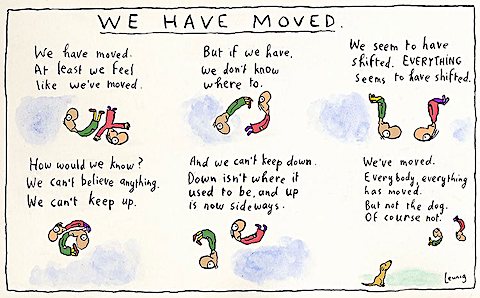
PREPARING FOR CIVILIZATION’S COLLAPSE

cartoon by the wonderful michael leunig

Straddling the Old Economy and the New: Charles Eisenstein, author of Sacred Economics, was recently in Vancouver and spoke powerfully for 80 minutes about what the New Economy represents and how we can encourage it as a means of preparing ourselves for the Old Economy’s collapse. He made a similar speech in Vancouver a year ago, talking about how we’ll need to straddle the two economies for decades as the Long Emergency unfolds. Highlights of the more recent speech (I’ll link to it if/when it comes online):

  • He covered many of the issues in this excellent short (12 minute) film about his book in more detail.
  • For those who want to hear a full (over one hour) Eisenstein speech the ones he gave in Portland and London are very good.
  • One of his essential messages is about how money enslaves us physically and intellectually even though it is nothing more than a set of agreements (based on underlying stories) about what has value, and “all” we have to do to bring about a New Economy is the “impossible” task of changing those agreements and stories to ones that are aligned with what we really value.
  • He spoke poignantly about his activist friend who spent much of the last year looking after his 95-year-old mother-in-law, and how under our old-style economic thinking even progressives would see this as a “waste of time”, a diversion from his more “important” activist work. In the New Economy, he said, that work would be valued and supported, and the fact it isn’t tells us a lot about our culture and our world.
  • The New Economy, he said, will encourage and enable us to stop ‘working for a living’ to make ends meet, and instead focus on identifying what our unique gift to the world is, and how we can offer it, without having to worry about whether anyone will pay us for that. It will be a Gift Economy based on generosity and trust that when we each offer what we can, and see our lives as lives of service to all-life-on-Earth, not lives of working harder and harder to stave off scarcity, we will discover that we don’t need most of what we buy, and we don’t need to work that hard or long to live very comfortable, meaningful lives. “A gift is different from a financial transaction. If I buy something from you, I give you the money and you give me the thing, and we have no more relationship after that. I don’t owe you anything, you don’t owe me anything. The transaction is finished. But if you give me something, that’s different because now I kind of feel like I owe you one. It could be a feeling of obligation, or you could say it’s a feeling of gratitude. What’s gratitude? Gratitude is the recognition that you’ve received, and the desire to give in turn. And that’s why we are driven to give. Because everything we’ve received is a gift. Our life is a gift. Having air to breathe – we didn’t earn that. We didn’t earn being born. We didn’t earn having food. We didn’t earn seeds being able to grow. Everything that we have is a gift.”
  • He explained that our ‘growth’ economy, based as it is on the need for ever more debt to offset the printing of ever-more money, is unsustainable and ruinous (scroll down from this link to see the article). “The problem that we are seemingly unable to countenance is the end of growth. Today’s system is predicated on the progressive conversion of nature into products, people into consumers, cultures into markets and time into money. We could perhaps extend that growth for a few more years by fracking, deep-sea oil drilling, deforestation, land grabs from indigenous people and so on, but only at a higher and higher cost to future generations. Sooner or later – hopefully sooner – we will have to transition towards a steady-state or degrowth economy.”
  • He often pauses to ask “What if we…?” and “Why not?” questions. This thinking forces us from our worldview that this economic system is the only one that can work in the 21st century. While I’m still not convinced “we can get there from here”, his ability to articulate what’s going on and the possibilities for “impossible” change is the best out there right now.

Experiments in the New Economy: Gar Alperovitz talks (also for over an hour) about how the new economy is creeping in, as social networks allow us to discover and work with others who understand that our current economy is unsustainable and will soon collapse, and try interesting experiments in what he calls “democratized wealth” economics. Teaser: “The pain levels are forcing people to do new things because they have to. In a crisis that isn’t what happens; you get explosions. But what we’re seeing, and this is the part that’a very interesting to me, what we’re seeing is an explosion of activity, both political, some social, but above all economic in a way I think could matter.” Thanks to Jon Husband for the link, and the one that follows.

Manuel Castells on New Economy Cultures: Sociologist Manuel Castells talks about how the failure of our industrial growth economy to provide for most citizens, combined with distrust of the political system to reform it, is driving cultural change that is enabling the emergence of the New Economy. Excerpt:

When I mention this alternative economic culture, it’s a combination of two things. A number of people have been doing this for quite a while already because they don’t agree with the meaninglessness of their lives. Now there is something else – it’s the legion of consumers who cannot consume - they don’t have the money, they don’t have the credit, they don’t have anything – [so] they try at least to make sense of their lives doing something different. So, it’s because of needs and because of values – the two things together – that’s why it’s expanding.

Places Worth Caring About: James Kunstler argues that the blight of most modern North American cities and the “public realm” spaces within them results from the negligence of architects, designers and developers to define spaces that reflect the nature, needs and interests of the people they are allegedly building for. Thanks to Don Marshall for the link. Excerpts:

We know what’s going on in these [modern suburban] houses, you know. We know that little Skippy is loading his Uzi down here, getting ready for homeroom. We know that his sister Heather is turning tricks up here to support her drug habit. Because these places, these habitats, are inducing immense amounts of anxiety and depression in children, and they don’t have a lot of experience with medication. So they take the first one that comes along, often. These are not good enough for Americans…

We’ve got a lot of work to do… No amount or combination of alternative fuels is going to allow us to continue running what we’re running, the way we’re running it. We’re going to have to do everything very differently. And America’s not prepared. We are sleepwalking into the future. We’re not ready for what’s coming at us. So I urge you all to do what you can. Life in the mid-21st century is going to be about living locally. Be prepared to be good neighbors. Be prepared to find vocations that make you useful to your neighbors and to your fellow citizens. One final thing — please, stop referring to yourselves as “consumers.” Consumers are different than citizens. Consumers do not have obligations, responsibilities and duties to their fellow human beings. And as long as you’re using that word ‘consumer’ in the public discussion, you will be degrading the quality of the discussion.

The Myth of Disaster Looting: A new investigative report shows that, when disasters hit, people rally together and crime rates actually drop. This is something to keep in mind when we prepare for the Long Emergency, since it will be no different. No Mad Max, no armed roving gangs, just communities struggling, as they do now in most of the world, to meet the needs of the moment, together. Thanks to Phil Jones for the link, and the one that follows.

The Arrival of Peak Fertilizer: We’ve been told that our industrial agriculture system is heavily dependent on oil; a new Mother Jones article explains how, reveals how perilously small the supply of both phosphates and potassium (two of the four key components of modern fertilizers) is, and explains how ecologically devastating the production of synthetic nitrogen (ammonium, the third key component) is. It omits describing the equal noxiousness of oil-derived sulphur, the fourth component. Most of this artificial fertilizer ends up in runoff into lakes, groundwater and oceans, so this oil-dependent and scarcity-prone substance fouls both the air and the water.

LIVING SMARTER

cartoon by hugh mcleod at gapingvoid, and great advice to prospective entrepreneurs

The Only Thing Co-Working Needs to Be: Last year Bill Tozier wrote a brilliant, and very funny, rant about the misconceptions of people about “co-working”, as if it was about office space, or making money, or any of a dozen other misconceptions. It’s really about community. If you’re a small business owner, or aspire to be one, read Bill’s article. He makes one of the main points I try to make in my book: Don’t try to do this alone.

How to Help Small Business? Shut Up and Listen: Ernesto Sirolli has an excellent speech excoriating Westerners for our arrogant attempts to “teach” entrepreneurship in struggling nations, instead of listening and appreciating the local context and culture for enterprise, appreciating the passions of their prospective entrepreneurs, and understanding local needs. Thanks to Cheryl and to Pauline Le Bel for sending me this link almost simultaneously.

Death, and Life, with Dignity: I want to acknowledge the courage of ALS-sufferer Gloria Taylor, who got Canada’s ban on doctor-assisted suicide ruled as unconstitutional in June, defeating both the federal and provincial governments who opposed her case. She died last month, of complications of an infection, but the battle goes on, as the ruling has been appealed by the federal government. The right to die is destined to become one of the biggest issues of the coming decades, with the religious right resorting to fear-mongering about it inevitably leading to elder, and other, abuse. The Canadian federal government did make one intelligent decision this month, however, refusing to block the production of generic oxycodone, and in so doing putting the needs of chronic pain sufferers ahead of the concerns of addiction treatment professionals and law enforcement agencies.

What If We Trusted You?: My friend Jerry Michalski talks about institutional education versus unschooling in the context of trust, and shows how distrust creates dysfunction and how trust (e.g. Wikipedia’s open editing) leads to a renewed passion for learning. And then he posits that this choice, between institutionalized distrust and liberating trust, has been made, and made poorly, in every facet of civilized life, not just education, and that we can make a different choice.

Velomobiles: The Future of the Car?: Working prototypes of a recumbent tricycle with an aerodynamic shell and electric motor suggest they can go as fast as today’s electric cars with 1/80th the power use.

POLITICS & ECONOMICS AS USUAL

cartoon by dan piraro

Grand Juries: The American Inquisition System: Few people know about how the “grand jury” system in the US works, and that’s the way they like it. This is one of the reasons I get uncomfortable every time I visit the US — anyone, without cause, can be simply “disappeared” in this system. If you’re a vocal supporter of any non-mainstream political group or idea in the US, be cautious, and be aware. This process removes every “human right” you thought you had, on the whim of any zealous prosecutor or law enforcement officer. Even the ABA’s FAQ damns the process. No other ‘democratic’ country allows this. Thanks to Morva Bowman for the link.

Naomi Klein’s Disaster Capitalism: An excellent documentary based on Klein’s book Shock Doctrine, explains how the Chicago/Friedman/Rumsfeld school has encouraged, advised and supported political, economic and military terrorism (“shock therapy”) around the world, notably in Allende’s Chile, Thatcher’s UK, Reagan’s pre-9/11 and Bush’s post 9/11 US, US-occupied Iraq, Yeltsin’s Russia, and disaster-stricken New Orleans, all designed to privatize everything under the control of a small elite and cow the citizens into meek obedience to extreme right-wing authoritarian political-military-industrial regimes. The 2008 market collapse and subsequent gutting of the public treasury to ‘bail out’ the private sector is just the latest volley in this ongoing and relentless corporatist war, and, Klein says, it will only stop when we make them stop. Thanks to Poor Richard for the link.

Frack Fight: An explanation of how ecologically devastating fracking is, and how Big Oil is pulling out all the stops to crush opposition to it anyway.

Canada’s Bizarre ‘Entitled’ Conservatives: It’s funny how Canada’s (few) conservative icons just keep disgracing themselves. I think we should create the Conrad award, after the neocon publisher Conrad Black who was imprisoned for fleecing his companies (and their shareholders) to pay for his and his wife’s spending excesses. This month’s Conrad awards go to Margaret Wente, Canada’s most execrable reporter, for serial plagiarism and hysterical denial in the face of overwhelming evidence (she’s still on the payroll of the now equally-execrable Globe & Mail, once a respectable newspaper), and to John Furlong, Olympic organizer, TEDx speaker, Order of Canada holder and idol of the hard-work-and-integrity crowd, for his self-aggrandizing autobiography’s failure to mention his years of alleged abuse of First Nations children (although many sworn affidavits have been filed by his alleged victims, he’s denied everything and hired an army of lawyers to sue the reporter who broke the story). Sad. And vying for possible Conrad awards next month are two more right-wingers, Toronto’s loony mayor Rob Ford and Alberta premier Alison Redford, who both seem to think conflict of interest doesn’t apply to them.

Canada’s Debt Levels Reaching Pre-Collapse Levels: Canadian citizens’ debts are now at the same level that US debts were at just prior to the housing market collapse. Still, they’re saying it can’t happen here.

The Secret Canadian Geoengineering Experiment You Weren’t Supposed to Know About: With federal government knowledge and approval, a wingnut group dumped 100 tons of iron suphate into the ocean near ecologically fragile Haida Gwaii, BC, in violation of several international ocean treaty and environmental laws, producing a plankton bloom that could be seen from space, in the hopes it would produce a temporary fish boom and that they could sell carbon offset credits for the project. It, uh, didn’t work.

Using Invasive Species as Biofuels: Now that the economics of ethanol have been shown definitively to be disastrous, defenders of growing stuff to burn in our cars are promoting invasive species that grow really tall really fast with minimal needs for cultivating as more ‘efficient’ biofuel sources. They call the latest weed a ‘miracle’. They said the same of the oil-fertilizer-based ‘green revolution’. Thanks to Tree for the link.

And Now the FHA Needs a Bailout: The US FHA, which stepped in to insure risky mortgages when Fannie Mae and Freddie Mac went under, now bankrolls over $1T in mortgages — and it’s underwater, even if house prices don’t fall further.

FUN AND INSPIRATION

cartoon from XKCD

Funny Pie Charts: This list of the world’s most hilarious pie charts is priceless; you may have to sign up for Quora to see them. Thanks to Seb Paquet for the link, and the one that follows.

How We Decide What We Think: Interesting hypothesis by Gene Bellinger on how we decide what we think and do. It notes that our worldview filters out data that is not consistent with that we (already believe), but doesn’t mention that there is evidence (from studying the neural processes in our brains) that our actions actually precede our decisions, i.e. the physical action we take in the moment often occurs before the cognitive process that supposedly produces the decision to take that action. That means that our actions determine our beliefs in another positive feedback loop, and our beliefs are often just rationalizations for what we have already decided (emotionally and/or instinctively) to do.

New Yorker Magazine Calls for Obama to Launch Huge Effort to Combat Climate Change: David Remnick’s lead editorial “No More Magical Thinking” calls on him to use the Presidential Address to start an effort to combat climate change comparable to Kennedy’s project to put a man on the moon. We’ll see.

The Keys to Well-Being: A new study of UK census data on the subject of people’s sense of well-being revealed that disabled people, visible minorities (non-whites), the unemployed (especially long-term unemployed), those in temp jobs, those working long hours, those working in the private sector, and those living in the cities and very impoverished areas are relatively unhappy, while the retired, local government workers, and those who work part-time by choice are the happiest. Thanks to David Hodgson for the link. Meanwhile, a new book, The Antidote (review coming soon), argues that “positive thinking” seminars and self-help books actually raise expectations and hence increase unhappiness when they fail to deliver, and a contrary strategy of imagining the worst and then realizing something better can actually help. Joyful pessimism, anyone?

How Indigenous People Sleep: Research on non-Western sleep habits reveals that indigenous peoples, including children, have no “regular” bedtime, are usually accustomed to sleeping with noises and/or movement going on around them, and often sleep in two 3-5 hour stretches with an hour or two of calm wakefulness between them. Thanks to Tree for the link.

Anne Lamott’s Secret Prayer: Help. Thanks. Wow. Anne Lamott’s three words that represent what she prays about. I’m an atheist and I’m not buying, but damn the woman can write.

THOUGHTS FOR THE MONTH

photo by Wilma Hurskainen (thanks to Dave Riddell for the link)

What is the #1 killer worldwide of girls age 15-19?: Answer: Complications of pregnancy and childbirth. Thanks to Liz McLellan for the link.

From Karen Maezen Miller (thanks to Beth Patterson for the link), on loving a teenager:

They love us in a different way. I said that when someone asked what it was like to have a teenager.

I feel like we’ve lost a daughter. My husband said that after a silent and inconsequential Sunday.

Just shut up. I said that to her after a ride in the car yesterday.

And yet, there is love, so much love between us and it has gone nowhere! I am standing on the high bluff over death valley, infinite openness in all directions, stunned dumb in the emptiness, but I know the space before me is pure love. Pure love. Life grows here, even when we can’t see it. Refreshed in a cool night, fed by invisible rivulets. A whisper of sea sails five hundred miles across five mountain ranges, and the whisper is this.

They love us in a different way. They love us in the space, the space that is nothing but love.

Love is not a feeling, not a thought, nothing given or got, not more or less. Not a precaution or warning, not a push or a prod. Not a reminder, not a teaching, not a performance. Love is not what I say and not what you hear. Not how was school how was the test what about homework what are you wearing wash your face eat your dinner pick up your shoes I don’t like her him that when if what did you do what did you say what about your terrible wonderful failure success happiness sadness what about me what about me what about me?

Love is the space between us. There is so much space.

What will you put into that space today, I ask myself before I hear the roar of my own echo: Just shut up.

From Zvika Krieger (thanks to Harold Jarche for the link), on the future of “employed” work:

I asked Elli Sharef [of the headhunter/employee assessment firm HireArt] if she had any insights on the broader employment picture, since she spends most of her day trying to match employers with employees. The most striking trend she sees is that having a strong, well-rounded resume is no longer good enough. Employers are increasingly looking for specific [pre-existing] skills sets that match their needs.

They don’t want to train people on the job anymore,” she says, marking a shift away from the apprenticeship model that defined many sectors in the economy before the recession. “There are just too many people looking for work for companies to waste time on someone who can’t start, ready to go, on the first day.”

This is Not Cool.

From Ann McMaster (thanks to Maristela for the link), on the difference between ‘detached’ and ‘unattached’:

When I’ve been attached to my dream [of co-creating a better world], I’ve been consumed by it, pouring so much energy into it that I eventually felt drained, hopeless, defeated when it didn’t look like it was going to happen. That’s when I let it go, detaching myself from what was once important. [But] detached means separated, and in this context, distant from my heart. While unattached means autonomous, self-governing – open to possibility. When I’m in right relationship with myself and my dreams – I have them, they don’t have me.

November 26, 2012

Distracted

Filed under: Creative Works — Dave Pollard @ 23:49

(this story is fiction: none of it really happened, or is ever likely to, and none of the characters in the story, other than the writers referred to, are real people or based on real people, including me :-) vancouver skyline

“So what did you think of Charles?”

I was sitting on Lori’s balcony looking at the night skyline, the stars and the ships in English Bay harbour — ugly rusted polluting hulks during the day, but beautiful at night, with their bulk and tarnish hidden by the dark and their lights glimmering and reflected in the sparkling water.

The ‘Charles’ in question was Charles Eisenstein, whom Lori and I had gone to see the previous evening, speaking about “Living the New Economy”, and how we would have to straddle the old industrial growth economy and the new, fledgling, gift economy, probably for decades until the former had completely collapsed. Lori slid through the sliding door and into the seat beside me, carrying a tray of tea, and handed me my mug.

“The idealist in me loved his speech”, I replied. “He’s absolutely right that the only thing that keeps us shackled to the old economy is the belief of almost everyone we know in the world, that the old economy is the only one that can work in today’s world. It may indeed be as easy as just acknowledging that the agreements that underlie the industrial economy, with its addiction to endless growth and endless increases in debt and the desolation of our planet, no longer serve us, and that we need a new set of agreements based on what we really value in the world. Then our ‘value’ in the world would no longer be measured by our wealth and income, but by our ability to identify and offer our unique gift to the world, and in so doing increase the amount of connection and love and appreciation and joy in the world, and make it sustainable and resilient in the face of the problems we’re going to deal with over the next few decades — economic collapse, energy collapse, and ecological collapse.” I took a sip of tea. “But I’m still not sure we can get there from here, despite his elegant arguments. Even if everyone on the Exxon Valdez had seen the ship heading for the reef and wanted to change course in time, that would not have prevented the environmental disaster.” Another sip. “What did you think?”

“I think you’re a crotchety old pessimist,” she replied, smiling at me. Read about the Hisatsinom/Se’da peoples of the American Southwest. They built a culture that lasted thousands of years, and when it was wracked by climate change — the 300 year drought, the mini ice age and the deforestation of the Southwest — they just walked away, decided that this complex, ancient culture and its religions and ‘agreements’ no longer served them. They remembered from their ancestors that humans are by nature nomadic, so they abandoned their astonishing but no-longer-sustainable pueblo settlements, and went back to the land. They travelled to areas where indigenous nomadic peoples were thriving and learned from and integrated themselves into them. They made new agreements with the natural world and all life within it. Why can’t we do the same?”

I sighed, and thought for a while. In addition to Eisenstein’s Sacred Economy I had been reading Chris Ware’s brilliantly-drawn box of comics Building Stories, a set of 14 graphic novels about the inhabitants of a 3-story apartment building in Chicago. The characters of these novels (short stories, really) are tragic — lonely, confused, anxious, struggling, trapped by their circumstances of ill health, poverty, age, low self-esteem and ignorance — and none of the stories has a resolution. They just kind of end with an acknowledgement of hopelessness and despair. They are sympathetic, desperate characters, best ‘personified’ by a bee who gets caught inside the apartment, repeatedly smashes into the windows trying to reach his family and the flowers outside, and laments the invisible “hard air” that inexplicably prevents him from escape, from achieving his goals. These characters seemed to me to represent most of the people in the world, far more than the capable, psyched-up group we sat amongst listening to Eisenstein. I wondered what they would have thought of his speech, and how they would have answered Lori’s question.

Ware writes “We exist in the present, but we spend the majority of our time thinking about the past and worrying about the future. We don’t really experience what’s going on in the exact moment.” How, I wondered, could we hope to get even a small proportion of the people shackled to our industrial growth economy sufficiently present, sufficiently aware, sufficiently free of the millions of distractions that prevent us from having any idea what we’re doing to this world, and ourselves, and each other, to begin to create this “new agreement”? Are most people even capable any more of knowing, imagining what their gift to the world is, and how they could offer it in a world that valued it instead of ‘economic wealth’?

I went into Lori’s kitchen and got us a bowl of raspberry sorbet, and two spoons, still thinking about what she’d said. I imagined the pueblo dwellers abandoning their elaborate and comfortable caveside homes and religious sculptures and other unsustainable artifacts and processes of living, and trekking to the lands of indigenous nomadic tribes to ask if they could be taught how to be gatherer-hunters again. I sat down beside Lori, gesturing to the sorbet.

“My guess is that the Se’da probably clung to their civilized ways for a couple of centuries as climate hell was breaking loose, hoping to figure out some way to keep their complex civilization going, just as we are, before it reached such an irretrievable state of collapse that they had no choice but to abandon it. And I’d guess that their birth rate had dropped so much for so long by then that there weren’t a lot of them left to assimilate. We humans are a stubborn and change resistant lot.”

Lori looked at me with a frown, and displayed that skeptical mouth-turned-down pout I loved so much. I laughed. She stood and put her hands on the railing of the balcony, avoiding the chicken wire we’d rigged to the balcony spindles to keep Myron the cat from accidentally falling through. She turned to me. “Your grandparents told you that they survived the Great Depression because most people then still knew how to grow their own food, make their own clothes, and basically be self-sufficient when they couldn’t afford to buy anything. My great-grandparents, who wrote about those times, said the opposite. Most people in cities lived in apartments then and didn’t know how to do much more than the clerical jobs most of them did in those days. Your grandparents lived in Winnipeg, Spencer — hello, grow your own food? But they learned to do what they had to to survive. And they did it fast. Look at the Cuban people when the Soviet empire collapsed and their oil supply suddenly dropped by 95%. In just three years they went from 10% organic agriculture to 85%. They lost an average of 20 pounds apiece but they did it. They had no other choice. They’re smart people. They turned it around.” She sat on her haunches and poked me gently in the nose. “We’re smart too. We can turn it around.” She sat, taking the sorbet bowl as she did.

“I don’t know what happened to previous collapsed civilizations, or how difficult it was for them to walk away from the only culture they knew, but I suspect it wasn’t like Charles Eisenstein’s dream of orderly and enlightened transition,” I said. “And my guess is that the Se’da were just as smart as we are and less dependent on centralized systems. As for  Cuba, they’re not in any better shape than any of the countries around them. They depend on Venezuela’s help and oil, their infrastructure is collapsing even faster than ours, and most of them from what I understand want to repeat all the economic mistakes we’ve made in the last half century, in the belief it will make their economic lives better. As we face more frequent and serious economic, energy and ecological crises in the coming years, we’re going to respond as best we can, and we’ll do some amazing things, but they won’t be fast enough or substantial enough changes to keep our civilization from collapsing in fits and starts until there’s nothing left of it. Just because we can theoretically create a better, more sustainable economy, responsive to our true values, doesn’t mean we will, or even that we could practically engender the collective will to practically do so. Economies evolve, they aren’t designed. When governments have tried to impose radically new economies on citizens they’ve failed, even when the citizens were initially keen.”

Lori shrugged. “Well, it may not be in our nature to change our behaviour quickly, or to change it radically on any scale until and unless there appears to be no other choice. But it is in our nature, I think, to try to change our, and others’ behaviour, as soon as we perceive a need to change. So I respect your curmudgeonly defeatist’s belief that it’s hopeless and your right to give up trying to bring about any large-scale change, but you should also respect my, and Charles’, and many others’ fervent belief that what seems now ‘impossible’ — living and co-creating the new economy until it replaces the old one — is our only option and is worth working all-out to try to achieve. And not undermine us or get in our way.”

“I would never get in your way,” I replied, gesturing deferentially. “But I’m not sure I can promise not to undermine you. Lots of people ask me for my opinion on what I think they can and ‘should’ do, and I’m not going to be dishonest with them. I’m going to tell them that what I’m doing is letting go of the belief that we can bring about any significant change to our political, economic or other systems until we have absolutely no other choice but to change (and even then, I doubt that the change most people will make will be the one that is ‘best’ for them, no matter how cleverly you model it and no matter how articulately you argue for it). I’m going to tell them that what I’m doing is living in the moment, as joyfully as possible, without denying or contributing excessively to the damage our culture is doing to this planet. I’m going to tell them that I think our purpose for being here is to connect, and learn, and love, and understand, and play, and pay attention, and discover and be who we really are, and that’s enough. In fact, if we are able to do that, I think we’ll then know what we must do, what we can do, and what we want to do. We won’t need anyone to tell us, or persuade us.”

Lori gave me an incredulous look, and she knew immediately from my expression that I wasn’t so sure of this myself. I gave her the hands-out-sideways, palms-face-up “at least I think so” signal, and she replied with the self-satisfied “yeah I figured” double-nod. Recently we’d been talking less and just being with each other more, and had picked up this marvellous vocabulary of unspoken signs and gestures. We’d probably always been using them to accompany our spoken words, but now without the words we realized how much they conveyed, in many ways better than the words ever could.

I thought back a week to when we had been together at my house on the island, looking out from my balcony at night over forest and mountains and sea, with no human constructs to dim the awesome sight of the ocean of stars spread out before and below us, and the moon intermittently shrouded by fog and mist.

We’d had a discussion then about Chris Ware’s disconnected, distracted, damaged, cowed people, and about lots of people we knew like them, and what it might take to convince them that our civilization was roaring off a cliff and soon all our lives would be much different, unrecognizable, more local, more focused on sufficiency and self-reliance and resilience, based primarily on sharing and generosity among immediate neighbours that today, by choice, we hardly even know. Some of them, we decided, would understand — the grounded ones who, despite the turmoil and busy-ness and preoccupation with the needs of the moment that dominated their lives, intuitively knew that something was very wrong with the way we mostly live now, and that it could not go on much longer. Most, though, we knew, would think we were slightly or completely crazy. They would not know what to make of Charles Eisenstein or his ideas, and would probably dismiss them quickly as either naive or just bizarre. I stood up and wrapped my arms around Lori as she stared at the city below, Vancouver at midnight, everyone trying to sleep to be ready to face tomorrow’s needs.

“We are all like TS Eliot’s wounded surgeon,” I said, finally, “trying to help others and heal ourselves at the same time. And as we do that we are so utterly distracted from seeing the world, and ourselves in it, as they really are, that it is as if we are doing this healing work in a phantom world, what Joe Bageant called a hologram, a thin but dazzling electromechanical replica of the world that includes only selected human-constructed parts of it, and none of the natural world. A complicated projection of the complex world that is not the real world at all, but we’re so distracted by all the propaganda and gaudy, violent and escapist entertainments and phoney, ‘urgent’ choices, and manufactured scarcities and crises inside it, that we don’t notice it’s not real. We have no time or capacity left to realize that we stopped living in the real world long ago, when at a young age our culture began to wire our brains to be a miniature representation of the hologram, and train us to live inside our heads, inside the hologram inside the hologram. The real world is here, now, outside our heads, outside our human constructs, connected with all other life on Earth. We know that, but like the bee caught inside by the ‘hard air’, we cannot reach it, cannot get to it.” I moved my fingers, bee-like, and bumped them repeatedly into the glass sliding door. Myron looked at me quizzically. He couldn’t see or smell the bee, and the ‘hard air’ didn’t seem a problem for him; he just scratched at it when he wanted in or out, and someone would come along and move it out of the way.

Lori turned around and returned my embrace. She looked at me and held me and signalled to me at once her empathy, her groundedness, her amusement, her appreciation, her fears, her dissatisfaction with my inability to articulate exactly what I meant, that she was close to understanding. We just stood like that, wordlessly, for a while. Finally, she said, quietly, “Well, my love, what should we do in the meantime?”

I sighed again, breathing in the smell of her. “I think we should get undressed and make love for six hours until nothing else matters, and then sleep til three in the afternoon, and then go for a long walk in the forest in the rain and stop in at that tea house in the park and have people in kimonos shower us with flower petals and incant the wisdom of the ages. And then give each other a massage and shower together and make love for another six hours.”

Lori punched me playfully and pushed me away. “You’re incorrigible,” she said. “You think sex is the answer to everything, even though you yourself wrote recently — and I quote — ‘ecstasy is not the same as presence’. It’s not nirvana, it’s a form of escapism, Spencer. There’s a reason no woman wants to have sex for six hours, just like no one wants to go bungee jumping for six hours. It’s unnatural. The flood of pleasure chemicals is wonderful, of course, but you can’t sustain it for too long or indulge it too often or it becomes, well, too much. I’m worried about you, my love. Talk about distractions.

“I’ll prove you wrong,” I said, lifting her up and carrying her through (or around) the sliding door to the bedroom, her giggling soon infecting me too. We compromised, making love for two hours, and then, naked and wrapped together in a lovely, giant soft blanket, shuffled back to the balcony, grabbing cans of grapefruit soda on the way. Myron followed, chasing the part of the blanket that dragged on the floor. We fell together into one of the balcony chairs, Lori deliciously perched on my lap.

The city below us was quiet, but bright with the blaze of miles of streetlights and apartment lights spread out before us. I quoted Rebecca Lee from her story “Bobcat”: “The city never disappoints…It doesn’t know what you want, so it tries to give you everything.” We stared out at the skyline for a while, silently. Our bodies talked to each other, while our heads went off, presumably, in different directions. Mine was inventing stories about the people in the apartments below, some darkened, many still alight. “You see that apartment there?”, I said, pointing. “The guy in there is desperately trying to get to sleep, worrying about a presentation he has to make to a large audience tomorrow about performance management systems. He has never cooked a meal for himself, and wouldn’t know how to begin. His employer has given ten straight unqualified audit opinions to three of the companies driving development of the Tar Sands. And the woman civil servant in that apartment over there is worried because her two-year-old isn’t really talking much yet, and because money is so scarce she may have to give up her apartment and move somewhere she thinks is more dangerous. Her ex-boyfriend convinced her climate change is a myth, and she’s never even heard of peak oil. Her boss’ boss, the federal finance minister, just signed a secret trade deal with China that will bind future generations to give them our oil and water for 50 years or face billion-dollar treaty abrogation fines.”

Lori put her hand over my mouth. “Shh, I know. We’re all distracted in our own way.” she said. Then she laughed to herself and started to impersonate me, with a mock stern expression on her face and her head bobbing from side to side, saying, in a deep voice, “We are all wounded, lost in our personal crises, misinformed, distrustful of the media, and vaguely aware of what’s going on in the world but without the time or energy to research, to ask questions, or reflect, to make sense of it all, to know the real cost of our distraction. We have not merely been turned into unconscious, conditioned consumers of our culture, we have begun to be consumed by it.” She mimicked my palm-upward “it’s hopeless” signal. I laughed, and, though she couldn’t see me from her position on my lap, I gave her the “I’m not worthy” signal. Somehow she picked it up and gave a small exaggerated bow, and then snuggled back into my chest.

She’d put on the “Evergreen” classical Internet music radio station I loved (she called it the “Sad Adagios” station) on low on our way into the bedroom, and now Shostakovich’s 2nd piano concerto was playing quietly inside, and the combination of Lori’s unspoken signals of affection, and the lights, and the buzz of the love chemicals still coursing through my body, and the pathetic state of the world and its creatures, and the soft pressure of Lori’s body against mine, and the lovely music, coming together, overwhelmed me. It was as if I was joining all-life-on-Earth in a giant, synchronous, sympathetic sigh. Tears filled my eyes, and an amazing feeling of love and connection filled the rest of me. Lori used her arms to pull mine tighter around her, and whispered “It’s OK sweetie.”

We just breathed together for a few moments, and then Lori announced, holding up the five fingers of her left hand: “Five things we’re going to do to make things better, Spence. You can join us or just play around us, but don’t get in our way. One, instead of telling people what not to do, or what they should do, we’re going to make it easy and fun for them to do the right things, things like walking instead of driving, and things like inviting your neighbours to a party to learn how to make jam.” She was expecting me to interject and was ready to shush me but I was just listening, breathing, taking it all in, uncritical for a change.

Two, we’re going to make resilience relevant to the here-and-now, so people will want to learn it now, rather than just before everything is unquestionably falling apart. We’ll make the woman in that apartment you were talking about more resilient so she can be at peace with her child’s rate of development, and at peace with the beauty and joy and sense of community to be found wherever she lives. We’ll show that guy how enjoyable and liberating it is to learn to cook, and grow some of his own food, maybe in a communal garden on the rooftop of his apartment. And we’ll show people that being resilient doesn’t require you to change, or “become better”, just a little less dependent on The Machine and more aware of the power and wisdom and pleasure of the company of the people right in your community, and that drawing on that community and its resources can actually save you more time than it asks of you.”

Three. We’re going to engage the busiest and most distracted people in the community by engaging their children and grandchildren first, through their schools and their games and their music and their movies and the things they do for fun. Not by propaganda or scary stories about the future, but by showing them enjoyable, creative things to do that will actually be useful to them. Like how to use their computer to design their own clothes professionally and then create a printable pattern that will let them make, and re-make, those clothes themselves. Like how to prepare for a pandemic by participating in a real-time, cooperative massive multiplayer online game that will involve doing stuff in the real world to ‘win’. Like how to direct their own learning to identify what they really want to do in the world that they can do well and that meets a real need, and then convert that knowledge into a real local cooperative, meeting and working with others in the community with complementary skills, so that they never need to depend on someone else ‘giving’ them a ‘job’, a job they’d probably hate anyway.”

Four. We’re going to engage the grandmothers to tell stories about how they learned to cope with grief, and loss, and sorrow, and helplessness, and despair, and fear, and outrage, and powerlessness, and use those stories to return the grandmothers to the revered status they once held in every society and which they still hold in many indigenous cultures. Because the grandmothers know the answers to the questions most of the rest of us are afraid to ask, to deal with, to face. And we’re going to use the most subversive tool ever invented, the story, to show the rest of us we need not be afraid, that the grandmothers can teach us, can model for us, what we need to know to face any crisis, now and in the future.”

Five. And you’ll love this one, Spence. We’re going to liberate the dependent captives of our culture by taking on the identity, the persona and the costume of the trickster, the raven, the Loki, the coyote, the satyr, the faun, the mischief-maker, and in that role bring to bear the ‘crazy wisdom’ that Tom Robbins and Kenny Ausubel talk about, the ‘wisdom that evolves when one, while refusing to avert one’s gaze from the sorrows and injustices of the world, insists on joy in spite of everything’. Your ‘joyful pessimism’, Spencer! We will learn to play the Fool, the Green Man, the harbinger of new beginnings, the innocent who brings fresh eyes and naive ‘Emperor’s got no clothes’ courage and cleverly replace the old frames with new impossible, intuitive, wondrous children’s frames, by sleight of mind. We will distract them back to reality.”

I looked at her open-mouthed. “Wow,” I said, “where did that come from? That’s amazing.”

“It came from out there,” she replied, gesturing over the balcony. “And in here.” She pointed to her body. “And from in here, too,” she added, pointing at my body. “Our bodies talked, once your mind got out of the way, and they dreamed some of this up between them. They know a lot that we never listen to.”

“I’m blown away. That’s an awesome list. I should be taking notes. Just one question, though: Who is this ‘we’ that is going to do these five things?”

Lori thought for a moment. “You know when Charles Eisenstein talks about how the emerging new economy will allow people to ‘make a living’ by identifying and offering their unique gift to the world? Well, ‘we’ are the people whose unique gift is congruent with one or more of these five actions. A coalition of those  who both care about making the world a better place, right now and in the future, and believe it’s worth trying, even if it’s hopeless, even if it’s ‘impossible’. For the actions about making things easy and fun, that would be facilitators and game-makers and people from who we can relearn how to play. For the actions around becoming more resilient now in all we do, that might be people who have nothing to lose, people who have learned to let go of everything. For the actions around engaging young people it might be people who really care about kids, people — probably not teachers, though — who do things that appeal to young people’s sense of self-discovery and wonder and curiosity, people who demonstrate stuff, who let you try it just for fun, just to see if you can do it. For the actions around listening to the grandmothers, it will be the grandmothers of course, but also the First Nations people, and the story-tellers.”

She paused, and wrinkled her nose, and then went on: “The actions around the trickster, the Fool, may be harder to initiate and recruit the right people for. It might be improv people, or people like you who have good imaginations and love to play, and clever scriptwriters. But we have nature’s tricksters to learn from too. Right, Myron?” she said, as the cat batted a piece of paper among the chair legs. “I’ve seen you play with Myron, pulling a string around the room for an hour while he chased it. He basically taught you how to play with him, and a lot more besides. He is at once wise and silly, a perfect trickster.”

We both fell silent after that, listening to the music and staring at the lights above and below us. There was a full moon, but a rolling translucent mist softened its edges, gave it a halo. Neither of us was tired, and neither of us had to get up early the next day, so we just were, together, talking with our eyes and our faces and our bodies, breathing together.

“Up,” she said, after a while, pulling me up as she rose, the blanket still wrapped around both of our still-naked bodies. When I gave her the ‘what’s up’ look she said “I’m going to teach you something about resilience.” She went into the bedroom and retrieved a second oversized blanket, and then wrapped one around each of us, using some velcro tabs she’d somehow attached to them, until they were loosely but securely wrapped around each of us, like ersatz microfibre ankle-length kimonos. “Neat, huh? Instant one-layer all-weather clothing. A homeless guy showed me the idea. Now we’re going for a walk in the forest. Yes, I know it’s the middle of the night, and no, we’re not going to take flashlights or GPS gadgets. I’m going to bring out the bonobo in you. Just trust me.”

She led me out and down the elevator and soon we were walking along the deserted street, hand-in-hand, the five blocks to the entrance of Stanley Park, one of the world’s largest urban forests. I was anxious as soon as we entered the park and made our way onto one of the myriad of trails, which was not lit for night travel. It was incredibly beautiful, in there under the stars and the hazy moon, with fog sweeping in from the harbour. But I could not enjoy it. My mind imagined encountering unhinged people sleeping in the park, night police sweeps, one of us falling and knocking ourselves unconscious. I’d gotten lost running in this forest lots of times, in full daylight when you could see and read the path markers. Lori could sense the tension in me just from holding my hand.

“OK, here’s where the bonobo comes in,” she said. She pulled me off the trail and for about a minute we stumbled through total darkness. Then she sat me on a log, a fallen Douglas Fir. She knelt in front of me and pulled off the velcro that kept the blankets in place in the front, from chest to knees, first mine, then hers. Then she gently but insistently rubbed the front of her naked body against mine, to heavenly effect. She fended off my attempts to kiss her, hold her, and just continued the calming, rubbing motion, for about two minutes. Then she re-attached the velcro, drew me to my feet, and led me back to the path. “OK, now,” she said in a half-asking, half-declarative voice.

It felt as if my heart rate had fallen by half. Instead of aroused, or perhaps in addition to aroused, I felt serene, as if all my fears and dreads and sorrows had evaporated. Once back on the path, my eyes now adjusted to darkness, the moonlight was enough to make me feel more confident navigating the pathway, despite the shadow of the looming, ancient rainforest all around us. I became aware of smells and sounds and even the taste of the air that I’d never noticed before. For an hour or so we walked, doing what Lori called “mindful wandering”, in silence, just sensing, noticing, perceiving, imagining, ‘making sense’.

And then Lori once again pulled me off the trail, deeper and deeper into the darkness, and my anxiety level soared again. Again, Lori sensed this and sat me on the ground, only this time she only opened the velcro on her own blanket, and kneeling in front of me drew me towards her and guided my lips to her breasts. Involuntarily, driven by some primal instinct I didn’t recognize, I suckled like a baby, and for what seemed several minutes Lori sang to me, so quietly that sometimes the light wind drowned out her words. I lost track of time before Lori reattached her blanket and led me still further into the forest.

I was going to say something about how wonderfully distracting her actions were in calming me, but then, as if I could hear her voice answering me, I realized that what she was doing was the opposite of distraction, that it was the fears and imaginings in my head, and my body’s tense fight-or-flight reaction to those fears and imaginings, that were the distraction. And that her feral, comforting actions were bringing me away from that distraction, away from the fictions I’d made up in my head, and back to reality. I was swooning, and exhausted, but felt more alive and at peace than I could remember ever feeling.

We stopped when we came to a clearing, soft, flat and moss-covered. “Good enough for the deer, good enough for us,” she said to herself quietly, and pulled me down beside her. She lay me down on my side and then lay in front of me, head-to-feet, feet-to-head. “Put your head on my thigh, like a pillow” she said, opening one of the velcro pieces, lifting her top leg, and angling her body slightly to accommodate my head. She gently lowered her leg to cocoon me between her indescribably soft thighs. She created a pillow for herself between my thighs the same way. The padding of the moss and the blankets cushioned us perfectly.

She was asleep in a moment. I just lay there, enveloped by her, breathless. All that existed was the sound of her breath, the smell of her, the sound of the breeze beyond. It was magic. I drifted off and woke again, wanting to memorize what this felt like, what this was, so that I could stop myself from ever going back into that terrible unreal place in my head. I could hear the rustle of the ravens’ feathers as they surveyed us from the trees above. I could hear the coyotes’ howl and the cats’ knowing purr. I could see the etched faces of the First Nations grandmothers, laughing, nodding at my acknowledgement of what they had always known.

November 11, 2012

The Elements of Community?

Filed under: Preparing for Civilization's End — Dave Pollard @ 03:11

I have been writing a lot of late on the importance of relearning to build and live in community, if we are going to cope well with the coming economic, energy and ecological crises. Problem is, most of us now live in anonymous, opportunistic, disconnected neighbourhoods, relating primarily to those outside rather than inside our communities, depending on outside centralized systems for just about everything, and not knowing or particularly caring about the people who live around us, the natural ecosystem of the place where we live, or how much of anything essential really works. We’ve forgotten what real community means, what it is.

This got me thinking: What are the essential elements of community, anyway? If we succeeded in creating or reshaping our neighbourhoods into authentic communities, what would they “contain”? What would they look like? How would they work? I started scribbling and the sketch above is the first draft I came up with. Imagine it scrawled on the back of a napkin (if my handwriting was legible I would have used a hand drawn sketch instead).

I have no idea what to do with this, and I’m sure it’s a very flawed and incomplete model. But it seems to me it’s something we need to have a model of, if we hope to create (or at least help evolve) communities that work.

November 8, 2012

Several Short Sentences About Empathy

Filed under: Our Culture / Ourselves — Dave Pollard @ 01:33

(the style of this essay is borrowed from that of NYT nature writer Verlyn Klinkenborg’s brilliant essay & book “Several Short Sentences About Writing”; I’m playing with it as an interesting new form of prose)

  1. If we’re going to survive as a species when our civilization crumbles (and when that collapse brings about the end of the industrial economy, the end of abundant cheap energy and the end of stable climate), we are going to have to relearn how to live in community.
  2. That will entail relearning to get along with (and to love, not just tolerate) people in our physical communities who we don’t like much. In our modern, anonymous, isolating society we have not had to do this.
  3. Getting along with people we don’t like will require us to study, understand and appreciate why they are the way they are. They are the way they are for a reason.
  4. Once we appreciate this reason, we will be able to empathize with their behaviour, and from that it’s a short journey to loving them.
  5. One of the likely reasons they are the way they are is that, because of how and where they were raised, they learned that this is a good way to be. A good way to be, depending on the worldview you’re endowed with (and evolve through critical and imaginative thinking) is one that is, at least for you: Moral, safe, rewarded and/or mandated.
  6. This good way to be, to others who do not share your worldview, may come across as: Unreasonable, cruel, insane, insensitive, irrational, defensive, insufferable, frightening, threatening and/or reality-denying.
  7. There are a number of evolved “rules” for behaviour in modern businesses (and most workplaces), and generally in the Anglo-American cultures (and some other cultures) that reflect a certain, now widely-prevalent antipathetic worldview. These rules include:
    • Do not express your feelings. That is a sign of weakness. Only exception: Male superiors may express (justifiable) anger towards subordinates.
    • Do not accept responsibility, and, more specifically, make and hold others responsible for as much as possible. You always want to have more power (authority) than you have responsibility. Otherwise you will get none of the credit and all of the blame (and most of the work).
    • Someone must always be to blame. It is always about “human error”, weakness, failure. To admit otherwise would be to acknowledge that we, civilized humans, and especially our leaders, are not in control and/or do not really know what is going on.
    • We must never admit that no one is in control and that no one really knows what is going on, because to do so would forfeit our authority, undermine our sense of self-control and the natural hierarchical order of things, and hence lead to terror and anarchy.
    • We must, ourselves, always appear to be in control and to know what is going on. The best way to do this is to convince ourselves it is true.
  8. There is no room for empathy, or the embracing of uncertainty, ambiguity or complexity in such a worldview.
  9. Evolving an alternative worldview that does allow room for these things is essential to us rediscovering how to live in true community. Such a worldview would have these qualities and favour these behaviours:
    • We know ourselves well: We know what we are competent at (and not), what we love (and hate) doing, what triggers us and why.
    • We believe everyone is doing their best, and everyone is, to some extent, suffering and handicapped and in need.
    • When someone exhibits behaviour that we don’t understand, we talk and work with that person and with others in the community to try to understand it. We try hard not to judge it.
    • We are distrustful of hierarchy and avoid it as much as possible.
    • We believe in the power of consensus, empathy, conversation and appreciative inquiry, and the wisdom of the crowd.
    • When something happens that triggers anger, fear, anxiety, sadness or grief, we recognize the trigger for what it is and don’t let it own us. We own it. We appreciate that the trigger is our “stuff”, not that of the person who provoked it.
    • We trust that the person was not maliciously trying to trigger us, and try to understand why they said or did what they did. We don’t try to “fix” the situation so it can’t recur, or “fix” the person who provoked it. We accept them for who they are.
    • We let it go and move on.
  10. When our economy collapses, and central organizations can no longer do things for us (give us jobs, provide us services, import and export things, transport us by air, inform us, entertain us, treat our illnesses and accidents, train us, or tell us what to do) we will have to learn to invite people in our local communities to come together to find ways to do these things for ourselves.
  11. By “ourselves” I mean all of us living in a local physical community, the people who happen to live in the same neighbourhood when the shit hits the fan. By “ourselves” I do not mean us as dangerously armed individuals behind a bunker and barbed wire with large amounts of emergency provisions and duct tape. These provisions, no matter how extensive or carefully assembled, will run out long before the Long Emergency does. And to believe that we can survive system collapse “alone” in some kind of nuclear family unit is pure hubris.
  12. None of this will happen quickly; over the next few decades it will get intermittently better and worse, but mostly worse, in periods of punctuated equilibrium. We will have time to relearn to do this stuff. But it wouldn’t hurt to start now; there’s a lot to relearn and we’re going to make a lot of awful mistakes in the process.
  13. The communities we find ourselves in when this happens will be accidental communities. We may want them to be intentional communities, full of like-minded people with broad, deep, complementary skills. But they won’t.
  14. Our accidental communities will include (probably many) individuals struggling with one or more of these challenges: Homelessness, alcohol, gambling, nicotine, drug and other addictions (to many kinds of substances and behaviours), chronic depression (possibly suicidal), physical mobility issues, Alzheimers, autism spectrum and other dissociative behaviours, visual and/or auditory incapacity, dependence on expensive and complex medications, autoimmune diseases, cancers, anger and sexual abuse issues (both protagonists and victims), propensity to steal, vigilantism, mental illnesses, incapacity to care for themselves (e.g. orphaned and abandoned children), inability to speak the native language (e.g. refugees), religious and political intolerance, chromosome dysfunctions (e.g. Down’s), learning disabilities, bullying behaviours, narcissism, obsessive/compulsive behaviours and beliefs (e.g. conspiracy theories), exaggerated and diminished sense of self-worth, and many others. As the struggles get harder and the crises deepen, we will all start to manifest more of these behaviours. There will likely be no central institutions to deal with these issues outside our communities. We will have to find a way to deal with them ourselves.
  15. Empathy is a quality that is neither essential nor common in our modern civilization. It takes spending some time with the worldview summarized in point 9 above, and a lot of practice, to be skilled at it. Bonobos appear to be skilled at it.
  16. I, for one, am not skilled at it.
  17. Empathy is not just a feeling; it is an offering. It is something you give another because you want to, and because you can. It cannot be extracted by demand, or by plea, or (for very long) by manipulation or coercion. If it’s not genuine it’s not empathy.
  18. Empathy is not feeling sorry for someone. It is the capacity to understand, accept, appreciate and care about another’s feelings, and, sometimes, to convey that to the ones one empathizes with (through words, expression, touch and other means). Its presence or absence drives the behaviours and actions we take as part of a community.
  19. In the coming decades, as our lives revolve more and more around the accidental communities in which we find ourselves, empathy will become, along with facilitation and mentoring skills, absolutely crucial. Without it, these communities will disintegrate. With it, they will be able to create new, stable, resilient societies.
  20. It is likely that, across the globe, some communities will succeed at this, and others will fail. It will be impossible to predict which will succeed, or why, so any success will probably not be replicable. Each tribe will succeed on its own. Or not.

October 30, 2012

Conversations That Matter

Filed under: Our Culture / Ourselves,Working Smarter — Dave Pollard @ 23:11

conversation by pam o'connell

painting “In Deep Conversation” by Irish artist Pam O’Connell

When I was younger, most of my waking life was consumed in conversations. In my work life, I learned that most learning occurs, and most decisions are made, in small group conversations, often ad hoc. I was persuaded that good conversation skills were the key to good relationships. I believed, in short, that conversation mattered.

Now that I’m no longer working, and rarely required to converse with anyone, I’ve come to believe that, as GB Shaw put it, “the biggest problem with communication is the illusion that it has taken place”. In retrospect, I would guess that most of the conversations I was party to over the years were incompetently conducted and largely a waste of time. The conversants, for the most part, had already decided what they believed or what needed to be done, and were just looking for reassurance. Or they were talking to hear themselves think, and not listening to anyone else. There was almost never any real exchange of information, or ideas, or perspectives, despite the earnest attempts of the conversants to convey these things. Our languages are not very good at that, and the complicity of creatures that make up what we believe to be “us”, as individuals, rarely allows our minds — their minds really — to focus more than a small bit of our attention on anything not directly relevant to the needs of the moment. And our culture does its best to obfuscate and distort the meaning of words and the events of the day, so that most of what we manage to convey is probably lies anyway.

So lately I have chosen to converse less, even in the company of others. I begin conversations less often, say less, and become restless with what others are trying to say more quickly. I have become a more sensuous, perceptual and intuitive person and less conceptual and verbal. I would rather just be with the people I love than talk with them.

When I meet someone new who intrigues me, someone (male or female) I might like to spend time with in some shared activity other than talking — or perhaps doing nothing more than just being with them in some beautiful place — I now try to begin, like a feral creature, with non-verbal communication. Nature has equipped us, since the aeons before our newly-invented languages, with a very powerful set of tools to communicate without words. Body language, eye and facial movements, pheromones, a host of (to us) subtle means of conveying what we feel without saying a word. There are a million ways to smile at someone, to smile with someone, and our bodies are very adept at translating their meaning, as long as our heads don’t get in the way. Few joys can compare, for example, with flirting wordlessly with someone and knowing you have made a connection. Alas, in our desperate, lonely modern world flirting is too often seen as intentional, a lead-in to something serious, rather than just play, pleasure, joy, something done for its own sake.

Eventually, however, it is likely that I am going to have to engage the people whose company I like, or think I might like, in conversation. Our first conversation with someone is almost always precedent-setting: if it’s small-talk, or appreciative, or attentive, or inviting, the other person will probably come to expect more of the same from us. So the one who opens the conversation is now more or less obliged, committed, to provide more of the same, and if that opening was banal, or inauthentic, or hyperbolic, or aggressive, it does not bode well for the future of that relationship to be equal, honest and interesting.

In recent years, as someone with relatively high self-esteem and with nothing to lose for trying, I’ve tended to open conversations with an invitation. That’s true whether my tentative interest in them is intellectual, romantic, collaborative, or aesthetic. Being forward carries the risk of a direct ‘no’ reply to your invitation (or worse, an apologetic, ambiguous reply intended to be a ‘no’). But my sense is that we’re pretty quick deciders, we humans, and that by the time I utter the invitation the recipient’s answer is already decided, so preceding it with a bunch of polite and/or flattering blather is unlikely to change anything, and might create false understandings or expectations.

Lately I’ve wondered whether there might be a better way to start a meaningful conversation with someone. That has got me asking: What are the “conversations that matter”, if most of the conversations that consume our lives do not?

I’ve recently returned from a series of events at which I’ve been extolling the use of the Group Works deck, a set of 91 cards representing the characteristics, or “patterns” of exceptionally effective “group processes” — meetings, conferences, collaborative and deliberative events — that an event facilitator or participant can invoke or draw upon. It’s occurred to me that the same qualities that make for a great meeting — qualities like a great location, inquiry, advance research and preparation, playfulness, letting go, listening, openness, improvisation etc. — could also be the qualities of a great conversation. But, again, bringing these qualities to the conversation is, likewise, only worth pursuing if the conversation is one that matters.

To try to answer this question — what are the “conversations that matter”? — I’ve been reviewing and reflecting upon the conversations in my own life that have made the greatest difference — those that brought about a major, sustained change in what is done, what is believed, or what is understood by one or more participants in the conversation.

My analysis of these conversations suggests that “conversations that matter” tend to be one (or more) of five types, each of which has an essential question that the conversation generally turns on (the cards pictured above each type are from the Group Works deck — more about them later in the article):

1. Existential (Connecting) Conversations / What Do You Really Care About, and Why?: Not who do you care about, what do you care about deeply, with all your heart, to the point it drives you, makes you crazy, makes you leap tall buildings, commands your attention, affects your behaviour, profoundly informs your worldview, makes you ache so much that sometimes you cannot bear to think about it, or witness it? And why do you care so much?

It takes courage to have a conversation about such things, since we often can’t control our feelings about them, and that lack of control makes us vulnerable, defensive, self-protective. But what could be more important to talk about? These are the things that define us, and an understanding of them can clue us in to who we really are. To ask “what do you care about?” is to ask “who are you?”.

Ask me what I care about most and I’d say, I think, it’s the needless suffering of all the creatures of this world (including humans), and the needless and disastrous desolation of our planet. I know I can’t change it, I know no one can stop it and that it will get worse until our civilization collapses, and that no one is to blame. But knowing this doesn’t make me care any less about it. We can’t control or change what we care about. I care about this because I can see, sense, intuitively know that when we lived in the rainforest, for the first million years of our species’ existence, we had everything we needed for an easy, joyful, sustainable life and so did the rest of all life on Earth. I’m filled with grief that we lived an idyllic, harmonious life, and for whatever reason (the reason no longer matters) we abandoned it, destroyed it. Now we are facing the terrible consequences.

I care, too, about beauty and love and wild places and play and peacefulness. I can’t get enough of these things. I pursue them, always and everywhere. I have always cared about these things and they have driven me all my life, made me who I am, who I always have been. I care about them because when they’re present — when I’m present — time stops, and the grey disconnecting veil through which I see the whole world from inside my head lifts. I become another person, free, my true self, connected with and at one with and part of all life on Earth. Real.

2. Intentional (Challenging) Conversations / What Do You Most Want (to happen or to achieve in your life), and Why? If it’s unlikely to happen (the big lottery win) or likely impossible to achieve (the perfect happily-ever-after relationship/life), what is it that keeps you dreaming about it, what is the cost of your obsession with it (lack of presence, wasted life, lifelong dissatisfaction), and what would it take to let it go? And if it is realizable or achievable, why is it so important to you, and how might you free up your time and energy from the urgent needs of the moment to begin to begin to achieve it?

While we can’t control or change what we care about, we may be able to change what we want. We may be able to stop hopelessly wanting what we can probably never have (despite the media’s relentless want-creation and perfection-is-possible-and-desirable machine). And despite Pollard’s Law of Human Behaviour (the “merely important” things always get back-burnered in favour of what’s urgent, and then, in our exhaustion, in favour of what’s easy and/or fun), we do have the capacity to simplify our lives, reduce the number of urgent tasks we face each day, and the amount of stuff we have that we have to look after, so we can get around, at last, to realizing or achieving what we really want. Or, if that’s impossible, stop wanting it and move on with our lives.

Ask me what I want and one of my responses would likely be “a life without stress” (since I handle stress badly, physically and emotionally). It’s a foolish, impossible desire, even in my relatively idyllic retirement, and I would be wise to let it go, and instead pursue practices that increase my resilience to stress. Another response would likely be, perhaps ironically, I want to know what I really want. Since collapsing into retirement I have taken up a lot of hobbies, taken on a lot of projects, and done some very satisfying work. But I’m still not happy that I’m fulfilling my purpose in this world, and a lot of the things I think I should do, or should want to do, I somehow know I don’t want to do (though I’m not sure why). Get me in a conversation about this and I’ll have your head spinning. But for me, at least, it would be a conversation that mattered.

3. Learning (Exploring, Capacity Building) Conversations / What Information, Ideas, Understandings, Insights and Perspectives Can You (We) Offer (Share)? Learning is an iterative process. True exchange of knowledge and meaning occurs interactively and contextually. “What do you mean by that? Are you saying… If that’s true then… But what about…” — this back-and-forth struggle for coherence and appreciation is how true communication occurs. As TS Eliot put it, “Trying to learn to use words… every attempt is a wholly new start, and a different kind of failure, because one has only learnt to get the better of words for the thing one no longer has to say, or the way in which one is no longer disposed to say it. And so each venture is a new beginning, a raid on the inarticulate with shabby equipment always deteriorating in the general mess of imprecision of feeling.” Many of us blog principally because it enables us to have learning conversations with ourselves (with a little help from our readers). For many, reading is a learning conversation with the writer. And the best learning conversations are not debates or competitions for nods of agreement, but offers — of information, ideas, understandings, insights and perspectives. The point of the offer is not to get attention or appreciation, but to help.

Conversations, if the space for learning is held open by the participants, enables learning through exploration in a way other forms of learning cannot. Exploration (“What if…”) gives participants permission to stray from the script of the text, and it is in this way that unexpected connections and discoveries are made, and powerful collective learning results. And conversations can be interspersed with demonstration: “Let me show you… Now you try it… Why do you do it that way; what if instead… I don’t understand… Try this… — improving the capacities of both teachers and students, while often blurring the line between them.

These days, as I’ve written often on these pages, my beliefs and insights on the things I think important are so radically different from, and unsettling to, most people’s thinking that I have few opportunities for totally candid conversations about them. So my learning conversations with others are often of the “just help them get started” variety. By suggesting readings, providing factual information, telling stories, I can subversively impart radically different perspectives and understandings by allowing other conversants to draw their own conclusions. The games that I’m working to develop now, on the Gift Economy, and on Preparing for Collapse, are really just a framework for Learning Conversations about these subjects.

The conversations from which I learn the most are those that include masterful conversationalists, people who can (seemingly) effortlessly and unobtrusively steward and shepherd the conversation to make it more relevant, succinct, focused, articulate, and effective at its purpose. More about that later in this article.

inviting conv cards

4. Inviting (Engaging, Playing, Creating) Conversations / What Do You Like to Do? What Are You Really Good At? We all love to play, and conversations that invite others to play, that engage them and encourage them to do what they enjoy, things that stimulate their creativity, imagination and sense of humour, open us and them to the unpredictable products of any joyful activity that draws on our energies and passion. Invention and innovation. Enduring, creative partnerships. Works of art. Love.

Invitation is itself an art form, and the best Inviting Conversations are usually preceded by thorough research and carefully crafted. If the invitation is misrepresented or inauthentic, it will be a quick conversation-stopper. Paradoxically, we spend so much of our lives doing things we think we must do, that we are often unaware of the things we like doing, and the things that we’re good at doing, and Inviting Conversations can enable their discovery. These are often conversations where the non-verbal “conversation” is at least as important as what is actually said. Such conversations often benefit from the use of tools that allow visual expression of what is said or meant, to complement the verbal record.

In recent years, as I start to take my importance, and myself, less seriously, this has become my favourite type of conversation. Clever banter is not small-talk, it is a form of play that takes practice to become skilled at. My way of making new friends is to explore with people what they like and what they’re good at, and if these are things I also enjoy, figure out what we might both like, or what we might together offer the world, and use that as the invitation to both an activity and a relationship.

5. Problem-Solving (Collaborating) Conversations / How Might We Deal With or Respond to (a specific issue, challenge or predicament)? Of the five types, this is probably the most difficult type of conversation to facilitate and enable. This is because few people understand that most modern ‘problems’ are actually complex predicaments, and that simplistic solutions (despite what politicians, consultants, business ‘leaders’ and others try to tell us) rarely ‘fix’ them, at least not for long. In such cases it is usually more effective to look for ways to adapt to the predicament, approaches to deal with it, and mitigate its worst effects.

We all love a challenge, and conversations that have a purpose as pointed and explicit as solving a specific problem are often enticing. What is more difficult is facilitating such conversations in such a way that the tendency to oversimplify, create false dichotomies and choices, and rush to conclusions (who will do what by when) is reined in, and the true nature of the problem (and why it has resisted previous efforts to ‘solve’ it) have become clearer. Understanding  the true nature of a complex problem (predicament) and discovery of possible approaches to deal with it generally co-emerge from thoughtful, open, genuine inquiry through conversation. Getting all the voices in the conversation heard, ensuring the relevant information is at hand, getting participants to see things from different perspectives, and encouraging stories that help clarify and level knowledge and bring appreciation of the issues complexity, require patience from the group and self-discipline from participants.

These days I don’t engage in many Problem-Solving Conversations. Because they consumed so much of my work life, when I retired from paid work I also resolved to retire from such conversations. Much of the work of the Transition movement is conversations of this type, however, so my focus now is learning (slowly) how to be better at facilitating them to avoid the landmines so many of my work-life conversations encountered.

•     •     •     •     •

So how do we engage in such “conversations that matter”? Baldly asking the essential questions corresponding to each of the five types of conversations above, especially of someone you don’t know well, might well produce a defensive or even angry response. One possible way to broach an Existential, Intentional, or Inviting conversation might be to ask (especially of people with busy schedules): If you had one extra hour each day, what would you spend it doing? Their answer to this question might hint at what they really care about, want, or like, and precipitate a conversation on that subject.

What is most needed to make Conversations that Matter more effective, I think, is better facilitation of such conversations. That’s where the Group Works deck I mentioned earlier comes in. Although it was designed (by a group of 50 people, of which I was one) to help meeting and other “group process” facilitators design and conduct such activities more effectively, I’ve realized that Conversations That Matter are really just a form of “group process”, and while most such conversations are ad hoc and do not have appointed facilitators, there is no reason why all the participants of such conversations shouldn’t hone their facilitation skills and gently apply them in such conversations (in an unofficial role often called “guerrilla facilitation”) — at every stage, from pre-conversation ‘design’ (research, location-setting etc.), intention- and context-setting, tending the relationships and flow of the conversation, encouraging creativity, inquiry and synthesis, perspective shifts and trust, and modelling exemplary conversational skills and behaviours that others can learn from and emulate. The 15 card images depicted above show some of the 91 patterns of exemplary practice that might be applied to different types of conversations.

So the next time you find yourself in, or scheduled for, a conversation, ask yourself: Is it a Conversation That Matters? If it isn’t, see whether with some tweaking it might be made into one (or else consider whether you want to avoid it). And if most of the conversations you engage in are not Conversations That Matter, maybe it’s time to shift gears and find ways, and people, to initiate and participate in ones that are.

And when you do, pay attention to what’s happening in the conversation beyond just the words said. Chances are you’ll discover there are some masterful conversationalists in your circles (I’m not one of them, by the way, not by a long shot). Study them, learn from them, discover how they “guerrilla facilitate” the conversation, and follow their example. It’s one of the most important skills you can learn.

October 20, 2012

The Elephant in the Rooms

Filed under: Our Culture / Ourselves — Dave Pollard @ 19:59

deck photo

For the last couple of weeks I’ve been attending conferences and small-group meetings in Seattle, Washington DC and Toronto to show people the Group Works deck: a set of 91 cards representing a “pattern language” of best practices and processes that can be invoked in various group activities: Meetings, group deliberative and learning sessions of various kinds and sizes, and even small group conversations.

The message at all of these events has been the same: By learning to be a better facilitator (formally or informally) of such group activities, you can dramatically improve their effectiveness — how much people learn, the quality of decisions made, the depth of relationships built, the level of mutual trust and appreciation, and the conversational, deliberative and collaborative skills of all participants.

The audiences were of two “flavours”: People concerned with civic/community engagement (consultation with and/or recruitment of citizens for political or volunteer awareness or activism), and people concerned with the effectiveness of learning, knowledge-sharing, technology and decision-making in their (mostly business) organizations. Both types of audience readily admit to the need for better group processes and facilitation skills. But because filling this need is no one’s “job” there is little awareness of, or consensus on, just how this might be accomplished. The Group Works card deck provides a fun, intuitive way to gain appreciation of what these processes, practices and skills are (and how they might be improved). As one of many authors of this non-profit tool, I take every opportunity to be an evangelist for it.

I’ve written a rather silly, short 9-scene play exemplifying “worst practices” in group process as a means of introducing and orienting people to the cards. I pick volunteers from the audience to act out the script, and my audiences really seem to like identifying what “went wrong” in each scene and how invoking the patterns on the cards could have led to much better outcomes.  So when I visit with people at these events, show them the cards and how to use them, “play” with them in front of audiences, and practice employing the cards in simulated meetings, conversations and other deliberative activities, the decks practically sell themselves (we’re a non-profit, and we charge just enough to recoup printing and other development costs).

I am pleased that, in this work, I am helping people to improve learning, decision-making, meeting effectiveness, trust, relationships and interpersonal skills. This is important, in just about every context of our modern lives.

But since I retired from paid work two and a half years ago, I’ve become aware of just how radically different the context of most people’s lives (including those of my recent audiences) is from my own. namingA few of the attendees are aware of my blog and the worldview it attempts to convey — one of a civilization on the brink of an inevitable, wrenching series of cascading economic, energy and ecological crises that will culminate, in the latter part of this century, in its collapse, and usher in an unrecognizably different, relocalized, low-tech, subsistence way of life.

There is even some quiet acknowledgement that my “joyful pessimist’s” take on our future is probably right. But for the most part, beyond a sad smile and a shrug from those familiar with my writing, there is little interest in discussing such a dark future, or even discussing how the skills and capacities that facilitation in general, and the Group Works deck in particular, might be applied to help us all cope with such a future.

So I have felt, for the past two weeks, as if there is a giant elephant in the room that has followed me from Seattle to DC to Toronto, and will probably follow me home to Vancouver, one that almost no one but me is able to see.

The audiences that I have met are, at heart, believers in one form or another of what I have called “magical thinking”. They believe that the crises we face today can be resolved by education or persuasion or activism or prayer or innovation or greater consciousness or a million small acts of intelligence and kindness, or some combination of the above. And that through this resolution we will be able, somehow, to continue to live the privileged, resource-exhausting, extravagant life that we have come to see as the only way to live, and perhaps even allow the 90% of humans who can now only dream of such a life (and probably do, as they see it depicted in the ubiquitous global media) to share in it as well.

I wonder why I do not challenge this belief, which, I can see in the eyes of many I meet these days, is becoming ever more tenuous, more doubtful. Magical thinking continues now, I suspect, not because people really believe it, but because they want to believe it, they cannot bear to not believe it. I should, if I am a believer in taking my own medicine, be “naming” this doubt, this foolish magical thinking. As the “Naming” card in the Group Works deck says: “Call it out, stating directly what is perceived. Naming functions to birth things not yet recognized by the group, sometimes things that are taboo… to name can be to transform.”

So what if I were to stand up in front of a group of business people or a group of believers in the power of public engagement, and tell them I believe everything they were doing was a waste of time, of energy, of their lives (and why I believe that)? What if I were to tell them that I want them to learn to be better “group process facilitators”, not so that their organizations will be more innovative or better learning environments, and not so that they will be better able to achieve consensus and creative ideas to transform our industrial growth society, but because our 30,000 year old human civilization is about to come to a crashing halt over the next 50-75 short years, and deep and broad group process skills are going to be absolutely essential to coping with this crash?

In other words, what if I were willing to “name” the elephant in the room that most cannot see, and those who can see, or intuitively sense its presence don’t want — or can’t bear — to acknowledge? Am I really doing anyone a favour? Or is it enough, and is it better, that I help people learn to appreciate and acquire essential skills to do things that, in the long run, don’t matter, so that when those skills are desperately needed to do things that do matter, things that will make a critical difference in a world without an industrial “growth” economy, without abundant cheap energy, without a stable climate, they will have learned and practiced those skills?

You can order copies of the deckdownload a free PDF copy and learn about the project on our website, groupworksdeck.org. The cards can be used to prepare for a group event, to reflect on and debrief a recent event, to learn, self-assess and teach facilitation, conversation and other group process skills, to deal with group process nightmares in the moment, and as an inspiration or “oracle”  for thinking about your group process work. 

« Newer PostsOlder Posts »

Powered by WordPress