Dave Pollard's environmental philosophy, creative works, business papers and essays.
In search of a better way to live and make a living, and a better understanding of how the world really works.


May 21, 2005

Saturday Roundup: Five Thought Provokers

Filed under: How the World Really Works — Dave Pollard @ 14:03
moyersThe Fifty-Year Shadow: The last living signatory of the Russell-Einstein Manifesto of 1955, warning politicians and the world of the dangers of nuclear arms proliferation, explains eloquently in this week’s NYT why that warning is just as relevant fifty years later.

Freakonomics: Named after their recent bestseller, this blog by Steven Levitt and Stephen Dubner continues to explore riddles — the reason behind situations and facts that seem to defy conventional wisdom. The approach is a mix of sleuthing and cultural anthropology, but the purpose is vital: As I’ve put it, Things happen the way they do for a reason, and if you want to change them, you must first understand what that reason is. These guys will show you how to unearth those reasons.

BookTalk: This online community of avid, progressive and skeptical book readers, coordinated by Chris O’Connor, discusses selected “big think” non-fiction books when they first come out, and has attracted some big-name authors to participate in the discussion of their own books (Richard Dawkins was recently on, and Jared Diamond is scheduled).

The Brights’ Net: A community for believers in a naturalistic worldview, and perhaps a much-needed reframing of ‘environmentalism’ and ‘atheism’.

Moyers on the Stifling of Public Broadcasting: As right-wing ideologues attempt to censor and dismantle public broadcasting, Moyers explains what it could mean to America.

And, via Doug’s Dynamic Drivel, this thought-provoking quote from Dwight Eisenhower in a letter he wrote in 1954:

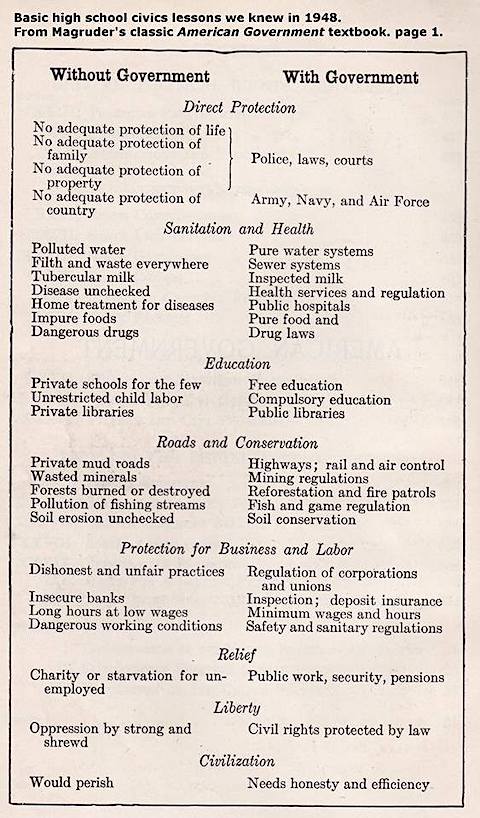
ìShould any political party attempt to abolish social security, unemployment insurance and eliminate labor laws and farm programs, you would not hear of that party again in our political history. There is a tiny splinter group, of course, that believes that you can do these things. Among them are a few Texas oil millionaires, and an occasional politician or businessman from other areas. Their number is negligible and they are stupid.î

The Great Refusal, by Glenn Parton

Filed under: Preparing for Civilization's End — Dave Pollard @ 12:35
This is the third and final part of Glenn Parton’s latest essay. Part one, Exterminism, is a broad criticism of Western culture. Part two, Free Love, outlines a mystical approach in support of a polyamory lifestyle. In this third part, The Great Refusal, he advocates a movement that combines a rejection of monogamy with a progressive integral politics.The ideas in the essay are Glenn’s, not mine, and you can tell him what you think through the comment facility below, or e-mail him directly.  Although I’ll be writing about my reaction to Glenn’s essay in a future article, my general views on the subject were contained in this article.

The Great Refusal by Glenn Parton

The development of global financial markets and transnational corporations is the Big Problem, but this does not mean that there is no significant difference between the Republican and Democratic Parties. The Republican Party is nothing but the political arm of corporate globalization on U.S. terms, while the Democratic Party has some wider human and ecological interests and concerns that will ìslow downî the process, and upon this ìsmallî difference hangs the fate of the earth and its inhabitants because we need ìtimeî to evolve fundamental lifestyle changes to American-led world capitalism. Only by slowing down the Corporate-Republican agenda (which is speeding us directly to hell), with the assistance of the Democratic Party, can we secure the essential time to resolve the Deep Crisis.

Party-politics or electoral politics is the politics of emergency: itís about putting out fires, treating the symptoms, staying alive, while we develop an Alternative to being burned and buried by a nuclear fireball or Global Warming. It postpones disaster, but it will not save the world unless we also begin, very soon, a deep, long-range eco-social movement that transforms the established reality (in the available time given to us by the politics of emergency). If we donít root out the original cause of U.S. global hegemony, then this social disease will grow back even stronger until it kills all of Life on earth.

Resurrecting the Founding Fathers is not the remedy because Ben Franklin, Thomas Jefferson, John Adams, George Washington, Alexander Hamilton, wanted to pursue their own entrepreneurial endeavors with a minimum of government interference, so they set up, under the influence of Adam Smith, a free-market society in which the American political system enables the unlimited accumulation of wealth in the private sector by removing natural and man-made obstacles. To borrow a metaphor form Calvin Coolidge, the country was to be carried comfortable down the river by the current or flow of Capital, and the function of government is merely to put out an oar where there is any danger of it drifting into the bank. Unfortunately, the Founding Fathers saw government as the major threat to (commercial) freedom, with no understanding that the major threat to (human) freedom is the concentration and centralization of wealth in private hands, and there is nothing in the constitution, as they envisioned it, to correct this fatal flaw of no positive role for government in the re-distribution of wealth.

We need a completely new American Experiment that does not replace British Empire with American Empire, but rather, restores the tribal wisdom to see (immediately and intuitively) the atrocities of ìfree enterpriseî (or what Smith called ìa New Order of the Agesî that is inscribed on the back of each dollar bill). In the jungle towns of Ecuador it is known that Global Empire destroys forests, pollutes rivers, pushes indigenous cultures to the brink of extinction. The neighboring people of Venezuela, Argentina, and Brazil do not want to be integrated into a worldwide system of commerce that privatizes key sectors of the economy: energy, water, sanitation, transportation, utilities, and communications, because they know that ìliberating the market, deregulation, trade liberalizationî polarizes the world into the super-rich and the global proletarian, i.e. into the masters of the universe and those who suffer tighter and tighter austerity measures.

The whole system of world capitalism is so unnatural, so contrary to human nature, that it is resisted by the overwhelming majority of (sane) people around the world (including Iraqis, who oppose the globalization and privatization of their state enterprises) but not in America, where about one-half of the voting population supports it, brags about it, fights for it, and goes to war for it, not out of ignorance, for the facts and evidence of the Great American Beast are everywhere, but due to psychological damage from the cumulative over-restriction of sexual freedom, more than anything else, that closes the heart and mind. Once the heart and mind are closed, due to sexual wounding, then people stop learning from the consequences of their actions and end up supporting, with a lot of hatred and resentment, destructive ends. If we are to defeat the American rise and supremacy of the psychologically damaged, which are using voting-power to harm themselves and everyone in the world, then we need a new American Political Experiment of Sexual Liberation (that ultimately leads to the creation of a tribal constitution that exceeds the scope of this essay).

The merger of the Religious Right and the Neocons is predicable because they are both reactionary movements to the permissiveness of the Counterculture of the sixties and seventies that called into question and challenged traditional American values, especially marriage and the nuclear family. Cultural Conservatives understand better than Progressives that monogamous family life is the foundation of modern society–if you put out this lynchpin, then the whole system will eventually fallóand that is why experimenting with alternatives to it cuts sorely into the conservative core of most Americans (on the Right and Left). We need to question and challenge, again, the sexually conservative core of the American psyche because it is preventing progressive politics from taking hold and growing.

The fragmentation of the tribe into isolated nuclear units, which predates the body-hating, guilt-ridden morality of Christianity, was a huge blow to the communitarian nature and wider sexual freedom of human beings, making it the deepest layer in the geology of exterminism, and so we must face and embrace the sexual dimension of our being in order to heal the wounds we have inflected on ourselves and the planet. I am not suggesting starting communes in America because, for one thing, this path is not economically feasible for most of us, and, for another reason, we are not ready, inwardly, for such ìhighî living, even if some of us could verbally agree that this is the best way to live. However, Refusing Monogamy is within our reach, wounded and fearful as we are, and this simple decision would shake and eventually crumble the foundation of our entire way of life (which is based on the single-family household), and prepare the ground for a new lifestyle, but if and only if it is combined with political activism.

I propose that politically aware individuals (those who know that Global Empire is causing world-destruction) form free associations of individuals who renounce monogamy in principle, in favor of the principle that it is possible and desirable to sexually love more than one person of the opposite sex at the same time. I say, ìin principle,î because there can be nothing obligatory about sexual love except the willingness, courage, and intelligence not to limit it. It is perfectly acceptable, according to my strategy for social change, for a politically awake person not to find sexual love with anyone, or perhaps only with one person, so long as s/he remains genuinely open to the ideal of unlimited sexual love, and does not give up on this endeavor. What would this accomplish? 

This strategy would form a political community that is united not only by ideas and values, but also by emotions and desires. This is the key to successful political organization because ideas and ideals, no matter how important, are not strong enough, by themselves, to hold people together over the long runówitness the rise and fall of numerous progressive movements over the last half-century. The pattern is that caring individuals gather and organize for the best political reasons, but over time the group declines from within due to jealousy, competition, or personality conflicts of one kind or another. Only a holistic or integral community that engages the whole human beingómind, heart, and desire (knowledge, compassion, and sex), can achieve the cohesion, solidarity, creativity, and intelligence that are required for the long and difficult task of total social transformation.

Once sexual love is put in a monogamous box, then the couple becomes a community within a community, which is to say, it fragments the larger community, prevents it from reaching higher levels of complexity, integration and oneness, stops the free flow of sexual energy which is the only force in the universe, beyond friendship and intellectual bonding, strong enough to overcome the artificial boundary of monogamous coupledom that separates, isolates, and imprisons us. If we let sex out of the box, among the politically awake, at least in theory, then We would initiate a new love paradigm of togetherness, devotion and oneness. Given the selfishness that presently prevails in the dominate Culture, I do not think that free love outside of a safe progressive political context is the best strategy for social change, but if it was combined with the very best political intentions and actions, then non-exclusive sexual love would become a vehicle that carries us upward and onward, a groundswell for a new politics of vitality, adventure, and joy.

There is nothing young adults care about more than sexual love. Giving our politics a sexual dimension would draw them into a Movement (waiting to happen) far more powerfully than anything else, including ideas and ideals for ending world poverty, disease, genocide and ecocide. Sexual energy is the lifeblood of any social and political gathering, and if it is overly restrained and weakened by unnecessary and unquestioned customs and conventions, then frustration and boredom result, leaving only duty-bound morality to motivate people beyond ego and little family concerns, which has never been enough, and never will be enough, to save the world. In contrast, the battle cry, ìrefuse monogamy in favor of sexual-love-politics for world transformation,î would certainly get and hold their attention, not to mention the attention of the media, and it could lead to a global youth revolution that finally rejects the false masters whose only joy is suffering unto death.

Not just the young, but all adults have an inalienable right to a rich and diverse erotic life, but it is no where to be found in this ascetic culture, not in our mental-politics, and not in our false (desexualized) spirituality that believes that Enlightenment comes from leaving behind the physical (the human body and the larger body of earth). The sad truth is that Americans cannot handle sex, not in our politics and not in our spirituality because we are infected with the ìideaî of it as something dirty, shameful, or violent. The word ìspiritî stands for the integration and evolution of the total human being, which means that the 3 dimensions of human existence (sexuality, love, and knowledge) comprise a balanced whole in which each part is playing its proper role and getting its own just desert. I am not proposing (or condemning) free sex (for fun or recreation) for anyone, but I am saying that small circles of individuals who practice an integral politics that refuses to disregard or minimize any vital aspect of the human animal could begin a new society that everyone (sane) will eventually join.

May 20, 2005

Looks Like the Fourth Turning After All

Filed under: How the World Really Works — Dave Pollard @ 08:11
The Idea: Is the US predestined to slide into totalitarianism?
endofdemocracy
I haven’t written much about US politics lately, but that doesn’t mean I haven’t been paying attention. As distraught as I am about the extremist ideology of the party in power in the US, I am far more concerned about the means they are using to try to subvert the will of the moderate majority. These are the means of people with totalitarian aspirations, megalomanic personalities, and undemocratic agendas:
  • Hiding extremist, unpopular and inadequately-explained legislation in ‘omnibus’ bills
  • Bullying and threatening the media
  • Fomenting fear and hysteria and wars against imaginary and exaggerated ‘enemies’ to distract attention from domestic political subterfuge
  • Lying about the ends in order to suppress popular opposition to the means
  • Characterizing flagrantly undemocratic political and electoral abuses like gerrymandering as ‘normal’ outcomes of a partisan political system
  • Mortgaging the future to curry favour with today’s voters
  • Unwillingness to study or learn the lessons of history, almost to the point of taking pride in ignorance and misrepresenting it as populism
  • Orwellian, deceptive misnaming of legislation, as part of a broader, carefully managed propaganda scheme
  • Deliberately stirring up xenophobic nationalism by misconstruing international loathing for a right-wing US regime as anti-Americanism
  • Showing contempt for vital constitutional principles like the independence of the judiciary and the separation of church and state
  • Withdrawal from and subversion of international institutions and agreements
  • Refusing to enforce, and compelling public employees to ignore, laws that are inconsistent with government ideology
  • Deliberately undermining support for public and private institutions whose mandate is to safeguard the rights of minorities, the disadvantaged and the disenfranchised, or to monitor and report on government and corporate abuses

Governments planning to subvert the will of the people and undermine the democratic process almost always masquerade as ‘populists’, using a charismatic or malleable front-man and applying precisely the techniques listed above to manufacture a series of crises and paint its opponents as traitorous, ineffectual or extremist, in order to polarize the population. The objective is make government, constitutional liberalism and democracy look so feeble that the people are willing to at least tolerate corporatism (fascism), abrogation of constitutional rights and freedoms, and totalitarian control of the levers of power. The extremists currently in power do not trust Americans to do what they want done, and all their actions indicate a desperate and broad-based attempt to permanently consolidate power so that elections can be orchestrated and rigged and so that this extreme right-wing cabal can do as it will in perpetuity.

The techniques above work — they have been used by anti-democratic forces that believe they know better than people for centuries. And these techniques are working in America — whether you believe the 2004 election was stolen or not (and it is a tactic of anti-democratic groups to show the electoral process as suspect in order to undermine support for it), a lot of moderate Americans chose to vote for a bloc of decidedly non-moderate candidates at every level in the 2004 elections.

Everything is going exactly according to plan. Everything is being done to manufacture the next crisis — an economic collapse due to deliberate mismanagement of the national finances, by racking up the largest debt in the history of the planet, or a military crisis due to deliberate mismanagement of international diplomacy, on the pretext, this time, of dealing with the Iranian or North Korean ‘nuclear threat’. This has been in the planning stages for a decade — the plan to bankrupt the federal government and the names of the chosen ‘axis of evil’, three countries whose governments everyone loathes and which are convenient targets for whipped up nationalistic frenzy and fear, were decided upon long ago.

With the next crisis, look to see the government ‘test the waters’ by suspending civil liberties more broadly than in the first trial balloon, the Patriot Act. Look to see the government ask for permanent powers in the interest of ‘security’ that will wrench power from an unreliable Congress and an even less reliable electorate — powers that will include the right to launch ‘limited nuclear strikes’ (there is simply no money left for conventional warfare against Iran or North Korea, as it has all been given away as paybacks to the large corporations that bankrolled the right-wing coup). And powers that will include the right to permanently dismantle every part of the federal government except the military and ‘homeland security’ in the interest of restoring government solvency.

It is a shame that in this century where real, long-term global crises are looming, we seem so incapable of learning the lessons of history, and so we keep repeating the same mistakes. America’s slide into totalitarianism is the last thing we need now — it could well distract the world for decades from dealing with global warming, the dangers of bioterrorism, and the acceleration of epidemic diseases, all of which will be much harder to solve than an American dictatorship. What is most telling, and most frightening, is the silence of the media, the ignorance of the population, and the denial by all but a tiny minority that anything is seriously wrong. Take a look at any country that has fallen from democracy to totalitarianism and you will see the same signs. This is the calm before the storm.

Is there anything that can be done about it? Probably not. Impeaching Bush might work, but I wouldn’t count on that happening. America’s democracy has always been fragile — since it was established it has never been seriously threatened so there’s been no need to pay attention to keeping it robust. It will be a useful object lesson for the rest of the world. And it will make the authors of The Fourth Turning look prophetic indeed.

May 19, 2005

Making Blogs Browsable

Filed under: Using Weblogs and Technology,Working Smarter — Dave Pollard @ 16:33
The Idea: By allowing blog articles to be indexed the way their author would organize them in a filing cabinet, and by allowing the reader to view blog articles by topic and sub-topic instead of just reverse chronological order, blogs would become much more useful for browsing, and this capability would also greatly enhance their value as business tools.

Knowledge Management experts will tell you there are three ways of looking for information, when you can’t get it first-hand: (a) searching, (b) browsing, and (c) using alerts & profiles

Searching is looking, just-in-time, for information about a specific subject or event. When you do research, you usually start by searching. When I was growing up, you started with the encyclopedia, and then went to the library subject card catalogue or bibliography. Today, you start with Google, follow the links, and backtrack each time you reach a dead end.

Browsing is reading serendipitously, looking for anything of interest. I can spend a whole day in a bookstore, wandering from section to section and stack to stack, reading bits of several hundred books and coming out with a half-dozen. This is possible, but much harder and less intuitive, with Amazon’s “read inside” capability (which allows you to read online an image of the first few pages of a book, and its table of contents and index). I used to browse the newspaper as well, because I believed its editors tried their best to cover a broad cross-section of subjects and events, and laid them out so I could quickly browse them by starting with the headline, then the first paragraph, and then, if I was interested in more, the details and the “continued on page A15″ material. Online, newspapers also provide links to “related stories”, and some (but increasingly few) provide free archives online. Once I discovered that newspapers select the cheapest and most sensational articles for inclusion, not the most interesting or important ones, I stopped browsing newspapers. I still browse some magazines like The New Yorker, Wired, and Fast Company, since they appreciate that some people still want to read about important things.

Alerts and profiles are pre-set, ‘standing order’ requests that notify you, usually daily, of any new information about a specific subject or event. There are four main kinds of alert tools.

  • Keyword alerts retrieve articles and new web pages that contain selected keywords or strings.
  • Subject alerts retrieve articles about a particular subject (you generally have to pick from a pre-set taxonomy or index of subjects) that have been ‘tagged’ with that subject tag. These vary from very narrow (e.g. New York Times international news headlines) to quite broad (e.g. StumbleUpon has subject categories that include complexity theory, dogs and women’s issues).
  • Source alerts retrieve any new articles from a particular source (periodical, website etc.). RSS feeds are a form of Source Alert.
  • Synopses are distillations of longer works (e.g. Executive Book Summaries) or of all major stories on a particular subject in the last day, week or month (e.g. Innovation Weekly).

Alerts and profiles come in ‘push’ and ‘pull’ varieties. ‘Push’ alerts send something (an e-mail or notification) to your mailbox or desktop. ‘Pull’ alerts store the retrieved articles on a page for you that you must remember to go out and browse (e.g. Bloglines).

None of these three ways of looking for information is ideal in every case, and no information source lends itself perfectly to all three ways of looking. Here’s a current ‘scorecard’ of how the sources stack up today:

Information Source Suitability for Searching Suitability for Browsing Suitability for Keyword  Alerts Suitability for Source Alerts
Radio or TV News not possible (though a few sources do provide transcripts) poor (unless you’re really adept with the channel-changer) not possible not possible
Newspapers & Magazines fair (table of contents; section headings) good (if only the content were better) not possible not possible
Bookstores & Libraries poor (have to know exactly what you’re looking for) excellent (if only the variety were better) poor poor (synopses and book reviews cover very few titles)
Online Newspapers, Magazines (those offering full, free content and archives) and Newsfeeds excellent good (if only the content were better) good (Note 1) excellent (RSS)
Online Newspapers and Magazines (those with limited free content or limited, pay-per-use archives) poor poor good excellent (RSS)
Online Bookstores not possible (except for titles) fair-to-good (depends on breadth of titles & availability of “read inside” capability) poor poor (synopses and book reviews cover very few titles)
Online Libraries good (if you’re good at using Google) excellent (if only the variety were better) poor (Note 2) excellent (RSS)
Websites good (if you’re good at using Google) varies from poor to excellent (depending on layout) poor (Note 2) varies
Weblogs good (if you’re good at using Google) fair (constrained by last-article-first architecture and inaccessibility of archives) poor (Note 2) excellent (RSS)

Note 1: If you’ve ever set up keyword alerts, you are probably aware that the results you get include a lot of self-aggrandizing corporate press releases (most of them close to spam) and a lot of duplication, as many sources republish the same articles. It’s a frustrating, needle-in-the-haystack exercise.
Note 2: Most alert services do not cover these sources.

The bottom line is that if you’re searching for specific information, you’re going to rely on the online newspapers and online magazines that provide full, free content and archives. Most of these companies are trying to get corporate researchers to pay big money for full content and archives, and it’s possible that thanks to corporate greed, these sources will soon no longer be available unless you have a big expense account. Fortunately the independent online media will continue to provide all of the non-proprietary articles (those from the news services), and bloggers, including an increasing number of freelance journalists who keep ‘mirror’ copies of their articles on their own websites, will keep almost all of this content online, free, indefinitely. It may be a bit harder to find, but it will be out there.

The bottom line for those browsing for information is that libraries (online and the old fashioned kind) are still the only way to go. Blogs could be excellent for browsing, but they’re constrained by the architecture of the current tools.

The bottom line for those who prefer alerts to get their information is to use RSS subscriptions for source alerts, and to be prepared for frustration if they’re using keyword alerts. The world needs much more sophisticated keyword alert tools, which will (a) filter out duplicate items, (b) filter out corporate press releases that are little more than spam disguised as news (“Megacorp announces innovative way to sell nothing for something”), and (c) broaden the reach of alerts to include new content in online libraries, websites and weblogs. None of these improvements will be easy. Many articles go through multiple drafts and rewrites and abridgements for different periodicals, so the ‘duplicate’ articles may be hard to spot. Some corporate press releases actually contain useful information. And there’s an ocean of material on websites and weblogs that information-seekers probably won’t consider useful information. A lot of experiments will be needed to design a keyword alert tool that strikes the right balance.

The task of making weblogs’ architecture more robust should be much easier. Weblog software with more dynamic information architecture would not only make blogs much more valuable to those browsing for information, they would make weblogs much more valuable in corporate environments. The current emphasis on adding ‘tagging’ information is, in my opinion, misguided: That would make their content easier to search, and might solve the information overload problem when they’re embraced by keyword search agents, but it won’t make them easier to browse. Much of the readership of weblogs is serendipitous — people stumble on them (usually through search tools) when they’re looking for interesting reading. Or, they blogroll a weblog because some of its content is of interest to them. What is needed is a way for people to browse through a selected subset of weblog content, all of the articles on a particular topic.

At present, weblogs can only be displayed one way: in reverse date order. After a week or so, the older content ‘disappears’ into the archives. The presumption is that it is no longer worth reading, like an old newspaper. But a weblog is not a newspaper, and many blogs have lots of information that has a long or even unlimited ‘shelf life’. The makers of blog tools have attempted to deal with this by allowing bloggers to set up ‘categories’, with each category separately subscribable using RSS. But each category still displays in reverse date order, and each ‘category’ is essentially a separate blog, with the category articles also disappearing into the archives.

The best analogy to the weblog is the newspaper or magazine columnist. They, too, write regularly on a variety of subjects, and would like to make their content available to people by subject, not just in reverse date order until it ‘disappears’. If they don’t write every day, like Malcolm Gladwell, they can at least fit all their article titles and links on one long page, and it’s awkward but not impossible to find and read everything he’s written on a particular subject. If you’re a weekly writer, like my friend Michel Dumais, finding all the articles on one subject can get ugly. Even a site-specific search bar like mine (which surprisingly few prolific bloggers provide) doesn’t help much if you’re not sure which keywords to use. If you want to read what I’ve written about the Wisdom of Crowds, do you use that phrase, or do you also have to check “collective wisdom” and “group intelligence” etc.?

If you’re working for a company and you want to read everything your company’s technology expert has written on a subject and his corporate weblog only lists the 8,000 articles in his ‘filing cabinet’ only in reverse chronological order, 20-per-page, chances are you’re going to give up before you find what you’re looking for. Yes, you can always search the corporate Intranet for everything containing both the subject in question and the expert’s name, but what if the subject goes by several names? And what if you get too many positives and have to wade through 100 articles one at a time to find the pertinent ones?

I have argued in past that the technology expert’s files, and Malcolm Gladwell’s and Michel Dumais’ columns, and the articles in each person’s blog, are analogous to the content in a personal filing cabinet. There is no ‘universal’ taxonomy that we would all agree upon for indexing this content by topic and sub-topic. But if we had access to the content the way the author would index it in his/her own filing cabinet, even if that isn’t the way we might choose to organize that content, it would certainly be much easier to browse.

In fact, new technology would allow you to index it in more than one way, so that, for example, an article like this, that talks about blogs in business, could ‘show up’ in two different filing cabinet organizing schemes, one by subject (blogs) and one by constituency of application (business). The most important thing requirement for each author to be able to organize content their own way(s), in whatever level of detail makes sense to them.

So how difficult would it be to allow each blog owner to set up their own taxonomy (filing cabinet ‘tabs’ and ‘subtabs’), and each time they write an article to ‘check off’ which ‘tabs’ it belongs under? You would of course need to be able to change and add to this organization, just as you might do if one section of your filing cabinet got too unwieldy.

And then, how difficult would it be to equip the weblog tool with a ‘toggle switch’ to allow readers to view articles by topic and subtopic, instead of just in reverse chronological order? So you would get a ‘table of contents’ on the ‘home page’, which would probably be in ‘outline view’ which you could expand to see the entire detailed taxonomy of the author, and the articles under each sub-topic.

This, I believe, would be all that is needed to make weblogs easy to browse, and hence far more useful as a research tool and as a ‘calling card’ for the author — and more enjoyable for serendipitous reading. And it could be all that is needed to allow weblogs to finally break into the business world and corporate intranets in a big way.

May 18, 2005

Twelve Ways to Think Differently

Filed under: Working Smarter — Dave Pollard @ 14:28
The Idea: Twelve methods that will exercise parts of your brain that rarely get it, and make you more creative and better able to understand the world.

yinOur minds are like our bodies — fail to exercise them and they atrophy and break down. We live in an age of specialization, where we are encouraged to narrow our interests and our activities, to focus and limit ourselves to doing things at which we are very competent. So parts of our brain get a lot of exercise and other parts very little. What’s worse, this can actually narrow our comfort zone, the range of things we enjoy doing or thinking about and are competent in. Many of our cultural activities and artefacts: political debates, win/lose competitions, hierarchies, laws, religions, ‘best practices’, systematization, uniforms, and monolithic architecture and design — all tend to reinforce ‘one right answer’ thinking that discourages and ultimately excludes and prevents us from thinking differently. Even the mental exercises we do as we get older are designed to stem the loss of analytical skills and memory rather than broadening our thinking or our thinking ability. We live in a world of stultifying sameness and uniformity: physically, ideologically, intellectually. There is little motivation, little day-to-day need, to exercise the parts and processes of our brain that rarely get a workout.

So how can we learn to broaden our thinking, to think differently? This is not just a matter of critical thinking, creative thinking, ‘outside the box’ thinking. It is about opening up our minds to the world and all its possibilities. This is one of the essences of the Four Practices of Open Space, (opening, inviting, making room, acting/realizing). But it is not at all easy. Our brain structures are actually formed as we grow, to reflect and accommodate the analytical and ‘one right answer’ thinking that constitutes most of what we are taught when we are young. Broadening our thinking therefore requires us to consciously will ourselves to think about things, and think in ways, that we are not comfortable or familiar with. It is counter-cultural, more of an unlearning than a learning process. It is kind of like the agony that runners who do not regularly do ‘loosening up’ exercises must go through to stretch the muscles that have tightened (shortened, atrophied) in response to the running routine.

From my own experience, some research and a couple of recent conversations, here are twelve mental ‘stretching’ techniques that can enable you to think differently. Before you consider them, you might want to ask yourself whether you need them. They are unlikely to make you happier, though they will probably make you more creative, and more understanding. Remember, I’m the guy who lives to foment dissatisfaction, so be forewarned. In no particular order, and with some likely overlap:

  1. Meditation: Or whatever ‘stand still and look until you really see’ attention techniques work for you. Anything that can still the noise of the machine in our heads, anything (like Getting Things Done) that can empty the detailed minutiae of your life from your memory and make room for something new. Because the better you are at paying attention, the more likely you are to be able to see and appreciate other perspectives.
  2. Reconnect With Your Senses: Do exercises that increase your awareness and the sensitivity of your senses. Most of what you learn is perceptual rather than conceptual, and you can learn an astonishing amount by just becoming more aware of nature, and of yourself, and of the connection between your senses and the senses of all life on Earth.
  3. Reconnect With Your Intuition: We are taught to distrust it, but for three million years it informed us about the world and how to deal with it successfully and happily. It’s all there encoded in your DNA — how to live, how to handle any situation, what to do. The perspective you can get when your intuition provides one viewpoint on a situation and your ‘book learning’ another is remarkable. It’s like suddenly seeing stereo when all your life you’ve only seen with one eye. Instant depth perception.
  4. Analogies and Metaphors: “Science is Metaphor” said Timothy Leary. Analogies and metaphors allow you to ‘re-see’ something abstract as something concrete, something conceptual as perceptual. Lakoff points out that “We cannot think just anything – only what our embodied brains permit”, and analogies and metaphors permit us to think things we probably otherwise couldn’t. My recent “If the Shoe Were On the Other Foot” article was an example of this.
  5. Conversations and Interviews: A wonderful enabler for thinking differently is the shared context that comes from conversations and interviews. Several of my most popular articles have been conversations with myself or with other people, because they help people understand my thought process much better than analytical discourse. Like everything natural, they are inefficient but extremely effective. Interviews work the same way. Face-to-face and recorded conversations and interviews, if they are natural and probing and improvisational, are even better, because you learn more of the participants’ worldview from the vocal nuances and body language.
  6. Synthesis, Distillation and Restatement: When you recapitulate and condense what you’ve read or heard, you force yourself to use your own words to say what they had to say. You can learn as much from this about their way of thinking, and your own, as you can from the reading or listening experience itself.
  7. Reading (and Writing) Fiction: The most important character in stories is the narrator, not the protagonist. While empathy with the protagonist will keep you reading, it is from understanding the perspective of the narrator, and contrasting it with your own, that you learn the most. Here as an illustration is an excerpt from Mark Haddon’s wonderful book The Curious Incident of the Dog in the Night-Time (thank you to the reader who recommended this book to me) — told from the point of view of an autistic child::
And then I thought about how for a long time scientists were puzzled by the fact that the sky is dark at night, even though there are billions of stars in the universe and there must be stars in every direction you look, so that the sky should be full of starlight because there is very little in the way to stop the light from reaching Earth. Then they worked out that the universe was expanding, that the stars were all rushing away from one another after the Big Bang, and the further the stars were away from us, the faster they were moving, some of them nearly as fast as the speed of light, which is why their light never reached us.

I like this fact. It is something you can work out in your own mind just by looking at the sky above your head at night and thinking without having to ask anyone. And when the universe has finished exploding, all the stars will slow down, like a ball that has been thrown into the air, and they will come to a halt and they will all begin to fall towards the centre of the universe again. And then there will be nothing to stop us from seeing all the stars in the world because they will all be moving towards us, gradually faster and faster, and we will know that the world is going to end soon because when we look up into the sky at night there will be no darkness, just the blazing light of billions and billions of stars, all falling.

Except that no one will see this because there will be no people left on Earth to see it. They will probably have become extinct by then. And even if there are people still in existence, they will not see it because the light will be so bright and hot that everyone will be burned to death, even if they live in tunnels.

  1. Psychoactive and Other Drugs: They work for some people, and have for thousands of years. Nope, don’t have any on me.
  2. Learning a New Language: Linguists say all human languages are so similar than an alien would see them as indistinguishable, but anyone who doesn’t see how a language entrenches cultural preconceptions, ideas, and ways of thinking probably has never mastered a second one. The vocabulary, the syntax, the way in which it is ordered, the nuances of meaning, all push you to new ways of thinking.
  3. Learning Something Outside Your Comfort Zone: If you’re an artist, learn about String Theory. If you’re a scientist, learn about the aesthetics of music. The more novel and uncomfortable and strange it is, the more it will liberate your calcified brain.
  4. Do Impulsive and Serendipitous Things: Any activity that won’t let you plan or anticipate, but which instead forces you to perceive and learn quickly and pay attention and react and live in the moment, will get you outside the centre of your own universe and help you see and think differently. And if you can’t get yourself to do impulsive and serendipitous things, then at least read impulsively and serendipitously. Free the genie.
  5. Collaboration: Not just coordination or cooperation, true collaboration. When you have produced a truly collective work-product, you have in many ways got inside the heads of your fellow collaborators, and that will change you forever.

Courses in lateral thinking try to teach you how to identify and set aside the obstacles in your own head (biases and preconceptions, inability to concentrate or imagine, entrenched ways of thinking, fear, conservatism, ignorance) that prevent you from thinking in truly novel ways. These courses offer more exercises to show you how to train yourself to think differently. But ultimately, like any difficult and important skill, the only way to achieve mastery is to practice, practice, practice. The twelve techniques above are, at least for most of us, fun and engaging ways to do that.

May 17, 2005

By the Numbers: The Wal-Mart Dilemma, File Sharing and Lousy Service

Filed under: How the World Really Works — Dave Pollard @ 15:11
The Idea: Oligopolies, insane intellectual property laws, unreasonable shareholder expectations, government corporate welfare, massive subsides, corporate amorality and other aberrations keep the current economy light-years from being a true market economy, but at a micro level, customers are starting to flex their muscles and their creativity and working their way around market-distorting behaviours of obstinate and dysfunctional corporatists.  This article explains how it all works.

ByTheNumbersThe other day I was challenged to explain some of the economic phenomena I’ve written about on this blog, like the Wal-Mart Dilemma, file sharing and the end of affordable personal service, in terms of classical economic models. I was a little rusty, but here is how I replied:

In the ideal, ‘perfect’ marketplace (if we should ever find one), the amount of a product that is sold, and the price at which it is sold is determined by the intersection between the supply and demand curves, as illustrated in Fig. 1 at right. The black dot, which corresponds to the point at which y units of the product are sold at price x apiece, is that intersection: If a vendor charged more than x, the drop in demand would more than offset their improved margin, and some competitor would eventually step in at price x.

What Wal-Mart has done is shown in Fig. 2. They bully their suppliers to lower their wholesale prices to the point that Wal-Mart can sell for less (and less each year). Customers accordingly buy a lot more of each product, often more than they need, either to stock up or because they can get more of the product from Wal-Mart than from other vendor for less money, so even if they throw the extra away they’re still ahead. Much has been written about this practice, which is analogous to what, in international markets, is called ‘dumping’ — clearing out a product at a loss to force smaller competitors out of business. Much has been written, also, about the devastation this has wrought in the name of ‘productivity’: Vlasic pickles chased the Wal-Mart business to the point they produced almost half the US’s total pickle volume, but at margins so small they were unsustainable, and they became insolvent. The only way Levi Strauss could meet the price-cutting demands of Wal-Mart, upon whose business they quickly became dependent, was to close all of the company’s once-proud Made in America facilities, outsource everything to Asian sweatshops, and lay off all American production staff. The competitors of Vlasic and Levi Strauss (and many more companies like them), in the meantime, lost so much market share to the discounters that some of them, particularly small local vendors, disappeared as well, taking small local retailers with them. The Wal-Mart Dilemma has arisen as a result: The laid-off US workers can now only afford to buy from the same deep-discount retailer who put their employers in receivership or forced them to offshore their domestic operations. It’s a grim irony and socially devastating to millions, but to the shareholders of Wal-Mart it makes perfect sense. And, what’s worse, in most cases, the foreign crap that Wal-Mart sold was so inferior in quality that buyers found the ‘low prices’ weren’t even a bargain — their products had to be replaced much sooner and the absolute cost to the consumer (and to the society in energy waste and landfill garbage) was actually higher. Only when customers wake up and realize that they’re actually getting less value for money (and/or when Asian currencies are revaluated) will this aberration in the healthy supply/demand curve some to an end.

In industries where oligopolies use their size and domination of the market to crush or buy out small competitors, and hence jack up prices and margins to exorbitant levels, you get a picture like Fig. 3. In this case, the high prices drive customer demand to near zero, to the point where there is essentially no intersection of the supply and demand curves. We’ve seen this in the CD market, where the oligopoly dramatically reduced the number of titles it produced, jacked up margins to sky-high levels, and saw unit sales plummet for a decade as a result. While the oligopoly blames the sales drop on P2P suppliers (file-sharing), the P2P phenomenon is actually a result, not a cause, of exorbitant pricing and falling product diversity. The ‘market’ worked around both the excessive pricing of the oligopoly, and the lack of variety and quality of their product — consumers simply traded music with each other (as they in fact have always done, but on a much smaller scale), and welcomed independent online artists who offered the quality and variety they wanted at a reasonable price. Here the irony is working in the opposite direction than it does in the Wal-Mart case: The music oligopoly cannot afford to lower its prices, broaden supply or improve quality to recapture lost market share because their shareholders will not let them — this would at least temporarily hurt profits and share prices. So instead the oligopoly is simultaneously suing file-sharers and squeezing artists to try to find a way to sustain profits without capitulating to the market that its own greed has created — a losing game.

Fig. 4 shows yet another market anomaly: The unaffordability of decent customer service. The industrial model of the West is based on high margins (from oligopoly practices and automation) and high volume of identical products to sustain the absurdly high ROIs that shareholders demand of public companies. This leverage is much harder to achieve in services than it is in products. Vendors want customers whose products are obsolete or broken to throw them out and buy new ones — as often as possible. A market for durable used products would disrupt that consumer pattern, and the fact that companies like Amazon and eBay are meeting the exploding demand for quality second-hand products is alarming and threatening to all the companies that depend on the Western industrial model. It’s like the file-sharing nightmare, except now people are trading everything used, not just music, videos and software. Likewise a huge gap has opened up between the supply of and demand for quality customer service — another area where ROIs are constrained by lack of leverage: Service is hard to automate, usually dreadful when it’s offshored, and offers lousy margins compared to products to boot. Every segment of the customer population, from corporations and the rich to the poorest individuals, is dissatisfied with the quality and value-for-money (and sometimes the absolute unavailability) of quality customer service. Providing good service is expensive, and large corporations are trying everything they can to force customers to a ‘self-service’ (i.e. no service) model. Those in industries where they can’t just tell the consumer “Throw it out and buy a new one” are in especially deep trouble. Examples: the news media, professional services (legal, medical, financial etc.) are all under fire for their skyrocketing prices for less and less service time and value.

The curves in Fig. 4 are not sustainable. Customer demand is not going to yield — the need for quality service will never just go away, most people will never adapt to ‘self-serve’ models (the digital divide just keeps widening), and thanks to the Wal-Marts of the world customers’ ability to pay for quality service is going to decrease, not increase (especially when the stock market and housing market bubbles burst). This will widen the gulf in Fig. 4 even further. There are three possible scenarios, and we’re likely to see a mixture of all of them:

  1. New low-price, high-quality service suppliers will enter the market. If this happens (and it’s already started), expect a bloody battle from the incumbents who will do everything they can to prevent it — getting governments to ban ‘unlicensed’ (by the incumbents) service providers, rendering warranties invalid if service is done by ‘unauthorized’ personnel, and, of course, suing the new entrants. Credit unions, Internet banks and insurance companies, independent Sarbanes-Oxley ‘compliance consultants’, alternative media, paraprofessionals, alternative medicine practitioners, healthcare offshorers, self-publishers, investment clubs, alternative disputes settlement forums, and other ‘peer assist’ offerings are just some of the examples of alternative offerings eating into the ‘customer service’ establishment in many industries, and trying to close the gap in Fig. 4.
  2. The price ‘bubble’ for services will collapse, just as it has for products and just as it will for stocks and real estate. This will also be bloody. Public corporations in service industries will be crucified by shareholders as those incumbent service providers who break ranks drive service industry ROIs down to more reasonable levels. Large-firm ‘professionals’ who would faint at the unheard-of idea of salary cuts will see cuts in double-digits, which, on top of the incredible hours they already work, will probably lead to massive strikes by people you would never expect to see striking. Companies which make shoddy products and which try to shove off all service to outsourcers or offshorers, like the big computer hardware and software makers, construction companies and lawn tractor makers (according to Consumers’ Union, these industries’ products have the highest failure, repair and complaint rates, and none provides quality service) will face a consumer revolt, and demands for government regulation to improve or offer free replacement for defective products and work — which these industries will fiercely lobby against.
  3. Peer-to-peer service models will emerge. This could be fascinating, because there’s a precedent for it in just about every country that has ever suffered through an economic collapse. The next generation may start by working their way through university fixing computers inexpensively for the big, sloppy computer manufacturers. But why would they stop there? Once they become expert at repairing your piece-of-shit Dell computer, why wouldn’t they start building their own, and offering much more customization, better upgrade capability, lots of free, Open Source software bundled in, and friendly, reliable, knowledgeable local service? At a fraction of the price. Yes, at first some of them may be pretty crappy themselves, but the market will work that out, just as it did with the Japanese manufacturers when they first entered the Western market (remember when Made in Japan was synonymous with poor quality?)  And if you buy your next computer from your neighbour’s son’s upstart enterprise, why not do your banking through your niece’s new community bank, part of a huge peer-to-peer network of community banks all helping each other out? And why not a new industry comprised of young legal students (or retired lawyers) offering alternative dispute resolution services for $20/hour instead of the $200 the lawyer charges? Lots more examples spring to mind.

It’s hard to say where this could end: Whether customers will be content with a rectification of corporatists’ market-distorting abuses, by simply ‘working around’ the dysfunctional giants; or whether this trend could usher in, especially with the pending retirement of half a billion baby-boomers in the next decade, an early evolution of a new and entrepreneurial Gift Economy. If it should turn out to be the latter, we’ll need to find a replacement for the classic supply/demand curves that I’ve used in this article. When x=0, all the time, y by definition becomes infinitely large, and a world of scarcity becomes a world of incredible abundance. I’m not sure the Gloomy Profession is ready for that.

May 16, 2005

Making Peace With the End of Civilization

Filed under: Preparing for Civilization's End — Dave Pollard @ 12:52
The Idea: The author waxes philosophical about how he can be so pessimistic and so happy at the same time, and why he works so hard when he sees no perpetuity to what he does.

Here’s the gist of a recent conversation, of a type that I’m having a lot lately:

RS: Dave, you say you don’t have the patience to do knowledge consulting work anymore. Why is that?
Me: Well, I’ve recently been doing a lot of research and reading on the state of the world and on human nature, and I’ve come to the conclusion that we are living in the last century of human civilization. So I’ve become a little impatient with projects I don’t think are that important in the larger scheme of things.
RS: (strange look) Wow, that’s a depressing thought. It must be tough to do anything with that negative a perspective on life and the future.
Me: Actually, it’s very liberating, and I’m more at peace than I have been at any time in my life. Because I’ve come to believe that the end of civilization is something we can’t do anything about, nor is it anybody’s ‘fault’, or even necessarily a bad thing. As Canadian archaeologist Ronald Wright says, if we destroy the ecosystem that sustains us “nature will merely shrug and conclude that letting apes run the laboratory was fun for a while but in the end a bad idea”.
RS: Why don’t you think anything can be done about it, and that it’s nobody’s fault? That seems peculiarly fatalistic for someone as driven as you are.
Me: Nothing can be done about it because we are wrong in the uniquely human conceit that we are in charge of our own destiny and that there is some kind of collective politic and collective intelligence and ‘free will’ that can be harnessed to move us all in a chosen direction. We are nothing more or less than six billion creatures individually doing what we are driven to do moment by moment. We have been driven to overpopulate and despoil the planet and exhaust its resources by our DNA, and in so doing we are merely following Darwin’s law: Fierce, adaptable creatures flourish. And man is the fiercest and (next to bacteria, viruses, insects and birds, which palaeontologists believe are the four species likely to inherit the Earth when we are gone), the most adaptable the planet has ever seen. And how can we blame man for just being what he is?
RS: But surely you accept that man has evolved, and adapted himself, and introduced technologies that have made his life immeasurably better? Why don’t you think human ingenuity will allow us to evolve to solve the problems we are facing today as it has in the past?
Me: Technology and ingenuity have never solved problems, other than those created by previous technology and ingenuity. The greatest example of human ingenuity is the eradication of smallpox, a disease that had killed a billion humans. But smallpox was merely nature’s response to human overcrowding and poverty, which were in turn consequences of a previous ingenious human technology called agriculture. Technology and ingenuity have merely allowed our species to be more ‘successful’ in the evolutionary sense: To reproduce more of ourselves. There is growing evidence that we were much happier and much healthier before civilization began, when we lived as gatherer-hunters in harmony with, and integrated with, the rest of life on Earth. In those days the probability of being eaten by a large carnivore at any random point in one’s life was accepted with the equanimity with which we now accept a more protracted death at the unhealthiest and most unpleasant end of a longer, more predictable ‘civilized’ life.

We are simply running out of space and time for evermore expensive and evermore convoluted technologies to be applied to fix the problems that the last generation of technologies created. The Earth is finite, species die-off is already occurring at a rate comparable to that of the six previous major extinction events of our planet, and although we have some heavy hitters on ‘our’ side, nature always bats last.

RS: Well if you really believe that I can’t see how you can get engaged in projects like AHA! and business innovation and your writing projects. If we’re going to be gone in a century, what’s the point?
Me: That’s exactly the point. If we’re going to be gone in a century, why not live in the moment, use every minute to do what gives your life purpose and meaning and pleasure right now? For me that means learning something new every day, it means helping others, it means getting back in touch with my animal nature: reconnecting to the Earth and all its life and spending time just being, opening up all my senses, feeling, being happy to be alive and healthy and right here right now, and trusting my instincts.
RS: So you believe man is on the verge of exterminating himself and much of the life of the planet, but you’re not going to do anything about it?
Me: On the contrary, I’m going to do everything I can, short of murder or suicide, to try to help avert it, and to reduce the horrific suffering that civilization is inflicting on all life on our planet. I’m just philosophical about the fact that nothing I do or anyone else does has significant likelihood of changing the endgame, so I’m not going to beat myself up about failure, and I’m not going to feel guilty about just living in the moment and being happy.

One thing I will invest considerable time in is talking with my two granddaughters so they have an idea what they are facing, since they are more likely than we are to face the brunt of civilization’s collapse in their lifetime. I will try to be a role model for them, so that they too will try to do their best to alleviate suffering and avert the end of man, and in the meantime they will live full, passionate, informed, guilt-free and open lives. I hope they will love themselves and many other people without limit or condition or restraint, and that they will come to love learning as much as I do. And hopefully they will not blame anyone for the fact that, as EO Wilson put it, with man, “Darwin’s dice have rolled badly for Earth”.

RS: (exasperated look) I think if I believed that I’d become a nihilist or a survivalist or a hedonist and lose myself in sex, drugs and rock & roll.
Me: Well if you have to choose one of those I’d strongly recommend hedonism, in its original sense of pleasure-seeking rather than the more modern sense of extravagance. There’s lots of evidence that really good drugs can help you escape the straitjacket of cultural thinking and liberate you and reconnect you to Earth. Most such drugs are probably illegal for precisely that reason. And a six-hour marathon of sex has much to recommend it for reconnecting with your senses and your animal nature. And music is wonderful for stirring the memory and the soul, and is man’s greatest invention, the only one he hasn’t subsequently had to invent a cure for.
RS: I know you’ve written that you think traditional problems like nuclear or biological war or disease are greater threats to man than natural disasters that result from global warming. But don’t you think if there is a runaway war or disease the people left will just rebuild civilization all over again?
Me: From what I’ve read, populations going through extinction events follow a ‘normal’ curve — after an accelerating rise they go through a similar rapid decline, and then just tail off slowly to complete extinction. We have become so dependent on civilization — almost like perpetual children — that we don’t know how to live without it. The survivors will be so helpless without all the constructs we are now hardwired to base our lives on, that I doubt they will be able to adapt quickly enough to survive. The predator that ultimately causes the collapse — whether it be a new disease, bioterror agent or a nuclear winter — will continue to inflict casualties on the survivors, and prevent them from getting a new foothold. So, no, I don’t think there will be a rising of man from the ashes, and for that reason I don’t think there’s any point in writing messages for the ‘next civilization’ and burying them underground to be found After the Fall.

And the birds, insects, viruses and bacteria won’t have much use for them.

RS: How about space travel? Or communicating with some advanced alien species which could save us from ourselves?
Me: We got lucky with the development of nuclear weapons just at the time when they served as a deterrent rather than a destroyer of the planet. We’re extremely unlikely to be so lucky in stumbling on a technology that will allow us to escape our mess on Earth in sufficient numbers with sufficient time to find another inhabitable planet. And probability experts say the likelihood of verterbrate life (let alone a life form we could recognize as ‘intelligent’ and communicate with, or vice versa) emerging anywhere in the universe from the primordial soup is about one in sixty billion, so SETI is even more delusional than betting your life on winning the lottery. We should focus our attention instead on learning from the very intelligent and sensitive non-human life all around us.
RS: So why write then? Why try to set up your AHA! Learning & Discovery Centre? Why work so hard to help people become more innovative and more entrepreneurial?
Me: Because that’s who I am. That’s what I was meant to do. Just like the other six billion on the planet and the fifty billion who preceded them, I’m just playing out the role that was written for me in my DNA. I only wish I hadn’t been distracted for so many years from realizing what my role is. We don’t really do what we can. We do what we must.

May 15, 2005

We Need More ‘If the Shoe Were On the Other Foot’ Thinking

Filed under: Our Culture / Ourselves — Dave Pollard @ 11:47
The Idea: If we really want to break people out of their frames, we should make less use of satire and more use of analogous thinking based on an extension of the ‘golden rule’ .

whitehouse2By now you’re probably tired of reading about the need to ‘reframe’ debates and discussions in order for the ‘other side’ to appreciate your worldview and where you’re coming from, and hopefully see it your way. The problem is, it’s hard to reframe something from within your own frame, and unless you yourself are able to understand where the ‘other side‘ is coming from. Perhaps a useful exercise to practice, to become better at understanding opposing views, is ‘If the show were on the other foot’ scenarios.

I suggested one of these a couple of years ago to try to explain to Americans why most Iraqis viewed ‘Shock & Awe’ as invasion and oppression, not as liberation. Imagine, I said, if foreign governments, concerned perhaps about the anti-democratic practice of gerrymandering, and the possibility that the 2000 (and 2004) elections were stolen, and believing that in fact a quiet coup had occurred, decided to ‘liberate’ Americans from an illegitimate and extremist government. In such a scenario, does anyone doubt that even the most cynical and disenchanted liberals would join in a non-partisan resistance movement to oust the invaders, even at the cost of their lives? So why is it so hard to understand Iraqis of all stripes doing the same to defend their country?

US president Kennedy used this thinking in his anti-segregation speeches to whites in the 1960s, to try to get them to imagine what it is like facing discrimination strictly on the basis of skin colour.

We need more of this kind of thinking, because ‘If the shoe were on the other foot’ analogies are essentially stories, and as such they can be made context-rich, memorable and persuasive, and transcend thinking that is rooted in ‘frames’.

Example: The Republicans in the US are about to use their majority to bring about an end to the strange but honourable tradition of filibustering, in order to force through approval of some of the most frightening right-wing extremists the US has ever seen into powerful positions in the judiciary. This is might-makes-right thinking (in more ways than one) and its purpose is to extend the power and influence of unelected ultraconservatives well past the next election. But what if the shoe were on the other foot? What if, in the past or in a few years or in a parallel universe, some ultra-liberals were to use leverage on a moderate-progressive majority in Congress to push through judicial nominees who favoured the abolition of prisons, the elimination of private property, and unlimited, free abortion right up to the moment of conception? (oops, I meant birth — thanks, Richard). Would conservatives not want access to filibusters as a means of blocking extremist nominees and actions if the shoe were on the other foot?

Another example, from a different political perspective: Several countries in Europe are prohibiting any manifestations of personal religious belief in schools, workplaces and other ‘secular’ institutions. Clothing, symbols and rituals of faith are permitted only in private homes and churches. Young women who wear headscarves to school are told by school authorities that they have been brainwashed into supporting a religion that oppresses women, and suspended from class. But what if the shoe were on the other foot? What if, in the past or in a few years or in a parallel universe, Europe were taken over by a religious frenzy and only the clothing, symbols and rituals of that single religion were tolerated in schools? Would those of differing views not feel oppressed and outraged if they were told that clothing they thought perfectly respectable was blasphemous and that wearing a symbol of secular belief (like a peace sign) was grounds for expulsion from school?

Books like A Handmaid’s Tale and 1984 are (while excellent literature) usually quite ineffective at bringing about a change in worldview because they tend to preach to the choir — to those who already see the danger their cautionary tale warns about. To tell someone of a particular belief, however, what the world might be like if that belief were ubiquitous and pushed to an extreme, is unlikely to win any converts and will be dismissed by this audience as scaremongering and exaggeration.

A more effective means of changing someone’s worldview, I think, is to tell ‘If the shoe were on the other foot’ stories. I think mothers understand this particularly well: What mother hasn’t started many a dressing-down to her child with “How would you have felt if someone had done that to you?”

But it won’t be easy. Such thinking is uncomfortable, and exposes us to our own biases and presumptions as well as those of the people we seek to caution. It will take a lot of practice, and, perhaps, by the time we get really good at it, we’ll have broadened our thinking so much we won’t actually need to tell the stories anymore. The ‘golden rule’ is ubiquitous in all human cultures. We need merely extend it from ‘treat others as you want to be treated’, to ‘treat others as you would want to be treated if your situations were reversed‘.

May 14, 2005

A Little Bragging, A Little Contest, and the reason Dave’s RSS is MIA

Filed under: Using Weblogs and Technology — Dave Pollard @ 14:14
blogpop
Although my page-counts are going through their usual spring doldrums, my Technorati inbound blog count is creeping up on the magic 1000 mark, and should reach that level in the next week or two. This will be a first for anySalon blogger, and I’ll be the fourth (I think) Canadian to accomplish this. Although the numbers tend to jump around as people add and delete you from their blogrolls and as posts referring to you appear on and disappear off blog home pages, I will try my best to be watching for the moment I first reach that level, and I will award a small prize to the 1000th inbound blog, and also to one randomly selected blog linking to me already, and one randomly-selected reader of my RSS feeds. I’ll announce the winners as soon as that happens. Thanks to all readers — this is a truly grassroots accomplishment, as the only ‘A-list’ blogger who links to me is Canada’s most-linked blogger, technowhiz and Tucows guru Ross Rader.

Also, on a technical note, I inadvertently posted by May 12 post with a July 12 date, and since then, even though I deleted and reposted it with a correct date, my RSS feeds are no longer going out, I suspect because the RSS reader software is waiting for something more ‘current’ than July 12. I’m trying to fix it, but in the meantime if you find yourself on my blank July/05 page, please use the calendar to jump back into the present.

[Update: May 16 -- RSS feed fixed, thanks to Aalia Wayfare and Userland's Lawrence Lee! If anyone notices anything still amiss, please let me know]

Links of the Week

Filed under: How the World Really Works — Dave Pollard @ 12:34
germanhummerHere’s my usual Saturday assortment of interesting links sent to me or stumbled upon in the past week, this week with a predominantly feminine flavour:

The Real News from Iraq: Kentucky photojournalist Molly Bingham, who has risked her life several times in Iraq to get the real facts, laments the intellectual laziness, unquestioned partisanship, cultural ignorance and outright cowardice of media covering the endless quagmire of the Iraq War. Will Americans ever hear the real truth? Thanks to Jon Husband for the link.

The Real News from Afghanistan: The husband of fellow Salon Blogger Kate at Broken Windows — he’s a National Guardsman — has recently been drafted to serve in Afghanistan, and Kate’s blog is becoming a goldmine for information on this forgotten war. The image above is from this site, and shows the 12-foot-high armoured vehicles used by German peace-keeping troops in Afghanistan. Interesting contrast with what ‘support-our-troops’ Bush provides to protect US soldiers in the region.

How to Start a Conversation: The redoubtable Meg Wheatley has put some essential information from her new book Turning to One Another online. This particular link contains both new and ancient advice on how to moderate a group conversation to get the most learning from and for all participants. Thanks to another Salon blogger, Susan Hales for the link.

Trusted-Peer Review for Web Pages: German grad student Stan James has developed a software tool called Outfoxed as part of his thesis that will capture comments made by other readers on your self-maintained ‘trusted people list’, and display them when you visit those pages. Ingenious.

What Bush Really Thinks of Canada: Ignoring critics on both sides of the border, North Dakota is about to channel the entire contents of its toxic Devils Lake into the Red River, poisoning the drinking water of the people and the habitat of marine species in North Dakota, Minnesota and Manitoba. This article is an appeal to the people from Canada’s ambassador to the US in the NYT, since no one in the Bush administration will do anything.

A Blog that Critiques the Western Education System: Emily from the Strangechord blog has set up a sister blog Critical Studies of Schooling to compile information for a course in education studies she’s taking where she lives in Oregon. An excellent source of material critiquing the existing system and reviewing some of the alternatives (Waldorf, Montessori, freeschools, charter schools, unschooling etc.) If she’s missing something important, let her know — this blog could evolve into a permanent repository on the subject, which is much needed.

Two Great Examples of Business Storytelling: Reader and author Hillary Johnson tells riveting stories with important messages for business. These two are from Inc. magazine. The first explains why there is so little innovation in business today, and the second shows how much more valuable lessons from history and social collaboration are for managing a business than the usual crock about war, competitive advantage and leadership. Two great examples of how much more effective and memorable good narrative is than bullets and two-by-two matrices.

« Newer PostsOlder Posts »

Powered by WordPress