![]() You say “too late to start” You’ve got your heart in a headlock I don’t believe any of it; You are afraid to start You’ve got your heart in a headlock You know you’re better than this. – Imogen Heap, Headlock So you’ve instituted Getting Things Done, David Allen’s personal productivity methodology. You diligently read all the productivity hints in 43 Folders. You’ve even tried The Procrastinator’s Version, and GTD In Meetings. But for some reason, some of those critical Next Actions keep getting rescheduled and shuffled down the priority list. Important but not urgent, perhaps. Or is the real reason darker: Fear of Failure? As the delightful Imogen Heap song suggests, maybe you’ve got your heart in a headlock. Fear of failure is not the same as procrastination: Procrastination is usually the result of a project or Next Action just being too large or overwhelming — breaking it down into manageable pieces, identifying what’s blocking it, and drawing on inspirations and the assistance of others can usually resolve this. But if you’re afraid of failure, if that’s what’s holding you back, breaking it down may just deprive you of plausible deniability of your reasons for putting it off. Likewise, fear of failure has nothing to do with lack of courage. The people who have written to me about my earlier post on courage, people who are seen by others as incredibly courageous, tell me they don’t see themselves that way: Their actions, they say, were the only choice they had left. They agree with Jack Gilbert that real courage is enduring adversity and struggle, through no fault of your own, without fanfare or recognition, day after day, even for a lifetime. By that measure living one’s whole life with the fear of failure may be more an act of courage than facing it down and dealing with it. Kelly & Connor’s famous Emotional Cycle of Change has four stages:
It seems to me that those caught in the headlock of Fear of Failure are stuck in the first or second stage of this cycle, unable to move past it and ‘get real’. There are all sorts of perfectly reasonable reasons for this: A lack of self-confidence, our natural risk aversion, ignorance (sometimes wilful) of all the factors at play that will determine success or failure, and the lack of an alternative plan if the project runs into insuperable obstacles. If there is no ‘Plan B’, it is extremely tempting to defer moving ahead, and instead just keep the ideal alive, and delude yourself that you just ‘don’t have the time’ to move ahead and face the risk that the project may flounder. This is a trap for both dreamers and pessimists. Dreamers use the project as a perpetual carrot, a daily consolation for doing things they don’t really want to do: “As soon as I get this drudgery done, I’ll be able to start on this wonderful project“. It becomes a lifeline, an addiction, a promised path from a dreary present to a possibly unrealizable future. If they actually moved ahead and found that the wonderful project was impossible, they would be devastated. What’s the point of going on when the dream is gone? Pessimists use the project as a justification for not confronting and overcoming their pessimism. They suspect that the ‘wonderful project’ is an impossible dream, but it’s the only dream they have. While the dreamers fear (what they think is) unlikely but possible failure, the pessimists fear (what they think is) probable but not certain failure. They both fear learning the truth, and so they defer and deny that that’s why they aren’t moving forward. These ‘wonderful projects’ are important, but not only are they not urgent, it is to some extent urgent that they not move forward. The ideal can live forever, like the dream of winning the lottery or finding Prince(ss) Charming. Not so the reality. For those lacking self-confidence (and that’s most of us), for those averse to risk, for those frightened to discover whether the dream idea has wings, for those whose reason for going on is tied to an uncertain or even dubious dream, it is only natural to hesitate to learn the truth. The mathematics are simple: [probability of failure] times [consequence of failure] is a greater negative than [probability of success] times [consequence of success] is a positive. And if those probabilities are unknown, we err on the ‘safe’ side. So we don’t ask for the date, or the job, or the contract, or the promotion; we don’t take the dream trip, move to the new land, start the new business or intentional community. Perhaps this fear of failure even accounts for the falling birth rate and the fact so many unhappy couples stay together. Things happen the way they do for a reason, and I have no prescription for this fear. Knowledge is usually the best cure for uncertainty, but that’s no help when certainty is not what we necessarily want. Best to treat the underlying cause than the symptoms, in any case. If it’s lack of self-confidence, one cure is to surround yourself with people who like you, and who you like, and who are expressive of their feelings. Another cure for this is to collaborate in your quest with others who have skills and knowledge that complement yours, increasing your confidence in the project’s success (and also increasing the probability of its success). If it’s risk aversion, or lack of knowledge, the cure is to learn a little bit. Learning is like potato chips: Once you start you find you really like the taste, and you can’t quit. Even if you think you don’t really want to know, you’ll discover you do. And then those probabilities start getting very close to either 1 or 0. In any case, it always makes sense to have a Plan B. Like insurance, a viable Plan B is annoyingly expensive (in energy and emotion to produce it) and more often than not a bad investment. But it can make you bold. Fear of failure is an addiction, and in the long run its comfort is cold. Headlocks are very uncomfortable, not good for you, and an impedimentto Getting Things Done. The truth will set you free. |
April 20, 2006
Getting Things Done: Fear of Failure
April 19, 2006
The Dark and Gathering Sameness of the World
![]() The title of this post appears twice in Canadian conservationist Terry Glavin‘s remarkable new book Waiting for the Macaws. It should have been the book’s title, but then a lot of people would have been put off and not be attracted to buy it, as I was initially, by the extraordinary picture of the endangered scarlet macaw on its black cover. The masthead of How to Save the World features macaws, so of course I could not resist the book. The book is ostensibly a set of seven stories of Glavin’s visits to seven far-flung areas around the globe, and their lessons about loss of biodiversity and cultural diversity. Glavin is careful not to preach, letting the stories convey the messages:
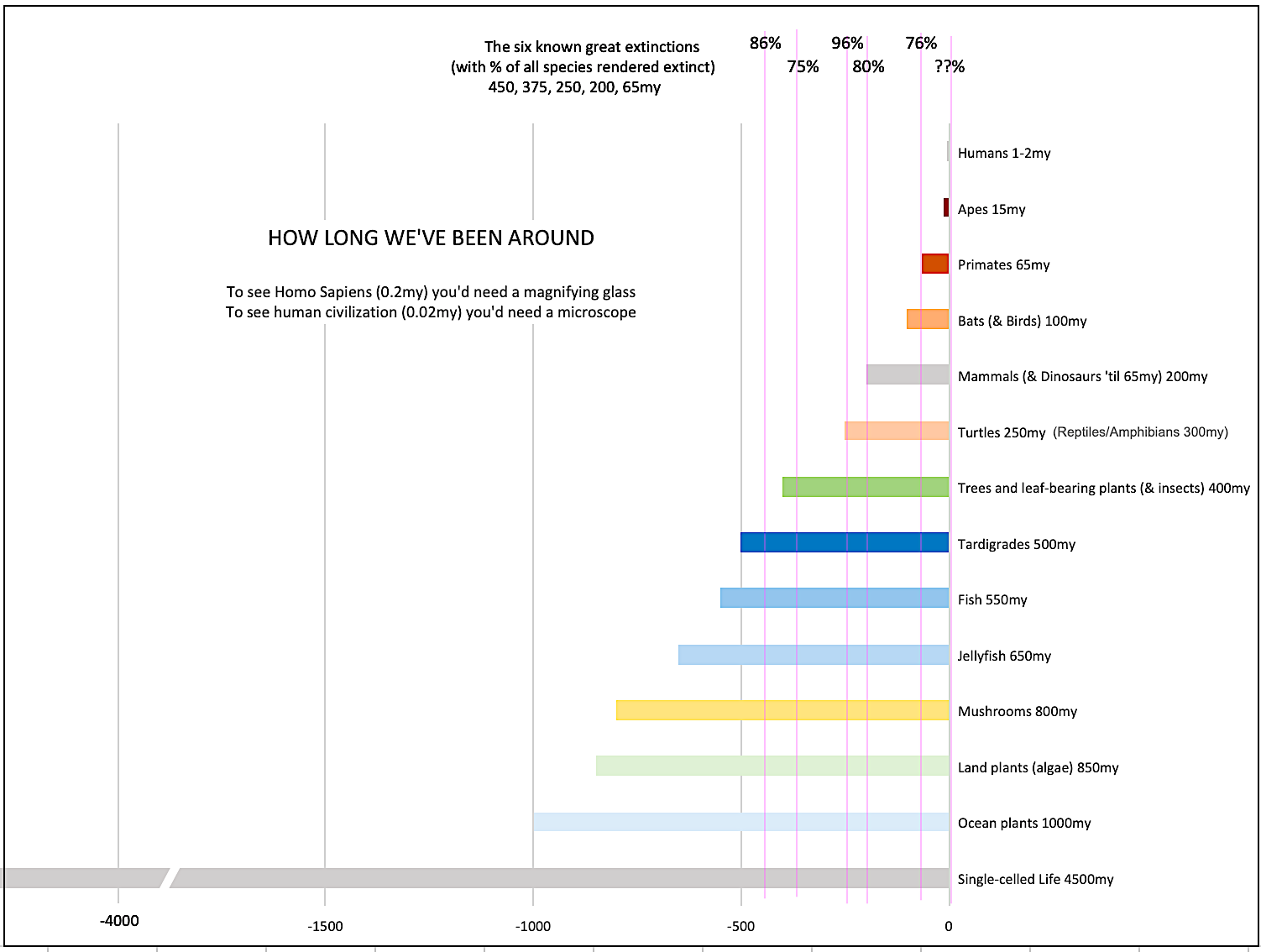
The consequence of this is a “plague of sameness” and the loss of a distinct species every ten minutes. Some types of fruits and vegetables have lost 90% of their variants. An entire language disappears every two weeks. “We are not gaining knowledge with every human generation”, Glavin says, “we are losing it”. “All these extinctions are related…and the language of environmentalism is wholly inadequate to the task of describing what is happening…It doesn’t have the words for it”. Wherever he travels, he says, he finds the overwhelming majority of people are troubled by this loss of diversity, but at a loss to know what to do about it. He unearths some interesting and astonishing facts in his research: Did you know that the Bronx zoo once proudly included aboriginal peoples in its ‘exhibits’? Or that Vladimir Putin abolished Russia’s environmental protection agency, forest service and conservation authorities? “We are living in an age when we will at last discover the answer to the question that has haunted philosophers from time out of mind. It’s the question about whether humanity is capable of determining its own destiny. We should know that by about 2030. Certainly not much later…To find some parallel with the conditions of recklessness and excess that prevail in the world…you have to look at those desperate moments in human history, those moments just before everything falls apart.” He draws parallels in particular with the situation in Ireland just before the horrific potato famine. In his prologue, he suggests that we may be headed for a titanic human struggle between two human ‘survival myths’, those of engineers and of naturalists. The engineers are those who fear and hate nature, who loathe complexity and diversity, who espouse the murderous ethic of the Puritans, who seek protection from fear and danger and death in genetic engineering, cryogenics, the homogenization and desensitization of humanity and culture, separateness from ‘nature as other’, immortality, and the extermination of all life that is not in the service of humans. The naturalists are those who suffer the grief of biophilia, who embrace complexity and celebrate diversity, whose ethic is one of sacred responsibility and respect for all life on Earth, who oppose technologies that increase ecological fragility and uniformity, and who accept that we are part of, not apart from, all life on our planet. The engineers, today, have the power and momentum, and are on the offensive; the naturalists still have the numbers but are always fighting a defensive, rear-guard battle. What makes the struggle so hard for the naturalists is that so many humans today know of no other life than an engineered, artificial one, and their proportion is growing. Now it is only ‘natural’ that they should fear a ‘natural’ way of living that they don’t know and cannot, any longer, even imagine. In the meantime, the dark and gathering sameness of the world keeps increasing, as biological and cultural diversity wither. Ultimately, Glavin says, This is a book about extinctions. It was written at the harsh dawn of an epoch that is coming to be called the Sixth Great Extinction. It is a time without parallel in the 65 million years that have passed since the end of the Cretaceous period. The world is again weary of empires. The dews still fall slowly, and the dreams still gather, but no matter the clash of fallen horsemen and the cries of unknown perishing armies in Yeatsís poem, we wonder, and we wait, and we go about our business, even as the sound of something terrible slowly approaches from acrossthe hills.
|
April 18, 2006
Thinking About Poetry
![]() “…And so each venture Is a new beginning, a raid on the inarticulate With shabby equipment always deteriorating In the general mess of imprecision of feeling, Undisciplined squads of emotion. And what there is to conquer By strength and submission, has already been discovered Once or twice, or several times, by men whom one cannot hope To emulate – but there is no competition - There is only the fight to recover what has been lost And found and lost again and again: and now, under conditions That seem unpropitious. But perhaps neither gain nor loss. For us, there is only the trying. The rest is not our business.” – TS Eliot, Four Quartets There’s a new book out by Salon columnist and contrarian feminist Camille Paglia that contains 43 “of the world’s best poems” (from Shakespeare to Joni Mitchell) and Ms. Paglia’s guide to their understanding. When I first saw it I shuddered: I remembered school days when we got passing or failing grades in English for our answers to questions like “What did the poet mean when s/he wrote…” My taste in poetry, as in all the arts, is amateur, eclectic and probably unexplainable. I have a weakness for dark imagery, for irony, for clever juxtapositions of words that probably create unnecessary ambiguity. I began to take it all less seriously after I took a literature interpretation question from my teacher to the author of the passage in question, and he ridiculed the absurdity of the question publicly in a humour column in the local newspaper the next day. I still have this fear that dissecting a poem will kill it. But I did enjoy reading the original manuscripts of TS Eliot’s The Waste Land (sample page above), with the aggressive editing of Ezra Pound and the gentler suggestions of Eliot’s wife shown on each page. I enjoyed reading them not because they enhanced my understanding of the meaning of this remarkable work, but because they gave insight into the collaborative process of writing it. I am sure there are nuances of meaning I am missing, that I could pick up if I studied it more carefully, but that doesn’t matter to me: It’s the way it sounds that I love, the way in which its words elegantly articulate what I realize I think, and tease out and amplify what I discover I feel, in a way that I do not care (or perhaps do not dare) to analyze. The rest, as Eliot said “is not our business”. Does it matter if the reader misinterprets the writer’s true intellectual and emotional meaning? Is it even possible for the written (or spoken) word to convey intellectual meaning with any high degree of precision, or emotional meaning with any precision whatsoever? Look in the right sidebar and you’ll find the songwriters (usually mostly female) whose work I have listened to most in the past week. I know the words by heart, and these songs have tremendous emotional meaning to me, but I doubt, given the incredible ambiguity of the lyrics, and even given the power of the music and voice inflection to convey emotion, that this was the precise meaning the songwriter intended. I recently heard that kids 13-17 search for music more often than porn on the Internet (the only age group with that distinction) — now that’s meaningful. But my guess is that the mix of chemicals that flow through the body and brain of each listener, triggered by a particular song, and hence the emotions that are felt or understood by each listener, are utterly different. The sense of shared emotional experience at a music concert (or poetry reading) is likewise, while powerful, surely illusionary. I have looked at my last.fm “neighbours” (the people whose taste in music, according to the software, most closely resembles mine) and noted how many of them are my age, my gender, and my nationality — put us all in a room without our beloved music and, I’d guess, the silence would soon be deafening. We’re listening to the same stuff, but ‘hearing’ it completely differently. And so with poetry. Perhaps then, poets should spend less time trying to be emotionally precise, and, while remaining authentic, focus more on the cleverness (in the positive sense of imaginativeness and thoughtful craftsmanship) and the emotional power of words by themselves and in particular juxtapositions and well-paced phrasings. To use a cooking metaphor, perhaps they should focus more on the quality of the ingredients and less on how they (seemingly) work together. Here are three poems by the wonderful (in my opinion) contemporary poet Jack Gilbert (probably a violation of copyright, so I hope Mr. Gilbert excuses my use of them as examples): The Abnormal Is Not Courage (by Jack Gilbert) The Forgotten Dialect Of The Heart (by Jack Gilbert) Rain (by Jack Gilbert) I have been easy with trees It is perhaps helpful but not essential to know that ‘Michiko’ is Gilbert’s deceased wife. Or that Gilbert is now 81, once celebrated but now largely ignored. Or that he’s been accused of misogyny. Or that his home town was Pittsburgh but he spent much of his writing life living modestly, in Europe. You can find lots of criticism and interpretation of his work online, but most of it is pretentious and dreadful — no wonder he fled and has chosen to write little in his later years. My only comment on his work is that it is well-crafted and evocative. I picked his work here because I think, for that reason alone, it lives up to e.e. cummings’ enormous charge to poets: A poet is somebody who feels, and who expresses his feelings through words. Almost anybody can learn to think or believe or know, but not a single human being As for expressing nobody-but-yourself in words, that means working just a little harder than anybody who isn’t a poet can possibly imagine. Why? Because nothing is quite as easy as using words like somebody else. We all of us do exactly this nearly all of the time – and whenever we do it, we are not poets. If, at the end of your first ten or fifteen years of fighting and working and feeling, you find you’ve written one line of one poem, you’ll be very lucky indeed. And so my advice to all young people who wish to become poets is: do something easy, like learning how to blow up the world — unless you’re not only willing, but glad, to feel and work and fight till you die. What is the purpose of all this toil, this “raid on the inarticulate”, this “fight to recover what has been lost and found and lost again and again”? My sense is that it is the same reason that solitary* crows sing to themselves, sometimes in their own voice, sometimes mimicking the sounds of others, even mimicking the sound of running water and wind: To keep company with themselves, to send messages to the rest of Earth, to anyone who is listening, to create something new, to find their own voice, to think out loud, to express themselves fearlessly and shamelessly. It is natural, insuppressible, our way of saying “Hello world, this is who I am!” And now we no longer need to fear the decline of this noble work in the inexhaustible frenzy to be busy and to be commercial: The Internet, and blogs in particular, have given us, poets everyone, back our voice. * Most crows, except each murder’s self-selected breeding pair, remain bachelors all their lives, and often overnight alone, farfrom their flock. |
April 17, 2006
Saving the World: What You Can Do
![]() Two years ago I put together a set of 15 actions that anyone can take to help create a new relater-sharer culture, a new, sustainable, collaborative and egalitarian economy and a new, responsible political system. I thought it would be useful to integrate this ‘what you can do’ list with actions that I have argued need to be done either as top-down political actions (institutional changes to public policies, programs and laws), or as peer-to-peer grassroots collective actions. To do so, I have regrouped the 15 actions into four categories:
Personal Learning and Preparedness Actions: Learn and Practice Critical Thinking: Challenge ‘established wisdom’, especially when your instincts tell you it’s dubious. Learn your vulnerability to spin, and how to recognize and discount it. Learn to avoid the intellectual fallacies of groupthink and arrogance, but also avoid black hat thinking. Develop emotional intelligence, but never use it to manipulate. Re-Learn How to Imagine: The school system and most business environments drive it out of us, and it’s easy to get caught up in your own left brain. It can also be frightening: imagining literally means putting your thoughts into images. But it’s powerful, motivating, educational, and creative. Imagine — picture it – what it happening in Sudan where genocide is happening right now. Imagine what is happening in the factory farms before you decide what to make for dinner. Imagine what you could be doing if it wasn’t for your boring, meaningless job. Imagine a better way of doing something, a better way to live. Imagine what could be. Your instincts will tell you what to do next. If we can’t imagine, we can do anything. That’s what got us into this mess. Reconnect With Your Senses and Instincts: Spend time both in nature, away from civilization, and with people, listening and talking about things that matter. In nature, reawaken and reconnect with your senses, focus each sense until you really see, hear, smell, taste, feel, connect with the rest of the living organism called Earth. Open yourself up to the joy, and learning of nature. Pay attention. Re-learn to wonder. Reconnect with your instincts, listen to them, and don’t let other people tell you you’re stupid, crazy, irrational, or immoral. If you’re unhappy it’s for a reason. Your gut feeling, your intuition, is written in your DNA, and it’s the source of knowledge that allows every living creature to know what to do. And it worked for man for the first three million years of his life on Earth as well — before language, before laws, before codes of right and wrong — and these were arguably the most successful, leisurely, and happy years of man’s existence. Listen to them, and they’ll tell you what to do. Be Good to Yourself: You’re not going to be any use saving the world if you’re depressed, unfit or stressed out. Don’t take the problems of the world personally, or blame yourself for them. Understand that at the heart of the modern age is a core of grief but don’t let that grief consume you. If news or failure to accomplish something gets you down, go out and do something you enjoy. Eat healthy and stay fit, but don’t make a religion of it. Learn how to prevent illnesses instead of waiting for them to occur. Spend time with people who like you, and accept their compliments warmly. Love yourself, realize that you can do anything you want to do. Appreciate that you’re part of the solution, and that makes you extraordinary. Personal Actions You Do One-on-One: Listen, Learn, and Teach Others: Have the courage to talk openly to people about things that really matter to you. Ignore the raised eyebrows and comments about your seriousness and intensity — you’ll find most people care, too. Then listen, don’t preach. Leave behind one practiced, important (to you), articulate idea or thought with the other person, like planting a seed. Learn to tell stories — it’s the only effective way to teach. But share what you know. When you’re talking to someone who strongly disagrees with you, listen, don’t try to convert them. There’s a reason why they feel so differently from you — ferret out and really understand what that reason is (don’t assume they’re ignorant or stupid). Then sow a single seed of doubt. And read quickly and selectively, but don’t let it keep you indoors, or away from people. The real learning is outside. So travel when you can, but forget the hotel chains and chain restaurants. Live with the locals, talk to them, try different things, listen and learn. Volunteer: Rather than sending guilt money, go out and spend time helping those suffering or in need. Pick a charity that you really care about — the soup kitchen, the animal shelter, whatever. Get involved, and talk to the people you’re helping. Don’t get talked into fundraising activities — really get out there and do something with your own two hands. You’ll learn a lot, you’ll feel better, you’ll make a difference, and you just might find out something important about yourself, about what needs to be done, about your purpose, about who needs your gift now. Stop at One and Encourage Others to Do Likewise: Consider the virtues of a single-child family. Learn why children in such families are the happiest and most successful. Better yet, adopt. Explain to others why you’re doing this, without being preachy about it. Be a Role Model: Talk to others about, and show others, what you’re doing, not just what you’re thinking. People are far more inspired by a good role model than a good speech. And if people tell you you’re a good role model, get out there and flaunt it in the right places — if you’re a woman engineer, go out to the schools and tell girls what a great career it is. If you’re doing half the things on this list, you’re a great role model — inspire others to follow your example. Infect Others With Your Spirit and Passion: Love openly, completely, as many people as you can. Be emotional, except in those very rare occasions when dispassion is needed. Smile excessively. But refuse to tolerate cruelty, suffering, unfairness, bullying, jealousy, apathy, despair, cynicism or hate, in yourself or others — alleviate it, disarm it, discharge it, whatever it takes to stop these negative emotions and activities, and appreciate that they’re signs of sickness, not evil. Personal Actions You Do As Part of Community: Share Your Expertise & Knowledge: If you have talents, specialized know-how, or technical or scientific skills and knowledge that could be useful in solving birth control, clean energy, disease prevention, conservation, animal cruelty, pollution and waste, local self-sufficiency, non-animal foods, ‘more-with-less’ product streamlining, self-organization, collaboration, consumer and citizen awareness and activism, animal communication, conflict resolution, mental illness, and other issues contributing to environmental deterioration, create exchanges and spaces where others can access what you know, contact you, and collaborate with you and with others to solve these problems. This work is essential to making Sustainability Information Exchanges work: Using shared, citizen/consumer knowledge to wrench power from irresponsible oligopolies and corporatists, and creating peer-to-peer networks that will render them obsolete. Find and Do Meaningful Work: Each of us has talents, interests, and time. It’s amazing how many of us spend all our time doing work that we find uninteresting, and which doesn’t effectively use our talents. We become wage slaves, underemployed and bored because we’re convinced or afraid that a better job doesn’t exist. And we work so hard at it we have no time left to challenge that conviction or fear. That’s what the corporatists are counting on. Don’t give them the satisfaction. Find the time to figure out what you really would like to do with your life, how you’d really like to make a living. Then research the possibilities, talk to people who are doing it, find out what’s possible, learn what’s involved in creating your own natural, sustainable enterprise (and don’t listen to accountants or MBAs). If we were all doing jobs we loved, with people we love, and in charge of our own careers, the corporatists would have no staff, and their environmentally devastating empires would crumble. We need to create a whole peer-to-peer economy of sustainable, egalitarian, responsible enterprises to replace them, and it starts with each of us ensuring our genius is ‘on purpose’, and what we do is of meaningful use. Use Less Stuff: Consumerism is doubly addictive — you get the fleeting pleasure of acquiring something, and then you have to work harder and earn more money for The Man so you can pay off the debt you incurred to buy it. Learn to live a Radically Simple life — buy better quality stuff that lasts longer, make your own meals instead of using processed foods (and consider a vegan diet, using local ingredients), think before you buy, don’t get into debt (only buy when you have the cash in your account), buy local rather than imported goods (especially stuff from countries that have poor social and environmental standards), complain about excessive packaging, recycle, reuse, buy used, share tools with neighbours, turn off the lights, cover the pool, use energy-efficient lighting, keep your tires inflated, carpool, walk or bike instead of driving — you know what to do. Make a list, draw up a schedule, and do it. And then connect with, and teach others, to increase your own and your community’s resilience even more, while reducing your collective impact on the Earth. Become Less Dependent: Learn how to fix things and make things instead of always having to buy replacements. Cut your own lawn and perform other services yourself, so you need less money and are not so needlessly dependent on others. Learn how to teach your children, even if you don’t home-school them. Learn how to prevent, self-diagnose and self-treat accidents and illnesses. Learn how to resolve disputes and grievances without using the dysfunctional legal system. Self-sufficiency is good for your self-esteem, lowers stress, reduces consumption and waste, helps the environment, and is good exercise. And if things go badly for civilization this century, it could be a survival skill. Pioneer: If you have the time and the passion for it, pick a new cause, use the Internet to find like minds, do your homework, organize, and do something completely new. Establish an Intentional Community with people you love, self-selected, self-organized, self-sufficient, with people you love, and show the world how much more sense this makes than living in a community of strangers and driving long distances to work for someone you dislike so you can buy stuff you don’t need made by other strangers even unhappier with their lives than you are. Start a community energy co-op. Set up a ‘virtual’ market for local crafts, organic or free-range foods, or whatever needs better local distribution. Establisha community-based business. The new culture will be built bottom-up, one community at a time, and the sooner we start finding community models that work well in a post-civilization society, the better.Personal Actions You Do to Bring About High-Level Political and Economic Reform: Become an Activist: Pick a cause you care about, research what needs to be done, use the Internet to organize, and do it. But follow Peter Singer’s advice to make sure your time is well-spent. Especially the parts about not getting caught up in administration, and not trying to change, or enforce, laws. The most fruitful activism is all about informing and educating people, making them aware of their options, and their power as citizens and consumers, often one person at a time, until enough people have changed their minds or their behaviours to change the system. The next most fruitful activism is the only thing that can bring about political and economic reform: Knowing how the existing system works, why it’s failing, why it is the way it is, and precisely how to change it. This requires patience, expertise, time and persistence. But it has paid off in Europe, for example, where energy conservation and alternative energy programs are light years ahead of North America’s, and where ecological tax-shifting has occurred because it was presented knowledgeably and effectively as a win-win. I’m a never-say-die change provocateur, but I’ve left activism until last for a reason. I really believe it is the least effective, and most discouraging, thing one can do to try to make the world a better place. The advice from Peter Singer I linked to above is brilliant, absolutely essential if you’re determined to bring about political change, but I know some people who have followed it and still failed. The system works the way it does for a reason, and often that reason is to increase the wealth and power of those who already have a disproportionate share of it, and to throw impossible barriers in the road of anyone seeking to change the status quo, even when that status quo is obscene. As Singer says, “The real battle is for the hearts and minds of people. Keeping in touch with what the public is thinking, selecting a target, setting an achievable goal, getting accurate information, maintaining credibility, suggesting alternative solutions, being ready to talk to adversaries or to confront them if they will not talkóall of these are directed toward creating a campaign that is a practical means of making a difference.” Such work is not for everyone. And it is not necessary that everyone be an activist. Unless saner minds prevail than the ones making most of the critical political and economic decisions today, we are heading on many fronts for a collision with unsustainability, and the inevitable political upheaval that always follows horrific scarcity and outrageous inequality in the distribution of wealth and power. In such a case the centralized and fragile institutions of our civilization may well not survive, making the struggle for needed political, legal and economic reforms moot. If that happens, billions of people will be looking for alternatives, another way to live, and those who have pursued the 15 actions above will be in the best position to show them how, and to lead our fierce and intelligent species forward to confront what could be its greatest challenge, and, after a long exile, to find our way home. |
April 15, 2006
Links for the Week – April 15/06
US Politics: Nukes Against Nukes in Iran: In case you haven’t already read it, Sy Hersh’s newest research in the New Yorker leaves no doubt that Bush plans a nuclear strike on Iran soon. Bush Buys ‘Moral Hazard’ Myth: Hendrik Hertzberg, also in this week’s New Yorker, shows that Bush’s health care policies are driven by the assumption that given the chance, the public will use health care needlessly. Malcolm Gladwell has already thoroughly debunked this neocon myth, but of course Bush isn’t interested in listening. The Republicans as a Religious Party: Kevin Phillips in the Washington Post explains how the party has grown more and more dependent on the support of the religious right, and the cost of that support, notably extreme hostility to all secular thinking. Thanks to Communicatrix for the link. Bush Anti-Global-Warming Skeptic Was in Pay of Big Tobacco: Dr. Frederick Seitz, a former president of the National Academy of Sciences and one of the most often-quoted skeptics on global warming, was paid over half a million dollars by the tobacco industry to obfuscate the connection between smoking and cancer. Seitz then went on to spearhead a campaign to cast scientific doubt about global warming. This guy gives prostitutes a bad name. Thanks to sustainablog for the link. The Environment and Energy: Carnival of the Green Now Subscribable: For those looking for environmental news and eco-blogs, there’s a weekly ‘carnival’ of postings. I’ll be hosting it later this year. If you want to check it out the latest one is here, and the del.icio.us link to all the weekly carnivals (RSS-subscribable) is here. Oil Crosses the Peak: From the London Times, more evidence that oil production has now peaked, meaning a sharp drop in production, followed immediately by a sharp drop in consumption and skyrocketing prices, is not far off. Thanks to Dale Asberry for the link. The Long Emergency Explained in 35 Minutes: Jim Kunstler summarizes his book in five short video segments produced by Orion Magazine. Thanks to Cyndy Roy for this link and the one that follows. Why Only a Local, Community-Based Economy Can Save Us: Wendell Berry, also in Orion, explains the intrinsic wisdom of small, self-sufficient, local intentional communities, and how they avoid the dysfunctions that bedevil our massive, top-down, trade-dependent economy. Excerpt: The idea of a local economy rests upon only two principles: neighborhood and subsistence. In a viable neighborhood, neighbors ask themselves what they can do or provide for one another, and they find answers that they and their place can afford. This, and nothing else, is the practice of neighborhood. This practice must be, in part, charitable, but it must also be economic, and the economic part must be equitable; there is a significant charity in just prices.
Of course, everything needed locally cannot be produced locally. But a viable neighborhood is a community; and a viable community is made up of neighbors who cherish and protect what they have in common. This is the principle of subsistence. A viable community, like a viable farm, protects its own production capacities. It does not import products that it can produce for itself. And it does not export local products until local needs have been met. The economic products of a viable community are understood either as belonging to the community’s subsistence or as surplus, and only the surplus is considered to be marketable abroad. A community, if it is to be viable, cannot think of producing solely for export, and it cannot permit importers to use cheaper labor and goods from other places to destroy the local capacity to produce goods that are needed locally. In charity, moreover, it must refuse to import goods that are produced at the cost of human or ecological degradation elsewhere. This principle applies not just to localities, but to regions and nations as well. The principles of neighborhood and subsistence will be disparaged by the globalists as “protectionism” – and that is exactly what it is. It is a protectionism that is just and sound, because it protects local producers and is the best assurance of adequate supplies to local consumers. And the idea that local needs should be met first and only surpluses exported does not imply any prejudice against charity toward people in other places or trade with them. The principle of neighborhood at home always implies the principle of charity abroad. And the principle of subsistence is in fact the best guarantee of giveable or marketable surpluses. Entrepreneurship Aids: Two New Free Communication Tools: I’m hearing a lot of buzz about Evoca, a podcast recording tool, and Gizmo, an alternative to Skype with built-in recording that works with its sister product Jabber, cross-platform IM tool (the one used by GMail). Anyone used any of these and have comments on them? Just For Fun: Owen & Mzee Blog: The lovable Hippo baby rescued from the tsunami and the 130-year-old tortoise who has adopted him are still, as the picture above shows, inseparable, and now they have their own blog. In Defense of French Dirigisme: John MacArthur, publisher of Harper’s magazine, writes a clever and eloquent editorial about the schadenfreude (delight in others’ misfortune) exhibited by many North Americans over the French youth demonstrations, as if somehow these demonstrations indicate their political system is a failure and vindicate our failed laissez-faire approach to managing national affairs. The relative success of the French approach on many issues, he argues, exemplifies the superiority of pragmatism overideological absolutism. Thanks to Umair Haque for the link. Secret Message to Salon Bloggers: There are 20 to find. Apologies to Sloggers who have moved to blog tools whose comments servers don’t accept eggs. Happy Easter, everyone! Taking a day off blogging for family stuff tomorrow. Back Monday. |
April 14, 2006
How to Save the World Reading List – Revised and Updated
In Beyond Civilization, Daniel Quinn says:
People will listen when they’re ready to listen and not before. Probably, once upon a time, you weren’t ready to listen to an idea than now seems to you obvious, even urgent. Let people come to it in their own time. Nagging or bullying will only alienate them. Don’t preach. Don’t waste time with people who want to argue. They’ll keep you immobilized forever. Look for people who are already open to something new.
Here’s the updated list — 80 books and articles that have forever changed my worldview and my purpose for living. The fifteen most critical readings have a numbered triangle in front of them, with the numbers reflecting the order that, I would suggest, it makes most sense to read them in. What Life was Really Like Before Civilization: Revisionist History
What’s Going On Under our Noses: The Real News
About Gaia: What Nature is Really About
Toolkit for Change: Knowledge We Can Use to Save the World
The table of contents of all 150+ articles I’ve written about Saving the World is here. (*In the update footnote earlier this week, these additions were inadvertently omitted) |
April 13, 2006
The Fear of Not Having Enough
![]() There’s an echo in here. A sense of foreboding, of dread. Not the pessimism of the informed, something much more personal. The fear of not having enough, as Derrick Jensen calls it in A Language Older Than Words. It’s an echo because those of us in the blogosphere are more knowledgeable than those in society’s mainstream, where most live with that fear, to a greater or lesser extent all their lives, and because we are less distracted than those who get their information and sense of what is happening from the detached, distorted and learned helplessness-inducing mainstream media. The rest of society will catch on sooner or later, but for now this fear is our dark secret. This isn’t just the gnawing fear and guilt and anger of having to do without things we’d really like, for ourselves, for our children, things the rich elite have in obscene abundance and squander without a second thought. This is the deeper, darker fear of soul-destroying deprivation, hunger, desperation, not knowing where the next meal is coming from. This fear is rooted in two dawning realizations:
The rich and powerful are immunizing themselves against this risk, although they still, mostly, deny it will happen. Using the economic power engine shown in the chart above (described in this earlier article), they are furiously redistributing wealth from the poor to themselves, calling in political favours to obtain tax cuts, government subsidies, and increased protection from creditors and litigants, and labouring to gut social programs and creditor and legal protection for everyone else, so that this flow of government largesse is not threatened by demands from the poor. They are dumping their domestic workforce in favour of faraway, cheap labourers who will have neither the means nor the will to vent their fury on the corporatists when Depression closes the plants and lifelines to even basic human necessities. They are reneging on pension and health obligations, cynically shifting worker pensions from defined benefit plans to defined contribution plans that will be worth nothing after an economic crash, which is precisely when they are most needed. They are urging the governments in their back pockets to abandon already weakened and inadequate social safety nets by declaring them bankrupt and walking away from them. The objective in all of this is not only to shift wealth from the poor to the rich, but to shift risk in the event of economic collapse from the rich to the poor. The rest of us have either learned that the government and corpocracy are not here to do us any favours, so we can expect nothing from them, or are prevented by pride and a sense of fairness from the shameless begging from politicians (described euphemistically as ‘lobbying’) that corporatists use to hedge their risks. So we don’t even ask for, or expect, any insurance from the impact of an economic depression or the inadequacy of our savings to provide even minimal needs in our senior years. There is nothing new in this. It happened during the era of the Robber Barons, and again during the so-called Roaring Twenties. If you harbour the illusion that the 1920s were a period in which the staggering affluence of the rich was shared with the working or even middle class, read this account, from a librarian at U. of Oregon. If the social parallels between the 1920s and the 2000s don’t make you shudder, then you’re not paying attention to what’s happening here, now. The economists, in the pay and employ of the corporatists, while still spouting their lies that ‘average’ GDP has anything at all to do with human well-being, will tell you that the technical causes of the Great Depression of the 1930s cannot recur because of technical safeguards instituted since then. But the primary cause of the Great Depression was not technical factors at all, but rather a crisis of confidence. It is only public confidence, the consensus of those investing their hard-earned money and savings, that accounts for houses that cost $100,000 to build and another $20,000 per year to commute to and from to work, somehow selling for, and hence being ‘worth’, $500,000 or more. It is only public confidence that accounts for shares of companies that are massively leveraged, dependent on government subsidies, tax exemptions, and artificially suppressed interest rates, selling crap manufactured half a world away by desperate slave labour, financed by debt ten times larger than anything seen in the history of the planet, imported cheap thanks to artificially suppressed oil prices, and flogged to the public at obscene profit margins, trading at 30x earnings or more — in other words priced on the expectation that these already overstretched and unsustainable profits will continue to increase by 20% or more every year forever. Eventually the baby boomers, a billion or more of them, will, except for a tiny elite, be forced to realize that they cannot afford to retire, and that they will have to work until they die, and liquidate everything they have to make ends meet, and stop buying everything except absolute necessities of life, and become self-sufficient (since they will no longer be able to afford to hire others to do everything for them). If you know anything about economics, you know what happens when large numbers of people stop spending and start liquidating their assets. Crash. Eventually the international game of chicken that has produced such staggering debt and imbalance in trade will reach the point at which someone says ‘uncle’. If the Chinese don’t do so (because their economy and the US economy are co-dependent), the Arab nations, realizing that their only asset is being exhausted by 8% per year and that to offset the fall they need both a commensurate increase in price and a stable currency in which to price it, probably will. If the Mideastern oil supply survives the Bush-Cheney Crusades (there’s evidence it won’t), the OPEC nations will soon start insisting on payment in a non-bankrupt currency. The Ponzi scheme will then be over, and the first to cash in their chips will do fine, the next will scrape by, and the remainder will be stuck with certificates and debentures whose only value is as wallpaper. The result is what is called a default, and it is the ultimate expression of a crisis of confidence. What happens next is that the US dollar becomes worthless, trade grinds to a halt, everyone whose job depends on trade is laid off, so they stop buying, pushing demand down to the point that price is less than cost, huge profits become huge losses, and the whole economy shuts down. It took until 1932 before someone had the courage to call the ‘correction’ what it really was. Hence the dread. It’s just a question of when. Cash in too soon and you’ll miss the last orgy of real estate and share price rises, leaving you with a nest egg considerably smaller than it could have been. Cash in too late and your assets will be worthless, and you’ll have no nest egg at all. As soon as a significant number of people start cashing in, the Tipping Point is reached, and there’s no turning back. Only the worn-out lies of economists, politicians and corporatists are delaying this inevitability. And, as I’ve already explained, they’ve hedged their bets already. Then the Fear of Not Having Enough will become a reality. Search the Internet for information on what living in the last Great Depression was like, and you’ll come up with surprisingly little. It’s almost as if this period in our history has been self-censored out of our consciousness. Maybe there’s a fear that if enough people realize how much our world today is like the 1920s, that could make its repetition a self-fulfilling prophecy. So what do we do? If you do a cash-flow forecast, on the assumption you will live to the age of 90 (likely if you’ve made it this far and in the absence of a pandemic or similar disaster), there’s an extremely high likelihood you will realize you don’t have enough to retire, ever. And if retirement is still too far away for you to be of concern, you need to prepare now to look after yourself and those you love when we reach the Tipping Point and plunge into the next Great Depression. In either case, you will have to do two things:
In short, this dread, this Fear of Not Having Enough, that is nagging us, those of us informed about what is happening in this world but not rich enough to immunize ourselves from it, is happening for a reason. We need to be the models for the rest of society, show them what needs to be done. This will take great courage, because we will be accused of being Chicken Littles, or worse, of starting a stampede needlessly. Keynes, the great student of economics, knew the Great Depression was coming but lacked the courage to act, still waiting for the top, for his pessimism to achieve some level of social consensus. As a result, he waited too long and was wiped out. Here’s how Zane at Lichenology has put it: So on the cusp of my official mid-life…I am recalibrating and stepping into the fullness of life. I want to serve my family and my community, to live with attention and respect, to be humble and generous. I believe we are entering another time in history when people will be asked to be and do all they can. Each of us must find our rightful place in this unfoldingówe need to find the sense of wholeness from which we can step up to our role.
We need to relearn to trust our instincts. Preparing for events we cannot even imagine, and which might be farther off than we fear, runs counter to accepted wisdom of ‘rational’ behaviour and to our human nature of acting only when we absolutely must, when there is no other choice. The voices of dread whispering to us, filling us with ‘irrational’ fears, are telling us something important. It’s time to pay attention. Others are dependingon us to show them the way. |
April 12, 2006
A Scientific Romance
![]() Dali, The Persistence of Memory Last year I wrote about archaeologist-historian-novelist Ronald Wright’s A Short History of Progress, a briefer, darker, and more insightful assessment of our civilization culture than the much more famous book that came out a few months later, Jared Diamond’s Collapse. A Short History of Progress summarizes and analyzes six spectacular civilizational collapses from throughout our history, and reads us the riot act about what we need to do now to avoid another collapse, this time a global one. The book is one of the 15* essential works on my longer, 65-book* Save the World reading list. Eight years ago, Wright wrote an award-winning (in four countries) novel called A Scientific Romance. Complex, satirical and dystopian, it is at its heart a murder mystery, unraveled piece by piece through its narrator, David Lambert. As tempting as it is, I will not reveal any of the plot’s secrets, or its conclusion, for to do so would spoil it for readers. Reading the book was an eerie experience for me: The protagonist’s name is David, and his love-interest’s name is Anita (my wife’s name). My discovery of this book was an instance of synchronicity: I was looking for two books in a Toronto bookstore when I discovered instead Tim Flannery’s The Weather Makers, which I reviewed last week. Ronald Wright’s praise for Flannery’s book, on its back cover, convinced me to buy it. The blurb described Wright first of all as a ‘novelist’, a fact I had forgotten, and I made a mental note to take a look for his novels. But as I climbed the bookstore stairs to look for the books on my list, in my path was a temporary display of ‘notable Canadian fiction’ in paperback, and on the top row of the display was A Scientific Romance. Some of the book’s passages also spooked me: Just twelve days ago I wrote about The Precautionary Principle, and Treating Polluters as Murderers, and now I read this, a comment by David, the novel’s protagonist: One thing I never understood about the law: If you dumped arsenic in Granny’s tea, you’d be put away for murder; if you poisoned a whole country with some cavalier industrial process, the worst you could expect was a paltry fine.
The book contains some prescient observations that also gave me a frisson — you know that strange sense of precognition that has you flipping to the inside cover to see if the book was really written eight long years ago, or searching your memory to recall what a passage reminded you of so strongly, that you can’t quite put your finger on. And then just a few pages later, the protagonist, David, himself experiences a frisson, as the words from his dream appear in a graffiti message, causing him to say “You will know the vertigo induced by that last line, a “Dunne” [a glimpse of the immediate future found in dreams, described in JW Dunne's An Experiment with Time] foreshadowed in my dream.” Here are a few delicious teaser paragraphs to give you an idea of the astonishing scope of Wright’s perceptiveness and imagination, and why I couldn’t put the book down: The rear-view mirror [our knowledge of history and archeology] breaks up the parochial landscape of the present. And our costly reward is to know that no culture is normal or inevitable; that none has a patent on wisdom or a guarantee of immortality; that civilizations, like individuals, are born, flourish and die; that the very qualities that bring them into being — their drive, their inventions, their beliefs, their ruthlessness — become the indulgences that in the end will poison them… Civilization is always a pyramid scheme. Living beyond your means. The rule of the many by the few. The trick is to keep wringing new loans from nature and your fellow man.
What is the critical mass of a world like ours? If the modern age began when the sum of Western knowledge became too large for any individual to command it — with the birth of the specialist — then the postmodern, strictly speaking, begins with the death of specialists. [Recalling learning in childhood of the automobile death of his parents] For some time I believed that it was I who had died, not they. That the rest of the world had carried on without me; that the story I’d been told was merely the stuff of hellfire. The adult mind employs more sophistication but it tells the same fables to itself. The sensation of having escaped and lived on becomes a solipsism, a trick of evaporating consciousness, or, if you like, an anodyne from a loving God to spare you the blow of your extinction. And it follows that one may never know when one has died, may go on living an echo, like a player performing to the darkness of an empty hall he thinks is a full house. And the ever-running play you write and act is your eternity. Why is the echo richer than the source, and time remembered always grief? People come and go, and you hardly notice how they feel, what you feel. Then one day when you least expect it remembrance slips like a blade into the heart: What you did and didn’t do, said and didn’t say; and suddenly you fall down into a cold and sunken place with only your regrets for company, there gutted by sorrow and remorse and left to die. Yet, if a dinosaur can become a hummingbird, all things are possible. The book contains some brilliant anagrams (see if you can spot them) and keeps you thinking and guessing, not only because of its plot twists and revelations and its jumps back and forth in time, but because its protagonist faces decisions that, in many ways, we all face today, and draws you into thinking: What would I do in that situation? Example: David needs to decide what period in history to try to explore in a supposed ‘time machine’ that he has inherited from a mysterious benefactor. He thinks out loud about all the possibilities, from past and future, keeping in mind the scientific theory that you can never go backwards (a meme undercurrent throughout this remarkable novel, and also its larger ecological message to the reader): We’ve been living a long time on nature’s savings, and there are signs her bank account is overdrawn. It seems to me that if I go ahead a few decades, or even generations, I run the risk of landing in a mess. So I’ve made up my mind to follow [the machine's inventor] Tania’s clue, to the middle of the new millennium. Five hundred years — long enough for a new dispensation; and why be hanged for a lamb?
Suppose you were David, and had the chance to travel to another time. Would you choose to defy the laws of physics and nature and go back, to a simpler time or to redress or preempt some past error? Or would you go forward, and if so, just a few years, to see if today’s optimists or pessimists are right, or a longer way, either into the abyss of the uncertain future our children’s children’s children will face, so that you can struggle or luxuriate alongside them, accepting your responsibility for their future, or far beyond that, into Gray’s future, “a time when humans have ceased to matter” or A Short History of Progress‘ future where “nature will merely shrug and conclude that letting apes run the laboratory was fun for a while but in the end a bad idea”? I would go far beyond the long tail of our civilization, roll the dice, and pick a time further in the future than our civilization stretches into the past — thirty millennia forward. What would you choose?
* I will be updating these lists soon, to reflect these additions: |
April 11, 2006
I’d Like to Keep My Memory All In One Place
![]() If it weren’t for Google Desktop I’d be spending an inordinate amount of time looking for stuff I’ve written, and then forgotten what I’d named it. But Google Desktop doesn’t do the whole job — I often comment on others’ blogs, in forums, in wikis and other places that most tools don’t keep track of, and I can never remember where these important thoughts were placed. And with multimedia and collaborative sites becoming more affordable and more important, it’s only going to get worse. I know CoComment is trying to help, but it’s just one more piece to add to the memory storage puzzle, and doesn’t even handle all blogs (including mine). What we need is a web page that works kind of in reverse — keeping track of everything we’ve ‘sent out’, in any online medium, regardless of where it ended up. This was an idea I proposed as CKO a few years ago (it was deemed technically too difficult). At that point all I wanted was for employees who had contributed documents (including e-mail messages) to internal repositories to have a place where all such contributed knowledge could be found in one place, so at annual performance review time it would be easy for them to say: “Here, this is what I contributed to our company’s collective knowledge this year.” The closest analogy I can think of is a scrapbook, a place where we keep all our ‘memories’. The online equivalent I’d like to see would capture all of the following on one ‘page’:
This massive aggregation would comprise ATSYCA (All The Stuff You Care About), a kind of super-memory or ‘subset of the Web’. Almost as important as the content itself is the names and contact information for all its authors and contributors, ATPYCA (All The People You Care About). Our brains seem to have an extraordinary random-access way of storing and finding all this stuff, but as new media are increasing the volume of this content by orders of magnitude (and old age is weakening the effectiveness of its recall), we need to rely more and more on mechanical aids to supplement our mental capacity and information processes. All this information needs to be ‘virtually’ organized in three different ways:
Search engines can enable the second type of use effectively (though with enormous waste, since every single word is indexed). They handle the first and third types of use badly. The first type of use, by subject (personal information taxonomy) needs a graphical layout organized according to the tableau at the top of the page, described in this earlier post, a landscape you could navigate from top level and drill down to as much depth as made sense, to organize all your ATSYCA/ATPYCA. That taxonomy and its granularity could evolve over time — you could ‘redraw the landscape’ as you learned more about some subjects and integrated thinking on others. The third type of use (by context and connection) also needs a graphical format, but this time ‘parsing’ and linking all the content by what (and who) it was connected to, rather than by subject. It would present a ‘route map’ rather than a ‘logical map’ of this content. It might also allow you to drill down from a ‘colloquium’ level to a ‘conversation’ level to a ‘thread’ level of granularity, and would provide ‘departure points’ where you could add and simultaneously share content (by allowing you to ‘publish to’ and others to ‘subscribe to’ new departures and amplifications from any node on the map. The result of both the first and third types of navigation could be (or at least include) what would effectively be ‘collective intelligence’ of a group, but the map would allow you to tweak it to your personal ‘view’, deleting or hiding content you didn’t find valuable and adding personal annotations ‘for your eyes only’. Although these taxonomic maps and routing maps (and perhaps tag clouds — you know those things that show the prevalence of tags on a particular site by the size of the font of the tag name) might actually reside on a single web site, or your own hard drive, they could just as easily reside out in hyperspace, where you and others could access them anytime from anywhere, and where they’d be easy to update and maintain. There are some technical challenges to doing this (notably keeping ‘public’ web-hosted and ‘private’ hard drive-located content separate according to each user’s personal permissioning rules), but the biggest challenges are likely to be imaginative: keeping the navigation ‘Google simple’, automating the update of the maps, and enabling interactivity of shared, published and subscribed content. But it shouldn’t be that hard to create such an application. If we don’t get a simple tool that can do this soon, we may literally start losing our minds. |
April 10, 2006
How Do You Make a Snowball?
Umair Haque says that “media (in fact, consumer [marketing]) strategy must shift from Blockbuster to Snowball…[enabled by] the self-organization and regulation of complex, interdependent collective action…This is inevitable; it’s the nearly bulletproof outcome of the economics of the edge, and market power shifting to consumers.”
Umair offers two recent examples of Snowballs: The sudden burst of popularity of some modest YouTube videos, and the rapid unmaking of Washington Post plagiarist neocon Ben Domenech. So what is the difference between a Blockbuster and a Snowball, and how do you ‘create’ the latter? In the case of a Blockbuster, the vendor is capitalizing on the substantial attention (a scarce commodity) that they can command through high advertising budgets, brand, celebrity endorsements etc. In a Snowball, the vendor is capitalizing on the perceived value, according to the wisdom of crowds, that their product has, and the enormous power of the Internet and word of mouth to coordinate and spread information about that perceived value quickly and inexpensively. Traditional big companies want to hope that it’s kinda the same thing — you blow enough money cleverly promoting your new product, lots of people are going to talk about the product and the promotion, and hence perhaps generate a Snowball on top of the Blockbuster. Often, however, this does not happen. Customers are not stupid, and are often cynical, and if you hype or lie about your Blockbuster in your zeal to promote it, the hype and lies will become the viral story, and the Snowball that occurs will crush you rather than rolling you to success. And sometimes Snowballs will occur in spite of a lack of promotion and other Blockbuster qualities, as the psychology of novelty, supporting underdogs, and ‘jamming the culture’ kicks in. As the availability of more, customizable, filterable information increases, customers will no longer need to rely on trusted brands or celebrity endorsements as surrogates for real information on value and quality. And they will be able to use that information to assess value and quality on their own terms, instead of the lowest-common-denominator terms of the mass market and mass media. Now, here’s where it gets really interesting. A Blockbuster is a complicated phenomenon — there are a finite number of variables that can be carefully analyzed and used to predict, with a high degree of certainty, that the next movie with Tom Hanks and Julia Roberts, based on a popular mass media novel, will be a spectacular financial success even if it’s a piece of crap. The same process can be used to predict that the sequel to this movie will attract 80% of the audience of the original with 50% of the marketing investment, even though almost all sequels are pieces of crap. By contrast, a Snowball is a complex phenomenon — there are an infinite number of variables at work, their cause and effect are impossible to analyze, and prediction is essentially impossible — you can influence complex phenomenon with appropriate attractors and barriers, but not control them, and the risk/return ratio to justify spending large sums trying to influence them is, like the risk/return ratio for rebuilding New Orleans (another complex problem) just not there. The oligopolies hate not having any control. They’d better get used to it. The control is passing rapidly to the customers, plural, which means essentially that, as in most complex situations, no one is in control. If this is the case, is trying to start a Snowball hopeless? Not at all. In fact, if you’ve done your research, so you know what your ‘customers’ (in the broader sense of the term: The Crowd) need, want, care about, your product, idea or proposal is much more likely to succeed, even without costly investment in hyping it. Could you possibly know that three quarters of a million people would watch the aforementioned YouTube video of a girl who “frets over the end of the relationship, as she simultaneously cheers herself up by playing with computer effects and altering her on-screen appearance with the click of a button”? Well, yes. It’s novel, it’s artistic, it’s entertaining, and it’s informative (a ton of people have learned what software they can use to creatively spice up their own videos on the fly). These are things people value. It consumes only 75 seconds of user attention while accomplishing this feat. And, of course, it’s free. Note that I said “what your customers need, want, care about” not “what your customers should need, want, care about”. You cannot get ahead of the market. There are some amazing blogs out there that people should be reading every day, but they won’t — like many great artists, scientists, composers and philosophers, they’re too far ahead of the curve to hope to become popular in their own time. Not Snowball material. So:
Two obvious examples that meet all of the above Snowball criteria: The Tipping Point (Malcolm Gladwell), and The Wisdom of Crowds (James Surowiecki). Gladwell is an expert Snowball-maker, and some of his Snowballs (learned helplessness, the moral hazard myth, cellular organization) have been launched with a single New Yorker column. An example that has 6 out of 7: Steven Levitt’s idea, in Freakonomics, that liberalization of abortion laws in the 1970s is the top reason urban crime in America has plummeted in the past 15 years. You’re thinking it fails #2? Nope — Lots of momentum for the discussion about drop in crime rates. It fails #4 — People balk at it because it’s confrontational, no matter where you sit on the political spectrum. It’s unsettling, makes people uncomfortable. So why is the book so popular? Because it uses the same methodology to give parents comfort that if their kids screw up their lives, it really isn’t their fault. That idea meets all seven Snowball criteria. My list may be flawed or incomplete, and since it fails to meet criterion #6 (I’m not a marketing expert, nor have I successfully launched a Snowball — yet) it is very unlikely that this post will become a Snowball on viral marketing or customer/citizen strategy either. Unless of course someone with credibility picks it up and — er — runs with it. In the meantime, additions to and critiques of the seven criteria for a successful Snowball are welcome. Umair’s started it,I’ve added a little snow — your turn. Photo: Swedish snowball lamp, from odla.nu. |


Learn and Practice Critical Thinking:
Become an Activist:
In 


Umair Haque