![]() It’s going to take a major shift in most people’s worldview — their beliefs, intentions, goals and actions — to steward our crippled civilization to a safe landing, or even just to cope with the world that remains after its collapse. That major shift — a Let-Self-Change by billions of people — has four necessary preconditions:
These preconditions are like four sequential locked doors between the corpocratic world most of us live in, many of us uneasily and anxiously, and the Edge, the way out. As long as most of us are caught inside these doors, or between them, the whole world will be caught between the distant promise of saving our society and our world, and its realization. The inertia of the corpocracy and the lure of corporatism are powerful: The corporatists control the media, and don’t want us to know how things really are. It is not nature’s way, or human nature, to change quickly and dramatically until there is unarguably no alternative. Peer pressure ostracizes those on the Edge from the hapless but comfortable guilty conformity of the civilized corpocracy. Actionable information is hard to come by: it threatens the status quo and is therefore suppressed as subversive. Meaningful, coordinated action requires the development of good working models of better ways to live and make a living, and these are even more threatening to the corpocracy, and obstructed by every means at its disposal. And, by keeping us busy, exhausted, isolated and discouraged, the corpocracy prevents us from opening the fourth door even when we have made our way through the first three, and hence prevents those on the Edge from developing the momentum we need for world-changing. How could we make it easier to get through these four doors, for ourselves and for others?
|
November 21, 2006
The Four Preconditions for Let-Self-Change
November 20, 2006
The Way of Ignorance
![]() Although I don’t agree with some of his religious views, Wendell Berry is the most eloquent spokesman of this century on two important subjects: The need to rediscover our relationship to land and community, and the importance of humility. I’ve referenced his wonderful essay in Orion on the former subject before. This article is about an essay on the latter subject (not online), entitled The Way of Ignorance, in his recent book of the same name. The title refers to a line in TS Eliot’s Four Quartets, that goes: In order to arrive at what you do not know
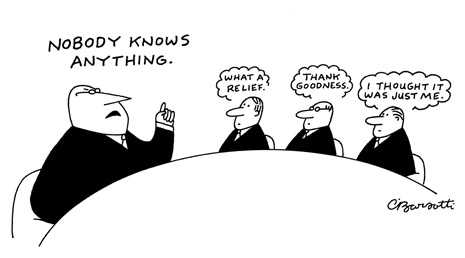
You must go by a way which is the way of ignorance The essay is about our arrogant assumption that we know enough, or that, in sufficient time, we will know or can know enough, to save the world from what we have done to it over the past thirty thousand years. In truth, he says, we have no idea, and what’s worse, we’re ignorant of our ignorance, which is what makes us so dangerous. The solution is humility — the way of ignorance. For readers of How to Save the World who wonder what my essays on Knowledge Management have to do with saving the world, Berry’s essay explains it better than I could. He starts his paper with a ‘taxonomy’ of the types of human ignorance and knowledge. Here is a summary: Varieties of ignorance:
Varieties of knowledge:
“Ignorance, arrogance, narrowness of mind, incomplete knowledge and counterfeit knowledge are of concern to us because they are dangerous; when united with great power, they cause great destruction”, Berry says. What he calls ‘corporate minds’ are more prone to such ignorance and arrogance than personal minds because they are so narrow and limited by their lowest common denominator, to strictly empirical knowledge. As such, the corporate mind is “compound and abstract, materialist, reductionist, greedy, and radically utilitarian”. Such a disembodied mind is incapable of complex or generous thought, and incapable of humility. Science, Berry argues, produces knowledge that, when purchased and applied by the corporate mind, yields at once great technological advances, and global warming, acid rain, Chernobyl, Bhopal and Love Canal. To this list we might add Enron, 9/11, cluster bombs and ‘shock and awe’. As I have argued before, these can all be seen as ‘knowledge failures’. Now that we’ve let this marvelous, dangerous genie out of the bottle, he asks, What can we do? “I have no large solution to offer”, he says. “Our damages to watersheds and ecosystems will have to be corrected one farm, one forest, one acre at a time. The aftermath of a bombing has to be dealt with one corpse, one wound at a time…If we find the consequences of our arrogant ignorance to be humbling, and we are humbled, then we have the first fact of hope: We can change ourselves. We, each of us severally, can remove our minds from the corporate ignorance and arrogance that is leading the world to destruction.” He goes on: “If the ability to change oneself is the first act of hope, then the second surely must be an honest assessment of the badness of our situation.” Berry, a man of faith, has great faith that if enough of us pursue these two acts of hope, the world can be saved. For believing this, he is almost apologetic: “I am aware that invoking personal decency, personal humility, as the solution to a vast risk taken on our half by corporate industrialism is not going to suit everybody. Some will find it an insult to their sense of proportion, others to their sense of drama. I am offended by it myself, and I wish I could do better. But having looked about, I have been unable to convince myself that there is a better solution or one that has a better chance of working.” Both John Gray, whose views are congruent with my own (as I reiterated in my last post), and Wendell Berry tell us that what we must do is Let-Self-Change, and focus our passion and energy at doing what we can at the local community level to make the world better. Neither believes that technology, or some external force, is going to save us. The difference is that Berry has faith in humanity’s ability to act, individually, quickly, dramatically and, most important, knowledgeably, in our collective interest. Gray and I do not. I am tempted to argue, without the benefit of Berry’s ‘religious knowledge’, that true humility might require us to acknowledge that such faith that he has in our wonderful, terrible and muddled species, might be misplaced — perhaps, even, a tiny bit arrogant. This won’t change our efforts to do what we must, of course. These differences of belief matter only because most of us alive today probably won’t be around long enough to see whose belief was right. Even though ultimately this knowledge, the knowledge of what our planet’s future holds, doesn’t matter, it would be nice to know. Photo by Kevin at the Bastish blog. |
November 19, 2006
Sunday Open Thread – November 19, 2006
What I’m thinking about this week:
My computer is still out of order, and I’m pledging that, within the next year, I’m going to move everything from my hard drive to cyberspace, so that I will be able to use any computer anywhere, to do anything I now do on ‘my’ PC. And then ‘my’ PC will become nothing more than a convenient backup storage device. My health is still fine, despite some recent stresses. In fact I just ran my fastest 5km in thirty years. So what’s on your mind? |
Links for the Week – November 18, 2006
Civilization’s End: Energy & the Environment: George Monbiot Summarizes His Own Book: The ten major elements of the radical program of CO2-reducing regulations proposed in his book Heat. The Folly of Biofuel Production in Struggling Nations: Despite the superficial appeal of producing and exporting biofuels to wealthy nations to reduce balance of payments deficits, the cost of this strategy — reducing the production of domestic foods and hence requiring even more imports of foods from affluent subsidizing nations — far exceeds the benefits. Salon’s HTWW explains the quandary. More Evidence that Civilization Was a Desperate and Impoverishing Response to Climate Change: Salon’s HTWW reviews an article from the UK’s Nick Brooks: “Civilization: a horrible accident forced upon us by climate change. We can only shudder at the prospects of further accidents, waiting to happen.” Vancouver Island Despoils Itself Further: As reported by Zane at Lichenology, Vancouver Island is preparing to excavate its already ravaged surface further, to sell six million tons of gravel a year to California. Grist Tells How to Argue with Global Warming Deniers: I’ve given up arguing with them — a total waste of time and energy. But if you’re inclined to do so, this is a great resource for dealing with skeptics. Thanks to Craig De Ruisseau for the link. Too Early to Act, Yet Running Out of Time: Inspector Lohmann offers a stunning, lengthy and articulate analysis of our modern predicament as we perch on the edge of apocalypse: “Basically, the world knows that the system cannot (nor should) endure, but word hasn’t spread, and solutions, though floating all around the ether, refuse to meaninfully coalesce given the staggeringly entrenched forces of greed opposed to a revolutionary paradigm shift that offers practical solutions to our dire situation.” He quotes Antonio Gramsci: “The crisis consists precisely in the fact that the old is dying and the new cannot be born.” Thanks to Jon Husband for the link. How the World Really Works: Politics & Economics: The WSJ Gets Religion on the Need to Reduce Economic Inequality: Salon’s HTWW reports that even the right-wing publications now seem to be embarrassed and distressed at the obscene inequality of income and wealth in the US. In New Orleans, Families Broken by Katrina Spawn New Problems: Natural disasters like Katrina are classic examples of complex phenomena that confound all simple and complicated plans and actions to prevent, predict and resolve them. Now it turns out that families separated and broken by Katrina are becoming dysfunctional and producing new chronic social problems such as violence and crime. Imagine a whole city afflicted with PTSD. Bush Bullies and Cheats Again on ‘Free’ Trade: It seems Canada’s feckless right-wing minority government will never learn not to trust the Bush administration. After allowing Bush to steal a billion dollars owed us for US violations of NAFTA (and trying to tell us it was a victory that they didn’t steal the other four billion), we’re now knuckling under to a whole barrage of new US import duties (masquerading as anti-terrorism fees) imposed on Canadian products, in violation of both NAFTA and WTO rules. It’s time to scrap NAFTA entirely — a corporatist con from the word go. …And They Plan to Spy on Canadians Too: Bush wants us to take their stuff duty-free, while they impose duties on our stuff. And now we find out they want us to visit them and spend money, but if we do they plan to ‘profile’ us — all of us — and keep their arbitrary assessments of our activism for 40 years. Maybe it’s time for us to get smart and find friendlier places to visit and vacation. Thanks to Dale Asberry for the link. Self-Experimentation: Scott Adams Cures Himself: The author or Dilbert used self-experimentation to discover a personal cure for Spasmodic Dysphonia. Thanks to both Michael Wiik and Judith Norton for the link. Thoughts for the Week: “If you are not outraged, you are not paying attention.” — anonymous graffiti in Clerkenwell, London, per an equally anonymous e-mail sent to hundreds of people last month. In A Motel Parking Lot, Thinking Of Dr. Williams I. II. |
November 16, 2006
This is Our Tomorrow, Today
![]() This is a grim post. Those easily depressed might want to give it a pass. By the end of this century, our planet will have, depending on who you believe, and on the impact of any global catastrophes, between nine and fourteen billion people. North America’s population, barring physical and military blockades blocking access by billions of desperate immigrants, will soar to between one and one and a half billion, with all of the increase from today’s levels attributable to immigration. North America’s metropolitan areas will grow rather more slowly than those in struggling nations, but will on average be five times larger than they are now in population, and thanks to urban sprawl, seven to ten times larger in area. Your reaction is probably to say “it will never happen, it’s inconceivable”. That’s what the planners said in 1980 when these kind of projections were made for Lagos, Nigeria. It was unimaginable that a city that in 1950 contained merely 300 thousand people would grow, in half a century, to become the world’s third largest and still fastest growing city at 15 million people, increasing by a million people per year. But, as George Packer reports in a stunning report in this week’s New Yorker (not available online) this is precisely what has happened. Lagos is a city that most of its own residents acknowledge to be hell on Earth, but still struggle and scrape through each day with the grim determination to survive and, just maybe, buck all the odds and climb out of destitution. This is a city of staggering inequality and inequity, with a Gini index nearing a ‘perfect’ 1.0 — almost all the wealth is held by a tiny minority of corrupt officials, criminals and mob leaders, and corruption and crime pervades all economic activity. This is a city of horrific and constant violence and the threat of violence — dead and mutilated human bodies are ignored the way we ignore roadkill. This is a city of absolute hierarchy — everyone is in thrall to those (ogas, — literally ‘masters’) one step higher in the pyramid, from whom they get ‘security’ and a chance at the few pitiful jobs, and to whom they pay 90% of what they earn. This pyramid is entirely unofficial, but ironclad — the cost of disregarding it is often your life. The struggle to survive is a 24/7 ordeal, so that, as one of the people in Packer’s report puts it, in Lagos, “if you sit down, you die”. This is a city that doesn’t have slums, it is a slum, all fifteen million people in every quarter of the city. It is a city where garbage and sewage and toxic waste is everywhere, where clean running water and flush toilets are virtually non-existent. Where disease is everywhere and ever-threatening. Where pollution is so bad that residents’ faces are grey. Where police, authorities and gangs all extort money from anyone who wants anything or dares to enter their turf. Where fuel dumps and waste fuel spills lit afire constantly light up the night and choke the lungs with toxins. Where the only significant change from year to year are the endless streams of new immigrants and the building husks left behind from rampant arson. Where most of the population sleeps outdoors, often surrounded by mosquitos, garbage and sewage. Where gang wars between Moslems and Christians, often precipitated by trivial events, kill thousands. Packer says “the human misery of Lagos not only overwhelms one’s senses and sympathy but also seem irreversible”. He quotes a city district senior administrator who describes the city as “an impending disaster…a powder keg…it’s just going to boil over” as it grows to 23 million people by 2015, and by another million a year after that. When Packer asked the editor of the city’s largest newspaper what keeps the people of Lagos going, when they have no homes, no basic government services, no utilities, no jobs, and no order or security, he replies “They never believe there’s no chance”. Religion is big business in Lagos, and the people not only cling to the hope of salvation in the afterlife, they cling to the promise of capitalism and civilization that if they work hard enough they will succeed in pulling themselves out of their desperate situation. Both promises seem leaps of impossible faith, since there is no evidence anywhere to support either of them. This, it seems, is the nature of humanity — no matter how far we fall from the grace of a joyful, easy, natural life, no matter how grim and brutal and full of pain and suffering our lives are, we plug on, never seeing how far we are from where we once were, never giving up, never becoming so full of grief for what we have lost, and forgotten, as to diminish our faith that, despite the fact that what we have been doing has got us into desperate straits, doing a little bit more of it will somehow get us out, lead us to salvation. We have no choice in this. This is who we are. I read this report right after re-reading Tom Robbins delightful article In Defiance of Gravity, in which he describes how he overcame near-suicidal depression and weltschmerz and rediscovered crazy wisdom, ”the wisdom that evolves when one, while refusing to avert one’s gaze from the sorrows and injustices of the world, insists on joy in spite of everything”. I have tried to embrace this wisdom, but it provides no protection against the bleak vision of the future that Packer presents to us. If we are be joyful in spite of everything we must do it the way John Gray suggests: do nothing more than becoming more our animal selves — reconnecting with the rest of life on Earth and with our primeval senses and instincts, getting outside our heads, coping with contingencies, relearning to play, living in the moment, turning back to real, mortal things, and simply seeing what is. That means giving up trying to save the world, and just working to make things better within our own communities, and creating working models that might be useful for those of our species that survive the fall. To some extent that means we have to “avert our gaze” from the truth of what we have done and what is likely to come. If we are not insane already, staring too long or too closely at that horrific truth will surely plunge us over the edge. And then we won’t be of any use to anyone. So here’s to seeing the truth and then turning away. We have so much work to do. And so much of life’s joys to experience, while we can. |
November 15, 2006
Effective Presentations — More Than One Way to Impress an Audience
Kathy Sierra’s post on how to start a presentation or novel is inspired, but it’s not for everyone. As I mentioned in my last post, people read, listen and pay attention for two reasons: to be informed, or to be entertained. If you can do both, you’re laughing (and more talented than I am). What’s important is that you do at least one of the two: inform, or entertain. Kathy’s six elements of an entertaining presentation, book, film or story are right on: provoke, empathize, amuse, surprise, suspend, and engage the emotions. This is especially true for fiction, but it also works for non-fiction. The most successful business gurus do more than inform — they rock the room. Love him or hate him, Michael Moore entertains an audience while he informs them. So does Jon Stewart. But suppose you’re Al Gore rather than Jon Stewart — what do you do? If you’re wise, you do three things:
It’s worked for me, anyway — I’m a clumsy speaker and storyteller, but I get pretty high marks, and repeat invitations, for most of my presentations. I’ve even had a couple of standing O’s. And it only took me 50 years. Good show, everyone. Photo of Jon Stewart is by the late Richard Avedon, part of an unfinished collection on campaign 2004. |
Ontario Buys Voting Machines for Municipal Elections
Imagine my surprise when I voted last Monday and discovered that I had to insert my ballot in an electronic tabulating machine. If the horrific lessons from the US were not enough, the government of Quebec has banned the use of these machines after last year’s experience, acknowledged by the provincial government as a “fiasco” that produced results that the Chief Electoral Officer admitted did “not offer sufficient guarantees of transparency and security to ensure the integrity of the vote”, seriously eroded voter confidence, took longer and cost 25% more than the paper system (that worked just fine) that it replaced. The long litany of problems with the machines included:
There’s a great Canadian blog covering this issue exclusively. The decision to use these machines in Ontario is made by the municipality — by the local incumbent politicians, not by an independent electoral commission. These are the same municipal politicians whose election campaigns are 90% funded by real estate developers. Yet this was not even mentioned as an election issue. In Caledon, the machine were bought from Dominion Voting Systems, who also runs the website where the official results are displayed. Their website contains no information on who owns them or who their executives are, though they do list the Conservative Party of Canada as a key client. *Sigh* We take so much for granted. The election turnout in our area was 34%. The media said nothing about electronic voting or the blatant conflict of interest of almost all the incumbents whose campaigns were substantially financed by developers — developers who will soon be applying to these same politicians for zoning variances and other concessions to accelerate endless urban sprawl. It’s only a democracy when you have a real choice, and the necessary information to exercise it. |
November 14, 2006
Adding Meaning & Value to Information — Final Presentation
| Following is the gist of my recent presentation in San Jose on “Adding Meaning & Value to Information”.
Dave Snowden’s famous comment about knowledge is that “we know more than we can say, and we can say more than we can write down”. In his case it has taken him four years to write the book on complex adaptive systems that he teaches in a three day course, and in neither the book nor the course could he hope to explain more than a fraction of all that he has learned on the subject. Those of us who manage written information therefore have a great challenge. How can we make what is written down more meaningful, more valuable? How can we make it “make more sense”? Here are ten principal ways to do so (the links in this chart are to illustrations or further discussions of each tool or skill):
Here’s an example of how these ten ways can be applied to some excellent, but unrefined and under-appreciated information: George Monbiot’s new book on global warming, Heat:
Before these tools and techniques can begin to augment and partially supplant face-to-face conversations as a means of adding meaning and value to information, many more people need to become much more adept at using them. In my opinion, the best way organizations can do this is by reintermediating the role of the Information Professional:
The great challenge in this task is enlightening management — the majority of executives still seem to see IT as a means to disintermediate information and get rid of the IP role entirely. It has been my experience that no one in the modern organization is as under-utilized and under-appreciated as the information professional. To demonstrate this to senior management, IPs themselves will have to take the initiative, championing small-scale experiments that use some of the above-mentioned tools and techniques, and demonstrating how much value they can add. The peer-to-peer networks of IPs are very strong (perhaps due to the fact that no one else in most organizations knows or cares much about what IPs do), so I’m optimistic that, by working collaboratively, IPs will be very successful introducing such initiatives and experiments, and will ultimately take their rightful place as the highly-valued stewards of the modern organization’s most important and strategic resource — what it knows. Boy, writing an article like this really makes me appreciate the truth of the statement in its second paragraph above — it takes a lot longer than actually delivering the presentation! |
My HP Laptop Will Be In For Repair for 2-3 More Weeks
| No I don’t have my HP laptop back yet — it’s going to take another 2-3 weeks to get the part in. So in the meantime I’ll be composing blog posts on another PC and loading them onto my crippled HP to upload them. Expect posting and e-mail response to remain sporadic until early December. This is intolerable! We need to create a domestic manufacturing industry that reintroduces pride and quality of workmanship, even if it means much higher prices. Updates to my HP experience will be posted to the comments thread to this post untilit’s fixed or I give up and buy a Mac. Sheesh! |
November 5, 2006
The Power, and Weakness, of Stories
We had some friends over for dinner last night, and one couple brought their 12-year-old daughter and her friend. Over dinner I listened to the two girls recounting recent episodes of the TV program Ghost Whisperer. At first I intervened only to ask if they were aware that the recurring theme of the show was giving closure to those suffering from grief over the loss of a loved one (and to some extent, closure to those who died suddenly with ‘unfinished business’). They didn’t seem too interested in this information. As one of the girls related another plotline from the TV series, I told them that it sounded similar to the children’s story There’s No Such Thing as a Dragon*. I told them this story, rather badly I thought, but they listened attentively (much more attentively than they did to my point about closure). I wondered if, had I told them my own personal story about closure, they would have been both more interested and more understanding.
I concluded that that story was too ‘old’ for them, and instead transitioned from the dragon story to its predecessor, the ancient HC Andersen story of The Emperor’s New Clothes. Once again, I was amazed at their attentiveness, as this time I drew out the story a bit. When I finished, they expressed no interest in the common tie-in or moral of the two stories but instead said to me: Tell us another story.
I was dumbfounded. I didn’t know any more stories. I didn’t know how to tell stories (despite having taken a course in it by Dave Snowden and having read Steve Denning’s book on the subject The Springboard). I had been told, and thought, that the power of stories lay in the personal joy of discovering and learning their meaning. In fact, I had just delivered a presentation at KMWorld that argued that stories add meaning and value to information by adding context and allowing people to become engaged by filling in the details from their own experience and ‘making the story their own’. Yet here the pleasure of listening to stories seemed to lay in just listening and imagining and visualizing the events and details of the stories themselves, and their lessons and moral were unimportant. Was this unique to children, or did adults also not care about what stories meant, as long as they found them entertaining? I thought back to a memorable story Dave Snowden had recounted at KMWorld, about his experience walking unawares at night through an extremely dangerous part of New York City after attending the opera in a tuxedo, having been informed by Google Maps that this was the fastest route to make his connection to his next scheduled appointment. The message, which Dave stated explicitly near the end of the story, was that Google Maps software was unable to manage the complex arc of information that would have allowed it to suggest a better (safer but slower) route. But what delighted the audience (me included) was the image of Dave being stopped, scolded and escorted to safety by the police. I could even imagine listeners retelling the story, perhaps with embellishments or even in the first person, appropriating the story as their own, and omitting the message or even the reference to Google Maps. Would the omission of the lesson about complexity diminish the story’s power and value? Would this omission actually enrich the story, by making it accessible to people who didn’t care about complexity or know what Google Maps was? Is the truth, including essential information and learnings, often and easily sacrificed in the interest of making a story more entertaining? When we tell stories, are we in fact giving them away? Can we presume to trust that what we consider their essential details and veracity will be retained in their retelling, or do we immediately give up all rights to such presumption, much as we do when we gift anything else, like a piece of jewelry or a book? Even if we authored that book? The truth about stories is that that’s all we are. If that’s the case, when we ‘give away’ stories, are we giving away a part of ourselves? Do we dare, then, get attached to our stories? Do we owe it, to the truth, to learn to tell true stories carefully, memorably, completely, so that those who ‘take them’ from us will be more inclined to recall and retell the truth when they pass them on? Conversation has two purposes — to inform or to entertain. There are ways to inform without entertaining (I’m reasonably good at this — in presentations and dialogues I give people a lot of ideas, links, reading suggestions and other ‘useful’ stuff). There are ways to entertain without informing (ask a stand-up comedian how — I’m terrible at this). Stories allow you to do both, separately or at the same time. But they run the risk that the information will be lost in the entertainment. I’ve resolved, once again, more than ever, to learn to be a better story-teller, mostly by practicing. But I’m asking myself why. Do I want to tell better stories to convey information better, with more context, more memorably? Or do I want to tell better stories to be more entertaining, more popular, even if it may mean being less informative? * In the business world, the metaphor substitutes an elephant (‘in the room’) for the dragon. |


Kathy Sierra’s post on
We had some friends over for dinner last night, and one couple brought their 12-year-old daughter and her friend. Over dinner I listened to the two girls recounting recent episodes of the TV program