Dave Pollard's environmental philosophy, creative works, business papers and essays.
In search of a better way to live and make a living, and a better understanding of how the world really works.


March 27, 2010

The Stuff of Relationship

Filed under: Our Culture / Ourselves — Dave Pollard @ 20:48

LoveAndFriendshipNesisElishevaIn a recent tweet, Jerry Michalski asks:

Is the www really connecting us? or just creating thin, artificial relationships?

To which I replied:

What is the ‘stuff’ of relationship anyway, and have we forgotten what it means, in the growing dearth of authentically shared experience?

Twitter is a great place for posting interesting rhetorical questions, but I thought these questions merited a blog post.

Let me start with Jerry’s questions. In a recent post, I posited that the number of relationships you can sustain at one time varies from 2 to perhaps 150, depending on their depth, since we only have a finite amount of time to invest in relationships. I hypothesized that one could develop a ‘quantum’ model of relationships that would depict them from inner to outer circles in decreasing level of intensity, with an outward shift making room for a closer one elsewhere in your community of relationships, and an inward shift forcing you to move other relationships to the periphery or even out of your orbit entirely.

Jerry’s question suggests the risk that online relationships, which are easy to establish and jettison, are mostly the ‘outside ring’ type, thin and somewhat artificial. Yet most of us have seen some such relationships blossom into close friendships and romances, not to mention powerful work colleagues, suppliers, customers, employers, publishers, and artistic, scientific or philosophical collaborators. What does it take for ‘gravity’ to kick in and add weight and depth to a casual relationship, online or face-to-face?

Looking at my own relationships, I would say the main gravitational forces are need and passion. What defines relationship most, however, is reciprocity. A one-way need or passion is pretty sad, but one that is reciprocal is powerful, what I have called (to use another term from molecular chemistry) covalent (literally ‘sharing or exchanging capacity’). This is the stuff of relationship — sharing or exchanging (knowledge, ideas, experiences, perspectives, and/or love, through conversation, in the broader sense of ‘turning together with’ another person).

How deeply can we share or exchange with ‘online’ relationships, where it is difficult to appreciate the other person’s context, needs and passions, and when there is usually not enough time or attention to nurture the relationship to move it to the inner circles — the circles of intimacy at which relationships really bubble, sizzle and soar. But there are exceptions. I have fallen in love online (in Second Life). I have developed online friendships so close that when we first, finally, met face to face we immediately embraced and talked for hours as if we had known each other a lifetime. I have been so sparked — intellectually, emotionally, or otherwise — by the ideas or rhetoric or creativity or knowledge or articulateness of some people that I first encountered online that I have aggressively pursued them to the point they are now good friends, lovers, intimates, and some of these relationships have lasted and others faded, largely based on reciprocity and whether the spark was sustainable.

What drove me to move these relationships to a more intimate level was a sense that, without close and frequent connection and an acknowledgement of reciprocal interest (need or passion), these relationships were really imagined, fantasies, exaggerated by my anticipation and imagination of their possibilities. I wanted to authenticate these relationships.

As I’ve mentioned before, relationships are complex phenomena, not predictable nor controllable. They are a form of dance, or play (in both sense of the word), that is largely unstructured, with the moves and ‘plot’ of the relationships co-developed by the players.

What do you think? Are we fooling ourselves into believing our 150 ‘relationships’ online are more valuable, reciprocal, and authentic than they really are? Are we imagining them to be what we want them to be because it’s easier than actually negotiating a ‘real’ relationship? And are we settling for large numbers of superficial relationships at the cost of true, dizzying, powerful, deep, intimate, authentic relationships, the kind that fill us with love, with intention, with meaning for our lives?

Photo “love and friendship’ by Nesis Elisheva from artmajeur.com

March 23, 2010

The Value of Conversation

Filed under: Our Culture / Ourselves — Dave Pollard @ 19:33

mindful wandering

photo by Maren Yumi

A couple of years ago, riffing off Nancy White, I wrote that

Life’s meaning, and an understanding of what needs to be done, emerges, most often, from conversation in community with people you love. It is the key to changing anything, whether it be the political or economic system, or yourself, or whether you want to save the whales, stop global warming, reform education, spark innovation or change anything else.

Now (thanks to Tree and my colleagues at Art of Hosting for the link) a new study suggests that when we have deep, meaningful conversations with others, we are happier people. The authors of the study say the result was counter-intuitive (“don’t worry, be happy” and “I don’t want to know”) but it really doesn’t surprise me. We are programmed to look for explanations and solutions for things we don’t understand and don’t like. Initially we may want to try to control the situation, rush to conclusions and solutions, but when those prove elusive, and the knowledge, ideas, perspectives and insights we have acquired don’t help us cope, we quickly turn to conversation. Why? I think there are ten reasons that conversations are so valuable they drive almost everything we believe, understand, and do:

  1. It’s better to know. Maybe we say and feel that we don’t want to know how bad it is, but when we say that we’re already imagining the worst. The truth is usually not that bad, and that truth often emerges from conversation.
  2. We like reassurance that what we feel and think makes sense. The fastest way to get that reassurance is to converse, to share, because from conversation come the nods of understanding, the appreciation, the sympathetic ideas, and the empathy that make what we feel and think more bearable, more sensible.
  3. It’s how we learn. We learn best by doing, by watching others, and by asking questions, and all three processes are improved through intelligent conversation. Tell me, how/why did you do that? Show me again and this time talk me through it. Now let me try, and tell me how I’m doing at each step.
  4. It’s how we decide. The best decisions are informed by ‘the wisdom of crowds’, by consultation, by talking through the options, by consensus.
  5. It’s how we resolve conflict. Conversation is how we ‘talk out’ our differences. When we discuss our respective viewpoints respectfully and openly, an appreciation of the other person’s feelings, beliefs and rationale can emerge, and the misunderstanding that usually underlies the conflict can be dissipated.
  6. It leads to intention, and hence to action. Often an event or learning will lead us to a sense of urgency to act, but not give us wisdom of what action to take. Conversation, once it has reassured us that our instinct to act is valid, can help us surface and learn some of the options to act, and hence propel us into action. And when we converse, we often state our commitment, our intention to act, and having a witness to that intention can also push us to act on it.
  7. It clarifies, in our own minds, what we care about and hence who we are. What we care about defines who we are, so when we have a conversation that helps us understand whether and to what degree we care about an issue, and why, we come to understand and know ourselves better. That makes us more useful in many ways, and in the process, probably makes us happier.
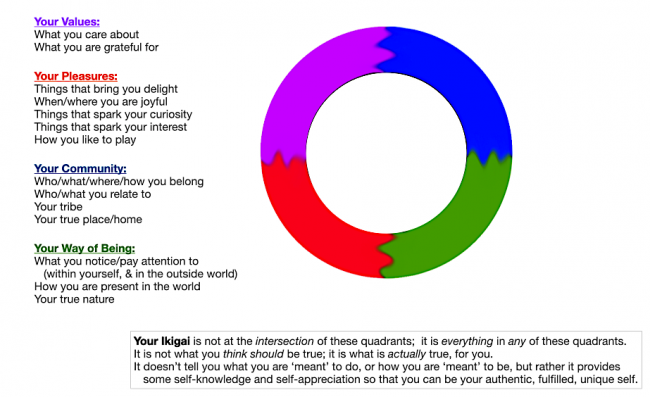
  8. With practice, it improves our social fluency, and other critical capacities and competencies. The chart below is one I co-developed with Chris Lott, and the blue circle which, in concert with our knowledge and thinking competencies enables us to be usefully expressive (artistic and improvisational, and hence socially fluent) is all about the capacity for and practice of conversation.
  9. With practice, it teaches us the critical appreciative skills of listening and attention. Every conversation is a dance, and you have to be pretty insensitive not to realize that if you always lead and dominate the conversation, soon people won’t want to dance with you any more. And of course we learn more when we pay attention, really listen to what others are saying.
  10. It opens us to new possibilities. Although often in conversation we are seeking reassurance, attention and appreciation, sometimes we will be surprised, bowled over, astonished, to hear something, or to realize something, that changes us radically, opens us to new ideas and worldviews, breaks our heart. That is the key to innovation and resilience, and good conversation can expose us and keep us open to these mind-altering, heart-breaking new possibilities.

social fluency

Yes, I know, lately I’ve been down on language because while it’s a passable tool for intellectual understanding it’s a poor one for communicating emotion. But I’m not sure you even need language to have a deep and meaningful conversation. Watch lovers converse with the ‘illiterate’ sounds and tones of their voices, watch the body language in meetings and casual encounters, watch wild animals collaborate on a project they couldn’t do alone — each is a wordless conversation. Even the conversation we have with ourselves (and imagine ourselves having with the author) when we read something stimulating is a substantially illiterate conversation — it’s more about acknowledging what we feel, and tapping into our instincts, than it is an intellectual word-conversation.

These ten ‘values’ of conversation make us more competent, more human, more appreciative, more collaborative.

No wonder conversation makes us happy.

March 21, 2010

Manifesto

Filed under: Our Culture / Ourselves — Dave Pollard @ 13:12

portraitM

I am not a consumer. I am not, as my friend Jerry Michalski acerbically puts it, “a gullet who lives only to gulp products and crap cash”. I am not here to use stuff up. I measure myself by my ability to live light upon the land, to consume as little as possible in the process of living, comfortably, sustainably, responsibly, joyfully, sufficiently. If I consume more than I must to live this way, then I am failing in my responsibility to all-life-on-Earth. When you, politicians and corporations, measure how much we humans collectively produce and consume, you are measuring the collective failure of our species to live responsibly and within its means, not its well-being.

I am not a user. A user is someone who is addicted, helpless to stop, at the mercy of pushers. I see you, the politician, the lackey, the monger, the lawyer, the marketeer, the corporate stooge, as the seller of lies and of endless shoddy, worthless junk. And I am not a junkie. I am not buying it, not any more. You are a perpetrator of misery and suffering, and you should be ashamed. You are desolating our planet, and you should stop.

I am not a debtor. I do not owe you or anyone anything. You cannot control me, or tell me what to do and what not to do. Your laws are not, as you assert, means to keep order; they are means to oppress, to subjugate. I am not your subject. I will not be bullied, cowed, bribed, intimidated, or propagandized. I do not recognize your or anyone’s authority over me, or over my freedom to be who I really am and do what I am intended to do.

I am not an employee. Common law defines an employee as a person in a ‘servant-master’ relationship to an employer. I have no master, and I am no one’s servant. The word “employ” means to fold in. I am not pliable, ployable, or employable. I do what I choose, what I know is right to do. Do not tell me, or ask me, to do otherwise.

I am not a resource. You cannot use me, or use me up. I am not a product. I am not my labour. You cannot consume me, or my interest. I am not a factor in production. However you want to gauge or measure my ‘productivity’ means nothing to me.

I am not an owner. Your ‘ownership society’ is a fraud, a grotesque deceit to convince those who live modesty that they should live more rapaciously, that they should hoard, that they should fight to acquire and protect mere stuff that you produce and peddle to us as a distraction from your ownership crimes. “Own your copy today,” you say, and then you tell me that I cannot sell, alter or duplicate “my” copy, that this violates your ownership and property rights. How stupid do you think I am? We do not have rights to own anything, we are merely entrusted with the collective stewardship of the land in partnership with the rest of all-life-on-Earth as our sacred responsibility. We belong to the land, not it to us. I claim ownership to nothing, and I do not recognize your ownership of anything, nor your rights, no matter how much you and your armies and your enforcers and your sleazy lawyers threaten me with your pathetic and abusive laws.

I am not a leader. I do not pretend to have answers, and I do not believe in hierarchy. We don’t need leaders and heroes cajoling and coercing us and letting us abrogate our own responsibility to discover and to do what we are meant to do. I am fed up with the rhetoric of leaders who would have us believe that they or anyone is or can be in control. What happens on this world is emergent and the collective result of what all of us do. We don’t need leaders to show us the way. We need facilitators, people who care, to help us work together in community and to remove obstacles and then get out of the way.

I am not a believer. There is no -ism that you can attach to me that will stick. Nobody knows anything, including me. We all just look after the needs of the moment. We do what we must, then we do what’s easy, and then we do what’s fun. Ideology has nothing to do with any of it. We are no closer to a global consciousness than the slugs, for all our human arrogance. Don’t tell me what to believe, or what you believe. Tell me what you care about, what you love, what you have passion for, and then show me, don’t tell me, why. Show me what you know how to do, that’s useful. Spare me your clever and useless rhetoric. I don’t believe in ideals any more. Look where they’ve got us.

I am a complicity and I am a part. A complicity of the creatures that make up what I singularly call ‘me’, and a part of the complicity of all-life-on-Earth. My ‘self-interest’ is a lie, a story that has been propagandized and instilled in me through cynicism, manipulation and fear, to keep me, and all of us, distracted, obedient. As I learn, finally, to scrape off all the gunk I acquired when I did not know better, and discover who I really am, nobody but myself, I discover that I have no self-interest. I am just a part, here to act as part of this amazing planet’s great circle of life and learning and love.

I am just the space through which stuff passes, a part of the unfathomably complex dance of all-life-on-Earth. And my role — my only role — is learning to improvise which of that passing-through stuff to touch, and which to just let go. It’s not a choice, so much as a knowing, a collective and connected knowing, an instinctive and sensual knowing. “Ah, I know how I can make this better, or clearer, or more interesting, or more useful, or more innovative, or more fun — there!” Like the expert who just knows, from practice, where the puck or ball is going to be, I’m learning, perpetually, to be there, to do that stuff I do that helps just a little bit, to know what to do and to have fun doing it. The wild creatures whose world I increasingly share understand this well, and it will take a lifetime of practice to become half as wise as they are in the arts of living, and making a living, and being of use, and being happy, without even trying. Just being the space, and touching the right stuff in just the right way as it passes through.

That’s who I am. Not a consumer, a user, a debtor, an employee, a resource, an owner, a leader, a believer, an -ist. So stop calling me these names. Understand who I am, and you may start to understand who you are as well. And then you will be free of all the names that imprison you, make you everybody-else, make you who you are not. I will see you then.

March 20, 2010

Links and Tweets of the Week/Month: March 20, 2010

Filed under: Preparing for Civilization's End — Dave Pollard @ 22:30

RealityWorstGameEver

PREPARING FOR CIVILIZATION’S END

The Myth of Self-Reliance: On the pages of most of us Post-Civ bloggers you’ll find exhortations for a return to a community-based society and economy, one based on principles of self-reliance. But Toby Hemenway makes a compelling argument that self-reliance in modern society is impossible and misguided, and our belief that by growing our own food, making our own clothes and tech tools, and learning to fix things, will somehow make us self-reliant when global systems collapse, is a dangerous illusion. Thanks to Tree for the link and the one that follows.

Solastalgia: Defined as “the pain experienced when there is recognition that the place where one resides and that one loves is under immediate assault”, solastalgia is “a global condition, felt to a greater or lesser degree by different people in different locations but felt increasingly, given the ongoing degradation of the environment. As our environment continues to change around us…  how deeply are our minds suffering in return?” I’m loath to allow psychotherapists and other pseudo-scientists and oversimplifiers to label as pathology what we must, by our nature, all feel, but this is an interesting read, a study of what Dave Smith helped me identify as “our unbearable grief for Gaia”.

“All We Make Now is Garbage”: Dmitry Orlov and John Michael Greer talk about the coming “long descent” civilizational collapse. Thanks to Avi Solomon for the link.

Get Ready For an Era of Deflation: Two interesting Automatic Earth reports this week. First, Ilargi explains why there will be a protracted period of deflation (falling prices and stagnant economic activity) before we can expect hyperinflation to kick in. And then, he explains why, as part of that deflation, housing prices are poised to collapse further as the government (i.e. taxpayer) gets out of the business of trying to boost prices. The argument that the first of the three big dominos of civilizational collapse will be the economy, not the End of Oil or ecological collapse, has never been stronger:

Home prices supported only by taxpayer money are doomed to crumble; the only things achieved by the Fed’s $1.25 trillion purchases are a temporary delay in home price plunges, and another giant transfer of bank and lender losses to the state (re: the population). If only for this reason the Fed would do well [as the British authorities recently did] to warn the American people that hard times are a-coming.

Most people are far too complacent when it comes to the consequences of a shrinking economic system. Many claim that we can easily downsize to smaller homes and smaller lives, since there’s so much we don’t really need anyway, that we will move in together and return to “good” conversations, growing our own tomatoes and all that. But that’s just not going to happen voluntarily, not on a large and wide scale. The human mind has no reverse. It doesn’t even have a steering wheel. We are built for one of two things: go forward or crash. It looks like there’s no forward left before a major crash happens first. It also looks like there’s not a whole lot of people who realize this.

Another $1.6T to US National Debt: A full $1T of the staggering and calamitous US overspending is military. Still, none of this is being paid for by war taxes on the rich, the only ones who could afford such taxes, as the US edges closer and closer to bankruptcy and a catastrophic downgrade of the its credit rating and a commensurate disastrous spike in borrowing costs. Thanks to Raffi Aftandelian for the link.

A Third of a Trillion Dollars to Fix Water Pipes: That’s the latest estimate from the US EPA to rectify decades of neglect and short-termism. Because the US states are starting to go bankrupt, none of this will be spent, and the consequence will be a gradual collapse of the country’s Civil War era water and sewer infrastructure. Get ready to haul your own drinking water, like in the struggling nations, unless you work for Goldman Sachs and can afford to pay someone else to do it for you.

America the Fragile Empire: Niall Ferguson rehashes the nature of complex systems and describes the vulnerability of the current American state. Unfortunately, unlike the collapse of the Soviet Union, a collapse of the US would precipitate the Long Emergency: a global economic collapse, leading to a series of global geopolitical crises and then, exacerbated by oil scarcity and ecological collapses, a slow crash of our equally fragile and overextended civilization.

LIVING BETTER

Just Do One Thing at a Time: PS Pirro reviews Seth Godin’s new book, and sums up the perils of multitasking: “Most of the energy it takes to juggle a bunch of projects goes into the juggling, not into the projects.”

History of Mondragon: A comprehensive summary of the world’s most successful and enduring cooperative. Thanks to Jerry Michalski for the link.

POLITICS AND ECONOMICS AS USUAL

Monsanto + Fox TV’s Health Danger Cover-Up: From a couple of year’s ago, a Canadian expose of how two Fox TV investigative reporters were threatened and bullied by Monsanto for a never-aired report telling the truth about the dangers of Monsanto’s bovine growth hormone (and the complicity of the FDA in approving it for sale), then intimidated and finally fired by their employer’s (Fox TV’s) lawyers and executives, when they refused to lie or bury the story. A shocking demonstration of the power and ruthlessness of global corporatists. Thanks to Jerry Michalski for the link.

Anthrax Murders Update: Although the FBI has deep-sixed the anthrax murder investigation and convicted “squalene Bruce” Ivins in absentia after his suicide, evidence keeps turning up that Ivins couldn’t have done it, at least not alone. The anthrax sent to the liberal Democrats in 2001 was astonishingly sophisticated stuff. We’ll never know who really was behind it. Thanks to Rayne for the link.

FUN AND INSPIRATION

cheneymortgagecartoon

Cartoon by Tom Cheney in The New Yorker. His artwork is available here.

Training the Consumer to Jump Through Hoops: Those of us who are exceptionally informed and resistant to commercialism may be surprised and disgusted at this vision of how average citizens will be seduced by commercial interests exploiting new RFID technologies and our inherent love of game-playing. Thanks to Jerry Michalski for the link.

Facebook: No Assisted Suicide Allowed: A new site is helping people commit Web 2.0 suicide, by disconnecting from social networks on the Web. Facebook is suing. Thanks to Tree for the link and the one that follows.

Playing Monopoly With People’s Lives: Another great creative activism event in Minneapolis aimed at megabank Wells Fargo.

Fallen on Hard Times: A clever, pertinent and vintage Jethro Tull song. Posted by Keith Farnish on the new post-civ blog we share with co-conspirators Sharon Astyk and Guy McPherson.

THOUGHTS OF THE WEEK

Let Your Dog Out to Pee: Reflections on the unnatural sport of skiing and more wonderfully-crafted wisdom from Melissa Holbrook Pierson.

A short poem from Edwin Markham (thanks to Chris Corrigan for the link and the one that follows):

OUTWITTED

He drew a circle that shut me out —
Heretic, rebel, a thing to flout.
But Love and I had the wit to win:
We drew a circle that took him in.

From Jack Ricciuto, Strategy in Four Easy Steps (beats the hell out of most of the approaches I’ve seen used in 35 years in business). Just answer these four questions:

  • Where do we want to be in 20 years?
  • Why does that matter to us?
  • How do we want to move towards getting there in the next 2 years? and
  • What would be wise for us to do in the next 2 quarters (and weeks) to start to move towards getting there?

March 10, 2010

How Many Relationships Can We Manage?

Filed under: Our Culture / Ourselves — Dave Pollard @ 22:57

support circlesympathy circletrust circle

Just about a year ago, I posted an article on the work that Christopher Allen had done on:

  • optimal size of groups for sustainability and collaborative effectiveness (short answer: around 5-7 for work groups and around 50 for networks/communities), and
  • maximal span of any one person’s relationship ‘circles’

Christopher illustrated his answer to the second issue (the one this article is about) with the lovely drawings of Nancy Margulies, shown above, of three concentric circles/spirals, which he called, respectively, the support circle, the sympathy circle, and the trust circle. He argued that there are rivers or threads running through all three circles representing common ‘context’ for these relationships (work, shared philosophy or beliefs, kinship, love etc.), what he calls ‘geographies of connection’ on the topographical map of our relationships. Here’s Nancy’s illustration of these threads:

geographies of connection

Over the last week, I’ve been chatting with Tree Bressen, Rob Paterson, Melinda Fleming and Nancy White about how many meaningful relationships we can sustain without exhaustion. I hypothesized that (based on people I know) most people have either 5-7 really close (family/love/other partnership) relationships that essentially take up all of their social time, or they have somewhere north of 50, almost all more tenuous, relationships. In either case there’s a constant struggle I would argue, to give and get the aggregate attention and appreciation one wants from one’s social network.

The prevailing view is that we can (and do) have both — an intimate inner circle and a more tenuous second and third circle (or perhaps there are more circles, or perhaps it’s just one continuous outward spiral with strong links at the centre and weak links further out). But my observation is that very very few people really have both, and that people are pretty willing to give up on their large networks if they can find what they want in their inner circle. There’s a constant tension, though — since that inner circle is “putting all one’s eggs in one basket” there is a risk of losing those relationships and not being able to replace them, so many people, I think, try to keep that larger network ‘in reserve’ as a safety net(work).

Because we only have a limited number of hours per year for social activity (take away sleep etc., work time and time wanted for solitary activities and I’d guess we each have between 1500 and 3000 hours a year of social time to parse out), cultivating our networks (which are largely outside our control) can be hugely challenging.

And on top of all this, some of us (sensibly I think) are trying to rediscover or maintain another essential relationship, to Gaia, to all-life-on-Earth, to the natural world. For most of us there is a huge disconnect here — the people in our circles, like we ourselves, live outside the natural world (both physically and especially psychologically) so there is no context of place in which to situate and ‘make sense’ of these relationships. There is, in short, no real community. The relationships, and the attention and appreciation that draw us to others and others to us, are substantially all in our heads.

I have said before that I think humans were and are meant to live a tribal, place-based life as part of community and of all-life-on-Earth. In that natural, prehistoric, and now ideal and unachievable world, we are, at a certain age of adulthood, given the choice of asking to be invited to join the community in which we grew up, or leaving the community and seeking another that gives our life more meaning and value. We can be a part of a community, or we can live peripherally to it, as a visitor or traveler or nomad, until we find the place and community (the two are largely inseparable) where we know we belong. In the natural and prehistoric world one is always a part of the greater circle of all-life-on-Earth, so even those who live on the periphery of community still feel a larger belonging, connection, and appreciation. But there is relatively little choice in such a world of who we can choose to live in community with. Most natural tribes (and not just in human societies) have significant buffer zones between them, and a certain Darwinian reticence to accept strangers. One earns one’s place in a community, and the relationships with the tribe naturally follow.

My Gravitational Community — the 50-70 people listed in the right sidebar — has evolved over the years but stayed roughly the same size. As some of the people who have come into my ‘orbit’ have become much closer to me, the attention I have for the rest (manifested mainly through this blog, IM, e-mail and Second Life) inevitably wanes and these relationships tend to weaken and ‘fall out of orbit’. I wonder if there’s a Quantum Theory for social networks, a ‘rule’ that determines, based on your total social time and energy and on the number of people in various levels of intimacy or proximity to you, how many ‘spaces’ are left in the outer orbits?

If all your relationships are shallow, I can envision you having 150 (Dunbar’s number) such relationships, and juggling them competently. At the other end of the spectrum, I suspect the maximum number of sustainable meaningful relationships for newlyweds and new mothers is between 1 and 2. Perhaps an inverse-square law applies. And then, as we all struggle with Tom Robbins’ great question How do we make love last?, some of those inner circle covalent relationships slide out to outer circles or out of orbit entirely, making room for either a host of new outer-orbit relationships or a new ‘one and only’.

It will not come as a surprise to my regular readers that I believe we are naturally polyamorous, and that there is more strength and sustainability in an set of 3-7 covalent relationships that are intimate and loving and appreciative and attentive but not exclusive, not demanding of the lion’s share of one’s time, and full of accommodation and compersion for each partner. These relationships (especially in today’s world) need not be reciprocal — each of the 3-7 others one has a poly relationship with may have 3-7 other relationships, such that the total poly network could involve dozens of people. This provides a lot more flexibility and support than can be expected from any monogamous relationship. But it is a lot of work, especially when the relationship members live far apart.

My Gravitational Community is broken down into categories that show how the people with whom I have meaningful relationships came into my life, but it would probably be more honest if I were to categorize them by what draws me to them (and hopefully, them to me): that draw may be emotional/visceral/erotic appeal, shared purpose or ideals, or any of three types of intellectual appeal (great intelligence, great creativity, or great communication skill or other attractive competency). Think of these appeals or ‘geographies of connection’ as spokes or rivers flowing out from the centre, as a second dimension (along with ‘quantum level’) of the ‘map’ of one’s social network. Might be a little too personal and too revealing to show for the Gravitational Community on my right sidebar though!

Please feel free to join the dialogue, and let me know if and how you think it’s possible to have it both ways — the ‘cold fusion’ of a fulfilling and intimate inner circle as well as a large and diverse and dynamic ‘outward spiral’ of people with whom one also manages to sustain an enduring and meaningful relationship.

And also please let me know if you have thoughts on how it might be possible to somehow ‘situate’ the people you have important relationships with, within the larger relationship we all have (but have largely forgotten) with all-life-on-Earth. To meld and merge all these juggled relationships into real communities.

March 9, 2010

Coping With Complexity

Filed under: Working Smarter — Dave Pollard @ 21:41

saraswati

saraswati, hindu goddess of knowledge, creativity and openness (image online, uncredited)

Some recent comments from readers of my First Principles post led me to revisit one of the first posts I wrote on this blog, nearly seven years ago. It was about a seven-step process for coping with a new situation that Cyndy Roy and I co-developed. Here’s an excerpt:

Sense, Self-control, Understand, Question, Imagine, Offer, Collaborate

Sense: Observe, listen, pay attention, open up your senses, perceive everything that has a bearing on the issue at hand. Connect.
Self-control: Don’t prejudge or jump to conclusions. Don’t lose your cool. Focus. Breathe.
Understand: Make sure you have the facts and appreciate the context. Things are the way they are for a reason. Know what that reason is. Sympathize.
Question: Ask, don’t tell. Challenge. Think critically.
Imagine: Picture, hear, feel what could be. Be visionary. Every problem is an opportunity. Anything is possible.
Offer: Consider. Give something away. Create options, new avenues to explore. Suggest possibilities. Lend a hand. Help.
Collaborate: Create something together. Evolve  collective approaches that are better than any set of individual approaches. Learn to yield, to build on, to bridge, to adapt your thinking.

We developed this before I started reading and writing about complexity theory, but it occurs to me that this is really a practice (can’t really call it a methodology) for coping with complexity — with situations that have no simple (put the lights on a timer) or merely complicated (include a torque converter in your electric bicycle conversion kit, and make sure you true the wheels before riding). In complex situations, there is no ‘right answer’ — there are too many variables, no clear cause-effect relationships (if you do X, you may or may not get result Y), and no way of predicting what will happen. Most of the ‘problems’ we face are not (complicated) problems (with ‘solutions’) but rather (complex) predicaments that we have to adapt ourselves to.

It seems to me that wild creatures (and perhaps Buddhists) appreciate this, and they appear to use these seven steps to cope with situations over which they (and we) have no real control. I think we would be wise to do likewise. Here’s how these seven steps differ from the normal ‘problem-solution’ process we use in merely complicated situations. As you review them, think about a specific complex situation: Example: Resolving a non-trivial conflict between two people you respect and who both have valid points that cannot be reconciled:

  1. Sense: Pay attention to everything that is happening. Don’t try to identify the ‘problem’, or the ’cause’ or the obvious ‘solution’ because in complex situations there are none of these. If we think we see a cause or solution, we’re probably over-simplifying and we will be prone to making erroneous decisions.
  2. Self-control: Become aware of your own subjectivity, biases, feelings, and predispositions. Know yourself, and appreciate that you are not separate from this situation or from others trying to cope with it. You are a part of the system and hence of the predicament. You cannot control it (though you probably wish you could and my want to try to); you can only control yourself, and your reaction to it. Appreciate that the situation is a predicament, that you and others need to accommodate and adapt to, not a ‘problem’ that needs to be ‘fixed’. Lower your own and others’ expectations that there are magical or simple ‘answers’ to this situation.
  3. Understand: Appreciate that things are the way they are for a reason, and that there’s a reason that this predicament has no simple (or complicated) ‘solution’. Appreciate the situation, and the different knowledge, ideas and perspectives that people have in regard to it. Appreciate not just the ‘intellectual’ content of the situation but also the emotions at play. Sympathize with what and how people feel and understand why they feel that way. Let your senses and intuition inform your understanding.
  4. Question: Use questions, of yourself and of others, to explore and deepen your appreciation, and that of others, of the situation. Don’t proffer answers or quick fixes, because if there were a quick fix it would already have occurred to someone and have been done. Ask questions that are not judgemental but which are probing, challenging, and which push past unacknowledged biases or assumptions.
  5. Imagine: Surface approaches and possibilities that others have not thought of, and encourage and facilitate others to do so, collaboratively. Hold these approaches and possibilities open. Find different ways to look at the situation. Think about how nature copes with analogous situations and challenges. Hold the creative tension between what is imaginable and what is practicable, by encouraging both creative and critical thinking.
  6. Offer: Be generous. Be the first to offer something of value — your time, resources, willingness to talk with others or do research. Give and incite others to give likewise, following your example, your intention. Take responsibility.
  7. Collaborate: While there are certain actions that each person will, as a result of the understanding and appreciation they have achieved through this process, do personally, take personal responsibility for, some of the most powerful actions that can come from this practice are collective, collaborative. In collaboration, you do what you do best, and show others what you do, and by watching others you learn from them too. And the collective product is a give and take, a weaving, an adaptation to each other as well as the predicament you are working to address, to adapt yourselves to. Collaboration can produce, unexpectedly and unpredictably, results that outshine what any individual, no matter how brilliant or competent, could ever do alone.

This seven-step practice was itself a collaboration with Cyndy, and despite all I have learned since we developed it, I can’t see how to improve on it, which shows, I think, the value of collaboration.

To remember the seven steps, I created a simple set of hand movements: open and receiving (sense), fingers together contemplatively (self-control), forefingers pointed up in aha! style (understand), left hand open in a receiving gesture (question), fingers  of right hand to temple (imagine), right hand open in giving gesture (offer), hands clasped supportively together (collaborate). Much better than an acronym.

It is a practice, and as such it takes practice, but it seems to work.

March 5, 2010

First Principles

Filed under: Preparing for Civilization's End — Dave Pollard @ 23:49

bowensunset

view from just above my new home; more of my recent photos here

One of the discoveries I’ve made as a result of retiring from paid work, and living alone for the first time in decades, is that I now have the freedom and responsibility to make my own decisions. When much of your life is tied up with work (collaborative or hierarchical) and the schedules and priorities of others, most decisions are made for you, or at least restricted by the constraints of society. It is a bit startling to realize that, suddenly, almost every decision I face is mine alone to make. Each decision may have repercussions for others, which I of course have to think about, but ultimately my decisions are now driven by principles, not by accommodation.

As I’ve made these decisions, I’ve started thinking about What are the principles that are driving them? So far they boil down to just three, which I’m calling First Principles — I wish it hadn’t taken me a lifetime to discover them.

  1. Being Generous: This principle is about realizing that we’re a part of all-life-on-Earth and that, contrary to what we have been taught, we are neither ‘alone’ nor ‘individual’. Paying attention to others, listening, giving, caring, sharing, ignoring one’s illusory ‘self’ and focusing on collective — community and planet, now and generations to come — not only makes sense, it is, I think, the essence of being human, of being alive, really here, now.
  2. Valuing Time: Much of what we do is a consequence of what we (are taught to) value. Too often we end up valuing money, or what it buys (security, we think, and even love) instead of realizing that our time has far more value than any ‘currency’. That doesn’t mean ‘saving’ time, or hoarding it, or seeing it as a scarcity to meted out selfishly. It means enjoying its passage. It means not giving it up for money (or even love). It means taking every moment as a gift. It means living Now, not in the past (regrets, nostalgia) or the future (dreams, fears).
  3. Living Naturally: We’ve lived so much of our lives in artificial environments, distracted, that we’ve forgotten how to see how nature makes decisions, and realize that those decisions, based on a billion years of evolved knowledge, are inevitably more sensible than any we might make ‘independently’. Nature shows us how to live: to adapt rather than trying to control. To love, abundantly. To see and enjoy beauty. To be honest, always, even when it hurts. To imagine and to improvise. To learn by doing and by watching, not by being told or even by reading. To let go of outcome and of what is past or might be in future, and just be.

That’s it. All the decisions I’ve made in the past couple of months, since I’ve been freed from having others make decisions for me, have been driven by these three First Principles: Be generous. Value your time. Live naturally.

My life used to be so complicated.

Now, suddenly, it’s merely complex. So much easier.

March 4, 2010

Links and Tweets for the Week: March 3, 2010

Filed under: Preparing for Civilization's End — Dave Pollard @ 00:02

One of the delightful cartoons of Natalie Dee. See lots more here.

PREPARING FOR CIVILIZATION’S END

Trying to Cure Reality: A new book Manufacturing Depression, by Gary Greenberg (reviewed by Louis Menand in the New Yorker) debunks the industrial economy myth that depression is a disease that needs chemical and therapeutic “curing”. Our civilization is collapsing, we’ve exhausted the natural resources our planet took a billion years to store up, we live in suffocating, overcrowded, polluted, horrifically stressful conditions, and we have launched the planet into the 6th global extinction. Why shouldn’t we feel bad? Thanks to Raffi Aftandelian for the link:

The National Institute of Mental Health estimates that more than fourteen million Americans suffer from major depression every year, and more than three million suffer from minor depression (whose symptoms are milder but last longer than two years). Greenberg thinks that numbers like these are ridiculous—not because people aren’t depressed but because, in most cases, their depression is not a mental illness. It’s a sane response to a crazy world.

“We Think We Are the Doctors. We Are the Disease”: Chris Hedges explains how our civilization culture is buckling and starting to crumble, and how we must both resist and dismantle this culture and create new sustainable living models. Thanks to Paul Heft for the link. Excerpt:

All resistance must recognize that the body politic and global capitalism are dead. We should stop wasting energy trying to reform or appeal to it. This does not mean the end of resistance, but it does mean very different forms of resistance. It means turning our energies toward building sustainable communities to weather the coming crisis, since we will be unable to survive and resist without a cooperative effort.

The Path of (Most) Resistance: Along the same lines as Chris Hedges’ article above, Derrick Jensen in his new article in Orion says we need to get past our belief that “resistance is futile” and realize that if we really want to save the planet we have to fight:

We need organized political resistance. Power needs to be named and then dismantled systematically. This requires joint action of whatever sort is deemed necessary. While the frontline actionists are taking apart systems of power and fighting to defend wild nature, the culture of resistance is providing loyalty and cooperation and material support, as well as building up alternate institutions—from means of bringing justice to economic systems to food supply chains to schools to new literary forms—that can take over as the system comes down. The template is not hard to understand. It will take its own culturally appropriate forms.

Right now, a small group of half-starved, poverty-stricken people in Nigeria have brought the oil industry in that country to its knees. They remember what it is to love their land and their communities—perhaps because they are not drowning in privilege, but in the toxic sludge of oil extraction. Is that what it will take to get environmentalists in the U.S. to fight back? [These Nigerians have] said to the oil industry: “It must be clear that the Nigerian government cannot protect your workers or assets. Leave our land while you can or die in it.” There is more courage, integrity, intelligence, and pragmatism in that statement … than in any statement I have ever read by any American environmentalist, including myself. We need to accept the fact that making this type of statement (and being prepared to act on it) might be necessary to preserve a living planet.

(And in a related story:  Several new local initiatives demonstrate that where there’s enough passion and energy focused at the local level, change happens. Thanks to the Bowen Island Phorum (my new daily guilty pleasure) for the link.)

Real Communities are Self-Organizing: Dmitri Orlov questions the feasibility of “building community”, arguing that organization cannot be imposed; it must occur by the collective consensus of members, or it won’t happen at all. Thanks to Jon Husband for the link. Excerpt:

How representative a democracy the US ever was is rather beside the point; the point is, it was once a country where people could successfully and openly self-organize, and now it isn’t. Once there were strong, cohesive communities in the US, which could organize and bring pressure to bear on their elected officials. And now, as described in Robert Putnam’s widely discussed book Bowling Alone (2000), there are no such strong, cohesive communities in the US, and so… they can’t organize, because, I would think, there is nothing for them to organize. Existence of communities allows communities to organize; lack of community prevents communities from organizing. That’s a bit of a tautology, is it not?

LIVING BETTER

5 Ways to Make Social Media Work: A great article and list by Justin Kownacki. (My comment to Justin on the list: “Much of this is about two important aspects of coping successfully in the 21st century: generosity (including listening and appreciation), and valuing your time — two things most of us are pretty lousy at.” The 5 Ways:

  • Have a purpose (if you don’t have anything insightful, clever, novel, or useful to say, then don’t say anything)
  • Don’t confuse media with marketing (one is communication; the other is trying to sell you something)
  • Let someone else be the expert (focus on what you really are exemplary at)
  • Comment selflessly (improve the conversation elsewhere than on your own blog)
  • Kill one of your channels (say less, and in fewer places, and say it better)

Brilliant Idea That Needs to Be Free: I’m a huge fan of mind-mapping (graphic that captures visually the organization, ideas, decisions and learnings of a meeting, course curriculum or other intellectual work) and also of collaborative work and tools (wikis etc.) So the new app co-mapping, which allows mind-maps to be collaboratively developed (in real time or not) really appeals to me. Problem is, they’re charging user license fees for it. Can someone develop a free open source alternative, or better, show the developers of this tool a better business model to pay their development and maintenance costs?

Inflatable Sleeping Coat: An award-winning idea for hikers, campers, trekkers, and perhaps for water safety and potentially light water travel as well. Not to mention a possible boon for the homeless, today and, as numbers swell, in the future. Essentially, this is an insulated, water-proof coat with two detachable, inflatable sections that can serve as a bed and pillow, a cushion, or even as a raft. Terrific. Thanks to reader Tatu Siltanen for the link.

Giving Away the Store: A man in Oregon gave his devoted employees a special gift on his 81st birthday: their company. With the distressing trend to “demutualization” it’s refreshing to see the opposite: a corporation converted to a co-operative. Thanks to Tree for the link and the two that follow.

A Business That’s Mushrooming: Now mushrooms are finding use as all-natural building materials, biodegradable packaging and ‘green’ insulation.

Tarot as an Insight Incubator: Rather than a dubious predictive tool, some people are now using Tarot readings to stimulate creativity, insight and self-knowledge. “The cards help us to see ourselves and events symbolically, as archetypes, and therefore more objectively. And that has a way of making our personal dramas feel much less overwhelming.”

Even More Reasons to Move Your Money: Not only do they invest more ethically, small financial institutions like credit unions also charge you lower fees and give you better interest on your deposits.

How Touch Heals, Inspires and Sustains: New research shows the incredible power of human touch. Thanks to Jerry Michalski for the link.

Dreams of Cascadia: The idea of creating a new coastal nation running from Northern California to British Columbia is not new, but the recent Vancouver Olympics fanned the dreams of idealists that it was possible, only to dash them on the rocks of surly xenophobic customs agents on both sides of the border.

POLITICS AND ECONOMICS AS USUAL

The very rich get (much) richer: New government data shows that for the 400 richest US taxpayers, the last year of Bush was yet another windfall year, as despite the recession their average income rose by $81 million while their average tax rate dropped. Simply obscene.

Wall Street’s Pushed Us to a Second Brink: An expose by Matt Taibbi explains how recent actions of big financial institutions not only haven’t contributed to lowering risk of a second economic collapse, they’re actually deliberately precipitating one. Thanks to Raffi Aftandelian for the link.

When Corporations Really Rule the World — Now: John Robb describes the stranglehold that corporate interests now have on political power in the US. Thanks to Paul Heft for the link.

Here Comes Permanent Unemployment: This endless recession (despite the moronic MSM reports touting a recovery) is creating chronic victims: Millions who became unemployed and who may never find work again in a permanently gutted job market.

The Trauma of Industrial Childbirth: A woman’s haunting story of how the ordeal of modern induced childbirth, necessary as it may have been, has left her permanently scarred with PTSD.

MRSA Has a New Virulent Cousin: MRSA, a devastating and antibiotic-resistant bacteria killing thousands in hospitals today, has a new and even more potent and resistant cousin, called “Gram-Negative” Bacteria (The name refers to its undetectability in a certain test, not its mass). Further indication that our foolish strategy of trying to eradicate bacteria (the only life-form with a greater mass on Earth than humans) by soaking everything in antibiotics only serves to accelerate bacteria’s incredible adaptive capacity and create even more deadly diseases. When will we realize we can’t control the Earth and it’s evolution, even if we were wise enough to be able to discharge that power competently?

Undamming the Salmon: After a huge amount of work, all parties have agreed in principle to dismantle dams in Oregon and California that have devastated salmon stocks. But many hurdles remain.

FUN AND INSPIRATION

Blame Canada (2010 Version): Steve Almond’s priceless take on the Vancouver Olympics. “But maybe I’m being too cynical. Maybe the Olympics have always been about vertical integration of ancillary entertainment platforms.”

why pirate movies

graphic of why people pirate movies (thanks to Rob Paterson for the link)

The Psychology of Small Urban Spaces: An old but still timely look at how humans behave in public spaces. Thanks to several readers for the link.

The Secret of the Maya: This is interesting, though I confess I find much of it unfathomable. Brilliant or nonsense? Thanks to Andrew Campbell for the link.

The Case for an Older Woman: OK Cupid provides some revealing data on what online daters are looking for, and what they should be looking for instead. We may lie about our biases, but we can’t hide from the numbers. Lots more to make you cringe with recognition or shame on this site — like this post on attractiveness. Thanks to Tree for the link.

Clever Made-Up Words: Results of a Washington Post contest from a few years ago that asked readers to take any word from the dictionary, alter it by adding, subtracting, or changing one letter, and supply a new definition. Thanks to Miralee for the link. The winners:
1. Cashtration (n.): The act of buying a house, which renders the subject financially impotent for an indefinite period of time.
2. Ignoranus: A person who’s both stupid and an asshole.
3. Intaxication: Euphoria at getting a tax refund, which lasts until you realize it was your money to start with.
4. Reintarnation: Coming back to life as a hillbilly.
5. Bozone (n.): The substance surrounding stupid people that stops bright ideas from penetrating. The bozone layer, unfortunately, shows little sign of breaking down in the near future.
6. Foreploy: Any misrepresentation a bout yourself for the purpose of getting lucky
7. Giraffiti: Vandalism spray-painted very, very high.
8. Sarchasm: The gulf between the author of sarcastic wit and the person who doesn’t get it.
9. Inoculatte: To take coffee intravenously when you are running late.
10. Hipatitis: Terminal coolness.
11. Osteopornosis: A degenerate disease.
12. Karmageddon: It’s when everybody is sending off all these really bad vibes, and then the Earth explodes, and it’s a serious bummer.
13. Decafalon (n.): The grueling event of getting through the day consuming only things that are good for you.
14. Glibido: All talk and no action.
15. Dopeler effect: The tendency of stupid ideas to seem smarter when they come at you rapidly.

love not war

Field Art: Thanks to Tree for the link.

THOUGHT FOR THE WEEK

From Bill Seitz “We don’t have many American product recalls, because we don’t make anything.”

March 1, 2010

Throwing Off the Shackles of Debt

Filed under: Preparing for Civilization's End — Dave Pollard @ 19:01

ShacklesOfDebtTactics

(A joint essay by Guy R. McPherson, Keith Farnish, Dave Pollard, and Sharon Astyk.)

Indebtedness is a form of servitude, sometimes involuntary, and, in extreme cases, can become a form of endless and harrowing imprisonment. Consider, for example, the current usurious rates of interest (compared to what savers earn on their savings in the same banks that charge that interest). Some religions consider the charging of interest as immoral, even criminal. According to all four gospels in the Christian bible, even the normally passive, peaceful prophet of Christianity got so worked up about usury in a temple he started acting like John Ferguson on the sidelines of a hockey game.

Purchases by consumers (this awful word is used here only because that’s what we citizens have become – involuntarily) drive the world’s industrial economy. And purchases by consumers depend on the confidence of those consumers, so that consumer confidence underlies commercial success. If a potential consumer has no confidence in her ability to purchase an item, then she won’t. If enough potential consumers lose confidence in their ability to purchase and pay for any particular item, the sales of that item will plummet, causing the manufacturer and sellers of that item to fail.

Considering the current economy, which will no doubt crash again within the next year or two, we can help create a situation that will both change behaviour for the better and prevent people from getting into financial trouble. Accomplishing this will require getting wide support for such ‘frugal’ activities, and this will pose a huge challenge to the hopelessly optimistic, reality-challenged corporations dependent on the industrial economy.

How do we persuade people that they definitely cannot afford to take out loans to buy more stuff? We can start by targeting luxury purchases such as houses, cars, and appliances. Governments throughout the industrial world recognize the importance of such purchases to the industrial economy, and have therefore provided huge subsidies, tax credits and other financial incentives (with taxpayer dollars) for purchasing houses, cars, and — more recently – appliances.

Most people need loans to purchase these “durable goods” (which are, ironically, no longer either durable or good). Loans traditionally are seen as safety nets, but it has become clear they really represent traps. Never mind the psychological or ecological implications of consumerism — there is no evidence to suggest anybody has minded so far — the focus here is on the trap into which each potential consumer falls by taking out a loan for frivolous purchases. Every loan is a bad deal for the borrower, whether it’s a line of credit, a secured loan, a mortgage or a credit card payment.

The system needs you to keep borrowing; if you don’t then who knows what could happen:

So what can we do? Here are some tactics that can be used to unshackle yourself, and help others unshackle themselves, from crushing and unnecessary debts. The risk assessments below are an average that the four of us came up with, but risk varies greatly by jurisdiction and personal risk tolerance, so be careful: Your mileage may vary, and it may be helpful to talk it over with others, even friendly legal advisors, before you try some of these tactics:

No Risk:

Don’t take out a loan for anything. If you need it — and probably you don’t — save your money and buy it, barter for it, or borrow it.

Encourage others to join you. Start by sharing your car (with those you trust), your garden, your tools, even your clothes. Pass stuff on; give stuff away. Buy stuff used. You don’t need that loan and neither do the people you care about.

Pay off your credit card regularly, on time, every month, and consolidate debts into the lowest-interest vehicle possible if you can’t pay them off entirely.

If you already have loans, and most recent students do, then seek deferral under economic hardship. Odds are pretty high you’re actually experiencing economic hardship, so this is not a lie. (But be aware that if you recover from this hardship these debts can come back to haunt you, so think about this if you’re not planning on living a subsistence life).

Before you sign anything that entails debt, read the fine print, pause, and talk with others, and help others do the same.

Low to Medium Risk:

Start a “misinformation” campaign (from the point of view of the loan companies):

Via snail mail, send out carefully crafted false “parody” press releases from loan companies and banks to media outlets such as local radio stations, local press (and even the nationals if you are brave and clever enough). These “press releases” should discourage people from taking out loans (because, after all, people don’t really need all the stuff they buy on credit).

If you make the “press releases” as authentic, virtuous-sounding and complete as possible, and word them so that responses are not required, then there is a good chance they will be run by the media without questions being asked.

Or, do a bit of “subvertising”, parodying corporate websites on the Internet or (at a little higher risk) posting parody billboards: Focus on loan companies and banks, changing the messages to emphasize the immoral aspect of loans. Alternatively, if your risk appetite (and tech savvy) is a bit higher, you can hack existing websites or remove loan advertisements entirely. For more information on techniques for doing this, read this Keith Farnish post. And EFF has a good online white paper about protecting yourself/your message when using the Internet for gripe/parody purposes.

Keep an eye on the legal situation as it unfolds: The tremendous success of groups like the Yes Men is attracting a lot of attention among corporate risk managers – and their lawyers. Risk of these tactics could rise as a result.

Other potential actions along these same lines include:

  • Organizing “default-ins” along the lines of the “love-ins” and “sit-ins” of the 1960s, public events to publicize the immorality of current usury and loan regulations and corporate exploitation of them, held in or near the premises of the worse offenders.
  • Devising and publicizing satiric fake get-rich-quick schemes that exploit government mortgage subsidies and the overvaluation of real estate: “Get $1 million in real estate free from Obama mortgage subsidy program with no risk or money down!”; “Sell real-estate short before the crash and make $1 million with no risk or cash!” Obvious satirical routines can be developed for a variety of venues. This strategy should hold particular appeal to artists.and
  • Helping to organize and formalize the exploding “gray” market for overpriced real estate: Thousands of people are moving or retiring and unable to sell their homes at anywhere near their mortgages, so they are renting out their homes for a fraction of current market rents, and likewise renting others’ homes in areas to which they are moving at far below market rents. Everyone hopes prices will somehow bounce back and save them from default. I can foresee a “showdown”: these homeowners will have to threaten default to get mortgage companies to write off the excess of mortgage value over real property values. We need to help them organize to burst the bubble and get these write-offs so that mortgages become affordable (and real estate prices reasonable), and we also need to help them find “gray” market properties in the meantime.
  • Medium Risk:

    Last month I wrote about ”Walking away from your mortgages”:

    Many people are now living in homes with mortgages that are greater than the value of their property. Why would anyone continue to pay a debt that is higher than the asset it secures? After all, big corporations view pulling the plug on unsuccessful ventures and sticking the debtholders and shareholders a key business strategy. The whole idea of “risk capital” is that the interest and other fees you earn for lending to risky borrowers compensates you for the risk, so that if the borrower defaults you accept the loss and chalk it up to experience. Yet for some reason homeowners feel some moral obligation to throw good money endlessly after bad. This of course is exactly what the corporatists, who have no such moral compunction, are counting on, what economists call moral asymmetry. The logical response would be to tell the lender to write off the excess of the mortgage beyond the property value, and refinance the mortgage accordingly. Apparently in some US states (called “recourse” states) this moral asymmetry is institutionalized — that is, lenders can go after a mortgagee’s personal assets if they default. There is, of course, no recourse when the corporatists walk away from debts, offshore their operations, and stiff the taxpayers whose subsidies and bailouts paid for the corporatists’ ventures.

    Where is the sense of outrage here? Have the education system and media so dumbed down the citizens that they can’t see this scheme for the cruel and criminal con it is? If everyone with a mortgage greater than the value of their home either walked away from it, or was legally empowered to require the excess to be written off as the “bad debt” it is, then of course there would be many bank failures and plunging profits. That’s how the market system is supposed to work. The lenders, of course, want it both ways, and Obama and the citizens seem blithely willing to let them have it.

  • Walking away from your “underwater” mortgage entails at least medium risk because it will damage your credit rating. Depending on the location and local mortgage laws (e.g. “recourse” vs. “non-recourse” jurisdictions) the risk to your other assets, sources of income, personal freedom and reputation, and hence the consequences of using this tactic, can vary considerably. When in doubt consult a progressive lawyer before acting.
  • On the same lines as the lower risk snail mail press releases described above, but using electronic communications, consider sending out false “parody” press releases from loan companies to media outlets. This requires a level of technical expertise as the spoofer will need to hide behind an alter-ego and fake domain.
  • High risk:

  • Taking a step beyond abandoning your underwater mortgage, don’t pay off your mortgage even if you’re not “underwater”. Simply default but continue to occupy your house. Ditto for other loans. The lenders may not be able or willing to tell their stockholders about it, so the borrower may get their loan “free”. This idea was encouraged by a reporter who writes about housing issues for the New York Times when he stopped paying his mortgage (and wrote about it, nine months later, in the Times, during which time nobody had asked for a payment).This idea is receiving plenty of attention, and even CNBC is talking about it.These actions are high risk. Definitely talk to your friendly progressive lawyer friend before trying this: S/he can advise you of potential consequences and how to minimize your personal risk. The bigger the mortgage, and the more publicity you get from this (and the whole point of this is to publicly embarrass usurers, not to make personal gain from this), the more likely you are to be a target of angry creditors. So be careful. The authors and the host of this web site do not advocate any actions which break the law. But let’s be clear – this is civil disobedience, and in a system that is skewed in favour of large multinational financial corporations and against the interests of citizens, it deserves serious consideration.

    What we’re trying to do here is help bring down a house of cards: People feeling forced to pay debts far greater than the real value of the assets that secure them. People seduced into getting into debt needlessly. People paying usurious interest rates and fees because the banks own the politicians and write the laws to their own advantage. It’s a debtors’ prison without locks and doors, and it’s immoral. Help us bring an end to it.

    ________________________

    This essay is part of a larger collaboration between the authors. It represents the third month of Keith Farnish’s Monthly Undermining Tasks.

  • Powered by WordPress