Dave Pollard's environmental philosophy, creative works, business papers and essays.
In search of a better way to live and make a living, and a better understanding of how the world really works.


January 31, 2012

The Cost of Seeking Invulnerability to Pain

Filed under: Our Culture / Ourselves — Dave Pollard @ 23:55

fears

chart of fears, from this earlier post

Nick Smith recently pointed me to a short article by Turil Cronburg, which in part read:

The way I’ve found real safety, even while being held captive in jail and in homeless shelters (run almost like a jail) and mental institutions (again pretty much like a jail) has been a combination of realizing that safety is really all about freedom, and finding clarity of my own purpose in life. And by freedom I mean freedom to be oneself. To react to life’s complications in a way that is honest and true to what one’s deepest self is – one’s highest ideals of what one wants to contribute to the world, one’s purpose in life.

If I am trapped physically by a violent individual or group – the shelter system, “legal” system, or “health care” system or any other forceful agent – I might not be especially free in a physical sense, which certainly sucks, and is something a healthy society will avoid at all costs, but on a deeper, more meaningful sense I am very much free to make at least some choices about what I do and say such that they help me make progress on my life’s goals…  Real safety comes from finding the most effective way of expressing your true self – what you want and what you have to offer – in every situation you come across in your path.

This is what ee cummings was saying when he wrote about how hard it is to be “nobody-but-yourself” in a world where everyone (the media, advertisers, peers, others trying to influence and/or control us, and even that small self-critical voice inside us) is trying to make us “everybody-else”.

The day after I read, Turil’s post, Mireille Jansma pointed me to this TedX talk by psychologist Brené Brown, in which Brené says something quite similar:

Whenever we’re on the verge of bliss, we picture something horrible happening… I blame this in part on the media… This is a symptom of an issue that is both universal and profoundly dangerous, and that is: We are losing our tolerance for vulnerability, which we see as synonymous with weakness, and which is at the core of our fear and anxiety and shame and other difficult emotions, but which also is at the core of joy, love, belonging, creativity, and faith.

When we lose our tolerance for vulnerability, joy becomes foreboding, disappointment, disconnection, perfectionism, [political, religious, and ideological] extremism, and most of all self-numbing, [mechanisms by which] we try to protect ourselves. What is driving this intolerance for vulnerability?… [I think it's] scarcity. We live in a culture that tells us that there is never enough [time, money, security etc. and] that we cannot ever be good enough. [We are inundated with hugely exaggerated messages of ubiquitous danger.]…

We numb vulnerability. We are the most addicted, the most medicated, obese and in debt cohort in human history. And we stay busy, so that the [feared] truth of our life can’t catch up. What are the consequences of numbing ourselves to vulnerability? You cannot selectively numb emotion. When we numb the dark emotions — vulnerability, fear, shame of not being good enough — we by default numb joy.

After this intriguing diagnosis, alas, Brené falls victim to the tendency of most ‘experts’ (and self-help book writers) to prescribe a cure for the malaise they’ve just identified.

How do we embrace vulnerability? Practice gratitude… Honor what’s ordinary about our lives… Play… [Appreciate] nature… We want more guarantees. We we want to believe that we we’re not going to get hurt and that bad things aren’t going to happen and they are. But if we don’t allow ourselves to [fully] experience joy and love we will definitely miss out on filling our reservoir with what we need when those hard things happen.

“Practice gratitude” is a nice phrase, and maybe whatever it means it works for her, but it’s not at all clear how this is supposed to help us “embrace vulnerability”. The advice, in any case, violates the corollary to Pollard’s Law: Things are the way they are for a reason. If you want to change something, first be sure you understand why it is the way it is. To tell us essentially the way to overcome our fears is “don’t be afraid” is not useful, or actionable, and the struggle in vain to try to follow this advice is likely to lead to even more feelings of “we can never be good enough”, and more retreat to numbness.

I am a fearful person, and I have become as a result of trying to cope with these fears and anxieties somewhat emotionally flattened, if not numbed. But I have come to accept myself: We cannot be other than who we really are. I aspire to liberate myself from civilization culture, and hence become less fearful and more present, more “nobody-but-myself”. But I acknowledge that this will take lifelong practice and may well be a fruitless pursuit.

As a result, a far more interesting approach, I think, would be to ask ourselves these questions, and come up with our own answers, coping practices, and self-acceptances:

  1. Who is “nobody-but-myself”? If I lived in a cultureal that didn’t try to make me “everybody-else”, what would I be like? What’s holding me back?
  2. What am I afraid of, and why? How do I cope with these fears (avoid, vent, condition/desensitize, learn, accept, detach/let go)? Why aren’t these coping mechanisms fully effective for me?

The ultimate question stemming from these is What can I do with this self-knowledge? And the answer may be: nothing. It may be enough just to understand ourselves a little better, to know why we are the way we are.

January 29, 2012

Links for the Month: January 29, 2012

Filed under: Preparing for Civilization's End — Dave Pollard @ 03:52

Not much to say this month as an intro to the links below; I think yesterday’s post about the insanity of our inexhaustible search for large-scale ways to save us from us sums up where I’m at: Full of joy, puttering away at learning to be present, and contributing as best I can to a thousand small sanities.

sand sculpture in honour of the year of the dragon — online in several places, source unknown

PREPARING FOR CIVILIZATION’S END

What Am I To Do With Feelings Like These?: Paul Kingsnorth’s Pilgrimage: This month’s Orion features a tour de force of passionate, sensitive writing about how the environmental movement has lost its way, and what he’s doing now as a result, from Dark Mountain co-founder Paul Kingsnorth, his best work I think since the Manifesto. Two excerpts from this lovely piece of writing (but please go read the whole article):

I look out across the moonlit Lake District ranges, and it’s as clear as the night air that what used to come in regular waves, pounding like the sea, comes now only in flashes, out of the corner of my eyes, like a lighthouse in a storm. Perhaps it’s the way the world has changed. There are more cars on the roads now, more satellites in the sky. The footpaths up the fells are like stone motorways, there are turbines on the moors, and the farmers are being edged out by south-country refugees like me, trying to escape but bringing with us the things we flee from. The new world is online and loving it, the virtual happily edging out the actual. The darkness is shut out and the night grows lighter and nobody is there to see it.

It could be all that, but it probably isn’t. It’s probably me. I am thirty-seven now. The world is smaller, more tired, more fragile, more horribly complex and full of troubles. Or, rather: the world is the same as it ever was, but I am more aware of it and of the reality of my place within it. I have grown up, and there is nothing to be done about it. The worst part of it is that I can’t seem to look without thinking anymore. And now I know far more about what we are doing. We: the people. I know what we are doing, all over the world, to everything, all of the time. I know why the magic is dying. It’s me. It’s us…

I don’t have any answers, if by answers we mean political systems, better machines, means of engineering some grand shift in consciousness. All I have is a personal conviction built on those feelings, those responses, that goes back to the moors of northern England and the rivers of southern Borneo—that something big is being missed. That we are both hollow men and stuffed men, and that we will keep stuffing ourselves until the food runs out, and if outside the dining room door we have made a wasteland and called it necessity, then at least we will know we were not to blame, because we are never to blame, because we are the humans.

What am I to do with feelings like these? Useless feelings in a world in which everything must be made useful. Sensibilities in a world of utility. Feelings like this provide no “solutions.” They build no new eco-homes, remove no carbon from the atmosphere. This is head-in-the-clouds stuff, as relevant to our busy, modern lives as the new moon or the date of the harvest. Easy to ignore, easy to dismiss, like the places that inspire the feelings, like the world outside the bubble, like the people who have seen it, if only in brief flashes beyond the ridge of some dark line of hills.

But this is fine—the dismissal, the platitudes, the brusque moving-on of the grown-ups. It’s all fine. I withdraw, you see. I withdraw from the campaigning and the marching, I withdraw from the arguing and the talked-up necessity and all of the false assumptions. I withdraw from the words. I am leaving. I am going to go out walking. I am leaving on a pilgrimage to find what I left behind in the jungles and by the cold campfires and in the parts of my head and my heart that I have been skirting around because I have been busy fragmenting the world in order to save it; busy believing it is mine to save. I am going to listen to the wind and see what it tells me, or whether it tells me anything at all. You see, it turns out that I have more time than I thought. I will follow the songlines and see what they sing to me and maybe, one day, I might even come back. And if I am very lucky I might bring with me a harvest of fresh tales, which I can scatter like apple seeds across this tired and angry land.

The Endless Obsession With What Might Be: My favourite non-fiction writer John Gray urges us to stop fixating on the future and learn to live in the now: “Without the faith that the future can be better than the past, many people say they could not go on. But when we look to the future to give meaning to our lives, we lose the meaning we can make for ourselves here and now.” Thanks to Euan Semple for the link.

Early Signs of Civilization’s Collapse: “This is one of the most important trends you’ll see in 2012 and beyond: Global supply lines are breaking down. The just-in-time system of deliveries on tap is deteriorating. Have you noticed how often the products or parts you need are backordered or delayed?” Thanks to Robert Volkwyn for the link.

LIVING BETTER

What Love Looks Like: An interview in Orion with Tim DeChristopher, in prison for daring to disrupt the sale of oil and gas leases on public land, on non-violent resistance and having the courage to risk your freedom for what you believe. Thanks to Tree for the link and the one that follows.

How Doctors Die: Most knowledgeable doctors refuse the same aggressive end-of-live medical treatments that so many of their patients demand, and that many doctors prescribe for them.

No Meat, No Dairy, No Problem: The NYT Food Critic Mark Bittman goes semi-vegan.

From Occupy Wall Street to National General Assembly: Lawrence Lessig: The Harvard prof and expert on political worldviews is encouraging Occupy to organize a new Constitutional Conference and National General Assembly to radically reform and democratize the US constitution. And Occupy is on the case. Thanks to Sam Rose for the link.

StreetBank is “a website that allows you to see all that your neighbours are giving away or lending. It’s a giant attic, garden shed, toolkit, fancy dress chest, library and DVD collection for you and anyone living within one mile of your home.” Thanks to my neighbour Don Marshall for the link.

POLITICS AND ECONOMICS AS USUAL

Who are the 1%?: Mostly doctors, lawyers, bankers, and financial and corporate executives.

Harper and His Ultra-Conservative Corporatists Wage All-Out War on Environmentalists:

FUN AND INSPIRATION

Here’s an amazing and beautifully-filmed dubstep video featuring Marquese Scott dancing to a remix of the song Pumped Up Kicks (caution: disturbing lyrics). Thanks to Liz Henry for the link.

And an equally remarkable video of a crow using a bottle cap to repeatedly sled down a garage roof. Thanks to Mushin Schilling for the link, and the one that follows.

Walking backwards through time, a clever video that will make you think twice about the nature of movement, and of time.

Jonah Lehrer writes in this week’s New Yorker (full article by subscription only) that research shows non-critical brainstorming doesn’t work — debate and criticism, it turns out, stimulates rather than represses creative ideas, the best ideation groups have a good mix of people who know each other and those who do not, and the best collaborations occur face-to-face where spontaneous and unexpected meet-ups are physically likely and culturally encouraged.

A poignant essay by a once middle-class American coping with a new “first-world problem”: ever-present daily struggle and anxiety over the basic necessities of life for herself and her family. Thanks to Tree for the link and the one that follows.

How Millennial Are You?: A just-for-fun self-test. I scored 53, a typical score for someone half my age.

Seeking the Kermode Bear in the threatened BC Great Bear Rainforest, photographer Paul Nicklen had a once-in-a-lifetime experience. Thanks to Sharon Goldberg for the link.

THOUGHTS FOR THE MONTH

From Wallace Stevens (thanks to Cheryl Long for the link):

THE SNOW MAN

One must have a mind of winter
To regard the frost and the boughs
Of the pine-trees crusted with snow;

And have been cold a long time
To behold the junipers shagged with ice,
The spruces rough in the distant glitter

Of the January sun; and not to think
Of any misery in the sound of the wind,
In the sound of a few leaves,

Which is the sound of the land
Full of the same wind
That is blowing in the same bare place

For the listener, who listens in the snow,
And, nothing himself, beholds
Nothing that is not there and the nothing that is.

From TS Eliot’s essay The Social Function of Poetry:

Poetry has to give pleasure… [and] the communication of some new experience, or some fresh understanding of the familiar, or the expression of something we have experienced but have no words for, which enlarges our consciousness or refines our sensibility… We all understand I think both the kind of pleasure that poetry can give and the kind of difference, beyond the pleasure, which it makes to our lives. Without producing these two effects it is simply not poetry.

From philosopher Eugene Gendlin (thanks to LessWrong for this quote and the three that follow):

YOU CAN FACE REALITY

What is true is already so.
Owning up to it doesn’t make it worse.
Not being open about it doesn’t make it go away.
And because it’s true, it is what is there to be interacted with.
Anything untrue isn’t there to be lived.
People can stand what is true, for they are already enduring it.

From cartoonist Tim Kreider, on being wedded to a fixed idea of the future:

Whether their motives were righteous or venal, highminded or base, noble or ig-, in retrospect the obvious verdict is that they were all morons–yes, even the distinguished fellows and visiting scholars at think tanks and deans of international studies schools. They were morons because the whole moral, political and practical purpose of their scheme depended on its going exactly according to plan. Which nothing ever does. The Latin phrase for this logical fallacy would be Duh. Some of them were halfway intelligent; some of them may even have been well-intentioned; but they lacked imagination, and this is a fatal flaw. What we learn from history is that it never turns out like it’s supposed to. And the one thing we know for sure about the future is that it won’t be like we think.

From A Softer World:

There should be a word for the things we do not because we want to but because we want to be the kind of person who wants to.

From Terry Pratchett, in the fantasy novel Making Money:

Plans can break down. You cannot plan the future. Only presumptuous fools plan. The wise man steers.

From John O’Donohue, in To Bless the Space Between Us (thanks to Chris Corrigan for the link):

FOR THE TIME OF NECESSARY DECISION

The mind of time is hard to read.
We can never predict what it will bring,
Nor even from all that is already gone
Can we say what form it finally takes;
For time gathers its moments secretly.
Often we only know it’s time to change
When a force has built inside the heart
That leaves us uneasy as we are.

Perhaps the work we do has lost its soul
Or the love where we once belonged
Calls nothing alive in us anymore.

We drift through this gray, increasing nowhere
Until we stand before a threshold we know
We have to cross to come alive once more.

May we have the courage to take the step
Into the unknown that beckons us;
Trust that a richer life awaits us there,
That we will lose nothing
But what has already died;
Feel the deeper knowing in us sure
Of all that is about to be born beyond
The pale frames where we stayed confined,
Not realizing how such vacant endurance
Was bleaching our soul’s desire.

January 28, 2012

The Intercession of a Thousand Small Sanities

Filed under: How the World Really Works — Dave Pollard @ 15:49

complexity approaches

diagram from my earlier blog post explaining what complex systems are and how they differ from ‘merely complicated’ systems

In last week’s New Yorker, Adam Gopnik laments the epidemic of imprisonment in America, especially of the young and visible minorities, and explores what leads a society to give up on, incarcerate and hence enslave so many in brutal, soul-destroying institutions. In the article he describes the atrocity of privatization of prisons:

No more chilling document exists in recent American life than the 2005 annual report of the biggest of these firms, the Corrections Corporation of America. Here the company (which spends millions lobbying legislators) is obliged to caution its investors about the risk that somehow, somewhere, someone might turn off the spigot of convicted men:

“Our growth is generally dependent upon our ability to obtain new contracts to develop and manage new correctional and detention facilities. . . . The demand for our facilities and services could be adversely affected by the relaxation of enforcement efforts, leniency in conviction and sentencing practices or through the decriminalization of certain activities that are currently proscribed by our criminal laws. For instance, any changes with respect to drugs and controlled substances or illegal immigration could affect the number of persons arrested, convicted, and sentenced, thereby potentially reducing demand for correctional facilities to house them.”

Brecht could hardly have imagined such a document: a capitalist enterprise that feeds on the misery of man trying as hard as it can to be sure that nothing is done to decrease that misery.

Gopnik reviews both the history of incarceration worldwide, and the circumstances that have led to different policies and approaches to defining, controlling and dealing with “crime”. He describes the precipitous decline in serious crime in New York and other large cities over the past two decades, and concludes that all three of the popular theories for this decline are wrong. Liberals are wrong to believe that better social programs and “broken windows” preventative programs are responsible — there is simply no evidence to support any correlation. Conservatives are wrong to believe getting tough on crime and more rigorous enforcement are responsible — if anything such actions have worsened the situation by leading to embittering enforcement excesses. And the statisticians who believe (as reported in Freakonomics) that it was the drop in birth rate among the poor and disadvantaged (as a result of Roe vs Wade) that is responsible, are also wrong — correlation doesn’t always mean cause and effect.

What led to the decrease, Gopnik found, was the combined effect of millions of small sustained actions by millions of determined people just trying to make their corner of the world a little better:

Epidemics seldom end with miracle cures. Most of the time in the history of medicine, the best way to end disease was to build a better sewer and get people to wash their hands. “Merely chipping away at the problem around the edges” is usually the very best thing to do with a problem; keep chipping away patiently and, eventually, you get to its heart. To read the literature on crime before it dropped is to see the same kind of dystopian despair we find in the new literature of punishment: we’d have to end poverty, or eradicate the ghettos, or declare war on the broken family, or the like, in order to end the crime wave. The truth is, a series of small actions and events ended up eliminating a problem that seemed to hang over everything. There was no miracle cure, just the intercession of a thousand smaller sanities. Ending sentencing for drug misdemeanors, decriminalizing marijuana, leaving judges free to use common sense (and, where possible, getting judges who are judges rather than politicians)—many small acts are possible that will help end the epidemic of imprisonment as they helped end the plague of crime.

Gopnik is saying, in effect, that complex ‘problems’ like crime, poverty, climate change, peak oil, corruption, pandemics, and unsustainable growth economies, are not ‘problems’ that can be ‘solved’ at all, but rather, as philosopher Abraham Kaplan explained, predicaments that must be “chipped away at” and adapted to. Our species tends to loathe complexity, and prefers to oversimplify everything, and the politicians, lawyers, corporations and media play on that loathing by always proposing analytic (“A or B”) dichotomies and simplistic “answers” — which cannot possibly work. “Three-strikes” laws, “trickle-down” economics, emissions trading schemes, subsidies, religious taboos and inquisitions, austerity programs, prohibitions, bailouts, military invasions and “quantitative easing” — these are all massively expensive complicated “solutions” to complex “problems”, and they have all failed spectacularly.

“The intercession of a thousand small sanities”, as Gopnik so elegantly puts it, will never be a popular approach to coping with complex predicaments, especially as they grow, through the indifference and incompetence of leaders and vested interests and the sheer size and scale of the systems creating them, into crises and then into chaos and collapse. Yet it is the only approach which has a chance of making things better.

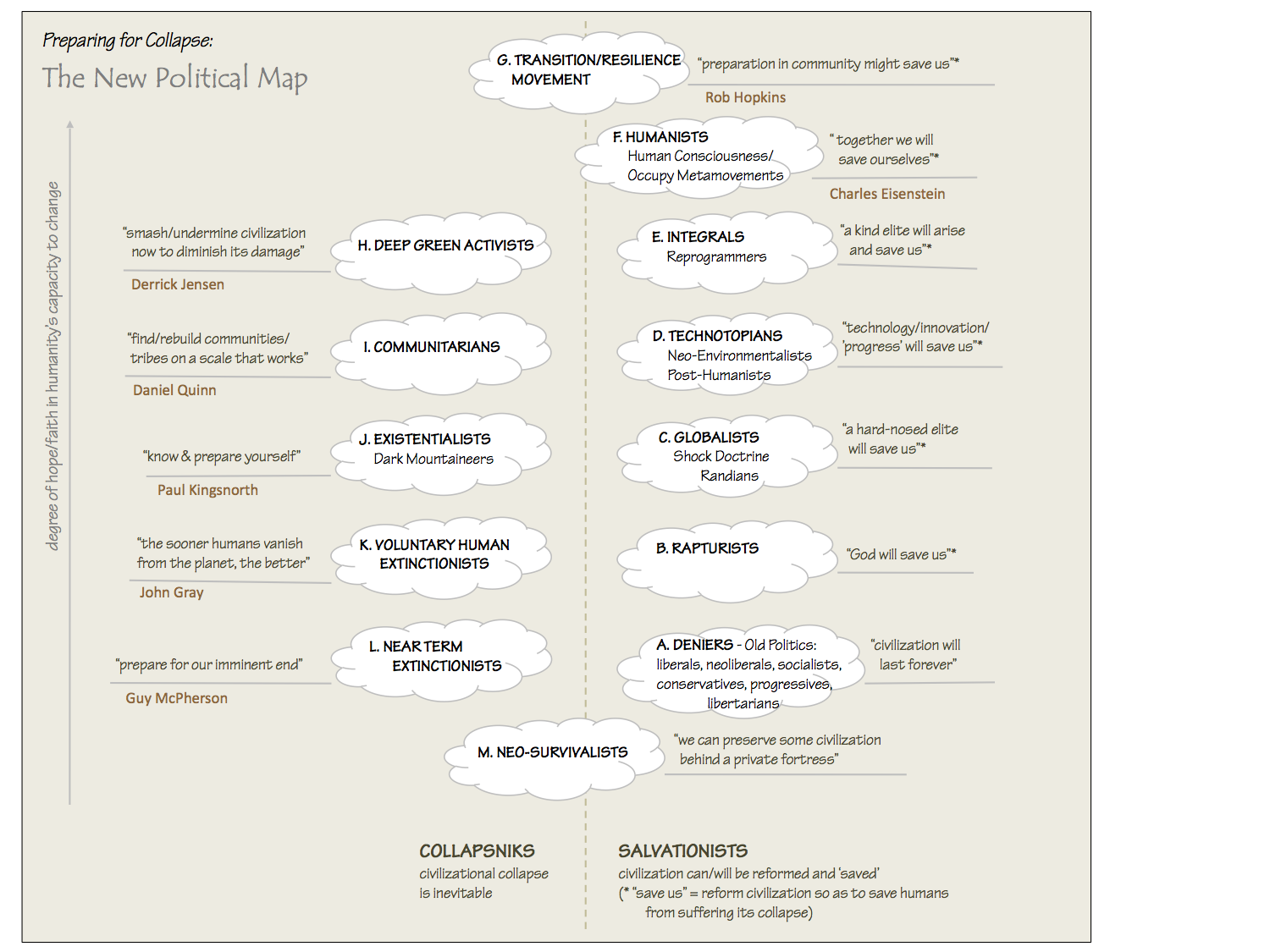
And this is the reason, I think, why more and more informed, intelligent, imaginative people are giving up on trying to ‘reform’ our systems through various complicated solutions, and joining the ranks of the ‘collapsniks’ who concur with John Gray’s analysis that our civilization and our world cannot be “saved”, and that instead of hoping and trying to save it we should do nothing more than becoming more our animal selves — reconnecting with the rest of life on Earth and with our primeval senses and instincts, getting outside our heads, coping with contingencies (perhaps through “the intercession of a thousand small sanities”), relearning to play, living in the moment, turning back to real, mortal things, and simply seeing what is.

This seems to me obvious in hindsight, but it has taken me a decade of study and learning and reflection to realize (and I have been so privileged to have had the opportunity to learn it)! What may now be labeled as fatalistic, pessimistic, hope-less “doomer porn” might, soon enough, come to be seen as just a modest and enlightened philosophy of how to live a better life.

January 27, 2012

Group Works Card Deck – A Joyful Announcement

Filed under: Working Smarter — Dave Pollard @ 15:54

For the past couple of years a group of professional facilitators and others experienced in and interested in improving “group process” has been working to create a “pattern language” (an integrated collection of practices, processes, qualities and other phenomena that “work” in many different group contexts and at different scales) to improve the effectiveness of meetings, conferences and other deliberative gatherings. I have had the privilege to have been part of the core team developing this “language”. When we started, we expected to produce a book, but instead we decided to produce a card deck, to make the tool more interactive, dynamic and fun.

I’m very pleased to announce that we have now published the deck. Here is our announcement:

——–

The Group Works card deck, the first product of the Group Pattern Language Project, is now out! You can order copies of the deck, download a free PDF copy and learn about our upcoming mobile/phone app version of the deck on our website, groupworksdeck.org .

Image by Susan Stewart

The deck is designed to support your process as a group convenor, planner, facilitator, or participant. The developers spent several years pooling our knowledge of the best group events we have ever witnessed.

We looked at meetings, conferences, retreats, town halls, and other sessions that give organizations life, solve a longstanding dilemma, get stuck relationships flowing, result in clear decisions with wide support, and make a lasting difference. We also looked at routine, well-run meetings that simply bring people together and get lots of stuff done.

The deck consists of 91 full-colour cards (plus a few blanks to add your own patterns), a five-panel explanatory category/legend card, and an accompanying booklet explaining the purpose and history of the project and suggesting uses for the cards in group process work.

Each 3.5″ x 5.5″ card is laid out as follows:

These cards are yours, of course, to use in whatever ways make sense and work for you:  in the workplace, in design and preparation of facilitated events, as a learning and teaching tool, for reflecting on how an event went, or just for fun.  The website and booklet explain some of the ways they have been used by facilitators and students so far, to give you some ideas to get started with, and we invite users to share their experiences and stories with us.

Image by Ethan Honeywell

For more information on the deck, please visit our website: http://groupworksdeck.org

—–

We have also drafted a .pptx brochure oriented to business audiences (most of our direct contacts are in the non-profit, public, education and government sectors), which you can download here.

Please let me know what you think of the material above, and how we might “tweak” it to make it better. Also, please let me know if you buy or download a deck yourself, or if you have contacts you’d be interested in presenting this to. And of course, if you use the deck to improve your meetings and other group processes, I’d love to hear your stories!

January 19, 2012

What We Like vs What We Want

Filed under: Our Culture / Ourselves — Dave Pollard @ 16:35

chemistry of love

This is another in my series of articles exploring the basic existential questions of who we are and what motivates us to do what we do. For those puzzled about what that has to do with “saving the world”, my answer is that if we hope to be able to organize with others to make the world a better place, and deal with the huge crises we are now beginning to face, we are going to have to be cognizant of the truth of human nature, and specifically these existential questions. There is no point hoping millions or billions of people are going to change their beliefs and behaviours if such change is just not in our nature. And, as regular readers of this blog know, I am inclined to believe it is not in our nature, though I’m open to evidence to the contrary.

My friend Dale Asberry has been writing about “human cognitive failures” and put me on to this article in the extraordinary Less Wrong wiki, about whether what we want and what we like are different, and if so how and why. At the same time, my contacts who are members of Quora, a collective brainstorming site on deep philosophical questions, have been pinging me about the threads related to the existence (or non-existence) of free will.

As I wrote last year, my position on who we are and the existence of free will is as follows:

  1. The cells and organs of our bodies evolved our brains as a feature-detection, protection and mobility management device for their purposes. The ‘existence’ of our minds and identities as ‘individuals’ is therefore a self-deception. Our minds are nothing more than processes carried out for the benefit of our cells and organs — they are their information processing system, not ‘ours’.
  2. Like most species, we are social creatures that have evolved codes of behaviour that enable us, as part of the larger organism of all-life-on-Earth, to collaborate, share and keep our numbers in balance with the local ecosystem — these are all evolutionary selected behaviours, since they enable us to adapt and fit well into these ecosystems. These learned codes of behaviour are called cultures.
  3. In times of stress, due to overcrowding, natural disasters, climate change or the exhaustion of local resources, cultures can intervene to act in adaptive ways that would be unneeded in normal times, including war, migration, adoption of new diets, new tools and new ways of living that are better suited in evolutionary terms to the changed environment. At some point some of our species chose to leave the trees of the tropical rainforest where we lived a leisurely life as vegetarian gatherers for a million years, and struggle to survive in other environments. We evolved weapons to kill other animals, enabling us to live as carnivores, and discovered ‘catastrophic’ agriculture, enabling us to live where there was insufficient food growing naturally. These new tools, however, required settlement and a very different kind of culture — civilization culture — to sustain.
  4. Civilization culture requires sacrificing a great many freedoms for the survival of the collective membership, and requires vastly more work, personal sacrifice, hardship, suffering, and vulnerability to catastrophe than other cultures. To keep people from obeying their cells’ and organs’ natural tendencies by just walking away from this culture, it is of necessity inherently coercive, using hierarchy, violence, threat of imprisonment, propaganda and other means to ensure obedience and conformity of the group.
  5. Whereas our cells and organs had nearly full control of our (their) minds before civilization culture evolved, the new culture was able, through language and coercion, to influence and seize control of a significant part of our minds. There has been a continuing and escalating war for control of our minds ever since. Our culture persuades us that we have ‘free will’ to ignore what our cells and organs impel us to do and instead do what it (our culture) wants us to do — that we have an ego, an identity, and a responsibility to conduct ourselves according to the rules of civilized society, or we must face the social consequences.

So ‘we’ are, essentially, helpless witnesses in an endless struggle between our cells/organs/bodies and our culture for control of ‘our’ minds, and our beliefs and behaviours reflect who has ‘won’ each battle in that struggle. By contrast, our close cousins the bonobos (yes, I know they aren’t perfect either) are at peace — there is no inherent conflict between what their bodies and culture want, no scarcity, no imposed responsibility, almost no aggression, no monogamy or jealousy, no hoarding. And their only real stress is caused by our brutal, cancerous culture, which is extinguishing theirs.

Where does ‘liking’ versus ‘wanting’ fit into this model of who we are? Things we like (such as being in love, being in nature, listening to music, play, learning and helping others), according to the Less Wrong article, are different from things we want (such as sex, addictive foods and other substances, attention, appreciation, and acquisition of shiny objects — all things that in our modern culture are usually scarce). When we do or get things we like, we are happy. When we do or get things we want, we are often not happy — just (for a time) satisfied. Wants are cravings; likes are joys. Needs are another matter entirely — none of the “wants” listed above are really needs, the way that nutritious food, water, warmth, and social contact are — things we cannot live without. Wants could be seen as the midpoint of a continuum between likes and needs. Some things may be both wants and likes — beauty, for example, may be something we crave (especially if our world offers little of it) but is also something we derive genuine happiness from.

An example to explain the difference: For many years I hosted and organized monthly neighbourhood poker games. The game was small stakes with strict limits, couples and total novices were welcome, and we played “dealer’s choice”, developing over the years a list of some 100 variants, some of them really silly. Really serious poker players who had to win to consider the event a success, generally dropped out after one or two months. Much of the game was about learning, sharing, showing, and inventing new games. It was fun, and generally people were happy, win or lose. But everyone sometimes got unhappy if they lost too many times in a row, or lost a large pot by a very close margin. At these points, when tension rose, liking to play became wanting to win. Joy became addiction to the ‘high’ of taking risks and winning big. The nights I liked best were the ones where I came out ahead, but not too far ahead, and not as a result of any one person’s loss. Yet I know there is a gambler in me, someone who wants to win more than he likes to play. When I get stressed, I distract myself with video games (including poker against computer opponents) and I want to win (and get upset when I don’t, even though there is no ‘real’ money involved).

Scientists now say that the chemical reactions in the body when we ‘want’ something (dopamine-based) are different from those when we ‘like’ something (endomorphin and enkephalin based). Why would this be so?

My hypothesis is that this different chemistry evolved to suit different requirements: Our wants take precedence in times of stress or scarcity, while our likes take precedence in times of peace and abundance. When we can “afford” it, we do what we like; the rest of the time, we do what we want. This does make sense in the context of wants being more urgent and closer to needs.

Creatures in the wild, according to some biologists, spend most of their lives in “Now Time” — present, blissful, unaware of the passage or even existence of “Clock Time”. During this time they are happy (that’s in the best interest of the perpetuation of the species) and their lives are seemingly eternal. Their body chemistry in this state is driven by endomorphins (not to be confused with endorphins) and enkephalins, which create a feeling of bliss.

In times of stress or scarcity, however, wild creatures snap into “Clock Time” (the instantaneous time-sensitive state that most humans spend their entire lives in), and hormones are produced to equip the body for fight-or-flight. They are driven then to satisfy immediate needs and wants (safety, food, victory over a predator or enemy etc.), and their body chemistry in this state is driven by dopamine — which immediately flushes the body when a craving for one of these needs or wants is satisfied. Not the same thing as happiness at all. When the crisis has passed, the creature returns quickly to Now Time, and the endomorphins and enkephalins again take charge of the body, seeking happiness.

Except for the few humans who are able to set aside the constant and chronic stressors of modern civilization culture (through meditation or other relaxation/awareness/presence practices), we humans spend all our lives charged up and seeking the satisfaction of our endless needs and wants, the dopamine “rush”. And our industrial civilization culture, which now depends on a constant growth of consumption, encourages this by creating additional “needs” and anxiety about scarcity and inadequacy. We’re never really happy, only temporarily satisfied.

My guess is that the emotional and erotic response stimuli shown in the Chemistry of Love chart above, are primarily “want” chemicals, while the aesthetic, sensual and intellectual response stimuli in the chart are primarily “like” chemicals. Science remains almost entirely clueless on this, however, so this is only a wild guess.

This is part of the reason, I think, that we humans have become so utterly disconnected from Gaia, from the land and place where we live, from all-life-on-Earth. That biophilia connection is a “like” connection, which only few humans, rarely, really feel, so deeply are we buried in the chemistry of unfulfilled needs and wants. Yet our instincts, I think, still “know” and long for this connection, and every once in a while, in those still, peaceful moments of deep relaxation and awareness, we become present, shift into Now Time, and start to resonate with the ancient and delightful chemistry of what we really like, beyond wants and needs.

That is why I believe that the essential preparation for the coming economic, energy and ecological crises, culminating in the collapse of our exhausted civilization, is re-acquiring those essential capacities that will lift us out of the culturally-created illusion that our world is one of endless conflict and scarcity, full of unmet needs and desperate wants, and move us into the real-ization that a better, simpler life is possible, one almost entirely without wants or needs, one where we are free to enjoy what we really like — being in love, being in nature, listening to music, play, learning and helping others, all things that are and have always been free.

Only then can we realize that our civilization culture cannot be reformed to provide what we want and need (in fact its purpose is to create more and greater wants and needs). And by its very design, it will never make us happy.

January 14, 2012

Gangsters and Banksters

Filed under: Preparing for Civilization's End — Dave Pollard @ 23:52

cartoon by Pat Bagley, Salt Lake Tribune, from Cagle comics

The Occupy movement has focused public attention on the vast and growing disparity of wealth and power in the US, and increasingly in other affluent nations. You’ve all seen the statistics — essentially all of the increase in real wealth and income over the last 40 years has accrued to less than 1% of citizens, and for the other 99% real wealth and income have declined, in some cases precipitously. As a result, nearly half of all Americans, and well more than half of American children, now live in poverty or near-poverty. There is essentially no social or economic mobility left in US society — if you’re born rich, you will surely grow richer, and if you’re born poor, you will surely grow poorer. The American Dream, and the American middle class, are dead.

This dramatic and accelerating shift has not been an accident. It is the result of deliberate policy decisions that have prevailed since the Reagan/Thatcher era: Huge subsidies, bailouts, tax loopholes and tax cuts for the rich and wealthy, near-zero interest rates (well below the real cost of living, masked by fake government statistics), massive deregulation (and non-enforcement or cheap out-of-court settlement of horrific regulatory violations), dismantling of employee benefits, crippling of unions and workers’ rights, incentives for offshoring and laying off domestic employees, and on and on.

The rich and powerful now own the politicians of all major parties, almost all of the large corporations that control much of the economy, and the mainstream media, and through them they have altered the financial, political, economic, tax, regulatory, information and education systems, globally, to suit their own purposes and entrench and further enlarge their power, wealth and privilege. As long as this elite continues to wield this much power, the situation will continue to get worse. And as renowned management consultant Charles Handy has said: No one gives up power willingly or voluntarily.

So how might this power be shifted? How can we radically redistribute income, accumulated wealth and power from the 1% to the 99%? The likelihood of revolution seems remote, and revolutions rarely achieve democratic or egalitarian ends anyways — the power and wealth are simply redistributed to a new elite. Political reform seems equally improbable, since the political systems (and the use of bribes, first-past-the-post voting, interference with minority voting rights, election-rigging, super PACs, paid media smears of establishment critics, backroom deals, threats from slimy corporate lawyers, and gerrymandering) ensure that there is no choice for voters that is not endorsed by the 1%.

We could wait until the economy collapses, at which point governments, banks, large corporations and the media will also collapse. The wealth and power of the 1% will then largely evaporate, and the elite will take what’s left of their money and retreat behind their gated mansions, as the suffering of everyone else mounts.

We will of course continue, no matter what happens and no matter what else we do, to try as networkers and teachers and writers to inform the majority of the 99% about the criminal actions and social and environmental atrocities that have allowed the 1% to acquire and entrench their wealth and power, and as activists to undermine, mitigate and undo some of their most outrageous damage and injustices. But this is a tall order: Decades of propaganda and educational neglect have brainwashed most citizens to believe the rich and powerful have earned their privileges legally and ethically, and that there are opportunities for anyone to join them. And that until/unless they join that elite the average citizen isn’t listened to and can’t change anything anyways.

Thanks to the Occupy movement, the Indignant movement and the Arab Spring movement, it is dawning on many people that the massive disparity and inequity of wealth, income and power in the world is not because some people are smarter or luckier or harder-working than others, but because the 1% have cheated, bribed and stolen the wealth of the 99%, and the natural wealth of the Earth, and used it to brutally and relentlessly consolidate their power over all of the systems of modern society, on a global basis. That, in effect, our society is now run by a privileged, in-bred and self-perpetuating elite of gangsters and banksters — an illegitimate, unelected, undemocratic, criminal elite. One that is running our economy off a cliff, and desolating our world to the point of collapse.

Still, the conditioned response of most people, even those most oppressed and those most aware of the true extent of malfeasance that has led to this state, is a “Well what can we do anyway?” shrug. “It’s always been this bad” resignation and “It’s not really that bad” denial play right into the hands of the elite. That is why I predicted that (although I think there is still considerable life left in it yet) the Metamovement will ultimately fail. No one gives up power willingly or voluntarily. And (almost) no one is prepared to make the powerful give it up involuntarily.

So we wait.

The people of the world’s struggling nations (and the homeless in affluent nations) are perhaps a step ahead of the rest of us in this cycle of growing disparity and hopelessness. They have lived with this reality longer, and while there are still millions, perhaps billions longing and dreaming of joining the elite, there are few in denial that the rich and powerful are substantially gangsters and banksters dressed up and posing as caring democrats.

If we can, like them, move past denial, what would it then take to move past outrage, and move to take back our political and economic systems? Is “involuntary” redistribution of income, wealth and power in a morally bankrupt political and economic system necessarily violent? Is it even possible, or, as Hendrik Hertzberg at The New Yorker has written, are the huge, massively-complicated, centralized, necessarily-bureaucratic systems that underpin our civilization themselves the problem — is their very size their undoing? Could we really bring about change, for example, by revoking the rights of corporations and making the elite individuals hiding behind them personally and fully liable for their corporations’ (and banks’, and political parties’) illegal activities? Or would their armies of well-paid lawyers simply prove, as many believe, that the rich and powerful can get away with anything?

And then what? When corrupted courts exonerate the criminal elite, will that elite be spurred to even more extreme and transparent outrages, and will a chastened citizenry give up once and for all and just struggle along as best they can? The failure of most of the public to become outraged at the Citizens United case, or other egregious highly-publicized pro-corporatist court decisions, is disturbing.

My sense is that most citizens (and the proportion is growing with each new generation) intuitively feel that the systems under which we are forced to live and work are hopelessly broken and that the elite is too well entrenched for there to be any hope of fixing these systems through reform, by “working within the system”.

So we wait.

The work of anthropologists suggests this is how civilizations often end. When the majority have given up believing in them and in their possible reform, but are not yet ready to walk away from them, system collapse becomes inevitable. The coming Long Emergency, as our unsustainable economic, energy and ecological activities cause all of our civilization’s systems to repeatedly reel and stumble, and finally fall, will give most of us, I think, the impetus we need to walk away, at first to the edges, where the homeless in affluent nations and the vast majority in struggling nations are already living — outside the purview of the “official” political, economic and other systems, and then off the edge, to begin to create new systems from the ground up. I see all of this happening, in waves and fits and starts, over the next half-century. We will have no other choice.

Until then, the gangsters and banksters will continue to rule, though more and more uneasily, as their own dependence on many of these systems results in them slowly or quickly losing most of their wealth and power. And even then they will have more than most of us could ever dream of.

So we wait. And do what we can, in the meantime, both to mitigate as much as possible the most egregious ills of the elite machine, and to begin to begin to learn what we must learn to start again when that machine completes its desolation of our planet, and implodes.

Powered by WordPress