Dave Pollard's environmental philosophy, creative works, business papers and essays.
In search of a better way to live and make a living, and a better understanding of how the world really works.


May 7, 2010

The Ten Most Important Questions I Heard at Northern Voice 2010

Filed under: Using Weblogs and Technology — Dave Pollard @ 22:46

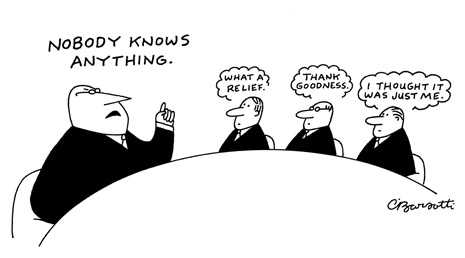
pc vey cartoon

I‘m at NV10, the annual bloggers’ conference in Vancouver BC, and what has impressed me most so far is the questions I have heard. With dozens of rapid-fire simultaneous sessions, there is not enough time for thorough answers, but the social networking is great, and the questions sometimes are more important anyway. So here are the ten most important questions I’ve heard (or overheard) at this year’s conference:

  1. If you want to start doing something new that you’ve been putting off because you didn’t have time, what are you going to stop doing in order to make time for it?
  2. How can we do a better job of identifying and inviting the ‘right’ people to meet and engage in conversations on subjects that matter?
  3. Why do we always end up focusing way too much on tools, instead of on processes and relationships?
  4. How can we create enough space and time to listen to substantial stories, enough so that we really understand what’s going on and why, and really learn from them?
  5. Why do so many people still talk about “creating community” and “building a culture of x” when these things are organic and evolutionary and cannot possibly be created or imposed?
  6. How do we set boundaries (spatial, temporal, and psychological) for, and balance energy spent on, individual vs group vs network vs community activities?
  7. Why do we feel so compelled (aesthetically and commercially) to ‘enhance reality’ by retouching, photoshopping, and otherwise making things larger and ‘better’ than real life?
  8. Why is the gap between traditional educational institutions and those in the educational vanguard, those using new technologies, processes and ideas, becoming wider and wider?
  9. Why has nothing come along to make blogs obsolete, or to significantly update/improve them?
  10. Is self-directed learning (unschooling) only for kids with good genes and/or devoted parents, or can it be effective for anyone who hasn’t been damaged by institutional education?

May 4, 2010

What Are You Going to Do When the Internet’s Gone?

Filed under: Using Weblogs and Technology — Dave Pollard @ 21:18

jackzieglercartoon

Cartoon by Jack Ziegler in the New Yorker. You can buy his stuff here.

What are you going to do when the Internet’s gone? That is the question that no one dares ask. I’m not talking about Net Neutrality and the takeover of the web by corporate interests. I’m talking about its simple disappearance, as infrastructure that’s simply unaffordable and unsustainable in a world of economic, energy and ecological collapse, stops working and falls apart.

The technophiles, the “bright greens” will tolerate no such talk, of course. They believe with a religious passion that technology will solve all the world’s problems (and let us live forever to enjoy the resultant eternal bliss of allknowingness). But the “dark greens” — the post-civs who see our society collapsing (”all civilizations do”) probably in this century — want to believe too. They want the Internet to help them organize resistance to the corporatists and globalists who are exacerbating the crises driving us off the edge of the cliff, if not in time to stop it, at least enough to be able to piece together some alternative models of how to live sustainably that the survivors (our grandchildren) will be able to use.

So asking this question generally raises a lot of scowls from all sides. Even the corporatists have become utterly dependent on it for the information and communication systems of their dysfunctional and plundering empires. A world without the Internet is simply…unthinkable.

Until you think about it. Consider that:

  • The Internet is a huge user of electricity and related electrical and telecommunication infrastructure. That infrastructure, as invisible as it is, requires massive amounts of continuous maintenance.
  • During the Great Depression of the 1930s, one of the first things to go was reliable phone and electrical service. The utilities went bankrupt like everyone else, because their customers couldn’t afford to pay the bills, so the utilities as a result couldn’t afford to pay repair, maintenance and service people to keep these services operating. (When farmers abandoned their unsustainable, monoculture farms, they left notes on their doors inviting other migrants to stay and take care of their homes to ward off poachers, and left the doors unlocked. No power, no phones.)
  • The Internet requires, for most of its value, a huge number of ‘volunteers’ working mostly at the ‘edges’ providing millions of hours of free labour to write the software to keep it running and to keep its content current. Most of these volunteers are people who have a source of income (other than the Internet) that allows them to volunteer this effort in their ’spare’ time. No full-time jobs, no time for volunteer work.
  • The hardware that allows us to use the Internet is utterly dependent on large-scale, inexpensive global trade in metals, minerals and materials, some of them rare and scarce. You can’t build computers, servers and telecom lines from materials you can find locally. When global trade grinds to a halt, made worse by the end of cheap, affordable oil, where are we going to get these things? And what happens when supply of these materials simply runs out and there’s no money to research and develop alternatives?

Just as in the last Great Depression, the collapse of essential information and communication infrastructure won’t happen all it once. It will be a gradual decline. The first signs, I think, will be the loss of the generosity economy features that have made the Internet so ubiquitous — the free software and free services that advertisers and ‘free-mium’ service buyers and enthused volunteer labour funded. There are already some disturbing signs of this happening: Gaia.com, a large blog platform, has folded; Friendfeed has been bought out by Facebook (which, despite its immense popularity and reach, has surprisingly small revenues and must be operating on razor-thin margins); Yahoo has been closing many of its services and is rumoured to be in difficulty. And all the wonderful stuff we have from Google comes thanks to advertising revenues, even though there is almost no evidence that such advertising is effective.

So what you’ll see, I think, is a lot of consolidation, disappearance of free services (Ning recently announced it is abandoning all its ‘free’ services, and their customers) and an annoying increase in fees (the giant global right-wing news empire News Corp is again planning to start charging for its content). “The end of free” will drive millions of Internet readers (and writers) away. Advertisers will then flee. What will be left will be tons of people using ‘free’ bandwidth to try to download huge amounts of ‘free’ music and video, and ISPs will then find relatively little resistance to them bringing in huge increases in bandwidth fees (and the end of fixed rates). If you’ve ever dealt with the outrage of ‘roaming’ charges for data, imagine such charges for all use.

The next wave of the Internet’s decline will be when the next long Depression begins, probably in a decade or two. When communication and electrical service becomes intermittent as utilities cut back, Internet service, having been marginalized by the events described above, will be considered a non-essential service, and regularly shut down in favour of more critical uses of these services. And then, as PCs become less ubiquitous and people get used to finding alternative ways to get their information and entertainment, and as the availability of components and materials falls and their cost increases, computers will start to become community resources rather than personal ones, and you’ll have to go to the library or the neighbourhood school to find one in working order. And eventually even these will break down, and people will, as they always do, find workarounds.

I’m sure most readers of this article are shaking their heads, saying this will never happen. And I’m sure that most readers who are also students of history are probably nodding their heads, saying they can imagine this, and perhaps it wouldn’t be so terrible. True innovation blossoms when there is a real human need that is not being met, and the need for information and communication and entertainment is eternal. How to evolve and adapt to the end of the Internet? Maybe like this:

  • Instead of downloading music and film, create your own music and theatre, in live performance
  • Instead of taking photos, draw, paint, sculpt
  • Instead of blogging, write a journal, and meet in your community and share stories and ideas, cook together, rant, organize, build something together
  • Instead of playing online games, organize a real-space scavenger hunt, eco-walk, or bicycle rallye
  • Instead of taking online courses, unschool yourself in your own community, and learn about your place… or show/teach others what you know (including, most importantly, teaching children how to think and learn for themselves)
  • Instead of organizing online petitions and complaining online about the state of the world, go visit your local politician, get involved in community activities that make a difference (disrupt, show your outrage, satirize, or create something better)
  • Instead of looking for health information online, set up a local self-help health co-op, offering preventive care, self-diagnostic and holistic self-treatment information
  • Instead of porn… well, use your imagination

How well will you be prepared to adapt to the end of the Internet? Are you dependent on it, now, for critical information you need, for connection with those you love and those you seek to love, to work with, to partner with, and for what brings you joy or blessed escape? The biggest uses of the Internet today are music, porn, health information, games, and amateur photo/video sharing. To the extent you use the Internet for any of these things, do you have a way of doing them, with no or low technology, when the Internet’s gone?

And in the meantime, don’t take the Internet and all its ‘free’ offerings for granted. It’s a rare window of incredible opportunity, and it won’t last forever. Like everything else in our overwrought civilization, it’s unsustainable.

So blog like hell while you can.

September 13, 2009

Google Wave (continued): The Conversation Becomes the Process, and Even the Product

Filed under: Using Weblogs and Technology — Dave Pollard @ 22:34


GWave logoBack in June, I wrote about the new (it’s being rolled out, slowly, starting this fall) GWave product as representing “the wikification of conversation.” The more I think about it, and play with it, the more I become convinced that this tool will not only revolutionize how we communicate on-line, but how we work. And by “work” I mean everything we do collaboratively that isn’t done face-to-face.

Just to re-cap, here’s a story from the previous post that illustrates how GWave works:

One of our tasks is to provide guidance on how the transition of Canadian companies to IFRS (the new global accounting standards) will affect IT departments, and specifically how financial and reporting systems will have to change to accommodate these new standards. We’ve prepared an online training program (a webcast), a recorded interview with some IT experts who have implemented IFRS in Europe (a podcast), and an article in our association magazine. These three resources have been posted to our website, but we’re struggling to get the intended IT audience to visit the site, because they’re not aware of it. Marketing is, alas, not our strong suit.

Suppose we had done all of this in 2011 instead of 2009. In 2011 we will have access to Google Wave, a new tool that integrates the functionality of e-mail, IM, wikis, blogs, Twitter, and other social networking tools. Here’s what we would do instead of our ‘IFRS for IT’ web page, and what might happen as a result:

  1. We set up a ‘wave’ (a container for a conversation) entitled ‘IFRS for IT’.
  2. We post a text summary of the webcast, podcast and article to the wave. We embed the webcast, podcast and article (not just links to them) below the text summaries.
  3. One of the audience members of the webcast and podcast, who has put these two recordings through a voice recognition software tool, posts a text transcription of them underneath the embedded casts. The built-in Google Wave semantic spell-checker auto-corrects spelling and homonym (”there” vs. “their”) errors.
  4. We use the built-in Google Wave translation tool to simultaneously post a French language translation of the transcriptions.
  5. The twelve of us (the ‘core group’) involved in the project each independently “subscribe” people and groups we think might be interested to the wave. They receive the entire ‘conversation’ to date (the content and messages in the above steps). They can, if they wish, ‘rewind’ it and see each step as it was added in turn.
  6. Several of the invitees post IMs right in the text of the articles and transcriptions — comments, clarifications, suggestions, and questions. The entire wave is a wiki — people have full ‘author’ privileges to make changes (which are ascribed to them, and which can be reversed or amended, wikipedia-style, by a member of the core group if necessary).
  7. Other invitees, and core group members, join in the conversation, adding replies to the questions and to the suggestions. A whole new section of the article, dealing with specific IFRS IT issues for the banking industry, called a “wavelet” is contributed by one invitee, who invites other bank IT executives to contribute to this ‘wavelet’.
  8. One banker embeds a YouTube video in the wavelet, a transcription for it is added, and several discussions about it ensue.
  9. One invitee solicits ‘best practices’ in transitioning IT departments to IFRS, and posts a ‘form’ (essentially a database) for replies to the invitation, using the built-in Google Wave form generator. Within days, fifty practices have been posted to the database. Some people begin and reply to conversations about some of the specific practices in the database.
  10. Someone starts a Twitter tag called #IFRSIT and, using the Twave widget of Google Wave, embeds a real-time feed of tweets containing this tag into the wave.
  11. One of the bankers wants a conference call on IFRS IT implications for that industry. He posts a form soliciting participants for the call, several people enrol, the call is scheduled and held, and a recording and transcription of the call are immediately posted to the banking industry wavelet.
Some remarkable things have happened here. There is no marketing involved. People invite people who invite others, and all are immediately included and engaged in the conversation. They can subscribe to the whole wave or just wavelets. They can have sidebar conversations, with full discretion over whether they are public or private. There is a complete, organized transcription of the entire ‘conversation’. The conversation is collectively managed and collectively edited and formatted to suit the needs of the self-selecting participants, and it’s easy to follow the threads. Updates and notifications occur in real time, and several people can be changing any part of the wave at the same time. With Google Voice (also new from Google), voice conversations can be recorded and transcribed and fed into the wave as well.

Now suppose you have decided upon a new project, that involves activities such as project team selection, doing a needs assessment, conducting research, brainstorming to develop innovative solutions, pilot testing, sourcing supply, production, logistics, communication, measurement and evalution. This could be either for a commercial project, or analogously for a community improvement or other not-for-profit project. How might this project be enabled by the use of GWave?

Let’s assume this is 2011 and that GWave has become ubiquitous — just about everyone has it on their desktop. Here’s how the project might evolve the old way, versus the new GWave enabled way. First, here’s a typical commercial organization’s new product development process, the old way and the new way:

Project Phase 2009 Process 2011 Process
1. Selecting project team Project director hand-picks team of employees. Invitation is sent to initial list by GWave, passed on to others. Team members volunteer and are approved by director. Team includes employees at all levels, customers, suppliers and other stakeholders, as well as members of the company’s internal innovation group, a total of over 100 people, mostly volunteers.
2. Needs assessment Marketing is assigned to do a survey of 20 closed-ended questions to assess needs and appetites for 5 proposed new products on a 10-point scale. The self-selecting team members interview others through GWave voice, IM and other tools using open-ended questions and ‘what ifs’. A total of 40 unmet needs are identified, along with over 300 ideas, challenges and criteria to consider in addressing them. This entire archive is captured and embedded in the GWave. ‘Wavelets’ for each of the 40 unmet needs are established.
3. Conducting research Research department does a SWOT analysis of competing products. The research and SWOT analysis has already been done as part of the phase 2 teamwork.
4. Innovating solutions New product development brainstorms and designs  a total of 15 product alternatives that deliver on the needs and new product ideas identified in phase 2 and exploit the competitors’ weaknesses identified in phase 3; they also include some ideas from the company’s internal innovation group. New product development has been involved in the conversations on each of the 40 unmet needs from the outset. They coordinate both online and real-space brainstorming sessions on each of the 40 unmet needs; the total number of people subscribed to the wave and wavelets jumps to over 400. A total of 125 product alternatives are surfaced, mapped to the unmet needs. The team members self-select online into technical feasibility, strategic fit and profitability assessment teams, and each of the 125 product alternatives is scored on all three criteria. Finally, 22 of these ideas are green-lighted by the company for pilot testing, 35 are put on hold for further assessment the folowing year, and the remainder are ’set free’; anyone who has participated in the wave is allowed to pursue these ideas privately, and eight spin-off teams self-create to pursue some of these ideas.
5. Pilot testing Engineering reviews the designs and, after some back and forth on technical feasibility, comes up with some prototypes, which are market tested. Based on this, management gives a “go” to two new products. Engineering has been involved in the conversations since phase 2, and soon 22 prototypes are available. Marketing has also been involved since phase 2, and they coodinate market tests, drawing on additional testing that various team members agrees to do. The testing is much broader and more comprehensive than was possible under the old system, and it is iterative: prospective purchasers, many of them part of the wave, provide useful ‘tweaks’ to the prototypes which are then re-tested. All of the testing is coordinated through the wave itself. Fifteen new products are approved; the other 7 prototyped ideas are added to the 35 “on hold” for reassessment the following year.
6. Sourcing supply Purchasing puts out RFPs to prospective suppliers and selects winning bids. Some of the actual production will be done in-house; the rest it is decided will be outsourced. Many suppliers and prospective outsourcers have been part of the wave since early in the process, so the RFP process is dramatically streamlined and done as part of the wave itself.
7. Production The in-house production is planned for. Equipment is purchased or retooled. Production staff are hired and trained. The products are manufactured and inventoried. Production has also been part of the wave since early in the process, and were instrumental in the decision on which products to make in-house and which to outsource. The hiring and training of new staff is coordinated as part of the wave itself. The products are manufactured and inventoried.
8. Logistics Logistics arranges distribution to and warehousing with wholesalers and retailers. Logistics, and key distributors, wholesale and retail customers have been part of the wave since early in the process. They have already been discussing logistics, distribution and approximate order sizes in their own wavelets attached to the wave, so formal contracts can be fast-tracked.
9. Communication Advertising and other communications go out about the new products. Prospective customers have already been virally marketing the 15 new products, and have fed back responses and ideas to the marketing and communications groups, right on the wave. The formal advertising and communications programs capitalize on this.
10. Measurement and evaluation A budget is established for each new product’s expected unit sales, revenues, variable and fixed costs, profits and ROI, and compared against actual results. Customer satisfaction surveys are carried out. Returns and repairs are monitored. This phase is unchanged by the introduction of GWave; see process at left.
11. Customer affinity program The company has not traditionally had a customer affinity program. Customers develop and subscribe to GWaves around each of the company’s products. They use them to share information, to rate and rave or complain about the products, to surface ideas for product improvement, and to develop ‘wraparound’ products and services (for example, product add-ons, extended servicing, get-togethers of more rabid customers). The company monitors and participates in these waves but doesn’t ‘own’ them.

Now let’s look at a ‘greening our community’ project, for a municipality of say 100,000 people, again the old way and the new way:

Project Phase 2009 Process 2011 Process
1. Selecting project team Project director hand-picks team of municipal employees. The team does an RFP for an external consultant to advise on the project. Invitation is sent to initial list by GWave, passed on to others. Team members volunteer and are approved by director. Team includes employees at all levels, citizens, suppliers and other stakeholders, a total of over 300 people, mostly volunteers. No external consultant is used.
2. Needs assessment No needs assessment is done. The self-selecting team members interview others through GWave voice, IM and other tools using open-ended questions and ‘what ifs’. A total of 40 ‘greening the community’ project categories are identified, along with over 600 project ideas, some unique and some borrowed from other communities. This entire archive is captured and embedded in the GWave. ‘Wavelets’ for each of the 40 project categories are established.
3. Conducting research The consultant-employee team does online research to see what other municipalities of similar size have done.  This research has already been done as part of the phase 2 teamwork.
4. Innovating solutions A project outline is developed. An invitation is sent to local environmental groups and other known interested people to participate in a day-long workshop to review the project outline. Based on this, a program is developed and budget approval is sought. The project is scaled back to the approved budget; it involves public education, some changes to municipal purchasing policies, and funding of several new ‘green’ NPOs. Environmental groups and local suppliers have been involved in the conversations on each of the 40 project categories from the outset. With their assistance, self-selecting project team members coordinate both online and real-space brainstorming sessions on each of the 40 project categories; the total number of people subscribed to the wave and wavelets jumps to over 1,000. The team members collaborate on the wave to identify value-for-money assessment criteria for project ideas, and each of the 600+ project ideas is costed and scored on these criteria. 
5. Pilot testing No pilot testing is done. The group collectively nominates a Project Group Leader for each of the 40 project categories, and under these Leaders a ‘catalogue’ of project ideas is produced, in decreasing order of value-for-money ’score’. Volunteer projects with passing ’scores’ and no cost to the municipality are early-launched. The municipality provides a grant to the team to be allocated, by team consensus, for pilot projects that have exceptionally high value-for-money scores but significant costs or risks. Based on the available total project budget and available volunteer effort, a line is drawn on each of the 40 project category ‘catalogues’ above which projects are approved, and below which they are deferred for future years’ consideration.
6. Sourcing supply Purchasing puts out RFPs to prospective suppliers of public education, and prospective NPO grant recipients, and selects winning bids. All project work from this point will be done by the outsiders with successful proposals. The ‘green’ changes to municipal purchasing policy are implemented. Many prospective suppliers have been part of the wave since early in the process, so the RFP process for all non-volunteer elements of the approved projects is dramatically streamlined and done as part of the wave itself.
7. Production The suppliers produce and deliver the public education and grant activities. Volunteers and successful bidding suppliers produce and deliver the products and services for projects in all 40 categories.
8. Logistics Not applicable. Not applicable.
9. Communication Promotional brochures, press releases and other communications go out about the new programs. Team members have already been virally marketing the program and its projects throughout the municipality, and have fed back responses and ideas to the municipality’s communications staff, right on the wave. The program brochures, press releases and other communications capitalize on this. 
10. Measurement and evaluation Program costs are monitored against budget. Taxpayer awareness surveys on the new program are carried out.  This phase is unchanged by the introduction of GWave; see process at left.
11. Customer affinity program Not applicable. Citizens participating in the program develop and subscribe to GWaves around each of the 40 program categories. They use them to share information, to rate and rave or complain about the program, to surface ideas for program improvement, and to develop and promote both volunteer and private-sector ‘wraparound’ products and services (for example, green products for household use). The municipality monitors and participates in these waves but doesn’t ‘own’ them.

The bottom line is that, through a mechanism such as GWave, instead of the communications and conversations about a new project being widely dispersed and unconnected, the entire set of conversations on a project can be captured and disseminated as a single wave, allowing far more participation, self-organization, information and idea exchange and assessment, project coordination, and collaboration to occur, involving a much broader set of interested, creative and knowledgeable people.

GWave could be the springboard to Peer Production — the co-creation and co-development of new products and services by suppliers, customers and others, in a way that will be more responsive to needs, more creative, more customized, better informed and better coodinated than was possible when the participants were separated by organizational boundaries. GWave could prove to be so robust that the conversation actually becomes the process and, except for the parts made of atoms, the product and service too. In business and in public organizations, that would change everything.

August 16, 2009

Smart Phones: What Comes Next

Filed under: Using Weblogs and Technology — Dave Pollard @ 23:25


projection monitor and keyboard

A few years ago I made a pitch to one of the large cellphone manufacturers to create a smart phone that could, to some extent, become a ‘buddy’ — it could remind you of things, monitor things for you, and by interacting with the ‘buddies’ of other phone users introduce you to people with whom you shared certain affinities. The cellphone company thought it was too wild, and couldn’t see the ‘business model’ (how they could make money from it), so it never went anywhere. Since then, new technologies have made some of what was then impossible commonplace, and presented some new possibilities. So here is a story of what our cellphones might, if their manufacturers aren’t too obsessed with profit and legal risk, soon do for you (you can find early demos of all of these technologies online — I’m not inventing any of this):

Karen props her phone on the table in front of her. It uses a combination of voice recognition and lip-reading technology (through its camera) to listen to and respond to her instructions. She reviews her Waves (new and open multimedia conversations) which are projected in large easy-to-read size onto the table, wall, or even holographically into mid-air. She answers or participates in most of them through dictation and voice-recognition instructions, editing them through use of a virtual keyboard, pointer and touch-screen that are part of the phone’s projection display; her phone recognizes and translates her hand-movements through the camera.

She also takes a look at her Subscribed Content, which includes blogs, wikis, updates to friends’ and colleagues’ personal home pages and tweets. Most of these are already embedded in Waves, and she comments on some of these and ’subscribes’ friends to other Waves she thinks they might be interested in. She also looks at the active Waves that have formed around her own blog articles, and adds to these conversations.

She changes her Conversation Status to Available for selected friends and work colleagues, and opens some new Waves, simultaneously carrying on several IM, voice, and video conversations; the people she is speaking with, and the documents and other objects she is sharing with them, are projector displayed. Some of her closest friends she has on Continuous Virtual Presence Status — they can hear her, and see both what is in her camera image and what she is looking at on her projected display, any time they choose to, and vice versa (a small photo of them appears on her display whenever they are ‘with’ her). She calls up and plays a full-size projected Virtual Piano, practicing a new song she has writen for a free concert her band is putting on this weekend.

She is notified that Ben, a work colleague from Finland, is currently in her town; their GPS proximity-detection software, their scheduling software and their affinity software (which allows you to list people you would like to meet, if and when they are willing and able), have worked together to set up a meeting at a nearby coffee shop in 30 minutes. Karen’s phone asks her to confirm both her availability and her order, which will be waiting at her reserved table when she arrives.

As she walks to the meeting, she is told about additional special offerings on the menu that coincide with her profile of food and beverage preferences, and she changes her order by voice instruction. Her menu is added to her daily calorie and nutrition counter, which tells her how her consumption fits with recommended daily allowances. The calories expended on the walk are also automatically registered and logged to her exercise program. She also reviews some ‘auto-tweets’ sent to her by her appliances (an updated grocery list), her home monitoring system (lights left on, windows closed), her plants (some of them need fertilizer) and her cat RonRon (photos taken by his collarcam every 15 minutes, and a view from his current location in the laundry basket).

After several similarly-scheduled and coordinated meetings, she goes for a drink with her friend Rayah. They both decide to set their affinity software to Open, and they’re discreetly shown photos and shared interests of other people nearby who have also set their status to Open. They agree that a foursome of business travelers from Chile would be interesting to meet, and signal their willingness through their phones. Their invitation is accepted and they are directed to a table at the other end of the bar they’re in. The six hit it off well, and Karen and her friend show the visitors around town and invite them for dinner. Karen and one of the visitors begin a romantic relationship.

Back at home, Karen’s exercise regime is planned and monitored by software on her phone and sensors connected wirelessly to it. She also uses a biofeedback application to help her with her meditation practice and to manage her stress levels. As she uses her rowing machine, her phone projects holographic images of the Thames synced to the speed of her rowing motions. When Karen’s away from home, she uses easy-to-pack resistance bands to replace the resistance of the rowing machine, so she can do these same exercises anywhere.

The next day, her phone’s CarShare program tells her that it’s her turn to drive, and suggests the optimal route for her to pick up her three passengers for the morning drive. Her affinity software also tells her what interests she has in common with these strangers, so they have much to talk about. The speed detectors in phones in other cars along her route, and the overhead cameras of the department of transport, automatically feed information to her GPS, advising her of the best route to take. Her account is automatically credited with ‘gas money’ from her passengers.

During a learning seminar that day, she voice- and video-links in several other people unable to attend in person, and the backchannel discussions she has with other participants are relayed to the seminar leaders, who improvise the program to respond to comments from all participants. The backchannel also leads to an impromptu follow-up meeting with several other far-flung participants Karen has never met, who, she discovers, share an interest in one specific aspect of the seminar subject-matter. That impromptu meeting turns out to be more valuable than the initial seminar.

After the meeting, Karen accedes to her scheduling software’s suggestion that she go grocery shopping. She negotiates the list with the shopping software, which uses economic order quantity algorithms to minimize both running out of items and the number of shopping trips she needs to make. This software also tells her which stores close to her have most or all of what she needs, and the total price. Once she’s chosen a store, and even while she’s shopping, sensors on the store’s merchandise and elsewhere suggest additional or alternative purchases, and give her social responsibility, ecological and unit price data and comparatives on all the products on her list. Her proximity software tells her a friend is in the store, and they chat for awhile and agree to a later meeting. She also picks up items on the list of her elderly neighbour, and has a visit with her when she drops them off.

That weekend, Karen participates in a city-wide bike rally and scavenger hunt for a local charity. Her enrollment, selection of team-mates, sponsors and donations for the charity, and play-by-play event instructions are all coordinated through open source software on her phone.

A few themes to this coming-soon technology:

  1. It’s mostly open source, collaboratively developed, free software. It’s designed to improve users’ social interaction, work effectiveness and time management, not to sell products. And it’s developed by millions of people with the time and passion to develop, and essentially give away, extraordinary and innovative software, because it costs almost nothing except time to develop. This is integral to the emerging Gift Economy.
  2. Many more people have cellphones than laptops. As desktops have given way to laptops and now even smaller notepad computers, the obvious destination is the cellphone. Technology to do away with the physical keyboard and monitor are already here, so it’s only a matter of time.
  3. If you want to know what’s possible in business and social applications, look to the gaming applications, which are always two steps ahead. The camera-based apps described above were developed first for the Wii and other gaming platforms.
  4. Acceptance of these tools will always be a function of (a) ease of use (intuitive), (b) trust (the user has control, not the vendor), and (c) comfort (every new tool no matter how sexy will take a generation to become ubiquitous, because you’re only really comfortable with what you’ve grown up with).
  5. The variable pricing model in place in most of the world for cellphone usage (including here in Canada) is an enormous barrier to the realization of these technologies. Many kids now are rationing and finding cheap workarounds to be able to afford usurous cellphone costs for both voice and data. We need to force carriers to move to a reasonably-priced, flat-rate-everywhere rate for cellphone charges.

Thanks to Mushin: my conversation with him the other day was the inspiration for this exercise in imagining possibilities.

I know some of you have wondered how someone who sees our civilization poised for collapse in this century can be so enamoured of this relatively frivolous technology. Since it’s a subject I’ve been thinking about a lot lately (another of our knowing/feeling/doing disconnects), I’ll have more to say about this in an upcoming post.

June 25, 2009

Google Wave: The Wikification of Conversation

Filed under: Using Weblogs and Technology — Dave Pollard @ 21:21


google wave logoAt a meeting of Canadian IT leaders today, I was charged with explaining Google Wave to them. The objective was for them to appreciate how GWave will change the way people in business communicate.

I’ve viewed the videos and some online explanations of the product, which is due for public release in the fall. But none of these really gives the end-user a sense of what GWave is, or does. So I decided to tell a story instead. Here’s the story I told them:

One of our tasks is to provide guidance on how the transition of Canadian companies to IFRS (the new global accounting standards) will affect IT departments, and specifically how financial and reporting systems will have to change to accommodate these new standards. We’ve prepared an online training program (a webcast), a recorded interview with some IT experts who have implemented IFRS in Europe (a podcast), and an article in our association magazine. These three resources have been posted to our website, but we’re struggling to get the intended IT audience to visit the site, because they’re not aware of it. Marketing is, alas, not our strong suit.

Suppose we had done all of this in 2010 instead of 2009. In 2010 we will have access to Google Wave, a new tool that integrates the functionality of e-mail, IM, wikis, blogs, Twitter, and other social networking tools. Here’s what we would do instead of our ‘IFRS for IT’ web page, and what might happen as a result:

  1. We set up a ‘wave’ (a container for a conversation) entitled ‘IFRS for IT’. 
  2. We post a text summary of the webcast, podcast and article to the wave. We embed the webcast, podcast and article (not just links to them) below the text summaries.
  3. One of the audience members of the webcast and podcast, who has put these two recordings through a voice recognition software tool, posts a text transcription of them underneath the embedded casts. The built-in Google Wave semantic spell-checker auto-corrects spelling and homonym (”there” vs. “their”) errors.
  4. We use the built-in Google Wave translation tool to simultaneously post a French language translation of the transcriptions. 
  5. The twelve of us (the ‘core group’) involved in the project each independently “subscribe” people and groups we think might be interested to the wave. They receive the entire ‘conversation’ to date (the content and messages in the above steps). They can, if they wish, ‘rewind’ it and see each step as it was added in turn.
  6. Several of the invitees post IMs right in the text of the articles and transcriptions — comments, clarifications, suggestions, and questions. The entire wave is a wiki — people have full ‘author’ privileges to make changes (which are ascribed to them, and which can be reversed or amended, wikipedia-style, by a member of the core group if necessary).
  7. Other invitees, and core group members, join in the conversation, adding replies to the questions and to the suggestions. A whole new section of the article, dealing with specific IFRS IT issues for the banking industry, is contributed by one invitee, who invites other bank IT executives to contribute to this ‘wavelet’.
  8. One banker embeds a YouTube video in the wavelet, a transcription for it is added, and several discussions about it ensue.
  9. One invitee solicits ‘best practices’ in transitioning IT departments to IFRS, and posts a ‘form’ (essentially a database) for replies, using the built-in Google Wave form generator. Within days, fifty practices have been posted to the database. Some people begin and reply to conversations about some of the specific practices in the database.
  10. Someone starts a Twitter tag called #IFRSIT and, using the Twave widget of Google Wave, embeds a real-time feed of tweets containing this tag into the wave.
  11. One of the bankers wants a conference call on IFRS IT implications for that industry. He posts a form soliciting participants for the call. Several people enrol, the call is scheduled and held, and a recording and transcription of it are immediately posted to the banking industry wavelet.

Some remarkable things have happened here. There is no marketing involved. People invite people who invite others, and all are immediately included and engaged in the conversation. They can subscribe to the whole wave or just wavelets. They can have sidebar conversations, with full discretion over whether they are public or private. There is a complete, organized transcription of the entire ‘conversation’. The conversation is collectively managed and collectively edited and formatted to suit the needs of the self-selecting participants, and it’s easy to follow the threads. Updates and notifications occur in real time, and several people can be changing any part of the wave at the same time. With Google Voice (also new from Google), voice conversations can be recorded and transcribed and fed into the wave as well.

Inventing the story above (based on the features described in the Google Wave publicity materials) led me to an Aha! moment:

Google Wave is the wikification of conversation

You read it here first. I predict this will be the tagline of this new tool, and that GWave will render e-mail largely obsolete. And why would you send an IM or a tweet when it’s just as easy to start a wave, and capture and archive the entire multimedia ‘conversation’, and when waves can be linked together (a tsunami?)

Here’s another story, this one about (perhaps) the future of this blog:

  1. It’s May 2010, and I’ve just agreed to do a conference presentation on Transitioning to a Steady-State Economy and what it means for producers and consumers. 
  2. I go for a walk in the forest, with my iPhone and sketch pad in hand. I take some video of the forest, with the voice track of my preliminary thoughts on both the subject of my presentation (what I will say) and the format (I want to make it interactive, conversational). I stop to rest, and sketch out some graphics I’d like to show, and take a camera shot of them. I also retrieve some useful graphics and links from the Web.
  3. I set up a Wave entitled ‘Mindful Wandering – Thoughts on a Seminar on the Steady-State Economy’. It contains the video of the forest (just because it’s beautiful), a GWave-produced, auto-corrected transcription of my spoken thoughts, my sketches, and the graphics and links I’ve retrieved from the Web. I post the Wave to my blog (this is how I do all my blogging these days).
  4. My readers edit, comment on, provide suggestions to, add to, and ask questions about, the transcription of my conference outline, key messages, and graphics. This is interactive — I’m online the whole time, replying immediately by text or recorded voice, and all the discussions get added to the Wave. Someone contributes a video by Herman Daly, and someone else attaches extensive, highlighted extracts from one of Richard Douthwaite’s online e-books.
  5. I casually mention I’d love to be able to talk with these two ecological economists. Someone who knows Herman Daly arranges an introduction and time for a phone conversation. I come up with and post the questions I’d like to ask him. Readers suggest additional questions and refinements. I edit them into a final question list. We have the conversation, and it’s recorded and transcribed, and posted to the Wave.
  6. Now I’m ready to finalize the presentation content. I create a mindmap of the presentation, and link it to various parts of the Wave. Then I reorganize and clean up the Wave to mirror the mindmap. All of the changes in the above steps show up immediately on my blog, since by now blog ‘posts’ have been replaced by blog ‘waves’.
  7. I ‘perform’ (using my webcam) my presentation, and produce a simultaneous transcription of my talk. I post it, in pieces, to the Wave, so that it’s sync’d to the graphics. Now anyone who can’t attend the presentation can see/hear it all, and those who prefer the text over the spoken version can opt for that instead, or in addition.
  8. I muse with my readers about the format for the presentation. Should participants be expected to watch/read the Wave version of the presentation in its entirety before the conference, so that we can spend the whole session just talking and answering questions? Should I just ‘play’ the presentation, in sections, on the big conference screen, and then entertain questions and conversations during the breaks between sections? Should I ‘re-enact’ the presentation, live, at the conference, a kind of lip-sync’d version so people get to look at me and not just the screen? 
  9. There’s lots of discussion, but the conclusion is that, since it’s a live conference and since the audience can’t be expected to view the Wave in advance, I’ll have to ‘re-enact’ what’s already on the Wave. I feel like Vanilla Ice but that’s what I do, and thanks to all the input from my readers, it’s a big hit. The live conference session is recorded, but the only part of the live session that actually makes it into the Wave is a transcript of the Q&A. 
  10. We all wonder how long it will be before such conference sessions are replaced entirely by ‘live Waves’, where ‘pre-recorded’ wavelets are posted in real time on a ‘conference Wave Site’, with real-time questions submitted by the virtual ‘attendees’ queued and answered in real time at designated points in the ‘presentation’ (or answered after the session if there are more questions than can be answered in the time allotted). We conclude that, precluding $200 a barrel oil, this will not happen soon, because the real value of these conferences, as has always been the case, is the networking that occurs in the corridors between and around the actual presentations.

If you’re sufficiently familiar with Google Wave, I’d love your thoughts on how fanciful the above story is — it sounds as if GWave should be able to deliver all this functionality, but perhaps my expectations are too high.

On the way home from the meeting I listened to a great David Weinberger podcast from TVO, dating back to February. It just reinforced my sense that GWave, by adding context to conversations, will revolutionize the way we communicate. Highlights from David’s presentation:

  • We worry too much about the ‘echo chamber’ danger of the Internet. There is no evidence that we ever sought out people with conflicting views before the Internet came along, nor that we change our minds once we’ve made them up. Conversation is essential to how we self-identify.
  • Machines and digital computers may be useful metaphors for how our DNA and brains work, but they are not how our DNA and brains work.
  • The Internet has altered long-held views that knowledge is orderly, order-able, the same as ‘content’, more than mere ‘opinion’ or ‘belief’, or that any bit of knowledge fits in one best ‘place’ (under a specific ‘topic’ in a taxonomy or in a specific location). “Philosophy is not a topic“.
  • It’s easier and preferable to filter stuff on the way out (user discretion) than on the way in (provider discretion).
  • “Expertise doesn’t scale.” Mailing lists (the wisdom and conversation of a group) are inherently smarter than experts.
  • Broadcasting, politics and advertising all oversimplify (dumb down) complex subjects to “maximize information ROI”. Conversations and blogs add back the complexity, and in so doing add context and meaning.
  • Our modern perception that we (can) live inside our heads is “psychotic metaphysics”.
  • “Knowledge is never done….We never get anything right, and then we die….[so] transparency is the new objectivity.”
  • Knowledge by itself, without context, is worthless. Its value is as a means to understanding.

June 19, 2009

The Psychology of Twitter: Doubly Addictive

Filed under: Using Weblogs and Technology — Dave Pollard @ 20:56


twitter

OK, let me start by saying I’m a Twitter user and fan. But something about it disturbs me. Like the near-defunct Usenet, the now-collapsing MySpace, and the soon to collapse under its own weight Facebook, Twitter doesn’t make sense. For that reason, I predict it will soon suffer the same fate, replaced by tools that will do all the same good things, and which do make sense.  

For those unfamiliar with Twitter (and users who haven’t really thought about it), here is what Twitter is in a nutshell:

Twitter is an instant messaging tool where the recipients of the messages are determined by the recipients, not by the sender.


HOW TWITTER WORKS

So you sign up, and send a bunch of IMs (instant messages — short electronic messages that are delivered immediately and pop up on the recipients’ laptops or phones) into cyberspace, into the void. Just like a newbie blogger, no one reads what you write, at first. Eventually some people will ‘find’ you and subscribe to your messages (’tweets’), and if they like them, they’ll rebroadcast them (’re-tweet’) to the people who subscribe to their tweets. Some of those second-hand readers will like what you say and subscribe to your tweets. When you subscribe to others’ tweets, some of them, out of curiosity or a sense of reciprocity, may subscribe back to yours. You can post your Twitter name on your blog, and on your Facebook page, and send it out to your friends to get them to subscribe. This way, you build an audience.

Just as there are ‘A-list’ bloggers with thousands of readers, there are ‘A-list’ tweeters who have audiences in the tens of thousands. And just as there are organizational and ghostwritten celebrity blogs, there are organizational and ghost-written tweeters, trying, mostly futilely, to market their product or information using this new medium. Unsurprisingly, there are bloggers who simply ‘tweet’ links to their latest blog posts. Tweets are supposed to be conversational (more than half of them are replies to previous tweets, identified using the @ sign before the original tweeter’s username), so most of these lazy ‘broadcasting’ machinations are considered bad ‘twitterquette’, and generally fail. (Businesses, spammers and people trying to sell stuff through Twitter, please take the hint and stop).

The catch with this reverse-IM tool is that the maximum length of a tweet is 140 characters, including the characters needed to acknowledge the original sender(s) in a re-tweet. You can extend this somewhat by linking to something longer by putting its URL in your tweet, or linking to a photo or video or song with its URL, and if the URL is long you can use any of the URL-shortening services to save precious characters. But there is no effective way to link tweets together to make a longer one. Brevity is everything. If you can’t say it in 140 characters, it doesn’t belong on Twitter.

WHAT’S WRONG WITH TWITTER

What you end up with, mostly, is a lot of cryptic messages you don’t understand. In the process of squeezing your message to 140 characters, you will generally squeeze almost all of the meaning out of it. For example, when I’ve read the rapid-fire tweets of people tweeting from conferences, one highlight sentence or quote at a time, I’ve found it impossible to fathom most of what the tweeter found remarkable, or even what s/he meant. There is simply no context to provide meaning, so most of what you read is meaningless.

What’s worse, when most of the tweets of people you’ve subscribed to are replies to (or retweets from) people you are not subscribed to, it is almost impossible (and rarely worth the effort) to chase down the original thread to understand the context for the reply. In fact Twitter is in something of a war with users, since they have tried to reduce volume by suppressing these replies, so you only see replies to you, and to people who both the replier and you subscribe to. Users have developed ways around this, of course, and the war continues.

Currently I ‘follow’ (subscribe to the tweets of) about 100 people, close to the Twitter median, who between them produce about 10 tweets an hour. I probably find time to read about 1/4 of the tweets they send. On top of this, I try to read any replies to my own tweets (those that have @davepollard in the message are displayed for me on a separate Twitter tab), and I read any direct messages sent specifically and only to me (traditional IMs, displayed on yet another separate tab). I have about 700 ‘followers’.

The protocol for IM replies has generally carried over to tweets: Unlike e-mails, which you are generally expected to reply to, it is perfectly acceptable not to acknowledge or reply to IMs, and the same applies to tweets. This is one reason why I like IMs and Twitter more than e-mail.

Based on some research I did the other day, I would estimate that, per year, for 240 hours’ time investment, I scan about 36,000 tweets (most of them unintelligable) and in so doing discover about 200 interesting or memorable thoughts or ideas, identify a third of the content of my Links of the Week blog posts, have perhaps 20 useful follow-up one-on-one conversations and maybe make two new real friends. If I spent that 240 hours in other social activities, would the yield be higher or lower?

gtalk with twitter

WHAT TWITTER SHOULD BE

Twitter has been important in emergency relief and grassroots organizing, and the reason for this is simple: It is currently the most globally ubiquitous real-time text communication tool. But the tool we should have is an IM tool that allows you to send real-time messages either to people on your IM/e-mail contact list, or to people who subscribe to your IMs, or both. This would be a simple add-on to GTalk or other IM tools, and it would render Twitter obsolete because it would have all Twitter’s functionality, and more, in an existing ubiquitous tool. Tweets you receive would simply appear alongside your other incoming IMs, and you’d likewise be able to send tweets the same way you send IMs. In fact, Twitter originally did have an IM interface for GTalk like the one depicted above, but Twitter (perhaps fearing that IM tool developers would soon co-opt and obsolesce Twitter’s functionality) disabled that interface some time ago.

Such a send-publish-and/or-subscribe IM tool would also have great value within medium-to-large organizations, and could substantially replace internal e-mail. It appears that Google Wave will incorporate it, but expect to see IM and Twitter-type reverse-IM tools integrated within the next few months. It just makes sense.

THE PSYCHOLOGY OF TWITTER

What is it that makes people sign up for, and spend time with, Twitter? I think there are two reasons:

  1. Twitter is addictive to news junkies: The people who go through withdrawal or feel guilty if they don’t read the morning paper cover-to-cover every day. The ones who look at every incoming e-mail immediately, even during conversations, meetings, or while driving. The ones who have more information in their RSS feeds than any human could possibly hope to absorb. The ones who are hooked on all-news stations with live coverage of the latest crisis, and watch as nothing happens for hours, taking in all the inane, meaningless and unactionable nearby-rooftop reports. For them (OK, us) Twitter is like crack — live instant updates from real people right there, at the earthquake site, or at the ZXZZ technology conference.
  1. People are looking for attention, appreciation, affirmation, connection, and recognition. In short, we’re looking for love. Twitter lets us get it (or feel like we’re getting it) quickly, safely, and anonymously. This is addictive self-gratification. Having hundreds or thousands of people ‘following’ us is consoling when our self-esteem is low. Getting people we don’t know to reply to us affirmatively is consoling when we’re lonely. With text, with all the wisdom of the Internet (and other tweeters) to draw upon and quote, we can sound very smart, very together. All it takes is a willingness to churn out a lot of short messages and read through mountains of similarly cryptic messages from people we follow, looking for a few to comment on, and we can delude ourselves into believing we’re appreciated, we’re connected, we’re engaging in meaningful conversation, we’re expanding our networks, we’re recognized, and people are paying attention to us. 
As Dermot Casey has pointed out, we’ve been through all this before, with Usenet, twenty years ago. Tens of thousands of Usenet forums were inundated with millions of short messages, some of them fired off in such rapid succession that they were close to real-time, and the only substantive difference between Usenet and Twitter is that instead of subscribing to a person you subscribed to a group about a particular topic (perhaps Noam Chomsky, or nude celebrity photos, or how to commit suicide painlessly). Your posts were supposed to be ‘on-topic’, but as long as you marked the article ‘OT’ (for ‘off-topic’) it was OK, and what happened is that people formed clique communities where the people in the group, and their relationships, were more important than the ostensible topic.

What happened to Usenet, and many other online forums that played around with social networking in those Web 1.0 days? Mostly, people realized that they weren’t building real relationships, real friendships, that the information they were exchanging was ephemeral, and that the online relationships they thought they had built were more imagined, idealized, than real. This same phenomenon is evident in Second Life, where text is preferred over voice for communication because it’s easier to sustain the illusion of an idealized, reciprocal, perfect relationship. With online tools like this, we’re clever, we’re witty, we’re knowledgeable, we’re articulate, we look good and sound good. We’re always on. Totally addictive.

We are inundated with mainstream media that feed a dumbed-down populace with propaganda and pap. It is not surprising then, that a medium like Twitter, with its immediate, unrehearsed, uncontrolled, authentic messages would have enormous appeal, and feed our addiction for information at the same time. Likewise, we live in a fragmented, stressful, isolating world, where despite the crowded cities most of us live in we find it difficult to make true connections, to build deep and enduring relationships, to be appreciated and get attention for who we really are and what we do. So we shouldn’t be surprised, or ashamed to admit, that real-time, social networking tools like Twitter can fill an emotional void in our lives, a craving for connection.

Is this harmless? For most people it probably is. We all have our little addictions, whether it be chocolate or sudoku. Recreation is good for us, and forty minutes a day Twittered away is pretty benign, I’d guess. It depends on what you’d do with that forty minutes a day (or more), if you weren’t tweeting.

I think what we will see, over time, is that our longing for authentic, one-on-one connection, and for context, will win out, and wean us off tools like Twitter in favour of richer and more personal ones. And the technology, with bandwidth and memory becoming almost unlimited and free, will enable us to approximate genuine physical meeting and rich face-to-face conversation more and more. There are a few tools out already that hint at what this might look like.

The challenge is not in making the conversation real; it is in finding the people with whom to engage in conversation. This is the real magic of Twitter, and of other ‘tools of discovery’ like blogs: The onus to search for someone of like mind is moved from the searcher to the audience. The people you’re looking for find you, based on your simple advertisements, in Twitter, blogs and similar media, that say, simply: Hey, world, this is me! Anyone want to connect?

May 24, 2009

Clay Shirky on Helping People Find You, Content as Mere Conversation Fodder, and Letting Users Identify Their Needs

Filed under: Using Weblogs and Technology — Dave Pollard @ 19:36


Back to Toronto early from the BALLE conference in Denver this past weekend. I wrenched my back getting up after sitting too long on a concrete floor (the only electrical outlets for my laptop in the huge meeting room were by the floor at the back of the room). I knew one day my addiction to technology would be my downfall. Another form of information sickness?

network of dense clusters - clay shirky

“A network of dense clusters has fewer connections than if everyone were connected to everyone, but still puts everyone at most three degrees of separation from everyone else.”

I finally got around to reading Clay Shirky’s Here Comes Everybody. The thesis of the book is that technology itself isn’t what brings about social change, it’s the behaviour change once the technology becomes ubiquitous that does so. For example, he says, the intellectual landscape of the Reformation wasn’t caused by the invention of movable type and the printing press, but it was made possible by those technologies. For social networking to work, he says, you need, in order, three things:

  1. A plausible promise (something prospective members need or want that they don’t have now)
  2. An effective tool (that helps the members find each other, connect, and collaborate), and
  3. An acceptable bargain for members (what everyone contributes relative to others, works for them)

So for example, Open Space Technology works because it’s premised on an invitation that will ensure that only those who find that invitation (promise) compelling will show up; it has a well-honed self-management methodology (tool) that enables members who show up to collaborate to achieve shared objectives; and it provides a mechanism called ‘the law of two feet’ (bargain) that ensures everyone will get as much out of the Open Space event as possible.

Sometimes it takes a lot of work to extend the promise (Caterina Fake said the success of Flickr depended on the premise that “you have to greet the first 10,000 users personally”). The promise and tool must address a real need: Shirky notes wryly “If you designed a better shovel, people would not rush out to dig more ditches”.

I realized too late (after I’d made a promise in my book) that the website that I’d planned to accompany the book did not (and does not) meet these criteria — there is (as yet) no tool that can deliver on this promise (the promise being to help people find potential partners for their sustainable enterprises, such that the site would become an ‘incubator’). More about this sad site in a moment.

The big shift that social networking (the actions that occur when you have the plausible promise, the effective tool and the acceptable bargain in place) makes possible, Shirky says, is that large scale group activities and political/social actions that once required an expensive, hierarchical organization to accomplish, can now be done by self-managed collaborative groups — and faster, cheaper, and more congenially to boot. These traditional organizations need to spend a lot of time and money attracting, motivating and managing the hierarchy. When these costs of hierarchy exceed the benefits they produce, ‘markets’ of organizations start to outperform single monolithic ‘organizations’.

An interesting side-effect of this that I’ve observed in organizations with many young people is that, to Gen Y’ers, the ‘costs’ of compliance with ineffective constraints (processes, restrictions on software access, and rules) quickly exceed the value (job security), so they are finding workarounds that bypass these constraints and set up ‘markets’ for other ways of doing things (use of processes that they’ve imported from friends’ organizations or from previous experience, or use of free commercial software tools). The use of these unapproved ‘insecure’ processes and tools has set the stage in many organizations for a culture war between the older, command-and-control style of senior management and the new, peer-to-peer, workaround-based style of Gen Y’ers, powered mainly by social networking. As Shirky puts it (and Dave Snowden has illustrated in many case studies) “employees do better at sharing information with one another directly than when they go through official channels.” It enables them to do their jobs more effectively, and for many employees (especially the young) that’s more important than doing what they’re told. The result is an epic battle for control of what goes on in the organization, and in fact for control of the organization.

Shirky asks, and doesn’t really answer, the critical question that has prevented my book’s website (and a ton of other sites and social networking tools) from doing its intended job: How do you reach the people you want, without having to broadcast your message to everybody?

The book kind of implies an answer, though (using the successes and failures of Meetup.com as his case study). The answer is you don’t; you let the people you want to reach find you. This is now the challenge that I’m going to apply in rethinking my book’s website. Instead of trying to attract millions of prospective entrepreneurs to my site (effectively reinventing marginally effective social networking tools like LinkedIn), how can I enable anyone looking for partners in a new sustainable business (what Shirky calls ‘latent groups’) to find and ‘Meetup’ with each other using some combination or mashup of existing social networking tools? If you’re a whiz a social networking, and have some ideas on this (that meet Shirky’s three criteria) please let me know; I’d be pleased to have some real-time conversations on this.

Enough about my book; back to Shirky’s. He observes that the fact that in large organizations information travels vertically, one layer at a time, and poorly (instructions flow rigidly top-down, and information requested by managers flows up, appropriately filtered so bad news never makes it to the corner offices, because no one want to tell the boss bad news, and s/he doesn’t really want to hear it anyway) is inherent in the very design of managerial culture — it’s the way organizations prevent the ‘information overload’ that peer-to-peer communications and messages that skip levels in the hierarchy would otherwise produce.

Social networking ‘tasks’, he says, fall into three categories: in increasing order of both difficulty and potential value they are (1) sharing/coordination, (2) conversation/cooperation, and (3) collaboration (collective action). I’ve written about these three forms of group activity before. The third category requires a strong enough shared vision that decisions that some members don’t like won’t be enough to drive them out of the group — these, he says, are rare.

An important emerging phenomenon of social networking tools is what he calls “mass amateurization”– the capacity of non-professionals to do what was always professional work: “Just as you no longer need to be a professional driver to drive, you no longer have to be a professional publisher to publish.” It’s interesting to think about whether every profession (doctors, lawyers, teachers, accountants) might be doomed by this phenomenon. Will a million people passionately collaborating to help each other deal with a shared disease eliminate the need for expensive specialists in that disease (except perhaps for the actual surgery)? Will ‘peer production’ replace what all professionals do today?

While social networking technology enables individuals and groups to do some things they could never do before, the dilemma (a consequence of Shirky’s now-famous Power Law) is that social limitations quickly replace the technological limitations. Once bloggers become ‘famous’ they lose the important ability to communicate at any meaningful level with their individual readers. Bloggers with a dozen readers, he says “don’t have a small audience, they don’t have an audience at all; they have friends.” Interactive TV is an oxymoron, he says, because “gathering an audience at TV scale defeats anything more interactive than voting for someone on American Idol”. A few e-mail messages allow you to converse powerfully with people anywhere in the world, but 100 e-mails a day prevents you from meaningfully conversing with anyone. So those will large audiences broadcast, and those with small audiences converse. The most effective networks draw on both: clusters of small tight networks loosely ‘bridged’ by Gladwell’s ‘connectors’ into large networks with many members spreading the word (see illustration above).

The challenge is to get the balance right. The most specific groups (e.g. wiccans in Omaha) tend to bond best, but never achieve critical mass. Those with the most potential members (e.g. environmentalists) are too broad in scope to attract a devoted and attentive membership. Meetup.com solved this problem of size/specificity optimization by leaving it to the users themselves.

I thought about this in the context of the challenge for prospective entrepreneurs to find each other and to find their ‘audience’ — i.e. the customers who need something the enterprise provides. Perhaps, I thought, I’m trying to bring together the wrong groups of people. What if, instead of a ‘dating service’ site for prospective entrepreneurs, I was to create a series of unconferences not of prospective entrepreneurs but of needy people — people who share an unmet, and probably unarticulated, need?

So, for example, what if we brought together people struggling to find healthy, local, organic food? Prospective entrepreneurs who cared about the issue of healthy food would be invited to sit upstairs in the audience and just listen. Then, once the size and scope and nature of the needs had been articulated, the prospective entrepreneur ‘audience’ would come down to the floor and brainstorm possible ways of meeting that articulated need. The needy customer group would indicate whether they would ‘buy’ any of the proposed solutions of the prospective entrepreneurs or not. As in all complex problem situations, the problem and the solution would co-evolve. Partnerships (perhaps including both prospective entrepreneurs and customers) and enterprises would emerge naturally.

Could this ‘customer-supplier’ enterprise co-development model work? What kinds of ‘unmet need’ problems might it work for, and scale to? Would it work for intractible, ‘wicked’ problems like community poverty and urban sprawl?

As social creatures, Shirky says, we make meaning out of information through conversation. The value of the content itself, he says (in a message everyone in the ‘Knowledge Management’ business should pay attention to) is nothing but fodder for sense-making conversations. Or as Cory Doctorow puts it “Conversation is king. Content is just something to talk about.”

And ultimately, Shirky argues, “all businesses are media businesses, because they rely on the management of information” for their employees and customers. Because of the power of social networking, “the more an industry relies on information as its core product, the greater and more complete the change [that social networking will have on it] will be.”

I’m not a believer in the value of trying to achieve large-scale social or political change through networks (the fix is in, and a million small, poor voices will rarely achieve what one rich lobbyist can). So I don’t have much to say about Shirky’s suggestions on making such political activism movements more effective.  

He makes some interesting comments on the Bowling Alone hypothesis (that many modern American phenomena like suburbanization have fractured Americans’ participation in groups, and drastically reduced the nation’s ’social capital’ as a result). Some social networking tools and activities (like Meetup) are, he says, attempts to rediscover and reestablish that social capital.

He also talks about how Open Source capitalizes on social networking: “Open source is a profound threat, not because the open source ecosystem is outsucceeding commercial efforts but because it is outfailing them.” We learn from mistakes, and social networking lets us make mistakes faster and cheaper than any ommercial organization can match. What this teaches us is that “the communnal can be at least as durable as the commercial. For any software, the question ‘Do the people who like it take care of each other?’ turns out to be a better predictor of success than ‘What’s the business model?’ ”

One point he makes that I found intriguing (and frightening) is that social networking is far more effective for passionate cadres of loosely-linked extremist groups than it is for citizens with more than one issue in their agenda. What will happen when it’s discovered that social media are enabling the desperate and the criminal to do their work more effectively? Will there be an outcry for censorship of these tools?

So if you haven’t bought or borrowed Here Comes Everybody yet, I’d recommend it highly. And I’d love your comments on the four sets of questions I ask (in red) above.

April 30, 2009

Making a Living From Your Blog: A Mini-Book-Review

Filed under: Using Weblogs and Technology — Dave Pollard @ 11:55


chris guillebeau logoAs I mentioned a couple of weeks ago, citing Seth Godin’s link to it, Chris Guillebeau has written a free, downloadable manual on how to make a decent living ($50,000 per year or so) from your blog.

What’s interesting about this manual is that it tracks very closely the approach to entrepreneurship that I present in my book Finding the Sweet Spot. It even has a chart that shows, in a simplified version of my ’sweet spot’, the intersection of “things you really like to do” (what I call your Passions) and “what your followers want” (similar to what I call your Purpose, something needed in the world that you care about). Chris misses the importance of also doing what you’re competent at, and the importance of finding good partners, but he’s on the right track.

In a nutshell, he proposes this process:

  1. Have a well-designed blog that tells an interesting, useful, consistent story and builds readership over several months to a few years, with free content. It should clearly and continuously answer the question “Why should I regularly visit this blog?”
  2. Identify which of your followers (readers, potential customers) is your real audience — the subset who appreciate your ideas and competencies enough be willing to pay a small amount of money to get something of value from you. This may be a very different group from those who comment on your posts.
  3. Ask this audience what they want and find a way to give it to them. Use SurveyMonkey Pro or some similar tool to ask them why they visit and what they’re most looking for help with.
  4. Avoid traditional advertising (AdSense etc.) and traditional ‘mass’ marketing approaches — they don’t work.
  5. Write something substantial (1000-3000 words) regularly — at least twice a week — on one or a few related themes that will make your blog a regular destination for your audience. Whatever your frequency, get into the habit of writing at least 1000 words per day. Pace yourself, make it good stuff, and have the ambition and intention that this become a true business, not just a hobby.
  6. Be prepared to put in many hours writing your blog posts and products, and an equal amount of time in one-on-one marketing to increase visibility and readership of your blog (e.g. posting good ideas on Twitter, sending out review copies of your products, writing regular guest posts for A-list bloggers, answering all e-mails, letting people subscribe to your blog by e-mail, including sending e-mail subscribers special articles that don’t appear on your blog, building relationships with journalists and other key ‘linkers’ of all kinds). Say thank you for the links you get. You have to get the word out about what you do and why it’s unique and valuable — don’t expect people to discover you by word of mouth.
  7. Gradually and carefully (i.e. use an effective product launch process) introduce additional value-added online products (detailed guides, webinars, projects, consulting, teaching etc.) that build on what you write about on your blog, products for which you charge a sum that increases as your audience and reputation grow. Use e-junkie with your PayPal account to make it easy for people to pay you online. Study what other commercially successful bloggers have done (Chris lists a dozen or more). Be prepared to weather the inevitable critics who don’t like anyone charging for their online work.

For me, point #6 is the biggie. Chris says your blog needs to be essentially a full-time job, a quality, commercial product that you work at. No writing whimsical stuff that’s off-topic. No skipping a week because you’re uninspired. To me my blog is recreational, and for me to work that hard at it would take much of the joy and spontaneity out of blogging. I’m not sure I’m ready for that, but it’s worth thinking about.

But I think Chris is right — if I really wanted to make money from my blog, I’d have to prioritize my topics and my time and get down to business. I’d have to learn to write what my (potentially paying) customers want me to write about, not what I want to write about.

My favourite quote from Chris’ manual is from Oscar Wilde: “Be yourself, because everybody else is already taken”. That’s great advice for bloggers, whether they’re trying to make money from their blogs or not. We all need to find and speak in our own ‘voice’.

Thanks to Chris for this compact, thoughtful, well-researched and useful work.

Category: Blogging Advice

March 18, 2009

The Optimal Size of Groups

Filed under: Using Weblogs and Technology — Dave Pollard @ 22:40


Christopher Allen of the Life With Alacrity blog has expanded his articles on group size, with an article on community sizes and another on personal circle sizes. The latter are our own self-centred circles (those we’re in the middle of), while the former are circles of which we have chosen to be a member. The dynamics of the two, Christopher says, are different. Let’s start with the personal circles:

support circle The Support Circle (3-5 people) is the innermost, and consists of people you would seek help from in a crisis.

sympathy circle The Sympathy Circle (7-20 people, with a median of 10-15) are those whose death you’d find devastating, people you really care about.

trust circle The Trust Circle (40-200 people, with a median of about 120) are those people you trust and have strong personal ties with (you’d miss them if you/they ‘moved away’).

The Emotional Circle (median size of just under 300 people) are those people you have “weak ties” to, i.e. some kind of probably non-reciprocal ‘liking’ for. You’re probably familiar with ‘The Strength of Weak Ties‘ and the importance of this peripheral group of people in helping you find the people and opportunities that will have a dramatic effect on your life and happiness.

Christopher also refers to a group called ‘familiar strangers’, people you recognize but don’t know.

topology of circles

Taken together, these circles form a ‘topology’ that Christopher describes as follows:

Think of these circles as the ridge lines of a topographical map. An individual sits at the center, and around him lie many other people, fading slowly away as the distance increases. Winding through these topographical lines, like forests or rivers, are geographies of physical and emotional connection.

Kin are one of the most interesting geographies, because they lie all across the map. There’s a clump of them in the innermost circles, but there are also many who lie in the realm of Familiar Strangers, including those cousins and great-aunts who you only see at family gatherings, and whom you know nothing about. There are also forces being exerted upon the circles, acting like gravity to draw people together.

Turning to community sizes:

working groupWorking Groups (optimally 4-9 people, with a median of 7): Many studies suggest this size is optimal for communication, collaboration, and decision-making. Also works well for dinner parties and poker games. Beyond 9 and up to 25 members, groups get increasingly dysfunctional (12-15 is worst, so think twice about gathering your whole Sympathy Circle together for any purpose).

enterprise groupEnterprise Groups (optimally 25-75, with a median of 50): An enterprise is a systemic activity, a mutual undertaking with a common objective or focus of interest. This is the optimal size for guilds, associations, business enterprises, ‘unconferences’ and social networks — you get diversity and the ‘wisdom of crowds’ and critical mass for action, but the group is still self-manageable. Christopher calls this the ‘non-exclusive Dunbar number’ because such groups rarely have sufficient cohesion to attract anyone’s full-time or life-long energies. Beyond 75, groups again become increasingly dysfunctional, until, beyond the ‘official’ Dunbar number of 150, the geometrically increasing work needed to try to sustain any real cohesion, trust and participation outweighs the so-called ‘economies of scale’.

So what does all this mean for social networking, blogging, twittering, Natural Enterprise, intentional community, the future of work, etc.? Here are Pollard’s Hypotheses of Social Cohesion, so far hypothetical, except insofar as I’ve observed the dynamics in a lot of workplaces:

  1. If we want business to be agile, resilient and innovative, we should break all organizations down into small, autonomous enterprises, ideally with no more than 75 people each, and ideally focused on the local community they’re a part of, where their people and customers live (physically, or, if the product is made of bits rather than atoms, virtually). There really are no ‘economies of scale’ beyond this size. 
  2. As we move towards the World of Ends, more and more production will be Peer Production, and stuff will be made by networks of innovative small enterprises and Working Groups, not by large corporations. I describe how that will work here.
  3. The project teams I have worked on that have accomplished the most per-person per-hour have had memberships hovering around 7 or 50, with the smaller size (7) working best for short-term focused projects and projects that have a lot of shared and enduring passion among the members, and the larger size (50) working best for more ambitious, open-ended problem-solving projects where passion is more diffused or the members don’t know each other well. My guess is that Open Space events would work best with groups of about 50, though I may be wrong.
  4. Indigenous ‘uncivilized’ cultures generally had clans similar in size to the optimal Enterprise Groups, and gatherer-hunter groups similar in size to the optimal Working Groups. But because their ‘world’ of possible contacts was so much smaller than ours their Emotional Circle and Trust Circle would have been the same group, and that probably would have allowed them the ‘bandwidth’ to have a larger Sympathy Circle and Support Circle as well — in fact all four might have been the same, their ‘tribe’ or ‘clan’. So they would have had no need for nuclear ‘families’ or for an inner circle of ‘intimate’ friends for sympathy and support. I think one of the challenges of intentional communities is that some members, perhaps ‘naturally’, expect them to be the Support, Sympathy, Trust and Emotional Circle all wrapped up in one — unrealistic in our modern society. Perhaps intentional communities need to plan to create cohesive Support and Sympathy Circles within their membership, while encouraging the whole community to become a Trust Circle, so that they can expand beyond the Sympathy Circle size most seem to be stuck at. 
  5. My ‘Gravitational Community’ listed on the right sidebar of this blog, and the number of people I’m in regular two-way contact with (mostly as a result of my blog), and the number of people I follow on Twitter, all seem to be converging on 70-80 people, with about 40 of them ‘hard core’ and the others ever-changing, entering and leaving my orbit as I enter and leave theirs. There is substantial gravitational pull in these networks, with many of the members likewise connected to each other. These are people I think I would like to live in community with. I think this is personal, social Trust Circle gravity. My guess is that, for most people, a manageable Trust Circle is closer to the low end than the high end of the 40-200 range and below the 120 median. As I’ve spent more and more time online I think the ‘quality’ of these friendships (congruence of interests, mutual knowledge and respect) has grown even though fewer and fewer live in my physical neighbourhood. I acknowledge, however, that it’s hard (and sometimes risky) to move ‘virtual’ relationships into your Support and Sympathy Circles.

We are social creatures at heart, and increasing our understanding of social cohesion and group effectiveness is important, for our personal happiness and ability to live peacefully with each other, and to help us to find meaningful, productive work as our current economy crumbles. What does the topology of your various social networks and work communities look like?

And what could we do, instead of herding people into anonymous housing subdivisions and indifferent hierarchical corporations, to better reflect our desire for self-selected social connection and to improve our work effectiveness?

Top 4 drawings, taken from Christopher’s site, drawn by Nancy Margulies.
Postscript: Christopher is planning another article in this series, this time on power laws, and what happens when some members of groups are more equal than others.

November 27, 2008

New E-mail Subscription Widget

Filed under: Using Weblogs and Technology — Dave Pollard @ 23:34

The R-mail subscription service that I have had on this blog for several years has ceased operation. At right you will see a sign-up for a new subscription service from Feedburner (now owned by Google), that you can use to receive this blog’s posts by e-mail. Sorry for the disruption in service. Please tell me how this new service works.

Older Posts »

Powered by WordPress