From time to time I browse the IshCon discussion forums, whose members are already sold on the need to create a bottom-up economy to replace our unsustainable ‘market’ economy. I rarely post there, however, because the format of discussion forums doesn’t work for me: not enough context for the ideas, a bit too much ‘echo chamber’, no good way to archive what’s really valuable in them, and (certainly not unique to forums) a dearth of experience in real enterprise formation and a poverty of imagination among many of the members. Recently, however, IshCon (and How to Save the World) reader MatthewJ pointed me to a couple of threads (1) (2) that were really earnest, action-oriented and thoughtful, and which tied in closely with two of my recent posts. The quotes that follow are (with one exception) made by Ghost (a Montrealer also named Matthew). Two points here: I agree entirely with most of what Ghost says in these threads, and I’m ‘picking on him’ in this article because I think he has a few misunderstandings about how economies and societies work that are making what he’s trying to do unnecessarily more difficult. So please IshCon’ers (I know several of them read this blog, and MatthewJ may send some others this way), don’t construe this article as being critical of Ghost or what IshCon is trying to do with New Tribal Ventures (very close to what I call Natural Enterprises). And secondly, several others have contributed importantly to this thread and to developing Ghost’s ideas, and I hope those I don’t mention don’t feel slighted that I’m focusing this article on just one contributor’s ideas. I do understand the power of collaboration. So here, unfairly out of context of all that Ghost has said that is exactly right, are some excerpts [in red text] from these two threads that I would take issue with, and why [my response in black text]. They’re important because, I think, they’re very common misconceptions about the workings of our economy, and of modern complex societies, misconceptions that are so subtly and relentlessly perpetrated that we tend to accept them as conventional wisdom, when they are in fact propaganda that advances the interests of a powerful and wealthy corporatist elite. Where I have used, on this blog, different terminology from that generally used on IshCon (terminology used by Daniel Quinn, whose books Ishmael, Story of B and Beyond Civilization inspired the discussion group), I note my equivalent terminology after an equal sign in italics (=like this) for ‘ease of translation’. [Ghost said]: The entire point of an intertribal economy (=networked economy) is about building one that works smack dab in the middle of claimed niches. It’s about becoming a parasite in an established host and reclaiming parts of their already claimed niches. It’s an opportunity for the millions not able to flee to the countryside to survive collapse. It’s a solution for the here and now…Niche markets are small markets and generally can’t support any competition. They are generally occupied by a single small business with 100% market share…Until they become independently self-sufficient, they simply need the [open market] client base to survive.
I think this is far too negative a view of the situation and need for struggle of Natural Enterprises. It’s a very popular, traditional and well-ingrained perception that entrepreneurship is an enormous amount of hard work and constant struggle fending off threats from bigger, established, well-bankrolled competitors. In my experience working with hundreds of entrepreneurs, nothing could be further from the truth. Large, multinational, hierarchical corporations are not designed to provide customer service. They are designed to maximize margin and profit for senior executives and major corporate shareholders, by charging the customer as much as possible and giving them as little as possible. Under their charter (and under threat of dismissal or legal charges if they defy it) they can do nothing else; they are tied to this model of operation and decision-making. Worse, they have to grow each year or die. The model is inherently unsustainable, and Fortune 500 companies all, inevitably, crash and burn. All Natural Enterprises need to do is focus on meeting customers’ evolving unmet needs effectively. Talk to anyone who is buying from a small business with no growth aspirations, instead of from a ‘competing’ large hierarchical corporation, and in so many words they will tell you that is why. The chart at the top of this page summarizes the 10 enormous advantages a Natural Enterprise has over a hierarchical corporation, when it ignores all the absurd conventional wisdom (about growth, external financing, advertising, huge risk, endless struggle, the need to do everything yourself etc.) and just focuses on meeting customers’ evolving unmet needs effectively. As my book explains, doing this takes a lot of work, but it is low-risk, low-stress, low-cost, joyful work. It is the antithesis of what most people do (even those who should know better) when they actually start to establish their own business. Today, customers place a high, but declining, premium on brand, on low-price, and on efficiency of purchase (“at your door in 30 minutes or it’s free”). Because of the Internet and the explosion of available information through it, those three advantages of large, hierarchical corporations are waning in importance. Fewer customers are buying into the nonsense that brand equates with self-worth, that “you are what you own”. Brand as a surrogate for quality and integrity is shattering as more an more corporations reveal their true stripes (lying to customers, suing customers, shutting down local operations and attaching their name to shoddy imported goods and services, and massive Enron-type frauds). After a few trips to Wal-Mart to buy the same thing over and over because everything bought there breaks in a day, customers are realizing that “you get what you pay for” (if you’re lucky) and, even if it hurts, are starting to make price/quality trade-offs in buying decisions. As the US government teeters over the edge into bankruptcy, it will no longer be able to afford the massive subsidies to big corporations that allow those corporations to sell stuff (with your tax dollars) to you so cheaply. It will no longer have the clout to bully other nations into ‘free’ trade agreements that distort and cripple those nations’ local economies for the benefit of the colonizers. And as we move to a network-facilitated economy of ‘mass customization’, fewer and fewer will opt to buy the ‘standard vanilla one-size-fits-all’ product today. They will opt instead to wait until next week and get precisely what they want from a (Natural) enterprise that has the capacity to provide that. So Natural Enterprises, if they’ve done their homework, ignored the conventional wisdom, set themselves up properly, and focused on meeting customers’ unmet evolving needs effectively, do not need for one moment to be parasites on the existing economy. When the customers are delighted, they will ‘work around’ the inhibitors and obstacles in the existing economy with you. If what you’re doing works for them, that’s all that matters. [Ghost said:] Tribal businesses (=natural enterprises) can no more compete with Annihilator businesses (=hierarchical corporate oligopolies) than tribes (=networked societies) can compete with Annihilator societies (=hierarchical, imperialist societies)…[a] biodiesel business is a great idea until Willie Nelson… or the oil [oligopoly] figures out there’s money in it… or that they can use the product themselves.
I think the chart above addresses this concern. A reading of Clay Christensen’s The Innovator’s Solution might alleviate some of these concerns, as it contains dozens of examples of small, customer-focused, well-researched entrepreneurs who made a very comfortable living off the many customers that large corporations simply are incapable of serving effectively, for the reasons I described above. What’s interesting is that the large corporations were aware of the ‘loss’ of these customers and made no move whatever to respond to it — it was a diversion from their obsession with growth and high margins — and eventually in many cases they lost all of their customers to the renegade who just provided solutions to unmet customer needs better. Suppose you were to set up a local all-renewable energy co-op to serve your community. Your initial customers might only be altruists willing to pay a premium to you to ‘be good’. But the grid providers, while efficient, are horrifically vulnerable — to The End of Oil, to terrorist activities, to weather-related transmission problems, to energy speculators, and many other factors, some of them inevitable. They don’t think ahead. They aren’t rewarded for doing so. There is insufficient short-term payback for their shareholders. They will ignore your co-op, even when your price drops below theirs (as renewable technology improves, and as their variable price soars, your fixed price drops). Their price increases will give you an ability to expand your capacity until the whole community is your customer. And when the grid goes down, you party. Is the community worried about your ‘monopoly’? No, because the whole community, all your customers, are your partners. They share in your success. Many of them probably work with you in the now-prosperous Natural Enterprise. And you never have to worry about terrorists, about war, resource depletion, transportation costs and disruptions, new pollution and global warming findings, or great depressions. You’re all in it together. You are resilient, immune to the effects of the ‘market’ economy. You never have to grow. I wrote recently about how many examples there are that work just as well as local energy co-ops, and cut across every sector of the economy. [Ghost said:] Small hierarchical businesses (=enterprises that use the traditional hierarchical corporate model to establish, fund and grow themselves, instead of the Natural Enterprise model) have the advantage in the open market in that they can expand…We’re better off starting businesses in the ‘limited’ sectors and the niche markets because they have a much better survival in the open market…If tribal businesses can become trendy, if it’s chic to shop at them, then that’s good for us…
There is no ‘open market’ or ‘free market’. We live in the most tightly-controlled oligopolistic economy in history. These oligopolies buy politicians (and hence subsidies and favours), corner supply, buy up competitors to eliminate competition, and blanket the media with an unprecedented and relentless flood of propaganda called ‘advertising’. We don’t want to compete in that market, and we don’t want to ‘expand’. Growth is unsustainable, period. What we do instead is outmaneuver. We’re better off starting businesses wherever there is a significant, researched, evolved unmet customer need that we have the competencies, knowledge and resources to fill. Every sector, every market has lots of them. And trendy business is not good for us. It’s ephemeral, it’s tying into people’s wish for escape. You can’t jam the culture; it will just co-opt you. [Ghost said:] Allegedly, the Chinese government condemns Falun Gong practitioners to death, executes them, and then harvests their organs (which are generally in good shape because of their health regimen), and sells them on the black market…for $40k…The commodification of humans is the ultimate expression of the free market, [which] is about unlimited competition…The free market violates the Law of Limited Competition…Today, small businesses are being swallowed whole by large multinational corporations, from the local cinema to the family farm. In an economy of Limited Competition, the small business would flourish.
The Law of Limited Competition is a principle arguing for a mixed economy, where some competition is encouraged to promote ‘efficiency’ but (now-defunct) anti-combines and anti-trust laws are used to prevent too much ‘efficiency’ leading to oligopoly and monopoly, which many view as the inevitable consequence of unregulated capitalism. But it doesn’t apply in today’s world at all, where we have no real competition left, and where politicians are bought to ensure, through subsidies, intellectual property laws, corporate indemnification and global ‘free’ trade agreements, that no significant competition is allowed to emerge anywhere on the planet. We are way past the point of being able to reign in multinational hierarchical corporations and ‘force’ them to allow new entrants to compete with them through regulation. That doesn’t work, and never has. What’s more, a lot of hierarchical, traditionally-structured small businesses are specifically designed to be swallowed up by large multinationals — that’s the whole point to their existence (“buy me, Google!”). I’ve spoken to many ‘small farmers’ who admit their goal in life is to wait until the city expands to their doorstep so they can sell their farms to real estate speculators and developers for fifty times what they’re ‘worth’ in the ‘open market’ as farms, and retire forever. The businesses that are swallowed reluctantly by bigger corporations generally have not realized or been able to capitalize on the ten advantages on the right side of the chart above, advantages they could or should have, but, (perhaps because they’ve bought too much of the conventional entrepreneurial wisdom), have not. Generally, because they have few or none of these ten advantages, they have no value, in any market, and usually get sold for a song, or just shut down, bankrupt. They’re not Natural Enterprises, just failed corporate wannabees. The bottom line here is that entrepreneurs (and aspiring entrepreneurs) should stop worrying about competing with hierarchical corporations, and instead just focus on discovering and meeting customers’ evolving unmet needs effectively. Through millions of Natural Enterprises doing just that, we could provide everything that we need that way. The collaboration together in a Networked Society of Natural Enterprises supporting and helping each other would just be a bonus, making us even stronger. Until that arrives, we would just operate below the radar of the hierarchical economy, disruptively innovating it from below, as Christensen explains. The only thing the hierarchical economy corporations can do in response is what they already do — advertise like hell, squeeze their hapless suppliers (to the point of bankruptcy) to keep “lowering prices every day”, and squeeze more money and favours from largely tapped-out governments. That is their ‘competitive advantage’, and it can’t hold a candle to the ten advantages of Natural Enterprise. [Ghost said:] [Ultimately], the hierarchical economy…will begin to collapse, not because of any kind of attack, but through simple abandonment.
Now you’ve got it. [MatthewJ said:] The only way I see this happening is if a fairly significant number of people who share these ideas…intentionally, physically get together, and start this from scratch. I don’t see the intertribal economy emerging from randomly forming tribal businesses (at least in the beginning)…We all need to move to one place and start this damned thing.
MatthewJ underestimates, I think, the power of complex adaptive systems. Nature, which understands exactly how such systems work, does not put all its eggs in one basket. Evolution is trying a large number of small, independent and diverse experiments, and seeing which ones ‘work’. The ones that work propagate in Darwinian fashion. I think it would improve our chances if “we all…moved to a bunch of places and started a bunch of different things”, and visited and communicated with each other to learn what’s working and what isn’t. As you probably know, I’m a believer in Intentional Communities, and I think they could be great incubators for whole sets of Natural Enterprises that collectively meet most of the needs of those communities. If they succeed, they would have great viral power and spread, I think, quickly to other communities. What I’m hoping to establish, in concert with some sustainable entrepreneurial associations like BALLE, is a centre and network where those wishing to establish Natural Enterprises can invite, find and meet partners to go into business with, get the tools, knowledge, resources and training needed to establish such an enterprise (and ignore all the dangerous conventional wisdom). This is not rocket science. Between us we have everything we need to make it happen. No war with oligopolistic hierarchical corporations and corporatist politicians. Just having fun experimenting with a new model that delights customers, and slowly weaning us all off dependence on the old, unsustainable, dysfunctional economy, until it collapses, starved of customers. Just gotta make sure this is a labour of love with the right people. Even when you’re saving the world, life’s too short to not love getting up in the morning to do the work you were meant to do with those youwere meant to do it with. |
July 16, 2006
No, That’s Not an Open Market, This is an Open Market
July 15, 2006
Saturday Links for the Week – July 15, 2006
![]() If you do nothing else during this visit to How to Save the World, please look at the first two videos, and watch them one after the other — they’ll put a smile on your face. Greening the South Bronx: From the 2006 TED Conference, Majora Carter talks about how the South Bronx community said ‘enough is enough’ to the trashing of their community for the convenience of more affluent and influential New York communities, and is building parks, dismantling expressways and rejecting polluting enterprises and waste dumps to take back their ravaged and impoverished community. Majora’s shy, halting, unassuming explanation of what her people have accomplished and are doing is mesmerizing, and drew a standing ovation from the crowd. To the black woman poet who said “The people of the hood can’t care about the planting of trees when they have to deal with the violence, the poverty, the drugs and the endless struggle of living here”, here is your answer. Thanks to patent/technology guru David Maurus for the link. Greening the Jordan Desert: Australian permaculturalist Geoff Lawton accepted the challenge to try to create viable permaculture in a corner of Jordan horrifically desertified and awash with salt from the Dead Sea. This video describes the astonishing results. Again, this was a community-driven achievement — Geoff just supplied the know-how. One of the gardens is illustrated above. Put this accomplishment with what Majora’s community has done in the South Bronx, and you have to believe that with the right people invited and engaged, the right tools and knowledge, and trust in the community, bottom-up initiatives can accomplish anything. Thanks to Craig De Ruisseau for the link. [Addendum July 21: Slawek Rogulski actually pointed this link out to me back on July 2, and I lost track of it] Keep Looking Up: Patricia Digh offers some inspiring advice for young people, but leaves us with the troubling thought that many of them are incapable of listening to it. Three Ways to Persuade: Jeremy Heigh describes three ways to persuade people to do something: Pitching (carefully crafting the ‘elevator pitch’ that will, if they’re ready, blow them away when they hear it); Flipping (finding the ‘tipping point’ where the person who you are trying to persuade is most open and vulnerable to your argument, and focusing on that; and Pinging (bouncing ideas and information and opportunities for communication off the person you want to persuade, and then listening and paying close attention to the responses until you know so much about that person and their wants and needs that you don’t need to persuade them, you just respond to what they’ve already told you they’ll ‘buy’. An Improvement on TinyURL: The short URLs that TinyURL and similar redirection services give you to replace those huge, impossible-to-remember-and-type URLs are really useful, but they’re so cryptic that you need to be very careful not to misspell them. Now, 310URL lets you pick your own short suffix to its 301url.com/ prefix. A Satiric Take on Higher Education: Also from the TED series, Sir Ken Robinson explains, in hilarious fashion, what’s wrong with the Western education system and how it could be made better. Thought for the week, on a somewhat more sombre note, from WaPo journalist Robert Samuelson, entitled “Global Warming’s Real Inconvenient Truth” (thanks to Dale Asberry for the link): [A new report from the International Energy Association indicates that, when it comes to global warming] we’re now powerless. We can’t end annual greenhouse emissions, and once in the atmosphere, the gases linger for decades. So concentration levels rise. They’re already about 36 percent higher than in 1800. Even with its [ambitious and optimistic assumptions] the IEA says another 45 percent rise may be unavoidable. How much warming this might create is uncertain; so are the consequences.
No government will adopt the draconian restrictions on economic growth and personal freedom (limits on electricity usage, driving and travel) that might curb global warming. Still, politicians want to show they’re “doing something.” The result is grandstanding. [Kyoto] allowed countries that joined to castigate those that didn’t but it hasn’t reduced carbon dioxide emissions (up about 25 percent since 1990), and by some estimates, Europe may overshoot targets by 15 percent and Japan by 25 percent. Ambitious U.S. politicians also practice this self-serving hypocrisy. Gov. Arnold Schwarzenegger has a global warming program. Gore counts 221 cities that have “ratified” Kyoto. Some pledge to curb their greenhouse emissions. None of these programs will reduce global warming. They’re public relations exercises. (Note: on national security grounds, I favor taxing oil, but the global warming effect would be trivial.) The practical conclusion is that if global warming is a potential calamity, the only salvation is new technology. The trouble with the global warming debate is that it has become a moral [and political] crusade when it’s really an engineering problem. The inconvenient truth is that if we don’t [or can't] solve the engineering problem, we’re helpless [fucked]. Not that this is any excuse for not ratifying Kyoto and trying, as some countries are doing, to achieve or exceed emission-reduction targets. But the point is valid. Politicians and idealistic citizens who don’t understand the impossibility of massive consensus intervention in complex systems need to wake up to the fact that it is not in our nature, and not in the capability of our political, social and economic systems, to change quickly and radically enough to address or even reduce global warming. There is no precedent for such utter change occurring anywhere near this quickly in human history. It ain’t gonna happen. Of course I also think it’s naive to believe, as Samuelson does (and as Bush does) in the god of technology as deus ex machina for the ‘problem’ of global warming. No technology has ever ‘solved’ a problem without raising or contributing to another intractable problem, usually more difficult than the one that was solved. To believe that some brilliant invention or combination of inventions will so reduce emissions (even in the face of political and economic indifference, intransigence, incompetence, and corruption that always mitigates against rapid introduction of all new technologies) that it will halt and reverse the accelerating effects of everything 6.5 billion of us are doing to add to greenhouse gases, is the technophile’s equivalent of The Rapture. And its believers must share with believers in The Rapture a fanatical refusal to acknowledge the lessons of history. Not to mention the laws of thermodynamics. The answer, like the answer to the reclaiming of the devastated land of the South Bronx and Jordan, is not political or technological, though both may play a small part (or may make the situation worse). The only approach that might work, the only approach that ever has, is bottom-up, one person and one community at a time, with a hundred million networked small self-selected groups of engaged people, self-equipped with the tools and knowledge and the know-how to make effective use of them, trustingin themselves and in each other, and in the outcome — a better, healthier, saner and less destructive way to live. |
July 14, 2006
Miniature Truths and the Embracing and Rejection of Complexity
Recently, in a communication with UK artist Andrew Campbell, I suggested that if I were to be an artist it would be as a portraitist of miniatures, drawing something tiny enough (an aphid, the knuckle of one finger, a bird’s eye, a single thread of a spider’s web wet with rain reflected by the sun) you could actually hope to really capture the true essence (not in the photographic sense, but in the artistic/metaphysical sense) in the moment, of that instant of ‘Now Time’ I’ve written about when time stops and simultaneously expands to become eternal. I wondered whether if you did this to a sufficient degree you could actually create a “portrait that becomes so miniature that it becomes the truth”.
Andrew liked the phrase, and we dug deeper into this possibility. I wrote: As a writer, the following comment by ee cummings is, I think, the equivalent to my belief in a “portrait that becomes so miniature that it becomes the truth”:
One line of one poem. Can’t get much more miniature than that. These lines are portraits of reality, not imitations, not figments, not representations. They are the truth.
I went on to say: Man cannot grasp, and is intolerant of, complexity. As Watterson says (via Calvin & Hobbes) it offends us that nature, Gaia, is indifferent to us, that we humans cannot know and understand everything, reduce it to simplicity. Religions, I believe, are of two varieties: (a) humanist religions: those that attempt, absurdly, to oversimplify everything, and fiercely, stubbornly disregard everything that does not fit within that simple model, and (b) spiritualist religions: those that personify complexity by imposing on it something larger that is still uniquely human — transcendent supernatural ‘beings’ that represent and reinforce human ethics and behaviours, behaviours that are archetypally and invariably (like Star Trek aliens) simplistic and humanoid.
The first variety denigrates nature, ignores it, refuses it. The second variety worships supernature as ‘above nature’. Both types are not only un-natural, they are nature-hostile. They both rephrase the understanding of the universe as simple and unnatural, controlled by humans or human-types. Why are we so desperate to have someone in control, someone or someones who are infinitely wise and somehow like us? My philosophy is not spiritual, and the Gaia that I believe self-manages all life on Earth is not human or human-type. Gaia is not to be revered or treated as sacred. Gaia just works, in both senses of the word. Gaia is all-of-us, connected, collectively, evolved and evolving to sustain all-of-us, connected, collectively. Gaia is massively complex. Far beyond our full understanding, just as the cells in my lungs lack a full understanding of the workings of my ‘whole’ body, of which they yet are an integral part. Gaia is real, not spiritual. A brief thirty millennia ago we acquired the insane conceit (based on some short-term modest success) that we could somehow self-manage ourselves, apart from Gaia, and could even control and master Gaia in our self-interest without destroying ‘us-all’ (I have occasionally called Gaia ‘she’, but that is blatant pandering to spiritualists and I’m trying to stop — the only appropriate way to describe Gaia is in the first person omni-plural, not the third person singular). Gaia aspires not only to maximize the quanta, diversity and balance of life-forms on Earth, but their individual and collective joy and wonder. Why? Because the rules by which Gaia self-manages (rules over which ‘we-all’ have no control) are that creatures who are full of joy and wonder want to live more than those who are not, and therefore do. By contrast, creatures who are fierce, intelligent and/or prolific have a temporary evolutionary advantage over those who are not, but that advantage is not sustainable — fierce, intelligent, prolific creatures who have no joy or wonder have no felt purpose to stay alive, so they don’t. My evidence for this audacious assertion is my personal observation that, except for us dissociated humans, I see and feel joy and wonder everywhere in other species, from aphids to ravens to spring peeper frogs to whitetail deer. Those creatures live in Now Time, and their lives are hence ‘eternal’, outside of (clock) time. You get closer and closer to these creatures, then just for an instant you become connected with them, with Gaia, and you look and — there, now — is reality, the truth, not the representation, not it, but us-all, Gaia. Our task, as artist, poet, philosopher, is to capture and convey that tiny, instant, eternal truth. In ten or fifteen years of hard work, one line. I met yesterday with Jeremy Heigh of Siftstar fame, and we talked a bit about complexity. We agreed that:
It seems to me, therefore, that the idea of great art becoming truth, becoming ‘real’, and the idea of children starting out as artists and appreciators of complexity, and then becoming inexorably neither, are connected. Also related is the acceptance, as we ‘mature’, of religions, either humanist or spiritual super-humanist, anti-natural moral codes that reject Gaia and the reality of the interconnectedness of all life on Earth. Perhaps these religions act as artificial, man-made ‘hearts’ to keep us going, to replace the natural ones that had to be removed because, in civilization culture, they wouldn’t stop bleeding.
Perhaps when Eliot said “human kind cannot bear very much reality”, he was telling us that, because we cannot conceive reality (it can only be perceived), we cannot, as we ‘mature’, understand it, and we therefore resent it, find it unbearable, intolerable, humiliating, terrifying. A complex, conceptually unfathomable Gaia does not and cannot ‘fit’ within the rational and moral models that man has constructed in his brain to make sense of his world. In fact, no complex (unordered), adaptive, ‘unknowable’ system that manages itself and is indifferent to human intervention and even human existence, fits within our rational and moral models. For that reason, complexity (and Gaia specifically) is not only resented, but intolerable, in the same way that the mere concept of Earth not being the centre of the universe was intolerable at the dawn of the Renaissance. We have ‘reinvented’ prehistory as one of outrageous disorder full of cannibals, fights to the death for no purpose, constant deprivation and suffering, beasts ‘red in tooth and claw’. But as Jonas Salk said “If all the insects on earth disappeared, within fifty years all life on Earth would disappear. If all humans disappeared, within fifty years life on Earth would flourish as never before.” No matter how we try to destroy, rationalize or moralize it out of existence, Gaia, the real, natural universe all around us (and still, dormant, within us) continues to defy us, defy our understanding and attempts to control it. You may have read my self-confessional article saying that I believe that I am damaged*, a shadow of my former self. Somehow (perhaps there is a bit of artist in me) I sensed this draining of capacity happening to me as it was occurring, and ever since I have been grieving its loss. Perhaps unlike most people I am just unable to get over this grief and get on with my new shallow life living inside my head. Perhaps I am romanticizing this loss — a butterfly lamenting the loss of those hundreds of caterpillar feet, when I should be rejoicing (re-Joyce-ing?) in the giving up of the ability to dance in favour of the ability to fly. But somehow I feel I have lost these capacities in return for nothing except an increased ability to cope with civilization, its demands and its restrictions. This draining of capacity, this detachment from Gaia, this dissociation from the instincts, from the senses, from the perceptions, from the reality of Now Time, this terrible loss, is what we call socialization. I’m not angry about having been subjected to this process. We do what we must, and this is the price of maintaining, for a little while longer, our fragile, man-made, anti-nature civilization. Heretics must be converted or suppressed, because the very tenets of the society that 6.5 billion people now depend on are at stake. If we were to accept that self-contained human societies living as much as possible outside of nature, managed by human hierarchies as well as possible, borrowing massively from billions of years of stored resources, were non-viable, when there is now no other possible way to keep those 6.5 billion people alive for even a short period of time, we would have complete social collapse, anarchy, the chaos that our rational and moral belief systems so abhor. This is unthinkable. Let the artists and the children perceive such realities and horrors, for awhile, if they must. We’ll get to them soon enough. *(and perhaps everyone is, though I wouldn’t presume to say so — well, yes I would, but I suppose I shouldn’t) |
July 13, 2006
Health Update
| Since a lot of people are asking, here’s a quick update on my situation. All the tests for infections came back negative, as did the x-rays. The stomach cramps and related symptoms continue unchanged for a 15th day. The doctors are stumped so they’re going to do a colonoscopy a week today (20th). Until then, it’s just lots of liquids, B12 and iron supplement, pain killers as needed and carry on.
You now know as much as I do. I’m not going to speculate until I get more data. More ina week’s time or so. And thanks for your expressions of concern. |
‘Solving’ Complex Problems: The Networked Society vs the Hierarchical One
Caveat: This is a long article, even by this blog’s standards. Find a comfy chair, or bookmark it and come back later. I think it’s important, and I need your contribution to make its core argument more compelling.![]() Illustration: My imagining of how a self-organized and self-managed natural intentional community might evolve its roles and core capacities. The Only Life We Know is my in-progress novel. Several readers like what I’ve been saying about significant change having to come from the bottom-up, but are skeptical that intentional communities, natural enterprises, and peer-to-peer information, education and action groups can scale sufficiently to have an impact on all the damage that big, top-down-organized governments and corporations are doing, and to solve the world’s most intractable problems. I want to explore that concern in this article. Top-down organizations are (generally) hierarchically organized. That means the power to make decisions on actions rests with one, or a very few people in the organization. It also means that those people have the authority to force those lower down in the hierarchy to carry out those decisions. The reality is that while those people will pay lip service to the instructions they receive, they will often not do what they’re told, either because (a) they don’t understand what they’re being told to do, or (b) they don’t agree with what they’ve been told (it doesn’t make sense, or it’s too much work) and they’re sufficiently buffered by the bureaucracy of the organization that they can get away with not doing it. The consequence is that these (usually) large, hierarchical organizations are utterly dysfunctional. The people at the top have the illusion (because no one dares tell them differently) that their instructions are understood and being effectively followed. The people at the bottom are (usually) just struggling to do their (usually) unique jobs the best way they can, despite ill-conceived, ill-informed, poorly-communicated and often foolish instructions from above. The customers/citizens that the organization is intended to serve are completely divorced from the top-down communication and decision-making process. If they don’t like the decisions they can buy from/vote for the other ‘choice’ in the political or economic oligopoly. That is the customer’s/citizen’s only input into the system. The reality is that the expensive and elaborate mission statements, strategic plans, statements of core values and principles, vision documents, and other ‘change’ programs usually have no effect on the organization at all. The achievements of the organization are simply the aggregate of the collective efforts of the employees, and success depends on an infinite number of factors, few of which the employees (let alone the people at the top) have any control over. What gets rewarded gets done, however, and what is rewarded in hierarchical organizations is finding ways to sell more products at higher prices to more customers while simultaneously hollowing out the organization to reduce costs (and hence, ironically, reduce capacity). This is euphemistically called ‘productivity’, and as I’ve reported before there are six main ways to do it:
Almost all activity of hierarchical organizations is currently devoted to these six tasks. Oligopolies enable this by eliminating competition. Massive deceptive advertising and PR campaigns are used to con the customer. Intensive lobbying buys politicians, who in turn provide subsidies, deregulation, corporate indemnification from litigation, and protectionist intellectual property laws. Outsourcing, offshoring, union-busting and benefit-stripping reduce labour costs. Egregious and environmentally ruinous ‘free’ trade agreements and one-sided contracts with struggling nations extract cheap materials. Collectively this is called ‘globalization’, and it is promoted as something that is good for all of us. The hierarchical organization is only doing what is rewarded. There is ferocious internal competition to take credit for the organization’s collective success and shift the blame for its collective failure. This adds to the dysfunction, preventing people from sharing ideas and information, and rewarding deceptive credit-taking, scapegoating and exploitation of other people and the environment (reducing costs by ‘externalizing’ them, i.e. making them someone else’s cost and problem, usually future generations’). This destructive dysfunction is papered over with absurd talk about the importance of teamwork and collaboration. Employees learn (by reward or punishment lessons) that the real objective is to use the team to produce what you can take disproportionate credit for. This behaviour is not unique to the private sector. Governments and government organizations are pursuing the same six ‘productivity’ goals bulleted above, via user fees, obfuscation of benefits, ‘centralization’ schemes, takeover of other government entities, reducing services, deceptive advertising and PR, and privatization. Politicians play up the myth that public organizations are less ‘efficient’ than private organizations of the same size (Ralston Saul and others have thoroughly debunked this myth, but it is immensely popular among a wide swath of simple-minded conservatives and libertarians who are easy to convince that, except for waging war, government-run organizations are inherently evil and incompetent). This, despite overwhelming evidence that the defence and ‘security’ functions of government are much less competently and ‘efficiently’ run than ‘privatizable’ functions like public health care and public education. Hierarchies scale well in one respect: They concentrate power and wealth in a few hands, where it can be used to acquire even more of it, using the techniques described above. This is known as ‘leverage’ (financial and political) and, like the overweight kid on the teeter-totter, they have a lot of it. This leverage compensates for the inherent lack of effective communication, lack of information-sharing, inertia, vulnerability (in the face of sudden catastrophe), destructive politics, and unresponsiveness and indifference to the needs and well-being of people, that renders hierarchies so dysfunctional. In the wake of hierarchies’ leverage, innovators, entrepreneurs, and imaginative alternative ways of doing things are crushed. Choose Tweedledum or Tweedledee, or drop out of the system. As citizen, as customer, as employee, that is the only choice you have. Enough about hierarchies. Let’s look now at networked systems, what Jon Husband calls ‘wirearchies’. The power in networked systems is decentralized, or as Searls & Weinberger put it ‘at the ends’. The obvious advantages of this are responsiveness (power distributed more broadly to people in touch with citizens, customers and employees are more aware of and more capable of responding to these constituencies’ needs) and resilience (when part of a networked system ‘goes down’, it is relatively simple to ‘work around’ it). The purpose of networked systems is, like the systems in nature, not ‘efficiency’ or ‘productivity’ but effectiveness. Look at the seeds of a tree, or the redundancy in any ecosystem, and you see how well it gets the job done, no matter what eventuality may occur, but in an extremely ‘inefficient’ manner. So imagine we were to evolve a new social, political and economic system, bottom-up, networked and non-hierarchical. Could it contend with the existing hierarchical system? And could it solve some of the intractable ‘wicked’ problems that the hierarchical system contends with now, and would have us believe it is coping with as well as is possible? In other words, can a Networked Society scale to do what it must to out-perform and replace our Hierarchical Society in dealing with the world’s intractable problems? I think there is broad dissatisfaction with the existing hierarchical system, but great skepticism about whether there is any alternative. Communal and socialistic societies don’t have a very good track record, even though there may be some argument that the hierarchical societies deliberately crushed them because they represented a threat. The reality is that people, as citizens, customers and employees, do not buy into theories or ideals. They want to see evidence that some alternative system actually works. They believe their peers, not pundits (whether those pundits be at the top of a hierarchy or out on the Edge). We do what we must. People will be inspired to stop voting for, buying from, and working for Tweedledum or Tweedledee only when they perceive they have no other choice, when the pain begins to considerably exceed the comfort that comes from the status quo. What’s more, they need to have some other choice presented to them, not just the idea of creating one. As I’ve said before, we need to start with local experiments of intentional communities (alternatives to the hierarchical political system), natural enterprises (alternatives to the hierarchical economic system) and peer-to-peer information, education and action groups (alternatives to the hierarchical social system). Just as the first life on our planet needed to brew in the primordial soup for a long time (probably with lots of false starts), we need to monitor and learn from these experiments, and let them evolve naturally. We cannot be concerned with whether we have the luxury of time for this to happen — one cannot invent a new Networked Society overnight, and evolution takes time. The Internet (so long as it remains free from hierarchical tolls) will allow these experiments to be watched more effectively and by more people, and will allow us to share ideas, experiences and learnings more effectively with other people on the Edge. This could accelerate the evolutionary process of the Networked Society somewhat. The way I see it evolving is more and more people slowly weaning themselves off the Hierarchical Society as real alternatives become available to them regarding:
These are the most important decisions most of us make in our lives, so the emergence of alternatives is likely to attract a lot of public interest. The powers in the Hierarchical Society are aware of this, and are trying to offer us some easy (for them and for us) alternatives (like houses with solar panels and organic products) to keep us from abandoning them. They don’t understand that this is far deeper than a fleeting yen for counter-culture or a new form of consumerism. There are, of course, many experiments in all these areas going on now. Should we be concerned that none of them have ‘caught on’ yet? I would be more concerned if some of these experiments had caught on. There is not yet a broad sense of urgency — we do what we must, and there is not yet that kind of imperative for the majority of people that they must do something other than what they’re already doing. What will precipitate this sense of urgency? Not likely a political or economic or environmental event — terrorist fear-mongering aside, these events just don’t get at us where we live. Unless you live(d) in New Orleans, it’s doubtful that global warming has yet changed your life-style or even made you wake up every day thinking you must, soon. Remember, this movement is bottom-up. What will precipitate this sense of urgency will be small successes communicated peer-to-peer. Peer-to-peer alternative music sharing shook an industry to its roots (and that industry reacted in the prototypical, hostile, hierarchical organization way). Imagine if we start sharing alternative ways to live, that require purchase of much less, and then nothing at all, from multinational corporations. That allow us to live comfortably, joyfully, with 90% less income and 90% less consumption of standardized, packaged, imported commercial products — and 90% less consumption of energy. That make starting your own business easier and more pleasurable than working for The Man. That eliminate your dependence on outside suppliers of good and services, and your dependence on ‘experts’. That are more fun. As I’ve mentioned before, these alternatives and changes could essentially starve the Hierarchical Society to death. That society depends utterly on our ‘consumerism’, on our tax dollars, on our Learned Helplessness, and on our psychological addiction and financial indebtedness to it. Show people that there is an alternative to that addiction and helplessness, one that is healthier and happier, and you need not do any selling. It will happen, growing slowly (too agonizingly slowly to suit most of us!), until people opt out of the Hierarchical Society and opt into the Networked Society, not out of political or ideological conviction, but simply because it’s easy and because that’s what their friends are all doing. So imagine that happens, and the starved Hierarchical Society crumbles. No more globalization and big multinational corporations. No more standardized, centralized systems for anything: health, education, utilities. All replaced with local, community-based, self-managed alternatives. How will this transitioning new world of self-sufficient communities deal with global warming, with terrorist threats, with foreign despots, with world poverty and hunger, with pandemic diseases, with natural disasters, with the End of Oil, with social security, with immigration, with national transportation? The (federal) government won’t be able to help — it won’t have enough revenue to do these things. Of course, we could argue that they’ve been useless at addressing these problems anyway, making the situation worse, if anything, with every intervention. But surely someone has to at least put on a brave face and try, lest these problems get away from us entirely and our countries be overrun with unwanted foreigners and fundamentalist crazies? Who’s going to negotiate for, and between, and coordinate and represent these little communities in situations of larger-scale conflict and catastrophe? We will still have a world in which most of humanity lives a marginal, dependent life in lands desolated by short-term, ill-considered economic and political activity. It is only we privileged few, a subset of the inhabitants of affluent nations, with substantial access to knowledge, resources, and collective organizational processes, who can hope to build and show off the experiments and models of a Networked Society. So how can we hope to not only scale these models to accommodate most humans in our own countries, but show them and introduce them to people who have none of the ingredients on which these models are built? How will a fledgling Networked Society ‘play’ in Darfur, in Tajikistan, in the South Bronx? Well, perhaps better than we might think. The people in ignored and devastated areas of the world (and within our own countries) have learned that community is everything, that if they don’t look after themselves no one will. All we need to do is help them remove the obstacles (poverty, pollution, corruption, warlords etc.) to making intentional communities, natural enterprises, and peer-to-peer information, education and action groups work for them, in their own way. How do we do that, in a bottom-up, peer-to-peer, non-hierarchical way? As I suggested the other day, if we can find ways to ‘solve’ poverty, pollution, corruption and crime in our own disenfranchised neighbourhoods, where these problems have defied all top-down approaches to alleviate, we should be able to apply the same ‘solutions’ to solve problems on a global scale: global poverty, global warming, despotism, terrorism etc. After all, neighbourhoods are complex systems. In a previous article I suggested a four-step methodology for doing this, built on Open Space and a group of other methods that seem best-suited to addressing complex system problems. The four steps were:
Pretty idealistic, huh? A few years ago the people of our neighbourhood got together and rebuilt a barn (actually a large garage for one of the neighbours, but it was originally a barn), which was close to falling down, and pretty sad to look at. No one in the neighbourhood is an expert in construction, but between us we knew a fair bit about different aspects of the job, and we had access to the Internet, and to others in our collective networks. We did an exemplary job, using precisely the four-step methodology noted above. We taught each other, we learned what we needed to learn, the invitation was so compelling and delightful we had a huge turnout (the only thing we ran out of was food, and that was quickly solved by self-organization), and the outcome was extraordinary. We did that! I am, as you probably know, a great believer in The Wisdom of Crowds. It makes enormous intuitive sense to me. This methodology is merely a facilitated application of that wisdom. You’re concerned about the places it doesn’t work — the places where the concentration of power and the abuse of that power is so extreme that bottom-up processes can’t overcome them. And so, they breed despots or terrorists or economy-wreckers and then we have a global threat to all of our communities and neither the time nor the ability to mobilize community-by-community to address that threat. Or you’re concerned about the surprises, like pandemic disease or tsunamis that wreak havoc before there is any chance to get together to work out an approach to them. Or you’re concerned about the cumulative effect of millions of communities, each by themselves not contributing much to global warming or The End of Oil but collectively threatening the survival of the planet and our civilization. Don’t we need some top-down powerful ‘force’ that can focus on just those problems? After all, even a radical communitarianist like Peter Singer says, advocating a ‘lite’ world government in his book One World: It is widely believed that a world government would be, at best, an unchecked bureaucratic behemoth that would make the bureaucracy of the EU look lean and efficient. At worst, it would become a global tyranny, unchecked and unchallengeable. These thoughts have to be taken seriously. How to prevent global bodies becoming either dangerous tyrannies or self-aggrandizing bureaucracies, and instead make them effective and responsive to the people whose lives they affect? It is a challenge that should not be beyond the best minds in the fields of political science and public administration.
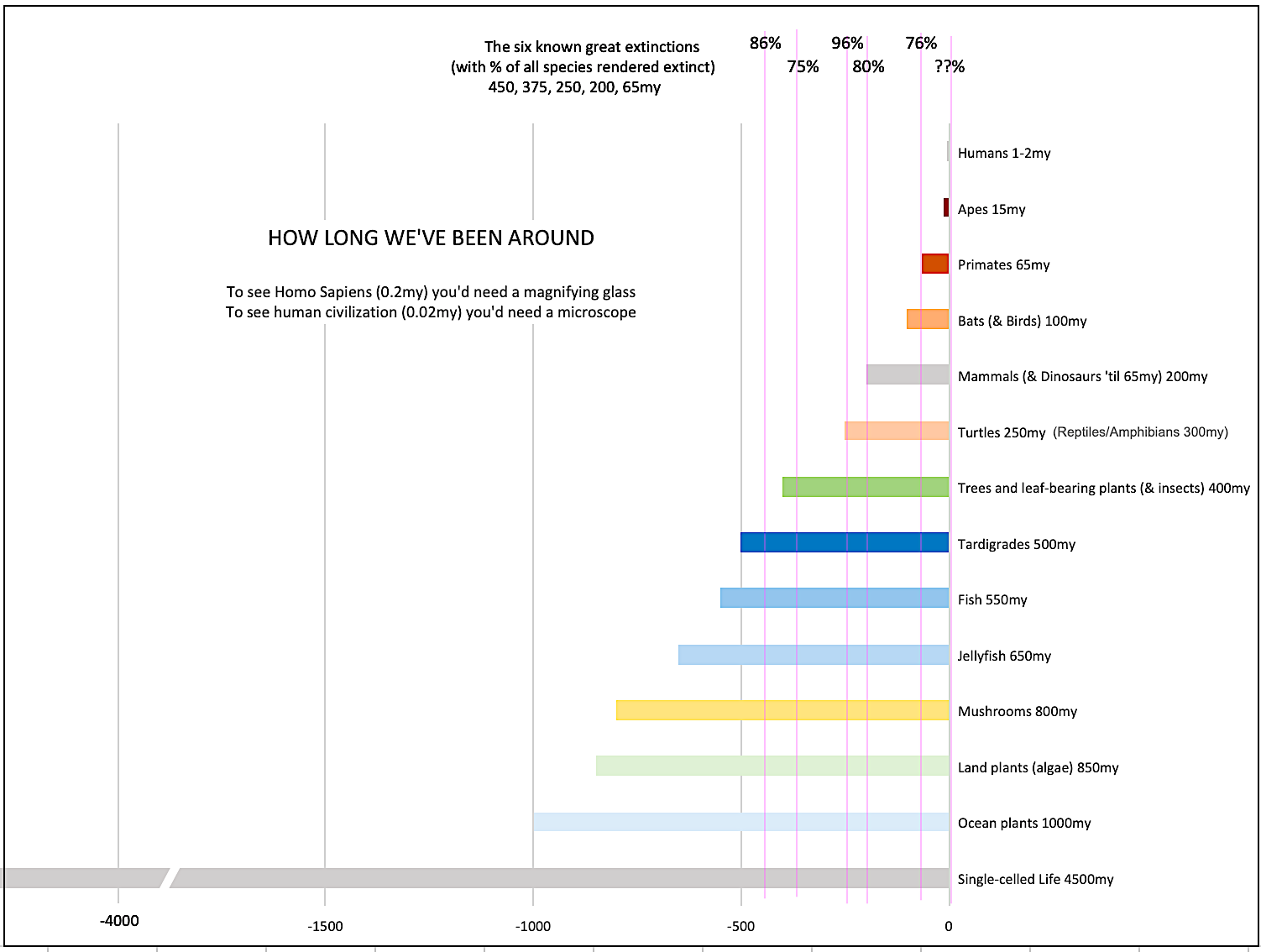
I’d love to know what you think about this. Personally, I don’t think it’s possible. It requires an altruism and a resistance to the temptation of power that is simply not in our nature. How does nature deal with such catastrophes that overwhelm its inherently self-organizing balancing mechanisms? It lets them happen, and shrugs them off. Or it adapts to them. These catastrophes, in the face of an enormously resilient ecosystem, are (except for the odd extinction event every 50 million years or so) ultimately limited in their impact, and unsustainable long-term. They burn themselves out. Indeed, that is precisely what nature is doing now, in the advanced stages of the Sixth Extinction in the planet’s known history, the first caused by the actions of a single species, us. We are, I suspect, too arrogant to just allow these things to happen, to wait for them to pass and ‘solve’ themselves. We couldn’t sit back and just allow Iraq to invade Kuwait, even though the reasons for that invasion were vastly more complex than the simple act of megalomania our politicians and press would have us believe was behind it. We can’t sit back and allow the Bush ideology to catapult the world into the Second Great Depression, even though the fuse is already lit and, if we turf him out of power and catch it, it will blow up in our face anyway. We can’t allow the wretched prisoners at Guantanamo to kill themselves, even if that means force feeding them until we concoct some excuse to execute them. We can’t shrug off 9/11 even though the trillions of dollars we’ve spent on ‘security’ and retribution in response to it have done nothing but make us less secure and have increased the popularity of the (surviving) perpetrators. We can’t accept that the solutions to global warming and the End of Oil that aren’t conceived and implemented in each local community according to its unique situation and needs, will never be acceptable enough to be implemented in any widespread way at all. We do what we must, but to the humanist in all of us, that is never enough. Foolish or futile as it may be, we have to do more. Try something. Do something. Anything. Make someone responsible. Appoint a committee. Draw up a plan. Get revenge, even though it changes nothing. Hang someone. Stop it from happening again. I’m not entirely satisfied with this ‘if you can’t do anything objectively useful, shrug off your grief and your outrage and get on with your life‘ answer. Not so much because it doesn’t make some intuitive sense to me that sometimes bad things happen, and last a while, and that attempting to either prevent or avenge them simply compounds (complexifies?) the problem. My dissatisfaction with this answer is more because I can’t sell this answer to people who might find the rest of the Networked Society elegant and compelling, but will find this sticking point intolerable. I’d welcome your thoughts. |
July 12, 2006
Links of the Week (Late) – July 12, 2006
![]() Too many links to point you to to let them accumulate until next Saturday. My punishment for taking last Saturday off, I guess. Here we go: Politics, Corporatism and All That Surviving the End of Oil: A Lesson from Russia: Dmitry Orlov in FTW tells the story of Russia’s economic collapse and the anarchy and desperation that prevails now in much of the country, and shows how those who are coping with it successfully (other than the crime lords) could provide models to follow when our own economy collapses. Meanwhile, the NYT reports the Russians are so desperate that they’ve agreed to become a colossal toxic waste dump for US nuclear garbage. The Suburb as Work Camp: An interesting and long essay by Swiss writer ‘P.M.’ explaining why unsustainable and unscalable “man-on-his-land” suburbia has such a powerful psychological draw to Americans, and why its reality (that it is really owned by the banks and by employers as a means of keeping workers pacified and dependent in a modern version of work-camps) is so different. Thanks to Andrew Campbell for the link. Big Tobacco Prevails Again: Consistent with previous rulings, a high US court has overturned another class action lawsuit award against big tobacco, on the basis that (this is a quote!) it would “result in an unlawful crippling of the defendant companies.” In other words, the health of ‘defendant companies’ that market addictive and lethal toxins to people, outweighs the health of those people. Big Ag Creates a Big Stink: “Factory farms are fouling the country’s waterways with millions of tons of animal waste. And the EPA’s proposed regulations may not solve the problem.” Amanda Griscom Little in Salon & Grist is putting it mildly. Big Finance Puts the Squeeze on the Hapless Poor: With US consumer debt skyrocketing, and with Bush eliminating most of the bankruptcy protection previously available to the poorest victims of usurers, it’s no surprise that the big finance corporations are ignoring the law and resorting to outright extorting money from the poor, exploiting their ignorance and often stealing money they aren’t even owed. This is what happens when a country treats poverty as a shameful personal crime instead of a national disgrace. Ahem, I Said, the US is About to Invade Iran: A wonderfully articulate argument that the decision to bomb Iran has already been made, its consequences, and why Bush will get away with it politically. I’ve been saying this for months, but Arthur says it better. Thanks to Dale Asberry for this link and the one that follows. And the US Dollar is Still Teetering on Collapse: Witty actor and economist Ben Stein tells it like it is: As I endlessly point out, taxes for the rich are lower than they have ever been in my lifetime. (To be fair, taxes for the nonrich are very low as well.) And this is occurring as we accumulate government liabilities that will kill us in the long run. (And cutting spending will not work. Most federal and state spending is for items that are untouchable, like Medicare, education, the military ó and, most cruelly of all, interest on the national debt. Every president promises to cut spending and not one of them does it unless a war comes to an end.)
We are mortgaging ourselves to foreigners on a scale that would make George Washington cry. Every day ó every single day ó we borrow a billion dollars from foreigners to buy petroleum from abroad, often from countries that hate us. We are the beggars of the world, financing our lavish lifestyle by selling our family heirlooms and by enslaving our progeny with the need to service the debt. I don’t see this ó except for the taxes ó as a Republican thing or a Democratic thing. It’s just the way we live today. Drunken sailors from the Capitol to the freeways. Heirs living on their inheritance and spending it fast. The titans of corporate America getting as much as they can get away with and hiring lawyers and public-relations people if there is a problem. It is later than anyone dares to think. Business and Innovation Co-Innovating With the Customer: Michael Schrage in S&B echoes the argument in many of my posts that innovation not only starts with paying attention to customers and their needs, but is best done in concert with those customers. Thanks to Innovation Weekly for the link. Small Business vs Entrepreneur: Seth has an interesting short discussion of the difference, and comes down on the side of small business because he thinks “growth for growth’s sake makes less sense every day“. Good to see other business advisors acknowledging that businesses don’t have to grow to be profitable and successful. Too bad about the ‘small potatoes’ connotation of the term, though. There’s no reason, of course, that you can’t call yourself an entrepreneur (literally, “one making a commitment to start and be responsible for something”) and still refuse to grow. Making Genetic Manufacturing Obsolete: Jeremy Rifkin says MAS technology, which involves traditional crop splicing and breeding techniques but uses the latest technology to improve it by honing in on the markers for the ideal characteristics, outperforms Genetic Manufacturing and entails none of the risks. Wisdom of Crowds Beats the Experts at Market Predictions: Investment funds whose make-up is determined entirely by computer algorithms that use only quantitative analysis, not fundamental data, about the companies they invest in, are now regularly outperforming those selected by the hugely overpaid investment brokers’ analysts (full disclosure: I used to work for one). So-called “technical analysis” is a ludicrous science about as sensible as alchemy, but it has one advantage that the hapless experts don’t: it reflects the collective wisdom of the crowd over time. Since the value of stocks is purely psychological, that’s a big advantage. PS: It works at the racetrack, too. Blogs & Blogging Stephen Hawking Goes Online With a Question: It’s basically the question my blog is designed to answer. I replied with the Credo from this recent post, joining some 22,000 other respondents. If I get a call from Hawking, I’ll let you know. Thanks to my former colleague Mark Matchen for thelink. Lots more on Saturday, with a decidedly upbeat tone. |
July 11, 2006
Miro
1 “Sorry to hear about your bad news, Miro”, the neighbour shouted, looking up from the garden he was weeding. Miro walked on, dismissing the neighbour with a smile, a wave and a shrug, determined to continue his constitutional without interruption. He paused at the country lane at the end of his road and contemplated which direction to walk today, when his thoughts were interrupted by the noise of a bright green sports car driving up and screeching to a halt. The driver appeared to be a lady in a ridiculous long tan-coloured cloak that spread across most of the front seat, and wearing a sombrero and dark glasses. She nudged the dark glasses down over her nose, peered at him and asked “You Miro?” “I am” Miro replied. “Get in”, the lady replied, throwing the dark glasses into the small rear seat of the vehicle. “We have a date”. “My mother always told me never to accept rides with strangers”, Miro said, smiling thinly. “You up for an adventure or not?”, she replied, pushing open the passenger door. “And do you want the top up or down?” “Down is fine”. He peered at the lady more closely. He was struck by her green eyes, alert like a cat’s. He got in. She drove in silence for a few moments. Miro grimaced as some of the car’s vibrations hurt him. “Can we stop somewhere and get some water?”, he asked. “I need to take my medicine”. “In the glove box”, she replied. Miro found the water and downed his pain-killers. “We’re going to be awhile”, she said. “Why don’t you sleep and I’ll wake you when we reach our destination.” Miro nodded, uncomfortable as he waited for the morphine to take effect. “But first, take off your clothes, except the shoes”, she said. “You won’t need them where we’re going. Wrap the mantle around you when you’re finished”, she added, nodding at the large expanse of tan cloak draped over the back of both seats. The cloth of the cloak was luxurious, astonishingly soft, like chamois. Miro did as he was told, and then said “So now we are sharing an item of clothing. Seems a strange intimacy, as though we were sharing a secret.” She nodded approvingly. “It’s plenty big enough to share.” She reached behind her seat and pulled out an oilcloth hat and placed it on his head. “Perfect”, she added. “This is how all men should dress — a hat that makes a statement, a non-binding cloak, and sandals laced up to their thighs. And nothing else”. She laughed. “Sounds like quite a costume party we’re going to”, Miro said. “Here”, she replied, drawing her hand down across the brim of his hat, and then softly across his eyes. “This should help you sleep.” That was the last thing he remembered. 2 When he awoke it was dark, and they were in a forest bathed in moonlight. What’s more, they were in some kind of observation platform high up in a tree. Miro looked around in amazement. The platform was large enough to walk around on, and had an edge, perhaps two feet high, all around it. It was soft as down on the feet, like an overgrown nest, and seemed constructed of some sophisticated thatching rather than wood. There was a large cloth-covered chest on one side, and at each of the four corners, a large lit candle burned. The green-eyed woman was seated behind him, and had drawn the cloak around both of them. “How the hell did you get me up here?”, he asked, turning his head and shoulders back to look at her. “I’m stronger than I look”, she replied with a guarded smile. She stared right back at him, studying him with her eyes. He was unnerved and averted his gaze reluctantly. “I thought the male was supposed to be the nest-builder”, he said, quietly, trying to absorb the situation. “Depends on the species”, she replied. She gave him water to drink, and a clay bowl with berries and nuts in it. The bowl had two paws or hands imprinted on it, as if to instruct the user how to hold it. He drank and ate quietly. As he did, it began to rain, first a fine mist, then a downpour that, in the silence of the forest, was as loud as thunder. The woman drew the cloak tighter around them and under them, although the canopy of the tree already provided some protection from the rain. She turned Miro to face her. “Close your eyes”, she said. “I am going to teach you something important that you have forgotten.” Her voice was like a robin’s, musical, as sweet and as intoxicating as the rain. “Open your mouth just a little and do exactly as I say. Feel me getting closer to you. Anticipate it. Break the distance, in time and space, between your lips and mine, into a million tiny pieces, and then, as slowly as you can, move one piece forward. Now stop. Pay attention. Without speaking, tell me what you sense.” Miro could hear the birds in the nearby trees, some of them luxuriating in the rain and others sheltered from it. He could hear their voices and understood what they were saying to each other. He could hear the rabbits and skunks and field mice scurrying for shelter on the ground far below. He could smell the woman’s breath, and parse that smell into molecules, each different, each landing on his tongue or in his nose, this one with the scent of red current, that one walnut, and this one with the scent of love and concern. Each moment brought their lips infinitesimally closer, and a profusion of new sensations. Now the wind was full of stories, of a wounded blackbird, the birth of a baby raccoon, the discovery of a patch of blueberries, wet with rain, the first thing a young sparrow saw when it opened its eyes. Miro learned these stories from the scents, the colours, the tastes and sounds and touches that were carried by the wind, each, like a snowflake, complex and rich and complete in its detail. Now he was parsing, miniaturizing time and space so finely that he could sense subtleties that he could not have imagined. The bird’s song was a symphony, and he could hear the elaborate melodies, the interwoven harmonies, the thousand messages of longing and love and connection that were encoded inside them. The bird was speaking to him, not personally, but as aware-part-of-this-place. Now closer. The smell from the woman’s breath was not just berries, it was those blackberries, there, that cluster, with a unique mix of acids and tones and nuances that only belonged to them, in that place, because a particular weed that shared their soil infused them with some of its flavour, because a bee had alit on them, briefly, imparting on them the precise mix of pollens its feet had touched before, because the angle of the sun and the leaves protecting them or not protecting them from the rain was slightly different there than anywhere else. Closer still, and now as he opened his eyes he could see in her eyes all the truths that were captured in a mere flicker, in the dilation of her pupils, in the flecks of blue and yellow that made up the stunning green that shone into him with the force of a thousand suns. In her eyes he saw what she felt. He was so overwhelmed that he cried, and each tear tumbling from his eyes was a torrent, a cascade of colour and the tinkling sound of it bouncing off his cheek and then off her cheek. And then the touch, as each cell of her lips caressed a cell from his. As the flavours from her mouth poured into his and he had to slow down even more, to savour each one, to hear its story and learn from it, to open himself up absolutely to it. He let go of everything and just became that endless moment, became her, became them, became all-of-life-on-Earth. Now he understood why the word ‘sense’ initially meant ‘to find one’s way’. There was no urgency in the kiss. Time stopped. There was all the time in the world. The kiss lasted forever, as if days and seasons and the rising and falling of mountains was all happening during it, and still it lingered, with the parting as slow and gentle and sweet as the first touch. She smiled at him, holding his head in her hands, her eyes downcast, almost shyly. “That is the time that all the creatures you see and sense around you live in. That is why, unlike humans, they are never in a hurry, never afraid to die. They have all the time in the world. That is what I wanted to teach you.” The rain had stopped and the woman rose, re-lit the candles and opened the cloth-covered chest, drawing from it two rough-hewn wooden instruments, a guitar and a recorder. She handed him the former, and when he made to protest that he did not play (at least not well), she shushed him. “Drink this”, she said, passing him a bowl with a thin blue liquid in it. “You do not need that to intoxicate me”, he said, smiling at her. “You already have me at a disadvantage.” “We owe the creatures of the forest a concert, and they are waiting for us to play. But first, I need to get your stubborn ego out of the way”, she said. Miro wasn’t sure if it was the effect of the kiss or the strange beverage, but he was beginning to see things, hear things, imagine things. “The creatures are sending you their dreams. Now play”, she said. Somehow Miro was able to find the notes to play a madrigal, one he had never heard before. It just came out of him. And now the woman was joining him with the recorder, playing notes that responded to and built on the deeper notes he was sounding. He played like a madman, as if his fingers did not belong to him, finding notes and chords and sounds he had never studied and did not ‘know’ to play. The woman nodded as she played, and then as he continued and moved into a frenzied, lightning-fast flurry of rhythm and melody way up on the frets a whole octave above open-string, she said, “Now you see, you are the instrument and not the player. The song is merely being played through you. You have opened yourself to it.” On and on they played the song of the forest, rising and dancing as they played, until they were exhausted. The woman put the instruments away and said “Now I have something else to show you. You know this. Your instincts have told you this truth. But it is time you saw it.” She re-wrapped the mantle around them both, drew her legs up under him and plunged them both off the side of the platform. She hovered just above ground-level, and pointed. First, in the moonlight, to baby rabbits being born. Then, a trio of young foxes wrestling with each other, then yawning and curling up into a ball together. Then, in closer, the intricate work of a spider, so close that Miro could see the weaving, and witness the wondrous speed and intricacy of its construction. And even closer, an aphid, lustrous in the moon’s glow, making its long journey to a new leaf — turning colour to signal her departure to her community, growing wings and soaring away, borne on the wind miles to a new and unknown home, and then the delight of discovering it, knowing it was waiting for her. And then the woman turned Miro’s face to hers and kissed him, and plunged again into a deep pond, using the cloak like fins to swim to the bottom. She breathed life into him, keeping their mouths locked, willing him not to panic, and by swirling around showed him the mysteries of life under the water, where all life began. She showed him creatures so tiny and strange that he could not believe his eyes. She showed him creatures that were transparent, that you could see right through and were so much a part of the pond that unless you were paying attention you would not notice them. She showed him, by guiding his hand, creatures that lived in continual darkness and therefore had no eyes, but which responded to his gentle touch so powerfully it was as if they purred. And then rising from the water she drew him up into the clouds, soaring, the cloak becoming wings, and pointed out to him patterns you could not see from ground level, or without the eyes of a raven or eagle. And then still higher, until the horizon of Earth was passed, and on into the stars, until even larger patterns became visible, even obvious, and then into other galaxies and universes that were beyond his comprehension, so he couldn’t see them at all. He began to get dizzy, and the last thing he understood was how the vibration of a single string, with no physical existence at all, could create everything. 3 The car rounded the final curve before the street that Miro lived on, and he woke up with a start. The woman was smiling at him, as she drew the car to a halt. He moved to say something but she put her finger to her lips and shushed him. He opened the car door and climbed out, weary and a bit disoriented. He was wearing his normal clothes again. She pointed up and he looked, instinctively, into the cloudless, dazzling blue sky. When he turned his gaze back, the car and the woman were gone. He made his way unsteadily back along the street. His neighbour was still tending his garden, and rose, wiping his forehead, and said, “You won’t get into shape if that’s the farthest you walk. At least walk around the block. D’you want me to come with you? We could share a beer.” “I feel like I’ve been gone for days, an eternity, even. You mean to tell me we were just talking?” “Not two minutes ago, my friend. I think you’d better take it easy with those medications. If you overdo them, they’ll drive you out of your mind”, said the neighbour. “I need a rest”, said Miro. “I’ll take you up on your kind offer soon, though.” And with a wave he continued down the road towards home. Suddenly a crow flew down and landed by his feet, not five yards ahead of him. The crow kept jerking its head up and down, finally staring into the sky. Again instinctively, Miro looked up too, and as he did, the crow cawed, rose up and landed on his shoulder and then on the outstretched hand he was using to shield his eyes from the bright sun. The two creatures looked at each other intently. Then the crow balanced itself on one leg,lifted the other to its breast, nodded twice, and flew away. Original artwork by the author, 2003. |
July 10, 2006
How Much Difference Does a Generation Make?
![]() I often read arguments about the ability or inability of humans to change. They generally fall into two categories, depending on their proponent’s worldview:
I’m not sure there’s any reconciling these two views, though there seem to be lots of people determined to try. For years I was a fence-sitter on this issue, unwilling or unable to make up my mind. Recently I’ve come down squarely in the second, less popular camp. That’s not to say I couldn’t be convinced to change my mind. But it jibes better both with my understanding of history and with my instincts. I remember sitting in a dentist’s waiting room many years ago and watching three generations of a Chinese-Canadian family. The grandparents spoke no English, dressed traditionally, and seemed bewildered and distraught about the world. The grandchildren spoke only English, dressed in definitive Canadian branded clothing, and seemed able to take anything in stride. The parents, caught in the middle, had to translate for their own families. They struck me as simply coping, dealing with the needs of the moment. To the grandparents, their grandchildren were utterly alien, incomprehensible. I’ve seen this again and again over the years, and I now closely observe my own grand-daughters for evidence of how able new generations are to make leapfrog changes that any one individual, no matter how long her lifetime, could not. I recall in my youth arguing with my father (himself a progressive, all his life) about his generation’s inability to change. I told him I didn’t trust anyone over thirty, and that it was time for ‘the establishment’ to get out of the way of the momentous change we were destined to bring about in a new, loving, peaceful Earth. Come gather ’round people wherever you roam, And admit that the waters around you have grown
And accept it that soon you’ll be drenched to the bone. If your time to you is worth savin’ Then you better start swimmin’ or you’ll sink like a stone, For the times they are a-changin’. Come writers and critics who prophesize with your pen, And keep your eyes wide the chance won’t come again Come senators, congressmen please heed the call, Don’t stand in the doorway don’t block up the hall Come mothers and fathers throughout the land, And don’t criticize what you can’t understand The line it is drawn the curse it is cast, The slow one now will later be fast Dylan wrote that over 40 years ago, and my father’s argument that it had all been said before, generation after generation, yet we kept making the same mistakes over and over, fell on deaf ears. He just didn’t understand, I thought. This is something new. And now, nearly 40 years later, I have become my father. And we are still making the same mistakes, over and over. My Genius is Imagining What’s Possible. It’s a useful and interesting talent. But I don’t confuse what’s possible with what’s likely. It’s possible that a meteor will hit the Earth tomorrow. It’s possible that some benign alien species will arrive tomorrow and fix all the world’s problems for us. But I’m not counting on it, in deciding what to do next and what to do in the future. It’s possible that humanity and technology will transcend the looming crisis facing us, and it’s interesting to imagine that happening. But it’s science fiction stuff, escapism, denial, a distraction from reality, from the real work facing us here, now. Back in the 1960s, we did what we had to do. We shook an intolerant, war-mongering, fearful culture to its foundations. We ended the war. We challenged everything. We tried some bold and optimistic experiments. But in the end, we changed nothing. Our twin religions of humanism and technology, it turned out, were not enough to make us, and our culture, over into something we, and it, were not. So now I’m a skeptic about our ability to change. I recognize its imperative. I can imagine and appreciate its possibility. And I think about the leapfrogs that were made, from the generation of my grandfather, an enlightened and conservative depression-era survivor (and, like me, a bird-watcher); to the generation of my father, a progressive and an explorer who is still today generous to a fault; to my generation; to that of my lovely children, utterly caught up, like the middle generation of that Chinese-Canadian family in the dentist’s office, with the immediate needs of the moment, raising their own families in a deeply troubled economy; to the generation of my extraordinary grand-daughters, who are learning, exploring, discovering what their world is about, and who are not yet ready for the terrible lessons I have for them about their future. My grand-daughters’ culture is as different from mine as mine was from my grandfather’s and from that Chinese-Canadian family’s. Yet somehow, in the ways that are important, these cultures are indistinguishable. Almost as much as ‘we’ are mere servants of our bodies, so too are we co-prisoners of our culture. Noam Chomsky has said that all human languages are so astonishingly similar that an alien ethnographer would have absolutely no doubt that we all came from a single ancestor. Anthropologists are flabbergasted that human groups so utterly separated by time and space have evolved such staggeringly similar cultures, quite independently. Our culture, with its local variations that cause us so much conflict, is becoming more homogeneous and undifferentiated, and hence poorer and less adaptable, less capable of complex change, every day. Rather than liberating us from doing what we must, and enabling us to do what we can and what is imaginable, our culture is instead our bodies’ evolutionary servant. Our bodies evolved our brains to invent culture because without it we would have perished. To see human culture and ‘consciousness’ as anything more than an evolutionary survival mechanism is a colossal, collective conceit, an exercise, like belief in The Rapture, in magical thinking. As Eliot said, “Human kind cannot bear very much reality”. So we go on doing what we must. Rising and groaning and going to work. Sublimating our dreams and intuitions and imaginations. Looking after the needs of the moment. Invading Iraq and tomorrow Iran to feed the inextinguishable hunger for the ‘food’ that nourishes our fragile bodies and keeps us in the evolutionary gene pool. Distracting ourselves to death with useless information and desperate consumption and flimsy entertainments. Exploding in numbers and despoiling and impoverishing the Earth. Generation after generation, being what we are, and doing what we do. The answer is, ironically, not striving for impossible, collective change, but rather becoming more truly human. Connecting better, more authentically to each other and to nature. Learning everything we can; learning to be useful, to be a part. Becoming more aware, more sensual, more instinctive, more generous, more in touch with ‘our’ bodies and hence ourselves. Taking delight in small pleasures. Living on the Edge. Slowing down and paying attention and living in the moment, undistracted. Refusing to be being everyone else in our culture. That will not save us, but it will give our lives meaning and purpose. Inthe end, I think, that is all there is, and all that can be asked of us. Image: From Danish Ministry of the Environment. |
July 9, 2006
Gang War
![]() Before you can appreciate what the characters in this scenario are likely to do, you need to know something about them. If you knew and grew up with them, you might not see them this way, but here’s how they see themselves:
So there are the nine characters in our story. They’re not very likable, I confess. It’s a tough neighbourhood. What I’d like you to do is to put yourself in the place of each of these characters and imagine what they might do next. How will the story of this sad community unfold? For example:
As you may have guessed, I’m setting you up. This is another of my If the Shoe Were On the Other Foot exercises. The ‘neighbourhood’ is Asia and the MidEast, Mark is America, Ray is Israel, Paul is Palestine, Benny is Bin Laden, Randy is Iran, Russ is Russia, Chas is China, Alf is Afghanistan and Rick is Iraq. The purpose of the exercise is to try to get you to see how the leaders or the people of each of these countries see themselves now, and why they are doing what they are doing. I can appreciate what drives people to commit suicide, and to become a suicide bomber. I can see why people who have hated each other for a long time continue to attack each other irrationally and refuse to find any kind of workable compromise. I can see that Al Qaeda, while it has succeeded in nearly bankrupting the US, has been ineffective in getting mainstream Islamic people to rise up against their governments, expel all vestiges of the West and create a single monolithic Islamic state. In that sense, especially since Bush is bankrupting the US even without its increased military spending, Bin Laden’s campaign has been a total failure. I can see why the situation in Russia and in Afghanistan (and in many of the former Soviet states) is so hopeless that the only real choice of the people is to kill themselves (by suicide or by drugs) or to flee. I understand China’s ambivalence to the US, its interest in establishing the SCO China-Russia-Iran-(India-Pakistan-Former Southern SSRs) alternative economic and power bloc, and its desire to wean itself off dependence on the US. And I can appreciate why Iran feels it has no choice but to become a nuclear power and threaten Israel, in its own defence (and why, as Sy Hersh explains this week in The New Yorker, the first response of Iran if it is attacked will be to pour its troops into Iraq to fight the US there). The situation is complex, which is why there is no clear human answer to it. Aside from its scale, it is not all that different from the situation in many poor urban areas that the government has given up trying to serve or save, and which are loosely controlled by the equivalent of the Afghani warlords who control (except for the capital) that country. In that sense, my little gang war scenario is a miniaturization of the situation in Asia and the MidEast, but not an oversimplification of it. The approach of the West to impose a Western-style political and economic system on the MidEast, where such systems are utterly alien, is much like the approach to ‘clean up’ gang-controlled areas of American cities: send in the troops, level everything, and let the ‘market’ build something that they will own and look after, so they’ll keep the locals in line to defend it. The hope is that if everyplace looks like an American suburb, replete with McDonalds and the Gap and Starbucks and heavily-armed cops and vigilantes and big privatized jails and pro-American churches and all the other icons of American capitalism, everyplace will start to act and be like an American suburb, and the ‘problem’ will go away. It hasn’t gone away in America’s cities (where this tactic has been tried) and it won’t go away in the MidEast either. If the US could figure out how to ‘liberate’ its own poor and down-trodden areas from poverty, disease (the infant mortality in these areas of the US is higher than in many third world countries, and the life expectancy lower), crime, abuse of power, corruption and desperation, it might then discover that the same approach could liberate many nations struggling with the same cycle of despair. But because this is a complex problem, and the existing systems and prevailing imaginative poverty are only capable of addressing simple problems with simplistic solutions, the US hasn’t the faintest inkling how to do it. The ‘right answer’ is never invasion, occupation, more guns, more prisons, more law enforcement, or ‘leaving it to the market’. These merely contribute to the problem. The ‘complex system’ answer is to remove the obstacles that prevent the people from taking back power and resources from the warlords and the gangs, and to provide incentives that will encourage and reward them for doing this for themselves. If the people win the peace, the people will protect it. This is not easy, of course, and it will take generations and cost far more than the trillion or so that Bush has squandered in Iraq. Complex system changes never are. But it’s achievable, with enough time, energy, and resources. But first we need to get rid of the imaginative poverty and simplistic thinking that merely exacerbates these problems, and the people, like those in the Bush regime, who resort to them. There is a real question of whether we can still afford the money, the resources, the energy and the time that it will take, to do this in most of the world. My guess is that the answer to this is no. But perhaps if we try it in a few places, and discover that it works, we will be motivated to do everything we can do to make it work everywhere else. So that, ultimately, there will be no place left for those who would exploit the ignorance, anger and suffering of others for their own advantage. Andthe gang wars of this planet, at every scale, will finally be over. Image: Donna DeCesare, taken for Dart Center in Guatemala last year. |
July 8, 2006
No Post Today
| Urrrrg. I’ve come down with some kind of nasty gastro-intestinal bug, which took a turn for the worse yesterday after hanging around and just being annoying for the nine days before. I thought maybe I was just overdoing the running/exercising, but whatever this is, it’s potent. So no ‘links of the week’ today, and I may hold off posting for a few days until this clears up. The doctor’s on it, and I’m being tested for all kindsof things. Back soon. |


Recently, in a communication with
What deranged madness grips (most of) us, what horrific violence so afflicts us, at some point in our young lives, that we lose our artistic capacity, our capacity for appreciating and embracing complexity, most of our capacity to imagine, and our ability to see and