Dave Pollard's environmental philosophy, creative works, business papers and essays.
In search of a better way to live and make a living, and a better understanding of how the world really works.


November 23, 2011

BC Ruling on Polygamy: Implications for Polyamory

Filed under: Our Culture / Ourselves — Dave Pollard @ 23:38

image from free-desktop-backgrounds.net

Today, after months of hearings and deliberation, a BC judge ruled that the Canadian federal law making “polygamous union” a criminal offence in Canada was needed and defensible notwithstanding the fact that it does violate freedom of religion and other provisions in the Canadian Charter of Rights and Freedoms. In a 300+ page judgement he ruled that the charter right to freedom from the threat of harm, particularly to women and children, outweighed religious charter rights. He also asserted that the law violates the charter’s right to fundamental justice when it is applied to minors, and as such the law cannot legally and should not be used to prosecute minors.

This means that actions taken under this law against leaders of an allegedly misogynist and child-abusing fundamentalist Mormon cult group in the village of Bountiful BC, which were thrown out on constitutional grounds, can be reinstated. It is unclear whether the decision will be appealed (to the Canadian Supreme Court), which would delay prosecution.

The West Coast Legal and Educational Action Fund (LEAF) argued that the law needed to be rewritten and narrowed to cover only situations involving “minors, exploitation, coercion, abuse of authority, a gross imbalance of power or undue influence”, an argument the judge rejected, claiming that the information presented to him made it clear that polygamy is inherently harmful and that “there is no such thing as ‘good polygamy’”. The Civil Liberties Association argued, also unsuccessfully, that the law should simply be ruled unconstitutional and not used, since by criminalizing polygamy it merely drives it underground, increasing rather than reducing the vulnerability of affected women and children. All of the opponents of the argued that there are many existing laws against child and spousal abuse, unlawful confinement, exploitation and similar crimes, and that recourse to an ancient anti-polygamy law is unnecessary to bring perpetrators of such crimes to justice.

Where does this leave those of us who are poly — who have more than one loving, adult, respectful, egalitarian, consensual relationship in our lives? The Canadian Polyamory Advocacy Association argued that if the polygamy law were upheld, it would jeopardize the rights of poly people and throw us, and our families, into a legal limbo where we could be harassed, threatened, charged and jailed for living a healthy, natural lifestyle.

The judge said a number of things to try to reassure us that the law is not intended and won’t be used to prosecute those in consensual, adult relationships:

“For polyamorists, the ability to live in a family with the people they love is essential… Each party must know of and consent to both the possibility and the reality of other relationships within the group. This need for openness and consent at all times necessitates considerable self-awareness, communication, conflict resolution and emotional processing on the part of all members…

“While polyamory has been a largely secular phenomenon to date, the evidence indicates that some polyamorists do favour religious ceremonies. Criminalization of these ceremonies significantly impairs the ability of polyamorists to experiment and innovate in this regard. As such, s. 293, as interpreted by the Attorneys General, directly infringes the religious liberty of polyamorists.”

The judge fell short, however, of saying that s. 293 (the polygamy criminalization law in question) should be amended to clearly exempt polyamory ceremonial unions. As a result, according to John Ince, lawyer for the CPAA,  the judgement “rules that the lifestyle of polyamorists as practiced in Canada is not illegal and we’re pleased with that.” Ince added that marriage is “not really an issue in the polyamorous community”, and concluded that “[multiple] common law relationships are clearly not prohibited. Polyamorists who are dealing with immigration or family custody issues for instance now need no longer worry about being considered to be criminals”.

CPAA spokesperson Zoe Duff cautioned however: “The decision still criminalizes a segment of the polyamorous community if they have a marriage ceremony… Polyamorous Canadians are responsible citizens who work toward sustaining healthy, loving, egalitarian relationships and it is wrong for Canada’s laws to continue to criminalize any of us. The number of people in any given relationship is not the issue. The health of the relationship and family is the issue.”

What does all this mean? The judge’s ruling is an interpretation on the constitutionality of the existing 120-year-old law. He ruled that the law violates religious rights and freedoms under the constitution but that notwithstanding this, the law is justified because the charter-protected right to freedom from harm or threat of harm (to the victims of coercive polygamous relationships) outweighs religious rights and freedoms.

A large part of the judgment is spent clarifying the judge’s conclusion that despite changes in both formal and informal relationships since the law was written 120 years ago, and despite changes in the definition of terms such as “marriage”, the law pertains only to multiple relationships sanctioned and recognized by marriage or comparable “conjugal union” ceremony. Specifically, he describes the ceremony that sanctions and recognizes a second marital relationship of any individual (subsequent to or simultaneous with the first) as a “capital M Marriage”, and asserts that this particular law applies to and allows prosecution of all (adult) marriage partners of the person or people in that/those “Marriage(s)”.

This is a particularly tricky bit of reasoning. It means that if you have multiple relationships sanctioned by a marriage ceremony, even if they are all with adults and all parties have consented to them, you are guilty of polygamy, and subject (for that reason alone) to harsh criminal punishments (up to 5 years in prison) under this Canadian law. But if you have multiple relationships not sanctioned by marriage ceremony, even if they are coercive or abusive, you are not subject to this law (though you may be subject to other Canadian laws). [Just as an aside, to show how arcane this law is, the very next section of the law prescribes up to 2 years in prison for "solemnizing or pretending to solemnize a marriage without lawful authority".]

I’m not sure that such a legal definitional nicety would pass scrutiny in an appeal. It seems to me discriminatory to apply a law to groups that hold religious ceremonies sacred, and not to those that don’t (and as you know I’m not a big fan of organized religion or ritual). Convenient in the case at hand, but pretty shaky as a precedent-setter.

What’s worse, though, is that I don’t think the subtlety of this distinction (which the judge takes many pages to draw) will be appreciated by law enforcement agencies that will, if this ruling is not appealed, see “polygamy is illegal” as justification for endless harassment and prosecution of poly people. It will be tempting for law enforcement agencies to make the following argument, for example:

  1. Under Canadian laws, if you cohabit with another person for a certain period of time, or if you have a child with another person, and/or if you “register your union” with an appropriate provincial authority (generally for purposes of claiming rights to jointly-registered property), you are deemed, for most legal and tax purposes, to be “equivalent to married”, and have most of the rights and responsibilities of a marriage party. So, if you do any of these things with more than one partner, law enforcement officials would have some justification for saying you are “equivalent to married” to more than one partner.
  2. Equivalent to married to more than one partner = polygamous = arrested and carted off to jail, possibly because your neighbour or one of your kid’s school-mates doesn’t like you. I wouldn’t want to have to try to explain to some misanthropic pepper-spraying beat cop the subtleties of the distinction: “No, really, officer, the law only applies to religious people who are officially married! We’re just poly! Read the whole twelve-page section of the ruling that explains that here.”

Just in case anyone misinterprets what I’m saying: I think people and leaders of cults that brainwash, exploit and abuse children and the weak, and who intimidate, threaten, harass and imprison ‘members’ who try to break free, should be put away for much longer than five years. We don’t need a law that restricts rights to and criminalizes assembly and association to do that. What we need is better whistle-blowing legislation and protection, better services for those living in fear to get help and find safety, and a much more responsible and less laissez-faire and less privacy-obsessed attitude towards what goes on behind closed doors and walls by all of us.

There’s something very wrong with our laws when, in order to shine a light on and bring justice to remedy outrageous and ritualized abuses ruthlessly perpetrated on the weak, while the bully perpetrators rely on “privacy rights” and “personal property rights”, we have to rely on a flimsy and inadequate 120-year-old statute that makes it illegal to have more than one “conjugal union” at a time.

November 19, 2011

Links of the Month: November 19, 2011

Filed under: Preparing for Civilization's End — Dave Pollard @ 23:40

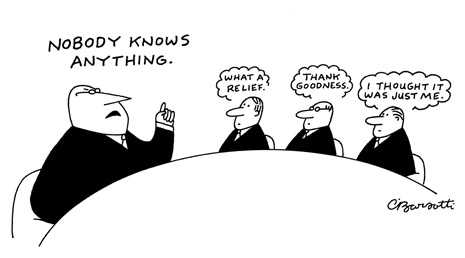
Cartoon by Mark Hurwitt

Quite often people ask me how I can live with a personal belief system that is so seemingly pessimistic and hope-less:

  • I believe that our civilization will inevitably collapse, in stages, over the course of this century, and that that collapse will bring immense suffering (though perhaps no more than the suffering that civilization inflicts now, every day, on the human and non-human creatures of this world).
  • I believe that, in our desperate efforts to deny or delay inevitable collapse, we will do more damage to our environment and exhaust more of the planet’s natural wealth in the decades to come than has even been done to date.
  • I believe that faith in technology, innovation, human ingenuity, ‘free’ markets, leaders, deities and spontaneous global consciousness-raising, to re-form civilization culture, are all desperate salvationist magical thinking, and that such thinking is foolish, dangerous and a distraction from coming to grips with what we can and must do.
  • I believe ‘we’ are not the rational ‘individuals’ we imagine ourselves to be. ‘We’ are nothing more than a complicity of our bodies’ organs that evolved our minds for their survival purposes, minds that our culture is, in its struggle to survive, trying to seize control of to have our bodies instead do its bidding. We are all, now, victims of this chronically stressful body-vs.-culture war inside us, that has left us feeling exhausted, anxious, fearful, powerless, helpless, culturally imprisoned, intellectually paralyzed, self-blaming, and physically and emotionally ill.

I have spent ten years coming to this conclusion, ten years of questioning and challenging and studying and re-thinking everything I have been taught to believe. And while many may think this is a dismal philosophy, I feel immensely liberated by it, freed from the illusions of responsibility for and control over and denial of who I am and what is happening in the world.

I think we will all have to achieve, in our own way, a high level of awareness of reality, and of self-awareness, and heal ourselves to reach a state of peace with that reality and with what it means, if we want to cope with what is in store for us in the coming decades. This blog has always been and continues to be my means of achieving this for myself and offering it, for what it’s worth, to others.

The Metamovement (the Occupy, Indignant and Arab Spring movements) has successfully provoked an awareness in many citizens of the inequity and injustice of wealth and power in the industrial growth economy, and how the 1% are now the sole beneficiaries of that economy and the accelerating desolation of the planet and liquidation of its resources. Many of us would like to believe that this heralds a broader understanding of how the world really works and what is needed to mitigate the suffering of civilization’s beginning collapse. Richard Heinberg, for example, writes that what protesters and activists are “for” is:

  1. Energy literacy
  2. Conservation
  3. Resilience
  4. Relocalization
  5. Family planning
  6. Beauty
  7. Biodiversity

I would love to believe that large swaths of the Metamovement have this degree of understanding of the current state of the world and what is needed to make it better. But there is no evidence that this is the case. As the cartoon above humorously illustrates, most of the current protests are about who has, and who should have, what share of the world’s power and wealth, and about the unjustly unpunished crimes of the powerful and the wealthy. That makes perfect sense, and the protesters’ cause is a good one. But it is light years shy of the kind of collective self-enlightenment that Mr. Heinberg (of whom I’m a great fan BTW) and other wishful thinkers would have us believe has been achieved.

But it’s a step in the right direction. Perhaps once people understand that most of what they have been and are being told by their ‘leaders’, by the corrupt political and economic establishment, by the incompetent and duty-derelict media, and, alas, by our teachers, parents and peers, are lies – then we might begin to wake up in large numbers to what is really happening in the world, and how we must start now to prepare for collapse, mostly by relearning essential competencies and capacities so we are ready and resilient, at the personal and community level, to deal with the unpredictable cascading crises ahead, in the moment, no matter when and how they hit us.

Thanks to Justin Bale’s OWS archive for most of the images in this post

PREPARING FOR CIVILIZATION’S COLLAPSE

The Coming Insurrection: This booklet, whose authors were charged with promoting “terrorism” for writing it, offers a fascinating insight into the anger of young Europeans, and how different the current political situation in Europe is from that in North America, due to the different power dynamics and greater political literacy of most Europeans. Thanks to Keith Farnish for the link.

The Informal Economy: Sharon Astyk envisions what a mixed formal/informal economy might look like after civilization’s collapse. I think she overestimates how much we’ll be willing to put any trust in formal economy structures once our economic system collapses, but it’s a great, and important, thought experiment, all part of being prepared for what comes next.

Emotional Resilience: Chris Martensen interviews Carolyn Baker on preparing ourselves emotionally for collapse. Carolyn draws on studies of areas hit by disaster to envision the challenges we’ll be facing, and prescribes preparations including increased self-awareness, self-knowledge, and self-management, making connections to others and the Earth, and increasing capacity to deal with our (and others’) negative emotions. Thanks to 3Es Newsletter for the link.

Be Prepared: I’m fond of saying that the key to resilience in the coming decades will be our ability, in the moment, to imagine ways around the crises we cannot prevent, predict or plan for. But that doesn’t mean that we shouldn’t be prepared for what is reasonably predictable/plausible. Flemming Funch explains: “Not only do you save yourself a lot of anxiety, but it is a lot more comfortable to prepare for things in advance. It is a lot easier to prepare to have a source of drinking water when the stores are open and your Internet connection works than it is when you’re thirsty and nothing is open, because of some kind of minor or major breakdown. It is a lot easier to think of how you’ll charge your cellphone or your radio before the electricity actually goes down.” Are you prepared?

Hubbert’s Third Prophecy: Many don’t realize that, after successfully predicting Peak Oil and its consequences a half-century ago, Hubbert went on to predict that the next major impact would be “cultural crisis”. Gary Flomenhoft explains, and suggests radical reform of the financial and money system to stave it off.

“A Single Chaotic Event”: Dmitry Orlov backpedals on his “five stages of collapse” model, saying that because the bailouts of banks and runaway indebtedness are escalating, the collapse is likely to be more sudden and more extreme than he’d previously predicted.

Anti-Fragile not Resilient: In a recent video’d speech, Black Swan author Nassim Taleb explains (caveat: he’s an arrogant and frustratingly unclear speaker) the thesis for his next book: The best preparation for “black swan” (unexpected, unpredictable and catastrophic) events is not “resilient” systems (i.e. with ability to bounce back from these events) but “anti-fragile” systems (i.e. that actually benefit from such events). Natural systems, he says, are mostly inherently anti-fragile (e.g. evolution). Human-made systems are mostly fragile; we need to learn from nature. Thanks to Avi Solomon for the link.

Greenhouse Gases Rise By Record Amount: To the surprise of few, political efforts to reduce global CO2 emissions are not only ineffective, the increase in pollution is actually accelerating.

RIP Richard Douthwaite: The brilliant environmental economist and author of Short Circuit, the free online manual for creating a new economy from the community up, passed away last Monday.

LIVING BETTER

Community Creates Its Own Co-op Department Store: Saranac Lake NY is learning what we’re all going to have to learn — how to self-manage a community when the economy collapses and all the big corporations disappear.

Nassim Taleb Calls for End to Bank Bonuses: When the risks of bad investment decisions are paid for by the taxpayer through bailouts, it’s outrageous that those making these decisions get huge bonuses when they make the right gambles (and often, significant bonuses when they make the wrong ones). Taleb says with their government protections banks are tantamount to government organizations, and bankers should be treated as public servants who get paid a fixed salary and no bonuses. Logical, but don’t hold your breath.

CBD Dares Say Overpopulation is a Key Environmental Issue: The Center for Biological Diversity asserts that without birth control sufficient to reduce human numbers, no amount of environmental effort will be enough to succeed. Glad someone is willing to name the elephant in the room.

Cartoon by Marco Marilungo, needs no translation

POLITICS AND ECONOMICS AS USUAL

Inequality and Abuse of Power and Wealth as the Issue of 2011: A recent OECD report put the US at the bottom of the heap of affluent nations in social justice (poverty, health, education and income/wealth inequality). Canada has nothing to be proud of either (its scores don’t justify its overall rank). Glenn Greenwald explains how the 99% are starting to realize the American Dream has been stolen by the 1%. Excerpt:

If you were to assess the state of the union in 2011, you might sum it up this way: rather than being subjected to the rule of law, the nation’s most powerful oligarchs control the law and are so exempt from it; and increasing numbers of Americans understand that and are outraged.  At exactly the same time that the nation’s elites enjoy legal immunity even for egregious crimes, ordinary Americans are being subjected to the world’s largest and one of its harshest penal states, under which they are unable to secure competent legal counsel and are harshly punished with lengthy prison terms for even trivial infractions. In lieu of the rule of law — the equal application of rules to everyone — what we have now is a two-tiered justice system in which the powerful are immunized while the powerless are punished with increasing mercilessness. As a guarantor of outcomes, the law has, by now, been so completely perverted that it is an incomparably potent weapon for entrenching inequality further, controlling the powerless, and ensuring corrupted outcomes.

The tide that was supposed to lift all ships has, in fact, left startling numbers of Americans underwater. In the process, we lost any sense that a common set of rules applies to everyone, and so there is no longer a legitimizing anchor for the vast income and wealth inequalities that plague the nation. That is what has changed, and a growing recognition of what it means is fueling rising citizen anger and protest. The inequality under which so many suffer is not only vast, but illegitimate, rooted as it is in lawlessness and corruption. Obscuring that fact has long been the linchpin for inducing Americans to accept vast and growing inequalities.  That fact is now too glaring to obscure any longer.

Occupy/Indignant/Metamovement Roundup:

The Graphics of Inequality: Several interesting charts on the power and wealth of the 1% vs the 99%:

Quarter of a Million Animals Abused Annually in UBC “Research”: The university’s official abuse apologist says this represents “less than 6%” of Canada-wide university laboratory abuse. That means the Canadian total is a disgraceful five million animals tortured in laboratories every year.

Canada’s Corporate SLAPP Lawsuits Intimidate Truth Tellers: The Walrus explains how the sleazy lawyers of big corporations in Canada use threats of massive, expensive defamation lawsuits to intimidate and silence whistle-blowers and critics of corporate abuses.

Too Big to Jail: Robert Scheer says that not only are the big banks and other mega-corporations “too big to fail”, their inept and corrupt leaders are “too big to jail”. To do so, he says, would be political suicide and set off a massive wealth exodus to a “safer” country, and perhaps a depression.

FUN AND INSPIRATION

Image from a post by Nick Smith, believed to be from the collection of John Wareham, artist unknown

The World’s Greatest Optical Illusions: A stunning and substantial set of illusions than can be viewed onscreen. Thanks to Seb Paquet for the link.

Imagine Armed Chinese Troops in Texas: Fascinating thought experiment to understand why so much of the world hates America, from the quixotic Ron Paul campaign. Thanks to my publisher Margo Baldwin for the link.

The Pathologization of Stress: Provocative argument that diagnosing many stress-related traumas as PTSD just plays into Big Pharma’s drugs-for-everything propaganda and doesn’t produce better healing.

The End of Happily Ever After: Bonnie Stewart ponders why so many of her monogamous friends are breaking up, and what that means for the rest of us.

The Once and Future Way to Run: The NYT discovers the best long-distance runners run differently from the way we’re all taught to run. See also this related video.

A Time Chart of Death By Violence: Interest NYT graphic shows deaths from wars, genocides and other violence throughout civilization’s history. Deaths since 2000 are absent, and many of the death tolls cited are most likely heavily understated. Nevertheless, the trend is pretty clear.

Adopt a Shelter Pet, Please: The shelter pet project asks that if you’re thinking of getting a cat or dog at this season of the year, please adopt a shelter pet instead of buying from a breeder or pet store.

Sony Introduces 3D Visor/Headset: Get rid of your monitor and get total immersion right in your face. As a fan of portability in technologies, this actually kind of intrigues me. Not so sure this is good for your eyes, or your brainwaves, however.

THOUGHT FOR THE MONTH

From Angie Riedel (thanks to Dale Asberry for the link):

The highest crime between people is demanding by force, by law, by deceit, by manipulation, by threat, by imprisonment, by bribery, by withholding information, by telling lies, by ultimatum, by any means of coercion at all, that someone else must relinquish themselves, in essence cease to exist, and instead become a mere extension of someone else’s will, carrying someone else’s thoughts, ideas, desires, goals and philosophies.

November 14, 2011

Coping With Triggers

Filed under: Our Culture / Ourselves — Dave Pollard @ 19:11

There are, it would seem, nearly as many approaches and therapies for dealing with triggers — events and actions that provoke negative emotions in us — as there are potential believers in them. Although I try to be open-minded about this, at this point in my life I tend to believe that there are a relatively tiny number of people with the skill, time and understanding of human nature to be able to help those afflicted (and I think that’s just about all of us, though I admit that triggers are more debilitating for some than others), over time, to recognize and ‘manage’ their triggers better. I have almost no use for the vast number of ‘self-help’ books that purport to help people deal with these on their own.

My sense is that most triggers tend to provoke three broad classes of negative emotional responses (there may well be triggers for positive emotions, but as long as they’re authentic and not delusional I’m content to see them as a good thing):

  • anger, jealousy/envy, hatred, self-hatred
  • fear, anxiety, dread, helplessness, feeling ‘trapped’
  • sadness, grief, shame, guilt, sorrow. hopelessness, anguish

This intuitive grouping corresponds well to Parrot’s emotion ‘tree’ (though I sense that the ‘anger’ and ‘sadness’ groupings are more closely connected than we might think). The triggers for any of these negative emotions depend on our own experience and worldview. For example, many of us get angry at being mistreated, fearful when we sense danger, and sad when we hear tragic news. What underlies all of these emotions, I think, is suffering — real or potential, past, present or future, personal or on behalf of those we care about. Suffering is a consequence of pain (though some would say not inevitably so). And there is a lot of pain in our overcrowded, overstressed, exhausted world.

In an article last spring I attempted to lay out a strategy for avoidance of and coping with triggers. I have tried very hard to apply it. To my credit, I think I have become much better at recognizing when I have been triggered, and the direct cause (event or action) and indirect causes (traumatic events in my past, feelings of incompetency etc.) All of these ’causes’ are, of course, stories (about myself, others, the past or the future) and all of them, as people like Tolle and Richard Moss will tell you, are inventions. That doesn’t mean the trauma wasn’t real or the feeling isn’t valid — it just means that what is causing suffering now when a triggering event occurs is our own intellectual and emotional processing — the stories we create to explain what happened and why, what will happen and why, or what we believe is true and why, and the negative emotions that these stories immediately provoke.

So, for example, when someone suddenly cuts in front of me in traffic after shouting ‘asshole’ in my window and giving me the finger, a flurry of negative emotions are provoked by the stories I immediately invent about this event:

  • this guy has publicly disrespected me for no valid reason (anger)
  • the guy is dangerous, and will now try to physically hurt me as a result of his anger (fear)
  • I was not paying attention, and must have created a traffic hazard, perhaps by wandering over the line (shame)

When this happens, I am pretty good at recognizing both the stories I am telling about it and the emotions these stories provoke. I’m even getting better at helping others, when they are triggered (even when it’s by my actions) to recognize the stories they are telling about it and the emotions these stories are provoking in them.

What I am not good at is preventing myself from getting triggered at all. As I move to prevent and avoid situations (and people) who I think are likely to trigger me, I find that as the situations that can trigger me get (on average) tamer, my sensitivity to them is actually increasing (perhaps due to lack of practice). So (what I perceive as) a mild personal rebuke now triggers me more than it used to.

And, worse, when I get triggered, the process I prepared for myself, and try to practice, to cope with the trigger, is not working at all. This process is:

  1. Recognize what I’m feeling (the pain and the emotions), and recognize the stories I’m telling myself that provoked these emotions. Don’t judge the validity of either the stories or the emotions in the moment. Just accept that this is who I am.
  2. Understand, take time to let feelings/thoughts settle, and put things in perspective.
    • For fear: What is it I really fear? Is the threat real? What does responding fearfully to these situations get me? Five years from now looking back, will my current fearful response seem justified? What steps can I reasonably take to mitigate the threat or its impact?
    • For anger and sadness: Be generous, appreciative and forgiving of others. Imagine alternative stories that make the behaviour that angered/saddened me more understandable.
  3. Be present. Breathe. Be aware of my body, how I am ‘embodying’ what I am thinking and feeling.
  4. Express my feelings. Let them out. Discharge.
  5. Let go of the feelings. If it’s a ‘fear’ trigger, let go too of the need for (and illusion of) control and certainty. Take the existential step of realizing that there is only this moment, now, and that I am not my mind, not my thoughts, not my feelings.

In reality, after doing step 1 I tend to jump directly to 4. I can’t help myself. And the problem with that is, by discharging what I feel too quickly and emotionally, I can trigger others, creating a vicious cycle of triggering. It can take me a long time to get around to 2, and if I were to be honest with myself, I probably don’t really do 3 or 5 at all.

The theory behind the ‘discharging’ step is the argument that all wild creatures do this after a stressful ‘fight or flight’ incident. They explode with anger. Then, immediately, they ‘shake it off’ physically — you can see this in animals that have just fought or just escaped danger. And then, supposedly, it’s done, forgotten.

Except it doesn’t seem to work that way for humans. Perhaps our brains get in the way, or perhaps our bodies are just not yet well-adapted to the types of triggers and stresses we face in modern civilization. In his book You Are Not So Smart, David McRaney cites studies that suggest that catharsis — venting our anger — does not discharge it at all, it keeps it in our system, and makes us more aggressive and more prone to seek ways to vent our anger when the next situation arises. Perhaps this is because of our egoic minds (it is doubtful most other creatures waste their time inventing stories about others’ motivations) — another facet of being ‘too smart for our own good.’ McRaney explains:

Catharsis will make you feel good, but it’s an emotional hamster wheel. The emotion which led you to catharsis will still be there afterward, and if it made you feel good, you’ll seek it out again in the future… Smashing plates or kicking doors after a fight with a roommate, spouse or lover doesn’t redirect your fury, it perpetuates your rancor. If you spank your children while infuriated, remember you are reinforcing something inside yourself. Common sense says venting is an important way to ease tension, but common sense is wrong. Venting – catharsis – is pouring fuel into a fire… [Instead, cool off]: delay your response, relax or distract yourself with an activity totally incompatible with aggression.

McRaney sites other studies that suggests catharsis (crying) often doesn’t help people recover from emotions of sadness, either — especially if it’s ‘protest crying’ — a plea for help rather than an expression of sadness.

But how are you supposed to start by ‘cooling off’ when your emotional reaction — the anger, fear or sadness you feel — is so powerful, so overwhelming that it just comes out, spontaneously?

There are a lot of sometimes-conflicting views on how to ‘manage’ the emotions that these triggers evoke:

  • So-called “anger management” programs focus on dealing with people who express their anger in physically or psychologically violent or threatening ways, and I think we can all agree that violent venting, directed against others, is abhorrent behaviour.
  • Some people argue that we need to be angry before we are ready to act to change something that needs changing but where advocating change poses a great personal risk — that our anger can effectively be ‘channelled’ into positive intention and activism.
  • In some cases (e.g. some childhood trauma victims), where external expression of anger or fear was or is taboo, people may internalize this feeling, and it may end up being expressed as sadness, shame, or grief. In these cases, some therapists would say it is better to be angry, to re-externalize this emotion. Might ‘anger catharsis’ work better for these sufferers than ‘sadness catharsis’ (crying)?
  • Grief counsellors often advise working through sadness at your own pace, aiming to reach acceptance, to the point the sufferer can to some extent ‘let go’ of their grief.
  • Most would agree, I think, that learning something new is always a good strategy, whether it’s just a distraction from the negative emotion, or acquiring self-knowledge or more knowledge about the situation or people that triggered the emotion, in order to better understand the psychological dynamics at work.

But none of this really answers the question: What can you do if you can’t ‘help yourself’ from immediately (non-violently) discharging your feelings of anger, fear or sadness, when there is (apparently) no cathartic benefit to doing so — in fact, your discharge may make you feel worse, may trigger others, may provoke additional or more extended negative emotions in you, and may increase your tendency to seek similar (unhelpful) catharsis in future recurrences?

In the diagram above I propose two ‘self-healing interventions’ we can try to invoke in the moment when we feel ourselves being triggered. The first entails changing the story we tell ourselves, either by finding a more benign one (in the case of anger or sadness triggers), or by having a ‘reality check’ on whether the threat is real and what mitigating steps we can take immediately to reduce it (in the case of fear triggers). The second entails, as McRaney suggests, delaying response (just giving it time), using relaxation techniques, or distracting yourself with a peaceful activity. I suspect this second intervention works best for anger triggers and is less effective for fear or sadness triggers.

Neither of these interventions is cathartic. But neither can (in my experience anyway) be invoked quickly enough to prevent the immediate response to the triggered pain — the created stories that explain what happened, and the negative emotions those stories evoke, in a vicious cycle. It’s fine to heal the damage through interventions after it’s happened, but isn’t there any way to prevent the pain responses (stories and negative emotions) from arising in the first place, with all the commensurate damage they can do?

Or is it just natural (and human nature) to react cathartically first and try to heal later? Our our primal “fight-or-flight” selves that badly maladapted to our modern culture and its triggers?

Anyone have any thoughts on this?

November 12, 2011

The Occupy Movement: Don’t Tell Us What To Do

Filed under: How the World Really Works — Dave Pollard @ 02:07

occupy togetherEveryone, it seems, has advice on what the Occupy movement should do next, in the face of winter, dwindling and hostile press coverage, flagging public support, volunteer burnout, and police raids and brutality. We’re all armchair strategists at heart.

The corporate-owned media have worked furiously to discredit the movement by portraying us as dangerous, dirty, and aimless, and by dwelling on the kind of mundane events that inevitably occur in all large unorganized groups operating in public spaces: fights, drug use, petty crime, fire hazards, waste disposal etc.

Criticism of the movement is now coming from some progressives as well, who compare Occupy’s relatively small numbers and unfocused strategies with those of the Arab Spring uprisings and those of our sister Indignant movement in Europe (here is just one week’s remarkable schedule of events, venues and issues addressed by the Madrid, Spain Indignant movement, for example). These critics also argue that Occupy’s biggest challenge is winning over the rest of the 99% and getting them to join us in outrage and solidarity (this is much harder to do in North America, where the 99% is less informed and engaged in the political process than those in other parts of the world).

All these criticisms miss the point.  The Occupy movement has already accomplished an enormous amount. The people attending the general assemblies and camping out with others are creating a vital basis for long-term solidarity, and learning a huge amount about how the world really works, about consensus and cooperation, about self-organization, and how to create and live together in community. We are learning that we don’t have to put up with systems plagued with corruption, inequity and rot. We have learned that it just might be possible to create something new, together, to replace the systems that are crumbling, systems which do nothing for us and which are destroying our dignity, our humanity, and our world.

But we are just starting. As Matt Taibbi brilliantly points out today, we don’t know what we want. We just want the rest of the world to know that we’re outraged, and fed up with the 1% controlling our lives and our government and our economy and our media, and we want to urge the 99% to join us as we begin to begin to figure out what to do about it, now that we know the existing power structure is not going to do anything for us.

We don’t want to be led. We don’t want anyone in control. We don’t want anyone to speak to the media or governments for us or to represent us or make decisions for us. We’ve tried that system and it doesn’t work, at least not for the 99%. We want to create something new, together. We have absolutely no idea what it is, or what it will look like, or how long it will take. We don’t need anyone’s advice as we figure it out. If you want to help, come and join us, but speak with us and not to us. And most of all, listen and help us get organized. And be patient. It takes time to co-create something new, together, as equals.

So, thank you, Occupy comrades, in the camps, the streets, the houses and schools and workplaces and wherever we rise to speak truth to power and work to begin to bring the corporate and political criminals to justice, to re-enfranchise and re-empower us and return dignity and equity and what’s been stolen from us, and to create better ways to live and make a living. Don’t listen to what others tell us to do. Together, in our own way, taking as much time as we need, we are figuring out exactly what needs to be done. They can tear down our tents, and fill the jails and courts and hospitals with our bodies, but the Movement is not going away. Keep the faith. En todo el mundo, la lucha está en la calle.

November 11, 2011

Who ‘We’ Are, Part Three: Our Behaviours Drive Our Beliefs

Filed under: Our Culture / Ourselves — Dave Pollard @ 23:59

why we do what we do

A quick re-cap of the hypothesis I laid out in parts one and two of Who ‘We’ Are:

  1. The cells and organs of our bodies evolved our brains as a feature-detection, protection and mobility management device for their purposes. Our cells collectively evolved organs and organisms by trying trillions of trillions of random variations, rolls of the genetic dice over four billion years. The evolutions that best adapted to and fit into the ever-changing global environment survived. It can be shown statistically (as Stephen J Gould did in Full House) that such evolutions will tend to produce greater diversity and complexity of life forms, and the human species is a reasonably but not exceptionally complex adaptation compared to the rest of life on Earth.
  2. The ‘existence’ of our minds and identities as ‘individuals’ is therefore self-delusion, self-deception, as Stewart and Cohen explain in Figments of Reality and as John Gray reiterates in Straw Dogs. Our minds are nothing more than processes carried out for the benefit of our cells and organs — they are their information processing system, not ‘ours’. The four aspects of our ‘selves’: intellectual, emotional, sensory and intuitive, are simply the four sets of chemical processes that our cells and organs use, and weigh and balance, in making decisions in their collective best interest, as shown in the upper right chart above. To use Stewart and Cohen’s term, we are a complicity, a complex collaborative ‘folding together’ of the collective interests of our component parts. Each individual creature is plural, not singular. This is true for all complex creatures, not just our species.
  3. Like most species, we are social creatures. Such creatures evolve codes of behaviour that enable them, as part of the larger organism of all-life-on-Earth, to collaborate, share and keep their numbers in balance with the local ecosystem — these are all evolutionary selected behaviours, since they enable us to adapt and fit well into these ecosystems. These codes of behaviour are called cultures. Cultures are learned rather than genetically innate codes, so they can evolve much faster than our bodies can.
  4. In times of stress, due to overcrowding, natural disasters, climate change or the exhaustion of local resources, cultures can intervene to act in adaptive ways that would be unneeded in normal times. These ways can include war and other aggressive and violent behaviour (as scientists have observed in mouse populations under stress). They can also include migration and adoption of new diets, new tools and new ways of living that are better suited in evolutionary terms to the changed environment. At some point, for reasons we don’t know, some of our species chose to leave the trees of the tropical rainforest where we lived a leisurely life as vegetarian gatherers for a million years, and struggle to survive in other environments. We evolved weapons to kill other animals , enabling us to live as carnivores, and discovered (by studying plant growth in floodplains and fire-burned areas) what Richard Manning in Against the Grain calls ‘catastrophic’ agriculture (as opposed to sustainable permaculture), enabling us to live where there was insufficient food growing naturally. These new tools, however, required settlement and a very different kind of culture — civilization culture — to sustain.
  5. Civilization culture requires sacrificing a great many freedoms for the survival of the collective membership, and requires vastly more work, personal sacrifice, hardship, suffering, and vulnerability to catastrophe than other cultures. To keep people from obeying their cells’ and organs’ natural tendencies by just walking away from this culture, it is of necessity inherently coercive, using hierarchy, violence, threat of imprisonment, propaganda and other means to ensure ‘law and order’ — obedience and conformity of the group, without which the new civilized settlements would naturally disintegrate. Two key adaptations to enable this were the evolution of abstract language, suitable for the giving of instructions down the hierarchy and the reporting of information back up, and the concept of clock time. None of this is ‘evil’ — its is all just necessary evolutionary adaptation to a changing environment.
  6. Whereas our cells and organs had nearly full control of our (their) minds before civilization culture evolved, the new culture was able, through language and coercion, to influence and seize control of a significant part of our minds. There has been a continuing and escalating war for control of our minds ever since. Our culture persuades us that we have ‘free will’ to ignore what our cells and organs impel us to do and instead do what it (our culture) wants us to do — that we have an ego, an identity, and a responsibility to conduct ourselves according to the rules of civilized society, or we must face the social consequences. As Eckhart Tolle explains in his books, the consequence of this great deception is a vicious cycle of egoic mind (fictional stories that our culture has told us are true and ‘factual’) and pain-body (the negative emotions such as anger, fear, guilt, shame and grief that these stories invoke in us). As shown in the illustration above left, the egoic mind and pain-body can be easily triggered by our culture to control or debilitate us, and the resultant psychological illness (which often also manifests as physical illness in the form of chronic stress-related diseases) cripples our ability to be present and at peace in the world. Again, this triggering is not malicious (except when instigated by psychopaths). Our reaction to it is mostly autonomic and beyond our control: We cannot be other than who ‘we’ are.

As I concluded in part two, now that our civilization culture has (as an unintended consequence of its evolution) desolated the Earth, and has begun to collapse, we are left to wonder what will be left of ‘us’, and some of us who believe that culture cannot be ‘saved’ have started to try to liberate ourselves from civilization culture, and our dependence on it, now. I wrote:

This does not mean moving to neo-survival mode, but rather moving away from civilization culture’s broken, desperate, coercive survival mode. Moving from a society whose worldview is one of scarcity, competition, obedience and sacrifice, to one whose worldview is one of abundance, cooperation, independence and generosity. Moving forward to a natural society. One that trusts the wisdom of each individual’s cells, organs, instincts, senses, emotions, intellect, biophilia, to know just what to do, and to act on that holistic wisdom. One that through its connection to all-life-on-Earth intuitively and collectively and wordlessly manages its numbers and behaviour (as most complex natural species do) to contribute to, not destroy, the complexity and diversity of life on our planet. In our cells, in our organs, in our DNA, this is who we are, and who we always have been, except for a few desperate millennia, when we forgot.

In my postscript I mentioned that we can use music and other sensuous stimuli, and love, and perhaps ‘mind-full’ activities such as meditation, gardening etc., to at least temporarily cut through the egoic mind and pain-body that has made us all mentally ill and begin again to function as natural creatures, aware and relaxed, present and at peace, as in the diagram in the upper right. There are many other things we can do as well to liberate ourselves from our crumbling civilization culture:

  • Relearn the skills and capacities of community self-sufficiency that will allow us to become less dependent on our fragile, globalized, reeling civilization culture.
  • Reconnect with and trust the wisdom of our senses, our instincts, our emotions, our bodies and all-life-on-Earth through personal practices (which will require patience — the disconnections that civilization culture has wreaked on our minds are the result of a lifelong war of propaganda and incapacitation on us and our communities, ostensibly ‘for our own good’).
  • Think critically — challenge everything we’re told, turn off the obfuscating media, and recreate local ‘salons’ where people can talk about things that are important again (as opposed to things that are merely urgent, and things that are entertaining and hence distracting) in ways that are re-empowering and community-building

A new thought: The two diagrams above both imply that it is our ‘beliefs’ (what we know or think we know) that drive our behaviours, our actions. I’m now in the process of reading David McRaney’s You Are Not So Smart, and in this book he argues that it is the opposite: our actions and behaviours inform and determine our beliefs.

What actually happens in our minds, he writes, is that we act first, and then rationalize and self-justify our actions. Our minds don’t ‘decide’ at all. The decision is made for us by our cells and organs, or by our culture, whichever has the upper hand in the moment (or perhaps a mix of both, which can make our behaviour confusing and inconsistent). Whichever has the upper hand is determined by how susceptible we are to (or skeptical we are of) the messages of our culture, and how we understand those messages; by how powerful and clear and trusted the messages our senses and intuition send us are; by how much information we have and how unambiguous that information is; and most of all by which has most influence over the chemicals that are rushing through our bodies in the moment: our cells and organs or the pain-body our culture is triggering in us. ‘We’ have nothing to do with it.

When there is a cognitive dissonance between our behaviour and our beliefs, we attempt to resolve it by adjusting our beliefs, rather than changing our behaviour. Why should this be so? My hypothesis is:

  • Our beliefs, conceptions and worldview are simplified models of reality created in our minds. Before the influence of our culture became so pervasive, these were, like upper legislatures were once supposed to be, places where actions could be second-thought, analyzed, assessed for effectiveness. These assessments, ‘stories’ about what happened and why, may be used to prompt overriding or mitigating actions, and to ‘re-mind’ the emotions if that situation occurs again. An excellent adaptation of the brain’s information processing capacities by our cells and organs.
  • But now that most of these ‘stories’ are propagated by our culture, not formed from personal body-assessed experience, the egoic mind and pain-body interfere with our natural decision-making process. Our culture can play with us as if we are puppets by triggering the appropriate negative emotions, invoking the appropriate fictional ‘stories’ of what happened and why, and making us behave the way it wants us to. Now we have to reconcile what we have done with what we believe, by altering inconsistencies between our actions and beliefs the only way we can — by changing our beliefs to justify and rationalize our behaviour — so we can ‘live with’ ourselves. Our culture is, of course, delighted with this reinforcement of its message.

So our beliefs and worldview are not a moral or behavioural compass that is used in guiding how we live our lives. On the contrary, our beliefs and worldview are our rationalizations for what we have done and are doing, and why.

This does not require that the arrows in the models depicted above need to be reversed. Who ‘we’ are is not our beliefs or our worldviews. What the models need, to reflect that our behaviours and actions drive our beliefs, is an additional ‘feedback’ arrow from the Decisions and Actions box back to the Intellect box. On the right side, this might be called ‘learning and modelling of reality’. On the left side, it is these things too, but also ‘rationalization and justification’, because when we’re afflicted with egoic mind and pain-body, without rationalization and justification for actions that otherwise make no sense, we cannot live with our ‘selves’.

Why is it important (at least to me) to have some kind of explanation for who ‘we’ are, some model that makes sense of how and what we think and feel and believe and do? I believe self-knowledge is one of the most important and difficult to achieve of the essential capacities we need to acquire to be ready to cope with the challenges we face in the years ahead. I believe our civilization’s collapse has already begun, that it is irreversible and will bring with it an enormous amount of suffering (not that our world isn’t already filled with suffering). How can we hope to be able to deal with the cascading crises of economic, energy and ecological crises likely to roll over us in the Long Emergency decades of this century, if we don’t know ourselves, and our motivations, and if we’re not sufficiently self-aware and present and at peace with ourselves to competently self-manage, deal with crisis, and create healthy, sustainable communities in the aftermath of civilization’s collapse?

I hope this is a useful, or at least interesting, model of ‘self’ for you to think about as you work on building your personal capacities for resilience and your own projects to find better ways to live, now and for the generations to come.

November 7, 2011

Who ‘We’ Are, Part Two: Ego: Our Debilitating Self-Deception

Filed under: Our Culture / Ourselves — Dave Pollard @ 02:22

why we do what we do

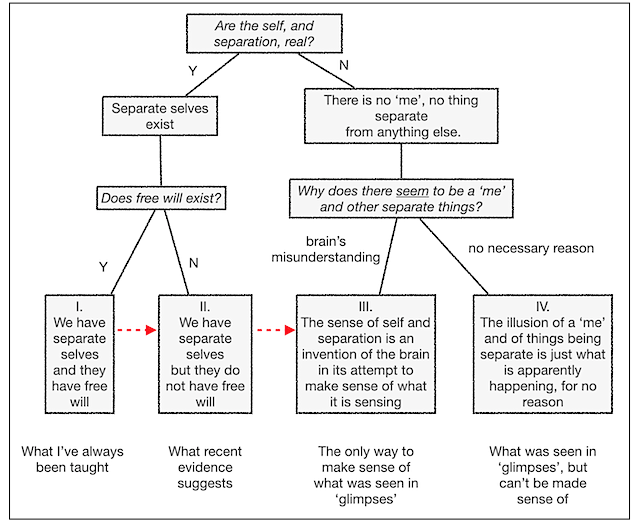
I should have realized that my recent post on Who ‘We’ Are would get me embroiled in a discussion on ‘free will’. So here’s Part Two of this existential rant, to hopefully explore and clear up some of the comments and questions the first article provoked.

In Straw Dogs John Gray writes that “free will is a trick of perspective,” based on the self-delusion that there is “an inner person directing our behaviour.”:

We act in the belief that we are all of one piece, but we are able to cope with things only because we are a succession of fragments. We cannot shake off the sense that we are enduring selves, and yet we know we are not.

These ‘fragments’ that are conceived by our minds are what Stewart and Cohen call “figments (simplified, invented models) — of reality“. Our ‘minds’, they argue, are nothing more than processes that produce these figments (originally for the benefit of our cells’ and organs’ survival, but now, with the increasing power of our culture due to language, also appropriated by our culture).

This is what I was getting at in the previous article when I said that one’s ‘mind’ is a battleground, without any ‘natives’ to defend the territory, where a ceaseless battle rages between the cells and organs of our bodies which evolved our brains as a feature-detection, protection and mobility management device for their purposes, and our culture which uses every available form of propaganda and coercion to try to seize control of our minds for their purposes. As our culture accelerates over the edge of a cliff, these ‘purposes’ are increasingly divergent.

That we have a ‘choice’ between doing what our cells and organs would have us do, and doing what our culture would have us do, hardly constitutes ‘free will’, as humanists would have us believe. It is hard to imagine anything further from ‘freedom’ than to have to make a Sophie’s choice between two irreconcilable alternatives, the choice of either of which will inevitably hurt us, either through damage to our physical and/or mental health, or the angry opprobrium of the well-brainwashed majority in our culture.

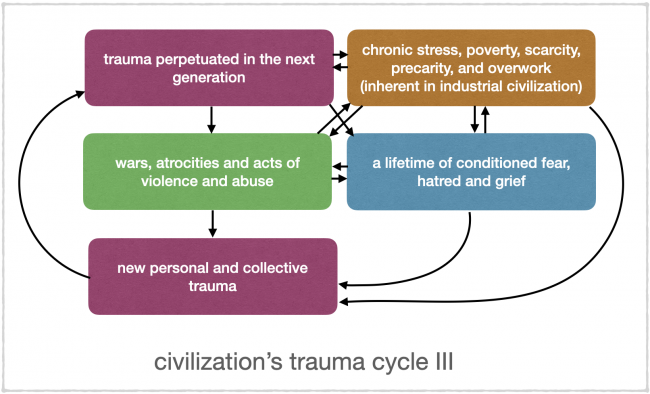
In Tolle’s model (above, left), the constant traumas inflicted upon us by our dying, ruthless culture produce a vicious cycle: Our brains invent stories to try to ‘make sense’ of our suffering, and these stories in turn provoke negative emotions (anger, fear, grief etc.), our experience of which reinforces the ‘validity’ of these fictional stories. Many stressful events in our culture (e.g. attacks on us or our loved-ones or our beliefs, bad news about the planet, and a million others) trigger these negative emotions and the stories that we’ve invented to try to make sense of them. Our culture puts its ‘spin’ on each event’s story to pressure us to do its bidding, or to make us believe there is nothing we can do. As a result we are intellectually and emotionally incapacitated, often to the point of chronic mental and physical illness.

So the battle between our biology and our culture for control of our minds (and hence control over our beliefs and actions) is further aggravated by these incapacitating triggers, which take our minds (our intellectual and emotional ‘selves’) hostage. Many of us dissociate, and, in order to try to avoid the triggers, endeavour to live inside our heads, disconnect the four aspects of our ‘selves’ (intellectual, emotional, sensual and intuitive) from each other and from the ‘real’ world, and hide away in a ‘safe’ world of our own making. Except it’s not really our own making: We are really living inside our culturally ‘dis-eased’ mind. This ‘we’ that is doing so is, of course, another fiction — our ego, a cultural construct that exploits a brain that is too smart (and too vulnerable to stress) for its own good. As Gray explains, this ego is just a self-delusion that an inner person is directing our behaviour.

It’s very difficult to shake the delusion that our ego is ‘real’ however, because our culture constantly tells us it is real — and as long as we all believe our egos are ‘real’ we will go on reinforcing that delusion in our every contact with others. The culture tells us that we must take responsibility (as our culture defines responsibility, which in today’s overwrought world is tantamount to self-induced imprisonment and slavery), that we must do what those in power tell us (on threat of punishment), and that we must conform and be like everybody else (or be shunned and ostracized). It also tells most of us that we are sinful, vulnerable and only worth what our culture deems us to be worth.

Inevitably and endlessly our culture fills us with feelings of guilt, fear, shame and self-loathing, and false stories that support these feelings.  When the egoic mind and the ‘pain-body’ (the chronic negative emotions the egoic mind’s stories provoke) churn fast enough, we slide into depression (a form of disengaging from our emotions and thoughts when they become too much to bear), or lash out against others (in personal violence or collective wars), or retreat into paralysis or denial (consumed by fear, or nostalgia, or irrational magical thinking). Our culture knows how to pull the triggers and exploit the ego only too well.

Much has been written about how to ‘realize’ that the egoic mind and pain-body are not real; they are just, as Stewart and Cohen say, ‘figments of reality’ — false models, self-constructed and culturally-reinforced fictions. Even more has been written about how to free ourselves from them.

If we can do so, if we can get rid of the fictional egoic ‘gunk’ that our culture has, throughout our lives, layered on us, our ‘selves’ begin to look more like the ‘present’ self on the right side of the illustration above. With the deception of the ego gone, we are free of the controlling and debilitating effects of culturally-induced triggers. Our senses, instincts, intellects and emotions are reconnected with each other and with the ‘real’ world, and we become healthy and fully functional — that amazing combination of relaxation and awareness that allows us to be fearlessly open to what our instincts, senses, emotions and intellect perceive (not what they conceive, nor what others conceive and urge us to take as ‘true’), and at the same time calm, comfortable and competent to assess what they mean, without bias, judgement or expectation.

In this ‘frame of mind’ we can be both fully present and at peace in the world (the way I believe most wild animals live, most of the time), and able to bring a mindful approach (rather than a reactive one) to each event we face, such as the 7-step process I have tried to use: Sense, self-control, understand, question, imagine, offer, collaborate. The knowledge (instinctive, emotional, sensory and intellectual) we have and can draw on can then be integrated and appropriate actions taken, in the moment.

But if we are just a collection of cells and organs who have evolved a ‘mind’ to create useful (to them) figments (models) of reality, a mind that is, to some extent or other, invaded and controlled by our culture, who, then, is taking these ‘present’ actions?

I would argue that it is our cells and organs, ‘speaking’ to us through our cleared minds. Our senses and instincts are primeval, and the knowledge they convey to us requires no mental model, no ‘figment of reality’. Our minds, when they are as free of cultural baggage as possible, use our instincts’ and senses’ knowledge to decide on actions that are in our cells’ and organs’ interest. These need not be selfish actions — our bodies are ‘smart’ enough (consider e.g. the urge to procreate, to socialize, and to nurture) to act in concert with others in the greater good of all-life-on-Earth, which they (we) instinctively appreciate — our biophilia is innate, an evolutionary prime directive in our genes, at least when this biophilia is not overridden by the nature-fearing stories of our culture.

Our cells and organs prompt us in integrating this knowledge by producing chemicals that evoke strong emotions (in the natural world these are mostly positive, except in fight-or-flight situations) to goad us into appropriate behaviours.

Our culture is of no help at all in this process. In ‘less-civilized’, healthy societies the culture of the people rarely interferes to compel its members to act against their cells’ and organs’ interests. Individuals in such societies are trusted to make their own decisions, without coercion; the purpose of the culture is to provide objective knowledge through stories, not to advise.

So what’s wrong with our ‘civilized’ culture, that it has so overstepped its bounds of helpfulness, and now tries to control ‘us’ to the point we are mostly ill, disconnected, imprisoned, and dysfunctional?

My guess is that our culture became, as a consequence of our own inventiveness, perverted, deranged, cancerous. When our species faced crises that threatened our existence, our response was to invent the arrowhead, and then agriculture, and then settlement — ‘civilization’. Without these inventions we might not have survived the ice ages — earlier rounds of severe climate change.

But these new inventions required a great deal more interdependence and associations much larger than tribes — the bigger the better. We naturally did not take to the constraints such interdependence and scale required — hierarchy, conformity, obedience, settlement, dependence on fragile human systems, and suffering with plagues, famines and violence, all consequences of living in unnaturally large numbers in close quarters. Our culture, which as ‘software’ can evolve must faster than our cells’ and organs’ ‘hardware’, adapted quickly to the need to enforce compliance and uniformity. Language was its most powerful tool. As civilization ratcheted up to 100 million people, and then a billion, and now seven billion, the culture has needed to restrict personal ‘choices’ and freedoms more and more. It had to get inside our heads and control us, from birth, put us in thrall to civilization culture to keep us in line, keep fuelling the culture. And that’s where we are today — like lab rats starved of food, beginning to eat our own young.

The libertarian-anarchist streak in many of us is producing a now-futile yearning to be free from civilization’s control. But our civilization is collapsing, and as it does survival will depend on our ability to reconnect, to be present and at peace — to be nobody-but-ourselves, feral, social in a collaborative and diverse way, not in civilization culture’s coercive and homogeneous way.

I sense that this is what those who have moved past the Second Denial are now trying to do. We are trying to simultaneously unplug from civilization culture’s thrall (freeing ourselves from the egoic mind and pain-body) and reconnect to the larger ‘organ’/society of all-life-on-Earth, whose voice has been all but drowned out by civilization’s noise.

This does not mean moving to neo-survival mode, but rather moving away from civilization culture’s broken, desperate, coercive survival mode. Moving from a society whose worldview is one of scarcity, competition, obedience and sacrifice, to one whose worldview is one of abundance, cooperation, independence and generosity. Moving forward to a natural society. One that trusts the wisdom of each individual’s cells, organs, instincts, senses, emotions, intellect, biophilia, to know just what to do, and to act on that holistic wisdom. One that through its connection to all-life-on-Earth intuitively and collectively and wordlessly manages its numbers and behaviour (as most complex natural species do) to contribute to, not destroy, the complexity and diversity of life on our planet. In our cells, in our organs, in our DNA, this is who we are, and who we always have been, except for a few desperate millennia, when we forgot.

.     .     .     .     .

Postscript: When I wrote the earlier post arguing that we have no identity, that there is no inner person directing our behaviour, a couple of respondents asked me: What about music? If there is no ‘me’, who/what is it that responds so viscerally and rapturously to great music — even if that music has no words?

My tentative answer to this is that music cuts through the ‘gunk’ of our egoic mind and pain-body, kind of like how a dishwashing detergent cuts through grease. It doesn’t get rid of it, it just makes it seem to disappear for a while, gets it out of the way. Music goes right to our emotions, and I think it may short-circuit the vicious cycle that connects our egoic mind (those ghastly fictitious stories) and our pain-body (the negative emotions that these stories evoke). The direct connection temporarily cuts off the stories and stops the vicious cycle. The result can be an amazing feeling of relief, calmness, awareness. When my depression is at its worst, I know when I begin to respond to music that it’s lifting. This is when I cry, and it’s wonderful.

There are other ‘sensations’ that likewise seem to cut through and cut off the egoic-mind/pain-body connection. While I’m sure they are different for everyone, for me they are:

  • lights and/or sounds in the darkness — the moon, streetlights, rain, the night calls of birds and animals, fragrant breezes, storms etc.
  • falling in love
  • poetry — especially brief, powerful, lyrical turns of phrase that directly call up an emotion or paint a picture
  • playing with animals
  • being in hot water — hot tubs, baths, even showers, seem to liberate my mind from intellectual constraints and stimulate my imagination
  • sometimes, movement — being in a gently moving vehicle that I’m not driving

There is something about all these experiences that accentuates the sensual, relaxes and stimulates at the same time. The senses and instincts take over and then appeal directly to the emotions or the intellect. For a short while, I am ‘cured’ of the suffering and dysfunction in the upper left diagram, and able to function in the healthy way depicted in the upper right diagram; freed briefly from the suffocating ‘dis-ease’ of our culture.

November 5, 2011

The Metamovement’s Message: “We’re Not Buying It Any More”

Filed under: Preparing for Civilization's End — Dave Pollard @ 05:46

The Metamovement (the umbrella term for the Occupy Movement, the Indignant Movement, the Arab Spring Movements and other anti-capitalist and pro-true-democracy movements around the world) has succeeded in drawing attention of many citizens to the fact that the actions of powerful, amoral large corporations are now much worse for the 99%, and for our planet, than those of large governments.

More importantly, there is a dawning acknowledgement that railing at governments now solves nothing — replacing politicians with others is ineffectual, adding more regulation or taxes on the rich (when there is no political will, no resources for enforcement, and infinite loopholes for the 1%’s army of expensive and well-connected lawyers to exploit) accomplishes nothing, and deregulating and allowing the ‘markets’ (i.e. the capitalist oligopolies) to solve our problems is a recipe for disaster, fraud and bankruptcy. And likewise, we can not possibly hope for or want a resurgence of “economic growth” (which accrues inevitably and entirely to the 1% in today’s hopelessly broken systems) to get us out of the hole we’re in.

The 99% is beginning to realize that, while they definitely need to make demands — for fairness and more equitable distribution of income, wealth and power, for example — to keep the corporatists’ vile excesses from getting even worse, trying to “reform” the present-day political and economic systems is fruitless, a waste of time and energy.

Instead, what is needed is for the 99% to walk away from the current unsustainable, rapacious, soul-destroying and Earth-destroying systems the 1% have so effectively exploited to their own advantage — the political, economic, work, media, education, health, and technology systems on which we are all, today, utterly dependentand build a new culture with new systems and infrastructure, bottom-up, egalitarian, community-based, focused on the welfare and well-being of all, without the 1%’s help or the need for their support.

Just like those who walked away from past ‘civilized’ cultures when they began to crumble, we have to start now to build a new culture, and let the current one die. In fact, we need to help it die faster instead of encouraging it with bailouts, subsidies, tax breaks, artificially suppressed interest rates, cheap labour and meaningless consumption and crushing indebtedness — encouragements whose benefits accrue entirely to the 1% and are all at our expense.

To help it die faster we need to starve it — of our spending, our labour, our investment, our votes, our financial indebtedness, our tax dollars, and most of all our quiet complacency, compliance and complicity in its oppression of us all and its destruction of our planet. And in doing so we need to show solidarity with those of the 99% who live in struggling nations, by ending our wars (declared, undeclared and secret) against them, by forgiving their debts, and by giving them back the land and resources that the 1% extorted from them in collusion with the local thugs our so-called democratic governments installed and supported to run their countries.

To do all this we have to starve the growth-addicted capitalist system until it collapses (it’s already teetering), and then dismantle it and return its stolen property to the people of the local communities it has turned into social, political and economic dependants. The 1% are not stupid, though, and knowing this day would come they have worked very hard to shift the entire economy from a production one that depends on dedicated and thoughtful labour and innovation, to a financial one that depends on endless increases in spending and indebtedness, where wealth comes not from making anything useful but from the mere printing of money and the perpetuation of the illusion that only money — not anything else, not work, not love, not collaboration, not citizens’ health or well-being, not people at all — has value. They have successfully brainwashed us to believe that our only value in this society is as consumers, and as borrowers to fund ever more consumption.

It’s time to call their bluff, and tell them: We’re not buying it any more. We’re not buying any more their crappy goods made by the 99% working in virtual slavery in struggling nations. We’re not buying any more the propaganda their media spin out about the importance of GDP and “growth” and stock prices and austerity (for the masses) and the need to keep slavishly paying the crushing mortgages on underwater homes. We’re not buying any more the legitimacy of the police surveillance state created under the guise of fighting “terrorism” and now used to spy on, terrorize, destabilize and demoralize our own citizens. We’re not buying any more the crappy McJobs that are offered to us as crumbs when we leave the zombifying universities, drowning in debt. We’re not buying any more their wars, that chew up our poorest and naivest citizens as fodder in the imperialist crusade to steal the last of the world’s resources and to silence or imprison anyone who dares speak the truth about them. We’re not buying any more the worthless Ponzi scheme of stocks and bonds that provide cheap capital to shift even more wealth and power to the 1%, and the fear-mongering that if we stop believing in them we will lose our life savings and our pensions. We’re not buying any more the bailouts and subsidies and handouts to the ultra-rich and ultra-reckless 1%, that our tax dollars have been stolen to fund. We’re not buying any more that wealth trickles down and that anyone can be or do anything if she or he applies herself or himself hard enough. We’re not buying any more that our chronic illnesses and grinding poverty and homelessness and unemployment are somehow our fault. We’re not buying any of it any more.

In the streets of our cities, in protest, in indignation, in revolution, in conversation, in comradeship, in community, we’re realizing that everything the 1% have told us and sold us is a lie, and we’re beginning the work at last to “buy instead” a new vision of how the world can work. A vision we are just starting to put together. A vision the realization of which we are preparing to invest our labour, our energy, our inventiveness, our passion, our earnings, our savings, and possibly the rest of our lives to achieve.

It’s a vision of people making decisions in our communities that benefit everyone, respectfully, listening and appreciating all points of view, seeking consensus, collaborating, letting the wisdom of the crowd emerge, and respecting generations yet unborn, and all life on Earth.

It’s a vision of finding meaningful, joyful, creative work for everyone, doing things we are competent, even exemplary at doing, which meet real, local, human needs and leave the planet better than we found it. And providing the products of that work generously to those who need it, and our knowledge to those who wish to do similar work, without expectation of reciprocity or payment, without fear, without competitiveness, knowing that in this way everyone in the community will look after each other, and no one need keep score of who did how much of what in this win-for-all cause.

It’s a vision of deschooling us all so that we relearn how to learn and think critically and rediscover the joy of learning what we want to learn, when and how we want to learn it, by doing and participating and watching and being mentored, and knowing that in this way we will discover the work we were meant to do, and dive passionately into the challenge of learning how to do it well, and continuing to learn, in everything we do for our whole lives.

It’s a vision of a world where information and actionable news is conveyed through conversation, dialogue, in context, where we make sense of it together, in thoughtful deliberation.

It’s a vision of living a healthy self-managed life in a healthy community, preventing rather than having to treat accidents and illness, self-monitoring, self-treating, helping each other and drawing on the wisdom of many kinds of skilled healers when needed, and, when our time comes, dying with dignity.

It’s a vision of living sufficiently, modestly, sharing and belonging (with each other, to the place we live, as part of all-life-on-Earth) rather than owning and dominating. Of entertaining ourselves imaginatively in our abundant leisure time, and rediscovering the meaning and value and joy of play.

It’s a vision of a world where the pursuit of growth and ‘progress’ are seen as folly, where envy and possessiveness and jealousy are seen as childish and unseemly, where anger and fear and sadness are transient and acknowledged by others with compassion and understanding and a desire to help heal, and where the measures of how well we are doing are the amount of love in the community, the amount of genuine laughter, and the freedom of all creatures, at last, from suffering, from confinement, and from fear. All made possible because our new culture sees the world as a place of abundance and not of scarcity, and makes it so…

Some of the people involved with and attending the Metamovement’s events are seeing the stirrings of this already. Robert Jensen is listening in, and advising us that the systems we need to replace are collapsing now and that even (perhaps especially) the 1% know it:

The inhuman and antidemocratic features of capitalism mean that, like a cancer, the death system will eventually destroy the living host… The people who run this world are eager to contain the Occupy energy not because they believe that the critics of concentrated wealth and power are wrong, but because somewhere deep down in their souls…the powerful know we are right. People in power are insulated by wealth and privilege, but they can see the systems falling apart. US military power can no longer guarantee world domination. Financial corporations can no longer pretend to provide order in the economy. The industrial system is incompatible with life.

Michael Albert suggests how the Metamovement can begin the task of building a new culture by reaching out, listening to and engaging the rest of the 99% and then moving into community-building activities like education, housing and the arts:

Why not have classes for learning? Why not have activities for creating?… Why not have a program of activities that returns people to their home locales for organizing purposes each night, or even for all but the explicit time of assembly meetings, perhaps?… [O]nce an occupation has a lot of people, have subgroups initiate other occupations in more places, all federated together and providing one another mutual aid. In the most local, neighborhood occupations, visit every home. Talk with every resident. Involve as many neighbors as possible. Determine real felt needs. If what is most upsetting neighbors is housing concerns, daycare issues, traffic patterns, mutual aid, loneliness, whatever, try to act to address the problems. Have occupations self manage and create innovations artistically, socially, and politically. Have occupations occupy indoors, not just outside… [G]o get them [the rest of the 99%], inform them, inspire them, enlist them, empower them, and they will come.

And philosopher and lifelong activist Grace Lee Boggs tells us that:

You begin with a demonstration. You begin with a protest. But you have to move on from there, and that’s what I see happening now with [the Metamovement]. The people are rightfully, righteously protesting the corporations and the domination of the culture by the corporations and the suffering that that is inducing. But out of the protests they have to move to another stage.

You have to begin doing something that doesn’t depend on exposing the “enemy”. You have to begin becoming the solution yourself instead of just protesting and challenging the enemy. We need people to be reinventing the institutions in our society: Reinventing work, so that we don’t think that having a job and being able to pay the bills is what being a human being is all about. And reinventing education, so that our young people are able to see themselves as part of the rebuilding of our society.

So many of the institutions of our society need reinventing, need re-thinking, and you [the Metamovement] need to do that. You cannot be satisfied with rebelling. You have to be aware that we are at one of the turning points in history where we need revolution, and revolution means reinventing culture.

Reinventing culture, creating a new vision that returns power to the people and strives for well-being for all, is an epic challenge, and if it is successful at all, it will take a generation or more. It starts by realizing that, as Hendrik Hertzberg of the New Yorker has said, it is the systems that are broken, and irreparably so. The 1% have exploited them, ruthlessly and methodically, for their own advantage, but no one is in control. To reinvent our culture, so that the 99% have something else to ‘buy’, instead of trying to get politicians or other ‘leaders’ to ‘fix’ the systems, and instead of believing that the only problem is an evil, greedy 1%, we have to abandon those systems and create new ones from the ground up, that will help us achieve the vision I described above.

I’ve written before that I’m not optimistic that the Metamovement, or anyone, can succeed in this mammoth task. We’re all exhausted already, and few are up for this dangerous, risky and all-consuming challenge. It is easier, and safer, to stay in denial, to listen to the messages that promise better times ahead with patience and some minor tinkering with the existing systems. This desperate belief in the sustainability of our bankrupt and desolating culture is the Grand Delusion of our age. Its adherents run the gamut of the political spectrum and include religious salvationists, techno-salvationists, humanist salvationists, and all manner of libertarians, idealists, neo-cons, neo-liberals, free-marketers, reactionaries, denialists, wishful and magical thinkers, and of course corporatists. There are a lot of them in the 99%, and we’ll have to be patient until they’re ready to listen, and to join us.

I still think the Grand Delusion will prevail for at least another decade, and will be fuelled by exploiting  the remaining resources of our planet even faster and more recklessly, and by printing even more imaginary wealth into existence, and pretending it has value. But I no longer think we’ll last until the 2030s before the Grand Delusion loses all credibility and the next Great Depression hits. And, as Sharon Astyk has said, we won’t have cheap energy to power ourselves out of it next time.

At some point reasonably soon our cartoon coyote civilization is going to look down and realize the cliff edge was back there. A growing number in the Metamovement have realized this already. There is and will be no option of clawing our way back to the cliff. Although momentum is now on our side, gravity is not. The real question is, if we don’t start right now — and even if we do — do we have any hope of learning to fly before we hit the ground?

(thanks to Tom Atlee and Maia Duerr for some of the links above)

November 3, 2011

Who ‘We’ Are: An Existential Analysis

Filed under: Our Culture / Ourselves — Dave Pollard @ 23:56

If there is a consensus in the responses I have received to my recent posts about being unhappy and ‘un-present‘, I think it would be:

  • I should be grateful (and ‘get over myself’)
  • I should stop thinking so much and just be
  • I should act (do what my instincts tell me ‘needs’ to be done) and those actions will resolve my unhappiness and lack of presence (along these lines, this fascinating article asserts our actions drive our beliefs — what we do determines who we are — rather than the other way around)

We are, I believe, products of both (a) our biology (‘we’ are a collection, a complicity, of cells and organs in a watery sack, cells and organs that together evolved our minds, our ‘consciousness’, as a feature-detection, protection and mobility management device for their — our organs’ — benefit) and (b) our culture (we are ‘each’ a part of an evolving society, a larger organism, self-organized for our collective survival). Both ‘we’s’ are extraordinarily complex, beyond more than rudimentary knowing, so we flounder around, pushed in often different directions by our biological selves and our cultural selves, profoundly un-self-aware and profoundly ‘alone’.

We have, arguably, no identity — there is no ‘us’ other than our constituent organs (whose consciousness and knowledge are largely unfathomable to our ‘minds’) and the self-delusion of ourselves as ‘individuals’ which has been created and ‘taught’ to us by our culture (through its propaganda tool, language) for their collective purpose. Our cells and organs, our microcosmic selves-as-collection, are in a relentless war with our culture, our macrocosmic selves-as-part, and the battleground is our minds. We might see ourselves as being at the mercy of two colonizing forces, one that created our minds for its purposes and the other trying endlessly to co-opt our minds for its purposes. Except that there is no ‘ourselves’ to be colonized. The suffering and weary terrain of our minds has no natives. There is no ‘us’ to take sides in this battle. We are, as I keep saying, just the space through which stuff (chemicals, information, ideas) passes.

I don’t mean this post to be about the existence, or not, of free will. I am trying to get at something more profound, about the non-existence of identity. When we fall in love, when we crave, or nurture, or erupt, or laugh, or cry, or cower, or mourn, we are doing our biology’s carefully-selected bidding — our cells and organs count on ‘us’ doing these things, for their health and survival, so they flush our minds so full of powerful chemicals that we can do nothing else. When we join others, in war, in celebration, in protest, in recreation, in obedience, in activism, in outrage, in conversation, in solidarity, in community, and especially in acceptance of our social situation, social norms and worldviews, we are doing our culture’s carefully-programmed bidding — our civilization counts on us doing these things, for its health and survival.

When the imperatives of our biology (“go hit on that beautiful creature over there”) and those of our culture (“unfaithfulness to one’s partner — and you can only have one partner –  is a sin with ghastly consequences”) are in conflict, we feel obliged (and empowered) to make a ‘choice’ which to obey. But it is hardly a choice — ‘we’ are in truth merely spectators of the conflict, and they will determine the winner.

When my cells and organs have decided it is in their interest for me to make a bond with someone, they stimulate my imagination to create a fiction in my mind of who that person ‘is’, what they are feeling, and what my relationship with them is or could or should be, that cannot possibly be real, since no one can ‘know’ what it is to be another person. The two of us act out a script, more or less mindlessly, that has been written by our respective bodies, in testosterone and oxytocin and other colourful inks, with characters and plot sufficiently delicious to make us enjoy the performance, and hopefully to enchant us to repeat it, at least until it gets boring and a change of cast is called for.

Likewise our culture uses us, brainwashing us from birth into believing that we have rights within and responsibilities to that culture, and that the way it dictates we live our lives is the only way to live, until we lose awareness that we have given up our freedom (in order to continue at a scale of 7 billion, our culture must now dictate and micromanage our every behaviour) and our health (our bodies are not evolved to cope with civilization’s endless and intense anxiety, so stress-catalyzed chronic physical and mental illnesses are epidemic). And in the process, we have mindlessly desolated our planet and precipitated a sixth great extinction of life on it.

Why has our culture done this to us? As I have written before, I think it is because we became too smart for our own good. Much of what civilization has wrought is an unintended consequence of the evolution of the human brain to the point that our inventions and technologies outpaced our ability to come to grips with their consequences, and to the point that we fell under the thrall of the imagined world inside our heads and others’ ability to manipulate that world, until we became, as ee cummings put it, “everybody-else” — the tide in the war between our biology and our culture shifted inexorably in favour of the latter. Once we became ‘smart’ enough to realize at an existential level that we were completely, utterly alone, we were even more willing recruits to the side of our culture, which comforts us with the illusion that we are not.

So now, retired, with a comfortable pension, free of debts and obligations, living by myself on top of a hill on a staggeringly beautiful island, I am free, at last, to spend the time to contemplate what all this means. To strip off the mask and belief systems and worldview and other gunk that my culture covered me over with for more than fifty years and told me was ‘me’ and stand naked, feral, unencumbered. To stand outside my biological self, still preoccupied with creature comforts and its self-induced chemical addictions. To stand outside my cultural self, so long preoccupied with the carefully-crafted fictions about my ‘self’ and the past and the future and how to behave.

And to realize that, outside of these two warring tyrant ‘selves’, there is no ‘me’. No volition. no ego, no identity, no purpose. Just space.

When I first experienced this ‘spacey’ feeling I feared it was disconnection, which is often, for me, a precursor to depression. But I’m starting to realize that it’s not disconnection from all-life-on-Earth, but from civilization culture, and it’s not disengagement, it’s re-engagement, liberation. It’s just very new to me, and not a little scary. I don’t know what to do with my ‘self’. I am meditating, taking yoga, and spending as much time as possible language-free (no talking or listening or reading or writing). I am listening to, and writing, songs without words. I am spending time in nature trying to just be, to accept what is, to let go, to really see and sense and feel. Raw.

When I am with people, now, even people I love, I am impatient. I don’t want to behave in a ‘civilized’ way anymore. I don’t want to talk at all. I don’t want to care about how others have been trapped by civilization culture, and the terrible minutiae and infinite suffering of their lives — I don’t believe in ‘saving’ people, and recognize (at last) that it is up to them to liberate themselves. I just want to ‘be’ with people who just ‘are’ themselves. Uncivilized. Primal. Wild. In the hope that, in their presence, we can learn together how to be nobody-but-ourselves.

I sit here, naked, on the deck, on the hill, staring up at the moon. Rachmaninoff playing in the background, and the sound of owls in the dark in the nearby trees. Breathing. Letting go. Dissipating, falling apart, crying, howling, becoming part of all-life-on-Earth, which calls me, always, quietly, home.

Powered by WordPress