<?xml version="1.0" encoding="UTF-8"?>
<rss version="2.0"
	xmlns:content="http://purl.org/rss/1.0/modules/content/"
	xmlns:wfw="http://wellformedweb.org/CommentAPI/"
	xmlns:dc="http://purl.org/dc/elements/1.1/"
	xmlns:atom="http://www.w3.org/2005/Atom"
	xmlns:sy="http://purl.org/rss/1.0/modules/syndication/"
	xmlns:slash="http://purl.org/rss/1.0/modules/slash/"
	>

<channel>
	<title>how to save the world</title>
	<atom:link href="http://howtosavetheworld.ca/feed/" rel="self" type="application/rss+xml" />
	<link>http://howtosavetheworld.ca</link>
	<description>In search of a better way to live and make a living, and a better understanding of how the world really works.</description>
	<lastBuildDate>Tue, 14 May 2013 07:44:06 +0000</lastBuildDate>
	<language>en-US</language>
	<sy:updatePeriod>hourly</sy:updatePeriod>
	<sy:updateFrequency>1</sy:updateFrequency>
	<generator>http://wordpress.org/?v=3.5.1</generator>
		<item>
		<title>The Cognitive Dissonance of the New Yorker and the NYT</title>
		<link>http://howtosavetheworld.ca/2013/05/08/the-cognitive-dissonance-of-the-new-yorker-and-the-nyt/</link>
		<comments>http://howtosavetheworld.ca/2013/05/08/the-cognitive-dissonance-of-the-new-yorker-and-the-nyt/#comments</comments>
		<pubDate>Wed, 08 May 2013 10:25:01 +0000</pubDate>
		<dc:creator>Dave Pollard</dc:creator>
				<category><![CDATA[Preparing for Civilization's End]]></category>

		<guid isPermaLink="false">http://howtosavetheworld.ca/?p=5784</guid>
		<description><![CDATA[cartoon by David Sipress  from (of course) the New Yorker I don&#8217;t read much &#8216;news&#8217; anymore. I read articles and books that promise new knowledge, insight, ideas or perspectives on the huge energy, economic and ecological challenges facing us now, as our civilization accelerates into collapse. I read articles and books that offer practical actions [...]]]></description>
				<content:encoded><![CDATA[<p><a href="http://howtosavetheworld.ca/images/sipress-cognitive-dissonance.jpg"><img class="alignnone size-full wp-image-5789" alt="sipress cognitive dissonance" src="http://howtosavetheworld.ca/images/sipress-cognitive-dissonance.jpg" width="439" height="340" /></a></p>
<p><span style="font-size: x-small;"><em>cartoon by <a href="http://www.condenaststore.com/-st/David-Sipress-Cartoons-Prints_c146242_p6_.htm">David Sipress</a>  from (of course) the New Yorker</em></span></p>
<p><span style="font-size: large;">I</span> don&#8217;t read much &#8216;news&#8217; anymore. I read articles and books that promise new knowledge, insight, ideas or perspectives on the huge energy, economic and ecological challenges facing us now, as our civilization accelerates into collapse. I read articles and books that offer practical actions that go beyond protesting and signing petitions. They&#8217;re pretty rare these days, and seem to be getting rarer.</p>
<p>I continue to skim the headlines of the NYT every day, and pick from them the articles and op eds (perhaps one every couple of days) that would seem to meet the above criteria. And I read the New Yorker every week, focused on the lead editorial, James Surowiecki&#8217;s column when he&#8217;s in good form, and an average of one in-depth report each week (some of them are small-book length), though the quality of the reporting is variable and the trend is discouraging. And of course I read the cartoons.</p>
<p>The alt-media resources I read mainly for local news (the Tyee, Vancouver Observer and Vancouver Media Co-op mostly), to keep abreast of recent corporate and government atrocities and the utter inability of our political system to deal with or even acknowledge them. There&#8217;s an election for a new Provincial Government next week, but in our FPTP system my vote is wasted, since the outcome in my constituency is already certain. I will keep alive my 43-year-long streak of always voting, and of never having my candidate even come close to winning. I&#8217;m confident that the new government (the NDP is expected to win by a wide margin), which purports to be pro-labour and light-green, will change essentially nothing, as they did(n&#8217;t) last time they were elected. I keep my expectations low.</p>
<p>Lately I&#8217;ve found myself rushing through the NYT and the New Yorker as quickly as possible, and I wasn&#8217;t sure why until this past week. I&#8217;m used to this with the dismal and unactionable articles in the &#8216;alternative&#8217; press, and now only subscribe to indymedia aggregators, and race through their headlines, out of habit, just hoping to find something non-whiny or actionable. But my Links of the Month still often contain links to intriguing articles in these two publications, so I was puzzled by my impatience at wading through them.</p>
<p>The first clue was when I realized the NYT was, at the same time it was including articles and op eds about the inevitability of disastrous climate change, constantly trumpeting the need for &#8216;economic recovery&#8217; and &#8216;new sustained growth&#8217;. The paper, I guess in the interest of keeping a broad swath of readers happy, as well as their advertisers, seems content to include articles with totally irreconcilable worldviews and contradictory messages and ideas, often on the same page. And this cognitive dissonance is not confined to the unreal writings of their three token conservative op ed writers (Brooks, Douthat and Friedman), which I never read.</p>
<p>What does it do to your brain when you read one of Paul Krugman&#8217;s pro-growth exhortations, and then flip the page and read that that growth is <em>precisely</em> what is precipitating the destruction of the natural environment, the critical exhaustion of natural resources, the obscene and ever-widening chasm between rich and poor, the spiral of unrepayable debt (financial, social and ecological) we are loading onto our children&#8217;s shoulders, the desperate economic state and ecological exhaustion of most &#8216;third world&#8217; nations, the stretching of our economy to a horrific and inevitable breaking point, and the disastrous and accelerating emission of carbon into our atmosphere? Yet the reader of the NYT is left with no choice but to wonder if they are (or the NYT is) missing something really, really important here. It&#8217;s like the right wingnuts who are somehow able to reconcile support for the Patriot Act with opposition to background checks for people buying assault rifles. It truly boggles the mind.</p>
<p>My guess is that most of the editorial staff of the NYT are still in denial about the inevitable collapse of our energy, economic and ecological systems, and hence our civilization culture. A few have probably read the books and articles of &#8216;collapsnik&#8217; writers and acknowledged that they might just be right (but hope they&#8217;re not), but while these few enable some of the reportage of collapse to get into the pages of the NYT, none of them is prepared (or, most likely, allowed) to point out the total cognitive dissonance between these reports and rest of the reporting in the newspaper. What would it take for a publication like the NYT to report that we&#8217;re fucked, and explain every day why that is? It would render almost everything else that appears in the paper trivial. So they just go on obliviously, I suppose hoping that no one will notice and call them on it, at least until it&#8217;s staring them in the face and the advertisers have all gone south.</p>
<p>This week&#8217;s New Yorker contains two articles that evidence the same kind of cognitive dissonance. The first is <a href="http://www.newyorker.com/reporting/2013/04/29/130429fa_fact_finnegan">The Deportation Machine</a> (full article, alas, is behind their paywall &#8212; here&#8217;s a <a href="http://rt.com/usa/obama-deportation-machine-exiles-american-423/">precis</a>), by William Finnegan, which describes the almost incredible ordeal of a wrongfully deported man (a life-long but dysfunctional US citizen with cognitive disorders who&#8217;s been severely damaged by childhood trauma) and the massive machinery that systematically and horrifically abuses citizens and immigrants under the guise of homeland security, and how these abuses have become much larger in scale and more flagrant under Obama than they were under Bush. He describes a Kafkaesque bureaucracy that works hand in hand with a bloated and run-amok security apparatus that is desperately trying to justify its existence and a cynical fantastically profitable private prison corpocracy that feeds off fear, violence and the abuse of power. The US is now deporting a record 400,000 people every year, in an impersonal, dehumanizing, brutal, mechanistic mass process that would make any observer or student of history shudder. The reader&#8217;s reaction is inevitably: <em>This is insane.</em> This is evidence of a state in the advanced stages of self-destruction and collapse. We have to find a way to stop this, and other abuses, soon. The globally embarrassing, intractable Guantanamo situation, the failure (and vulnerability to unwinding) of even modest health care reform, the debacle of attempts to put a lid on epidemic gun violence, and the militarization of the police and brutal repression of non-violent protests such as Occupy (all subjects covered in the New Yorker in the past couple of years), are all chapters in the same story, the story of a nation that has lost its reason and lost control of its agents of authority.</p>
<p>Yet a few pages on in the same New Yorker edition is a George Packer article called <a href="http://www.newyorker.com/arts/critics/atlarge/2013/04/29/130429crat_atlarge_packer">Don&#8217;t Look Down</a> (also behind their paywall), ostensibly about reportage of the current economic turndown versus reporting of the 1930s Great Depression. The article is all over the place, very briefly reviewing more than a dozen books from the 1930s and a similar number from the current &#8216;recession&#8217;. There seem to be two theses: (1) That it&#8217;s nowhere as bad as it was in the 1930s, and isn&#8217;t likely to ever be; and (2) That the reason there have been so few protests or mass movements this time around is that today there is &#8220;a lack of a vision of the future&#8230; and the moral and intellectual energy such a vision confers.&#8221; My response would be (1) Just wait a few years, and in the meantime read your colleague Finnegan&#8217;s article to see how dissent and desperate poverty are likely to be handled by your country&#8217;s enforcers of law and order; and (2) If the Occupy mission of ending abusive corporate personhood, and ending the obscene disparity of wealth and power that is killing the economy and the planet, isn&#8217;t a vision, what is?</p>
<p>But I read on, and finally got a sense of Packer&#8217;s real worldview of the society that Finnegan&#8217;s article exposes, as Packer ridicules Chris Hedges&#8217; <em>Days of Destruction, Days of Revolt</em>, supposedly for its &#8220;inflated prose&#8221;, but mostly because Hedges dares to talk about what underlies the desperation, the fear, the bewilderment, the lack of direction or purpose, the sense of hopelessness, the anomie that pervades modern American life. Here are two passes from Hedges that Packer picks out for special scorn, dismissing Hedges as someone who &#8220;can&#8217;t describe a dilapidated house without pronouncing damnation on the corporate state.&#8221;:</p>
<p style="padding-left: 30px;"><a href="http://www.thedailybeast.com/articles/2012/06/14/chris-hedges-and-joe-sacco-chronicle-mining-catastrophes-in-west-virginia.html">Those who carry out this pillage</a> [mountaintop removal] probably believe they can outrun their own destructiveness. They think that their wealth, privilege, and gated communities will save them. Or maybe they do not think about the future at all. But the death they have unleashed, the relentless contamination of air, soil, and water, the physical collapse of communities, and the eventual exhaustion of coal and fossil fuels themselves, will not spare them. They, too, will succumb to the poisoning of nature; the climate dislocations and freak weather caused by global warming; the spread of new, deadly viruses; and the food riots and huge migrations that will begin as the desperate flee from flooded or drought-stricken pockets of the earth. The steady plundering of the natural world, the failure to heed the warning signs of the planet, will teach us a lesson about the danger of hubris. The health of the land and the purity of water is the final measurement of whether any society is sustainable. “A culture,” the poet W.H. Auden observed, “is no better than its woods.”</p>
<p>What would cause a New Yorker reporter to ridicule such writing? I think it&#8217;s a fear of acknowledging the cognitive dissonance that allows the New Yorker to publish exposes like Finnegan&#8217;s sandwiched between greenwashing ads for Shell and Chevron. Here&#8217;s the second passage from <em>Days of Destruction</em> that Packer mocks, after setting it up this way: &#8220;Hedges takes [Occupy] for the first tremors of a revolutionary uprising against the long history of corporate and state atrocities described in his book. He ends with a dramatization of his arrest at a protest in front of the Goldman Sachs building&#8230;&#8221;:</p>
<p style="padding-left: 30px;"><a href="https://www.commondreams.org/view/2011/11/07-0">To be intelligent</a>, as many are at least in a narrow, analytical way, is morally neutral. These respectable citizens are inculcated in their elitist enclaves with “values” and “norms,” including pious acts of charity used to justify their privilege, and a belief in the innate goodness of American power. They are trained to pay deference to systems of authority. They are taught to believe in their own goodness, unable to see or comprehend—and are perhaps indifferent to—the cruelty inflicted on others by the exclusive systems they serve. And as norms mutate and change, as the world is steadily transformed by corporate forces into one of a small cabal of predators and a vast herd of human prey, these elites seamlessly replace one set of “values” with another. These elites obey the rules. They make the system work. And they are rewarded for this. In return, they do not question.</p>
<p style="padding-left: 30px;">Those who resist—the doubters, outcasts, renegades, skeptics and rebels—rarely come from the elite. They ask different questions. They seek something else—a life of meaning. They have grasped Immanuel Kant’s dictum, “If justice perishes, human life on Earth has lost its meaning.” And in their search they come to the conclusion that, as Socrates said, it is better to suffer wrong than to do wrong. This conclusion is rational, yet cannot be rationally defended. It makes a leap into the moral, which is beyond rational thought. It refuses to place a monetary value on human life. It acknowledges human life, indeed all life, as sacred. And this is why, as Arendt points out, the only morally reliable people when the chips are down are not those who say “this is wrong,” or “this should not be done,” but those who say “I can’t.&#8221;</p>
<p style="padding-left: 30px;">There are streaks in my lungs, traces of the tuberculosis that I picked up around hundreds of dying Sudanese during the famine I covered as a foreign correspondent. I was strong and privileged and fought off the disease. They were not and did not. The bodies, most of them children, were dumped into hastily dug mass graves. The scars I carry within me are the whispers of these dead. They are the faint marks of those who never had a chance to become men or women, to fall in love and have children of their own. I carried these scars to the doors of Goldman Sachs. I had returned to living. Those whose last breaths had marked my lungs had not. I placed myself at the feet of these commodity traders to call for justice because the dead, and those who are dying in slums and refugee camps across the planet, could not make this journey. I see their faces. They haunt me in the day and come to me in the dark. They force me to remember. They make me choose sides.</p>
<p>In order to justify writing this off as &#8220;inflated prose&#8221;, Packer has to dismiss the entire Occupy movement with two sentences: &#8220;But Occupy turned out to be a moment of its time &#8212; a cri de coeur, stylish, media-distracted, and&#8230; not so hardly wounded as easily killed&#8230; [w]ithout an idea of the future that&#8217;s genuinely shared by large numbers of people, a real and lasting solution to the conditions described in these books.&#8221;</p>
<p>It&#8217;s hard to imagine how Packer, if he indeed spent any time at Occupy at all, or had researched the ongoing work that Occupy is doing <a href="http://www.occupyfightsforeclosures.org/">fighting against foreclosures</a> and <a href="http://www.nytimes.com/2012/11/11/nyregion/where-fema-fell-short-occupy-sandy-was-there.html?pagewanted=all&amp;_r=0">helping hurricane victims</a> (far more effectively than the state did, and yes I appreciate the irony that this link is from the NYT), or had read any of the cogent analyses of <a href="http://howtosavetheworld.ca/2013/04/29/the-democracy-project/">what Occupy did and is now moving to do</a>, could say anything so outrageous. Unless it was to cover his own outrage, his own unease at having someone else draw the sensible, terrible conclusions that the New Yorker&#8217;s dystopian portraits of a country in collapse lead you to. While the New Yorker itself draws back, afraid of being too radical, too dark, of scaring off its complacent and respectable readers and rich corporatist advertisers. The cognitive dissonance is jarring.</p>
<p>I still read them, the New Yorker and the NYT. Now that I understand what they can add (some rare and often penetrating investigative reporting in the New Yorker, and occasionally brilliant &#8216;guest editorial&#8217; writing in the NYT), and what they can&#8217;t, or won&#8217;t add (a stark and unvarnished acknowledgement of what it really means), it&#8217;s less troubling to have to turn from their work to the work of the &#8216;collapsniks&#8217; who have moved past that denial and fear, and the absurd demand for &#8220;real and lasting solutions&#8221;, to provide the terrible knowledge of what has begun, and what is inevitably to come, and what we must do now to prepare for it.</p>
]]></content:encoded>
			<wfw:commentRss>http://howtosavetheworld.ca/2013/05/08/the-cognitive-dissonance-of-the-new-yorker-and-the-nyt/feed/</wfw:commentRss>
		<slash:comments>6</slash:comments>
		</item>
		<item>
		<title>The Democracy Project</title>
		<link>http://howtosavetheworld.ca/2013/04/29/the-democracy-project/</link>
		<comments>http://howtosavetheworld.ca/2013/04/29/the-democracy-project/#comments</comments>
		<pubDate>Mon, 29 Apr 2013 09:28:54 +0000</pubDate>
		<dc:creator>Dave Pollard</dc:creator>
				<category><![CDATA[Preparing for Civilization's End]]></category>

		<guid isPermaLink="false">http://howtosavetheworld.ca/?p=5774</guid>
		<description><![CDATA[my sketch of the &#8216;camps&#8217; of political and philosophical movements of the 21st century; elaborated on here David Graeber, who was actively involved in the early days of Occupy Wall Street and continues to work to advance its principles, starts his new book The Democracy Project with a fascinating (if long) personal history of how [...]]]></description>
				<content:encoded><![CDATA[<p><a href="http://howtosavetheworld.ca/images/New-Political-Map.jpg"><img class="alignnone size-large wp-image-5576" alt="New Political Map" src="http://howtosavetheworld.ca/images/New-Political-Map-650x647.jpg" width="650" height="647" /></a></p>
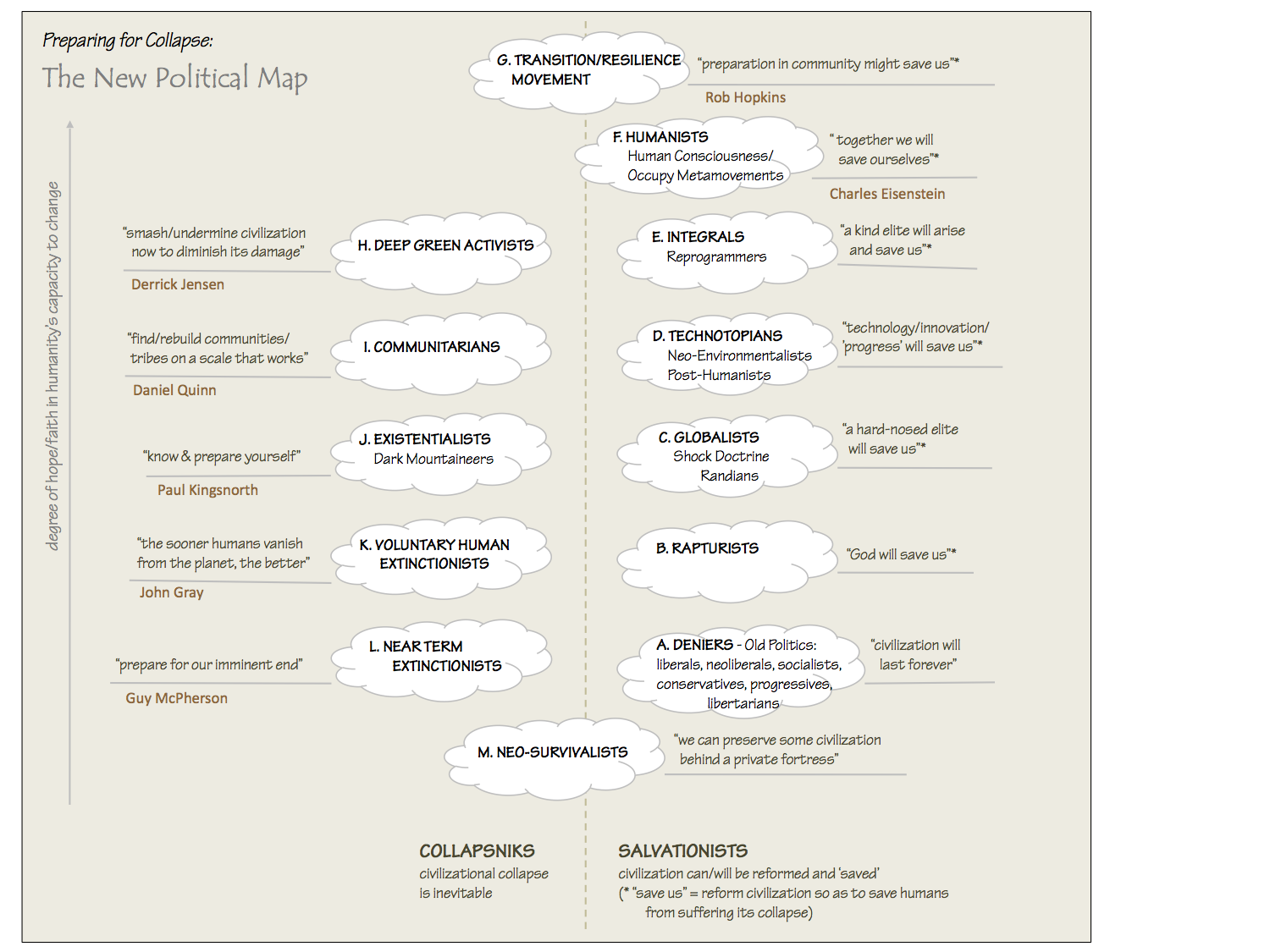
<p><span style="font-size: x-small;"><em>my sketch of the &#8216;camps&#8217; of political and philosophical movements of the 21st century; elaborated on <a href="http://howtosavetheworld.ca/2013/02/04/">here</a></em></span></p>
<p><span style="font-size: large;">D</span>avid Graeber, who was actively involved in the early days of Occupy Wall Street and continues to work to advance its principles, starts his new book <i>The Democracy Project</i> with a fascinating (if long) personal history of how OWS found its legs and what it had to deal with (notably the brutal suppression of November 2011 when the governments of the day decided to shut down the protest through a sustained, globally coordinated and ruthless operation, and the disgraceful behaviour of the media &#8216;covering&#8217; the movement, and then abruptly not covering it at all).</p>
<p>He sees OWS and its sister movements in Europe and the Mideast as important experiments in rediscovering the potential of a real democracy, and a society which retains real freedoms, even at a cost. To explain both the meaning and value of that, he presents a history of both democracy and anarchism that are starkly different from the histories we are taught in school. Democracy, he explains, was initially a derogatory term used interchangeably with the term &#8220;anarchy&#8221; by the ruling educated elites in most non-egalitarian, hierarchical, class-defined nations:</p>
<p style="padding-left: 30px;">Jackson was running as a populist—once again, against the central banking system, which he did temporarily manage to dismantle. As Dupuis-Déri observes, “Jackson and his allies were well aware that their use of democracy was akin to what would today be called political marketing”; it was basically a cynical ploy, but it was wildly successful—so much so that within ten years time all candidates of all political parties were referring to themselves as “democrats.” Since the same thing happened everywhere—France, England, Canada—where the franchise was widened sufficiently that masses of ordinary citizens were allowed to vote, the result was that the term “democracy” itself changed as well—so that the elaborate republican system that the Founders had created with the express purpose of containing the dangers of democracy, itself was relabeled “democracy,” which is how we continue to use the term today.</p>
<p>What is democracy, in its essence? David defines it this way:</p>
<p style="padding-left: 30px;">Democracy was not invented in ancient Greece. Granted, the word “democracy” was invented in ancient Greece—but largely by people who didn’t like the thing itself very much. Democracy was never really “invented” at all. Neither does it emerge from any particular intellectual tradition. It’s not even really a mode of government. In its essence it is just <b>the belief that humans are fundamentally equal and ought to be allowed to manage their collective affairs in an egalitarian fashion,</b> using whatever means appear most conducive. That, and the hard work of bringing arrangements based on those principles into being.</p>
<p>Consensus, rather than voting, has always, he says, been the preferred means of group decision-making in decentralized, non-militarized societies:</p>
<p style="padding-left: 30px;">Even if people throughout history have always known how to count, there are good reasons why counting has often been avoided as a means of reaching group decisions. Voting is divisive. If a community lacks means to compel its members to obey a collective decision, then probably the stupidest thing one could do is to stage a series of public contests in which one side will, necessarily, be seen to lose; this would not only allow decisions that as many as 49 percent of the community strongly oppose, it would also maximize the possibility of hard feelings among that part of the community one most needs to convince to go along despite their opposition. <b>A process of consensus finding, of mutual accommodation and compromise to reach a collective decision everyone at least does not find strongly objectionable, is far more suited</b> <strong>to [a true democracy</strong>, i.e. to] situations where those who have to carry out a decision lack the sort of centralized bureaucracy, and particularly, the means of systematic coercion, that would be required to force an angry minority to comply with decisions they found stupid, obnoxious, or unfair.</p>
<p>Over the past two centuries, while the term &#8220;democracy&#8221;, in its distorted current sense of voting for one or another slate of elite leaders, rather than as defined above, has developed a positive connotation, &#8220;anarchy&#8221; has developed a negative one, for reasons that suit those with power. David explains:</p>
<p style="padding-left: 30px;">In 1550, or even 1750, when both words were still terms of abuse, detractors often used “democracy” interchangeably with “anarchy,” or “democrat” with “anarchist.” In each case, some radicals eventually began using the term, defiantly, to describe themselves. But while “democracy” gradually became something everyone felt they had to support (even as no one agreed on what precisely it was), “anarchy” took the opposite path, becoming for most a synonym for violent disorder.</p>
<p>What then is anarchism? David defines it this way:</p>
<p style="padding-left: 30px;">Actually the term means simply “without rulers.” The easiest way to explain anarchism &#8230; is to say that it is a <b>political movement that aims to bring about a genuinely free society—and that defines a “free society” as one where humans only enter those kinds of relations with one another that would not have to be enforced by the constant threat of violence</b>. History has shown that vast inequalities of wealth, institutions like slavery, debt peonage, or wage labor, can only exist if backed up by armies, prisons, and police. Even deeper structural inequalities like racism and sexism are ultimately based on the (more subtle and insidious) threat of force. Anarchists thus envision a world based on equality and solidarity, in which human beings would be free to associate with one another to pursue an endless variety of visions, projects, and conceptions of what they find valuable in life.</p>
<p><a href="http://howtosavetheworld.ca/2011/11/19/links-of-the-month-november-19-2011/complexity-not-chaos/" rel="attachment wp-att-4654"><img title="complexity-not-chaos" alt="" src="http://howtosavetheworld.ca/images/complexity-not-chaos.jpg" width="640" height="427" /></a></p>
<p><span style="font-size: x-small;"><em>image from <a href="https://plus.google.com/u/0/photos/111694424168117997300/albums/5664298972076875585">Justin Bale’s OWS archive</a> </em></span></p>
<p>Far from being the philosophy of crazed bomb-throwers set on terrifying and unsettling the populace, anarchism has a long pacifist tradition, one whose greatest challenge is not a lack of purpose, but an almost dreamy idealism that many would probably think impossible to achieve in the &#8220;real&#8221; world. David asserts:</p>
<p style="padding-left: 30px;">[In Europe in the 19th and 20th centuries] anarchists insisted that it wasn’t just that the ends do not justify the means (though the ends do not, of course, justify the means) but that <b>you will never achieve the ends at all unless the means are themselves a model for the world you wish to create</b>.</p>
<p>David is pragmatic about how this convergence of real (direct, egalitarian, non-hierarchical) democracy and true (with complete freedom of action and freedom from violence and coercion) anarchism might be achieved. He seems to suggest we should <em>just start</em>; disconnect from the dysfunctional political and economic systems that current oppress us and try living together in ways consistent with democratic and anarchist principles (which are, in fact, totally aligned):</p>
<p style="padding-left: 30px;">It’s hard to figure out exactly what kind of anarchism makes the most sense when so many questions can only be answered further down the road. Would there be a role for markets in a truly free society? How could we know? I myself am confident, based on history, that even if we did try to maintain a market economy in such a free society—that is, one in which there would be no state to enforce contracts, so that agreements came to be based only on trust—economic relations would rapidly morph into something libertarians would find completely unrecognizable, and would soon not resemble anything we are used to thinking of as a “market” at all. I certainly can’t imagine anyone agreeing to work for wages if they have any other options. But who knows, maybe I’m wrong. <b>I am less interested in working out what the detailed architecture of what a free society would be like than in creating the conditions that would enable us to find out</b>.</p>
<p>To my colleagues doing the difficult and important work of being facilitators in a world used to right by might, David would suggest that it is you who are leading the anarchist charge, you who hold the key to helping citizens find a better way to live:</p>
<p style="padding-left: 30px;">What has now come to be called Anarchist Process—all those elaborate techniques of facilitation and consensus finding, the hand signals and the like—emerged from radical feminism, Quakerism, and even Native American traditions… Consensus is not just a set of techniques. When we talk about process, what we’re really talking about is the gradual creation of a culture of democracy… <strong>Consensus is an attempt to create a politics founded on the principle of reasonableness</strong>—one that, as feminist philosopher Deborah Heikes has pointed out, requires not only logical consistency, but “a measure of good judgment, self-criticism, a capacity for social interaction, and a willingness to give and consider reasons.” Genuine deliberation, in short. As a facilitation trainer would likely put it, it requires the ability to listen well enough to understand perspectives that are fundamentally different from one’s own, and then try to find pragmatic common ground without attempting to convert one’s interlocutors completely to one’s own perspective. <b>It means viewing democracy as common problem solving </b>among those who respect the fact they will always have, like all humans, somewhat incommensurable points of view.&#8221;</p>
<p>David then goes on to provide some of the techniques he believes could be instrumental in The Democracy Project &#8212; working to institute a true democratic and anarchic society. They include</p>
<ul>
<li>(i) learning, practicing and instituting principles of consensus (in various forms, pragmatically) in all group deliberations, problem-solving and decision-making;</li>
<li>(ii) direct action,  civil disobedience and camping/occupying initiatives (creating in the process &#8220;communities of caring&#8221;) striving to achieve solidarity and freedoms, and to achieve a more just and egalitarian distribution of wealth, income and power; that includes respecting but not liaising or cooperating in any way with police and other authorities, applying improvisation and creativity to keep the forces of power off-guard, and, like the Zapatistas, &#8220;using precisely [and only] as much outright violence as [required] in order to put [our]selves in a position not to have to use violence anymore&#8221;; and</li>
<li>(iii) creating &#8220;liberated spaces&#8221; and institutions within those spaces that demonstrate the viability of alternative democratic/anarchic models of living and self-governance and which reflect the dysfunction and illegitimacy of the current undemocratic and oppressive systems.</li>
</ul>
<p>In the concluding chapter, some of which was recently posted online as <a href="http://www.thebaffler.com/past/practical_utopians_guide">A Practical Utopian&#8217;s Guide to the Coming Collapse</a>, he talks about how much of the political and military policy in the US since Vietnam has been about minimizing dissent among the domestic population, and how policies like the use of drones (with huge &#8216;collateral&#8217; damages but minimal harm to red-blooded Americans) directly stem from that. He asks &#8220;What happens when the creation of [a] sense of failure, of the complete ineffectiveness of political action against the system, becomes the chief objective of those in power?&#8221;</p>
<p>He goes on:</p>
<p style="padding-left: 30px;">The politicians, CEOs, trade bureaucrats, and so forth who regularly meet at summits like Davos or the G20 may have done a miserable job in creating a world capitalist economy that meets the needs of a majority of the world’s inhabitants (let alone produces hope, happiness, security, or meaning), but they have succeeded magnificently in convincing the world that capitalism—and not just capitalism, but exactly the financialized, semifeudal capitalism we happen to have right now—is the only viable economic system. If you think about it, this is a remarkable accomplishment.</p>
<p style="padding-left: 30px;">How did they pull it off? The preemptive attitude toward social movements is clearly a part of it; <b>under no conditions can alternatives, or anyone proposing alternatives, be seen to experience success</b>. This helps explain the almost unimaginable investment in &#8216;security systems&#8217; of one sort or another: the fact that the United States, which lacks any major rival, spends more on its military and intelligence than it did during the Cold War, along with the almost dazzling accumulation of private security agencies, intelligence agencies, militarized police, guards, and mercenaries. Then there are the propaganda organs, including a massive media industry that did not even exist before the sixties, celebrating police. Mostly these systems do not so much attack dissidents directly as contribute to a pervasive climate of fear, jingoistic conformity, life insecurity, and simple despair that makes any thought of changing the world seem an idle fantasy. Yet these security systems are also extremely expensive. Some economists estimate that <em>a quarter of the American population is now engaged in &#8216;guard labor&#8217;</em> of one sort or another—defending property, supervising work, or otherwise keeping their fellow Americans in line.</p>
<p>To exploit this, he says, strategies for The Democracy Project might include persuading the corporatists that a general debt amnesty would be an excellent release valve for growing citizen anger over inequality. It would bankrupt Wall Street, and devastate some (mostly financial) sectors of the stock market, but it would give citizens back a modicum of control over their lives, and enable them to contribute again to the rest of the economy, and also rein in the catastrophic growth (and the need for it) that is desolating our planet. He writes:</p>
<p style="padding-left: 30px;">Even those running the system are reluctantly beginning to conclude that some kind of mass debt cancellation—some kind of <a href="http://en.wikipedia.org/wiki/Jubilee_(Christianity)">jubilee</a>—is inevitable. The real political struggle is going to be over the form that it takes. Well, isn’t the obvious thing to address both problems simultaneously? Why not a planetary debt cancellation, as broad as practically possible, followed by a mass reduction in working hours: a four-hour day, perhaps, or a guaranteed five-month vacation? This might not only save the planet but also (since it’s not like everyone would just be sitting around in their newfound hours of freedom) begin to change our basic conceptions of what value-creating labor might actually be.</p>
<p style="padding-left: 30px;">Occupy was surely right not to make demands, but if I were to have to formulate one, that would be it. After all, this would be an attack on the dominant ideology at its very strongest points. The morality of debt and the morality of work are the most powerful ideological weapons in the hands of those running the current system. That’s why they cling to them even as they are effectively destroying everything else. It’s also why debt cancellation would make the perfect revolutionary demand… [It would] bring home that <strong>money is really just a human product, a set of promises, that by its nature can always be renegotiated</strong>&#8230;</p>
<p style="padding-left: 30px;">[And] I think any levelheaded assessment of the world situation would have to conclude that what’s really needed is not more work, but less. And this is true even if we don’t take into account ecological concerns—that is, the fact that the current pace of the global work machine is rapidly rendering the planet uninhabitable… It’s not a question of building an entirely new society whole cloth. It’s a question of building on what we are already doing, expanding the zones of freedom, until freedom becomes the ultimate organizing principle. I actually don’t think the technical aspects of coming up with how to produce and distribute manufactured objects is likely to be the great problem, though we are constantly told to believe it’s the only problem.</p>
<p>David is skeptical of the value of complicated &#8216;designs&#8217; for an alternative economy and society, arguing that this isn&#8217;t how change happens. He says &#8220;I am less interested in deciding what sort of economic system we should have in a free society than in creating the means by which people can make such decisions for themselves. This is why I spent so much of this book talking about democratic decision making. And the very experience of taking part in such new forms of decision making encourages one to look on the world with new eyes.&#8221;</p>
<p>When I <a href="http://howtosavetheworld.ca/2011/10/11/why-the-metamovement-will-ultimately-fail/">predicted</a> the failure of OWS, it was not because I believed there is no alternative to the economic and political systems we have now. I expected that the powers of the day would not tolerate any threatening dissent for a prolonged period, and would use the newly militarized police and media to smash the movement. And I expected it to fail as well because of the endemic poverty of imagination of our dumbed-down citizens, who have been schooled and propagandized from birth to believe there are only variations of the one way to live. Too many in OWS just wanted their &#8216;fair share&#8217; of the wealth and power of the 1%, a redistribution of resources of the unsustainable, massively destructive and dehumanizing society we have created, a rearrangement of the deck chairs on the Titanic. Too many believed that things really weren&#8217;t that bad, and that in any case nothing could be done to make it measurably better.</p>
<p>It&#8217;s great to read about someone, still active in the movement, with the knowledge, intelligence and imagination to see not only a better way to live that is radically different, but a means to overthrow (with minimal violence) the existing power structure in order to institute it.</p>
<p>I have written often on these pages that everything I know leads me to believe we are too late to prevent or even mitigate the collapse of civilization culture, and that we will be wracked in the coming decades by a cascading series of energy, economic and ecological crises. I have personally given up aspiring to be a radical activist, because I believe it would be too little too late, and that thanks to the Jevons Paradox anything I was able to accomplish would almost surely be offset or undone by positive feedback loops committed to the insane perpetuation of the existing systems for a while longer. And because I am afraid of pain and imprisonment.</p>
<p>But I am still a cheerleader for Occupy (camp F in the map above), still active in the Transition movement (camp G), still a supporter of Deep Green Resistance (camp H), especially against the Tar Sands, factory farming and other ecological and humanitarian corporatist atrocities, and still a believer in Communitarianism (camp I). All these movements embrace the only forms of action that still make sense:</p>
<ul>
<li>learning how to live together in community,</li>
<li>learning the essential capacities of resilience that will make us better able to cope with collapse,</li>
<li>fighting back against the worst injustices of the global corporatist cabal, and</li>
<li>creating models of a better way to live that just might be useful to the survivors of collapse, our descendants, as they work to create what will be almost unrecognizably different, relocalized post-collapse cultures.</li>
</ul>
<p>David Graeber&#8217;s vision draws on elements of all four camps, and his call for mass debt cancellation and the reinvention of work (to be meaningful, self-determined, sustainable and responsible), is just what&#8217;s needed to yank us out of our state of exhausted resignation and stir the idealist in us. Time for those of us who got our first real taste, our first sense of the possibility of real democracy and real freedom in the streets and parks and places we Occupied, to come together again.</p>
]]></content:encoded>
			<wfw:commentRss>http://howtosavetheworld.ca/2013/04/29/the-democracy-project/feed/</wfw:commentRss>
		<slash:comments>10</slash:comments>
		</item>
		<item>
		<title>Links of the Month: April 16, 2013</title>
		<link>http://howtosavetheworld.ca/2013/04/16/links-of-the-month-april-16-2013/</link>
		<comments>http://howtosavetheworld.ca/2013/04/16/links-of-the-month-april-16-2013/#comments</comments>
		<pubDate>Wed, 17 Apr 2013 06:14:18 +0000</pubDate>
		<dc:creator>Dave Pollard</dc:creator>
				<category><![CDATA[Preparing for Civilization's End]]></category>

		<guid isPermaLink="false">http://howtosavetheworld.ca/?p=5748</guid>
		<description><![CDATA[Of late I have, at last, begun to act in accordance with my stated beliefs and intentions &#8212; spending more time in beautiful natural places, and composing creative works (poetry, music, games). Spending less time reading (and writing) non-fiction, especially online. Doing and thinking and talking less, and seeing and being more. I&#8217;ve always been [...]]]></description>
				<content:encoded><![CDATA[<p><span style="font-size: large;">O</span>f late I have, at last, begun to act in accordance with my stated beliefs and intentions &#8212; spending more time in beautiful natural places, and composing creative works (poetry, music, games). Spending less time reading (and writing) non-fiction, especially online. Doing and thinking and talking less, and seeing and being more. I&#8217;ve always been a slow learner, but I think I&#8217;m finally &#8216;getting&#8217; what I have been writing and talking about for nearly a decade now (this blog passed its 10th anniversary in February).</p>
<p>It&#8217;s curious how, when we have a breakthrough in our thinking that transforms our worldview and our belief systems, we live in a state of considerable cognitive dissonance for a while (a long while in my case), during which our ongoing actions and our new beliefs are very much at odds. Many of us talk about changing the work we do, changing our relationships, changing our whole way of being in the world,  long before we do it. For some, the change never comes &#8212; there are too many excuses for continuing the old behaviours even though the cognitive dissonance is obvious to everyone. Both of <a href="http://philebersole.wordpress.com/2012/10/17/pollards-laws/">Pollard&#8217;s Laws</a> apply here.</p>
<p>I expect to keep blogging at my current miserly pace of a few articles a month, because it&#8217;s my way of keeping track both of my own evolving ideas and of how our civilization&#8217;s collapse is unfolding. But my real energies now are focused elsewhere. I expect to publish some of my creative work here, though music and games are less well-suited to a blog than what I have been producing. In accordance with my desire to &#8216;play&#8217; more (since that is as close to a purpose for my life as I&#8217;ve found), I want to <em>perform</em> my creative work (poetry, stories, songs, and perhaps plays and films and some new vehicles that don&#8217;t really have a name yet), and I want to learn and help others learn (especially young people) through playing games (face-to-face, not online). I want my creations to be more social, more interactive, more collaborative, more <em>physical</em>. I&#8217;ve even started to paint.</p>
<p>How, I&#8217;m wondering, might we create such stuff <em>together</em>, instead of as such solitary pursuits?</p>
<p>.     .     .     .     .</p>
<p>I wanted to give a shoutout to two groups that were kind enough to repost some of my recent blog articles (their reposts engendered a lot more discussion than the original articles did): <a href="https://www.facebook.com/GenerationAlpha">Generation Alpha</a> (Ben Pennings) and <a href="http://actions4sustainability.ning.com/">Actions 4 Sustainability</a> (John Strohl and David Cameron).</p>
<p>______________________________________</p>
<p><span style="font-size: x-small;"><strong>PREPARING FOR CIVILIZATION&#8217;S COLLAPSE</strong></span></p>
<p><a href="http://howtosavetheworld.ca/images/what-news-is.jpg"><img class="alignnone size-large wp-image-5767" alt="what news is" src="http://howtosavetheworld.ca/images/what-news-is-650x432.jpg" width="650" height="432" /></a></p>
<p><strong><span style="color: #800000;">Collapse Isn&#8217;t Coming, It&#8217;s Underway:</span> </strong>About a year ago, collapsnik blogger and architect escapefromwisconsin posted an article that suggested <a href="http://hipcrime.blogspot.ca/2012/04/what-if-collapse-happened-and-nobody.html">past collapses weren&#8217;t recognized as such until much later</a>, and then went on to catalogue reasons why collapse is already upon us. Reading this a year later is enough to make you shudder &#8212; the situation is much worse today. So what happens if we acknowledge that the complete and permanent collapse of our economy, and ultimately our civilization culture, is already well underway? The same thing that happens when we acknowledge that the sixth great extinction of life on the planet actually began with the invention of the arrowhead and the commensurate slaughter of all the world&#8217;s great mammals. <em>Nothing.</em> There will come a tipping point at which, like the first declaration in 1932 that the economy was in the midst of a global Great Depression, a large enough proportion of the population will acknowledge that our civilization is done for, that we will start acting accordingly. Those of us who realize this now will find no solace then in saying &#8220;I told you so&#8221;. (Thanks to <a href="https://plus.google.com/100313086520534185887/posts">Seb Paquet</a> for the link, and the one that follows.)</p>
<p><strong><span style="color: #800000;">The Five Stages of Collapse:</span></strong> This is the title of Dmitry Orlov&#8217;s new book (available for pre-orders). It&#8217;s reviewed on Dmitry&#8217;s site by Carolyn Baker, who&#8217;s worked with the Transition movement on their &#8220;heart and soul&#8221; initiative. The five stages of collapse (which Dmitry correctly predicted in the fall of the Soviet Union, and <a href="http://cluborlov.blogspot.ca/2013/04/the-five-stages-of-collapse-reviewed-by.html#more">which he sees happening at different rates and in different ways in different places</a>) are as follows:</p>
<ol>
<li><span style="line-height: 13px;">Financial collapse: Faith in business is lost. Banks go bankrupt. Savings and net worth disappear.</span></li>
<li>Commercial collapse: Businesses go bankrupt. Currencies collapse. Trade collapses. Shift from commercial &#8216;trade&#8217; economy to barter and then to Gift Economy.</li>
<li>Political collapse: Governments go bankrupt. Power devolves to local levels by default, and this leads to power struggles. Communications systems collapse.</li>
<li>Social collapse: Trust in others is lost. Communities struggle, as charities and other local groups exhaust resources and squabble. This is because &#8220;the sort of community that stands a chance post-collapse is simply unacceptable pre-collapse: it is illegal, it is uncomfortable and it is unsafe. No reasonable person would want any part of it.&#8221; Those who had power before collapse fight fiercely and desperately to hold on to it.</li>
<li>Cultural collapse: Faith in the goodness of humanity is lost. Civilization collapses.</li>
</ol>
<p><strong><span style="color: #800000;">The Collapse of Meaning:</span></strong> Dark Mountain co-founder Dougald Hine writes about the extent to which <a href="http://edgeryders.eu/blog/the-regeneration-of-meaning">our sense of ourselves is caught up in our work</a>, which for most means our employment. We depend on it for our financial security, our sense of identity, and our direction for what we should do (next, in the short-term, and for the rest of our lives). As economies collapse, unemployment soars, and young people despair of ever getting a foothold in the work world, more and more of us are having to find financial security, identity and direction from something else than a career as an employee. He suggests that many will, as a result, face a crisis of meaning at the same time that, or even before, they have to face the crises of large-scale economic, energy or ecological collapse. Perhaps how most face this crisis will show us something about how we will face the larger-scale crises to follow.</p>
<p><strong><span style="color: #800000;">The Road Down from Empire:</span></strong> John Michael Greer describes <a href="http://www.resilience.org/stories/2013-01-17/the-road-down-from-empire">the ongoing collapse of the US economy</a>, and the denials and &#8216;hopeful&#8217; reactions of various factions in that country that prevent any meaningful steps being taken to deal with it. He advocates the personal actions of using less of everything, becoming less dependent and acquiring critical competencies and skills in preparation. But like most collapsniks he acknowledges that these actions will not be enough to prevent the &#8220;fall of empire&#8221;. Excerpt:</p>
<p style="padding-left: 30px;">As the costs of empire rise, the profits of empire dwindle, the national economy circles the drain, the burden of deferred maintenance on the nation’s infrastructure grows, and the impact of the limits to growth on industrial civilization worldwide becomes ever harder to evade, they face the unenviable choice between massive trouble now and even more massive trouble later; being human, they repeatedly choose the latter, and console themselves with the empty hope that something might turn up. It’s a common hope these days. I’ve commented here more than once about the way that the Rapture, the Singularity, and all the other apocalyptic fantasies on offer these days serve primarily as a means by which people can pretend to themselves that the future they’re going to get isn’t the one that their actions and evasions are busily creating for them. The same is true of a great many less gaudy fictions about the future—the much-ballyhooed breakthroughs that never quite get around to happening, the would-be mass movements that never attract anyone but the usual handful of activists, the great though usually unspecified leaps in consciousness that will allegedly happen any day now, and all the rest of it.</p>
<p><strong><span style="color: #800000;">Environmental Melancholia:</span> <span style="color: #800000;">Pre-Traumatic Stress Disorder:</span></strong> A lovely article by Carolyn Raffensperger describes <a href="https://www.commondreams.org/view/2013/01/24-12#.UQKgFNpxkOc.facebook">the unbearable sense of grief</a> that those of us aware of the accelerating damage we are doing to this planet, and the consequent accelerating suffering of creatures (wild and domesticated, including humans), are now living with. Thanks to <a href="https://www.facebook.com/AProudFire">Anne Proudfire</a> for the link. Excerpt:</p>
<p style="padding-left: 30px;">The moral injury stemming from our participation in destruction of the planet has two dimensions: knowledge of our role and an inability to act. Our culture lacks the mechanisms for taking account of collective moral injuries and then finding the vision and creativity to address them. The difference between a soldier’s moral injury and our environmental moral injuries is that environmental wounds aren’t a shattering of moral expectations, but a steady, grinding erosion—a slow-motion relentless sorrow.</p>
<p style="padding-left: 30px;">Environmental lawyer Bob Gough says that he suffers from pre-traumatic stress disorder. Pre-traumatic stress disorder is short hand for the fact that he is fully aware of the future trauma, the moral injury that we individually and collectively suffer, the effects on the Earth of that injury, and our inability to act in time. Essentially pre-traumatic stress disorder, the environmentalist’s malady, is a result of our inability to prevent harm.</p>
<p><span style="color: #800000;"><strong>Burning Up:</strong></span> A new Shell report forecasts that by 2030, thanks to the Tar Sands, fracking and other goodies jointly brought to us by Big Oil and corrupt corporatist politicians, we will be <a href="http://www.vancouverobserver.com/blogs/climatesnapshot/peak-oil-solved-climate-will-fry-bp-report">burning 15% more oil, 26% more coal, and 46&amp; more methane</a> (&#8220;natural gas&#8221;) than we are now &#8212; more than enough to put us into 6C catastrophic climate change by mid-century. This assumes our exhausted economy can afford to pay for its very high extraction and end-user costs. Either we will hit Peak Oil when we cannot afford the cost of new production, or we will burn up from the consequences of affording it. Or both.</p>
<p><strong><span style="color: #800000;">State-Wrecked:</span> </strong>A <a href="http://www.nytimes.com/2013/03/31/opinion/sunday/sundown-in-america.html">Reagan advisor admits, in a NYT op-ed, that the economy is collapsing</a>. His argument is dismissed by a progressive Cornell prof, but not because he doesn&#8217;t agree with the prognosis, but because he <a href="http://www.salon.com/2013/04/04/don%E2%80%99t_catch_his_eye_david_stockman%E2%80%99s_alien_abduction_partner/">disagrees about whether and how it can be &#8216;managed&#8217;</a>. Both have made long strides in their thinking, but both have a long way to go to move past the <a href="http://howtosavetheworld.ca/2011/07/30/the-second-denial/">second denial</a>.</p>
<p>______________________________________</p>
<p><span style="font-size: x-small;"><strong>LIVING BETTER</strong></span></p>
<p><a href="http://howtosavetheworld.ca/images/vegan-challenge.jpg"><img class="alignnone size-full wp-image-5768" style="border: 1px solid black;" alt="vegan-challenge" src="http://howtosavetheworld.ca/images/vegan-challenge.jpg" width="350" height="292" /></a></p>
<p><strong><span style="color: #800000;">Why We&#8217;re All Addicted, and How to Live With That:</span></strong> Gabor Mate is a hard-working physician who learned about addiction by working for years in Vancouver&#8217;s grim Downtown East Side, and who has become notorious for promoting the ingesting of the plant ayahuasca (with appropriate professional guidance) as a means of facing your true self and moving past addictions, trauma, and stress-related chronic diseases (including the one I suffer from, ulcerative colitis). He&#8217;s a brilliant speaker and the people I&#8217;ve met who&#8217;ve worked with him hold him in the highest esteem. If you&#8217;re curious, here&#8217;s a <a href="http://www.youtube.com/watch?feature=player_embedded&amp;v=DLki68uLfjw">presentation</a> he made in Vancouver; here he is <a href="http://www.beamsandstruts.com/bits-a-pieces/item/1164-gabor-on-ayahuasca">answering questions</a> about the use of ayahuasca, and here&#8217;s an <a href="http://www.unwelcomeguests.net/638">audio interview</a> with him (if that&#8217;s not enough, there&#8217;s tons more <a href="http://drgabormate.com/in-the-newsmedia/audio-visual/">on his website</a>). My notes from his presentations, in case they&#8217;re of any use:</p>
<p style="padding-left: 30px;">&#8220;Clues&#8221; to understanding and overcoming addiction/trauma/chronic illness:</p>
<p style="padding-left: 30px;">1. It&#8217;s important to try to attain (a) a high level of self-awareness, (b) acceptance of and compassion for the self (self-love), and (c) courage to look at what actually is, without denial.<br />
2. It&#8217;s useful to disidentify the self from the experience (you are not &#8220;an addict&#8221; or &#8220;a survivor&#8221;, those are merely your <em>experiences</em>); in this he quibbles with the labeling of the 12-step programs.<br />
3. Beware of being addicted to being &#8216;on&#8217; (i.e. being admired, successful) and hence the inevitable withdrawal caused by the egoic mind when experiences of that abate. Even when your experiences are positive <em>you are not your experiences</em>, and your experiences keep you in your addiction.<br />
4. It is in the structural nature of the egoic mind to want, to crave, to get temporary relief and then to want again &#8212; we are all addicts, constantly &#8216;sold&#8217; suffering and scarcity and isolation by our culture, creating an addiction to &#8216;self-ishness&#8217;; every addiction starts with pain and inevitably ends with pain.<br />
5. &#8216;Attachment&#8217; in addiction terminology is craving and holding on in an unhealthy way to transient pleasure; but in psychology &#8216;attachment&#8217; is healthy connection to parents &#8212; the less you had of the healthy attachment (connection) as a child the more you will have of the unhealthy attachment (addiction) as an adult and vice versa.<br />
6. All (negative) emotions are to some extent evidence of the fundamental experience of being disconnected from the core of your being, your essence.<br />
7. It&#8217;s important to accept your pain and remain vulnerable &#8212; that pain is the &#8216;real&#8217; you trying to wake you up and show you the path to reconnection and the need to let go of your egoic mind.</p>
<p><strong><span style="color: #800000;">Radical Conservation:</span></strong> Brian Fey is the director of the Bosque Village in Mexico, a combination forest permaculture project and intentional community. In this candid and disarming video, he explains the idea of creating an intentional &#8216;village&#8217; with more decision-making and living autonomy than most intentional communities offer (while still sharing and centralizing resources as much as possible), the challenges of finding compatible residents and coping with eager but time- and resource-sapping volunteers, and the idea that the key to sustainability now and in the future is &#8220;radical conservation&#8221; &#8212; reducing the human footprint by <a href="http://www.youtube.com/watch?feature=player_embedded&amp;v=3UYHoLzxb_4">using the absolute minimum amount of resources of all kinds and leaving as much of the natural life of the area as intact as possible</a>, while still engendering a joyful and comfortable community life. More on his work <a href="http://www.nakedcapitalism.com/2013/01/brian-fey-talking-about-permaculture-in-the-bosque-village.html">here</a>. Thanks to <a href="https://plus.google.com/100313086520534185887/posts">Seb Paquet</a> for the link.</p>
<p><strong><span style="color: #800000;">One Day Everything Will Be Free:</span></strong> A different community but with a remarkably similar set of underlying principles to Brian Fey&#8217;s is Haiti&#8217;s Sadhana Forest, also in substance <a href="http://sadhanaforest.org/wp/category/projects/haiti/">a combination of a forest permaculture project and an intentional community</a>. Sadhana is the subject of an <a href="http://onedayeverythingwillbefree.com/statement/">upcoming documentary film</a> by Joseph Redwood-Martinez that I&#8217;ve had the privilege of viewing an advance copy of. The film is called <em>One Day Everything Will Be Free</em> and is an immersive experience, with gorgeous photography and no prescribed message. It drops you into the village where you can hear comments, both critical and supportive, about the issues they are facing. The community is an experiment in progress, with a long-term vision but no NGO-type time-fixed goals. Watching the film is like being in the village, as a new volunteer walking around getting oriented, left to make your own decisions. It&#8217;s a remarkable achievement, and if you&#8217;re a member of a film club or transition or permaculture group you can <a href="http://onedayeverythingwillbefree.com/screening/">host a screening</a> and have Joseph call in for a Q&amp;A session with your group by Skype. Thanks to <a href="http://blog.p2pfoundation.net/sadhana-forest-haiti-the-one-day-everything-will-be-free-film-project/2013/02/26">Michel Bauwens</a> for the link.</p>
<p>______________________________________</p>
<p><span style="font-size: x-small;"><strong>POLITICS AND ECONOMICS AS USUAL</strong></span></p>
<p><a href="http://howtosavetheworld.ca/images/NRA-cartoon.jpg"><img class="alignnone size-full wp-image-5759" alt="NRA cartoon" src="http://howtosavetheworld.ca/images/NRA-cartoon.jpg" width="400" height="400" /></a></p>
<p>&nbsp;</p>
<p><span style="font-size: x-small;"><em>graphic from <a href="http://other98.com/">the other 98%</a> (thanks to David Hodgson for the link)</em></span></p>
<p><strong><span style="color: #800000;">Politicians Cede Drafting New Laws to Corporatists:</span></strong> For those not familiar with it, ALEC, the American Legislative Exchange Council, is a cabal of right-wing multinational corporate executives and right-wing politicians, whose role is to draft legislation that furthers corporatist agendas and introduce it in each US state and nationwide (and even internationally). Armies of corporate-funded lawyers do the dirty work for ultraconservative politicians. Here&#8217;s the scoop on <a href="http://www.alecexposed.org/wiki/ALEC_Exposed">what these influence peddlers are doing now</a>. Thanks to <a href="https://www.facebook.com/samrose.onemillionandone">Sam Rose</a> for the link.</p>
<p><strong><span style="color: #800000;">The War on Terra:</span></strong> Biting look from Juice Media at what the <a href="http://www.youtube.com/watch?feature=player_embedded&amp;v=RM3W5XBrVEA">governments of Canada and Australia are doing to contribute shamelessly and disproportionately to climate change</a>. Thanks to Paul Heft for the link. More seriously, in the NYT, Thomas Homer-Dixon summarizes <a href="http://www.nytimes.com/2013/04/01/opinion/the-tar-sands-disaster.html">the Tar Sands disaster</a>, and Tar Sands Blockade works around the media blackout of the recent <a href="http://tarsandsblockade.org/">horrific Exxon Mayflower Arkansas Tar Sands spill</a>.</p>
<p><strong><span style="color: #800000;">How the Rich Pay No Taxes:</span> </strong>A massive international investigative project by the ICIJ that involved poring through mountains of leaked documents has revealed the astonishing <a href="http://www.icij.org/offshore">extent to which the rich and super-rich around the world use secret accounts and offshore tax havens</a> to avoid income and wealth taxes. Thanks to <a href="https://plus.google.com/100313086520534185887/posts">Seb Paquet</a> for the link.</p>
<p><span style="color: #800000;"><strong>What is Actually Going On in Iceland and Venezuela:</strong></span> We progressives like to point to these two countries as alternative models to corporatist-dominated western governments. But maybe they are not such good models after all. <a href="http://studiotendra.com/2012/12/29/what-is-actually-going-on-in-iceland/">A progressive in Iceland</a>, and the New Yorker&#8217;s Jon Lee Anderson writing <a href="http://www.newyorker.com/online/blogs/newsdesk/2013/03/postscript-hugo-chavez-1954-2013.html?intcid=obnetwork">Hugo Chavez&#8217;s obituary</a>, suggest that we are not likely to find alternatives to our collapsing global industrial economy there, or perhaps anywhere. (And no, I&#8217;m not going to take sides in the debate about Anderson&#8217;s journalistic integrity.)</p>
<p><strong><span style="color: #800000;">Homeland Security and Drones at the Canadian Border:</span></strong> I cross the US border quite regularly, and every time I do it&#8217;s with trepidation. Ever since learning about Canadians who were arrested on false information and sent to foreign torture prisons, I wonder what risks I take entering the increasingly foreigner-hostile US. Most Americans I know are welcoming and generous, but what&#8217;s happening at the Canadian border is scary. As Todd Miller reports, <a href="http://www.salon.com/2013/02/07/the_canadian_border_a_constitution_free_zone_partner/?source=newsletter">experiments with drones, surveillance and ever-increasing numbers of multiple types of security forces</a>, all gorging on the endless and absurd budget increases the US government doles out for &#8220;security&#8221; (that has done nothing but make the US less safe), are continuing with increasing fervour, and in a legal limbo that makes the situation there largely lawless, and border justice arbitrary.</p>
<p><strong><span style="color: #800000;">Avian Flu Update:</span> </strong>So far there are <a href="http://www.dw.de/china-begins-mass-slaughter-of-poultry-after-bird-flu-found/a-16722409">16 confirmed deaths and millions of birds slaughtered in the recent outbreak of H7N9</a> avian flu. So far the virulence and transmissability of the new strain seem to be low. But as long as industrial agriculture continues, the billions of cruelly confined antibiotic-laden birds in factory farms are a vector for disaster, and sooner or later we&#8217;ll see a pandemic that will, at least for a few years, dwarf all of the other issues facing us.</p>
<p>______________________________________</p>
<p><strong><span style="font-size: x-small;">FUN AND INSPIRATION</span></strong></p>
<p><a href="http://howtosavetheworld.ca/images/arnie-levin-cartoon.jpg"><img class="alignnone size-full wp-image-5758" style="border: 1px solid black;" alt="arnie-levin-cartoon" src="http://howtosavetheworld.ca/images/arnie-levin-cartoon.jpg" width="465" height="363" /></a></p>
<p>&nbsp;</p>
<p><em><span style="font-size: x-small;">cartoon by <a href="http://www.condenaststore.com/-sp/User-name-and-password-New-Yorker-Cartoon-Prints_i8543979_.htm">arnie levin</a> in the new yorker</span></em></p>
<p><strong><span style="color: #800000;">The Words We Have Inherited:</span></strong> Niigaan Sinclair responds to a racist editorial by the publisher of the Morris (Manitoba) Mirror newspaper. It&#8217;s a <a href="http://www.winnipegfreepress.com/opinion/westview/the-words-we-have-inherited-188173041.html">beautiful, articulate, disarming response</a>. Thanks to <a href="http://chriscorrigan.com/parkinglot/">Chris Corrigan</a> for the link.</p>
<p><strong><span style="color: #800000;">Whale Shows Appreciation for Rescue:</span></strong> Amazing video of <a href="http://www.youtube.com/watch?v=tcXU7G6zhjU&amp;feature=share">a whale&#8217;s celebration</a> after being cut free from a fishing net by conservationists. Thanks to <a href="http://www.findingground.com/">Beth Patterson</a> for the link.</p>
<p><strong><span style="color: #800000;">Being Afraid of the Wrong Things:</span> </strong>Jared Diamond explains that we should be more focused on statistically real dangers to our health and safety &#8212; <a href="http://www.nytimes.com/2013/01/29/science/jared-diamonds-guide-to-reducing-lifes-risks.html?smid=fb-share&amp;_r=1&amp;">showers, stepladders, staircases and slippery sidewalks</a> &#8212; and less on statistically insignificant risks like terrorists, robbers and armed strangers. Thanks to <a href="https://www.facebook.com/sue.bullock.503">Sue Bullock</a> for the link.</p>
<p><strong><span style="color: #800000;">The Big Electron:</span></strong> A mash-up of <a href="http://www.youtube.com/watch?v=cvz9uSK3zXo&amp;feature=player_embedded">Bill Hicks and George Carlin musings on the wonder of life</a>, by melodysheep. Thanks to <a href="https://www.facebook.com/Bodhisantra">Paul Chefurka</a> for the link.</p>
<p><strong><span style="color: #800000;">Contronyms:</span> </strong>These are <a href="http://www.salon.com/2013/04/07/inside_the_topsy_turvy_world_of_contronyms_partner/?source=newsletter">words that have evolved two opposite meanings</a>: sanction, oversight, left, dust, seed, stone, trim, cleave, resign, fast, off, weather, screen, help, apology, bill, bolt, buckle, clip, consult, continue, custom, enjoin, fine, finish, garnish, handicap, lease, liege, overlook, peer, rent, sanguine, scan, splice, table, temper, transparent. Be careful when you use them!</p>
<p><strong><span style="color: #800000;">Not As Good For You As You Thought:</span></strong> A <a href="http://www.nuval.com/scores">new scoring system for foods</a> has some nutritional value surprises. Paleo diet fans will disagree with the scoring. Thanks to <a href="http://treegroup.info/">Tree</a> for the link.</p>
<p><strong><span style="color: #800000;">Shit Facilitators Say:</span> </strong>Confess, <a href="https://twitter.com/ShitFacilitator">you&#8217;ve said some of these things</a>. And cringed at some others. Thanks to <a href="https://www.facebook.com/hildyg">Hildy Gottlieb</a> for the link.</p>
<p><strong><span style="color: #800000;">Shaggy Dog Story:</span></strong> In California, a <a href="http://www.salon.com/2013/03/21/blind_dog_has_seeing_eye_dog_cuteness_ensues/">blind stray Husky was &#8216;adopted&#8217; by a stray terrier</a>, and when they were captured on the streets, they&#8217;d become inseparable.</p>
<p>______________________________________</p>
<p><span style="font-size: x-small;"><strong>THOUGHTS FOR THE MONTH</strong></span></p>
<p>From Ralph Waldo Emerson (thanks to <a href="https://www.facebook.com/jeff.mincey">Jeff Mincey</a> for the link):</p>
<p style="padding-left: 30px;">Nothing is more disgusting than the crowing about liberty by slaves, as most men are, and the flippant mistaking for freedom of some paper preamble like a Declaration of Independence, or the statute right to vote, by those who never dared to think or to act.</p>
<p>From <a href="https://www.facebook.com/jeff.mincey">Jeff Mincey</a>:</p>
<p style="padding-left: 30px;">The odds are that in the course of your life, someone you know by the name parent, friend, lover, or spouse will project their own dreams upon you — often in the name of having your best interests at heart. Or they may genuinely have good intentions, even as they nonetheless advocate in behalf of their own agenda for how you should live your life. Either way, resist. Hold fast to your dreams, for they are yours. To consider the advice or counsel of others is fine; but never let anyone talk you out of your dreams.</p>
<p>From <a href="http://writersalmanac.publicradio.org/author.php?auth_id=1959">May Sarton</a>: <em>New Year Resolve</em> (thanks to <a href="http://treegroup.info/">Tree</a> for the link):</p>
<p style="padding-left: 30px;">The time has come to stop allowing the clutter<br />
to clutter my mind like dirty snow,<br />
shove it off and find clear time, clear water.</p>
<p style="padding-left: 30px;">Time for a change. Let silence in like a cat<br />
who has sat at my door neither wild nor strange<br />
hoping for food from my store, and shivering on the mat.</p>
<p style="padding-left: 30px;">Let silence in. She will rarely speak or mew,<br />
she will sleep on my bed, and all I have ever been<br />
either false or true will live again in my head.</p>
<p style="padding-left: 30px;">For it is now or not, as old age silts the stream,<br />
to shove away the clutter, to untie every knot,<br />
to take the time to dream, to come back to still water.</p>
<p>From <a href="http://www.sott.net/article/227389-Narcissism-and-Spiritual-Materialism-The-New-Age-Legacy">Kobutsu Malone</a>, on the narcissism that pervades the &#8216;new age&#8217; movement (thanks to <a href="https://www.facebook.com/tswabbit">Tim Bennett</a> for the link):</p>
<p style="padding-left: 30px;">In our Western society materialism has become so all encompassing that we have no clue as to any alternatives, since our foundation, our psychology, our spiritual leanings have all been contaminated by materialism. We have no way to relate to things other than materialistically. The New Age phenomenon is very much a materialistic approach; in fact it is a thinly disguised system of conquest applied to what we perceive as the spiritual. In so many cases, our thirst for meaning, our need for fulfillment, can only manifest in terms of wanting to appropriate more &#8220;stuff.&#8221; In the New Age this means appropriating the spirituality of other cultures because we are so impoverished and have squandered our heritage and fatally polluted it with our materialistic attitude of conquest and ownership.</p>
<p>From <a href="http://www.youtube.com/watch?v=WeR5uaUdalE">Stuart Malcolm Scott</a>, on Presence:</p>
<p style="padding-left: 30px;">The act of noticing I am not present is an opening to presence. Admitting I didn&#8217;t understand something. Admitting my mind wandered momentarily and asking somebody to repeat. Admitting I am stuck and don&#8217;t know what to do next. These are ways of allowing myself to be without defenses. And for me, to be defenseless is to be present.</p>
<p>From Daniel Quinn, on Unschooling, from his book Providence (thanks to <a href="https://www.facebook.com/tswabbit">Tim Bennett</a> for the quote):</p>
<p style="padding-left: 30px;">Our entire program [Compulsory Schooling] is based on this argument: &#8220;We know kids learn effortlessly if they have their own reasons for learning, but we can&#8217;t wait for them to find their own reasons. We have to provide them with reasons that are not their own. This doesn&#8217;t work, but it&#8217;s the only practical way to organize our schools.&#8221; &#8230; How would I organize the schools? To ask this question presupposes that we must have schools, doesn&#8217;t it? &#8230; We know what works for children up to the age where we ship them off to school: Let them be around you, pay attention to them, give them access to as much as you can, let them try things, and that&#8217;s it. They&#8217;ll take care of the rest.</p>
<p>From Tim Minchin (from his animated short film <a href="http://www.youtube.com/watch?feature=player_embedded&amp;v=HhGuXCuDb1U">Storm</a>):</p>
<p style="padding-left: 30px;">Isn’t this enough? Just this world? Just this beautiful, complex wonderfully unfathomable world? How does it so fail to hold our attention that we have to diminish it with the invention of cheap, man-made myths and monsters?</p>
<p>From Hafiz, 14th century Sufi poet (thanks to <a href="https://plus.google.com/100313086520534185887/posts">Seb Paquet</a> for the link):</p>
<p style="padding-left: 30px;">The small man<br />
builds cages for everyone he knows,<br />
while the sage,<br />
who has to duck his head<br />
when the moon is low,<br />
keeps dropping keys all night long<br />
for the<br />
beautiful<br />
rowdy<br />
prisoners.</p>
]]></content:encoded>
			<wfw:commentRss>http://howtosavetheworld.ca/2013/04/16/links-of-the-month-april-16-2013/feed/</wfw:commentRss>
		<slash:comments>2</slash:comments>
		</item>
		<item>
		<title>Enough</title>
		<link>http://howtosavetheworld.ca/2013/04/07/enough/</link>
		<comments>http://howtosavetheworld.ca/2013/04/07/enough/#comments</comments>
		<pubDate>Mon, 08 Apr 2013 06:15:30 +0000</pubDate>
		<dc:creator>Dave Pollard</dc:creator>
				<category><![CDATA[Creative Works]]></category>

		<guid isPermaLink="false">http://howtosavetheworld.ca/?p=5736</guid>
		<description><![CDATA[&#8220;and i thought i saw someone who seemed &#8212; at last! &#8212; to know the truth; i was mistaken: only a child laughing in the sun.&#8221;  &#8211; david crosby one day, everything will be free. one day, we will again belong to the earth, and not remember that we once believed the earth belonged to [...]]]></description>
				<content:encoded><![CDATA[<p><a href="http://howtosavetheworld.ca/images/enough.jpg"><img class="alignnone size-full wp-image-5737" alt="enough" src="http://howtosavetheworld.ca/images/enough.jpg" width="283" height="73" /></a></p>
<p style="padding-left: 30px;"><em><span style="font-size: x-small;">&#8220;and i thought i saw someone who seemed &#8212; at last! &#8212; to know the truth; i was mistaken: only a child laughing in the sun.&#8221;</span></em></p>
<p style="padding-left: 30px;"><em><span style="font-size: x-small;"> &#8211; david crosby</span></em></p>
<p><em>one day, everything will be free.</em></p>
<p>one day, we will again belong to the earth, and not remember that we once believed the earth belonged to us.</p>
<p>one day, there will be no signs of progress.</p>
<p>one day, there will be no need for &#8216;stores&#8217;.</p>
<p>one day, we will be able to see the path through the woods.</p>
<p>one day, we will let the ravens and the whales and the wolf cubs teach us how to play.</p>
<p>one day, we will know the real truth.</p>
<p>one day, the water will be safe to drink.</p>
<p>one day, we will not have to fuck the pain away.</p>
<p>one day, when we go we will leave no footprint.</p>
<p><a href="http://howtosavetheworld.ca/images/grizzly-fishing.jpg"><img class="alignnone size-full wp-image-5743" style="border: 2px solid black;" alt="grizzly fishing" src="http://howtosavetheworld.ca/images/grizzly-fishing.jpg" width="452" height="360" /></a></p>
<p>one day, source waters and freshwater creatures will flow unimpeded down all the earth&#8217;s rivers to the sea, and the waters will so teem with life that bears will be able to feed by simply sitting in the stream with their mouths open.</p>
<p>one day, we will not run for shelter when it rains.</p>
<p>one day, we will not need words to know we are loved or to show that we love.</p>
<p>one day, we will all be wild.</p>
<p>one day, we will understand what the chickadees have been telling us.</p>
<p>one day, the dragons will return.</p>
<p>one day, we will not care that the lovely rain and warming sun washed away our drawings.</p>
<p>one day, we will know enough to be &#8216;unsettled&#8217;.</p>
<p>one day, we will have nowhere to go.</p>
<p>one day, the night sky will be silent and alive.</p>
<p><img alt="baraka" src="http://howtosavetheworld.ca/images/baraka.jpg" width="452" height="212" /></p>
<p>one day, our principal canvasses will be our bodies.</p>
<p>one day, the wind will whisper secrets that we couldn&#8217;t hear before.</p>
<p>one day, we will remember how to sleep in trees.</p>
<p>one day, we will learn to walk like foxes.</p>
<p>one day, we will not need the word &#8216;should&#8217;.</p>
<p>one day, the last of our species will die, unnoticed.</p>
<p>one day, we will not have to be &#8216;mindful&#8217;.</p>
<p>one day, we will answer the coyote&#8217;s call.</p>
<p>one day, we will not be afraid.</p>
<p>one day, we will really see.</p>
<p>one day, we will just be.</p>
<p>one day, this beautiful, complex, unfathomable world will be enough.</p>
<p>one day, everything will be free.</p>
<p>&nbsp;</p>
<p><span style="font-size: x-small;"><em>(Credits: The second last line of this poem was adapted from <a href="http://nepentheiii.tumblr.com/post/44649291649/isnt-it-enough-just-this-world-just-this">this</a> excerpt from <a href="http://www.youtube.com/watch?feature=player_embedded&amp;v=HhGuXCuDb1U">this</a> video by Tim Minchin, which also inspired this poem&#8217;s title; the first (and last) line of the poem is the title of <a href="http://permaculturenews.org/2013/03/30/film-review-one-day-everything-will-be-free/">this</a> interesting-sounding new film about intentional communities in Haiti; both the stylized O logo in the title and the grizzly image were sent to me and I cannot find their original sources online; the image of the Amazonian girl is from the film <a href="http://en.wikipedia.org/wiki/Baraka_(film)">Baraka</a>.)</em></span></p>
<p>&nbsp;</p>
]]></content:encoded>
			<wfw:commentRss>http://howtosavetheworld.ca/2013/04/07/enough/feed/</wfw:commentRss>
		<slash:comments>5</slash:comments>
		</item>
		<item>
		<title>In Praise of the Unexamined Life</title>
		<link>http://howtosavetheworld.ca/2013/03/16/in-praise-of-the-unexamined-life/</link>
		<comments>http://howtosavetheworld.ca/2013/03/16/in-praise-of-the-unexamined-life/#comments</comments>
		<pubDate>Sun, 17 Mar 2013 01:27:34 +0000</pubDate>
		<dc:creator>Dave Pollard</dc:creator>
				<category><![CDATA[Our Culture / Ourselves]]></category>

		<guid isPermaLink="false">http://howtosavetheworld.ca/?p=5724</guid>
		<description><![CDATA[&#8216;us&#8217; at work (photo by nancy white) In recent years, this rambling blog has had two main focuses: (1) Trying to better understand how the world really works (and why as a result &#8216;saving&#8217; our civilization culture from collapse and saving the world from the sixth great extinction of life is impossible), and (2) trying [...]]]></description>
				<content:encoded><![CDATA[<p><a href="http://howtosavetheworld.ca/images/dave-at-work.jpg"><img class="alignnone size-full wp-image-5726" alt="dave-at-work" src="http://howtosavetheworld.ca/images/dave-at-work.jpg" width="725" height="591" /></a></p>
<p><span style="font-size: x-small;"><em>&#8216;us&#8217; at work (photo by nancy white)</em></span></p>
<p><span style="font-size: large;">I</span>n recent years, this rambling blog has had two main focuses: (1) Trying to better understand how the world really works (and why as a result &#8216;saving&#8217; our civilization culture from collapse and saving the world from the sixth great extinction of life is impossible), and (2) trying to better understand the essential nature of humans (and specifically and in that context, the essential nature of one human, the author).</p>
<p>The first focus has allowed me to move past denial that we are inevitably headed into a very difficult few decades that will leave the way our species lives utterly changed, and greatly reduced in numbers. And it&#8217;s enabled me to appreciate that we should give up trying to reform/change our culture and our behaviour and instead learn to become more resilient as individuals and as communities, to be prepared for cascading crises and the eventual collapse of civilization in the decades to come. As a result, this blog has shifted from being a prescription for making a better world to a chronicling of civilization&#8217;s tragic but unavoidable collapse.</p>
<p>The second focus has allowed me to appreciate that, despite the disaster our species has wreaked on the planet and the massive suffering and horror we continue to inflict on each other and other living creatures, we have done this out of ignorance and fear and trauma, not out of malice. We are, I have come to believe, a fatally flawed species, not an evil one. An evolutionary misstep, this development of a brain too large and powerful for our own and our planet&#8217;s good. Our brain has, out of its extraordinarily expanded capacity for invention, violence and fear, deluded us into believing it is us, and disconnected us from our a-part-hood with our true selves and with all life on earth, with ghastly consequences.</p>
<p>In order to understand my own trauma, fear, anger, grief, detachment and disconnection, I have been studying the processes that make me &#8216;me&#8217;, examining my life for clues on how to be less fearful, how to reconnect, how to be present and more useful to the world. Socrates first postulated &#8220;An unexamined life is not worth living&#8221;. Few people would choose to disagree (and those who might probably have never heard of Socrates). And there is great joy and solace in learning.</p>
<p>But now I am not so sure Socrates was right. All this self-examination has led me to self-dissatisfaction (notably with how much of my life I wasted doing what I was told and thought was the right way to live, and how incapable I seem to be to let go of the world inside my head and simply be, here, present, in the moment). I&#8217;ve concluded that my &#8216;purpose&#8217; for living is to play, to just be, to enjoy and share the incredible beauty and the astonishing ride that is life on this planet. But I &#8216;knew&#8217; that when I was just five years old. A half-century of self-examination and work has brought me back to the same knowledge and beliefs I had when I didn&#8217;t think about things, just accepted what was. And now I appreciate this, what else is there to &#8216;self-examine&#8217;?</p>
<p>The first inkling that my self-analysis was a fruitless undertaking arose when I realized we cannot be other than who we really are. Our attempts at &#8220;self-improvement&#8221; and &#8220;self-actualization&#8221;, I have come to appreciate, can only lead to disappointment and self-approbation, and are useless. Still, I thought, surely there is benefit in self-knowledge, in knowing who we really are, at least so that we can get rid of all the &#8216;not-us&#8217; stuff our culture has layered on us and become, once again, truly ourselves?</p>
<p>So I know, now (at least I think I do) that I am a complicity of my body&#8217;s cells and organs, not an &#8216;I&#8217; at all but a &#8216;we&#8217;. &#8216;Our&#8217; mind, which I used to think was me, is just an evolved feature-detection system for this complicity, enabling &#8216;us&#8217; to protect &#8216;our&#8217;selves from danger, find food and other resources for &#8216;our&#8217; well-being, and move the mostly-water-filled bag that contains &#8216;us&#8217; around when that&#8217;s advantageous for &#8216;our&#8217; survival. And much of the contents of this bag is bacteria and other autonomous creatures, each with its own DNA and sense of &#8216;self&#8217;, creatures that are so much a part of &#8216;us&#8217; that without them &#8216;we&#8217; would quickly ail and perish. And all of the contents of this complicity are transient, coming and going regularly, to be replaced with new components that once were part of other creatures, or other planets.</p>
<p>And I know, now (at least I think I do) that our culture, with the best of intentions to look after the well-being of the whole group of human-shaped complicities on the planet, has attempted (with considerable success) to occupy my (&#8216;our&#8217;) feature-detection system with concepts that are completely unreal, and in so doing to compel me (&#8216;us&#8217;) to behave in ways that are often in conflict with what my complicity is trying to compel me (&#8216;us&#8217;) to do, with traumatic and dysfunctional results. So I am (&#8216;we&#8217; are) trying to take back my (&#8216;our&#8217;) body/self and be who I (&#8216;we&#8217;) really am/are/was before being colonized by human civilization culture. And that&#8217;s really hard to do.</p>
<p>But what does this knowledge and self-knowledge get me (&#8216;us&#8217;)? In a recent <a href="http://www.telegraph.co.uk/culture/books/booknews/9888780/John-Gray-interview-how-an-English-academic-become-the-worlds-pre-eminent-prophet-of-doom.html">review</a> of John Gray&#8217;s new (not yet released) book <em>The Silence of Animals</em> (more about that in future articles) John says &#8220;To adopt happiness as a goal actually makes people less adventurous. Far better just to try to live your life in an interesting and fulfilling way. Looking for your true self invites unending disappointment.&#8221; He argues that we don&#8217;t need, and don&#8217;t benefit from, a &#8216;purpose&#8217; in life, and would be better off trusting our instincts of the moment to do what seems interesting and worthwhile. The title of the book refers, according to one reviewer, to the wisdom of looking at the world silently as an animal does, not with a mind towards how it might be better, but rather as it most wonderfully is. This, importantly, does not at all preclude the use of the imagination, but rather the focusing of the imagination on the fullness of what really is.</p>
<p>How does one do this, saddled with a human mind restless to think about the past, the future, the possible, anything except the here and now? As one of the book&#8217;s reviewers, Philip Hensher <a href="http://www.spectator.co.uk/books/8847381/be-careful-what-you-wish-for/">notes</a>, the book presents a paradox: &#8220;to suggest that a human being could develop the kind of animal, present-tense registering mind of silence that John explores may or may not be possible&#8230;. Is it not another suggestion of how the mind of man might be improved?&#8221;</p>
<p>Perhaps the key to presence is not meditative practice or mental discipline, but just a willingness to pay attention, to wrap oneself (one&#8217;s selves?) up in what our senses and imagination can perceive of what is and what is happening outside, all around us, now. Or as the old 1960s motivational poster put it &#8220;Stand still and look until you really see&#8221;. With the eyes of a falcon, or a five-year-old child.</p>
]]></content:encoded>
			<wfw:commentRss>http://howtosavetheworld.ca/2013/03/16/in-praise-of-the-unexamined-life/feed/</wfw:commentRss>
		<slash:comments>14</slash:comments>
		</item>
		<item>
		<title>The Rocky Transition to a Natural, Gift Economy</title>
		<link>http://howtosavetheworld.ca/2013/03/10/the-rocky-transition-to-a-natural-gift-economy/</link>
		<comments>http://howtosavetheworld.ca/2013/03/10/the-rocky-transition-to-a-natural-gift-economy/#comments</comments>
		<pubDate>Mon, 11 Mar 2013 04:50:50 +0000</pubDate>
		<dc:creator>Dave Pollard</dc:creator>
				<category><![CDATA[Preparing for Civilization's End]]></category>

		<guid isPermaLink="false">http://howtosavetheworld.ca/?p=5708</guid>
		<description><![CDATA[System diagram of the vicious cycle of the Industrial Economy (red, top) and the virtuous cycle of the Natural Economy (green, bottom) One of the things Ferananda Ibarra and Jeff Clearwater stress in their New Economy workshops is the importance of not framing the terms and concepts of this economy the same way the old Industrial Growth Economy is [...]]]></description>
				<content:encoded><![CDATA[<p><img style="border: 1px solid black;" alt="natural economy cycle" src="http://howtosavetheworld.ca/images/virtuousnaturalcycle.jpg" width="471" height="589" /></p>
<p><em><small>System diagram of the vicious cycle of the Industrial Economy (red, top) and the virtuous cycle of the <a href="http://howtosavetheworld.ca/2008/11/04/">Natural Economy</a> (green, bottom)</small></em></p>
<p><span style="font-size: large;">O</span>ne of the things Ferananda Ibarra and Jeff Clearwater stress in their <a href="http://howtosavetheworld.ca/2012/05/11/caught-in-our-own-words/">New Economy workshops</a> is the importance of not framing the terms and concepts of this economy the same way the old Industrial Growth Economy is framed. It&#8217;s much like getting sucked into debating conservative or Orwellian terms like &#8220;right to life&#8221;, &#8220;entitlements&#8221; or &#8220;freedom&#8221; (as in &#8220;free&#8221; trade etc.) in the frames in which proponents of a particular worldview on these subjects argue from. Or trying to explain how to meditate using intellectual language. You&#8217;re at a disadvantage before you start.</p>
<p>I&#8217;m planning a workshop on the New Economy (also known variously as the Gift Economy, Leisure Economy or Natural Economy) this spring. First task on the agenda is to explain what an &#8220;economy&#8221; is, and hence the difference between the current Industrial Growth Economy and the New Economy that will emerge when the Industrial Growth Economy collapses. Complicating matters is that the New Economy already exists in some ways and places, and the Industrial Growth Economy is likely to fall apart slowly, so the two will co-exist for at least the next few decades.</p>
<p>So my first task is to create a new &#8216;frame&#8217; to explain the New Economy, a &#8216;skin&#8217; that it naturally fits within, instead of trying to explain it in terms of the Industrial Growth Economy&#8217;s vocabulary and core concepts. This will also help me explain (a subject for a future article) what community currencies are and why they&#8217;re beneficial and will soon be essential.</p>
<p>The very word &#8216;economy&#8217; has come to mean something very different from its original meaning. Its etymological meaning is &#8220;stewardship of the village or household&#8221;, and that&#8217;s what it meant until the 17th century, when industrial society began using the word as a shortened form of &#8220;political economy&#8221;, to mean &#8220;governance of the wealth and resources of a region or nation&#8221;. The industrial growth economy pushed the definition even further, so that the economy became about the means to increase wealth and resources (i.e. perpetual growth) and about its allocation and distribution (who gets what wealth and resources for what purposes). Neoclassical &#8216;capitalist&#8217; (political-) economists believe the &#8216;market&#8217; (i.e. those who have wealth and power) should make decisions about allocation and distribution of wealth and resources. Their policies have inevitably led to ever-greater concentration of wealth and resources (those that have, can get more; those without continue to get none). Socialist (political-) economists believe government should intervene in decisions about allocation and distribution of wealth and resources, sufficiently to ensure reasonably equitable allocation and distribution. The power of money ensures that capitalist politicians (and corrupt politicians that can be bought) prevail in most nations.</p>
<p>So now, immersed in the newspeak of neoclassical economics, we take for granted that &#8220;free&#8221; (i.e. unregulated, easily corrupted) markets are the &#8216;best&#8217; way to allocate and distribute wealth and resources, that &#8216;private&#8217; ownership and &#8216;enclosure&#8217; (legally preventing others from accessing or using wealth and resources that used to be part of the Commons) are in everyone&#8217;s best interest, and are inalienable &#8216;rights&#8217;, and that &#8216;economic growth&#8217; (i.e. perpetual, exponential increases in the use of resources, production of goods and creation of &#8216;wealth&#8217;) is inherently good for all, or at least for all humans.</p>
<p>To try to explain the New Economy to people who have accepted these (recent) &#8216;economic&#8217; developments as the way things always have been, are and must be in a &#8216;democratic&#8217; world, is immensely difficult. It is hard, when you&#8217;ve never known anything else, to conceive of a world without centralized &#8216;market-based&#8217; economic decision-making, without (fiat currency) money, without &#8216;private&#8217; property, and without debts. Depending on your worldview, such an economic world probably seems either anarchic (and dangerous) or utopian (and naive). No wonder discussion of the New Economy has so many people rolling their eyes.</p>
<p>The first thing we have to explain is that the Industrial Growth Economy that began in the 17th century and is now global in reach (and in political, philosophical and, some would say, religious acceptance) is a modern aberration, not the historical norm in human societies, and that most human cultures throughout history and across the world would find our acceptance of the Industrial Growth Economy unfathomable and pathological. What we&#8217;re talking about when we talk about the New Economy is, essentially, the economy (in its original meaning) of the vast majority of human cultures throughout history.</p>
<p>To explain this, we have to &#8216;reframe&#8217; the terms and concepts of the Industrial Growth Economy into a New Economy framework.</p>
<p>Such a framework has no place (or equivalents) for some of the accepted and essential concepts of the Industrial Growth Economy: (personal or corporate) assets, wealth, capital and property, debts (liabilities), revenues and income, expenses, customers, suppliers, financing, marketing, and work. Instead, this framework is based on the concepts of the Commons, sufficiency, sustainability, well-being, stewardship and generosity.</p>
<p>There is considerable evidence that most indigenous peoples had no need for money, and consensual exchange between tribes (although such exchanges were apparently rare, since tribes were economically self-sufficient and often distrustful or belligerent) were not money-denominated or barter transactions, but rather arose from generosity and as a gesture of welcome. While there is much controversy about the degree to which indigenous peoples in various parts of the world recognized individual property rights, it is doubtful that they recognized them to the extent of modern property &#8216;ownership&#8217;, carrying with it the unrestricted right to sell, use exclusively, and protect (fence off, defend with arms) that we accept today.</p>
<p>Most indigenous tribes, from what I can see in my research, had established territories and a buffer zone between their territories and those of neighbouring tribes. These territories were Commons, not individually owned but stewarded collectively by the members of the tribe for the benefit of all members, to provide sufficient resources and well-being for all in a sustainable (ecological) way. This is an evolutionary success strategy in both human and non-human animal populations, one that our modern culture has forgotten.</p>
<p>Their &#8216;economies&#8217;, inseparable parts of their cultures, were simple: Steward and harvest enough, varied food, medicines and other resources for all members of the tribe to live comfortably even through periods of bad weather and poor growing conditions. Leave the land as you found it. Respect, even revere, the other creatures that play essential roles in the balance of the ecosystem and the food cycle. Don&#8217;t take what you don&#8217;t need. Live within your means. There was no &#8216;work&#8217; in these societies, and the responsibilities of stewardship and harvesting generally took no more than an hour per day, leaving the rest of the day for leisure and self-invented recreation. (To be fair, this became less true the further the tribe migrated from the rich rainforest whence the human species first arose.)</p>
<p>It is hard to imagine transplanting such an economy to our modern, globalized culture. We no longer have identifiable &#8216;tribes&#8217;, communities or boundaries. We are not at all self-sufficient, and our massively swollen populations depend utterly on the theft (from the poor, from struggling nations, from our desolated natural environments and from future generations) and importation of huge quantities of complicated manufactured goods and raw materials, and on a fragile economy of just-in-time production and delivery that leaves no room for error or disaster, natural or man-made. The Industrial Growth Economy depends on the wage slavery of all, working at paid and unpaid jobs to eke out just enough to live an unhealthy, violent, fiercely competitive, endlessly stressful life.</p>
<p>Yet the New Economy already co-exists, uneasily, with the dying Industrial Growth Economy it will eventually replace. When we look after each other&#8217;s children, when we engage in philanthropy or volunteer our time, when we buy and trade at local community markets, when we share our tools, our knowledge (including expert scientific knowledge among peers), our ideas (online and at community events), our couches, our potluck meals and our files (Open Source), or when we donate used clothing and goods, we are creating and supporting the New Economy. In the process we are at war with wealthy, corrupt corporatists and privatizers and &#8216;enclosers&#8217; using their media and lawyer mouthpieces to propagandize and threaten us so they can hoard and transfer yet more resources and scarce financial wealth from the poor to the rich.</p>
<p>This New Economy is occurring because, for an increasing number of people, the Industrial Growth Economy is now priced out of reach. The old economy increasingly depends on the rich, and corporations that receive billions in taxpayer subsidies through extortion, graft, bribery and theft, buying more and more stuff from each other, while most citizens can only participate at the marginal <a href="http://howtosavetheworld.ca/2003/11/18/">Wal-Mart</a> level. Change in human societies generally occurs only when there is no choice but to change, and for the poor and disappearing middle class that time has come, and the New Economy is taking over. Those now living increasingly in the New Economy realize that record Dow Jones market performance is not a sign of economic health, but of the inequality of wealth and the volume of over-priced trade among the rich, their lackeys and apologists and addicted dependents. They realize that real rates of inflation and unemployment are 2-3 times the &#8216;official&#8217; political rates, and that they will never decline, because the Industrial Growth Economy offers no solution for either problem.</p>
<p>And it is just beginning. Look at your monthly expenditures and you will probably discover that most of your money (rent, financial and consumer purchases) continues to support the Industrial Growth Economy. But as the housing market collapses, as governments run out of money to pay for financial corporation bailouts and subsidies and the big financial institutions and subsidized corporations collapse, as oil costs and climate change events make massive movement of goods uneconomic and import/export markets seize up, driving large centralized corporations out of business, you will find, slowly but surely, that you are more and more a part of the transition to the New Economy.</p>
<p>What will that New Economy look like, once the transition is substantially complete in a few decades? Here&#8217;s what I foresee:</p>
<ul>
<li><span style="line-height: 13px;"> As growth- and debt-dependent fiat currencies collapse, we will try many alternative standards for exchange (gold, barter etc.), but none of them will work. We will start giving what we have, beyond our personal needs, away to those who need it, without charge, not because we are generous but because there will be no viable currency to use instead of the collapsed currencies. We will reluctantly trust that, by doing so, we will receive enough of the generosity of others to compensate us for our own generosity and will end up with all we need for a comfortable, healthy life. At first, this will seem hopeless and naive. But slowly but surely we will discover that it works, especially among local, coherent communities whose members we know and (perhaps reluctantly at first) come to care about.</span></li>
<li>In part because of our doubts about whether such an economy can work, we will instinctively devote much more time to building local communities. There will be no formula for doing this, no ideal community size or location. Pre-existing wealth will not be a success factor, but collective practical knowledge and skills will, as will the health of the local land and ecosystems. We will have time for this community building because we will, with few exceptions, no longer have jobs in the Industrial Growth Economy.</li>
<li>As we rediscover the value of community, we will rediscover our own gifts and passions and the community&#8217;s (many, many) now-unmet needs. We will relearn quickly and joyfully how to make a living for ourselves, in what I have called &#8220;Natural Enterprises&#8221;, meeting those needs in partnerships and in cooperatives with other community members with complementary knowledge and skills and shared passions. We will develop a deep understanding of what our community needs, so there will be no waste, no losses, no need for &#8216;marketing&#8217;, no risk of failure. We will give away what we produce because we can, because we know it&#8217;s needed, and because we care. And we will receive what we need from others in the community.</li>
<li>We will learn to live with much less, and discover to our astonishment that we are happier than when we had much more &#8216;wealth&#8217; (and much more debt offsetting it). We will discover the freedom of self-sufficiency, not having to be dependent on big corporations for jobs, on lawyers and bankers for money, on &#8216;professional&#8217; entertainers and commercial media for fun, on lawyers for compensation for corporatist abuses, on medical professionals and drugs for our well-being, on schools for learning, on our cars to get us everywhere we must be, on stock market growth for financial security, or on the propagandizing media for information.</li>
<li>We will find ourselves with much more leisure time than we ever imagined. It will change our relationship with time, and with each other, and our priorities of what is important in the world.</li>
<li>There will be much hardship during the transition, but we will be so busy coping with it, and being astonished at the joys and freedoms that this new economy brings us, that we will not feel as if we are living in times of hardship. Nevertheless, in the process of relearning to look after our own nutrition, health and well-being, many people will die from serious illnesses and injuries who might have lived a while longer (with variable quality of life) under the old Industrial Growth Economy. It will take us a while to wean ourselves off the addictions of the old economy: sugars, salt, corn products, fats, alcohol, drugs, antibiotics and other overused chemicals. In the meantime our lives will remain malnourished and unhealthy and we will suffer accordingly. Birth rates will plummet and death rates rise moderately, until our population begins a rapid decline that will, in concert with the final collapse of the Industrial Growth Economy, eliminate remaining resource scarcities. We will learn to eat and act healthier because in the New Economy there will be no alternative. And our population will drop to each community&#8217;s natural carrying capacity because there will be no alternative.</li>
</ul>
<p>Our tribal natures, encoded for a million years in our DNA, will probably re-emerge. But just as in times of crisis humans tend to pull together and help each other, my guess is that this new tribalism will take a while to reassert itself &#8212; possibly until population has dropped enough to provide space between communities and communities have developed a strong sense of loyalty and identity.</p>
<p>Or possibly not. Inter-tribal warfare predates the Industrial Growth Economy by millennia, and we can only speculate on whether it was rare or endemic, and what precipitated it. There are arguments that we have inherited the belligerent genes of our chimpanzee cousins rather than the more peaceful ones of our other cousins, the bonobos, and that we slaughtered our hominid Neanderthal cousins to extinction long before the discovery of agriculture and the possibility of &#8216;permanent&#8217; settlement. So while we might make the difficult transition to the New Economy, our ability to transition to a new, peaceful <em>political</em> society is a different issue. There is some evidence that human societies have worked to create nations in part precisely for the purpose of reducing inter-tribal strife. Yet those nations have yielded both inter-national and internal wars that dwarf in scale and ferocity the battles between pre-civilization tribes.</p>
<p>That&#8217;s the paradox we&#8217;re going to face in the coming decades. There&#8217;s lots of evidence that humans, prior to the Industrial Growth Economy, were capable of evolving economies of abundance, peace and leisure within tribal groups. But there is little evidence that we have been successful at evolving political systems and cultures that allow these thriving tribes to co-exist with each other.</p>
<p>That shouldn&#8217;t stop us from working to enable a transition to the New Economy, community by community around the world, and to help undermine and end the Industrial Growth Economy that is desolating our world and has imprisoned us all. But it should give us pause to wonder whether this is enough, and whether, despite our economic ingenuity and evolutionary capacity, our fierce political nature will yet get the better of us, and undo us all.</p>
]]></content:encoded>
			<wfw:commentRss>http://howtosavetheworld.ca/2013/03/10/the-rocky-transition-to-a-natural-gift-economy/feed/</wfw:commentRss>
		<slash:comments>8</slash:comments>
		</item>
		<item>
		<title>Every Picture Sells a Story</title>
		<link>http://howtosavetheworld.ca/2013/02/11/every-picture-sells-a-story/</link>
		<comments>http://howtosavetheworld.ca/2013/02/11/every-picture-sells-a-story/#comments</comments>
		<pubDate>Mon, 11 Feb 2013 22:12:12 +0000</pubDate>
		<dc:creator>Dave Pollard</dc:creator>
				<category><![CDATA[Our Culture / Ourselves]]></category>

		<guid isPermaLink="false">http://howtosavetheworld.ca/?p=5590</guid>
		<description><![CDATA[(And now for something completely different. This article is a bit of a flight of fancy, since looking at photos can encourage such strange imaginings. It may come across as pat or angry but it&#8217;s not intended that way &#8212; it&#8217;s meant to be provocative, to get me (and you, if you&#8217;re so inclined) thinking [...]]]></description>
				<content:encoded><![CDATA[<p><span style="font-size: x-small;"><em>(And now for something completely different. This article is a bit of a flight of fancy, since looking at photos can encourage such strange imaginings. It may come across as pat or angry but it&#8217;s not intended that way &#8212; it&#8217;s meant to be provocative, to get me (and you, if you&#8217;re so inclined) thinking in a different way about what we see, and what it means. Please don&#8217;t take my meanderings below too seriously &#8212; I&#8217;m just trying out some new ideas out loud. &#8212; Dave)</em></span></p>
<p><span style="font-size: large;">T</span>ake a look at <a href="http://blogs.denverpost.com/captured/2010/07/26/captured-america-in-color-from-1939-1943/">these early colour photos</a>, taken in the US between 1939-43: <img alt="denver post photo" src="http://howtosavetheworld.ca/images/denver-post-photo-1943.jpg" width="650" height="523" /></p>
<p>Take a look at the whole series, not just the one I&#8217;ve sampled above. Take your time. Look at each photo. What is it telling you?</p>
<p>Take a look, too, at <a href="http://www.paris1914.com/">these early colour photos</a>, taken in Paris between 1909-30. <a href="http://howtosavetheworld.ca/images/paris-1914.jpg"><img class="alignnone size-full wp-image-5591" alt="paris-1914" src="http://howtosavetheworld.ca/images/paris-1914.jpg" width="639" height="474" /></a></p>
<p>And at <a href="http://www.boston.com/bigpicture/2010/08/russia_in_color_a_century_ago.html">these early colour photos</a>, taken in Russia between 1909-12. Hard to believe they were all taken in the same country (then the Russian Empire), isn&#8217;t it?</p>
<p><a href="http://howtosavetheworld.ca/images/russia-1909.jpg"><img class="alignnone size-full wp-image-5596" alt="russia-1909" src="http://howtosavetheworld.ca/images/russia-1909.jpg" width="650" height="433" /></a></p>
<p>Although the following photos have been colorized from high-quality black and white shots, they&#8217;re also worth a look. Here&#8217;s a photo of the Bowery in New York in 1905, by colorist Scott R at Shorpy&#8217;s vintage photo site; see the full-size version <a href="http://www.shorpy.com/node/14354?size=_original#caption">here</a> if you want to look at the facial expressions:</p>
<p><a href="http://howtosavetheworld.ca/images/TheBoweryLookingEastRockawayNYC1905.jpg"><img class="alignnone size-full wp-image-5594" alt="TheBoweryLookingEastRockawayNYC1905" src="http://howtosavetheworld.ca/images/TheBoweryLookingEastRockawayNYC1905.jpg" width="650" height="366" /></a></p>
<p>Here&#8217;s a version of a photo of flood victims lined up for assistance in 1937 in front of an ironic billboard, by the amazing Swedish colorist Sanna Dullaway for Time magazine from <a href="http://lightbox.time.com/2012/10/25/a-vibrant-past-colorizing-the-archives-of-history/#1">this collection</a>:</p>
<p><a href="http://howtosavetheworld.ca/images/flood-victims-1937.jpg"><img class="alignnone size-full wp-image-5595" alt="flood-victims-1937" src="http://howtosavetheworld.ca/images/flood-victims-1937.jpg" width="650" height="470" /></a></p>
<p>The reaction of a lot of people looking at these photos (based on the comments on several of these photosets&#8217; websites) is: (1) life was much harder back then; things are much better now; and (2) people sure have changed since those days (for better or worse, depending on the commenter).</p>
<p>My reaction was the opposite. The median real annual income of a working person today is not significantly different from what it was at any time in the 20th century when these photos were taken. That&#8217;s using <a href="http://www.shadowstats.com/alternate_data/inflation-charts">real inflation</a> numbers, not the falsified ones published by self-interested governments. That&#8217;s medians, not averages skewed by the incomes of the ultra-rich. And that&#8217;s per worker, not per household (cost of living requires two incomes in most households today to provide the same purchasing power than one income provided in the first half of the 20th century). The median real net worth of a household today (again, in real-inflation-adjusted dollars) is not significantly different from what it was at any time in the 20th century &#8212; that is, nearly zero (most families have debts approximating the value of their assets, when those assets values are discounted by the bubble factors affecting most real estate and stock and bond investments today). And many households are &#8220;under water&#8221; i.e. they have a negative real net worth.</p>
<p>The women working for the defense industry in the first set of photos above (just about the only industry there was in war-time, end-of-depression-era years) are there because their husbands and fathers are fighting overseas; they will be immediately laid off as soon as the war is over.</p>
<p>So why do they look so poor? One reason: the banks had not yet decided to ratchet up the consumer economy by making credit available to everyone, and, working with the corporate sector and media, propagandizing the population to believe that having two or five times the assets, along with two or five times the debts, somehow represented an &#8220;improvement&#8221; in their lives, and that if they didn&#8217;t acquire all the assets their credit limit would allow, they would be considered economic &#8220;failures&#8221; by their superficially-&#8221;richer&#8221; neighbours and peers.</p>
<p>Where has this superficial &#8220;wealth&#8221; come from? From using cheap energy and cheap foreign (and domestic, non-unionized, minimum-wage-or-less) labour to exhaust the planet&#8217;s resources to make billions of shoddy, throw-away products (keep &#8216;em buying more). From indebting workers their whole lives so they will stay in thrall to the corporatist employers that exploit them, and then passing those debts on to their survivors. From using up, in a couple of generations, cheap (when costs are externalized) natural assets the planet took hundreds of millennia to produce, and hence depriving future generations of enough resources for them to live on, while saddling those future generations with mountains of garbage, toxic wastes and trillions of dollars in debts that can never be repaid without impossible, perpetual growth &#8212; debts that will come due and collapse the economy beyond recognition. From stealing land and resources from the commons, the people, for exploitation by a tiny minority of rich corporatists. From stealing the land and resources of third world nations and then saddling those nations with phoney, inflated &#8220;debts&#8221; and inflicting misery and deprivation on their people to punish them for the avarice and greed of corrupt &#8220;leaders&#8221; once sponsored and supported by the colonial corporatists in return for giving away that land and resources.</p>
<p>In other words, the current &#8220;wealth&#8221; is a fiction. If you were to take the photos in the sets above and photoshop them by putting obscenely expensive jewelry and clothing on all the people, replacing the cars and wagons with limousines and private airplanes, and &#8220;painting&#8221; the walls of all the buildings with marble and tapestries, you would get only a slightly exaggerated comparison with what today&#8217;s photographs, with our debt-laden buildings, vehicles and clothing, and our resource-exhausting, ecosystem-destroying and climate-destroying &#8220;wealth&#8221;, present. And for this, two people per household put in longer hours with less work &#8220;security&#8221; than past generations (some studies have suggested that for more than half of today&#8217;s &#8220;affluent nation&#8221; families, they would be bankrupt in 60 days or less if, due to some adversity, one family member suddenly lost their income).</p>
<p>What if we were to do the opposite, and &#8220;photoshop&#8221; <em>today&#8217;s</em> photographs to eliminate all the &#8220;wealth&#8221; that hasn&#8217;t been paid for and for which there is no reasonable expectation that it ever can be repaid? And to eliminate all the &#8220;wealth&#8221; that came from stealing from future generations, third-world nations and a million times our share of nature&#8217;s resources? My answer? Pretty much this: Seven billion naked, starving, clueless people scrounging through garbage and exhausted soil for clean water and their next meal. That&#8217;s the <em>real</em> story our modern photos tell.</p>
<p>So much for things being better now.</p>
<p>Have people really changed in the last 100 years? Some of the commenters on the sites where these photos were published write with either nostalgia (that life was simpler and people better-behaved then) or self-satisfaction (that life provides far more freedoms now).</p>
<p>That&#8217;s not what I see in these old photos, or the faces in them. What I see is conformity, resignation and mindless obedience to the beliefs and standards of behaviour and appearance of the day. For these people, regardless of their place (country of residence or social situation), there is just one correct way to live. The costumes are different but uniform in each picture. So is the behaviour, and, implicit in the exhibitions of patriotism, of work, of posture and action and dress, so are the beliefs. I look at these faces and recall what my parents believed, and my grandparents, and, from my research and my grandparents&#8217; stories, what their parents and grandparents before them believed. They all believed what they were told, by their parents, by their &#8220;leaders&#8221;, by their bosses, by the politicians and media and, most of all, by their peers and friends and spouses. Their actions were in accordance with these beliefs. Non-conformity and rebellion and disobedience were tolerated in youth, in moderation, with the knowledge that the relentless and combined effect of the homogeneous culture would soon grind down such misbehaviour and recalcitrance and remake every individual into, as EE Cummings put it, &#8220;everybody else&#8221;. Not just <em>like</em> everybody else. <em>Into</em> everybody else.</p>
<p>But that&#8217;s changed, right? Look at today&#8217;s photos and you see a vast divergence and high tolerance for and displays of diversity of appearance, beliefs and behaviours? No?</p>
<p>No. Go ahead, look at the photos in your newspaper, your yearbook, Flickr, or Facebook, or the iconic photos in the magazine racks. What do you notice about these photos? <em>They&#8217;re all the same.</em> Just like a century ago, we&#8217;re all brainwashed, from birth, to dress, think and act like everybody else. To <em>be</em> everybody else.</p>
<p>There is <em>one</em> significant difference between the photos of a century ago and those of today. A century ago the homogeneity was <em>within</em> each culture. And there were lots of somewhat different cultures then. Today there is only one culture, and it&#8217;s global. It is eating up the remaining cultures and the last vestiges of diversity of dress, of thought, and of action, just as it&#8217;s eating up the resources of the planet, at a dizzying pace. Everyone is becoming, more and more, everybody else. It&#8217;s a corporatist&#8217;s wet dream.</p>
<p>That&#8217;s what I see, in these photos of the past, and the present. Perhaps I&#8217;m seeing something most others are not. Or perhaps I&#8217;m missing what they&#8217;re seeing. Or what they want to believe they&#8217;re seeing.</p>
<p>Every photo is a story, and as soon as it&#8217;s taken, it&#8217;s a story of the past. It&#8217;s a fiction. It&#8217;s only a story, though it&#8217;s <em>our</em> story, or so we tell ourselves. It&#8217;s only sensible that we want to capture it, recall it, tell it again. How much harm can there be in that?</p>
]]></content:encoded>
			<wfw:commentRss>http://howtosavetheworld.ca/2013/02/11/every-picture-sells-a-story/feed/</wfw:commentRss>
		<slash:comments>8</slash:comments>
		</item>
		<item>
		<title>Getting Out Of My Head: My &#8220;Presence&#8221; Practice</title>
		<link>http://howtosavetheworld.ca/2013/02/06/getting-out-of-my-head-my-presence-practice/</link>
		<comments>http://howtosavetheworld.ca/2013/02/06/getting-out-of-my-head-my-presence-practice/#comments</comments>
		<pubDate>Wed, 06 Feb 2013 09:00:04 +0000</pubDate>
		<dc:creator>Dave Pollard</dc:creator>
				<category><![CDATA[Our Culture / Ourselves]]></category>

		<guid isPermaLink="false">http://howtosavetheworld.ca/?p=5570</guid>
		<description><![CDATA[For the last few weeks I&#8217;ve been practicing learning to be &#8220;present&#8221; using a combination of methods from Adyashanti, Eckart Tolle, Richard Moss and Gabor Maté (more about him in a later post). I have yet to be &#8220;awakened to my true natural state&#8221;, but I feel closer to that than I ever have before, [...]]]></description>
				<content:encoded><![CDATA[<p><img style="border: 1px solid black;" alt="fears" src="http://howtosavetheworld.ca/images/fears.jpg" width="481" height="561" /></p>
<p><span style="font-size: large;">F</span>or the last few weeks I&#8217;ve been practicing learning to be &#8220;present&#8221; using a combination of methods from Adyashanti, Eckart Tolle, Richard Moss and Gabor Maté (more about him in a later post). I have yet to be &#8220;awakened to my true natural state&#8221;, but I feel closer to that than I ever have before, and am really enjoying the journey. Here&#8217;s a summary of what I&#8217;ve been doing.</p>
<p>Rather than just focusing on meditation, Adyashanti combines it with an &#8220;inquiry and contemplation&#8221; practice. They work together like this (indents are from my study notes, with my paraphrasing, vetted by my friend Paul Heft, who&#8217;s also studying his work):</p>
<p style="padding-left: 30px;">Three <span style="background-color: #ffff00;">Core Practices</span> are used together, to enable &#8220;awakening to your true self&#8221;:</p>
<p style="padding-left: 30px;">1. <em>Meditation|Being Still:</em> Dropping resistance to the present moment, and relaxing into the silence of being and awareness; realizing that your mind and its egoic consciousness is only a part of you, reliquishing its control over you, and realizing you are a connected part of everything.<br />
2. <em>Inquiry:</em> Questioning who/what we are (the answer is not a noun/thing and can&#8217;t be put into words) and what is real, from that still state, discarding the ego&#8217;s intellectual preconceptions and emotions (you are not your thoughts or your feelings or your mind), and going deeper and questioning everything (is it true/real? that is meaningful/important to you).<br />
3. <em>Contemplation:</em> Holding a phrase/idea/question in your awareness openly and non-analytically until meaning emerges, e.g. contemplate why what we do and what we think we want to do are different; this is a &#8220;letting come&#8221; process less intellectual than inquiry.</p>
<p style="padding-left: 30px;">Understanding the following 4 <span style="background-color: #ffff00;">Principles of Practice</span> can help you in the above activities:</p>
<p style="padding-left: 30px;">• <em>Suffering</em> is a function and result of our identifying with our personal and collective egoic consciousness.<br />
• <em>Ego</em> is a fiction created by circular patterns of addictive thinking based on the idea of the separate self.<br />
• <em>Freedom from ego</em> comes from awakening to your true nature as &#8220;conscious spirit&#8221;, a kind of ineffable (can&#8217;t be explained in language) presence; the meditative still state is our natural state of being.<br />
• <em>Conscious spirit</em> (unlike the ego&#8217;s values that are based in separation) universally and inherently values truthfulness, unity (which is something more than just &#8216;connectedness&#8217;), freedom, peace, love, gratitude and appreciation.</p>
<p style="padding-left: 30px;">The following 4 <span style="background-color: #ffff00;">Orienting Ideas</span> can guide you to what you&#8217;re looking to achieve in your practice:</p>
<p style="padding-left: 30px;">1. <em>Awakening to &#8220;being&#8221;:</em> alive, intuitive, relaxed awareness in unity that can only be understood through experience; just like balancing (on a bicycle etc.) you can&#8217;t figure it out in your head or teach it, you can only practice it until you start to be competent, and &#8220;get&#8221; it, this natural state of being.<br />
2. <em>Giving up the &#8220;false self&#8221;:</em> letting go of all the things you think and/or feel about yourself, which can then allow us to free ourselves from and realize this self as &#8220;not us&#8221; when we begin to awaken to being.<br />
3. <em>Recognizing the &#8220;dream state&#8221;</em> for what it is, which is not reality: ridding ourselves of the personal and collective worldview we create with the false self, the unreality in which most of us normally live.<br />
4. <em>Finding what works for you:</em> This process is largely a matter of overcoming our resistance to (and fear of) just perceiving what is. It&#8217;s understandable to fear this because what&#8217;s left is like an empty space; surrender is frightening, but the fear and the assumptions of what you&#8217;re afraid of are just part of the dream state. You just have to keep trying things, through meditation and inquiry and contemplation, until you find something that works, until you realize that you (we all) have the innate capacity to free ourselves, to awaken to being and give up the false self and its dream state.</p>
<p style="padding-left: 30px;">There are also 5 <span style="background-color: #ffff99;">Prerequisites</span> of self-knowledge and self-discipline; you should be able to answer these 5 questions knowingly and affirmatively, both before you begin and as you create your practice:</p>
<p style="padding-left: 30px;">1. <em>What is important to you here and now?:</em> Being aware of your aspirations and values, both in your thoughts and as manifested by your actions.<br />
2. <em>Are you willing to follow through?:</em> Being aware of and willing to do/not do what is necessary to move toward your practice&#8217;s aspirations, every moment, not just during your practices.<br />
3. <em>Can you accept responsibility and authority for your own process?:</em> It&#8217;s not the teacher&#8217;s role to provide the learning and to pursue the practice; it&#8217;s yours. Most of the work is solo and self-directed and unique to you.<br />
4. <em>Can you be honest with yourself without judgement?:</em> Can you bring sufficient self-knowledge, self-awareness and self-management to your practice that you are not &#8216;at war with your mind&#8217; (this is tough)!<br />
5. <em>Will you give each moment of your life authentic attention?:</em> without avoidance, denial, or magical thinking.</p>
<p style="padding-left: 30px;">And finally there are three <span style="background-color: #ffff99;">Purposes or Attainments</span> for these practices, which practitioners tend to pursue sequentially as their practice &#8216;deepens&#8217;:</p>
<p style="padding-left: 30px;">1. <em>To reduce personal suffering.</em><br />
2. <em>To know the truth about yourself and the world:</em> to follow your passion, beyond mere intellectual curiosity and emotional longing, to learn and know what really is.<br />
3. <em>To surrender the self</em>, which occurs in several stages: First, giving up the &#8216;lower self&#8217;, the ego/will, without ceding or surrendering it to another&#8217;s (teacher&#8217;s) ego/will. Then, achieving a fundamental shift of identity and the realization of the unity of everything (while avoiding the temptation to allow the ego to re-establish itself as a self-aggrandizing &#8216;enlightened&#8217; or &#8216;spiritual&#8217; self). And finally, allowing the falling away of the &#8216;higher self&#8217;, including all one&#8217;s experiences and spirituality, all aspects of self-referential being.</p>
<p>This is pretty heavy stuff, to be sure, but I find it more pragmatic and empowering, and better articulated than a lot of more rigid, dogmatic and &#8220;master/student&#8221; approaches. It respects that we all learn and discover differently. I also like that it embraces the idea from <a href="http://howtosavetheworld.ca/2011/11/11/who-we-are-part-three-our-behaviours-drive-our-beliefs/">Eckart Tolle</a> that much of our lives is spent inside our heads helplessly retreading the &#8216;stories&#8217; that the egoic mind tells us (of four types, as <a href="http://howtosavetheworld.ca/2009/05/15/living-in-the-here-and-now/">Richard Moss</a> delineates: stories about the past, about the future, about ourselves, and about others/the &#8216;outside&#8217; world), and these stories invoke &#8216;pain-body&#8217; emotions (regret and shame and nostalgia about the past, dread or unreasonable hope for the future, shame and sadness about ourselves, anger and grief about others and the state of the world etc.). The vicious cycle of intellectualized stories and debilitating emotions combine to possess us, so we can no longer see what&#8217;s real.</p>
<p><img style="border: 1px solid black;" alt="fear cycle" src="http://howtosavetheworld.ca/images/fear-cycle.jpg" width="575" height="221" /></p>
<p>What&#8217;s wrong with us, or our minds, that so many of us live in this debilitated, unreal state, not present, alive, now, in the moment? My sense is that our brains have grown too large and complex for our own good.</p>
<p>The mind evolved, according to a theory espoused by Stewart and Cohen, as a &#8216;feature detection&#8217; system, for the collective benefit of our body&#8217;s constituent cells and organs, the &#8216;creature&#8217; that is us; the ability to recognize and react to different &#8216;features&#8217; of the &#8216;real&#8217; world was evolutionarily selected for. But this evolution had an unintended consequence: eventually this feature detection system began to confuse its representation of these &#8216;features&#8217; (figments of reality) with reality (akin to confusing a map with the territory) and began to confuse its &#8216;self&#8221; (the feature detection system) with the constituent cells and organs (the creature) it evolved to serve, &#8216;believing&#8217; that this &#8216;self&#8217; was real. Stewart and Cohen (in <a href="http://howtosavetheworld.ca/2005/12/30/figments-of-reality-and-the-theatre-of-the-mind-part-two-of-three/"><em>Figments of Reality</em></a>) explain it this way:</p>
<p style="padding-left: 30px;">Our minds lead a dual existence&#8230; It is a duality of interpretations, just as a map can be a sheet of paper but represent a world. Features of the outside world are converted, via our senses, into ‘ﬁgments’ in our brains. On one level (brain) these are ordinary real-world processes involving chemicals, electrons, whatever; but simultaneously on another level (mind) they are mental maps of a very different order of reality, [representations of] tigers and cows and people’s faces. This kind of two-level feedback&#8230; provides a key to the curious ‘dual’ nature of brain/mind. For example, why does the real world seem so vivid? Why does red look so utterly different from green – and yet why do we ﬁnd it impossible to imagine a colour that is different from the standard repertoire? Why is touch so sensual, why is pain so immediate, impossible to ignore, and just plain nasty?</p>
<p style="padding-left: 30px;">On the ‘ﬁgment’ level our brains do not perceive the universe in a passive manner; instead, they project the inner world of ﬁgments <em>back on to (our conception of) the outer world of reality</em>, so that our private inner world appears to us – but not to anybody else – to be ‘out there’. (What others perceive ‘out there’ is their own back-projection of their mental ﬁgments. However, on the whole different observers agree on what is projected, because it all stems from that common external reality, and is produced by similar brains, trained by similar Make-a-Human Kits [cultures].) Our brains, in this sense, create their own realities – and this enables them to attach vivid labels to prosaic reality, labels that are vivid because they are inside our minds <em>where our personal identities also reside</em>; but also labels that have evolved to be vivid because we survive much better if they are&#8230; Labels and associations that originally exist in the external world can, over time, be replaced by internal feedback loops in the mind which mimic the external loop sufﬁciently closely to have survival value. So our inner world of vivid ﬁgments must match the external realities well; for if it did not then we might easily imagine a tiger to be a rock, and try to sit on it, an action that would not be conducive to survival. It is evolution that binds the brain/mind strange loop together so that it evolves as a whole, ensuring that what mind chooses to perceive is usefully related to what is really there. And mind ‘decorates’ the important sensory messages with qualia like ‘red’, ‘bang!’ and ‘ouch!’</p>
<p style="padding-left: 30px;">This leads to a delightful paradox. Perceived reality (as opposed to real reality) seems vivid to our perceptions, not because it is real, but because it is virtual. ‘Red’ is a vivid construct of our minds, which we plaster over our perceptions by projecting them back into the outside world. There is an objective sense in which the outside world is red too – it reﬂects light of an appropriate wavelength. But that is a different kind of ‘redness’ altogether, with none of the vividness that our minds use for ‘red’ decoration of London buses and blood. It’s just light bouncing around. Indeed ‘wavelength red’ does not correlate perfectly with ‘sensual red’: our colour vision is buffered against severe variations in observing conditions, such as changes in light intensity created by shadows or bright sunlight&#8230; The bee’s virtual world is different from our virtual world, and while they both are rooted in the same objective reality, they are different interpretations of it&#8230;</p>
<p style="padding-left: 30px;">Smell&#8230; and taste&#8230; are perhaps more obvious cases where our vivid sensual impression has no direct external match: we smell ‘bacon’ but the real world just produces molecules; <em>the response they excite has much more to do with our sensory apparatus than with any natural feature of the molecules</em>&#8230; Most adult humans are ‘smell-blind’ along at least one dimension of smell-space. So our personal experiences of smell, and yours, are very probably different – an interesting case where we can do experiments on ‘what it is like to be’ somebody else. If you really want proof that the world of our senses is a ﬁgment of reality, go to the nearest amusement arcade and put on a Virtual Reality headset. The crude, blocky computer-generated images that these gadgets present to the eye ‘possess’ – that is give our minds a vivid impression of – the same solidity as the more reﬁned images of reality that our eyes present to our brains. Yet here the actual external reality is quite different: a pair of tiny TV screens carrying images that have been tailored speciﬁcally to create the illusion of depth. The three-dimensional world that they appear to depict exists only as a mathematical map in the computer’s memory. Despite this, they have depth, presence &#8230; they look real. This is because ‘red’ is the ‘decorated’ picture that the brain cooks up when the eye is stimulated by light of certain wavelengths: our decorated version of reality is virtual.</p>
<p>So really, everything that our mind conceives and perceives is &#8216;unreal&#8217; &#8212; it is a simplified, culturally-influenced model or representation, a &#8216;story&#8217; about reality, that is not &#8216;true&#8217; at all. Reality just is; it exists outside of our minds and is something utterly different from the &#8216;figments of reality&#8217; our minds (for cultural and evolutionary reasons) invent, or are persuaded are &#8216;real&#8217; by our culture. (I confess that&#8217;s a phenomenological argument, and one, I should caution, I&#8217;m no longer particularly interested in debating.)</p>
<p>This has led me to believe that most creatures spend most of their lives in the moment, completely present. They are at once relaxed and aware. On rare occasions, a situation arises that causes adrenaline to flow, and provokes a fight/flight response. The response is largely instinctive, but, in many creatures, the experience is processed by the mind to inform future responses. Then these creatures return to their normal &#8216;now time&#8217; state. I&#8217;m not so sure that this is equally true for domesticated creatures that have grown up under the influence of modern human culture; the desperate symptoms of &#8216;separation anxiety&#8217; and the dreadful symptoms of fear-conditioning in human-abused animals, leads me to believe that you don&#8217;t need language or a large brain to develop a pain-body or be &#8216;taught to believe&#8217; the terrifying stories of a damaged human egoic mind.</p>
<p>Nevertheless, here we are, we humans, possessed of this amazing intellect that can invent a false self and a dream state &#8216;world&#8217;, and persuade ourselves (and/or be persuaded) that these are real, to the point we &#8216;forget&#8217; our knowledge of what is really real. This is what I mean when I say that because of our brains&#8217; complexity we have become &#8220;too smart for our own good&#8221;.</p>
<p>I have been quick to blame our culture for doing this to each of us (seven billion to one is pretty unfair odds) but I&#8217;m beginning to appreciate that our culture <em>co-evolved</em> with our brains. I&#8217;m beginning to believe that long before we realized (all too recently) that the artifacts and processes of our culture are bringing about the end of stable climate, the end of the industrial economy on which we all utterly depend, and the end of cheap energy (and ultimately, the end of civilization and the sixth great extinction of life on Earth), our big, fierce, intelligent brains were <em>already</em> doing a job on us. The history of pre-industrial eras, from the genocide of Neanderthals and the extinction of large mammals by &#8216;indigenous&#8217; peoples, to the staggering cruelty and suffering and enslavement of the dynasties of China, the Roman Empire, the Crusades and the Dark Ages, is one of a species already disconnected, already massively mentally ill, already the victim of a brain that can imagine and realize fears and atrocities enough to doom it to quick and nasty (and evolutionarily appropriate) extinction.</p>
<p>This is a far more depressing realization than the one that we have inadvertently overtaxed our planet&#8217;s resources to the point of collapse. As I put it in a recent note to Paul:</p>
<p style="padding-left: 30px;">Evolution of wings, originally for body temperature regulation, to eventually enable creatures to fly &#8212; <em>brilliant evolutionary success</em>. Evolution of minds, originally as a feature detection system for the protection and mobility of &#8216;bodies&#8217; of organs, to eventually create dream states so convincing that the creature mistakes them for reality &#8212; <em>ghastly evolutionary mistake</em>.</p>
<p>But here we are. Hence my desire to learn &#8216;presence&#8217; &#8212; to realize who I really am, beneath my mind&#8217;s false self, and to realize what the world, the &#8216;unity&#8217; of which I am an apparently indistinguishable part, really is, beyond my limited perceptions deep within this dream state my mind has concocted.</p>
<p>My reason for reproducing the two diagrams above (from previous posts) is that, between earnest attempts at meditation, I have been focusing my complementary &#8220;inquiry and contemplation&#8221; practices on the following questions:</p>
<ol>
<li><span style="line-height: 13px;">What are the </span>fears/anxieties/suffering/triggered emotional reactions I am trying to let go of? What is behind them? Are they &#8216;real&#8217;?</li>
<li>If I am able to &#8220;awaken to my true self&#8221; and see the world/myself as it/I really is/am, how will my experience of living, and in particular of anxiety, fear, suffering, grief and anger, change?</li>
</ol>
<p>The top chart above (with the 7 yellow diamonds) shows what I am (and I think most people to some extent are) afraid of. Fears of the three types on the left, I think, are universal to all creatures, and are instinctive &#8212; we&#8217;ve evolved to fear them because failure to do so has led the fearless to demise and removal from the gene pool. I&#8217;m told that many aboriginal tribes won&#8217;t camp overnight under some kinds of large trees because they know that the risk of them falling is relatively high and the consequences of being under them if they do, life-altering. Most wild creatures show far more aversion to risk of entrapment or confinement than to risk of short-term, even acute pain &#8212; for good reason.</p>
<p>Fears on the right of this chart are, I think, inculcated by human culture (and afflict our domesticated creatures as well as humans). These are the ones, I think, that we might be free of if we could &#8216;awaken&#8217; to our true nature. I have a great fear of driving on black ice (I had a one-car accident in 2008, and was part of a 30-car pile-up forty years ago, the only accidents I&#8217;ve ever been in, both due to black ice). Part of this is a fear of pain, and of being permanently injured (I&#8217;m not really afraid of dying if it&#8217;s painless). Part is the fear of being trapped (in an overturned car or away from my &#8216;safe&#8217; destination). Part is the fear of lack of control, and the fear that my incapacity might cause financial or psychological pain and hardship to others &#8220;due to my own stupidity&#8221; (fear of embarrassment).</p>
<p>If I were to be able to achieve a persistent state of presence, would these fears change? I&#8217;m not sure. As I say, I think the fears on the left side are more &#8220;existential&#8221;, &#8220;real&#8221;, and hence I&#8217;d guess that being &#8216;present&#8217; would have less impact on these fears than those on the right (though my &#8216;presence&#8217; might open me to information that showed fears in both columns to be unwarranted unless I was actually skidding on the ice at that moment). But some would have me believe I would be completely fearless if I were completely present. Maybe so.</p>
<p>I sense that &#8216;presence&#8217; would have a stronger impact on my (chronic) anxieties than on my (immediate) fears, because they are inherently less existential and more likely to be caused by triggers or &#8216;feedback loops&#8217; of the types shown in the second chart above (the one with the pink squares). Likewise, while I doubt (despite the reassurance of some yogis and their followers) my experience of (physical) pain would be much affected by learning to reconnect and live in the moment, I&#8217;m guessing my experience of (psychological) suffering might be dramatically reduced if not eliminated. And while I expect that some situations of immediate, real threat or directly experienced tragedy might still evoke brief flashes of acute anger and/or sadness, my sense is that it would pass more quickly, and be less likely to be re-triggered by memories or associations of the &#8216;false self&#8217;, if I were successful in my &#8216;presencing&#8217; practice.</p>
<p>If that were so, the first chart above might lose its entire right half, and the second chart above might start to look like this (this is how I imagine the birds outside my window live):</p>
<p><a href="http://howtosavetheworld.ca/images/present-fear-pain.jpg"><img class="alignnone size-full wp-image-5585" style="border: 1px solid black;" alt="present-fear-pain" src="http://howtosavetheworld.ca/images/present-fear-pain.jpg" width="465" height="182" /></a></p>
<p>Of course, if I were in a situation where real threats were constant (e.g. living under relentless harassment) or the pain was constant (e.g. with chronic pain syndrome or in the situation of the woman stuck looking after a highly autistic son in <em>A Long Way Down</em>), I don&#8217;t think I&#8217;d be able to &#8216;awaken&#8217; to a state free of anxiety, suffering, or incessant sorrow. Could you?</p>
<p>How do I imagine, in my moments of inquiry and contemplation, my normal state of living if I were able to awaken, connect, and realize who/what I (and the unity of which I am inextricably a part) really am, every moment?</p>
<p>I imagine myself in a state that is at once very relaxed and very aware. A state where my intellect is largely at rest (and damn it needs a rest!) and where my emotions are calm, even, compassionate, and playful &#8212; not &#8220;under control&#8221; but just at peace. A state where my senses and instinct come to the fore, with my senses acute, noticing, connected, taking in, feeling-at-one-with, enjoying, and my instincts are &#8216;directing&#8217; &#8216;me&#8217;, gently, letting go, letting things come, just being present, being generous, &#8216;touching&#8217; appropriately when that &#8216;touch&#8217; would be helpful.</p>
<p>No longer my &#8216;self&#8217;.</p>
<p>I imagine <del>myself</del> being just a part, flying, floating. Green and blue and white, flowing and glowing.</p>
<p>Softening. Getting lighter.</p>
<p>Vanishing.</p>
<p><span style="font-size: x-small;"><em>Thanks to the many people I&#8217;ve been speaking with about this in recent weeks, and especially to Paul Heft for the lengthy back-and-forth discussion that has helped me design my &#8220;presence&#8221; practice and draft this explanation of how and why I am pursuing it. I&#8217;ll let you know how it goes.</em></span></p>
]]></content:encoded>
			<wfw:commentRss>http://howtosavetheworld.ca/2013/02/06/getting-out-of-my-head-my-presence-practice/feed/</wfw:commentRss>
		<slash:comments>8</slash:comments>
		</item>
		<item>
		<title>Preparing for Collapse: The New Political Map</title>
		<link>http://howtosavetheworld.ca/2013/02/04/preparing-for-collapse-the-new-political-map/</link>
		<comments>http://howtosavetheworld.ca/2013/02/04/preparing-for-collapse-the-new-political-map/#comments</comments>
		<pubDate>Mon, 04 Feb 2013 21:44:20 +0000</pubDate>
		<dc:creator>Dave Pollard</dc:creator>
				<category><![CDATA[Preparing for Civilization's End]]></category>

		<guid isPermaLink="false">http://howtosavetheworld.ca/?p=5575</guid>
		<description><![CDATA[&#160; Couldn&#8217;t sleep last night. Perhaps it&#8217;s my meditation practice &#8212; my mind is fighting back against my attempts to quiet it. At any rate I finally gave up, got up, and sketched what was going through my mind. This is it. I think it&#8217;s self-explanatory. In 2008 I was, I think, in camp F, [...]]]></description>
				<content:encoded><![CDATA[<p><a href="http://howtosavetheworld.ca/images/New-Political-Map.jpg"><img class="alignnone size-full wp-image-5576" alt="New Political Map" src="http://howtosavetheworld.ca/images/New-Political-Map.jpg" width="750" height="747" /></a></p>
<p>&nbsp;</p>
<p><span style="font-size: large;">C</span>ouldn&#8217;t sleep last night. Perhaps it&#8217;s my meditation practice &#8212; my mind is fighting back against my attempts to quiet it. At any rate I finally gave up, got up, and sketched what was going through my mind. This is it. I think it&#8217;s self-explanatory.</p>
<p>In 2008 I was, I think, in camp F, because I believed in the power of the people, unchained.</p>
<p>In 2009 I was, I think, in camp G, because I&#8217;d begun to believe collapse was already too far along.</p>
<p>In 2010 I was, I think, in camp H, because I&#8217;d given up hope, but still wanted to do something.</p>
<p>In 2011 I was, I think, in camp I, because I realized the Jevons Paradox effect will negate the effects of any activism, and because I was afraid of being hurt or imprisoned as an activist.</p>
<p>In 2012 I was, I think, in camp J, because I realize that people will start to build real communities only when they have no other choice. The late great Joe Bageant rightly said: Community is born of necessity.</p>
<p>But I haven&#8217;t abandoned camp F, because I really want to believe, and really admire Charles Eisenstein, and because fellow phenomenologist David Abram is there.</p>
<p>And I haven&#8217;t abandoned camp G, because I really like Transition&#8217;s pragmatism, and really admire Rob Hopkins.</p>
<p>And I haven&#8217;t abandoned camp H, because my instincts tell me we have to fight, and because I really admire Derrick Jensen.</p>
<p>And I haven&#8217;t abandoned camp I, because we&#8217;ll have to do this work eventually, and because I&#8217;m always trying to get ahead of the game.</p>
<p>But as long as the media and many/most of the people I know are still in camp A, this map gives me some comfort that I&#8217;m not crazy, and some sense of where I&#8217;ve come from. Hope you find it useful, or at least fun.</p>
]]></content:encoded>
			<wfw:commentRss>http://howtosavetheworld.ca/2013/02/04/preparing-for-collapse-the-new-political-map/feed/</wfw:commentRss>
		<slash:comments>35</slash:comments>
		</item>
		<item>
		<title>Links of the Month: January 27, 2013</title>
		<link>http://howtosavetheworld.ca/2013/01/27/links-of-the-month-january-27-2013/</link>
		<comments>http://howtosavetheworld.ca/2013/01/27/links-of-the-month-january-27-2013/#comments</comments>
		<pubDate>Mon, 28 Jan 2013 04:37:43 +0000</pubDate>
		<dc:creator>Dave Pollard</dc:creator>
				<category><![CDATA[Preparing for Civilization's End]]></category>

		<guid isPermaLink="false">http://howtosavetheworld.ca/?p=5545</guid>
		<description><![CDATA[PREPARING FOR CIVILIZATION&#8217;S COLLAPSE thanks to Marc Hudson for the image above Most of the people I know have moved past the denial that our world faces massive change due to a combination of (1) the end of the industrial growth economy, (2) the end of cheap energy, and (3) the end of a stable [...]]]></description>
				<content:encoded><![CDATA[<p><span style="font-size: x-small;"><strong>PREPARING FOR CIVILIZATION&#8217;S COLLAPSE</strong></span></p>
<p><a href="http://howtosavetheworld.ca/2013/01/27/links-of-the-month-january-27-2013/camille-seaman-quote/" rel="attachment wp-att-5561"><img class="alignnone  wp-image-5561" style="border: 1px solid black;" title="camille-seaman-quote" src="http://howtosavetheworld.ca/images/camille-seaman-quote.jpg" alt="" width="360" height="409" /></a></p>
<p><span style="font-size: x-small;"><em>thanks to <a href="http://dwighttowers.wordpress.com/2013/01/13/why-bother-really-there-are-diems-to-be-carped/">Marc Hudson</a> for the image above</em></span></p>
<p><span style="font-size: large;">M</span>ost of the people I know have moved past the denial that our world faces massive change due to a combination of (1) the end of the industrial growth economy, (2) the end of cheap energy, and (3) the end of a stable climate. Many of them have moved past the second denial &#8212; that we can somehow prevent, work around or mitigate the crises and the terrible and ubiquitous suffering these changes will create for all of us in the next few decades. It now appears that a <a href="http://www.youtube.com/watch?feature=player_embedded&amp;v=pznsPkJy2x8#!">6C temperature rise</a> by <a href="http://guymcpherson.com/2012/12/the-twin-sides-of-the-fossil-fuel-coin-presenting-in-massachusetts/">mid-century</a>, with nearly unimaginably catastrophic results, is inevitable, due to positive feedback loops destabilizing our atmosphere and climate (Thanks David and Guy for your refreshing and courageous honesty in presenting these findings).</p>
<p>Many of the people I know still believe that by doing our own part to live responsibly, work for political and economic reform, and give more of our own time to help make the world a better place for those we love and for others, we can avoid the total collapse of civilization culture. Others, like me, believe a complete collapse is inevitable, brought about by a series of economic, ecological and energy crises, a series of shocks that will finally undo our culture and bring about the end of all the systems we have come to depend on by the latter part of the century. I believe this will usher in a new world of many fewer humans living a largely relocalized, low-tech, subsistence life. That insignificant role will continue, I believe, until our species (lacking the physiology to thrive outside the rainforest, and even less naturally suited to the volatile and extreme climate we have now ushered in) dwindles to tiny numbers and sparks out entirely in a few more millennia.</p>
<p>There is still no agreement, however, on what we should do in anticipation of this, beyond living as ecologically and socially responsible a life as our current culture permits. Many of those I know continue to believe we should devote our lives to the struggle for systematic reform of our culture even if it is ultimately futile. Others, Deep Green activists like <a href="http://guymcpherson.com/2012/12/kill-the-economy/">John Duffy</a> (thanks to Sue Bullock for the link) believe we should be working to undermine or smash the culture to reduce the damage it will ultimately do before it collapses. And yet others believe that, due to the Jevons Paradox and other phenomena of complex systems that tend to perpetuate the status quo, even reducing the destruction is impossible.</p>
<p>Dark Mountaineer Paul Kingsnorth is, I think, in this third camp, as am I for now. Paul&#8217;s latest article in Orion <a href="http://www.orionmagazine.org/index.php/articles/article/7277/">rails against the light green technophiles</a> he calls neo-environmentalists, who believe that innovation, technology, science and &#8220;progress&#8221; will allow us to move past the industrial economy and into a shiny new more-with-less future. He goes on to describe five things he&#8217;s doing instead: (1) withdrawing (walking away from and not participating in our dying culture), (2) preserving wilderness and non-human life, (3) learning practical physical low-tech skills, (4) valuing nature intrinsically, not for its human utility, and (5) building refuges, places resilient to coming crises.</p>
<p>It&#8217;s a good list, and one that&#8217;s more ambitious than mine. I&#8217;ve come to believe that I will be happiest, and most useful to the rest of the world, by first reconnecting with all-life-on-Earth and with myself &#8212; who I really am underneath the paralyzing &#8216;gunk&#8217; that has been layered over me (with my unwitting complicity) for the past five decades &#8212; and then assessing from that better, more &#8216;present&#8217; viewpoint what I should do with what remains of my life.</p>
<p>To that end, inspired by <a href="http://www.youtube.com/watch?v=5n6413nx6b0&amp;feature=youtu.be">this remarkable Buddy Wakefield talk about the value of meditation</a> (thanks to <a href="http://www.findingground.com/">Beth Patterson</a> for the link), I have been reading, listening to and studying (with the encouragement of, and ongoing online conversation with, my friend Paul Heft) the work of Adyashanti (his free <a href="http://www.adyashanti.org/cafedharma/index.php?file=library_video">basic teachings videos</a> are especially recommended, along with his free 50-page PDF e-book <a href="http://www.adyashanti.org/wayofliberation/">Way of Liberation</a>). I really like his candour, his articulateness and his humility. He basically suggests meditation as one of three related core practices, which I&#8217;d summarize as follows:</p>
<ol>
<li><em>Meditation|Being Still:</em> Dropping resistance to the present moment, and relaxing into the silence of being and awareness; realizing that your mind and its egoic consciousness is only a part of you and reliquishing its control over you, and realizing you are a connected part of everything.</li>
<li><em>Inquiry:</em> Questioning who/what we are (the answer is not a noun/thing and can&#8217;t be put into words) and what is real, from that still state, discarding the ego&#8217;s intellectual preconceptions and emotions (you are not your thoughts or your feelings or your mind), and going deeper and questioning everything (is it true/real? that is meaningful/important to you).</li>
<li><em>Contemplation</em>: Holding a phrase/idea/question in your awareness openly and non-analytically until meaning emerges, e.g. contemplate why what we do and what we think we want to do are different; a &#8220;letting come&#8221; process less intellectual than inquiry.</li>
</ol>
<p>This makes a lot of sense to me, since it provides more context for meditation and supports the idea that the meditative, still state is our natural state of being (or at least was until the stresses of our modern lives produced in our eager-to-explain brains the &#8216;false self&#8217; and the &#8216;dream state&#8217; in which we now mostly live). His principles (which resonate with what I&#8217;ve written about Eckhart Tolle and Richard Moss) are, essentially: (1) All suffering is a function of and result of our identifying with our personal and collective &#8216;egoic consciousness&#8217;; (2) Our ego is a fiction created by circular patterns of addictive thinking based on the (false) idea of the separate self; (3) Freedom from ego comes from awakening to our true nature as &#8216;conscious spirit&#8217;, a kind of ineffable (can&#8217;t be explained in language) presence, our natural state of being; (4) The three core practices above are designed to awaken us to this natural, alive, relaxed/aware state, and enable us to give up our &#8216;false self&#8217; and the &#8216;dream state&#8217; in which that self lives.</p>
<p>Of all the people in the &#8220;struggle to reform the culture even if it&#8217;s futile&#8221; first camp I referred to above, the one I have the most time for is <a href="http://howtosavetheworld.ca/2012/12/02/links-of-the-month-november-30-2012/">Charles Eisenstein</a>. This evening I saw the (well-made and inspiring) film <a href="http://occupylove.org/">Occupy Love</a> whose director Velcrow Ripper clearly agrees with Charles&#8217; belief that, in time, a large enough proportion of humanity will see the folly of the industrial growth economy and abandon it in favour of a gift economy built on optimizing well-being for all-life-on-Earth, and that this just might prevent civilization&#8217;s collapse.</p>
<p>I, of course, don&#8217;t share their optimism. I think our industrial growth economy and our civilization culture came about not by imposition by a psychopathic 1% but rather has evolved collectively by the efforts of all of us, and with the best intentions of serving us all. I think it became the Earth-destroying culture it has become because at some point when we left the security and abundance of our natural rainforest home, our exceptionally large and suggestible brains became traumatized by fear, anger and sadness, disconnected from our biophilia for all-life-on-Earth and invented the false self and dream state in which we now hide and live out our wounded, fearful lives.</p>
<p>And I don&#8217;t think a significant number of humans could (or would even want to) put the enormous effort into meditation, inquiry, contemplation and other practices sufficient to be able to free themselves from their addiction to this culture, walk away from it and create a natural human culture based on love and well-being of all-life-on-Earth. And even if they could, with 6C climate change already a certainty based on what our culture has already done, with the inexpensive half of the world&#8217;s resources already consumed by a human population now at least 10-20 times its natural sustainable carrying capacity, and with an economy so addicted to growth and debt that the inevitable withdrawal alone will kill it, it&#8217;s already too late.</p>
<p>So better to prepare for collapse than to expend any more energy trying to avoid or delay it. Get well, get reconnected, and then start figuring out how to get resilient. And always, fill your life (without being destructive or hurtful to yourself or others) with joy, with peace, with love, and with learning &#8212; about yourself and this amazing, astonishingly beautiful world.<br />
______________________________________<br />
<span style="font-size: x-small;"><strong>LIVING BETTER</strong></span></p>
<p><a href="http://howtosavetheworld.ca/2013/01/27/links-of-the-month-january-27-2013/idle-no-more/" rel="attachment wp-att-5553"><img class="alignnone size-full wp-image-5553" title="idle-no-more" src="http://howtosavetheworld.ca/images/idle-no-more.jpg" alt="" width="400" height="400" /></a></p>
<p><span style="font-size: x-small;"><em>idle no more movement logo by andy everson</em></span></p>
<p><strong><span style="color: #800000;">Evo Morales&#8217; Manifesto:</span></strong> The President of Bolivia made a speech to his people last month that contained the following <a href="http://truth-out.org/news/item/13643-bolivia-evo-morales-manifesto-of-the-island-of-the-sun">remarkable statement</a>:</p>
<p style="padding-left: 30px;">Let us witness the end of this age of violence against human beings and nature and let us move into a new age. An age where human beings and Mother Earth are one, and where all people live in harmony and balance with the entire cosmos&#8230; We are the Rainbow Warriors, the Warriors of right living, the rebels of the world. Here we give you ten ways to confront capitalism and start building a culture of life:</p>
<ul>
<li>Rebuild democracy and politics, transferring power to the poor and putting it at the service of the people</li>
<li>More social and human rights, not the commodification of human needs</li>
<li>Decolonize our peoples and cultures to build a communitarian socialism of well-being</li>
<li>A real environmental policy to stand against the environmental colonialism of the &#8216;green economy&#8217;</li>
<li>Sovereignty over natural resources as a prerequisite for the emancipation from neocolonial domination and a movement towards integral development of peoples</li>
<li>Food sovereignty and the human right to food</li>
<li>The alliance of the peoples of the south against interventionism, neo-liberalism and colonialism</li>
<li>The development of knowledge and technology for all</li>
<li>The construction of a global institutional union of peoples</li>
</ul>
<p style="padding-left: 30px;">Economic development should not have as its goal capital accumulation and profit, nor market income, but must be holistic, and seek people’s happiness and harmony with Mother Earth. This new age is one of the power of workers, of the power of ’communities’, of the solidarity of all peoples, of the communion of all living beings with Mother Earth, all working together towards building the communitarian socialism of well-being. Our vision of a communitarian socialism of well-being is based on rights and not on market forces; it is based on the fulfillment and happiness of humankind.</p>
<p><span style="color: #800000;"><strong>Idle No More:</strong></span> Morales&#8217; statement above seems consistent with the <a href="http://www.huffingtonpost.com/jacob-devaney/idle-no-more-the-beauty-o_b_2393053.html">mission of the Idle No More movement</a>, started by four First Nations women to seek social and economic justice for the indigenous peoples of North America. My friend <a href="http://chriscorrigan.com/parkinglot/?p=3754">Chris Corrigan summarizes the movement&#8217;s goals</a>. First Nations Chief Lookinghorse, in supporting the movement&#8217;s aims, writes:</p>
<p style="padding-left: 30px;">This effort to protect Mother Earth is all Humanity&#8217;s responsibility, not just Aboriginal Peoples&#8217;. Every human being has had Ancestors in their lineage that understood their umbilical cord to the Earth, understanding the need to always protect and thank her. Therefore, all Humanity has to re-connect to their own Indigenous Roots of their lineage &#8212; to heal their connection and responsibility with Mother Earth and become a united voice&#8230; All Nations, All Faiths, One Prayer.</p>
<p><span style="color: #800000;"><strong>What&#8217;s Wonderful About Being Solo, Poly and Single:</strong> </span>Why having several non-monogamous (and non-primary) relationships while living alone <a href="http://solopoly.net/2012/12/17/whats-wonderful-about-being-solo-polyamorous-and-single-part-1/">is probably the healthiest way to live</a>. Thanks to <a href="http://treegroup.info/">Tree</a> for the link.</p>
<p><span style="color: #800000;"><strong>Healing Shame:</strong></span> Brene Brown explains <a href="http://www.youtube.com/watch?feature=endscreen&amp;v=VjFfKkjKdUU&amp;NR=1">where shame comes from and how to disarm and heal from it</a>. The interviewing is a bit strange, but Brene is brilliant in this. Thanks to <a href="http://www.facebook.com/tswabbit">Tim Bennett</a> for the link.</p>
<p><span style="color: #800000;"><strong>Young People Are Screwed: Four Lessons:</strong> </span>Bryan Goldberg suggests this <a href="http://pandodaily.com/2013/01/09/young-people-are-screwed-heres-how-to-survive/">strategy for young people not yet in the workforce</a>: (1) Learn how to make something. (2) Expect nothing from the education system. (3) Ignore your parents&#8217;/grandparents&#8217; advice, because they don&#8217;t understand what&#8217;s happening now. (4) Don&#8217;t worry about your network; worry about your friends. Thanks to <a href="https://plus.google.com/100313086520534185887/posts">Seb Paquet</a> for the link, and the one that follows.</p>
<p><span style="color: #800000;"><strong>In the Spirit of the Oddfellows and Rebekahs:</strong></span> Clay Forsberg wants to resurrect the spirit (if not the pomp and hierarchy) of the Oddfellows and Rebekahs, <a href="http://clayforsberg.net/2013/01/02/resurrecting-the-odd-fellows/">social benevolent organizations of (male and female respectively) tradespeople dedicated to voluntary work building and supporting local community</a>. He cites wikipedia:</p>
<p style="padding-left: 30px;">The name Oddfellows refers to a number of friendly societies and fraternal organisations&#8230; set up [perhaps as early as the 6th century BCE] to protect and care for their members and communities at a time when there was no welfare state, trade unions or national health service. The aim was (and still is) to provide help to members and communities when they need it. The friendly societies are non-profit mutual organisations owned by their members. All income is passed back to the members in the form of services and benefits. The name “Odd Fellows” arose because, in smaller towns and villages, there were too few Fellows in the same trade to form a local Guild. The Fellows from a number of trades therefore joined together to form a local Guild of Fellows from an assortment of different trades, the Odd Fellows. [the Rebekahs were established as a sister organization for women, starting in the US in the 1860s]</p>
<p><span style="color: #800000;"><strong>Tell Your City&#8217;s Story:</strong> </span>Vancouver is just one city that is recruiting actors for <a href="http://forbiddenvancouver.ca/we-are-recruiting/">a new kind of tourism: Reliving the past of a place by dressing up, role-playing and telling the story of that place</a>. Brilliant idea.</p>
<p>______________________________________</p>
<p><span style="font-size: x-small;"><strong>POLITICS AND ECONOMICS AS USUAL</strong></span></p>
<p><a href="http://howtosavetheworld.ca/2013/01/27/links-of-the-month-january-27-2013/egypt-rioting/" rel="attachment wp-att-5552"><img class="alignnone size-full wp-image-5552" title="egypt-rioting" src="http://howtosavetheworld.ca/images/egypt-rioting.jpg" alt="" width="650" height="370" /></a></p>
<p><span style="font-size: x-small;"><em>image: al jazeera</em></span></p>
<p>What more is there to say about the global political situation? Obama has expanded executive powers to surveil, round up and detain indefinitely &#8212; or <a href="http://www.nytimes.com/2013/01/17/opinion/who-says-you-can-kill-americans-mr-president.html">murder</a> by unmanned aerial drone or disappearance into a foreign prison &#8212; anyone in the world they want, without need for justification, without right of trial or appeal or representation or contact with loved ones. Is the American corpocracy preparing for collapse in their own cynical way? Impossible to know. But it&#8217;s alarming that the response of the media, and most of the population who will be the subjects of this arbitrary &#8216;justice&#8217;, has been a massive collective shrug. We&#8217;ve been prepped for years to believe this will only affect others, &#8220;bad guys&#8221;, no one we care about. We have learned nothing from history. <a href="http://en.wikipedia.org/wiki/First_they_came...">First they came for the</a> &#8230;</p>
<p>In Canada, the federal government has become unapologetic corporatist cheerleaders, especially for <a href="http://www.vancouversun.com/opinion/columnists/Pete+McMartin+Government+lockdown+Northern+Gateway/7829975/story.html">Big Oil</a>. They speak for a small minority of befuddled Canadians, mostly in oil-rich and oil-devastated Alberta, but they have manipulated the political system to gain control, and are eliminating environmental regulations at a George Bush-like pace, mostly through omnibus bills and secret trade deals that neither the media nor the public even get to see.</p>
<p>Europe, in the meantime, continues to descend into economic hyper-contraction, massive unemployment, anti-immigrant frenzy, and political fascism, due mainly to ill-conceived government &#8220;austerity&#8221; responses to decades of corruption and extravagant, mismanaged and unsustainable government spending (especially in nations where tax cheats brag openly about their thefts). And the countries of Latin America, Africa and Asia just keep on <a href="http://worldnews.nbcnews.com/_news/2013/01/25/16692051-honduras-no-longer-functioning-after-plunging-over-fiscal-cliff?lite">falling apart</a> (thanks to <a href="http://www.facebook.com/samrose.onemillionandone">Sam Rose</a> for the link), but no one in the West is noticing.</p>
<p>But then you know all this. But perhaps you don&#8217;t know, as Kevin Drum reports, that <a href="http://m.motherjones.com/environment/2013/01/lead-crime-link-gasoline">the lead that Big Oil negligently added to gasoline for decades (to reduce &#8220;engine knock&#8221;) is likely responsible for such massive damage to our brains</a> (thanks to several people for sending me this link) that it accounts for much of the 20th century&#8217;s urban crime rate, a significant lowering of intelligence, and surges in ADHD and other diseases. We are all so used to being treated as guinea pigs for the toxicity of the latest industrial, commercial and medical products that we just chalk it up to a risk of modern living. The <a href="http://www.american.com/archive/2011/may/the-problems-with-precaution-a-principle-without-principle">corporatists tell us</a> (caution when following this link: reading AEI crap is hazardous to your mental health) that the Precautionary Principle would make everything horrifically expensive and inhibit innovation. What they&#8217;re essentially saying is that the industrial growth economy, on which we all now utterly depend, <em>cannot afford to care</em> about the health of citizens or our living environments.</p>
<p>But then you already knew that too.</p>
<p>______________________________________</p>
<p><span style="font-size: x-small;"><strong>FUN AND INSPIRATION</strong></span></p>
<p><a href="http://howtosavetheworld.ca/2013/01/27/links-of-the-month-january-27-2013/gender-correct-toys/" rel="attachment wp-att-5547"><img class="alignnone size-full wp-image-5547" title="gender-correct toys" src="http://howtosavetheworld.ca/images/gender-correct-toys.jpg" alt="" width="481" height="376" /></a></p>
<p><span style="font-size: x-small;"><em>how to select gender-correct toys for children (thanks to friend and facilitator Michael Wolf for the link)</em></span></p>
<p><span style="color: #800000;"><strong>You Can&#8217;t Imagine Who You&#8217;ll Be:</strong> </span>New research suggests <a href="http://www.nytimes.com/2013/01/04/science/study-in-science-shows-end-of-history-illusion.html?nl=todaysheadlines&amp;emc=edit_th_20130104&amp;_r=1&amp;">we tend to significantly underestimate how much we&#8217;ll have changed our beliefs and lifestyle in ten years&#8217; time</a>. Why? A combination of lack of imagination and a stubborn belief in our own &#8216;progress&#8217; so far.</p>
<p><span style="color: #800000;"><strong>We Can&#8217;t Be Empathetic and Analytical at the Same Time:</strong> </span>So concludes new research saying that <a href="http://www.sciencedaily.com/releases/2012/10/121030161416.htm">the occurrence of either analysis or empathy in the brain shuts down the neural pathways that enable the other process</a>. Thanks to <a href="http://www.facebook.com/samrose.onemillionandone">Sam Rose</a> for the link.</p>
<p><span style="color: #800000;"><strong>Emotions for Which There are No English Words:</strong></span> The format is really annoying, but these <a href="http://www.popsci.com/science/article/2013-01/emotions-which-there-are-no-english-words-infographic">21 &#8216;unspeakable&#8217; emotions</a> are fascinating. Thanks to <a href="https://plus.google.com/100313086520534185887/posts">Seb Paquet</a> for the link.</p>
<p><span style="color: #800000;"><strong>Are Large Brains an Evolutionary Error?</strong></span>: Biologist Jeff Schweitzer thinks so. Excerpts:</p>
<p style="padding-left: 30px;">I propose that <a href="http://www.huffingtonpost.com/jeff-schweitzer/big-brain-bravado_b_2410976.html?utm_hp_ref=fb&amp;src=sp&amp;comm_ref=false">big brains are rare in nature not because they are an expensive tissue to maintain, but because the consequences of complex thought are not adaptive</a>. Being smart is a dumb survival strategy&#8230; Our ancestors made it far enough to yield us, but the prospects for our future survival are not particularly bright. Extinction is the biological norm; so far at least the pattern of evolution for humans is no different from the rest of the earth&#8217;s fauna&#8230;</p>
<p style="padding-left: 30px;">In spite of our hubris, humans are nothing but a short-lived biological aberration, with no legitimate claim to superiority. As a minor branch on a vast evolutionary bush, modern humans have been roaming the earth for no more than a few hundred thousand years of the earth&#8217;s 4.5 billion-year history. Ours has been a brief presence, with too little time to demonstrate if the evolution of large brains is a successful strategy for long-term survival of the species. Our self-anointed position to exalted status has blinded us to the reality that our big brains might not be our savior but the potential source of our demise&#8230;</p>
<p style="padding-left: 30px;">If evolution had a pinnacle, bacteria would rest on top. While it hurts our ego, we live in the Age of Bugs, not the Age of Humans. These single-celled germs are the most successful of all life forms, and have been dividing away for more than 3 billion years&#8230; When the human species is a distant memory, bacteria will be dividing merrily away, oblivious to the odd bipedal mammal that once roamed the earth for such a brief moment in time. [Thanks to <a href="http://www.facebook.com/morva.bowman">Morva Bowman</a> for the link.]</p>
<p><span style="color: #800000;"><strong>Why We Lie:</strong></span> <a href="http://subrealism.blogspot.ca/2012/12/lying.html">Starting with every statement we make and thought we have that starts with the word &#8220;I&#8221;</a>. And <a href="http://subrealism.blogspot.ca/2012/12/imagination.html">who we ludicrously imagine ourselves to be</a>. Thanks to <a href="https://plus.google.com/112337227329569024639/posts">Dale Asberry</a> for the links, which are excerpts from interviews with PD Ouspensky.</p>
<p><span style="color: #800000;"><strong>Shit Poly People Say: </strong></span>Very <a href="http://www.youtube.com/watch?v=E9ip5j5Z60w">funny short video about the polyamory community</a>&#8216;s own unique vernacular. Thanks to <a href="http://treegroup.info/">Tree</a> for the link.</p>
<p><span style="color: #800000;"><strong>The Best Song of 2012:</strong> </span>Actually, it&#8217;s <a href="http://www.youtube.com/watch?v=6q0dsG8fTHY">the top 25 songs of last year</a>, mixed into one by DJ Earworm. And here&#8217;s the <a href="http://www.youtube.com/watch?feature=player_embedded&amp;v=If5MF4wm1T8">top 40 songs of last year, mashed up into one song</a>, mixed by Daniel Kim.</p>
<p>______________________________________</p>
<p><span style="font-size: x-small;"><strong>THOUGHTS OF THE MONTH</strong></span></p>
<p><a href="http://howtosavetheworld.ca/2013/01/27/links-of-the-month-january-27-2013/denver-post-photo-1943/" rel="attachment wp-att-5559"><img class="alignnone size-full wp-image-5559" title="denver-post-photo-1943" src="http://howtosavetheworld.ca/images/denver-post-photo-1943.jpg" alt="" width="650" height="523" /></a></p>
<p><span style="font-size: x-small;"><em>part of an amazing series of the first-ever colour photographs taken in the US, recently republished by the <a href="http://blogs.denverpost.com/captured/2010/07/26/captured-america-in-color-from-1939-1943/">Denver Post</a>; more on these photos in an upcoming article, and thanks to <a href="http://treegroup.info/">Tree</a>  for the link</em></span></p>
<p><span style="color: #800000;"><strong>From John Rember</strong></span>&#8216;s 2011 article <a href="http://guymcpherson.com/2011/10/emotional-morons/">Emotional Morons</a> in Nature Bats Last:</p>
<p style="padding-left: 30px;">Following Occam’s Razor, it is far easier to simply ignore people who are starving and dying of disease than it is to go to all the effort to dehumanize and then murder them. Take away the benefits of civilization from the folks who bother you, and eventually they will go away. If you’ve got shelter, clean water, an adequately defended local community, stored and/or stolen food, and patience and a cheerful outlook, you’ll still get all their stuff&#8230;</p>
<p style="padding-left: 30px;">Plenty of elaborate explanations have been proposed for our being alone in the cosmos, including the idea that we’re an incurably evil species and have been put in a permanent quarantine. But Occam’s Razor suggests a simpler answer: that intelligence invents the economic, social, and technological conditions that allow psychopathy to thrive, and once that happens, psychopathy expands and kills a civilization. That vast silence that has greeted our SETI antennae has a simple message: You’re Next.</p>
<p style="padding-left: 30px;">It’s a shame, because our prime directive has been crafted by people who will lay waste to our planet in the name of profit, and as long as there is a coal seam to mine, a strata of hard shale to frack, a deepwater well to be drilled, we’ll keep on keeping on. We’ll keep pumping water into the cooling pools outside nuclear power plants as long as the power is on and the pumps get replacement parts and somebody replaces them. Humans will keep messing with viruses and bacteria until we find one that shares our assumptions about our own tribe. We’ll keep doing the things that make us money, or at least the people who crafted the prime directive will.</p>
<p style="padding-left: 30px;">It’s not as though you can stop a market economy once it’s been invented, and teach an emotional moron to value feelings over profit. You can remove them from power, but as the current crop of presidential candidates attests, it’s not easy to find someone in politics who is not an emotional moron. It makes you wonder how the species that gave rise to Opus 35 in D Major can give rise to Koch Industries, but it did, and we’re about to find out the consequences of sending more people to Harvard Business School than Julliard.</p>
<p><span style="color: #800000;"><strong>From Guy McPherson</strong></span>, also from <a href="http://guymcpherson.com/2012/12/playing-court-jester/">Nature Bats Last</a>:</p>
<p style="padding-left: 30px;">Let’s move toward a simpler society, and the sooner the better. But let’s not deal with predicaments as hurdles to be leaped over or knocked down. Let’s take them on now, and let’s get to the root of the matter: Industrial civilization is destroying life on Earth. Rather than pondering how we can protect faux wealth as the industrial economy unwinds — the leading question for the civilized among us — let’s get to work saving the living planet by terminating industrial civilization.</p>
<p><span style="color: #800000;"><strong>From <a href="http://www.whatawaytogomovie.com/2013/01/keep-um/"><span style="color: #800000;">Tim Bennett</span></a>:</strong></span></p>
<p style="padding-left: 30px;">And so maybe that work is done, and it’s time to scrape the sign off my door and paint a new one&#8230; Beyond that, I’m not sure what else to do to help.  There are meals to cook and fires to build and sidewalks to shovel, and I am glad to do these things.  I can see how those actions help.  There are birds to converse with, and the sun and the wind to feel on my face.  There are people, flesh-and-blood human beings, a few, with whom I am beginning to share the deep, life-affirming salvation of music.  There are songs to sing and music to listen to and drums upon which I can pound out my heart.  There’s a story half-finished, with characters hovering in extremis, waiting patiently for me to move them forward.  And there are holes in my heart that need gentle tending if they’re to ever fully heal.  But beyond those things, I’m not really sure how else to be of service.  Perhaps it’s the trying to tag along that prevents me from simply knowing, and accepting, where I am.</p>
<p><span style="color: #800000;"><strong>From Ilargi</strong></span> in <a href="http://www.theautomaticearth.com/Earth/quote-of-the-year-and-the-next.html">The Automatic Earth</a>:</p>
<p style="padding-left: 30px;">We are incapable of solving our home made problems and crises for a whole series of reasons. We&#8217;re not just bad at it, we can&#8217;t do it at all. We&#8217;re incapable of solving the big problems, the global ones. [Dennis Meadows of the Club of Rome recently explained:] &#8220;You see, there are two kinds of big problems&#8230; universal problems [and] global problems. They both affect everybody. The difference is: Universal problems can be solved by small groups of people because they don&#8217;t have to wait for others. You can clean up the air in Hanover without having to wait for Beijing or Mexico City to do the same. Global problems, however, cannot be solved in a single place. There&#8217;s no way Hanover can solve climate change or stop the spread of nuclear weapons. For that to happen, people in China, the US and Russia must also do something. On the global problems, we will make no progress&#8230; We are going to evolve through crisis, not through proactive change.&#8221;</p>
<p><span style="color: #800000;"><strong>From the Aboriginal Activists Group</strong></span>, 1970s Queensland (thanks to <a href="http://www.facebook.com/sebpaquet">Seb Paquet</a> for the quote):</p>
<p style="padding-left: 30px;">If you have come to help me, you are wasting your time. But if you have come because your liberation is bound up with mine, then let us work together.</p>
<p><span style="color: #800000;"><strong>From the <a href="http://www.myspace.com/music/player?sid=20257476&amp;ac=now"><span style="color: #800000;">Wyrd Sisters</span></a></strong></span>, of Winnipeg, lyrics to their song Untitled:</p>
<p style="padding-left: 30px;">I wish I had told you, I wish I had said it<br />
I wanted, I tried and I surely regret that<br />
the moment slipped by and my voice remained quiet<br />
my heart called out loud but my lips denied it<br />
and now that &#8220;I wish&#8221; looms like a giant<br />
my voice cries aloud, but my heart is silent</p>
<p style="padding-left: 30px;">my moments of vision have come with a price<br />
they pull at my soul with fingers of ice<br />
I&#8217;ve fled from my fear, I&#8217;ve turned from its calling<br />
too late I have learned there is freedom in falling<br />
and now my desire looms like a giant<br />
I long for bravery, but no longer find it</p>
]]></content:encoded>
			<wfw:commentRss>http://howtosavetheworld.ca/2013/01/27/links-of-the-month-january-27-2013/feed/</wfw:commentRss>
		<slash:comments>8</slash:comments>
		</item>
	</channel>
</rss>